What are the Requirements for a France Student Visa from Nepal?

Jan 30, 2026
Many Nepali students dream of studying in France, but most get stuck at the student visa stage. The process can feel overwhelming, with long document lists, strict financial proofs, and small rules that are easy to miss. Even one mistake can delay or reject your visa.
France itself is affordable, offers English-taught programs, and has manageable living costs, making it an ideal study destination. Once you know the France student visa requirements and prepare your documents properly, the visa process becomes much smoother and predictable. This guide will take you step by step, covering eligibility, academics, finances, documents, and the full application process so you can move confidently toward your dream.
In this blog
What are the Requirements to Study in France from Nepal?
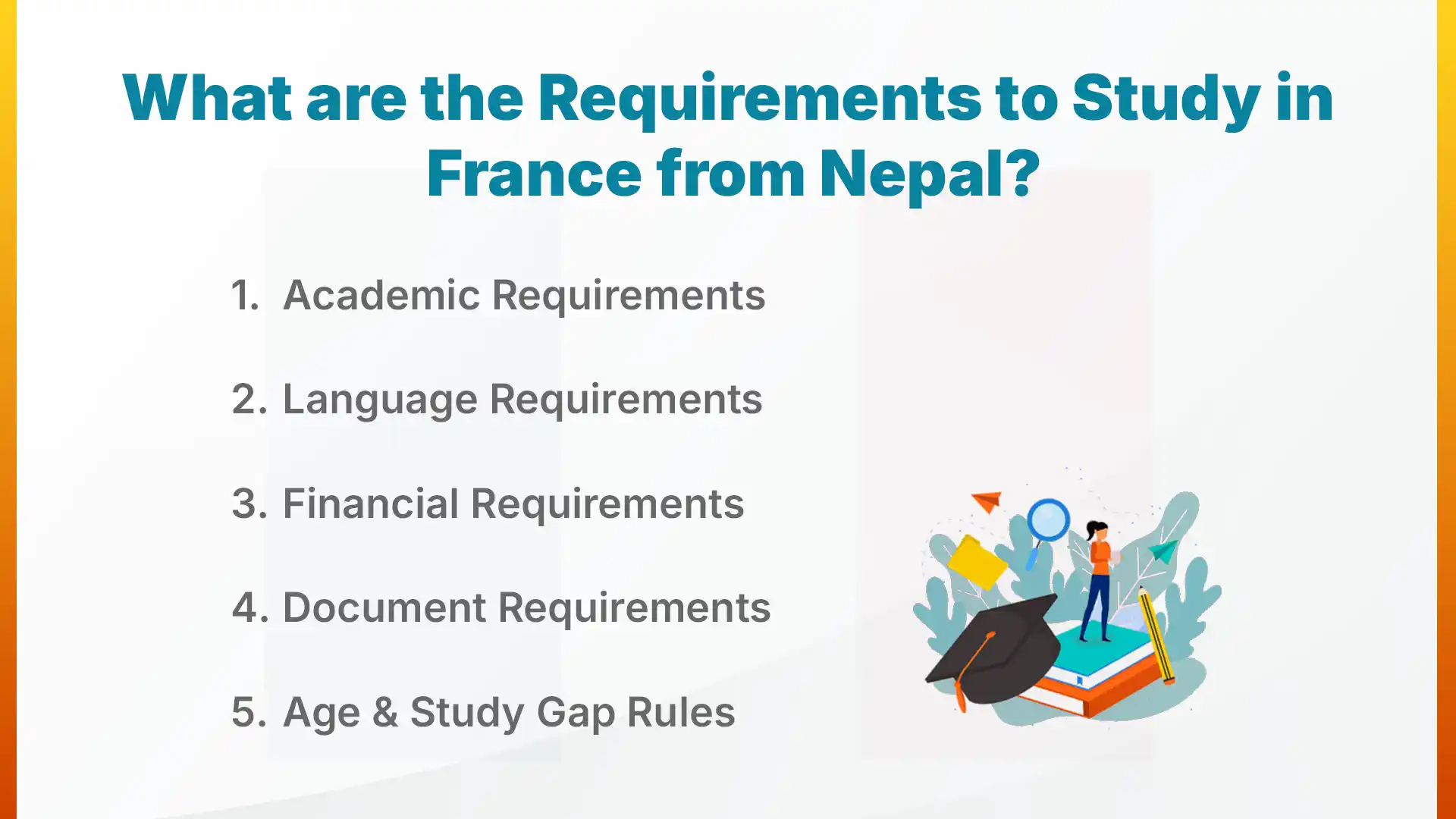
To study in France from Nepal, you mainly need the right academics, language proof, enough funds, complete documents, and a clear study timeline. Each requirement shows the university and the embassy that you are prepared, genuine, and able to support yourself. Let’s quickly walk through each one so you know exactly what to expect next.
1. Academic Requirements
First, you must meet the basic academic criteria for your chosen level of study. For a bachelor’s degree, you need to complete +2 or equivalent, and for a master’s, a related bachelor’s degree is required. Most universities also look at your GPA and subject background. Simply put, your past education should match the course you plan to study in France from Nepal.
2. Language Requirements
Next comes language, because you must understand your classes clearly. If your program is in English, tests like IELTS or TOEFL are commonly accepted. For French-taught programs, exams like DELF or DALF may be required. If you want to study in France without IELTS, some universities accept MOI, but having a test score often makes your application stronger and safer.
3. Financial Requirements
After that, you need to show that you can afford your stay in France. This includes tuition fees plus your yearly living expenses such as rent, food, and transport. The embassy checks whether you have enough money to live without financial stress. With proper planning and clear bank proof, this step becomes very manageable.
4. Document Requirements
Documents are the backbone of your entire application. You’ll prepare items like your passport, admission letter, academic papers, financial proof, and visa forms. Every paper must be correct, complete, and well organized. When your documents are strong, your visa process becomes much smoother.
5. Age & Study Gap Rules
Finally, your study timeline should make sense. France is flexible about age and gaps, but you must explain what you did during that time. Work experience, internships, or skill training are usually accepted reasons. As long as you can support your story with proof, gaps are rarely a problem.
This overview gives you the big picture. Now, let’s explore each requirement in detail so you can prepare confidently, step by step.
Academic Requirements to Study in France
To study in France, you must first meet the academic qualifications set by your chosen university and program. Universities always check your education history to see whether your background matches the course level and subject. Let’s break this down step by step so you clearly understand what you need to prepare.
1. Minimum +2 Qualification for Bachelor’s Programs
If you are applying for a bachelor’s degree, you must complete higher secondary education (+2 or equivalent). Your certificate should come from a recognized board and show that you have officially passed all subjects. Some courses may also require specific subjects, like math for engineering or science for health programs. So, always check the course requirements early and make sure your stream matches the program you choose.
2. Bachelor’s Degree Requirement for Master’s Programs
For a master’s program, you need a completed bachelor’s degree, usually three or four years long. Most universities prefer a degree in the same or a related field, because this shows you already understand the basics. For example, a business background suits MBA or management courses, while IT or math suits data or tech programs. In some cases, universities also check your total credits to confirm your degree meets European standards.
3. Minimum GPA Expectations
France does not always set a strict GPA cut-off, but good grades improve your chances a lot. Many public universities accept average scores, while competitive programs may expect higher marks. If your GPA is low, you can still strengthen your profile with strong IELTS scores, a good SOP, or relevant work experience. The key is to show that you are serious and capable of handling the course.
4. Required Academic Documents
Finally, you must submit proper academic documents to prove everything you claim. This usually includes transcripts, certificates, and your character or migration certificate. Some universities may also ask for recommendation letters from teachers or supervisors. Keep all documents clear, translated if needed, and neatly organized, because incomplete papers can delay your admission or visa.
5. Quick Academic Checklist
Once your academics are ready, the next step is proving your language ability, which we’ll cover in the following section.
Requirement | 2026 Updated Criteria |
| Bachelor’s Entry | +2 Completion (Year 12 equivalent); 60%–75% minimum avg. |
| Master’s Entry | Recognized 3 or 4-year Bachelor's; Relevant field preferred. |
| GPA / Marks | 2.4 – 3.0+ GPA (varies by level); 65%+ for top-tier schools. |
| English Proficiency | IELTS: 6.0–7.0 | PTE: 50–65+ | TOEFL: 67–94+ |
| SOP / GS Statement | Mandatory: Must include a "Genuine Student" (GS) justification. |
| Documentation | Transcripts, Provisional Certs, LORs (2), CV (for PG), Passport. |
Language Requirements for France Student Visa
To study in France, you must prove that you can understand your classes, either in English or French, depending on your program. For English-taught programs, most universities accept IELTS or TOEFL scores, usually requiring a minimum IELTS of 6.0–6.5, PTE of 55-70, or TOEFL iBT 80–90, while French-taught programs often require DELF, DALF, or TCF certificates. Let’s look at the different ways you can meet these language requirements and what each option involves.
1. Test Scores for English-Taught Programs
If your program is taught in English, most universities accept IELTS or TOEFL scores. Typically, a minimum IELTS score of 6.0–6.5, PTE score of 55-70, or a TOEFL iBT score of 80–90 is expected. Some competitive programs may require higher. These tests are widely recognized and accepted across France, making them the safest proof of English ability. Remember, both tests are valid for two years, so check the date of your score when applying.
2. DELF/DALF/TCF for French-Taught Programs
For programs taught in French, exams like DELF, DALF, or TCF are usually required. The minimum level is often B1 or B2, depending on the course and university. French proficiency is mandatory not just for lectures but also for exams and daily communication. Learning French also helps you adapt better to life in France and opens opportunities for internships and part-time jobs.
3. Study in France without IELTS
Some universities accept a Medium of Instruction (MOI) certificate instead of an English test if your previous studies were in English. However, even with MOI, the embassy may sometimes ask for IELTS or TOEFL to verify language ability. To avoid issues, always provide a clear MOI certificate on official letterhead and ensure it is properly signed and stamped. MOI works best when combined with strong academic performance and other supporting documents.
4. Quick Language Requirement Checklist
Requirement | Accepted Proof | 2026 Updated Criteria |
| English Programs | IELTS, TOEFL, PTE, Duolingo (DET) | IELTS 6.0–6.5 (min 5.5 per band); PTE 55–65; TOEFL 80–100. |
| French Programs | DELF, DALF, TCF TP, TEF | B2 level required for most Bachelor/Master's; B1 sometimes accepted. |
| MOI Certificate | Medium of Instruction letter | Accepted by many Business/Engineering schools; Embassy may still request interview. |
| Financial Proof | Bank Stmt, Blocked A/C, Sponsor | Minimum €615 per month; Blocked accounts rising in use. |
Financial Requirements for France Student Visa
You don’t need a huge fortune to study in France, but you do need to show that you can cover tuition, living expenses, and other costs. The embassy wants to be sure you can support yourself without financial stress while living abroad. Let’s break down what you need, how much it usually costs to study in France, and the documents you can use to prove your finances.
1. Minimum Living Cost Requirement (Yearly Estimate)
The French government requires students to have a minimum fund to cover living expenses for one year. On average, this ranges from €10,000 to €12,000 per year, depending on the city. Monthly costs include rent, food, transport, and basic utilities, usually around €800–€1,000. Knowing this helps you plan your budget realistically before applying.
2. Tuition Fees + Living Funds Calculation
Tuition fees vary depending on the university and program. Public universities are usually more affordable, ranging from €2,000 to €4,000 per year, while private universities can cost €10,000 or more. To calculate your total yearly requirement, add tuition fees to your estimated living costs. For example, a public university student may need around €12,000 per year in total, while a private university student might need €20,000 or more.
3. How Much Bank Balance Is Required for France Student Visa?
For a French student visa, you need to show that you have enough money to live and study in France. The French government requires you to have around €615 per month (around €7,380 per year) for living costs, plus your tuition fees. You can convert this to Nepali rupees when submitting documents, but always use the official conversion rate. Showing a slightly higher balance than required also strengthens your application. You can show this using recent bank statements, scholarship letters, or financial documents from a sponsor.
4. Accepted Proof of Funds Formats
You can prove your finances through documents like a bank balance certificate, six months of bank statements, or a sponsor letter if your parents are funding you. Income documents like salary slips, IT returns, or business registration can also help. If you take an education loan, an official approval letter is accepted as proof. Always make sure these documents are recent, official, and clearly readable.
Age Limit and Study Gap Rules for France
France is flexible when it comes to age limits and study gaps, but you must clearly justify your timeline to the embassy. There is no strict age cap for student visas, and gaps in study are usually accepted if you can explain them properly. Understanding these rules helps you plan your application without worry and strengthens your overall profile.
1. Is There an Age Limit for Student Visa?
There is no fixed upper age limit for applying for a French student visa. The embassy mainly looks for a logical study progression, meaning your education and career path should make sense. For example, applying for a bachelor’s degree right after +2, or a master’s soon after your undergraduate studies, is considered normal. Older students are also welcome as long as they show a clear study plan and genuine intentions.
2. Acceptable Study Gap Reasons
Study gaps are common, and France allows them if you have valid reasons. These include work experience, internships, skill training, business or family commitments, and exam preparation. The key is that your gap should reflect growth or meaningful activity rather than inactivity. Universities and embassies see this as a positive if it shows you used your time productively.
4. How to Justify Study Gap with Documents
You need proper documents to explain your study gap. Experience letters, salary slips, certificates from training programs, or proof of business activity are usually accepted. Writing a clear gap explanation letter or including it in your SOP adds credibility. Make sure every claim is backed by official evidence to avoid delays or doubts during the visa process.
Documents Required for France Student Visa
To apply for a France student visa, you need a complete set of documents that prove your identity, academics, finances, accommodation, and health coverage. These documents show both the embassy and the university that you are eligible, prepared, and able to support yourself while studying. Below, we break down each type of document with clear explanations and a checklist to make preparation easier.
1. Mandatory Documents
These documents are essential to prove your identity, confirm your admission, and verify your academic background. They form the core of your visa application and are carefully checked by both the embassy and the university.
- Passport
- Visa application form
- Campus France NOC
- University admission letter
- Tuition fee receipt
- Academic transcripts & certificates
- Language test result
- SOP / Motivation letter
- CV / Resume
- Passport-sized photo
2. Financial Documents
These documents show that you have sufficient funds to cover tuition, living costs, and other expenses while studying in France. Proper financial proof reassures the embassy that you will not face financial difficulties during your stay.
- Bank balance certificate
- Bank statements (last 6 months)
- Sponsor letter (if parents are funding)
- Income source proof
3. Accommodation Documents
Proof of accommodation is required to show where you will stay during your studies. It ensures the embassy that you have a safe place to live and helps confirm your living cost calculations.
- Hostel confirmation
- Rental agreement
- Invitation letter
4. Health & Insurance Documents
These documents are necessary to confirm that you are medically fit and adequately insured during your stay. Travel insurance is mandatory, and a medical certificate may also be required to ensure you can pursue studies without health-related issues.
- Travel insurance
- Medical certificate
5. Additional Supporting Documents (Sometimes Asked)
Optional documents can strengthen your application, explain special circumstances, or provide additional proof of identity, good conduct, or sponsorship. These are not always mandatory but can prevent delays or queries.
- Cover letter
- Police clearance certificate
- Birth certificate
- Relationship proof
What is the Process of a France Student Visa?
For a France student visa process from Nepal, the journey begins with securing admission to your chosen university. Once admitted, you must register with Campus France, which is mandatory for most programs. After that, gather and organize all your financial documents to prove you can support yourself. Next, book your appointment with VFS Global to submit your application. During the appointment, you will provide biometrics and attend a short interview. Finally, you wait for the visa decision, which typically comes in a few weeks.
Here’s a brief action-oriented summary of the steps:
- Apply for admission at your chosen university
- Complete registration with Campus France platform
- Gather and organize all financial documents
- Schedule appointment with VFS Global center
- Submit biometrics and attend visa interview
- Wait for visa approval and notification
Common Reasons France Student Visas Get Rejected
France student visas are most often rejected due to specific gaps or mistakes in the application, such as weak finances, missing documents, or unclear intentions. These rejections can usually be avoided by careful preparation and understanding exactly what the embassy expects. Knowing the common pitfalls helps you strengthen your application and increases your chances of approval.
1. Insufficient Funds
One of the top reasons visas get rejected is insufficient proof of finances. The embassy wants to see that you can cover tuition, living expenses, and other costs without stress. Even if your bank balance looks enough, inconsistent statements or unclear sources of funds can raise doubts. To avoid this, maintain proper bank statements, include sponsor letters if needed, and clearly explain any large deposits.
2. Incomplete Documents
Submitting incomplete or disorganized documents can quickly lead to rejection. Each paper requested by the embassy, from admission letters to language tests, must be provided and correctly formatted. Missing pages, incorrect translations, or outdated documents are common issues. Make a checklist, double-check each requirement, and ensure every document is official and clearly readable.
3. Weak SOP
A weak Statement of Purpose (SOP) can hurt your application because it shows a lack of clarity about your goals. The SOP should clearly explain why you chose France, your chosen course, and how it fits into your career plans. Generic or vague statements can make the embassy question your study intentions. Strengthen your SOP with personal experiences, future goals, and a clear study plan that aligns with your program.
4. Unclear Study Plan
Visa officers want to see a logical study path that makes sense with your academic background and career goals. If your choices appear random or inconsistent, it can create doubt about your intentions. Clearly explain your previous education, course selection, and why studying in France is essential for your career. Supporting this explanation with documents like academic transcripts or relevant work experience helps build credibility.
5. Fake Documents
Submitting fake or altered documents is a serious reason for visa denial and can result in long-term blacklisting. Embassies are very strict, and even minor discrepancies can be flagged. Always use original, verified, and correctly translated documents. If anything seems unusual or needs explanation, provide supporting evidence or clarification rather than trying to modify it.
Conclusion
Studying in France opens doors to new experiences, cultures, and opportunities. Yes, the paperwork can feel like a mountain, but with careful preparation, each step becomes a manageable climb rather than a hurdle.
Organize your academics, finances, language proof, and supporting documents in advance. For a smoother journey, find the best consultancy in Nepal for France. Consult with their certified counsellors and make every decision for your French education with confidence. With determination, clarity, and the right plan, what feels complicated today will soon be your success story tomorrow.
Your dream of studying in France is not just possible, it’s waiting for you, and every small effort you make now brings you one step closer to it.