Best Consultancy in Nepal to Study in France: Complete Guide

May 07, 2026
Dreaming of studying in Europe without the high cost of countries like the UK or Australia? France has emerged as one of the top study destinations for Nepali students who want globally recognized degrees, affordable tuition fees, and strong international career exposure.
With world-class universities, English-taught programs, and generous post-study work opportunities, the demand for studying in France is rapidly increasing among Nepali students. However, the admission and visa process can be complex without proper guidance, which is why choosing the best consultancy in Nepal to study in France plays a crucial role in ensuring a smooth and successful study-abroad journey.
In this blog
Which is the Best Consultancy in Nepal to Study in France?
SAS Education Consultancy is one of the best consultancies in Nepal for students planning to study in France. The consultancy has built a strong reputation for helping Nepali students with university selection, application support, SOP guidance, visa documentation, and interview preparation in a simple and student-friendly way.
What many students like about SAS is that they explain the entire France process clearly without making it feel confusing or overwhelming. From choosing affordable universities to understanding scholarship opportunities and visa requirements, they guide students step by step. For many students in Nepal, especially first-time applicants, त्यो clear guidance really matters.
SAS Education Consultancy is also known for being approachable and practical. Instead of just pushing applications, they focus on helping students understand what fits their budget, academic profile, and long-term goals in France.
Why Choose SAS Education Consultancy for Study in France?
Choosing the right consultancy can make a huge difference in your study-abroad journey. SAS Education Consultancy provides end-to-end support for Nepali students, from university selection to visa processing and post-arrival assistance. Their experienced team ensures that applications are complete, accurate, and tailored to each student’s profile, increasing the chances of admission and visa approval. With strong partnerships with French universities and a focus on transparency, SAS Education Consultancy makes the process smooth and stress-free.
- Expert Guidance on Admissions: Helps students select the best programs and prepares strong applications.
- Strong University Partnerships: Provides priority support and updates from top French institutions.
- Visa Application Assistance: Step-by-step guidance to avoid mistakes and ensure approval.
- Personalized Career Advice: Matches programs with students’ academic background and career goals.
- Transparent and Reliable Service: Clear processes and honest communication throughout.
- Post-Arrival Support: Helps students settle in France with accommodation, enrollment, and orientation guidance.
What are the Popular Courses to Study in France?
France offers a wide range of academic programs that attract Nepali students due to strong global recognition, practical learning, and career opportunities across Europe. Universities in France combine theoretical education with industry exposure, making graduates highly employable. Many of these courses are available in English and are aligned with international job market demand.
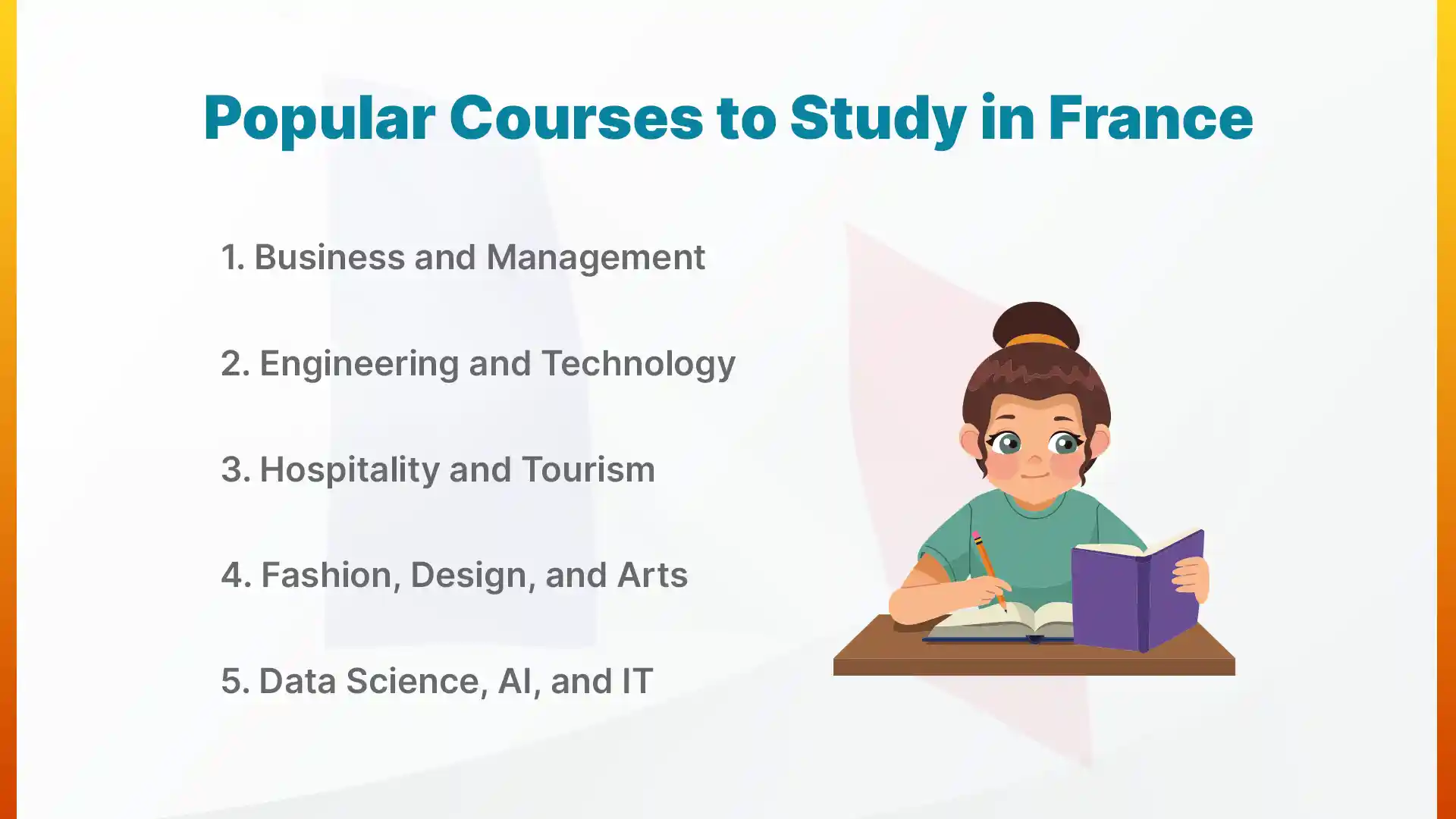
1. Business and Management
Business and Management programs in France are highly regarded worldwide, especially in areas such as MBA, finance, marketing, and international business. French business schools emphasize practical learning, case studies, and global exposure through internships and exchange programs. Students gain strong analytical, leadership, and strategic skills that are valued by multinational companies. Many programs are taught in English and offer opportunities for specialization. Graduates often find careers in corporate management, consulting, finance, and entrepreneurship.
2. Engineering and Technology
France is a leading destination for engineering and technology education, known for its Grandes Écoles and advanced research institutions. Programs focus on innovation, applied research, and industry collaboration. Students gain hands-on experience through lab work, projects, and industrial training. Engineering graduates are in high demand across sectors such as civil, mechanical, electrical, and computer engineering. French engineering degrees are globally recognized and open doors to international careers.
3. Hospitality and Tourism
Hospitality and Tourism programs in France are popular due to the country’s strong global reputation in tourism, luxury, and service management. These programs focus on hotel management, culinary arts, tourism operations, and customer experience. Students benefit from practical training, internships, and exposure to international hospitality standards. Graduates often work in hotels, resorts, airlines, and tourism companies worldwide. France’s strong tourism industry provides excellent learning and employment opportunities.
4. Fashion, Design, and Arts
France, especially cities like Paris, is considered a global hub for fashion, design, and arts education. Programs emphasize creativity, innovation, and industry exposure through workshops and projects. Students learn from experienced professionals and gain access to international fashion houses and design studios. Courses are available in fashion design, graphic design, interior design, and fine arts. Graduates pursue careers in fashion brands, creative agencies, and global design firms.
5. Data Science, AI, and IT
Data Science, Artificial Intelligence, and IT programs in France are growing rapidly due to high demand in the global job market. These courses focus on programming, machine learning, data analytics, cybersecurity, and software development. Universities offer strong research opportunities and industry collaboration. Students gain practical skills through projects and internships with tech companies. Graduates are well-prepared for careers in technology-driven industries across Europe and beyond.
Admission Requirements for Nepali Students
To study in France, Nepali students must meet specific academic, language, and documentation requirements. These criteria ensure that applicants are academically prepared and able to follow courses taught in English or French. Admission requirements vary slightly by institution and level of study (bachelor’s vs master’s), but the core elements remain consistent across universities. Preparing these carefully increases your chances of acceptance and successful visa approval.
1. Academic Qualifications
French universities require formal academic qualifications relevant to the program you are applying for. For bachelor’s degree programs, you typically need a Plus Two (10+2) completion certificate with a competitive percentage from a recognized board in Nepal. For master’s programs, a recognized bachelor’s degree with strong academic performance is essential. Some institutions may set minimum percentage thresholds — for example, 60% or above — especially for competitive programs like engineering or business. Universities also assess the relevance of your academic background to the chosen field of study to determine eligibility.
2. English or French Language Requirements
Language proficiency is a key part of the admission process. If the program is taught in English, most universities expect IELTS (usually 6.0–6.5) or TOEFL scores as proof that you can follow course material comfortably. For programs taught in French, certificates like DELF or DALF are commonly required, and a higher French level increases your chances of acceptance. Some universities also accept alternative language tests or internal language assessments. Note: It is possible to study in France from Nepal without IELTS, but most universities do not accept applications without an English proficiency test, so having IELTS or TOEFL significantly improves your chances. Strong language scores help not only with admission but also with the visa adjudication process.
3. Academic Transcripts and Supporting Documents
Applicants must provide official academic transcripts and certificates from all previous studies. These documents must be certified and translated into English or French if originally in Nepali. Universities often require a clear scan of mark sheets, degree certificates, passport information page, and other identity documents. Some institutions also ask for a copy of your resume/CV highlighting academic and extracurricular achievements. Maintaining organized and accurate documentation speeds up the application review process.
4. Statement of Purpose (SOP) and Recommendation Letters
A strong Statement of Purpose (SOP) is essential for French university applications. Your SOP should clearly explain your academic goals, reasons for choosing the program, and how the degree fits your long‑term career plans. It should be personal, specific, and professionally written, avoiding generic statements. Most universities also request 2–3 recommendation letters from teachers or employers who can attest to your academic potential and character. Well‑written recommendations significantly strengthen your application by providing insights into your abilities and motivation.
France Student Visa Process for Nepal
Nepali students need a student visa to study in France, which allows them to live and study legally for the duration of their program. There are primarily two types of student visas: short-stay visas (less than 6 months) for exchange programs or short courses, and long-stay visas (more than 6 months) for bachelor’s, master’s, or doctoral programs. The visa application process includes completing the online application through the Campus France portal, submitting required documents such as admission letters, passport, academic transcripts, proof of financial resources, and health insurance. Applicants may also need to attend an interview at the French Embassy or Consulate in Nepal to verify their intentions, study plans, and financial capability. The processing timeline generally takes 4-8 weeks, so students are advised to apply well in advance to avoid delays.
It is crucial to provide accurate financial proof, showing that you have sufficient funds to cover tuition fees, living expenses, and other mandatory costs during your stay. This can include bank statements, scholarship letters, or financial guarantees from parents or sponsors. A complete and well-prepared application reduces the risk of visa rejection and ensures a smoother transition to studying in France.
What is the Cost of Studying and Living in France?
Studying in France is comparatively affordable, but students must plan for tuition, living expenses, and additional costs when considering the cost to study in France. Tuition fees at public universities range from €200–€3,500 per year, depending on the program, while private institutions and Grandes Écoles may charge €5,000–€20,000 annually.
Living expenses, which are a major component of the cost to study in France, include accommodation, food, transport, and personal costs, averaging €800–€1,200 per month for a student in cities like Paris, Lyon, or Marseille. Health insurance is mandatory, costing approximately €200 per year, which covers medical emergencies and general healthcare.
Many international students also explore scholarship opportunities to reduce the overall cost to study in France
Scholarships may be offered by French universities, the French government, or private organizations and can cover tuition, accommodation, or living expenses partially or fully. Proper budgeting and early scholarship applications can make studying in France more accessible for Nepali students.
Conclusion
France is an excellent study destination for Nepali students due to its world-class universities, affordable tuition, English-taught programs, and strong career opportunities. Students gain not only quality education but also cultural exposure, international networking, and practical work experience.
Selecting the right consultancy in Nepal is crucial to ensure smooth admission, accurate documentation, and higher chances of visa approval. Experienced consultancies, like SAS Education Consultancy, provide personalized guidance, university selection advice, and post-arrival support, making the study-abroad journey less stressful and more successful.
If you are looking to study in France, consult SAS Education Consultancy for expert advice, assistance with applications, visa processing, and complete support throughout your education abroad journey.