Study in France Without IELTS: Complete Guide for Nepali Students

Jan 28, 2026
France is a great place to pursue higher education. You might dream about affordable tuition, scholarships, part-time jobs, and a European degree that opens global doors. But then comes the pressure of English tests. Expensive fees, months of preparation, and the fear of not getting your target band. For some students, IELTS becomes the biggest barrier, not academics or finances.
But the good news is, France is very flexible with language requirements. Many universities accept IELTS alternatives, and in some cases, you can study in France without IELTS at all!
This guide will walk you through your real options, clear the confusion, and show you exactly how to study in France without IELTS from Nepal in 2026, step by step and stress-free.
In this blog
Is IELTS Mandatory for a France Student Visa?
No, IELTS is not mandatory for a French student visa in most cases. France does not officially ask every student to submit an IELTS score. Instead, your university decides how you prove your English level. So, the real requirement usually comes from the college or course, not directly from the visa office.
Now, let’s break it down simply.
1. When IELTS is Required to Study in France
You may need IELTS if:
- The university clearly lists IELTS as compulsory
- Your course is fully English-taught and asks for a specific band score
- You don’t have other proof of English (like MOI or alternative tests)
In these cases, IELTS becomes the easiest way to show your language ability.
2. When IELTS is NOT required
You usually don’t need IELTS if:
- Your previous education was in English medium
- You submit a Medium of Instruction (MOI) certificate
- The university accepts Duolingo, TOEFL, or PTE
- You pass an interview or internal English test
So, instead of worrying about IELTS alone, focus on what your university accepts. Once they approve your English skills, your visa process becomes much smoother.
How to Study in France Without IELTS?
You can study in France without IELTS by choosing universities that accept other ways to prove your English skills. Many French institutions allow options like MOI letters, alternative tests, or interviews instead of a band score. So now, let’s look at each option clearly and see what you can actually do.
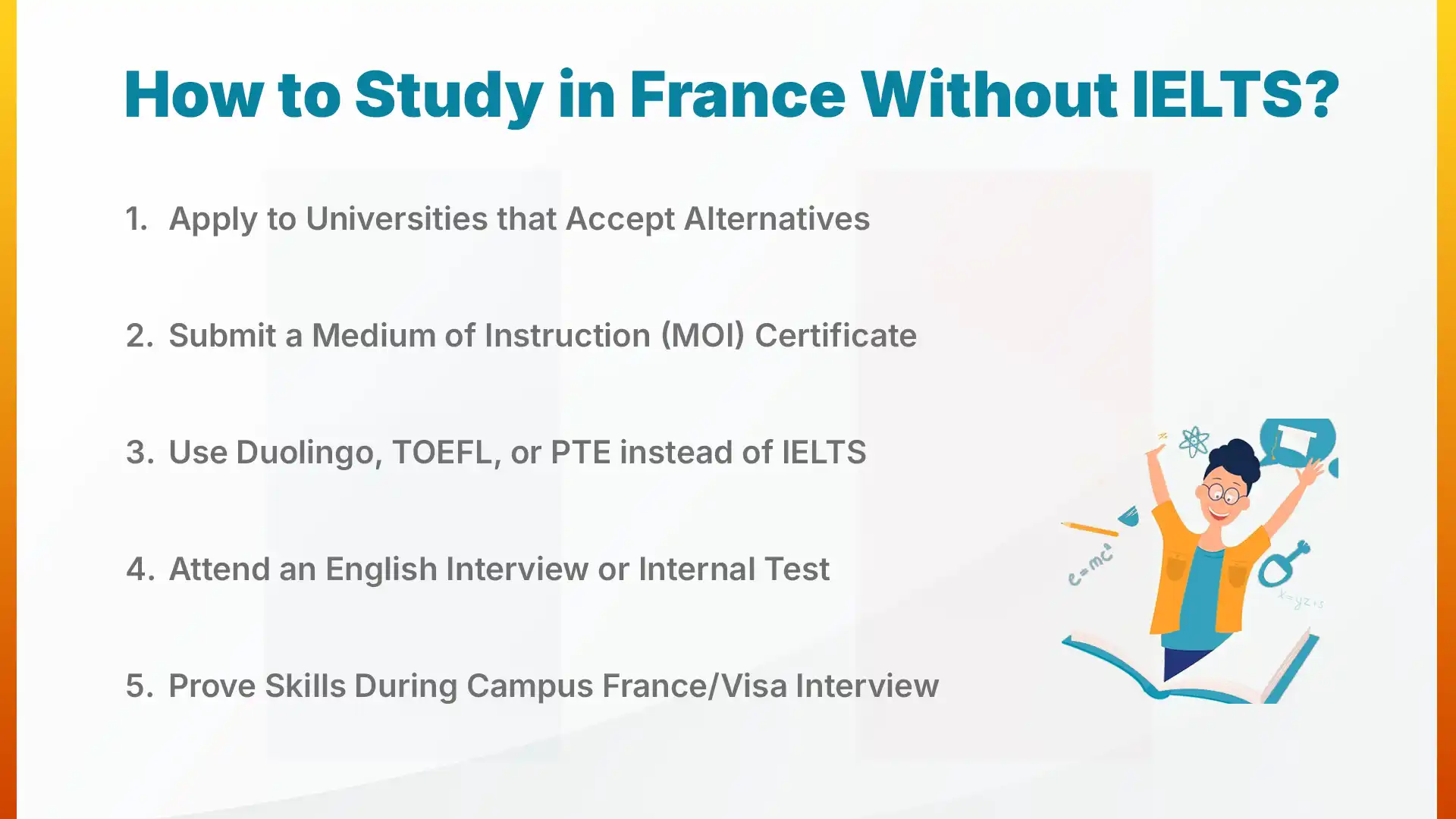
1. Apply to Universities that Accept IELTS Alternatives
First, focus only on universities that do not make IELTS compulsory. Many public universities and private schools accept other proof of English, so read the language section on their official website carefully. Look for words like “IELTS or equivalent” or “English proficiency proof,” which means you have choices. By shortlisting these flexible universities early, you save time, money, and unnecessary stress.
2. Submit a Medium of Instruction (MOI) Certificate
If you studied in an English-medium school or college, you can use an MOI certificate as proof. This is a simple letter from your institution that confirms your classes were taught in English. Most French universities accept this because it shows you already studied and wrote exams in English. So, request this letter early from your college and keep it ready with your documents.
3. Use Duolingo, TOEFL, or PTE Instead of IELTS
If a university still asks for a test score, don’t worry, IELTS is not your only option. Many schools accept Duolingo, TOEFL, or PTE, which are often cheaper and easier to schedule. For example, Duolingo can be taken online from home and gives results quickly. This gives you a faster and more flexible way to meet the language requirement.
4. Attend an English Interview or Internal Test
Some universities check your English through a simple interview instead of a formal test. During this, they may ask about your background, course choice, or future plans in English. They are not looking for perfect grammar, just clear communication and confidence. So, practice speaking regularly and be ready to express yourself naturally.
5. Prove Skills During Campus France/Visa Interview
Even without IELTS, you must show that you can communicate well during the Campus France or visa interview. The officer may ask basic questions about your studies, finances, and goals in English or French. If you answer clearly and confidently, it proves you can manage life and classes in France. In many cases, this real conversation matters more than any test score.
French Universities That May Not Require IELTS
Not all French universities make IELTS mandatory, and knowing your options can save time and stress. Many institutions accept alternatives or offer flexibility depending on your background and the course you choose. Here’s a breakdown of the types of universities where IELTS may not be required.
1. Public French Universities Accepting IELTS Alternatives
Public universities in France often have lower tuition fees and more flexible language requirements. Many of them accept a Medium of Instruction (MOI) certificate or other English proficiency proofs instead of IELTS. If your previous education was in English, public universities are usually the easiest option for bypassing IELTS. Always check the course language requirements, as some programs may still ask for test scores for competitive degrees.
University Name | Location |
| Université Paris-Saclay | Paris & surrounding campuses, France |
| Sorbonne University | Paris, France |
| Toulouse School of Management (TSM) | Toulouse, France |
| Université Grenoble Alpes | Grenoble, France |
| Aix-Marseille University | Aix-en-Provence & Marseille, France |
2. Private Business Schools
Private business schools often teach programs fully in English and are more flexible about language proofs. They may accept Duolingo, TOEFL, or internal English interviews instead of IELTS. Many private schools also offer fast-track admission, which can save time if you want to start sooner. This makes them a good option for students who want professional courses without IELTS pressure.
Institution Name | Location | Est. 2026 Tuition (EUR/Year) |
| Paris School of Business (PSB) | Paris, France | €11,000 – €19,000 |
| EDC Paris Business School | Paris La Défense, France | €10,500 – €17,500 |
| ESCE International Business School | Paris & Lyon, France | €9,500 – €13,000 |
| NEOMA Business School | Rouen & Reims, France | €12,000 – €18,500 |
| EBS Paris | Paris, France | €9,000 – €15,000 |
| Rennes School of Business | Rennes, France | €9,900 – €18,500 |
| INSEEC Business School | Paris & Lyon, France | €9,500 – €14,000 |
3. Grandes Écoles
Grandes Écoles are prestigious French institutions, usually in business, engineering, or management. While some programs ask for IELTS, many accept alternatives like MOI certificates or English interviews. Some also offer internal English tests for admission, giving you a chance to prove your skills without formal tests. These schools focus on practical ability, not just standardized scores.
Grande École Name | Location | 2026 Est. Tuition (Year) |
| HEC Paris | Jouy‑en‑Josas (near Paris) | €28,850 – €55,000+ |
| INSEAD (MBA focus) | Fontainebleau | €109,860 (Full MBA) |
| ESSEC Business School | Cergy (near Paris) | €20,500 – €50,000 |
| SKEMA Business School | Paris, Lille & Sophia Antipolis | €19,000 – €25,000 |
| Audencia Business School | Nantes | €18,900 – €31,500 |
| Grenoble Ecole de Management | Grenoble & Paris | €17,950 – €36,000 |
| IÉSEG School of Management | Lille & Paris | €12,100 – €39,000 |
| Burgundy School of Business | Dijon, Lyon & Paris | €9,500 – €16,000 |
4. How to Check a French University’s Language Policy?
Always start by visiting the official university website and looking for “English-taught programs” or “language requirements”. Check if they mention alternatives like MOI, Duolingo, or internal tests. If it’s unclear, email the admissions office. They usually respond quickly and clarify what you can submit. By confirming early, you avoid wasted applications and ensure a smooth admission process.
Courses You Can Study in France Without IELTS
Yes, you can study many courses in France even if you don’t have IELTS. Several universities and private schools accept alternatives like MOI, Duolingo, or internal interviews, which let you focus on your preferred program instead of worrying about the test. Let’s explore the popular courses Nepali students often choose and see what makes each a great option.
1. Business and Management
Business and management programs are very popular among international students in France. These courses cover marketing, finance, HR, and entrepreneurship, giving you practical skills for global careers. Many private business schools and Grandes Écoles offer English-taught programs with flexible language requirements. You can also join internships alongside your course, which helps you gain experience while studying.
2. Hospitality and Tourism
France is a top destination for hospitality and tourism studies due to its hotels, resorts, and tourist cities. Courses teach hotel management, travel planning, event management, and customer service skills. Private schools often provide English-taught programs without requiring IELTS and include hands-on training. Graduates can work in hotels, resorts, cruise lines, or tourism companies worldwide.
3. IT and Data Science
Information Technology and Data Science programs are in high demand globally. Courses cover programming, databases, machine learning, and data analysis skills. Many universities and private institutions accept MOI or Duolingo as proof of English, allowing students to start without IELTS. These programs often include project work or internships, making you ready for jobs in software, AI, or data-driven companies.
4. Engineering
France has strong engineering programs in fields like mechanical, civil, electrical, and aerospace engineering. Universities often teach technical knowledge alongside practical lab sessions and industry projects. Several public universities and Grandes Écoles allow applications without IELTS if you provide an MOI or pass an internal English test. Graduates can pursue careers in engineering firms, research, or international companies.
5. Arts and Design
Arts and design programs in France cover graphic design, fashion, interior design, and fine arts. These courses focus on creativity, practical projects, and portfolio development. Private schools and some universities may accept alternative English proofs, so IELTS is not always needed. Completing such programs opens doors to careers in fashion houses, design studios, advertising, or digital media.
Documents Required for Application Without IELTS in France
Even without IELTS, you need to submit your academic certificates, passport, SOP, CV, MOI certificate or alternative test score, and financial documents to complete your application smoothly. These papers prove your academics, identity, language ability, and finances, so keeping them ready early makes your application smooth. Here’s what you should prepare and why each is important.
1. Academic Transcripts and Certificates
These show your previous education, like +2 or Bachelor’s degree marksheets. Universities use them to check your eligibility for the course. Make sure your transcripts are clear, signed, and, if needed, translated into English or French. Always keep both originals and scanned copies ready for submission.
2. Passport
Your passport is the most basic identity proof required for admission and visa. Ensure it’s valid for at least six months beyond your intended stay in France. A clear scanned copy is usually needed with your application. Also, check that your name matches exactly with your academic certificates.
3. SOP / Motivation Letter
A Statement of Purpose (SOP) explains why you want to study that course in France. Highlight your goals, past achievements, and why you chose the specific university. Keep it personal, clear, and concise. Admissions officers read many applications. This letter can also show your English skills if IELTS is not provided.
4. CV
A simple CV lists your education, skills, internships, and achievements. Even short work experience or school projects can strengthen your application. Keep it professional and easy to read, preferably one page. This helps universities quickly understand your background.
5. MOI Certificate or Alternative Test Score
If you don’t have IELTS, this proves your English proficiency. A Medium of Instruction (MOI) letter from your school/college or a Duolingo, TOEFL, or PTE score works. Some universities also accept internal English tests or interviews. Submit this early to avoid delays in admission or visa processing.
6. Financial Documents
These show you can cover tuition and living expenses in France. Include bank statements, scholarship letters, or sponsor documents. Universities and visa offices often check this carefully, so ensure they are authentic and up-to-date. Clear financial proof reduces the risk of visa rejection.
Advantages of Studying in France Without IELTS
Studying in France without IELTS gives you multiple benefits, making your journey smoother and less stressful. It removes the need for expensive tests and long preparation, letting you focus directly on your course and university applications. Let’s explore the main advantages in detail so you know why this option can work well for Nepali students.
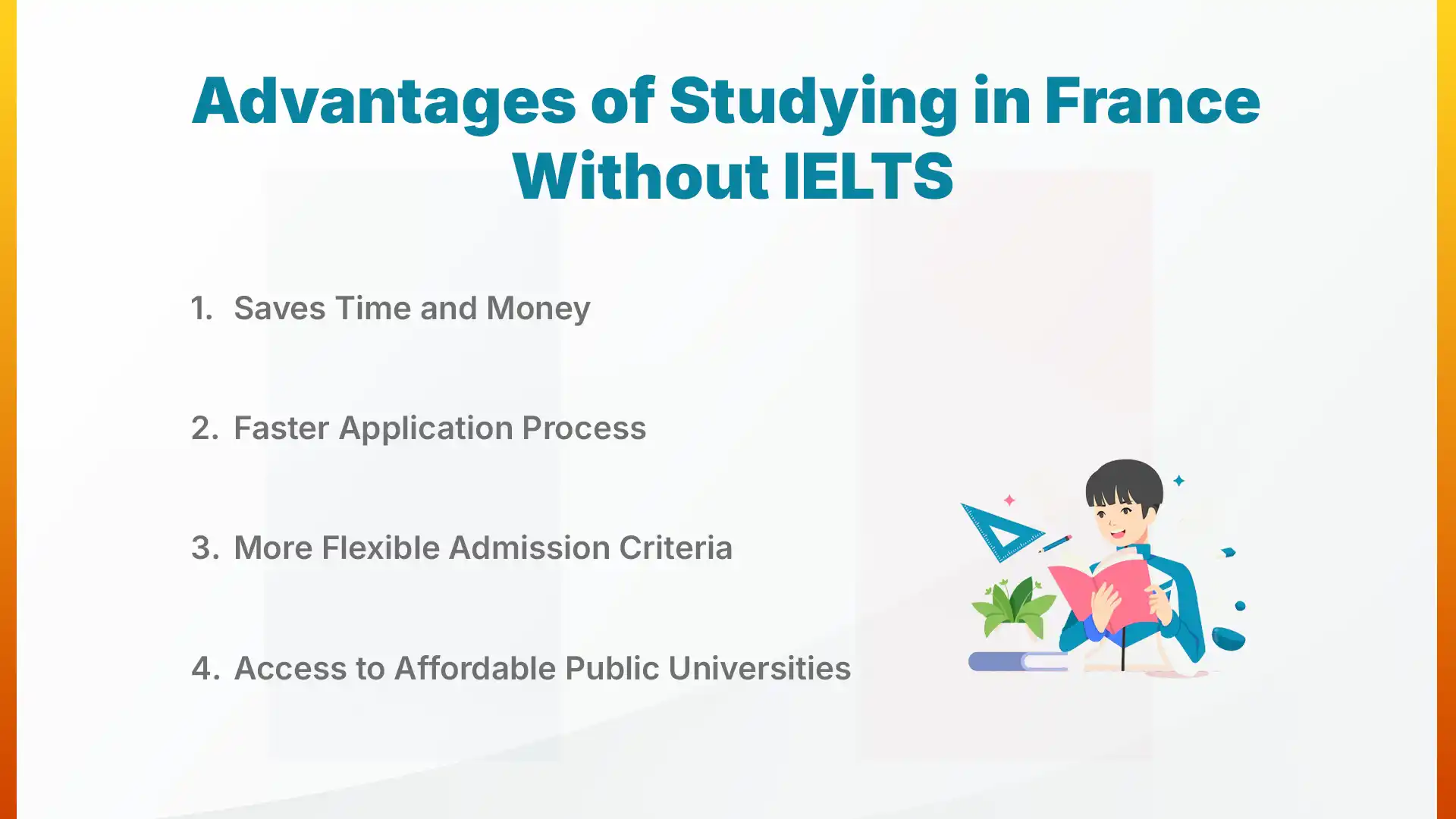
1. Saves Time and Money
Skipping IELTS saves both preparation time and exam fees, which can be significant. You don’t need to spend months studying for a specific band score, and you also avoid paying test registration fees. This lets you start preparing your university documents earlier. In addition, saving time and money gives you flexibility to explore scholarships or part-time opportunities in France.
2. Faster Application Process
Without IELTS, your application can move faster because you don’t need to wait for test dates or results. You can submit your documents as soon as your transcripts, SOP, and MOI certificate are ready. Many universities also have rolling admissions for students using alternative proof of English. This means you can get admission decisions sooner and plan your travel and visa application without delays.
3. More Flexible Admission Criteria
French universities that accept alternatives focus on your overall profile, not just one test score. They look at your academic performance, English-medium background, and motivation for the course. Some even conduct internal interviews to assess your language skills directly. This flexibility allows students who are strong academically but nervous about IELTS to still secure admission.
4. Access to Affordable Public Universities
Many public universities in France have low tuition fees compared to private institutions and English-speaking countries. Most of them accept MOI letters or alternative tests instead of IELTS. This means you can get a high-quality education without the extra cost of language exams. For Nepali students, it makes studying in France more practical and budget-friendly while still offering great opportunities for internships and future careers.
Things to Be Careful About Studying in France without IELTS
Studying in France without IELTS is possible, but you need to be careful to avoid mistakes that could delay or block your admission. Even if some universities are flexible, not all programs accept alternatives, and your English skills still matter for both studies and daily life. Understanding the rules, verifying requirements, and choosing trustworthy sources will keep your plan on track and help you succeed.
1. Not all Universities Accept MOI
While a Medium of Instruction (MOI) certificate works for many schools, some universities still require IELTS or another formal test. Always check the official language requirements for the specific program you are applying to. Submitting an MOI to a university that doesn’t accept it can waste time and delay admission. So, shortlist only those institutions that clearly state they accept MOI or alternative proofs.
2. English Skills Still Matter
Even if you bypass IELTS, your English ability affects your day-to-day classes and interactions. Courses, assignments, and exams are usually in English, and you need to communicate with professors and peers. If your skills are weak, consider extra practice or online courses to improve your confidence. Being prepared in English will make studying, living, and completing projects much smoother.
3. Always Confirm Official Requirements
Universities and programs can change their admission rules or English requirements. Don’t rely on second-hand information, websites of agents, or outdated sources. Always check the official university website or contact admissions directly to confirm what proof of English is acceptable. This ensures you submit the right documents the first time and avoid unnecessary delays.
4. Avoid Fake Promises or Agents
Some agents may guarantee admission without IELTS, but not all are trustworthy. Always verify claims, read reviews, and rely on well-recognized education consultancies only. Fake promises can lead to wasted money, rejected applications, or visa issues. Choose guidance only from reliable sources and official channels to keep your study abroad journey safe.
Conclusion
Studying in France without IELTS can be easier and faster if you know the right options. Remember, IELTS is just one way to prove your English skills. MOI certificates, alternative tests like PTE, and interviews are all valid paths. What matters most is your preparation, confidence, and choice of the right university.
So, don’t let the fear of IELTS stop you from pursuing your dream. Start exploring universities, gather your documents, and take that first step today. With careful planning and the right guidance, you can make your study abroad goal a reality.
Wondering if you can study in the UK without IELTS? Learn how to meet language requirements, explore alternative options, and choose the right universities for your dream course.