Cost of Studying in France from Nepal: Tuition, Living & Visa Fees

Jan 27, 2026

France is often seen as a dream study destination worldwide! Beautiful cities, world-class universities, and globally respected degrees. But can Nepali students afford this dream?
Tuition fees, rent, visa funds, flight tickets, insurance, when everything adds up, this dream feels expensive and uncertain. It’s easy to worry about hidden costs or whether your savings will be enough.
Studying in France is far more affordable than in countries like Australia, the UK, or the USA. With low public university fees, student discounts, and part-time work options, many Nepali students manage their budget comfortably. You’ll need a little planning, but it is all achievable.
In this guide, you’ll get a clear breakdown of every expense, real monthly estimates, and practical ways to reduce your costs. Plan your education in France with confidence!
In this blog
Why France is a Budget-Friendly Study Destination for Nepali Students
France is budget-friendly for Nepali students because tuition fees at public universities are low and the government supports student living costs. Compared to countries like Australia, the UK, or the USA, you spend much less on both education and daily life. Before we break down the exact expenses, let’s first understand what makes France affordable in the first place.
1. Low Public University Fees
First of all, France keeps tuition fees surprisingly low at public universities because higher education is funded by the government. Most Bachelor’s programs cost around €2,900 per year, while Master’s programs are about €3,900 per year. This is much cheaper than countries where you might pay €15,000–€30,000 annually. As a result, your biggest expense becomes manageable right from the start.
2. Government Subsidies for Students
In addition to tuition fees, the French government actively supports students through different subsidies and benefits. Many students get housing support (CAF), which can reduce monthly rent by €100–€300 depending on the city. Public healthcare is also subsidized, so you don’t need expensive private insurance. Because of these benefits, your overall living cost becomes lighter than expected.
3. Affordable Transport & Food
Daily life in France is also student-friendly when it comes to transport and food. Student metro or bus passes often cost around €20–€40 per month in many cities, which is very affordable. University cafeterias (CROUS restaurants) offer full meals for just €3–€4. So even with a small budget, you can travel and eat comfortably.
4. Scholarships Available
France offers several scholarships for international students. Programs like the Eiffel Excellence Scholarship or Erasmus+ can cover tuition fees and even provide a monthly stipend. Many universities also have their own grants or fee reductions. With the right scholarship, your total cost can drop significantly.
5. Part-Time Work Opportunities
International students in France are allowed to work part-time during their studies. You can work up to 964 hours per year, and the minimum wage is around €11–€12 per hour. This means you can earn €600–€900 per month to support your rent and daily expenses. Because of this flexibility, many students manage their finances independently while studying.
How Much Does it Cost to Study in France for Nepali Students?
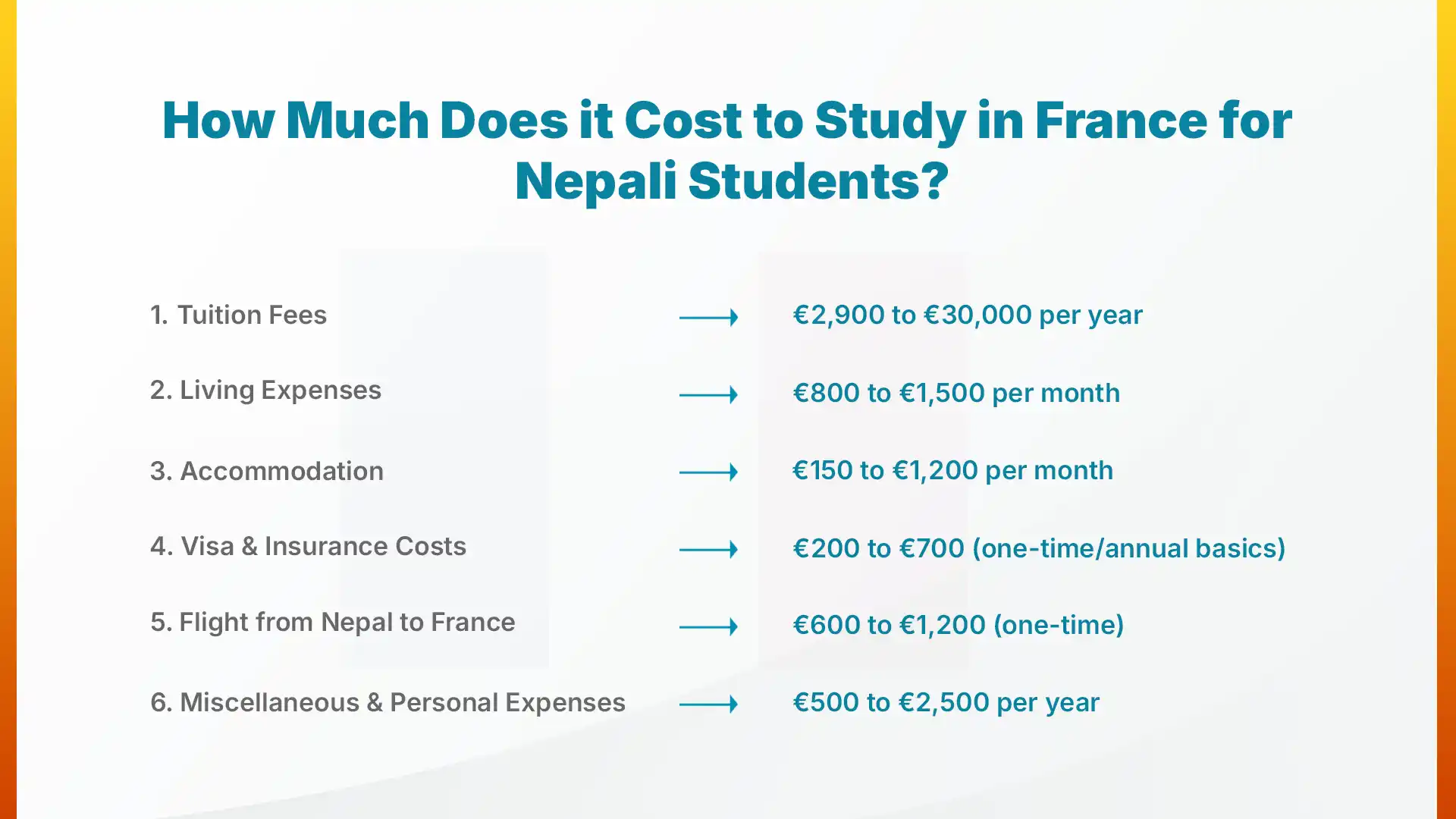
The total cost to study in France for Nepali students typically ranges from €15,000 to €65,000 per year, depending on tuition, living expenses, accommodation, visa fees, flights, and personal spending. While some costs like tuition vary depending on the university, others like food, transport, and housing also add up, so it’s important to understand where your money will go. Let’s take a quick look at the main expense categories to give you a clear overview before we explore each in detail.
1. Tuition Fees
Tuition fees are the biggest fixed cost for students. Public universities are very affordable, with Bachelor’s programs around €2,900 and Master’s around €3,900 per year. Private universities or Grandes Écoles can cost much more, up to €30,000 annually, depending on the program. Knowing this range helps you plan how much you need for your education itself.
2. Living Expenses
Living costs include food, transport, personal items, and daily spending. On average, a student spends between €800 and €1,500 each month, depending on lifestyle and city. This category is flexible and the expenses largely depend on your lifestyle choices. Cooking at home and using student discounts can lower it. Understanding living expenses gives you an idea of how much money you’ll need month-to-month.
3. Accommodation
Housing is often the largest part of monthly costs. Options range from university dorms (CROUS) at the lower end to shared apartments or private studios, especially in Paris, which are more expensive. Choosing the right accommodation can save you hundreds of euros each month. This helps you balance comfort with budget.
4. Visa & Insurance Costs
These are one-time or annual mandatory expenses. They include the student visa application fee and basic health insurance coverage. While not huge compared to tuition, they are necessary to study legally in France. It’s important to set this aside so you aren’t caught off guard.
5. Flight from Nepal to France
Your flight ticket is another one-time cost before you start your studies. Prices vary depending on the season, airline, and how early you book. Planning ahead can help you find cheaper tickets. This ensures your travel budget is included in your overall planning.
6. Miscellaneous & Personal Expenses
This category covers books, stationery, clothes, social activities, and unexpected expenses. Everyone’s spending varies, but it’s wise to keep a buffer for emergencies or small luxuries. These costs complete your total budget and make your planning realistic.
This overview gives you a clear snapshot of where your money goes as a Nepali student in France. Next, we will break down each category in detail so you can plan your budget confidently and make informed choices.
Tuition Fees in France for International Students
Tuition fees in France typically range from €2,900 to €30,000 per year depending on whether you choose a public university or a private institution. Public universities are heavily subsidized by the government, making them very affordable, while private universities and Grandes Écoles are significantly more expensive. Let’s look at the difference between these two options so you can plan your budget effectively.
1. Fees in Public Universities (Most Affordable Option)
Public universities in France are the cheapest option for international students because the government funds most of the cost. Bachelor’s programs usually cost around €2,900 per year, while Master’s programs are about €3,900 per year. This makes them an ideal choice for students on a tight budget, yet the quality of education remains high.
2. Private Universities & Grandes Écoles
Private universities and Grandes Écoles charge much higher tuition because they receive little government funding. Programs in business, engineering, or specialized fields can cost anywhere from €10,000 to €30,000 per year. While expensive, they may offer smaller class sizes, specialized programs, or better internship opportunities, which can make the extra cost worthwhile in some cases.
3. Annual Tuition Fee Comparison in French Universities
Degree Type | Public University (Non-EU, 2026) | Private / Grande École (2026) |
| Bachelor’s (Licence) | EUR 2,850 – 2,950 | EUR 6,000 – 18,000 |
| Master’s | EUR 3,850 – 4,000 | EUR 8,000 – 25,000 |
| MBA / Specialized | EUR 5,000 – 12,000 | EUR 15,000 – 35,000+ |
This table gives a clear picture of how tuition fees differ depending on the type of university and program. It helps you see where you can save and where paying extra might make sense for your career goals.
Living Expenses in France for Nepali Students
Living expenses in France usually range from about €800 to €1,500 per month for students, depending on city and lifestyle. This includes your biggest costs like housing and daily spending, and smaller ones like food, transport, and personal items. Now let’s take a closer look at what you’ll spend in each of these areas so you can picture your budget clearly.
1. Accommodation (Biggest Expense)
Accommodation is the largest part of a student’s monthly budget. University dorms or CROUS housing can cost around €150 – €500/month, while shared flats or private studios range higher, especially in cities like Paris, where they can be €600 – €1,200/month. Most students try to live in shared apartments or student residences to balance cost and comfort.
2. Food & Groceries
Food costs depend on your eating habits and where you shop. If you cook most meals at home, expect around €150 – €300/month for groceries, and you can save even more by eating at university cafeterias for just a few euros per meal. Eating out frequently will push your costs higher.
3. Transportation
Transport in France is reliable and often affordable for students. With a student public transport pass, you might pay roughly €20 – €75/month, depending on the city and the type of pass. Some students also use bikes or walk if they live close to campus, which helps reduce costs.
4. Utilities & Internet
Utilities like electricity, heating, water, and internet are usually around €50 – €100/month if they are not included in rent. In many student residences or shared flats, the internet may already be included, which helps keep bills a little lower.
5. Personal Expenses
Personal costs include things like mobile phone bills, toiletries, social activities, and occasional travel. For most students, this ranges around €50 – €150/month, but it can go up if you eat out often or enjoy weekend trips.
This breakdown should help you see where your money goes each month and give you a realistic picture of student life in France. Next, we’ll look at the one-time costs you pay before you even step on the plane.
One-Time Costs Before You Travel from Nepal
Before you even land in France, there are several one-time expenses you need to plan for. These include application fees, visa charges, flight tickets, and initial setup costs like rent deposits and insurance. Understanding these costs early helps you avoid surprises and ensures a smooth start to your study journey.
1. Campus France Fee
The Campus France application fee is required for all students applying to French universities. It usually costs around €90–€100 for international students. This fee covers the processing of your application and document verification, and it must be paid before your university accepts your application.
2. Visa Fee
A French student visa is mandatory and costs €99 (€99 (approx. NPR 15,961). You’ll also have to pay a VFS service fee of roughly €42–€50, depending on the type of visa and duration. This fee must be paid at the time of application, and it ensures you can legally study and stay in France. It’s important to budget for this along with your proof of funds.
3. Flight Ticket
Your flight from Nepal to France is another essential one-time cost. Depending on the airline, season, and how early you book, prices generally range from €600–€1,200. Booking early can help you save, and including luggage charges in your budget is wise.
4. First Month Rent Deposit
Most landlords in France require a security deposit when you rent a flat or studio. This deposit is usually equal to one month’s rent, ranging from €150 to €1,200, depending on your accommodation type. It is refundable at the end of your lease if there’s no damage.
5. Health Insurance
Health insurance is mandatory for all international students. Basic coverage through the French Social Security system costs around €200–€300 per year, while additional private insurance for extra benefits can cost more. This protects you against medical emergencies and gives peace of mind.
6. Document Preparation (IELTS, Translations, etc.)
You also need to budget for preparatory costs like IELTS or other English/French tests, document translations, and notarizations. These can add up to roughly €100–€300, depending on the services you use. Preparing all documents carefully in advance ensures your application process goes smoothly.
This overview of one-time costs gives you a clear picture of the upfront investment before starting your studies in France. Next, we’ll discuss student visa financial requirements and how much money you need to show to study there legally.
France Student Visa Financial Requirements for Nepali Students
One of the most important steps before studying in France is meeting the student visa financial requirements. The French authorities want to ensure that international students have enough money to cover their living expenses while studying. This means showing proof of funds, maintaining a minimum balance, and demonstrating financial stability for your stay.
1. Proof of Funds Needed
To obtain a student visa for France, you must provide evidence that you can support yourself financially during your studies. This can include:
- Personal bank statements showing your savings
- Bank statements of parents or sponsors, if they are funding you
- Loan sanction letters from banks
- Scholarship or grant letters
The goal is to prove that you can pay for rent, food, transportation, and other daily costs without relying illegally on part-time work. Make sure your documents are clear, authentic, and translated if necessary.
2. Minimum Funds Required to Study in France
The French government requires students to have at least €615 per month for living expenses. Over one year, this amounts to about €7,380. This minimum covers housing, food, transportation, and personal expenses, although students living in Paris or other expensive cities might need more. Planning for slightly higher funds than the minimum is safer and shows the visa officer that you are prepared.
3. Bank Balance Guidance
While the official minimum is €7,380 per year, it’s recommended to show a buffer of €8,000–€10,000 to strengthen your visa application. Here are some tips for Nepali students:
- Keep your funds in the bank for at least 3–6 months before applying
- Avoid sudden large deposits right before submission
- Maintain a clear and traceable transaction history
- If using parental funds, include a notarized declaration or proof of relationship
Having a stable and transparent financial record increases your chances of visa approval and gives you peace of mind before traveling.
By preparing your proof of funds carefully and maintaining the required balance, you can meet the visa requirements confidently and focus on planning your studies in France.
How to Reduce Your Study Cost in France: Smart Saving Tips
Reducing your study costs in France is possible if you plan carefully and make smart choices from the start. Many students save thousands of euros each year by choosing affordable universities, managing living costs, and taking advantage of scholarships and part-time jobs. Let’s explore practical ways you can cut expenses without compromising your study experience.

1. Choose Public Universities
Public universities in France are heavily subsidized by the government, which makes tuition very affordable. By choosing a public institution instead of a private one or Grande École, you could save up to €20,000 per year. These universities also provide quality education, internationally recognized degrees, and access to research facilities. Selecting a public university is the first and most impactful step to reduce your total cost.
2. Apply Early for Student Housing
Securing student accommodation early can help you lock in lower rent and better locations. Dormitories or CROUS housing often fill up quickly, especially in popular cities like Paris, Lyon, and Toulouse. By applying early, you can avoid high private rent costs and reduce commuting expenses. Planning ahead also gives you more time to compare options and pick the most budget-friendly choice.
3. Cook Meals at Home
Cooking your own meals is one of the easiest ways to lower daily expenses. University cafeterias (CROUS) are cheap, but preparing your own food can save even more, around €100–€200 per month. You also gain control over nutrition and avoid spending on snacks or frequent eating out. Buying fresh ingredients from local markets is affordable and allows you to manage your monthly food budget effectively.
4. Use Student Discounts
France offers a wide range of student discounts on transport, entertainment, museums, and even groceries. For example, student metro passes can cost half of the standard ticket price, and many stores or cinemas offer discounted entry with a student ID. Using these discounts consistently can save hundreds of euros over a year. Always carry your student ID and check for seasonal or local promotions to maximize savings.
5. Apply for Scholarships
Scholarships can significantly reduce tuition or living expenses if you qualify. Options include the Eiffel Excellence Scholarship, Erasmus+, university-specific grants, and French government aid. Applying early and submitting strong applications increases your chances of receiving funding. Even partial scholarships help reduce monthly costs, giving you more financial breathing room.
6. Work Part-Time
International students in France can legally work up to 964 hours per year, roughly 20 hours per week during term time. The minimum wage is around €11–€12 per hour, allowing students to earn €600–€900 per month. Part-time jobs like tutoring, café work, or campus assistance can cover living expenses or personal spending. Combining work with careful budgeting helps students stay financially independent.
7. Live Outside Paris
Living in smaller cities or towns outside Paris can cut housing costs by 30–50%. While Paris is attractive, rent there is the highest in the country, with private studios often over €1,000 per month. Cities like Lyon, Toulouse, or Montpellier offer quality universities and student life at a fraction of the cost. Choosing a more affordable city allows you to maintain a comfortable lifestyle while saving money.
This set of strategies gives you practical, actionable ways to reduce your total study cost in France while still enjoying a high-quality education and student life.
Is Studying in France Cheaper Than Australia, UK, or Canada?
Yes, studying in France is generally cheaper than studying in Australia, the UK, or Canada for international students. While France offers low public university fees, affordable living costs, and government support, the other countries often have higher tuition and living expenses, making France a more budget-friendly option. Let’s look at a clear comparison to see how costs differ across these popular study destinations.
Country | Student Visa Fee (2026) | Avg. Tuition (€ / Year) | Avg. Living (€ / Year) |
| France | €99 | €3,000 – €30,000 | €9,600 – €18,000 |
| Australia | AUD 2,000 (~€1,240) | €18,000 – €45,000 | €18,500 – €25,000 |
| UK | £524 (~€630) | €14,000 – €35,000 | €14,000 – €22,000 |
| Canada | CAD 150 (~€100) | €12,000 – €35,000 | €15,500 – €22,000 |
From this comparison, you can see that France is consistently more affordable, especially for students who choose public universities and manage their living costs wisely. Even though private institutions in France can be expensive, the country still offers a wider range of low-cost options and student benefits compared to these other destinations.
This makes France an excellent choice for Nepali students seeking quality education on a reasonable budget, without compromising opportunities for work or scholarships.
Conclusion
Studying in France is not only possible for Nepali students but also financially manageable with careful planning. Public universities, government subsidies, affordable living, scholarships, and part-time work make it one of the most budget-friendly study destinations in the world. While costs vary depending on lifestyle and city, a well-prepared student can enjoy quality education without overspending.
Remember, even with a limited budget, strategic choices like cooking at home, using student discounts, and applying for scholarships can make a big difference. France offers a perfect balance of world-class education, cultural experience, and cost efficiency. With the right preparation, your dream to study in France from Nepal can become a reality and a rewarding one at that.