Best MBA Universities in Australia for Nepalese Students

Mar 25, 2026

Every year, more students from Nepal start looking at Australia, not just as a study destination, but as a place to build a real career. And when it comes to business degrees, an MBA in Australia often sits right at the top of their list.
But here’s the challenge. With so many universities, different requirements, and high costs, it’s easy to feel confused about where to start or whether it’s even the right choice for you.
That’s exactly where this guide comes in. Instead of overwhelming you, it will walk you through the best MBA universities in Australia, what it costs, who can apply, and how you can actually make it happen. By the end, you’ll have a clear direction and more confidence to take your next step.
In this blog
Why Choose Australian Universities for MBA?
Studying an MBA in Australia gives you a globally recognised degree, strong job opportunities after graduation, flexible course options, and practical learning that prepares you for real careers. On top of that, you also gain international exposure, valuable connections, and a chance to grow both professionally and personally. Let’s break down exactly why this choice makes sense for many Nepalese students.

1. Globally Recognised Business Degree
An MBA from Australia is respected across the world, especially because many universities are accredited by global bodies like AACSB and EQUIS. This means your degree meets international standards and is trusted by employers. As a result, you’re not limited to jobs in Australia; you can apply in countries like Canada, the UK, or even return to Nepal with a strong profile. In the long run, this gives you more flexibility and better career mobility.
2. Big Opportunities to Build a Career After Graduation
After completing your MBA, you can apply for a post-study work visa (subclass 485), which usually allows you to stay and work for 2–3 years. During this time, many students secure full-time roles in fields like consulting, finance, and management. Australia also has a stable job market, with strong demand for skilled professionals. This means you’re not just earning a degree, you’re getting a real chance to start your career.
3. Customisable Courses to Shape Your MBA Around Your Goals
Australian universities offer a wide range of MBA specializations, from finance and marketing to business analytics and entrepreneurship. So instead of studying everything broadly, you can focus on what truly matches your career plan. Many programs also let you choose electives or projects based on your interests. This helps you build skills that are directly useful for the job you want.
4. A Worthwhile Investment for Your Future
MBA fees in Australia can range from AUD 50,000 to 100,000, which may feel high at first. However, many graduates earn between AUD 80,000 and 150,000 per year after completing their degree. Over time, this makes it possible to recover your investment and still grow financially. So, while the cost is significant, the long-term return can be strong if you plan well.
5. Practical Learning That Prepares You for Real Jobs
MBA programs in Australia focus heavily on real-world learning, not just theory. You’ll work on case studies, group projects, and sometimes even internships with companies. This means you learn how businesses actually operate, not just how they look in textbooks. By the time you graduate, you already have practical experience that employers value.
6. A Life Experience That Builds Confidence and Independence
Moving to a new country pushes you to manage everything on your own—from studies to daily life. At first, it may feel challenging, but over time, you become more confident and independent. You also learn how to adapt to new cultures and environments. These personal skills are just as important as your degree when building a successful career.
7. Strong Networking That Can Shape Your Career
During your MBA, you’ll meet classmates from different countries, experienced professors, and industry professionals. Many universities also host networking events, career fairs, and guest lectures. These connections can help you find internships, job opportunities, or even future business partners. In many cases, who you know becomes just as important as what you know.
What Are the Top 10 Best Universities in Australia for MBA?
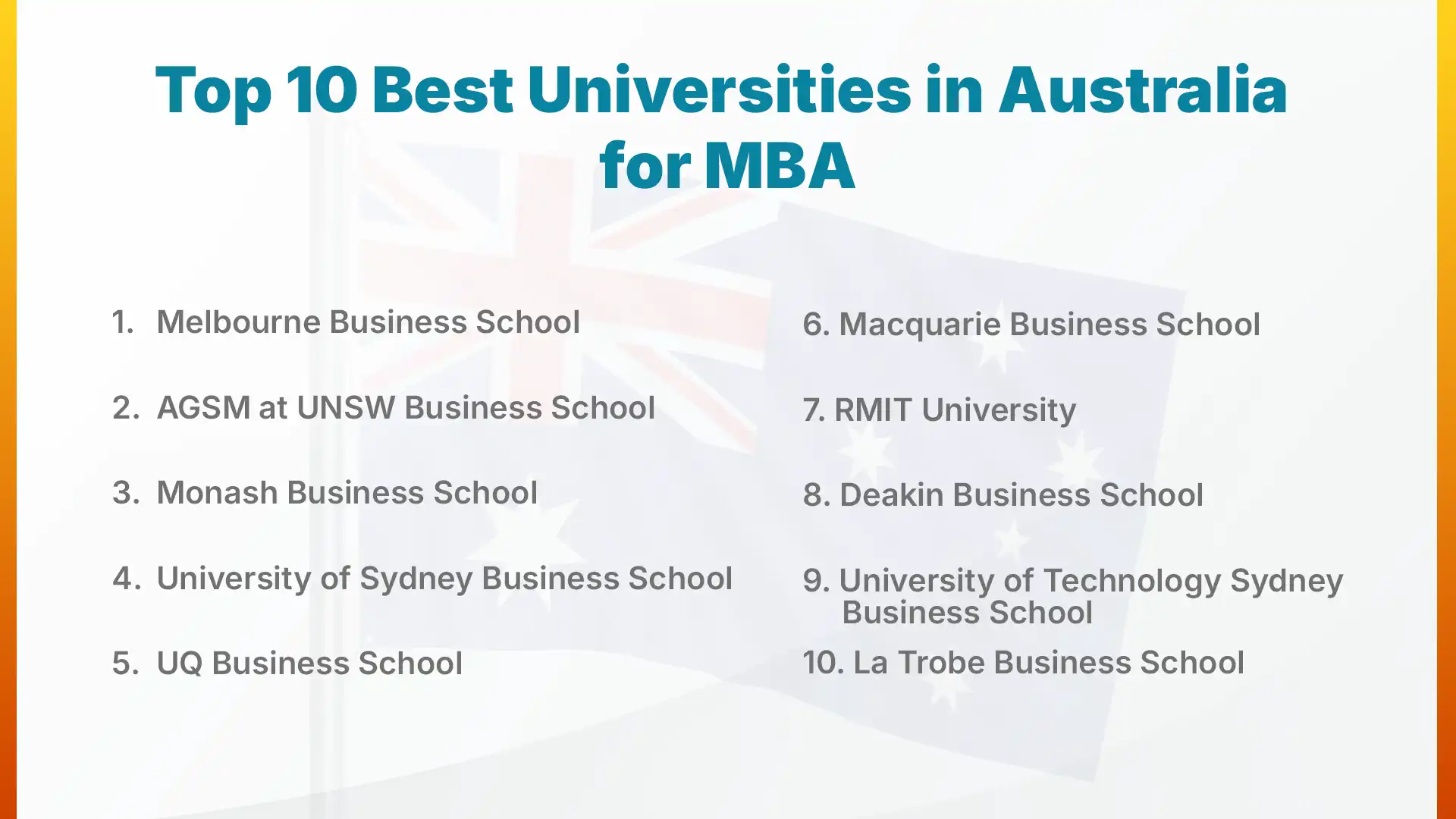
Some of the top universities in Australia for an MBA include Melbourne Business School, AGSM at UNSW Business School, Monash Business School, and University of Sydney Business School. These are just a few of the leading options, and in the next section, we’ll explore all the top MBA universities in Australia in detail so you can compare and choose the one that fits you best.
1. Melbourne Business School
This university offers a full-time MBA and a flexible part-time MBA, with the option to study over 1–2 years depending on your pace. They also provide accelerated study options and online elements, which allow students to balance learning with real-world exposure.
In terms of opportunities, students benefit from strong industry connections, career support, internships, and networking with top companies. The school also focuses heavily on leadership, strategy, and real business problem-solving.
When it comes to research, Melbourne Business School emphasizes practical, applied business research, especially in leadership, strategy, and decision-making, rather than purely academic theory.
2. AGSM at UNSW Business School
AGSM offers multiple MBA formats including full-time MBA, Executive MBA, and a fully online MBA (MBAX). The full-time MBA is intensive (around 12 months), while part-time and online options allow working professionals to study flexibly.
Students get access to global study tours, industry projects, and strong career support, helping them move into leadership roles. The program also connects students with top business leaders and companies.
AGSM focuses on real-world leadership, innovation, and strategic management research, with strong emphasis on solving modern business challenges.
3. Monash Business School
Monash offers a range of MBA options including Global Executive MBA, MBA (Digital), and part-time formats. The online MBA (MBA Digital) is especially designed for students who want 100% flexible study while working full-time.
Students benefit from international exposure, industry projects, and strong global connections, including overseas study modules. This helps build a global business mindset.
Monash focuses on global business research, innovation, and digital transformation, making it ideal for future-focused careers.
4. University of Sydney Business School
The University of Sydney offers a flexible MBA, which can be studied full-time or part-time depending on your schedule. Students can work while studying, and the program is designed to include industry engagement, leadership training, and practical learning.
The university provides strong networking opportunities, career services, and access to Sydney’s business ecosystem, which is one of Australia’s biggest advantages.
Research here focuses on entrepreneurship, innovation, and business leadership, with a strong connection to real-world applications.
5. UQ Business School
UQ offers a flexible MBA that can be completed full-time or part-time, making it suitable for both students and working professionals. It includes real business projects, case studies, and leadership development programs, giving you hands-on experience.
Students gain access to career services, global exposure, and industry connections, which help in job placement. The university focuses on leadership research, business innovation, and sustainable business practices, preparing students for modern challenges.
6. Macquarie Business School
Macquarie offers full-time, part-time, and flexible MBA formats, allowing students to study while working. The MBA is designed with strong industry input, meaning what you learn is directly useful in real jobs.
Students get opportunities for internships, networking, and career advancement, especially because of its Sydney location. Research here focuses on applied business knowledge, analytics, and industry-relevant studies.
7. RMIT University
RMIT offers a flexible MBA program with full-time and part-time options, often structured around real-world learning. The university is known for its industry-linked projects, internships, and practical learning approach.
Students benefit from strong employer connections and hands-on experience, which improves job readiness. RMIT focuses on applied research, innovation, and practical business solutions, rather than purely academic theory.
8. Deakin Business School
Deakin offers one of the most flexible MBA programs, including online, part-time, and on-campus study options. This makes it ideal for working professionals or students who need flexibility.
The university provides career support, industry projects, and strong student services, especially for international students. Deakin focuses on practical business research, digital business, and leadership development, with a strong focus on real-world impact.
9. University of Technology Sydney Business School
UTS offers full-time and flexible MBA options, with a strong focus on modern business and technology. The program includes industry projects, innovation labs, and collaboration with tech companies, making it highly practical.
Students gain direct exposure to real business environments in Sydney, which helps with job opportunities. UTS focuses on research in technology, innovation, and data-driven business, preparing students for the future economy.
10. La Trobe Business School
La Trobe offers full-time and part-time MBA programs, with a strong focus on affordability and flexibility. The program is designed for students who want quality education at a lower cost, without compromising on learning outcomes.
Students get access to career support, internships, and networking opportunities to help build their careers. Research here focuses on business management, leadership, and practical problem-solving, making it accessible and career-oriented.
Eligibility Requirements for MBA Universities in Australia
To study MBA in Australia, you need to meet a few basic academic, work, and language requirements set by universities. These requirements are not meant to make things difficult, but to ensure you are ready for the course and can succeed in it. Let’s go through each requirement for your Australian education so you can clearly understand where you stand and what you may need to prepare.
1. Academic Requirements
Most Australian universities expect you to have a bachelor’s degree in any field from a recognized institution. While the exact GPA varies, many universities look for at least a credit or above (around 60–65% or equivalent).
However, top universities may expect a stronger academic background, especially if they are highly competitive. If your grades are average, you need not worry! some universities also consider your work experience and overall profile. So, your academic record is important, but it’s not the only factor that decides your admission.
2. Work Experience
Most MBA programs in Australia prefer students who have 2 to 5 years of work experience. This is because MBA classes are designed for students who can relate theory to real-world situations.
If you already have work experience, it gives you an advantage during admission. But even if your experience is limited, some universities still accept fresh graduates, especially for less competitive programs. In short, work experience strengthens your profile, but it is not always a strict requirement.
3. English Language Requirements
Since courses are taught in English, you need to show your language ability through tests like IELTS or PTE. Most universities require an IELTS score of around 6.5 to 7.0 overall, with no band less than 6.0.
If you choose PTE, a similar score is usually expected. These scores help universities ensure that you can understand lectures, participate in discussions, and complete your assignments without difficulty.
4. GMAT/GRE Requirements for MBA in Australia
For top universities like Melbourne Business School or AGSM, a GMAT or GRE score is often required or strongly recommended. These tests help universities assess your analytical and reasoning skills.
However, many other universities in Australia do not strictly require GMAT or GRE. They may consider your work experience, academics, and overall profile instead. So, if you haven’t taken these tests, you still have good options available.
How Much Money is Required for an MBA in Australia from Nepal?
The cost of an MBA in Australia for international students usually ranges from AUD 50,000 to AUD 100,000, depending on the university and program. Along with tuition, you also need to consider living expenses, which vary by city, plus additional costs of studying in Australia like health insurance and visa fees.
Next, we’ll break down these costs in detail so you can clearly understand the total investment required.
1. What are the Tuition Fees in MBA Colleges in Australia?
MBA tuition fees in Australia usually range from AUD 50,000 to AUD 100,000, depending on the university, program type, and duration. Top-ranked universities like Melbourne Business School or AGSM tend to be on the higher end, while mid-range universities offer more affordable options. This range reflects the quality of education, global recognition, and strong career outcomes these programs provide. So, while the cost may seem high, it often comes with better opportunities and higher earning potential after graduation.
MBA Tuition Fees at Top Australian Universities
University | MBA Fees (Approx. 2026/27) |
| Melbourne Business School | AUD 120,000+ (Total) |
| AGSM at UNSW Business School | AUD 86,700 – 113,000 |
| Monash Business School | AUD 88,000 (Annual) |
| University of Sydney Business School | AUD 60,000 – 87,000 |
| UQ Business School | AUD 70,000 – 81,000 |
| Macquarie Business School | AUD 46,000 – 48,500 (Annual) |
| RMIT University | AUD 50,000 – 60,000 (Annual) |
| Deakin Business School | AUD 48,000 – 53,000 (Annual) |
| UTS Business School | AUD 50,000 – 85,000 |
| La Trobe Business School | AUD 37,000 – 42,000 (Annual) |
2. Living Expenses for Nepalese Students in Australia
Living expenses in Australia depend a lot on the city you choose. For example, cities like Sydney and Melbourne are more expensive, where monthly expenses can range from AUD 1,800 to 2,500. On the other hand, cities like Adelaide or Brisbane are more affordable, with costs closer to AUD 1,200 to 1,800 per month. These expenses include accommodation, food, transport, and daily needs. So, your total cost will vary based on your lifestyle and location, and planning wisely can help you manage your budget better.
3. Additional Costs of Studying in Australia
Apart from tuition and living expenses, there are a few extra costs you should plan for. One major requirement is Overseas Student Health Cover (OSHC), which can cost around AUD 500 to 700 per year. You’ll also need to budget for study materials like books, which may cost a few hundred dollars each year. Additionally, there are visa application fees and travel costs, which can add to your initial expenses. While these costs may seem small compared to tuition, they are important to include in your overall planning so you don’t face surprises later.
Best MBA Specializations in Australia
Best MBA specializations in Australia include Finance, Marketing, Business Analytics, International Business, and Entrepreneurship. Choosing the right MBA specialization in Australia helps you focus on a specific career path and build skills that match industry demand. Each specialization opens different job opportunities and shapes your future in a unique way.
Let’s explore the most popular options so you can see which one fits your goals best.
1. MBA with Finance
An MBA in Finance focuses on areas like financial analysis, investment management, corporate finance, and risk management. You’ll learn how to read financial statements, manage company budgets, and make smart investment decisions. This specialization is highly valuable because finance roles are always in demand across industries. After graduation, you can work as a financial analyst, investment banker, or financial manager, with strong salary growth potential over time.
2. MBA in Marketing
This specialization helps you understand how to promote products, build brands, and reach the right audience. You’ll study topics like digital marketing, consumer behavior, advertising, and market research. As businesses focus more on online presence, marketing skills are becoming more important than ever. With this MBA, you can work as a marketing manager, brand strategist, or digital marketing specialist in global companies.
3. MBA in Business Analytics
A Master of Business Analytics in Australia focuses on using data to make better business decisions. You’ll learn tools like data visualization, predictive analysis, and data interpretation. As companies rely more on data, this field is growing very fast worldwide. After completing this specialization, you can work as a data analyst, business analyst, or data consultant, helping companies improve performance and make informed decisions.
4. MBA in International Business
This specialization prepares you to work in global markets and understand international trade, cross-border management, and global strategies. You’ll learn how businesses operate across different countries and how to manage cultural and economic differences. This field is ideal if you want to work for multinational companies or in international roles. Career options include global business manager, export-import manager, and international consultant.
5. Entrepreneurship
Entrepreneurship focuses on building and managing your own business. You’ll learn how to develop business ideas, create business plans, manage finances, and handle risks. This specialization is perfect if you dream of starting your own company or startup. It also helps you develop leadership and problem-solving skills, which are useful even if you decide to work in a company later.
How to Choose the Right MBA University in Australia?
To choose the right MBA university in Australia, first define your budget, identify your career goals, compare universities based on location and lifestyle, and check their return on investment and rankings. Each of these factors plays a direct role in shaping your study experience and future opportunities. Let’s go deeper into each point so you can make a clear and confident decision.
1. Decide Based on Budget
Start by clearly defining how much you can realistically afford for your MBA, including tuition, living costs, and extra expenses. If your budget is tight, target universities with lower tuition fees like La Trobe or Deakin, and actively look for scholarships or payment plans.
You should also compare and choose to study in the best Australian cities, because living in Sydney or Melbourne costs more than in smaller cities like Adelaide. By planning your finances in advance and checking total costs, you can avoid stress and focus on your studies without financial pressure.
2. Based on Career Goals
Be clear about where you want to work after your MBA, because this should guide your university choice. For example, if you want a career in finance or consulting, choose universities with strong industry connections in those fields, such as Melbourne or UNSW.
If you are interested in tech or data, look for programs that include analytics, innovation, or digital business subjects. Also, check if the university offers internships, industry projects, or career support, because these directly improve your chances of landing a good job.
Make sure you explore the best master’s courses in Australia before you make your final decision.
3. Based on Location & Lifestyle
Think carefully about the city you will live in, because it affects both your expenses and daily life. Cities like Sydney and Melbourne offer more job opportunities, networking events, and internships, but they also come with higher rent and living costs. On the other hand, cities like Brisbane, Adelaide, or Perth are more affordable and less crowded, which can help you save money and live more comfortably.
Choose a location where you can balance your budget, studies, and personal comfort, because a good lifestyle helps you perform better academically.
4. Based on ROI and University Rankings
When choosing a university, always compare what you are paying with what you can gain after graduation. Look at graduate salary outcomes, job placement rates, and industry connections to understand the real return on investment.
Top-ranked universities, including Go8 universities, usually offer stronger career support and higher starting salaries, which can help you recover your costs faster. However, don’t choose based on rankings alone. Make sure the university also matches your budget, goals, and learning style. The best choice is one that gives you both value for money and strong career growth.
5. Take Guidance and Career Counselling
Sometimes, choosing the right university can feel confusing, especially with so many options and factors to consider. In such cases, getting expert guidance can make your decision much clearer and faster. You can visit a trusted consultancy for Australia in Nepal, where experts can guide you based on your profile, budget, and career goals. This small step can help you avoid mistakes and choose a university that truly fits your future plans.
Conclusion
Choosing an MBA in Australia can be a life-changing step, and in this guide, you’ve seen the top universities in Australia, costs, eligibility requirements, and the best specializations to consider. You also now understand how to choose the right university based on your goals, budget, and future plans.
If you’re someone dreaming of studying abroad from Nepal, it’s normal to feel unsure at first. But with the right information and clear direction, your goal is absolutely within reach. What matters now is taking the next step with confidence and choosing a path that truly fits your future.
Take your time, compare your options, and plan wisely. And when you’re ready, start your journey toward an MBA in Australia. The right decision today can shape a much brighter tomorrow.