Study Law in Canada: Diplomas, Legal Studies & Master's Degrees

Jun 15, 2026

Canada is one of the world's most respected destinations for legal education, with a strong common law tradition, globally recognized law schools, and a legal profession that is in consistent and growing demand across corporate, immigration, criminal, and public interest sectors.
For Nepalese students who want to build a career in law, Canada offers multiple entry points, from paralegal diplomas to prerequisite undergraduate degrees, professional Juris Doctor programs, and postgraduate Master of Laws degrees. This guide covers every pathway clearly so Nepalese students can make an informed decision. You can start by reading about studying in Canada for a broader picture of what the country offers.
In this blog
Can You Study Law at an Undergraduate Level in Canada?
Yes, but not in the way most Nepalese students expect. In Canada, law is not offered as a direct four-year undergraduate degree the way it is in the UK or Australia. Instead, the professional law degree in Canada is the Juris Doctor (JD), which is a graduate-level professional degree that requires applicants to first complete a three or four-year undergraduate degree in any discipline before applying. This means Nepalese students who want to become licensed lawyers in Canada must plan for a two-stage pathway: an undergraduate degree first, followed by the JD.
However, there is an important exception for students who want to enter the legal field directly after Plus Two. Diploma programs in paralegal studies or legal studies are available at Canadian colleges and can be completed in 1 to 2 years, leading directly to employment as a paralegal, legal assistant, or law clerk without requiring a JD. These are practical, employment-focused credentials recognized by provincial law societies. Nepalese students should decide early whether their goal is to become a licensed lawyer, which requires the full undergraduate plus JD pathway, or to work in a legal support role, which the paralegal diploma achieves more directly and affordably.
What Are the Law Programs Available in Canada?
Canada offers four distinct law-related program pathways for international students, ranging from a 1-year college diploma to a postgraduate Master of Laws degree. Nepalese students should choose based on their current qualification, career goal, and budget.
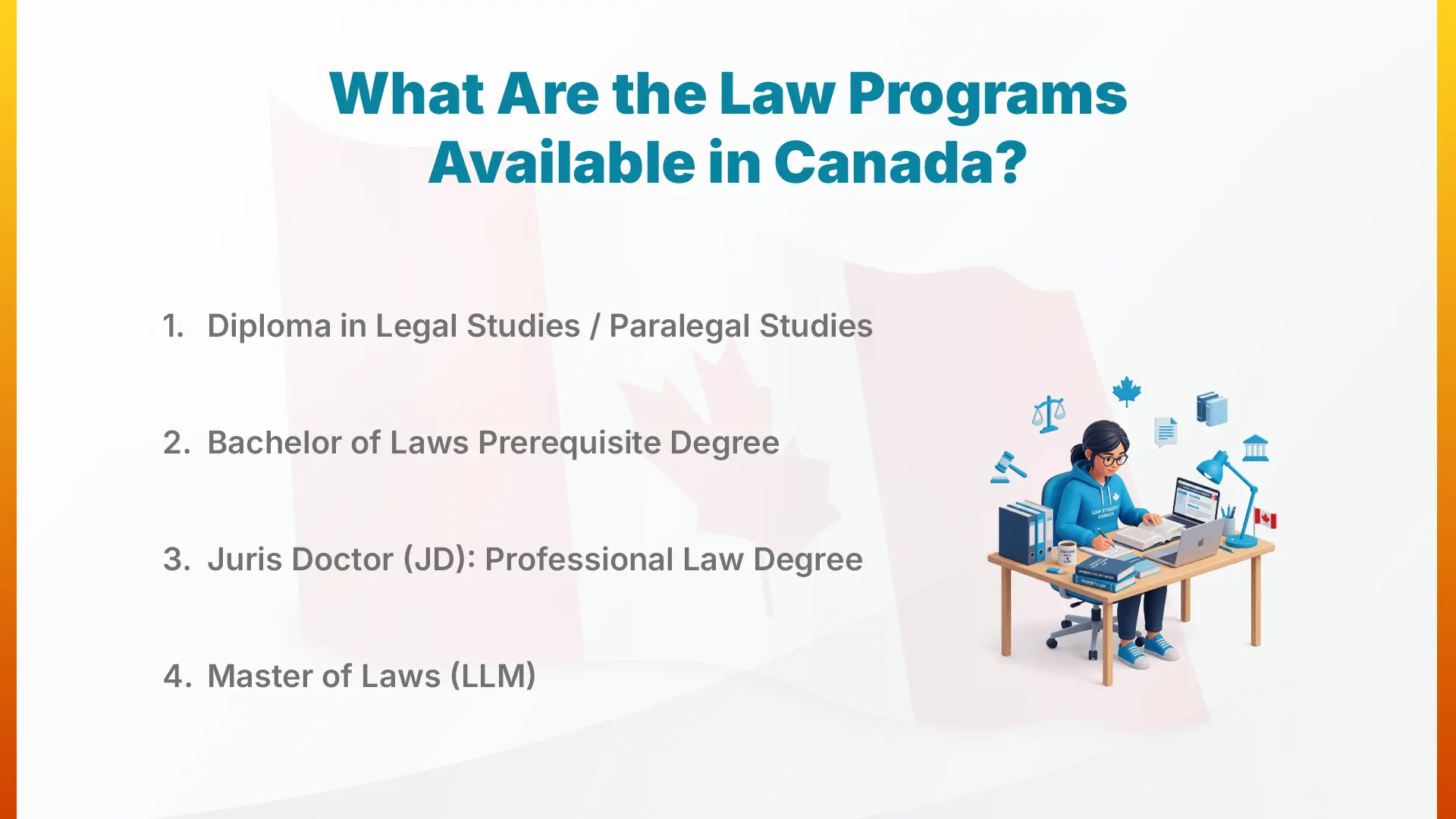
1. Diploma in Legal Studies / Paralegal Studies
Duration: 1 to 2 years
Entry requirement: Grade 12 / Plus Two
Offered at: Humber College, Seneca College, Algonquin College, George Brown College
Career outcome: Paralegal, legal assistant, law clerk, court officer
Key point: In Ontario, paralegals are licensed by the Law Society of Ontario. A diploma from an accredited program leads directly to licensure eligibility
2. Bachelor of Laws Prerequisite Degree
Duration: 3 to 4 years
Entry requirement: Grade 12 / Plus Two
Offered at: All major Canadian universities
Career outcome: Pre-law foundation qualifies students to apply for the JD
Key point: Any undergraduate major is accepted for JD admission; popular pre-law majors include political science, criminology, philosophy, and economics
3. Juris Doctor (JD) Professional Law Degree
Duration: 3 years (after undergraduate degree)
Entry requirement: Bachelor's degree + LSAT score
Offered at: University of Toronto, McGill, Osgoode Hall, UBC, University of Alberta
Career outcome: Licensed lawyer, barrister, solicitor, legal counsel
Key point: JD graduates must complete the bar admission process in their province to practice law in Canada
4. Master of Laws (LLM)
Duration: 1 to 2 years
Entry requirement: LLB or JD from a recognized institution
Offered at: University of Toronto, McGill, UBC, Dalhousie, Queen's University
Career outcome: Senior legal counsel, academic researcher, international law specialist, policy advisor
Key point: Nepalese students with an LLB from Nepal are eligible to apply for the LLM directly, making this the fastest pathway to a Canadian law qualification for existing law graduates
How Long Does It Take to Study Law in Canada?
The time it takes to study law in Canada depends entirely on which program you are entering and your existing qualifications. For Nepalese students starting from Plus Two, the full pathway to becoming a licensed lawyer in Canada takes 6 to 7 years. Students with an existing LLB from Nepal can enter the LLM directly and complete a Canadian law qualification in 1 to 2 years.
Program | Duration | Entry Requirement |
|---|---|---|
| Diploma in Paralegal / Legal Studies | 1 to 2 Years | Grade 12 / Plus Two |
| Undergraduate Pre-Law Degree | 3 to 4 Years | Grade 12 / Plus Two |
| Juris Doctor (JD) | 3 Years | Bachelor's Degree + LSAT |
| Master of Laws (LLM) | 1 to 2 Years | LLB or JD |
| Full Pathway (Undergrad + JD) | 6 to 7 Years | Grade 12 / Plus Two |
Which Are the Top Universities to Study Law in Canada?
The top universities to study law in Canada include the University of Toronto, McGill University, Osgoode Hall at York University, the University of British Columbia, and the University of Alberta, all offering JD and LLM programs that are highly regarded by Canadian and international employers.
The best universities in Canada for Nepalese students are those that balance high-quality education with accessible financial paths, a welcoming international community, and strong post-graduation work opportunities.
University | Location | Program | Known For |
|---|---|---|---|
| University of Toronto Faculty of Law | Toronto, Ontario | JD, LLM, SJD | Consistently Ranked Canada's Top Law School; Corporate, International, and Human Rights Law |
| McGill University Faculty of Law | Montreal, Quebec | JD/BCL, LLM | Unique Bijural Program in Both Common Law and Civil Law; Bilingual Environment |
| Osgoode Hall Law School (York University) | Toronto, Ontario | JD, LLM | Largest Law School in Canada; Strong Clinical and Public Interest Law Programs |
| UBC Peter A. Allard School of Law | Vancouver, British Columbia | JD, LLM | Top-Ranked for Environmental Law, Indigenous Law, and Asia-Pacific Legal Studies |
| University of Alberta Faculty of Law | Edmonton, Alberta | JD, LLM | Strong in Energy Law, Natural Resources Law, and Business Law |
The University of Toronto and McGill are Canada's most prestigious law schools globally. Osgoode Hall is the best option for students who want a large, diverse, and clinically active law school experience in Toronto.
What Are the Admission Requirements?
The admission requirements to study law in Canada include academic qualifications, LSAT scores for JD programs, English language proficiency, a personal statement, and financial documentation for the study permit.
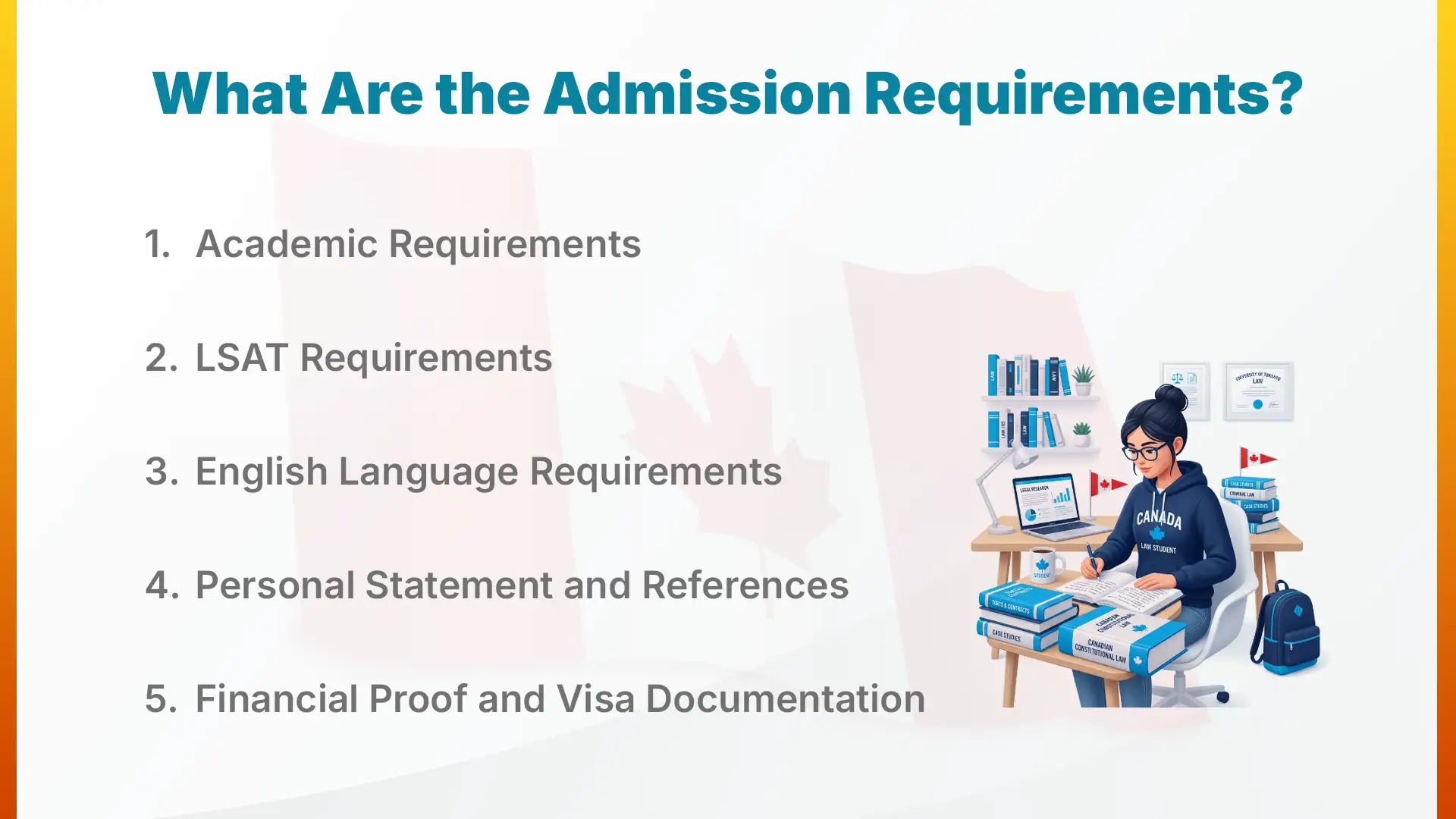
1. Academic Requirements
For diploma programs, applicants need Grade 12 or Plus Two with satisfactory results. For the JD, applicants must hold a completed bachelor's degree with a strong cumulative GPA. Most top law schools require a minimum GPA of 3.3 to 3.7 out of 4.0. For the LLM, an LLB or equivalent from a recognized institution is required with strong academic standing.
2. LSAT Requirements
The Law School Admission Test (LSAT) is required for JD admission at all Canadian law schools. Most top schools expect a score of 155 to 170 on the LSAT, with the University of Toronto and McGill requiring the highest scores among Canadian institutions. The LSAT is not required for diploma programs or the LLM.
3. English Language Requirements
All Bachelor of Development Studies programs in Canada are taught in English, and international applicants must demonstrate proficiency through an approved language test. The minimum scores required are outlined in the table below.
Test | Minimum Score |
|---|---|
| IELTS Academic | 6.5 to 7.0 Overall, No Band Below 6.0 |
| TOEFL iBT | 93 to 100 Depending on University |
| PTE Academic | 65 to 70 |
Nepalese students who need to strengthen their English score can enroll in IELTS preparation classes before applying.
4. Personal Statement and References
JD and LLM applications require a detailed personal statement explaining your motivation for studying law, relevant academic and professional experience, and your specific legal interests. Two to three reference letters from academic or professional supervisors are typically required. Nepalese students can follow the SOP format for Canada to structure their statement effectively.
5. Financial Proof and Visa Documentation
For the Canada Study Permit, students must provide proof of sufficient funds to cover tuition and living expenses. Prepare all the Requirements to Study in Canada from Nepal so that the approval rate of your visa increases.
How Much Does It Cost to Study Law in Canada?
The cost of studying law in Canada ranges from CAD 8,000 per year for a paralegal diploma to CAD 40,000 or more per year for a JD at a top law school. Law is one of the most expensive programs to study in Canada but also one of the highest-returning in terms of salary outcomes.
Because the overall cost to study in Canada differs significantly by academic program and destination city, students are highly advised to carefully choose their university and location according to their specific budget.
Program | Annual Tuition (CAD) | Annual Tuition (NPR approx.) |
|---|---|---|
| Diploma in Paralegal / Legal Studies | CAD 8,000 – CAD 15,000 | NPR 720,000 – NPR 1,350,000 |
| Undergraduate Pre-Law Degree | CAD 20,000 – CAD 38,000 | NPR 1,800,000 – NPR 3,420,000 |
| Juris Doctor (JD) | CAD 25,000 – CAD 45,000 | NPR 2,250,000 – NPR 4,050,000 |
| Master of Laws (LLM) | CAD 20,000 – CAD 38,000 | NPR 1,800,000 – NPR 3,420,000 |
Monthly living expenses in Canada range from CAD 900 to CAD 2,200 depending on the city, with Toronto being the most expensive and cities like Edmonton and Halifax being more affordable. Many Nepalese students take up part-time jobs in Canada during their studies to offset living costs.
Taking tuition and living expenses together, Nepalese students should budget approximately CAD 30,000 to CAD 58,000 per year in total depending on the program and city.
What Scholarships Are Available to Study Law in Canada?
Several scholarships are available for international students to study law in Canada, ranging from university-specific merit awards and need-based bursaries to external fellowships from legal associations and public interest organizations.
University of Toronto Faculty of Law Bursaries: need-based financial assistance for JD students with demonstrated financial need; among the most generous law school bursaries in Canada
McGill Faculty of Law Merit Awards: merit-based partial tuition awards for outstanding incoming JD and LLM students with strong academic records
Osgoode Hall Indigenous and Diversity Scholarships: awards specifically supporting students from underrepresented backgrounds, including international students from developing countries
Canadian Bar Association Law Student Diversity Fellowships: annual fellowships for law students who demonstrate commitment to diversity, access to justice, and public interest law
What Jobs Can You Get After Studying Law in Canada?
Graduates with a law qualification from Canada can work as licensed lawyers, corporate legal counsel, immigration lawyers, paralegals, and policy analysts across private practice, government, corporations, and international organizations.
A licensed lawyer/barrister: represents clients in court and provides legal advice across criminal, civil, family, and corporate matters after completing bar admission requirements
Corporate Legal Counsel: provides in-house legal advice to corporations on contracts, mergers, compliance, and regulatory matters; one of the highest-paid legal roles in Canada
Immigration Lawyer: specializes in immigration and refugee law; a particularly high-demand specialization given Canada's active immigration system and large international client base
Paralegal / Legal Assistant: provides licensed legal services in areas such as small claims court, landlord-tenant disputes, and traffic matters; directly accessible via paralegal diploma
Policy Analyst / Legal Researcher: works in government ministries, think tanks, and international organizations analyzing legislation, regulations, and legal frameworks
What Is the Salary and Scope After Law in Canada?
Entry-level law graduates in Canada earn between CAD 55,000 and CAD 80,000 per year, rising to CAD 80,000 to CAD 130,000 at mid-level, and CAD 130,000 or more for senior lawyers and partners at established firms.
Law is consistently among the highest-paying professions in Canada, and demand for legal professionals is growing across immigration, corporate, environmental, and technology law sectors. It is also one of the best courses in Canada for Nepalese students who want a prestigious, high-earning career with strong long-term immigration outcomes.
Experience Level | Annual Salary (CAD) | Annual Salary (NPR approx.) |
|---|---|---|
| Entry-Level (0–2 years) | CAD 55,000 – CAD 80,000 | NPR 4,950,000 – NPR 7,200,000 |
| Mid-Level (2–5 years) | CAD 80,000 – CAD 130,000 | NPR 7,200,000 – NPR 11,700,000 |
| Senior Lawyer / Partner (5+ years) | CAD 130,000 – CAD 250,000+ | NPR 11,700,000 – NPR 22,500,000+ |
After completing a JD or LLM, international graduates can apply for the Post-Graduation Work Permit (PGWP), which allows full-time work in Canada for up to three years in any role, including articling positions and associate lawyer roles that are the standard entry point into Canadian legal practice.
Lawyers and legal professionals qualify for permanent residency through Express Entry's Federal Skilled Worker Program and Canadian Experience Class. Several Provincial Nominee Programs, particularly in Ontario, British Columbia, and Alberta, actively support skilled legal professionals. Canada's continuously growing immigration intake, expanding corporate sector, and increasing regulatory complexity across technology and environmental law mean that demand for trained legal professionals will remain strong throughout the decade.
Conclusion
Canada offers Nepalese students a well-structured and professionally rewarding pathway into the legal profession, whether through a paralegal diploma, a prerequisite undergraduate degree, a Juris Doctor, or a Master of Laws. With world-class law schools, strong employment demand, competitive salaries, and a clear immigration pathway, Canada is one of the most strategically sound destinations for Nepalese students who are serious about a career in law.
Interested in studying law in Canada? Contact SAS Education Consultancy for a free counseling session, and let us help you identify the right pathway, prepare a strong application, and navigate the study permit process with confidence.