Study Cybersecurity in Korea: Programs, Requirements & Careers 2026

May 22, 2026
If you are a Nepali student searching for a way to build a serious career in cybersecurity without spending USD 40,000 a year on tuition, Korea deserves your full attention.
Korea is not just affordable. It is one of the most digitally advanced countries on earth, home to Samsung, SK Telecom, Kakao, and Naver companies that are actively hiring cybersecurity professionals right now. The Korean government has invested heavily in its National Cybersecurity Master Plan, creating a pipeline of government-funded research, industry collaboration, and graduate employment that directly benefits international students who study there.
This guide answers every question a Nepali student needs answered, from specific university programs and exact entry requirements to real salary figures and the step-by-step visa process from Kathmandu.
In this blog
Why Study Cybersecurity in Korea?
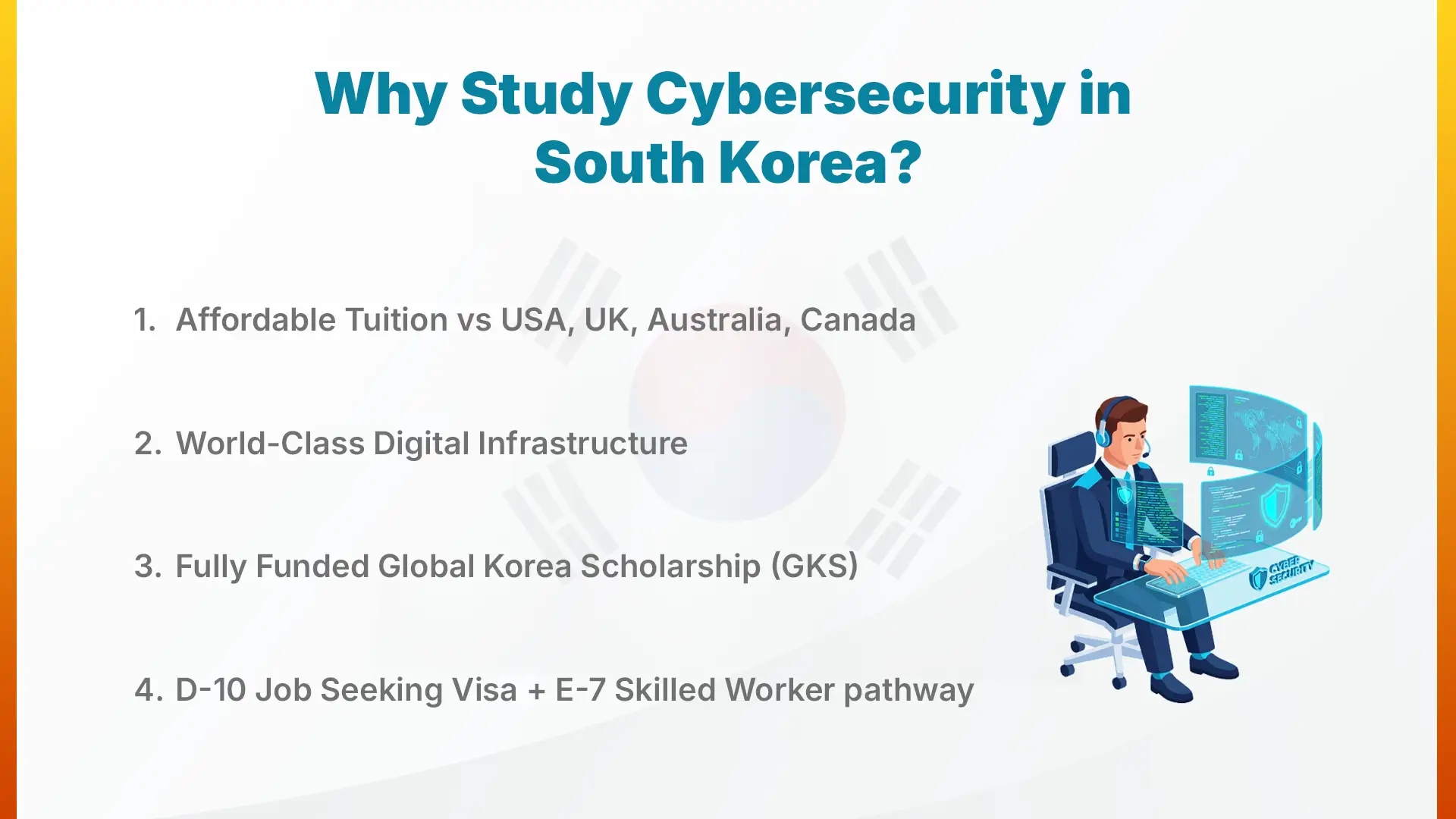
Study cybersecurity in Korea because it gives you something most study destinations cannot combine in one place: a globally ranked technical education, a fully funded scholarship pathway, direct access to world-leading tech companies, and a post-study visa that actually gives you time to build a career. These are the top reasons why students prefer South Korea for cybersec studies:
1. Tuition Is a Fraction of What You Would Pay in Western Countries
Most Nepali students shortlisting cybersecurity destinations start with Australia, Canada, the UK, or the USA. Korea rarely makes that first list, and that is a costly oversight.
A two-year master's in cybersecurity at a top Korean university costs roughly the same as a single semester in the USA. That is not a small discount; it is the difference between graduating with manageable finances and graduating with debt that takes a decade to clear.
Look at what the numbers actually say:
Country | Annual Tuition (Cybersecurity/IT) |
|---|---|
| USA | USD 25,000–45,000 (NPR 3.3M–6M) |
| UK | GBP 18,000–28,000 (NPR 3M–4.6M) |
| Australia | AUD 28,000–40,000 (NPR 3.1M–4.4M) |
| Canada | CAD 20,000–35,000 (NPR 2.2M–3.8M) |
| Korea | KRW 4M–10M (NPR 400K–1M) |
2. Korea's World-Class Digital Infrastructure
Korea has the fastest average internet speeds on earth. It was the first country to deploy a nationwide 5G network. Its technology sector, Samsung, LG, SK Telecom, Kakao, and Naver, processes hundreds of millions of transactions, messages, and data points every single day, at a scale that generates real, active, sophisticated cybersecurity challenges.
Those challenges feed directly into university research. When you study network security at KAIST, your professors are not working from outdated case studies. They are consulting for Samsung on live security architecture. They are advising KISA Korea's national cybersecurity agency on active policy. They are running research labs funded by companies that face nation-state-level threats.
That is the environment you are studying inside. Compare that to studying the same curriculum in a country where the tech sector is smaller, less connected to universities, and not facing the same scale of real-world threats. The difference in the quality of education you receive is tangible, and it shows in where Korean cybersecurity graduates end up working.
3. The D-10 Visa Is Korea's Most Underrated Advantage
Every country that accepts international students eventually asks the same question: what happens to you after you graduate? In most cases, the answer is a tight deadline, a scramble for employer sponsorship, and the real possibility that you leave without converting your degree into a career.
Korea answers that question differently.
The D-10 job-seeking visa gives you up to one full year after graduation to find employment in Korea without leaving the country, without your visa expiring, and without the pressure of a countdown forcing you into the wrong job just to stay legally. During that year you can attend job fairs, complete paid internships, build professional relationships, and interview properly.
Once you receive a job offer in cybersecurity, your employer sponsors your E-7 Skilled Worker Visa. Cybersecurity is explicitly listed under Korea's shortage occupation categories, meaning the E-7 approval process is more straightforward for this field than for most others. You are not fighting for a visa slot in a competitive general pool; you are applying in a category the Korean government has specifically said it needs to fill.
After accumulating sufficient time and points under Korea's immigration system on an E-7, you become eligible for F-5 permanent residency, the right to live and work in Korea indefinitely.
That progression from student visa to job seeker visa to skilled worker visa to permanent residency is a clear, documented, achievable pathway. It is not guaranteed, and it requires genuine effort at each stage. But it exists, it works, and cybersecurity graduates are among the best-positioned international students to complete it.
What Cybersecurity Courses Are Available in Korea?
Korea offers cybersecurity courses at every level, from four-year bachelor's degrees to two-year master's programs and short-term certificates. Whether you are coming straight from NEB +2 or already hold a bachelor's degree, there is a clear entry point for you
1. Bachelor's Degree in Cybersecurity (4 Years)
A bachelor's in cybersecurity is the right path if you have completed NEB +2 in the science stream. Most bachelor's programs are taught in Korean, which means you will need TOPIK Level 3 or above before enrolling, and reaching that level takes 12 to 18 months of serious preparation from zero. The degree covers networking, cryptography, ethical hacking, digital forensics, and information security law over four years.
2. Master's Degree in Information Security (2 Years)
If you already hold a bachelor's degree in computer science, IT, or engineering, the master's route is more immediately accessible. English-taught master's programs are widely available at KAIST, Yonsei, Korea University, and SKKU requiring IELTS 6.0–6.5 instead of TOPIK. This is the fastest and most practical entry point for most Nepali graduates.
3. Short-Term Certificates and Exchange Programs
For students not yet ready for a full degree, KAIST and POSTECH offer short-term summer programs and exchange courses in cybersecurity and IT security. These do not lead to a degree but provide genuine exposure to Korean academic culture and strengthen a future full-degree application.
Top Cybersecurity Universities in Korea
Korea Univeristy, KAIST, Yonsei, and Sungkyunkwan University are some of the most popular and renowned universities in South Korea, great for Nepalese students interested in cybersecurity. South Korea offers world-class cybersecurity education, heavily backed by government initiatives to foster cyber-defense talent. Top programs seamlessly blend fundamental cryptography with modern defense operations like network security and cyber forensic
1. Korea University (Seoul)
Korea University's Graduate School of Information Security is one of the most specialized cybersecurity programs in the country. It has a direct partnership with KISA, Korea's national cybersecurity agency, giving students access to real government research projects. It is a GKS-designated university, offers English-medium master's programs, and has a strong graduate placement record in Korean government and corporate sectors.
2. KAIST Korea Advanced Institute of Science and Technology (Daejeon)
KAIST is Korea's most globally recognized technology university, consistently ranking in the top 50 worldwide for computer science. Almost all graduate programs are taught in English, making it the most accessible top-tier option for Nepali students without Korean language skills. Admission is highly competitive a GPA of 3.5/4.0 or above is realistically necessary but internal research scholarships and monthly stipends are commonly available for accepted students.
3. Sungkyunkwan University / SKKU (Suwon/Seoul)
SKKU's defining advantage is its direct Samsung partnership. Samsung co-funds research centers on campus and actively recruits SKKU graduates, making Samsung internships and job placements more accessible here than at any other Korean university. Students interested in hardware security, IoT security, and semiconductor cybersecurity will find SKKU particularly well-suited to their career goals.
4.Yonsei University (Seoul)
Yonsei is one of Korea's prestigious SKY universities, and its name carries immediate recognition across Korean industry and government. It offers strong English-medium graduate programs, has one of the largest international student communities in Korea, and provides multiple scholarship, including its own merit-based International Student Scholarship covering up to 100% of tuition.
5. Sejong University (Seoul)
Sejong is a realistic and solid option for students who may not meet the GPA threshold for SKY universities or KAIST. Tuition is on the lower end at KRW 4M–6M per year, admission competition is less intense, and the university is expanding its English-medium offerings steadily. A Sejong degree requires strong internship performance and certifications to compete in the Korean job market, but it is a legitimate pathway into the industry.
Entry Requirements to Study Cybersecurity in South Korea
Studying cybersecurity in South Korea requires a strong academic background in STEM, recognized language proficiency, and proof of sufficient funds for your D-2 student visa. Depending on your degree level, you will need to meet specific educational and testing thresholds. Below, we have discussed the academic, language, and document requirements in detail:
1. Academic Requirements for Nepali Students
For Nepali students applying at the bachelor's level in Korea, a minimum of 60–70% aggregate in NEB +2 is required, with the science stream strongly preferred. For the master's level, a bachelor's degree in computer science, IT, or engineering with a minimum GPA of 3.0/4.0 is the standard entry requirement.
Level | Nepali Qualification | Minimum Grade | Notes |
|---|---|---|---|
| Bachelor's | NEB +2 (Science stream) | 60–70% aggregate | Science stream strongly preferred |
| Master's | Bachelor's in CS, IT, or Engineering | GPA 3.0/4.0 minimum | Competitive scholarships requires 80%+ equivalent |
2. Language Requirements
Program Type | Requirement | Preparation Timeline |
|---|---|---|
| Korean-taught bachelor's | TOPIK Level 3 minimum (Level 4 preferred) | 12–18 months of serious study from zero |
| Korean-taught master's | TOPIK Level 4 minimum | 18–24 months from zero |
| English-taught master's | IELTS 6.0–6.5 or TOEFL iBT 80+ | 3–6 months if already near band 6 |
This is the area where Nepali students most frequently make costly mistakes, either underestimating how long TOPIK preparation takes or applying to Korean-taught programs without adequate language skills.
TOPIK
TOPIK is not like IELTS, where most educated Nepali students can reach band 6.0 with a few months of focused preparation. Korean is a genuinely different language from Nepali or English. TOPIK Level 3 requires understanding everyday Korean conversation and basic written Korean. It is achievable, but only with consistent, dedicated study over at least a year. Do not apply to a Korean-taught bachelor's program unless you have the TOPIK score already in hand.
Join IELTS Preparation Classes Today!
3. Complete Documents Checklist
Every document submitted to a Korean university or embassy must be apostilled, certified by Nepal's Ministry of Foreign Affairs, and accompanied by a notarized English translation where the original is in Nepali.
Required for university application:
SLC/SEE certificate and mark sheets (apostilled)
NEB +2 transcripts and completion certificate (apostilled)
Bachelor's degree and transcripts, if applying for master's (apostilled)
Valid passport (minimum 2 years remaining validity)
Statement of Purpose (SOP for South Korea) 500–1,000 words
2–3 Letters of Recommendation from university faculty or employers
Language test score (TOPIK, IELTS, or TOEFL)
Research proposal (for thesis-track master's programs)
Required for D-2 visa application:
Letter of Admission from Korean university
Financial proof: a bank statement showing a minimum of KRW 10M–20M (approximately NPR 1M–2M) or scholarship confirmation letter
Health certificate from a registered medical practitioner
Completed visa application form (available at Korean Embassy, Kathmandu)
Passport-size photographs
Apostille timeline: Allow 2–3 weeks for apostille processing at the Ministry of Foreign Affairs in Kathmandu. Do not leave this to the last minute.
How to Apply for Cybersecurity Degree in South Korea in 2026?
Applying for a cybersecurity degree in South Korea involves selecting your program, preparing verified academic documents, and applying online during the Spring or Fall intake periods. Most international students apply directly through university websites or compete for the prestigious scholarships suitable for their academic profile. Here's the step-by-step guide for an organised process:
Step 1: Decide Your Route: Scholarship or Self-Funded, Korean or English-Taught
This is the most important decision, and it should drive everything else. Answer these questions first:
Do you have an IELTS score of 6.0+ already? → English-taught master's is immediately accessible
Are you currently studying NEB +2? → You have time to prepare TOPIK for a Korean-taught bachelor's
Do you have a bachelor's degree with 80%+ marks? → You are a competitive applicant for full scholarships
Are your grades below 75%? → Focus on strong SOP and LOR; self-funded route may be more realistic
Step 2: Prepare and Apostille Your Documents
Start this process 4–6 months before your target application deadline. The apostille process for Nepali educational documents involves:
Getting documents verified by the issuing institution (your school or university)
Submitting to the Ministry of Education for academic document verification
Submitting to the Ministry of Foreign Affairs for apostille stamp
Having documents notarized and translated into English by a certified translator
This chain takes time. Students who rush the apostille process often miss application windows.
Step 3: Apply
Competitive scholarship applicants:
Competitve applications have their own opening windw each year
Find the latest, accurate updates at: studyinkorea.go.kr
Learn application process for each scholarship from their official sites as much as possible. You can also explore other resources, study in Korea guides for reference.
Embassy Track allows you to name up to 3 universities; University Track is institution-specific
The Embassy Track is generally recommended for Nepali students as it gives more flexibility
Self-funded applicants:
Apply through each university's international admissions portal
Deadlines vary: most fall between November and March for September intake
Spring intake (March) has an earlier deadline, typically September–October of the prior year
Step 4: Receive Your Letter of Admission
Scholarship and application results are announced in May–June. University direct admission offers vary by institution. Once you receive your Letter of Admission (LOA), confirm your acceptance promptly. Korean universities have strict response deadlines.
Step 5: Apply for Your D-2 Student Visa in Kathmandu
Submit your D-2 visa application to the Embassy of the Republic of Korea, Kathmandu (located in Maharajgunj). Required documents include your LOA, apostilled transcripts, financial proof, health certificate, and completed application form. Processing takes 2–4 weeks. Book your appointment early, as the embassy is frequently busy during peak season (June–August).
How Much Does it Cost to Study Cybersecurity in South Korea?
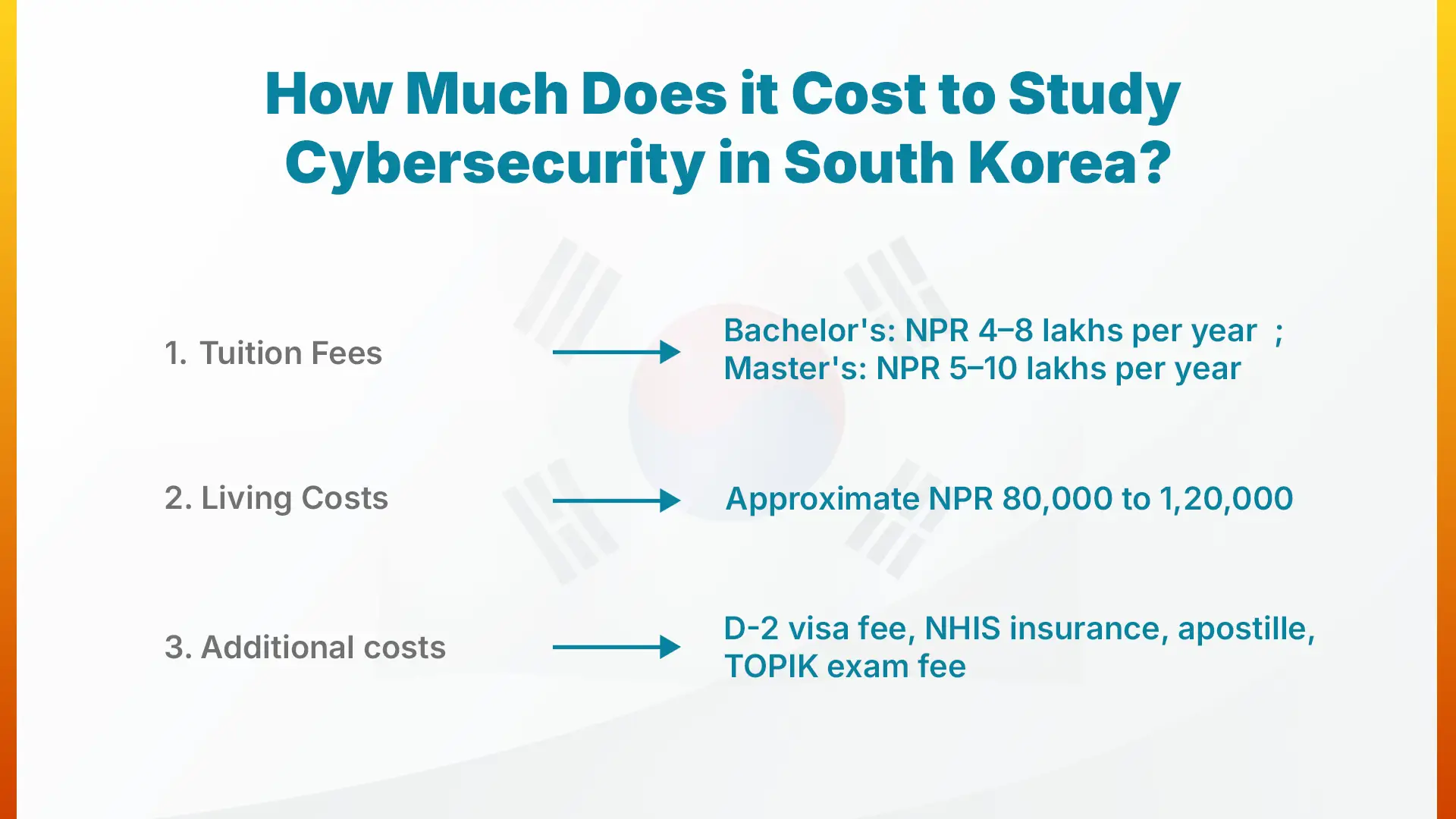
Studying cybersecurity in Korea is significantly more affordable than in Western destinations but understanding exactly where your money goes helps you plan realistically before you arrive. The total cost of studying in Korea breaks down into three categories: tuition, monthly living expenses, and one-time or annual additional costs
1. Tuition Fees
Tuition in Korea varies by university and level but remains far lower than comparable programs in the USA, UK, Australia, or Canada. Bachelor's programs typically cost between KRW 4,000,000 and KRW 8,000,000 per year (NPR 400,000–800,000), while master's programs range from KRW 5,000,000 to KRW 10,000,000 per year (NPR 500,000–1,000,000).
Level | Annual Tuition (KRW) | Approximate NPR | Notes |
|---|---|---|---|
| Bachelor's | KRW 4,000,000–8,000,000 | NPR 400,000–800,000 | Varies by university |
| Master's | KRW 5,000,000–10,000,000 | NPR 500,000–1,000,000 | KAIST on higher end |
Exchange rate used: 1 KRW ≈ NPR 0.10 (verify current rate before budgeting)
2. Monthly Living Costs
Your monthly living cost is generally in between the average of 80K and 120K Nepali Currency. Below are the differences in cost between different locations.
Expense | Seoul (KRW) | Seoul (NPR) | Daejeon (KRW) | Daejeon (NPR) |
|---|---|---|---|---|
| Accommodation (dormitory) | 300,000–500,000 | 30,000–50,000 | 200,000–350,000 | 20,000–35,000 |
| Food | 300,000–400,000 | 30,000–40,000 | 250,000–350,000 | 25,000–35,000 |
| Transport | 80,000–120,000 | 8,000–12,000 | 60,000–80,000 | 6,000–8,000 |
| Personal/misc | 150,000–200,000 | 15,000–20,000 | 100,000–150,000 | 10,000–15,000 |
| Monthly total | 830,000–1,220,000 | 83,000–122,000 | 610,000–930,000 | 61,000–93,000 |
3. One-Time and Annual Additional Costs
Beyond tuition and monthly living, there are several one-time and recurring costs that Nepali students frequently overlook during financial planning. The D-2 visa fee, apostille charges, health insurance, and exam fees are all costs you will encounter before or shortly after arriving in Korea. Factor these into your first-year budget so they do not catch you off guard
Expense | Cost |
|---|---|
| D-2 Visa fee | NPR 3,000–5,000 |
| NHIS Health Insurance (annual) | KRW 200,000–400,000 (NPR 20,000–40,000) |
| Apostille per document | NPR 500–1,500 |
| TOPIK exam (per sitting) | KRW 40,000 (NPR 4,000) |
| IELTS exam | NPR 25,000–28,000 |
| Textbooks and materials | KRW 300,000–500,000/year |
| Initial settlement (bedding, kitchenware, SIM) | KRW 300,000–500,000 one-time |
Total first-year cost estimate (self-funded, Seoul, master's): Approximately KRW 18,000,000–25,000,000, including tuition and living (NPR 1,800,000–2,500,000). This is still significantly lower than a single year at a Western university.
Cybersecurity Scholarships in Korea You Can Actually Get
Scholarships you can obtain for a cybersecurity course include the University Merit Scholarship, Global Korea Scholarship, and Korea International Cooperation Agency Scholarship. Below is the detailed breakdown of different types of scholarships.
1. University Merit Scholarships
KAIST: Research assistantship stipends (KRW 300,000–600,000/month) are standard for thesis-track master's students; some full tuition waivers exist for top applicants
Yonsei University: International Student Scholarship covers 30–100% of tuition based on academic merit; apply simultaneously with your admission application
Korea University: Academic excellence scholarships available for first-year international students with strong grades; automatic consideration in some departments
2. KOICA Scholarships
KOICA (Korea International Cooperation Agency) runs a separate master's scholarship program targeting students from developing countries, including Nepal. KOICA scholarships are particularly suited to cybersecurity students who can frame their studies around national development, for example, building Nepal's cybersecurity capacity, protecting critical infrastructure in developing economies, or strengthening government digital systems.
Application route: Through KOICA's World Friends Korea program and specific partner universities. Contact SAS Education Consultancy for current available institutions and deadlines.
3. Nepal-Side Funding
Nepal Rastra Bank Education Loan: Available from commercial banks under NRB guidelines for students enrolled at recognized foreign institutions; typically covers KRW 5,000,000–10,000,000 (NPR 500,000–1,000,000) per year
Ministry of Education Bilateral Framework: Check annually; Nepal-Korea educational cooperation occasionally releases additional grant funding for specific fields, including technology
Jobs, Salaries & Life After Graduation
Graduating in South Korea offers a highly competitive but rewarding path. Entry-level starting salaries typically range from 30 to 50 million KRW (approx. $22,000 to $37,000 USD) annually, depending on the sector. Securing a corporate role requires strong Korean language proficiency (TOPIK 4-6), a dedicated networking approach, and navigating an intense hiring culture.
1. The Korean Cybersecurity Job Market in 2026
Korea is experiencing a genuine, government-documented shortage of cybersecurity professionals. The National Cybersecurity Master Plan has committed the Korean government to training tens of thousands of new security professionals over the coming decade, and international graduates from Korean universities are eligible to fill those roles.
Important context: Korean salaries are supplemented by significant benefits: health insurance, pension contributions, housing allowances at many large companies, and performance bonuses. The effective compensation package is meaningfully higher than the base salary figure.
2. Certifications That Directly Improve Hiring Outcomes
Holding these certifications alongside your Korean degree significantly improves both your employability and your starting salary:
ISMS-P (Information Security Management System – Personal Information): Korea's most recognized domestic certification; required or preferred for roles in Korean enterprises and government agencies. An exam conducted in Korean is achievable after 1–2 years of Korean language proficiency.
CEH (Certified Ethical Hacker): Recognized across Korean private sector; useful for penetration testing and SOC roles
CISSP: Required for senior roles and CISO-track positions; typically pursued 3–5 years into your career
CompTIA Security+: A solid entry-level credential that signals foundational competence to Korean employers unfamiliar with Nepali university systems
3. Part-Time Work Rights During Studies
On a D-2 student visa, you can work:
During semester: Up to 20 hours per week
During official vacation periods: Full-time (no hourly cap)
You must obtain a part-time work permit from the Korea Immigration Service; this is separate from your visa and must be applied for before you start working. Working without this permit is a visa violation with serious consequences. Common roles for international cybersecurity students include campus IT support, translation work, and tech company internships.
4. The D-10 to E-7 to F-5 Pathway Explained
This is the clearest route to long-term residence in Korea as a cybersecurity professional:
Step 1: D-10 Job-Seeking Visa (up to 1 year)
Apply immediately after graduation. Allows full-time job searching, paid internships, and interview participation without leaving Korea.
Step 2: E-7 Skilled Worker Visa
Once you receive a job offer from a Korean employer, they sponsor your E-7. Cybersecurity roles fall under KSCO (Korean Standard Classification of Occupations) codes that qualify for E-7. Your employer submits the application to the Ministry of Justice.
Step 3 F-2 Long-Term Resident Visa
After accumulating sufficient points under Korea's Points-Based Immigration System (education, Korean language ability, income, age, and time in Korea), you qualify for F-2 status, which has almost no work restrictions.
Step 4: F-5 Permanent Residency
After holding an F-2 or qualifying through other PBIS points thresholds, you become eligible for F-5 permanent residency, the right to live and work in Korea indefinitely.
This is a realistic 8–12 year pathway from first arriving as a student to achieving permanent residency, and cybersecurity professionals are well-positioned to complete it given the field's shortage occupation status.
Conclusion
If you have read this far, you already know the answer for most Nepali students is yes, but let us be direct about exactly who this path is right for and what it actually requires.
Korea is the right choice if you are a Nepali student who wants a globally recognized cybersecurity degree without the crushing debt of a Western education, who is serious enough about their career to prepare properly, and who is willing to consider building a long-term future in one of Asia's most advanced economies rather than treating the degree as a short-term credential to bring home.
It is not the right choice if you are looking for the easiest possible path abroad, if you are unwilling to invest time in Korean language preparation, or if your academic record is weak and you are hoping a consultancy can paper over that gap.