Study Bachelor’s in South Korea: 2026 Guide for Nepalese Students

May 13, 2026
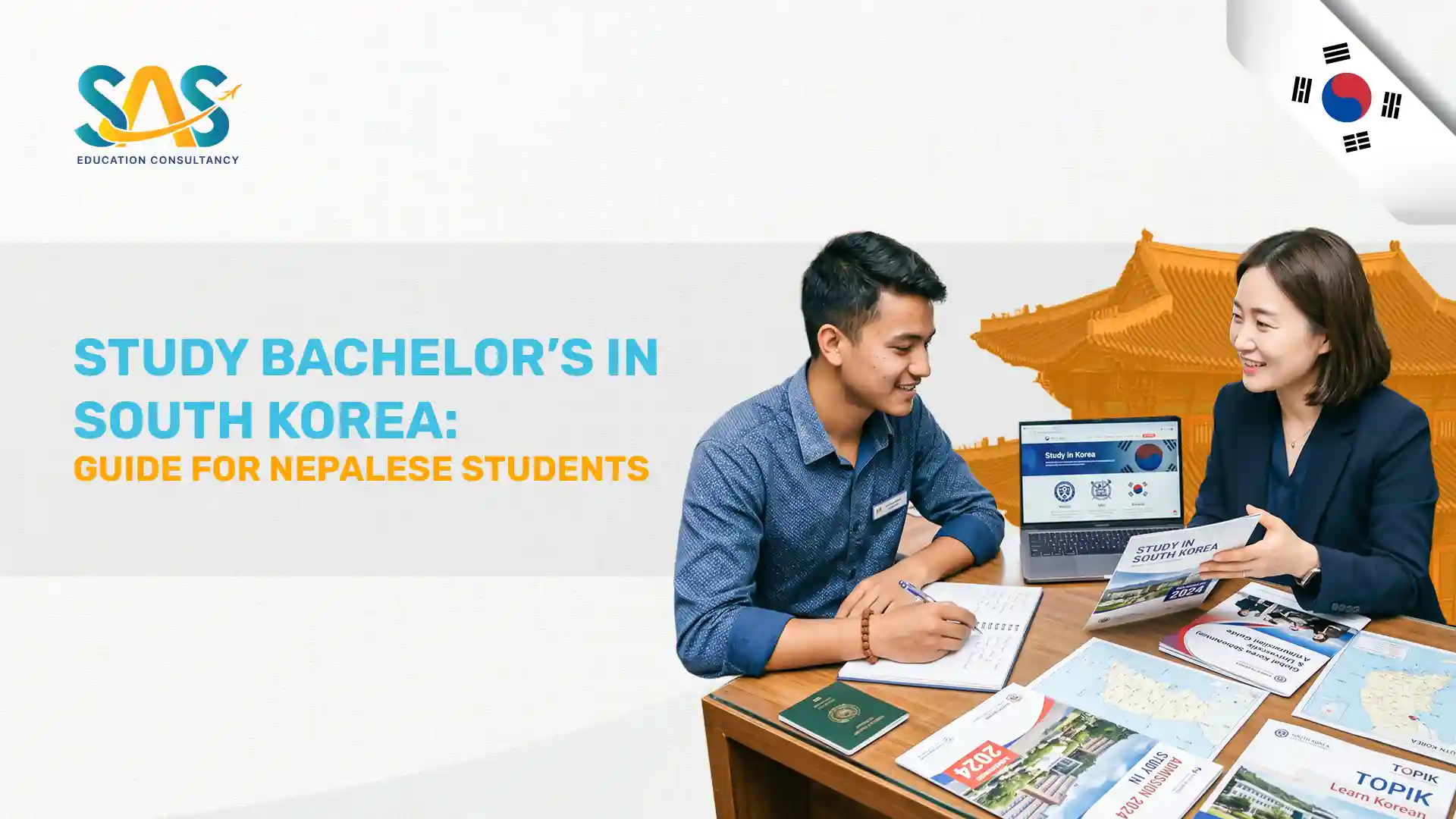
For many students in Nepal, South Korea has become a top destination for earning a world-class bachelor’s degree. With globally ranked universities, affordable tuition, generous scholarships, and strong career opportunities, Korea offers an excellent alternative to traditional Western destinations.
If you have completed your +2 and dream of studying engineering, business, computer science, media, or other in-demand fields, this guide will show you exactly how to make it happen. You will learn about admission requirements, scholarships, tuition fees, living costs, and the student visa process for South Korea.
By the end, you will have a clear roadmap to start your bachelor’s journey in South Korea.
In this blog
Why Study a Bachelor's Degree in South Korea?
South Korea is a mix of high-tech living and deep-rooted traditions. When you study here, you get access to some of the best labs and classrooms in the world. Many universities are now in the global top 100, meaning your degree will be respected everywhere.
The best part is that it is surprisingly affordable compared to the US or UK. You get a premium education without a massive price tag. Plus, the government is very welcoming to international students, offering many ways to stay and work after graduation.
- Top-ranked global universities.
- Cutting-edge technology and innovation.
- Very affordable tuition fees.
- Generous government-funded scholarships.
- Safe and modern living environment.
- Great part-time work opportunities.
- High post-study job prospects.
Quick Facts About Studying Bachelor in South Korea
Feature | Essential Details (2026/27 Intake) |
|---|---|
| Degree Duration | Standard 4 years for Undergraduate; 2 years for Master's. |
| Tuition Fees | USD 3,000 – 8,000 per year |
| Living Cost | USD 500 – 1,000 per month (Location dependent) |
| Scholarships | Extensive GKS and University-specific awards (30% to 100% coverage). |
| Intakes | Primary: March | Secondary: September |
| Part-Time Work | Up to 20–25 hours/week (D-2 Visa holders with TOPIK level). |
| Post-Study Work | Available via D-10 Job Seeker Visa (6 months, renewable). |
| Language | TOPIK (Korean) or IELTS/TOEFL (English-taught programs). |
Best Bachelor Degrees to Study in South Korea
Students usually choose popular fields like Engineering, Business, or Media Studies because Korea excels in these areas. Choosing the right major helps you land a great job after you graduate. Here is a list of the most valuable degrees you can pursue right now.
Here are some of the most valuable bachelor’s degrees to consider in South Korea.
1. Engineering and Technology
A bachelor’s degree in engineering typically includes subjects such as mathematics, physics, mechanics, electronics, and laboratory-based project work. Students can specialize in areas like mechanical, civil, electrical, chemical, or automotive engineering.
South Korea is one of the world’s leading manufacturing and industrial nations. Companies such as Samsung, Hyundai Motor Company, and LG have helped make the country a global technology powerhouse. As a result, Korean universities provide excellent facilities and close industry connections, making engineering one of the strongest choices for students who want a practical and highly respected degree.
2. Computer Science and Artificial Intelligence
Computer Science programs in South Korea focus on programming, software development, databases, cybersecurity, and algorithms. Artificial Intelligence specializations go further into machine learning, robotics, data science, and intelligent systems.
South Korea is among the most technologically advanced countries in the world and is investing heavily in AI and digital innovation. Studying in this environment allows students to learn in a country that is actively building the technologies of tomorrow. For Nepalese students who want careers in software, automation, or emerging technologies, this is one of the most future-oriented degrees available.
3. Business Administration
A bachelor’s degree in Business Administration covers accounting, marketing, finance, economics, management, and entrepreneurship. Students learn how organizations operate and how businesses expand in both local and international markets.
South Korea’s rapid economic growth makes it a fascinating place to study business. By living in one of Asia’s most dynamic economies, students gain insight into how global corporations are built and managed. A business degree in South Korea is especially valuable for those who hope to work in multinational companies or launch their own ventures in Nepal.
4. International Relations
International Relations explores diplomacy, political science, international law, global trade, and development issues. Students learn how countries interact and how global challenges are addressed through cooperation and policy.
South Korea occupies a strategically important position in Asia and maintains strong diplomatic and economic ties worldwide. Studying this subject in Korea provides a real-world perspective on international affairs, making it an excellent option for students interested in government, development organizations, or global institutions.
5. Media and Communication
This degree examines journalism, digital media, public relations, advertising, broadcasting, and content strategy. Students develop both creative and analytical skills needed to communicate effectively in the modern media landscape.
South Korea has become a global entertainment and cultural leader through K-dramas, K-pop, film, and digital marketing. Studying media in Seoul places students at the center of one of the world’s most influential creative industries. It is an ideal field for future journalists, marketers, and content creators.
6. Fashion and Design
Fashion and Design programs blend artistic creativity with technical skills in visual communication, branding, product development, and trend analysis.
Seoul is widely regarded as one of Asia’s most exciting fashion capitals. Students are surrounded by innovative design, modern aesthetics, and a vibrant creative culture. For those who dream of building a career in fashion, graphic design, or branding, South Korea offers a highly inspiring environment.
7. Biotechnology and Life Sciences
Biotechnology combines biology, chemistry, and technology to solve problems in medicine, agriculture, and environmental science. Students study genetics, microbiology, molecular biology, and laboratory research methods.
South Korea has invested heavily in healthcare and biomedical innovation, creating strong opportunities for students in scientific research and related industries. This degree is well suited to students who enjoy science and want to contribute to advances in medicine and technology.
8. Korean Language and Cultural Studies
This program goes beyond language learning to include Korean history, literature, society, and intercultural communication. Students gain deep knowledge of both the language and the cultural context in which it is used.
As Korean culture continues to gain global influence, professionals with Korean language skills are increasingly valuable in education, translation, tourism, and international business. For Nepalese students who want to become cultural and professional bridges between Nepal and South Korea, this can be a highly rewarding path.
Eligibility Requirements for Bachelor’s Education in South Korea
To apply for a Bachelor's, you generally need to have finished your +2 and have decent grades. Most universities look for a good mix of academic strength and language skills. Here is a breakdown of what you need for your application to South Korea:
1. Academic Requirements
You must have completed 12 years of formal education in Nepal. Most universities look for a GPA of at least 2.8 or higher to be safe. If you have higher grades, you have a better chance of getting a scholarship. Make sure your certificates are all officially recognized and ready for the process.
2. English Language Requirements
If you choose a program taught in English, you need an English test. Most schools accept IELTS with a score of 5.5 or 6.0. Some competitive universities might ask for a higher score like 6.5. This proves you can understand lectures and write your assignments clearly.
3. Korean Language Requirements
For programs taught in Korean, you need to pass the TOPIK exam. Usually, a TOPIK level 3 or 4 is the minimum for admission. If you don't know Korean yet, don't worry, because you can take a year of language school first in South Korea itself. Learning the language also makes your daily life in Korea much easier.
4. Financial Requirements
The Korean government wants to see that you can support yourself. You will need to show a bank balance of around USD 20,000 for a degree program. This covers your tuition and living costs for the first year. Having this money ready is a key part of getting your visa approved.
5. Documents Required for Admission
- Academic transcripts and certificates (attested).
- Valid Passport.
- Statement of Purpose (SOP) explaining your goals.
- Letters of Recommendation from your teachers.
- Language test scores (IELTS or TOPIK).
- Updated CV/Resume.
- Birth certificate to prove your identity.
- Bank statements showing enough funds.
- Recent passport-sized photographs.
English-Taught Bachelor Programs in South Korea
English-Taught Programs are special courses where all the lectures and exams are in English. They were created to help international students study without a language barrier. You still live in Korea, but your academic life runs in English. This is a very popular choice for many students from Nepal.
1. Popular English-Taught Majors
Most English programs are in fields like Business, International Studies, and Engineering. Many global colleges inside Korean universities offer these specific degrees. They often have international professors and students from all over the world. This gives you a very diverse and exciting learning experience.
2. Universities Offering English Programs
Top schools like Yonsei (Underwood International College) and Korea University have famous English tracks. SolBridge International School of Business is another great option for business lovers. Even science-focused schools like KAIST offer many courses in English. There are more options every year as Korea becomes more international.
The biggest benefit of English-taught programs in South Korea is that you can start your degree right away. You don't have to spend a full year learning Korean before you begin. It also makes you more employable in global companies that use English. Plus, you still learn basic Korean naturally while living there.
Korean Language Programs Before Bachelor Admission
Learning the Korean language before moving to the country gives you access to many more degree options. Most courses in Korea are still taught in the local language. If you speak Korean, you can also communicate better with locals. This makes finding part-time jobs in South Korea and making friends much easier for you.
Duration and Cost
Most language programs last for about six months to one full year. They are divided into 10-week terms called "quarters." You can expect to pay between USD 1,200 and USD 1,600 per term. It is an investment that pays off by opening more doors for your future.
Pathway to Degree Programs
After you reach TOPIK level 3, you can officially enter your bachelor's course. Many universities offer a "pathway" where you get a discount if you stay there. Completing the language program at your target school can boost your admission chances. It is a very smooth way to transition into university life.
What is the Tuition Fee to Study a Bachelor’s in South Korea?
Tuition fees usually range from USD 3,000 to USD 8,000 per year, depending on your major. Private universities in Seoul are usually more expensive than public ones in other cities. Here is a quick table to help you plan your budget.
Program Type | Annual Tuition (2026/27 USD) |
|---|---|
| Humanities & Social Sciences | $3,000 – $5,000 |
| Business & Economics | $4,000 – $6,000 |
| Engineering & Technology | $5,000 – $8,000 |
| Medicine & Pharmacy | $8,000 – $15,000+ |
| Arts, Design & Music | $5,000 – $8,000 |
When planning your education budget, remember that tuition fees are only one part of the overall expense. The total cost to study in South Korea also includes accommodation, food, transportation, health insurance, and personal expenses.
The good news is that many universities offer scholarships that can reduce your tuition significantly, and some awards may even cover the full cost of study. With careful financial planning, South Korea can be a surprisingly affordable destination for Nepalese students seeking a high-quality bachelor’s degree.
Scholarships in South Korea for Nepalese Students
You can apply for amazing scholarships like the GKS, University-led awards, and special department grants. These can cover everything from your flights to your monthly rent. Let’s look at the most popular scholarships in South Korea for students from Nepal.
1. Global Korea Scholarship (GKS)
The GKS is the "gold standard" of scholarships offered by the government. It covers your full tuition, provides a monthly allowance, and pays for airfare. You even get free medical insurance and a language training year. This is highly competitive but life-changing if you win it.
2. University Scholarships
Most universities offer their own discounts based on your entry grades. If you have a high GPA or high language scores, you can get 30% to 100% off. These are often automatically given when you apply for admission. It is a great way to lower your costs significantly.
3. Departmental Scholarships
Sometimes, specific departments have extra money for talented international students. This is common in Science and Engineering fields where research is important. You might need to maintain a certain GPA to keep this scholarship every semester. Always check your specific department’s website for these hidden gems.
Top Universities in South Korea for Bachelor Degree
You can find many amazing schools in Korea like Seoul National University, KAIST, and Yonsei University. These institutions are known for their high academic standards and beautiful campuses. Let’s look at where these top-rated universities are located across the country.
University Name | Location | Key Strengths (2026) |
|---|---|---|
| Seoul National University (SNU) | Seoul | National flagship; Law, Medicine, & Policy. |
| KAIST | Daejeon | Top STEM research; Robotics & AI powerhouse. |
| Yonsei University | Seoul | Internationalized environment; Business & UIC. |
| Korea University | Seoul | Strong alumni network; Law & Business. |
| Sungkyunkwan University (SKKU) | Seoul/Suwon | Samsung-backed; Semiconductor Engineering. |
| Hanyang University | Seoul/Ansan | "Engine of Korea"; Architecture & Industrial Eng. |
| POSTECH | Pohang | Specialized Science/Tech; Low student-to-faculty ratio. |
| Kyung Hee University | Seoul/Yongin | Hotel Management, Arts, & Oriental Medicine. |
How to Apply for a Bachelor's Course in South Korea?
Applying involves picking your schools, gathering documents, and submitting everything on time. It might look like a lot of steps, but it is quite simple if you follow a plan. Here is the step-by-step process you should follow.
Step 1 – Research Universities and Programs
Start by looking at which schools offer the major you actually want. Look at the location, the campus facilities, and the total tuition costs. Make a list of at least three schools that fit your budget. This helps you have a backup plan just in case.
Step 2 – Prepare Required Documents
Gather your mark sheets, character certificates, and get them notarized or apostilled. You will also need to write a strong Statement of Purpose (SOP for Korea). This letter is your chance to tell the university why they should pick you. Start this early so you don't have to rush later.
Step 3 – Take IELTS or TOPIK
Book your language test date at least three months before the application deadline. Give yourself enough time to study and get the score you need. If you don't get the score you wanted, you will still have time for a retake. Your scores must be valid and official when you submit them.
Step 4 – Submit Online Application
Most Korean universities use online portals for their international admissions process. Fill out every section carefully and upload your scanned documents in high quality. Pay the application fee, which is usually around USD 50 to USD 150. Always double-check your spelling and email address before clicking submit.
Step 5 – Receive Admission Letter
If the university likes your profile, they will send you a Letter of Admission. This is a very exciting moment for every student! This letter is needed for your visa and to show the bank. It means you are officially accepted into a Korean university.
Step 6 – Pay Tuition Deposit
To confirm your spot, you will need to pay the first semester's tuition. The university will give you a deadline and specific bank details for the transfer. Once they receive the money, they will send you the final "Certificate of Admission." You need the original copy of this document for your visa.
Step 7 – Apply for Student Visa
Take all your documents to the Korean Embassy in Kathmandu to apply for a D-2 visa. You will need your admission papers, bank statements, and academic certificates. The process can take a few weeks, so apply as soon as you can. Be ready for a simple interview if the embassy asks.
Step 8 – Book Flight and Prepare for Departure
Once your visa is in your hand, it is time to book your ticket to Korea! Start packing your clothes, including some warm layers for the cold Korean winters. Check with your university about dorm rooms or off-campus housing. You are now ready to start your amazing journey abroad!
What Admission Intakes Are Available in South Korea?
The main intakes in Korea happen in March (Spring) and September (Fall) each year. You should start preparing your documents at least six months before your chosen intake. Here is the timeline you need to keep in mind.
1. Spring Intake (March)
This is the main start of the academic year in South Korea. Applications usually open in September and close by November of the previous year. It is a great time to start because you join the new batch of local students. The weather is also beautiful as cherry blossoms start to bloom.
2. Fall Intake (September)
The September intake is very popular with international students from all over the world. Applications usually run from March to May for this start date. It gives you plenty of time to finish your exams in Nepal and prepare. Plus, you get to experience the stunning autumn colors when you arrive.
Intake | Application Period (2026/27 Window) |
|---|---|
| Spring (March Start) | September – November (of previous year) |
| Fall (September Start) | March – May (of the same year) |
Conclusion
South Korea is truly a land of opportunity for any hard-working student from Nepal. An education in South Korea offers you a global experience that will stay with you forever. From high-tech classrooms to amazing food and career growth, the benefits are endless.
I know it can feel a bit scary to think about moving to a new country. But remember, every successful professional was once exactly where you are right now. Unsure but hopeful.
You have the talent and the drive; all you need is the right guidance to open that door. Don't let your dreams wait for another year!
Are you ready to start your journey to South Korea? Contact a reputed South Korean consultancy today for a free counseling session, and let's make your dream happen together!