Study IT & Computer Science in South Korea (2026 Guide)

Nov 28, 2025
If you’re dreaming of studying IT or Computer Science abroad, South Korea is one of the most exciting destinations to consider. Known for its rapidly growing tech industry, advanced research, and innovative companies like Samsung, LG, Naver, and Kakao, the country offers a unique environment for students who want to combine quality education with real-world experience. South Korea’s universities are globally recognized and often collaborate with tech giants, giving students the chance to work on cutting-edge projects while studying.
For many Nepalese students, South Korea is both accessible and full of opportunities. Whether your goal is software development, artificial intelligence, cybersecurity, or data analytics, South Korean universities provide programs that help you specialize, gain hands-on experience, and prepare for a successful career in IT. This blog will guide you through the best IT courses in South Korea, top universities, scholarships, living costs, job prospects, post-study work options, and everything you need to plan your education in South Korea from Nepal.
In this blog
Why Choose South Korea for Computer Science & IT Studies?
South Korea has quickly become a global tech hub, offering a strong combination of education, industry connections, and innovation. Universities like KAIST, POSTECH, Seoul National University, and Yonsei are recognized for producing skilled IT professionals and researchers.
The country is home to major tech companies and startups, giving students access to internships, cooperative programs, and real-world projects. South Korea’s IT sector is growing rapidly, with high demand for software developers, data scientists, cybersecurity experts, and AI engineers. Their focus on innovation is one of the top reasons why students worldwide choose South Korea for higher education.
Studying here is also more affordable compared to the USA or Europe. The tuition fees and living costs in South Korea are significantly lower. Scholarships and government support are available for international students. Moreover, Nepalese students also benefit from the cheaper currency rate. Add to that a rich cultural experience, a safe environment, and opportunities to learn both English and Korean, and you get a destination that supports both personal growth and professional success.
What Are the Best Computer Science & IT Courses in South Korea?
The best Computer Science and IT courses in South Korea include Computer Science, AI & Machine Learning, Data Science, Cybersecurity, Cloud Computing, Game Development, UX/UI Design, and Information Systems. These courses teach practical skills that are in high demand and prepare students for careers in technology and innovation. Studying these in-demand programs in South Korea gives international students opportunities to work with top companies, gain internships, and build a global career.
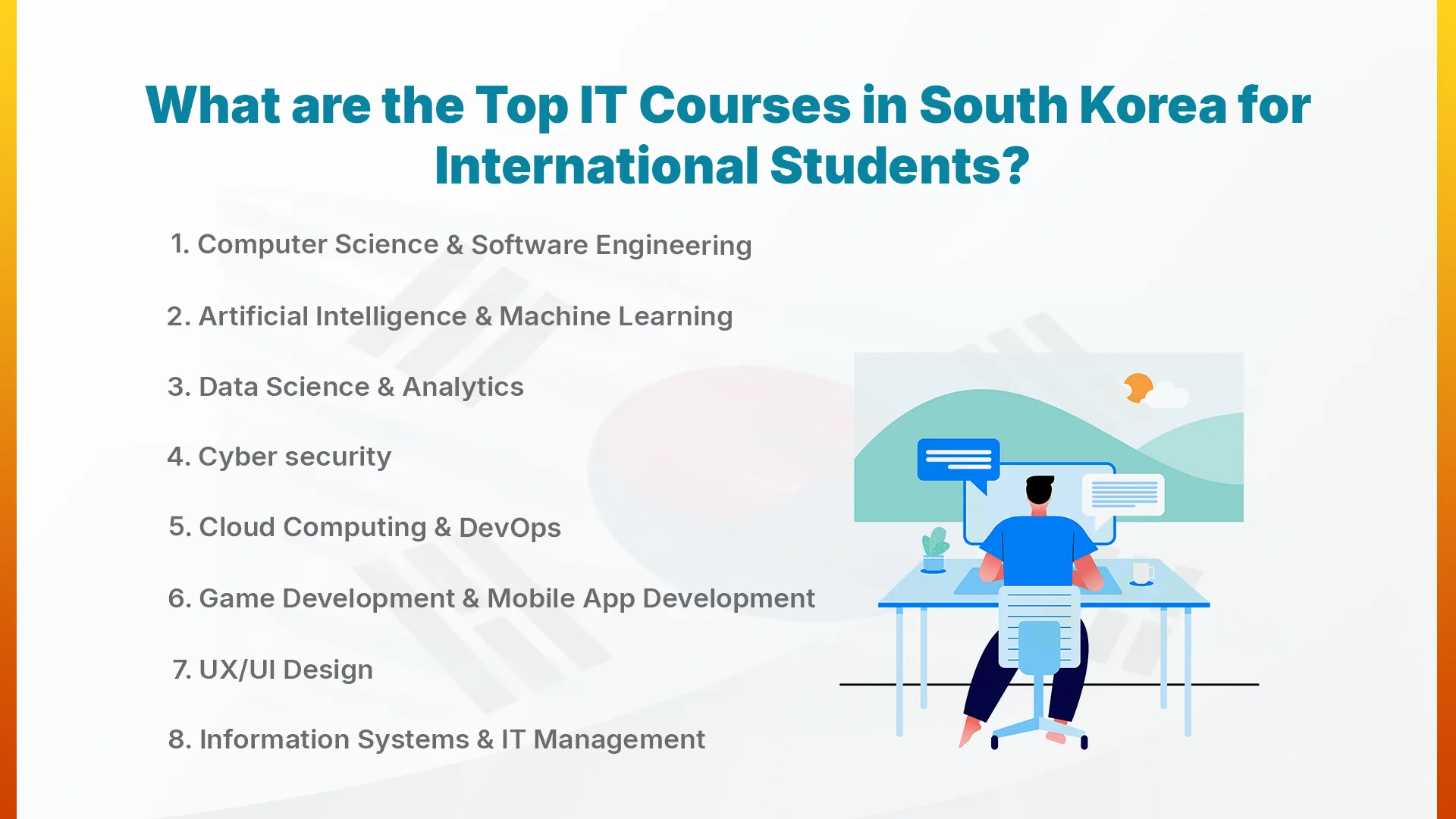
1. Computer Science & Software Engineering
This is the foundation of all IT careers, covering programming, algorithms, and software development. Students learn to design, develop, and maintain applications and systems used in businesses, tech companies, and startups. Graduates often work as software developers, system architects, or tech leads. South Korea’s growing tech industry ensures strong demand and opportunities to contribute to real-world projects. You will also learn problem-solving skills, teamwork, and project management, which are valuable in any tech career. With the rapid growth of software companies, there are many paths to leadership and innovation.
2. Artificial Intelligence & Machine Learning
AI and ML courses teach students to create intelligent systems that can learn and make decisions. You’ll work with algorithms, neural networks, and data models to build solutions for robotics, finance, and healthcare. Graduates are in high demand in South Korea and globally, with roles offering competitive salaries and the chance to work on cutting-edge technology. You will gain skills to analyze patterns in big data and develop systems that improve efficiency. Companies are increasingly investing in AI, so career opportunities are expanding rapidly.
3. Data Science & Analytics
Data science programs train students to collect, analyze, and interpret large amounts of information. Graduates can work as data analysts or data scientists, helping companies make informed business decisions. With South Korea’s tech companies focusing heavily on data-driven strategies, demand for skilled professionals is growing fast. You will also learn to use tools and programming languages like Python, R, and SQL. These skills help businesses understand trends, improve products, and make smarter decisions. Strong data skills can open doors to multinational companies and research projects.
4. Cybersecurity
Cybersecurity courses prepare students to protect networks, systems, and sensitive data from cyber threats. You’ll learn to monitor systems, respond to attacks, and implement security protocols. South Korea’s businesses and tech companies need experts to safeguard digital assets, making this a stable and rewarding career choice. You will gain skills in ethical hacking, risk assessment, and threat detection. Professionals in this field often work on high-impact projects that protect users and companies globally. The demand for cybersecurity experts continues to grow as digitalization increases.
5. Cloud Computing & DevOps
These courses focus on managing cloud infrastructure, deploying applications, and ensuring smooth IT operations. Students gain skills in AWS, Azure, and Google Cloud, along with automation and DevOps practices. Graduates are highly valued as companies increasingly rely on cloud services for scalable and secure solutions. You will also learn to monitor system performance, optimize resources, and manage large-scale IT environments. Cloud experts help companies save costs and improve efficiency. Career paths include cloud engineer, DevOps engineer, or cloud architect roles.
6. Game Development & Mobile App Development
South Korea is a global leader in gaming and mobile technology. Students learn to create games, apps, and interactive media for platforms like mobile, PC, and VR. Graduates can work in gaming studios, tech startups, or mobile-focused companies, with strong demand for creative and technical talent. You will also learn design principles, programming for interactive systems, and how to improve user engagement. Many companies in South Korea are developing AI-based and immersive games, creating exciting opportunities. These skills can also lead to freelance or entrepreneurial work in gaming and apps.
7. UX/UI Design
UX/UI programs teach students to design user-friendly digital interfaces and enhance user experiences. Graduates can work on web, mobile, and software platforms, ensuring products are intuitive and engaging. With the rise of digital services and apps in South Korea, skilled UX/UI designers are increasingly sought after. You will also learn to conduct user research, prototype designs, and improve usability. Strong UX/UI design skills make products more effective and enjoyable for users. Companies value designers who can bridge technology and human-centered design.
8. Information Systems & IT Management
These programs combine IT knowledge with business management skills. Students learn to oversee IT projects, manage systems, and align technology with business goals. Graduates often take roles as IT managers, system analysts, or project coordinators, bridging technical expertise with organizational strategy. You will also learn to plan IT budgets, implement policies, and coordinate teams. These skills help companies run IT operations efficiently and make strategic decisions. Career opportunities include IT consulting, enterprise management, and leadership roles in tech firms.
Top Universities in South Korea for IT & Computer Science
SNU, KAIST, POSTECH, Korea University, and Yonsei University are top South Korean universities known for their strong programs in IT and Computer Science. These schools offer advanced research, industry partnerships, and excellent career opportunities for graduates. Many of them collaborate closely with top companies like Samsung, LG, Naver, and Kakao, giving students real exposure to the tech industry. Here’s a quick look at some of the best options for international students.
University Name | Location | Top IT Courses |
| Seoul National University (SNU) | Seoul | AI, Robotics, Software Engineering |
| KAIST | Daejeon | AI, Machine Learning, Robotics |
| POSTECH | Pohang | Cybersecurity, Data Science |
| Korea University | Seoul | Software Engineering, Data Analytics |
| Yonsei University | Seoul | Human-Computer Interaction, Media Tech |
| Sungkyunkwan University (SKKU) | Seoul/Suwon | Semiconductors, Mobile Computing |
| Hanyang University | Seoul | Networks, Mobile Tech, Cybersecurity |
| Sejong University | Seoul | AI, Cybersecurity, IoT |
Tuition Fees for IT Courses in South Korea
Tuition fees for IT and Computer Science programs in South Korea usually range from KRW 4,000,000 to 12,000,000 per year, depending on the university and program level. Public universities are generally more affordable, while private institutions charge higher fees but often provide more specialized facilities and programs.
Program Level | Public Universities (Annual Fee) | Private Universities (Annual Fee) |
| Bachelor’s | KRW 4,000,000 – 8,000,000 | KRW 6,000,000 – 12,000,000 |
| Master’s | USD 3,000 – 6,000 / year | USD 7,000 – 15,000 / year |
IT & Computer Science Job Opportunities in South Korea
South Korea offers strong job opportunities for IT and Computer Science graduates in fields like software development, data science, AI, cybersecurity, cloud computing, and UX/UI design. Starting salaries for entry-level roles typically range from KRW 35,000,000 to KRW 65,000,000 per year, depending on the job and company. Graduates can find jobs through company career pages, LinkedIn, JobKorea, Saramin, and Dev-Korea.
1. Software Developer / Full-Stack Developer
Software developers build apps, websites, and systems for companies across tech, finance, e-commerce, and entertainment. In South Korea, a full-stack or software developer can expect a starting salary around KRW 35,000,000–50,000,000 per year for entry-level roles. With experience and skill growth, you can move into better-paying roles in big tech firms or startups.
2. Data Analyst / Data Scientist
Data analysts and data scientists help companies make sense of large amounts of information, guiding decisions and strategy. Entry-level data scientists often start at around KRW 50,000,000 per year and can increase as they gain experience. Because many South Korean firms across technology, healthcare, gaming, and finance rely on data heavily, the demand for these roles is strong and growing.
3. Cybersecurity Specialist
Cybersecurity professionals protect systems from hacking and digital threats. As companies expand their online operations, demand for cybersecurity experts is rising fast. Entry-level roles often offer salaries similar to software developers. Many employers start offers around KRW 40,000,000–55,000,000 per year, depending on skills and employer.
4. Cloud Engineer
Cloud engineers design and manage cloud infrastructure, helping organisations store data, run applications, and scale operations. A starting Cloud Engineer in South Korea typically earns in a range similar to developers, which is roughly KRW 50,000,000–60,000,000 per year for junior roles. The pay, however, depends heavily on the company and experience. As corporations and startups increasingly shift to cloud platforms, demand continues to rise, making this a promising path.
5. UI/UX Designer
UI/UX designers build user-friendly interfaces and shape how people interact with apps, games, and websites. Entry-level UI/UX roles often start around KRW 35,000,000–45,000,000 per year, depending on the company and your skills. South Korea’s booming sectors, such as gaming, e-commerce, and mobile apps, create a steady need for designers who understand both tech and human-centred design.
Admission Requirements for Computer Science & IT Courses in South Korea
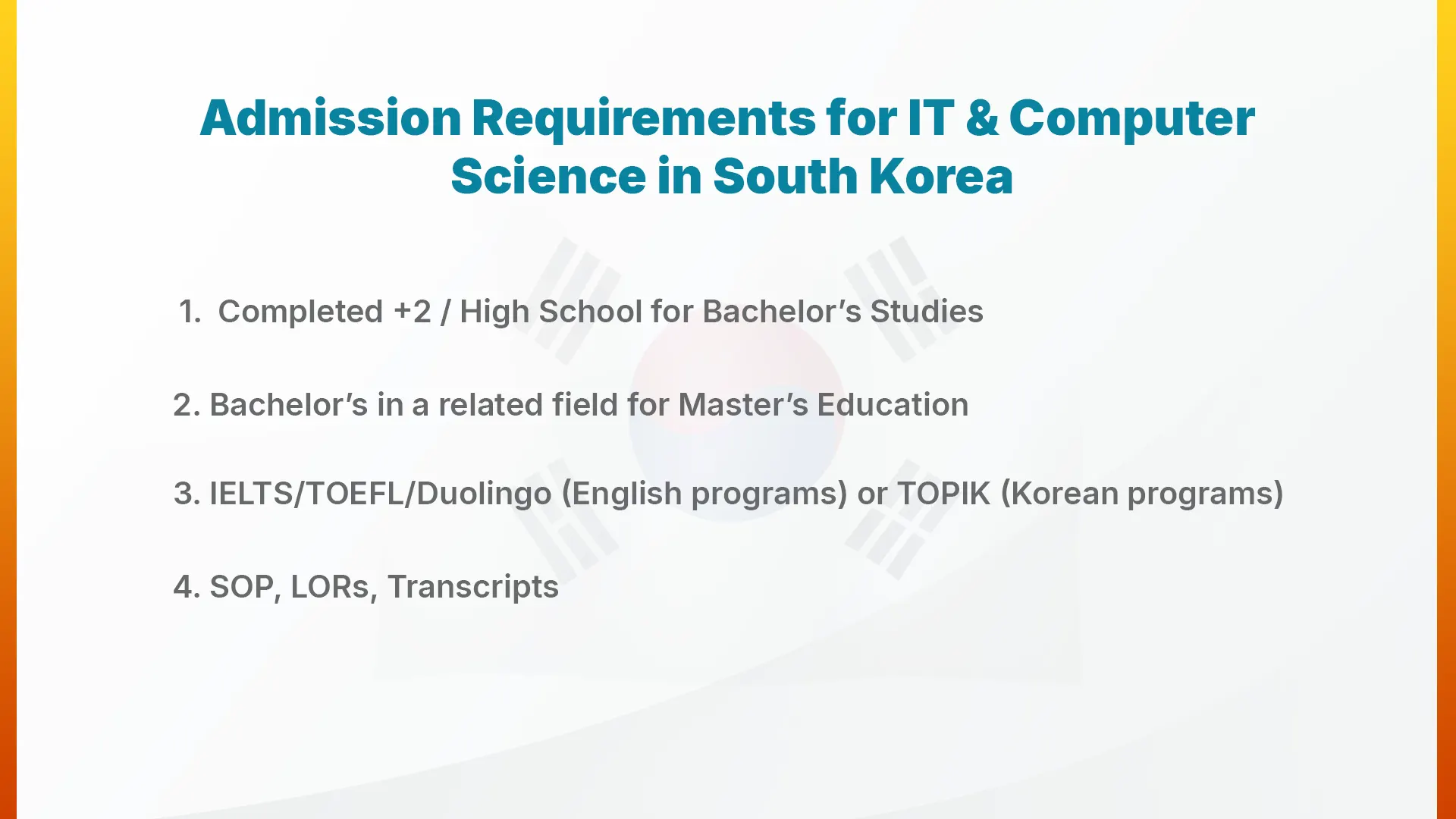
To study Computer Science or IT in South Korea, you need to have completed your previous education level: +2 for Bachelor’s and a relevant undergraduate degree for Master’s programs. You must also prove English or Korean language proficiency through tests like IELTS, TOEFL, or TOPIK. Requirements for studying in Korea vary slightly between universities, but most expect a strong academic background and proof of language proficiency.
1. Bachelor’s Programs
To apply for a Bachelor’s degree, you need to have completed your +2 or high school diploma with passing grades. Since programs are offered in English or Korean, you must provide English proficiency scores (IELTS, TOEFL, or other recognized tests) for English-taught programs, or Korean proficiency (TOPIK) if the program is taught in Korean.
Additionally, universities usually ask for a Statement of Purpose (SOP), Letters of Recommendation (LORs), and official transcripts to understand your academic background, motivation, and readiness for undergraduate study.
2, Master’s Programs
For Master’s programs, you must have a Bachelor’s degree in IT, Computer Science, or a related field. Language requirements depend on the program: English-taught programs require IELTS/TOEFL/Duolingo, while Korean-taught programs often require TOPIK certification.
You will also need to submit a Statement of Purpose (SOP), Curriculum Vitae (CV), Letters of Recommendation (LORs), and transcripts. Some universities may ask for GRE scores, but this is rare and mostly optional. These requirements ensure that you are academically and linguistically prepared for advanced study in South Korea
Post-Study Work Opportunities in South Korea
After completing an IT or Computer Science degree in South Korea, international graduates can apply for work visas to gain professional experience. The D-10 Job-Seeking Visa allows students to stay for 6 months to 1 year to find a job related to their field. Once employed, graduates can switch to an E-7 Work Visa, which allows long-term employment in IT, software, data, AI, cybersecurity, cloud computing, and other tech roles.
These programs give students valuable hands-on experience, help them build professional networks, and improve career prospects in South Korea’s fast-growing tech industry. Large companies like Samsung, LG, Naver, and Kakao often hire international graduates, especially those with internships, project experience, or strong academic performance. By planning carefully, you can use these opportunities to launch a successful career in IT while gaining exposure to one of Asia’s most advanced tech markets.
Scholarships for IT Students in South Korea
Scholarships for IT students in South Korea include university-specific awards from KAIST, POSTECH, SNU, and Korea University. Other options are the KOICA Scholarship and grants like BK21 at Korea University, mainly for graduate programs in AI, IT, and computer engineering. These scholarships in South Korea cover tuition, living expenses, and sometimes travel costs, making IT and Computer Science programs more affordable.
1. Korea University Scholarship
Korea University offers scholarships for outstanding international students in IT and Computer Science. These can cover partial or full tuition, and sometimes include additional support for research or project work. The scholarship also provides mentorship and networking opportunities within the university.
2. Yonsei University International Scholarship
Yonsei provides merit-based scholarships for top-performing international students. It can cover up to 100% of tuition fees and encourages students to engage in research, innovation, and practical projects. Recipients also gain access to exclusive workshops and academic events.
3. KAIST International Student Scholarship
KAIST offers scholarships for international students with strong academic records. Benefits include full tuition, a living stipend, and access to research programs in AI, robotics, data science, and software engineering. The scholarship also supports participation in conferences and tech competitions.
4. POSTECH Global Fellowship
POSTECH provides full or partial scholarships for international IT students. The program supports tuition, living costs, and research opportunities, giving students hands-on experience in advanced tech labs. Scholars also get mentoring from top faculty and industry experts.
5. University-Specific Grants & Tech Department Scholarships
Many universities offer additional grants or departmental scholarships for IT students based on academic excellence, project work, or financial need. These may include research assistantships, mentorship programs, or funding for innovation projects. These awards also help students build strong professional networks for future careers.
How to Apply for IT & CS Programs in South Korea? (Step-by-Step)
To apply for IT programs in South Korea, begin by researching universities and your preferred specialisation. Prepare your documents, submit applications, and obtain a student visa. Most universities have clear online portals for international students, making the process straightforward. Here’s a simple guide to help Nepalese students navigate the process:
1. Research Programs & Universities
Start by exploring universities and programs that match your interests. Look at course content, faculty expertise, research opportunities, internship options, and tuition fees. Consider whether the program is taught in English or Korean and check the university’s international student support services.
2. Check Eligibility
Review the admission requirements for your chosen programs. For Bachelor’s, you need +2 completion; for Master’s, a relevant undergraduate degree. Also, check language requirements (IELTS, TOEFL, or TOPIK) and any standardized tests if required.
3. Prepare Documents
Gather all necessary documents, including transcripts, certificates, Letters of Recommendation (LORs), Statement of Purpose (SOP), CV (for Master’s), and language test scores. Well-organized documents make your application stronger and easier for universities to evaluate.
4. Apply Online
Most universities have online application portals. Fill in your details carefully, upload documents, and pay any application fees. Double-check everything before submitting to avoid mistakes.
5. Wait for Admission Decision
Universities review applications and send offer letters or admission results. If accepted, you’ll receive an official document confirming your eligibility to enroll.
6. Accept Admission & Pay Deposit
To secure your spot, you may need to pay a tuition deposit. Confirm your acceptance through the university portal and complete any additional requirements like course registration or orientation.
7. Apply for a Student Visa
Once you have your admission letter (often called the Certificate of Admission), apply for a D-2 Student Visa. Submit required documents, pay the visa fee, and schedule your interview at the South Korean embassy or consulate.
Following these steps carefully will make your application process smoother and increase your chances of studying IT or Computer Science in South Korea successfully.
Conclusion
Studying IT or Computer Science in South Korea opens doors to world-class education, cutting-edge technology, and strong career opportunities. With top universities, you gain both academic excellence and practical experience in one of Asia’s most innovative tech markets. Post-study work options and scholarships make it possible to build your career while managing costs. And, living in Korea gives you exposure to a dynamic culture, advanced technology, and a vibrant professional network.
For Nepalese students with ambition and determination, South Korea offers a path to grow both personally and professionally. With careful planning, preparation, and persistence, your dream of studying IT or Computer Science abroad can become a reality. Start researching programs, prepare your documents, talk with a study abroad counsellor in Nepal, and take the first step toward a future in tech today!