Study Business in South Korea from Nepal - 2026 Guide

Dec 04, 2025
South Korea is home to one of Asia’s fastest-growing economies. Big companies like Samsung, Hyundai, and LG create high demand for skilled business professionals. This strong business environment is reflected on campus, where lecture halls have the latest digital tools and students from around the world share ideas over street food.
If you’ve been dreaming of studying abroad, this is the moment to aim higher. Many students from Nepal wonder the same things you may be thinking: Which business course should I choose? How much will it cost? What are the job prospects? Am I eligible?
This guide answers all those questions. Step by step, you’ll learn about the best business courses in South Korea, what they offer, how much they cost, and where they can take your career. It’s your starting point for a future built with confidence, clarity, and a world-class education.
In this blog
What Is a Business Course in South Korea?
A business course in South Korea is an academic program that deals with how companies operate, how decisions are made, and how products, people, and finances are managed. These programs are practical, career-focused, and built to help international students gain the skills needed in modern workplaces. The most popular options include BBA, MBA, Business Analytics, and Master of Management, each preparing you for different roles in the business world.
Business Course Duration in South Korea
Business programs are taught at different levels, and each level has its own study period, focus, and intake in South Korea. This helps you choose a course that matches your goals, whether you want basic knowledge, a full degree, or advanced skills for leadership roles.
Study Level | Duration | Types of Courses & What You Learn |
| Bachelor’s Level | 4 years | BBA, Bachelor of Management, Bachelor of Business Studies |
| Master’s Level | 1.5–2 years | MBA, Master of Business Analytics, Master of Management, Master of Finance/Marketing |
| Diploma Level | 1–2 years | Business Diploma, Management Certificate Programs |
| Intakes | March & September | Two major admission periods for undergraduate and graduate studies |
Across all levels, you’ll study subjects such as finance, marketing, human resources, analytics, entrepreneurship, accounting, and economics. These subjects help you build practical skills in planning, teamwork, communication, and decision-making.
Is South Korea Good for Studying Business?
Absolutely! South Korea is an excellent choice for studying business because it combines a strong global economy with high-quality, career-focused education. Universities offer programs like BBA, MBA, and Business Analytics that include practical projects, internships, and industry collaborations, giving students real-world experience. Additionally, the country provides affordable tuition, scholarships, and opportunities for international exposure, making it ideal for ambitious students from Nepal. Here are the main reasons why studying in South Korea can be a smart choice for business students:
1. Strong Global Economy and Business Environment
South Korea is the 10th largest economy in the world, home to global brands like Samsung, Hyundai, and LG. Studying in South Korea gives you exposure to real-world business practices in a fast-growing market. Many universities collaborate with top companies for internships and projects.
2. High-Quality Education and Innovative Programs
Korean universities offer modern business courses that combine theory with practical skills. Programs like BBA, MBA, and Business Analytics are designed with international standards in mind. Students also get hands-on experience through case studies, simulations, and research projects.
3. International Exposure and Networking Opportunities
South Korea attracts students from all over the world, creating a diverse learning environment. You can build a global network of peers and professionals while learning about international business cultures. Many universities also have exchange programs with top universities worldwide.
4. Career and Internship Opportunities
The country encourages international students to work during or after their studies through internships and part-time programs. Business students often get opportunities in tech, finance, and consulting sectors. These experiences increase your chances of landing a good job in Korea or internationally.
5. Affordable Tuition and Scholarships
Compared to Western countries, tuition in South Korea is relatively affordable, especially with scholarships for international students. Many universities offer partial or full financial aid based on merit or need. This makes high-quality business education accessible for students from Nepal.
Overall, South Korea offers Nepali students a strong mix of quality education, practical experience, international exposure, and career opportunities, making it a top choice for studying business. If you want to plan your journey carefully and make the most of these opportunities, consider visiting the best consultancy in Nepal. They can guide you through admissions, test preparation, visa processes, and scholarships.
Eligibility Requirements to Study Business in South Korea
To study business in South Korea, international students need to meet academic, language, and financial requirements. For bachelor’s programs, you should have completed +2 or equivalent with good grades, while master’s programs require a recognized bachelor’s degree and sometimes relevant work experience. Most programs are in English, so IELTS 6–6.5 is needed. You’ll also need to provide proof of funds, visa documents, and sometimes health checks or recommendation letters, depending on the university. Here’s a simple breakdown of requirements for South Korean education:
1. Academic Requirements for Bachelor’s Programs
For Bachelor’s education in South Korea, students must have completed +2 or equivalent from a recognized board with good grades in subjects like mathematics, economics, or business studies. This makes you eligible for courses like BBA and Business management. Some universities may require minimum GPA criteria, usually around 2.5–3.0 on a 4.0 scale.
2. Eligibility for Master’s Programs
For a master’s in business studies, applicants need a recognized bachelor’s degree in business, management, or a related field. Students from other backgrounds, like BSc, may still qualify if they have relevant work experience or internships. Some top programs also require a statement of purpose and recommendation letters.
3. English/Korean Language Requirements
Most business programs are taught in English, so you need IELTS 6.0–6.5 or TOEFL 80–90. If you choose a Korean-taught program, universities may require TOPIK Level 3–4.
4. Financial Proof and Documentation
Students must show proof of funds to cover tuition and living expenses, usually via bank statements. Universities may also ask for financial guarantees or scholarship confirmations.
5. Additional Requirements for International Students
Some universities may request health check reports, passport copies, and visa documents. Certain programs also require interviews or entrance tests to assess aptitude and motivation.
If you need any help with preparing your finances, documents, or streamlining application deadlines, consider visiting one of the top 10 best education consultancies in Nepal. Talk to the professionals, take advice, and adopt relevant strategies. Your dream of studying in South Korea is more achievable than you think.
How Much Does It Cost to Study Business in South Korea?
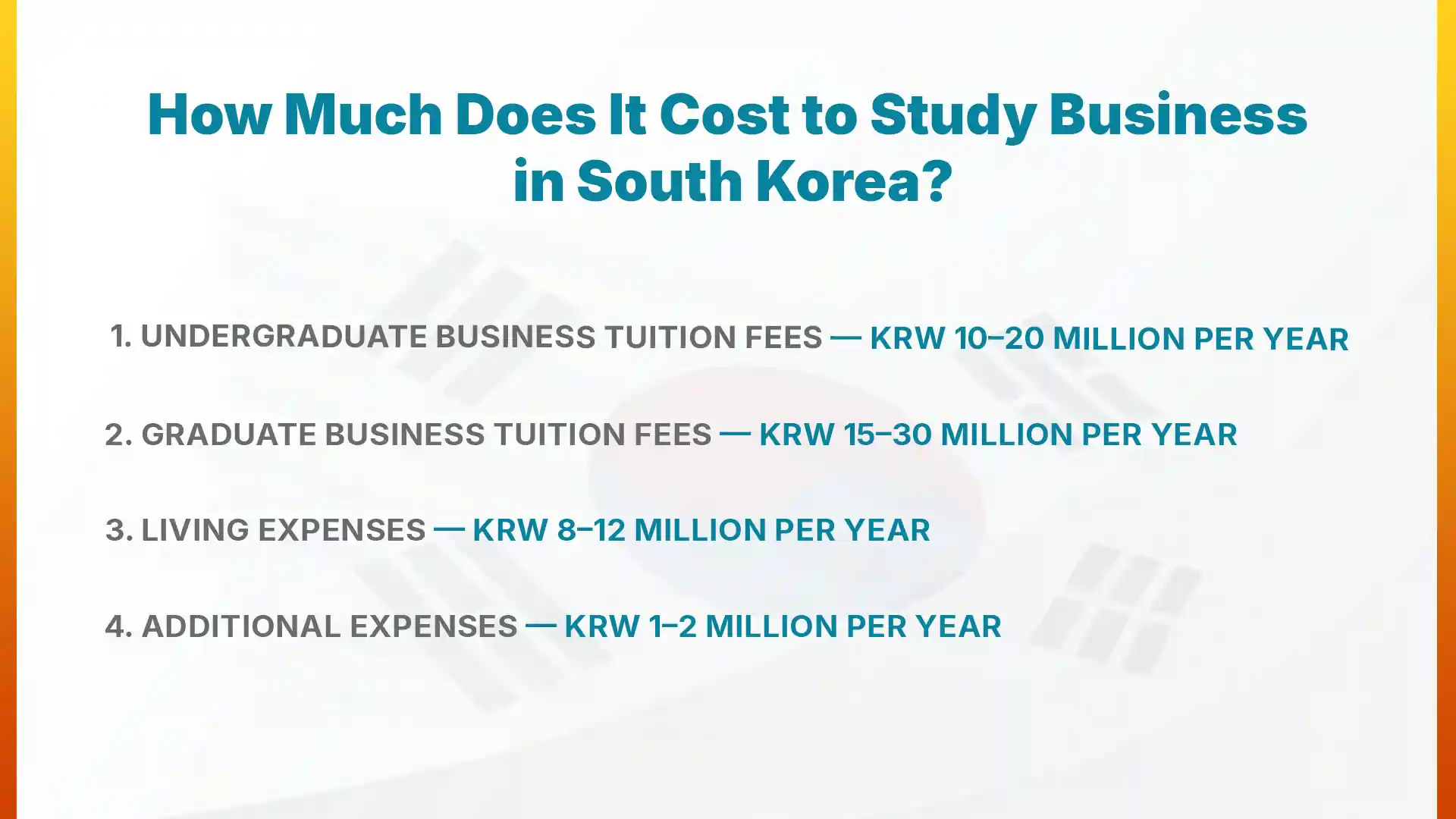
Studying business in South Korea typically costs between KRW 18–34 million per year for undergraduates, combining tuition and living expenses. For master’s programs, the total yearly cost can be around KRW 23–42 million, depending on the university and program. Additional expenses like books, insurance, and personal costs can add another 1–2 million KRW per year, but scholarships and part-time work opportunities can help reduce the overall cost. Here’s an overview of studying and living expenses in South Korea for international students:
1. Undergraduate Business Tuition
Undergraduate business programs in South Korea typically cost around KRW 10–20 million per year. The exact fee depends on the university and the program you choose. Public universities tend to be more affordable, while private institutions and specialized programs may charge higher tuition.
2. Graduate Business Tuition
Graduate-level business programs, such as MBA, Business Analytics, or Master of Management, usually cost KRW 15–30 million per year. Top-tier programs and private universities often have higher fees due to international exposure, advanced coursework, and added career support services.
3. Living Expenses
Living costs in South Korea range from KRW 8–12 million per year. This includes accommodation, food, local transport, and everyday expenses. Costs may vary depending on the city, lifestyle, and type of housing you choose.
4. Additional Expenses
Students should also budget KRW 1–2 million per year for additional costs. This covers books, insurance, student fees, and personal expenses. Planning for these extra costs ensures a smoother study experience without financial surprises.
Overall, the total cost varies depending on the program and lifestyle, but scholarships and part-time opportunities can help reduce the financial burden for international students.
What are Business Scholarships and Financial Aid Options in South Korea?
Many South Korean universities offer merit-based scholarships that can cover 50–100% of tuition fees for high-performing students. There are also need-based scholarships that cover tuition, living expenses, airfare, and health insurance.
Some universities provide department-specific scholarships for business students, especially for programs like BBA, MBA, or Business Analytics. Here are major scholarships in South Korea for Nepalese students:
1. University‑Specific Scholarships
Many top Korean universities offer their own scholarships to attract international talent. These may vary in coverage and often depend on merit or specific admission performance. Good grades and strong admission profiles greatly increase your chances.
Scholarship / University | Coverage |
| Seoul National University (SNU) International Scholarships | Tuition waiver ± stipend / support for international students |
| Yonsei University Scholarships (e.g. UIC / Graduate scholarships) | Partial to full tuition waiver, possible stipend depending on the program |
| Korea University Global / Merit Scholarships | Partial or full tuition coverage, possibly with other perks |
| POSTECH International Scholarships | Tuition waiver, living allowance, sometimes additional research support |
| KAIST International Student Scholarship | Full tuition waiver, monthly stipend, medical insurance |
2. Private / Foundation / Special Scholarships
Apart from government and university scholarships, there are several private and foundation-based scholarships available for international students. These programs are usually offered by educational foundations, cultural organizations, or specific university initiatives, and they can cover partial to full tuition, small stipends, or support for language courses. Some examples include International Student Awards that reward merit or financial need, and special grants for Korean-language learners or exchange students, which may cover tuition and living costs while helping you improve your Korean skills.
Although these scholarships are less predictable than government or university-funded programs, they can still significantly reduce your financial burden. They typically reward academic excellence, leadership, or financial need, and are a great option for students looking for additional funding opportunities while studying in South Korea.
Which University Is Best for Business Studies in South Korea?
The top universities for business studies in South Korea include Yonsei University, Seoul National University, Korea University, Sungkyunkwan University, and Hanyang University. Each of these institutions offers strong academics, global exposure, and industry connections that help students build successful business careers. Choosing the best one depends on your program preference, budget, and career goals, with public universities being more affordable and private universities offering broader international networks.
University | Undergraduate Tuition (per year) | Graduate Tuition (per year / full program) |
| Yonsei University | KRW 18–20 million | KRW 47–50 million |
| Seoul National University (SNU) | KRW 8–9 million | KRW 27–31 million |
| Sungkyunkwan University (SKKU) | KRW 9–11 million | KRW 27–31 million |
| Korea University (KU / KUBS) | KRW 9–12 million | KRW 27–31 million |
| Hanyang University | KRW 8–10 million | KRW 24–28 million |
| Sogang University | KRW 9–11 million | KRW 24–28 million |
| Pusan National University (PNU) | KRW 7–9 million | KRW 21–25 million |
| Chonnam National University | KRW 7–9 million | KRW 21–25 million |
| Korea University Business School (KUBS) | KRW 9–12 million | KRW 27–31 million |
Career Scope and Salary After Business Courses
Studying business in South Korea opens up a broad spectrum of career opportunities in a fast-growing, globalized economy. Graduates are in demand across multiple sectors, and their skills are highly valued for strategy, decision-making, and operational efficiency. Whether you aim for a corporate role, entrepreneurship, or international exposure, a business degree from a Korean university equips you for practical and leadership contributions.
Job Opportunities After Studying Business
Business graduates in South Korea have a wide range of career options across sectors such as corporate management, finance, marketing, consulting, entrepreneurship, and human resources. In management and corporate roles, they contribute by leading teams, improving operational efficiency, and implementing strategic decisions. In finance and investment banking, graduates analyze risks, manage capital, and plan profitable strategies, while marketing and sales roles focus on customer insights, brand growth, and revenue generation.
Consulting and business analytics positions allow graduates to support decision-making, identify opportunities, and solve operational challenges using data-driven insights. Entrepreneurship and start-up roles give graduates the chance to launch ventures or join early-stage companies, contributing innovative ideas and business strategies. Human resources professionals help organizations with workforce planning, talent development, and employee engagement, ensuring stronger team performance and organizational growth.
Overall, South Korea’s corporate sector, multinational companies, and start-up ecosystem actively seek skilled business graduates. High demand exists for professionals who combine analytical skills, leadership, and cross-cultural communication, making a business degree from a Korean university a valuable gateway to long-term career growth.
Salary of Business Graduates in South Korea
Business graduates in South Korea can expect entry-level salaries around KRW 25–35 million per year. With 3–5 years of experience, mid-level professionals typically earn KRW 40–70 million per year, depending on their role, company size, and sector. Graduates with expertise in finance, analytics, and strategic management often secure higher packages due to their specialized skills.
PR / Long-Term Work Options
After completing a business degree in South Korea, international students can apply for a work visa (E-7) if they secure a job related to their field of study. This visa allows graduates to work full-time and gain professional experience in Korean companies. Skilled graduates may later qualify for an F-2 long-term residence permit, which provides more stability and flexibility, and eventually, they can apply for permanent residency (PR) if they meet the criteria for continuous work, income, and integration into Korean society. This pathway makes studying business in Korea not just about earning a degree, but also about building a long-term career and living opportunity in the country.
Conclusion
For Nepali students, pursuing a business degree in South Korea is one of the most promising career options after class 12. Beyond academics, the country offers scholarships, internships, part-time work, and long-term visa pathways, making it a practical choice for both learning and professional growth.
With the right preparation, you can gain international exposure, develop critical business skills, and access high-demand job opportunities in sectors like finance, marketing, consulting, analytics, and entrepreneurship. Scholarships and financial aid programs further reduce the cost, while work visas and residence permits provide pathways to long-term career and settlement.
Guidance from experts can make this journey easier. A consultancy like SAS Education Consultancy can help you with test preparation, visa processing, scholarship applications, and career planning, ensuring you take the right steps toward a successful business career in South Korea.