Study Business Degrees in the UK: Fees, Top Universities & Scope

Jun 19, 2026

The UK is one of the strongest destinations in the world for business education, home to globally ranked business schools, centuries of academic tradition, and direct access to London, one of the world's leading financial and corporate hubs.
For Nepalese students, a business degree from the UK opens doors across finance, consulting, marketing, and entrepreneurship, both within the UK and internationally. This guide covers everything from bachelor's and master's programs to MBA pathways, costs, scholarships, and career outcomes. Students who are still exploring their options can read more about studying in the UK before deciding on a specific program.
In this blog
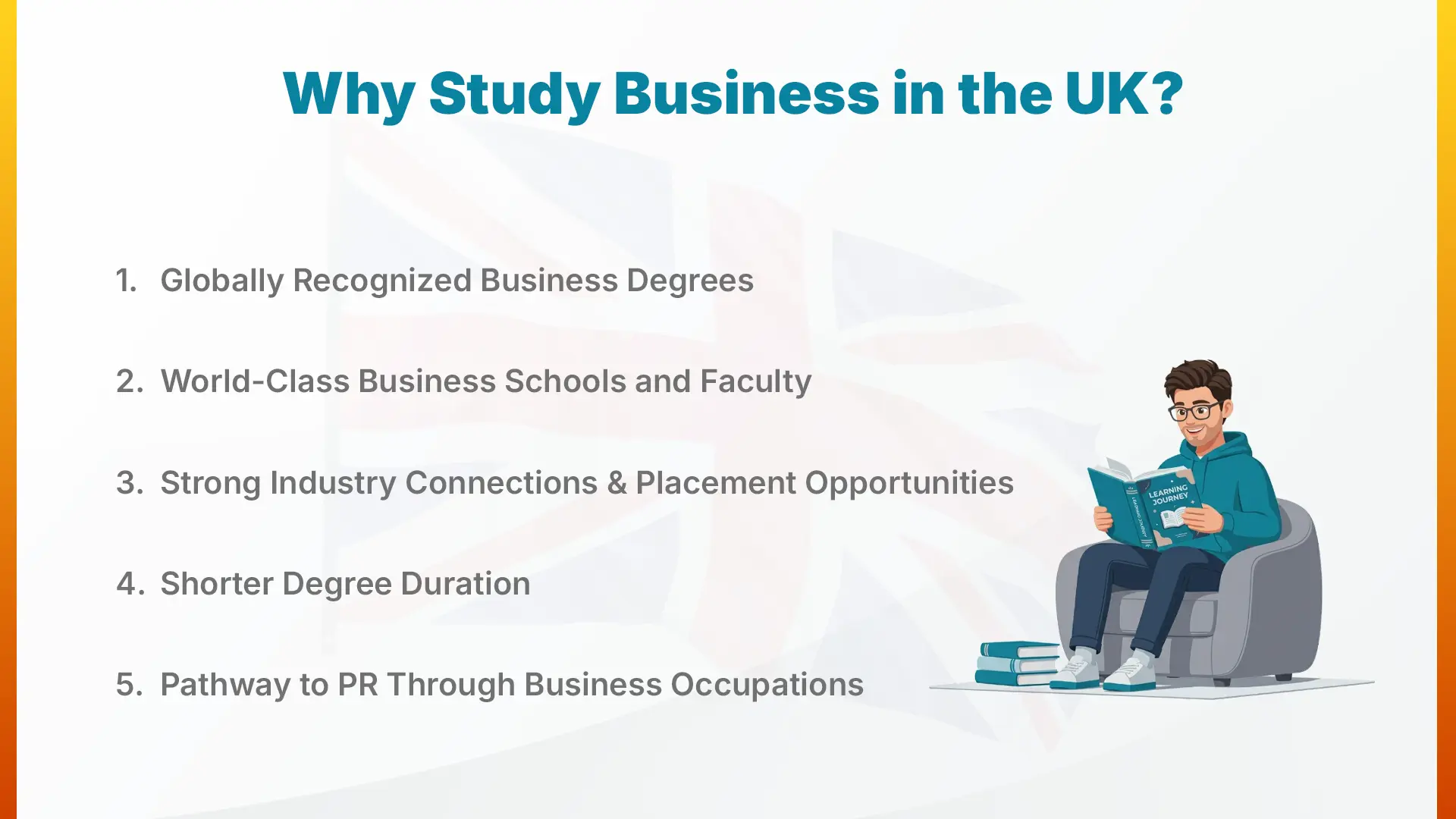
Why Study Business in the UK?
Study business in the UK because it offers globally recognized degrees, access to world-class business schools, strong industry placement opportunities, shorter degree durations than the USA or Canada, and a clear pathway to PR through skilled business occupations.
1. Globally Recognized Business Degrees
UK business degrees are respected by employers worldwide, carrying a reputation built on centuries of academic excellence and rigorous standards. Many programs hold triple accreditation from AACSB, EQUIS, and AMBA, a distinction held by less than 1% of business schools globally. This accreditation signals to employers that the curriculum, faculty, and student outcomes meet the highest international benchmarks. For Nepalese students, a triple-accredited UK degree significantly strengthens job applications both in the UK and back home in Nepal.
2. World-Class Business Schools and Faculty
The UK is home to some of the most respected business schools in the world, including London Business School, Oxford Saïd, and Cambridge Judge. These institutions are consistently ranked among the global top 20 and attract faculty who are not only leading academics but also experienced industry practitioners. Students benefit from case studies, research, and mentorship drawn directly from real-world business challenges. This combination of academic rigor and practical insight prepares graduates to think strategically from day one of their careers.
3. Strong Industry Connections and Placement Opportunities
Many UK business programs are designed with direct industry input, ensuring the curriculum stays relevant to current market demands. A large number of universities offer optional placement years, allowing students to gain a full year of paid work experience with major firms in finance, consulting, and marketing before graduating. These placements often lead to graduate job offers, giving students a significant head start in a competitive job market. For Nepalese students, this practical exposure is one of the strongest advantages of studying business in the UK.
4. Shorter Degree Duration
A UK bachelor's degree takes just 3 years to complete, compared to 4 years in the USA, Canada, and Australia. Postgraduate degrees such as an MSc or MBA typically take only 1 year, allowing students to enter the workforce or pursue further opportunities much sooner. This shorter timeline translates directly into lower overall tuition and living costs, making the UK one of the most time and cost-efficient destinations for business education. For Nepalese families managing education budgets carefully, this efficiency is a major financial advantage.
5. Pathway to PR Through Business Occupations
After graduating, international students can apply for the Graduate Route visa, which allows two years of full-time work in the UK without requiring employer sponsorship. Business graduates who secure a skilled job offer during this period can transition into the Skilled Worker visa, which is tied to a recognized employer and occupation. With continuous skilled employment, graduates become eligible to apply for indefinite leave to remain after five years, opening a genuine pathway to long-term settlement. This structured route makes the UK an attractive option for Nepalese students who see their business degree as the first step toward a long-term international career. This is why UK is the preferred destination for many international students.
What Business Programs Are Available in the UK?
The UK offers five business program pathways for international students: Bachelor of Business Administration, Bachelor of Commerce or BSc Business Management, Master of Business Administration, MSc in Management, Finance, or Marketing, and Graduate Diploma in Business, each suited to a different qualification level and career goal.
Bachelor of Business Administration (BBA): 3-year undergraduate degree covering management, finance, marketing, and operations fundamentals
Bachelor of Commerce / BSc Business Management: Similar to BBA with a stronger focus on economics, accounting, and quantitative analysis
Master of Business Administration (MBA): 1-year postgraduate degree designed for candidates with 2 to 5 years of work experience, focused on leadership and strategy
MSc in Management, Finance, or Marketing: 1-year specialized postgraduate degrees ideal for recent graduates without extensive work experience
Graduate Diploma in Business: A shorter, more affordable postgraduate pathway often used as a stepping stone to a master's or MBA
Which Are the Top Universities to Study Business in the UK?
The top universities to study business in the UK include the London School of Economics, University of Oxford, University of Cambridge, University of Manchester, University of Warwick, and Imperial College London, each offering globally ranked programs across undergraduate and postgraduate levels.
University | Location | Program | Known For |
|---|---|---|---|
| London School of Economics | London | BSc, MSc | Economics and Finance Prestige |
| University of Oxford (Saïd) | Oxford | MBA, MSc | Elite Global Network, Leadership |
| University of Cambridge (Judge) | Cambridge | MBA, MSc | Entrepreneurship, Innovation |
| University of Manchester | Manchester | BSc, MBA | Industry Connections, Affordability |
| University of Warwick | Warwick | BSc, MSc | Finance and Analytics |
| Imperial College London | London | MSc, MBA | Tech-Driven Business, FinTech |
LSE and Oxford lead for global prestige, while Manchester and Warwick offer strong value for Nepalese students seeking excellent ROI with lower costs. All of them fall under the best universities in the UK for international students.
What Are the Admission Requirements?
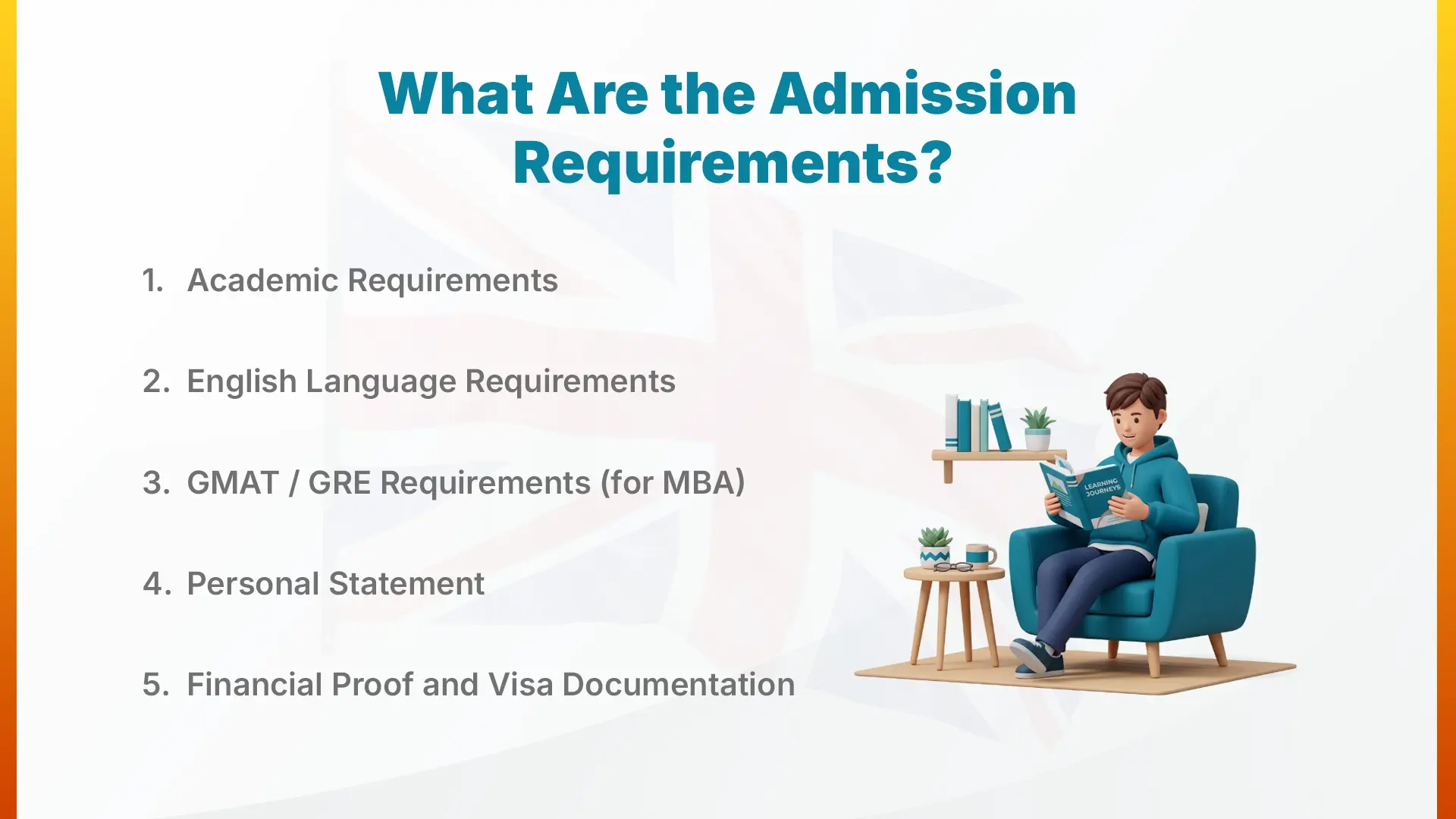
Admission requirements for business programs in the UK include strong academic results, English language proficiency, and, for MBA applicants, GMAT scores and significant work experience.
1. Academic Requirements
Bachelor's programs typically require Plus Two with 65% to 80% overall, with stronger emphasis placed on mathematics and English results. Master's programs require a relevant bachelor's degree with a minimum of 60% overall, though competitive universities like LSE and Oxford may expect higher. Some universities also consider the reputation of your previous institution and the relevance of your undergraduate major. Students applying with a non-business background may still be eligible for MSc programs, provided they demonstrate strong quantitative or analytical skills.
2. English Language Requirements
Bachelor's applicants typically need an IELTS score of 6.0 to 6.5 overall, with no individual band below 5.5. Master's and MBA programs require a higher threshold of 6.5 to 7.0 overall, reflecting the more advanced academic writing and communication expected at the postgraduate level. Some universities also accept PTE Academic or TOEFL as alternatives to IELTS. Students who do not meet the required score can often enroll in a pre-sessional English course before their main program begins.
3. GMAT / GRE Requirements
Most MBA programs require a GMAT score of 600 to 700 or higher, particularly at top-ranked business schools where competition for places is intense. Some MSc programs, especially in finance and analytics, also request a GMAT or GRE score from competitive applicants to strengthen their profile. A strong score can help offset a lower undergraduate GPA, making test preparation a worthwhile investment. Not all universities require GMAT for MSc programs, so students should check individual program requirements carefully.
4. Personal Statement
The personal statement should be a clear, well-structured document explaining your academic background, career goals, and motivation for studying business in the UK specifically. Admissions committees look for genuine reflection rather than generic statements, so students should connect their past experiences directly to their chosen program. It is also an opportunity to explain any gaps, career changes, or unique experiences that strengthen the overall application. A strong personal statement can meaningfully improve admission chances, especially for borderline academic profiles.
5. Financial Proof and Visa Documentation
Students must provide financial proof through bank statements or sponsor letters showing sufficient funds to cover tuition and living costs for at least one year. Once an offer is accepted, the university issues a CAS (Confirmation of Acceptance for Studies), which is required to apply for the UK Student Visa. The CAS contains key details about the course, tuition fees, and financial requirements that must match the visa application exactly. Any discrepancy between the CAS and supporting documents is one of the most common reasons for visa delays or rejections. So, students must fulfill all the requirements to study in the UK from Nepal to increase their chance of visa approval.
How to Apply to Study Business in the UK?
Applying to study business in the UK involves five steps: researching and shortlisting universities, preparing documents and English scores, submitting your application, writing your personal statement, and applying for the UK Student Visa.
Shortlist Universities: Compare programs based on ranking, location, tuition, and accreditation
Prepare Documents: Gather transcripts, IELTS scores, and (for MBA) GMAT results
Write Your SOP: Follow the SOP format for UK to structure a compelling personal statement
Submit Application: Apply directly through UCAS for undergraduate programs or university portals for postgraduate programs
Receive CAS and Apply for Visa: Once accepted, secure your CAS letter and apply for the student visa. Check the UK intakes to align your application timeline with September or January entry
How Much Does It Cost to Study Business in the UK?
Studying business in the UK costs between GBP 14,000 and GBP 38,000 per year depending on the program level and university, with MBA programs at top schools costing significantly more.
Program Level | Annual Tuition (GBP) | Annual Tuition (NPR approx.) |
|---|---|---|
| Bachelor (BBA / BSc) | GBP 14,000 – GBP 24,000 | NPR 2,310,000 – NPR 3,960,000 |
| MSc (Management / Finance) | GBP 18,000 – GBP 32,000 | NPR 2,970,000 – NPR 5,280,000 |
| MBA | GBP 25,000 – GBP 65,000 | NPR 4,125,000 – NPR 10,725,000 |
Living expenses in London range from GBP 1,300 to GBP 1,800 per month, while cities like Manchester or Warwick cost GBP 900 to GBP 1,300 per month. Including tuition and living costs, Nepalese students should budget approximately GBP 25,000 to GBP 45,000 per year for a complete and realistic financial plan.
Students who want a full breakdown of UK living costs by city can also search for how much it costs to study in the UK for a more detailed comparison.
What Scholarships Are Available?
Scholarships available for business students in the UK include the Chevening Scholarship, GREAT Scholarships, Commonwealth Scholarships, and university-specific merit awards, each offering partial to full tuition coverage depending on eligibility.
Chevening Scholarship: Fully funded UK government award for postgraduate study, highly competitive and prestigious
GREAT Scholarships: Partial tuition awards offered jointly by the British Council and UK universities
University Merit Scholarships: Many business schools offer 10% to 50% tuition reductions for high-achieving international applicants
Commonwealth Scholarships: Available for Nepalese students pursuing postgraduate study in priority development areas
Apply at least 8 to 10 months before intake, and tailor your personal statement specifically to each scholarship's selection criteria.
What Jobs Can You Get After Studying Business in the UK?
Business graduates in the UK can pursue five common career roles: financial analyst, management consultant, marketing manager, business development manager, and operations manager, each spanning finance, consulting, marketing, and management sectors.
Financial Analyst: Evaluates investment opportunities and company performance for banks and financial institutions
Management Consultant: Advises businesses on strategy, operations, and organizational improvement
Marketing Manager: Leads brand strategy, campaigns, and market research for companies of all sizes
Business Development Manager: Identifies growth opportunities and builds client and partner relationships
Operations Manager: Oversees daily business processes, supply chains, and efficiency improvements
What Is the Salary and Scope After Business in the UK?
The salary after studying business in the UK ranges from GBP 28,000 to GBP 85,000+ per year depending on experience level, with graduates also benefiting from the Graduate Route visa and a clear pathway to the Skilled Worker visa for long-term settlement.
Experience Level | Annual Salary (GBP) | Annual Salary (NPR approx.) |
|---|---|---|
| Entry-Level (0–2 Years) | GBP 28,000 – GBP 38,000 | NPR 4,620,000 – NPR 6,270,000 |
| Mid-Level (2–5 Years) | GBP 38,000 – GBP 55,000 | NPR 6,270,000 – NPR 9,075,000 |
| Senior / Management | GBP 55,000 – GBP 85,000+ | NPR 9,075,000 – NPR 14,025,000+ |
After graduating, students can apply for the Graduate Route visa, allowing two years of full-time work in the UK without employer sponsorship. Business graduates who secure skilled employment during this period can transition to the Skilled Worker visa, creating a realistic and well-supported pathway toward long-term settlement in the UK.
Conclusion
A business degree from the UK combines global prestige, shorter study duration, and strong career outcomes, making it one of the smartest investments for ambitious Nepalese students. With the right university, preparation, and financial planning, studying business in the UK can open doors to a truly international career.
Ready to start your application? Contact SAS Education Consultancy for a free counseling session and expert guidance on universities, scholarships, and your UK visa application.