Study Bachelor's in South Korea: Everything You Need to Know in 2026

Apr 03, 2026
You've decided South Korea might be the place to earn your bachelor's degree. The tuition looks reasonable, the university's rank is well-regarded globally, and the idea of studying in Seoul sounds exciting. But then the questions start piling up: how much will it actually cost? What documents do you need? Can you even apply without knowing Korean?
These are the exact questions that trip up students during planning. This guide walks you through tuition fees at public and private universities, admission requirements, scholarship options, the D-2 visa process, and what student life in Korea actually looks like.
In this blog
Why Study a Bachelor's in South Korea?
A bachelor's degree in South Korea takes four years to complete (six for medicine) and costs roughly $1,600–$10,800 per semester, depending on whether you attend a public or private university. International students typically pay the same tuition as Korean students, which makes Korea more affordable than many Western destinations. To apply, you'll need high school transcripts, proof of English or Korean language proficiency, and documentation showing you can cover your expenses.
So why are more Nepali students looking at Korea instead of the usual destinations like Australia or the USA? A few reasons stand out.
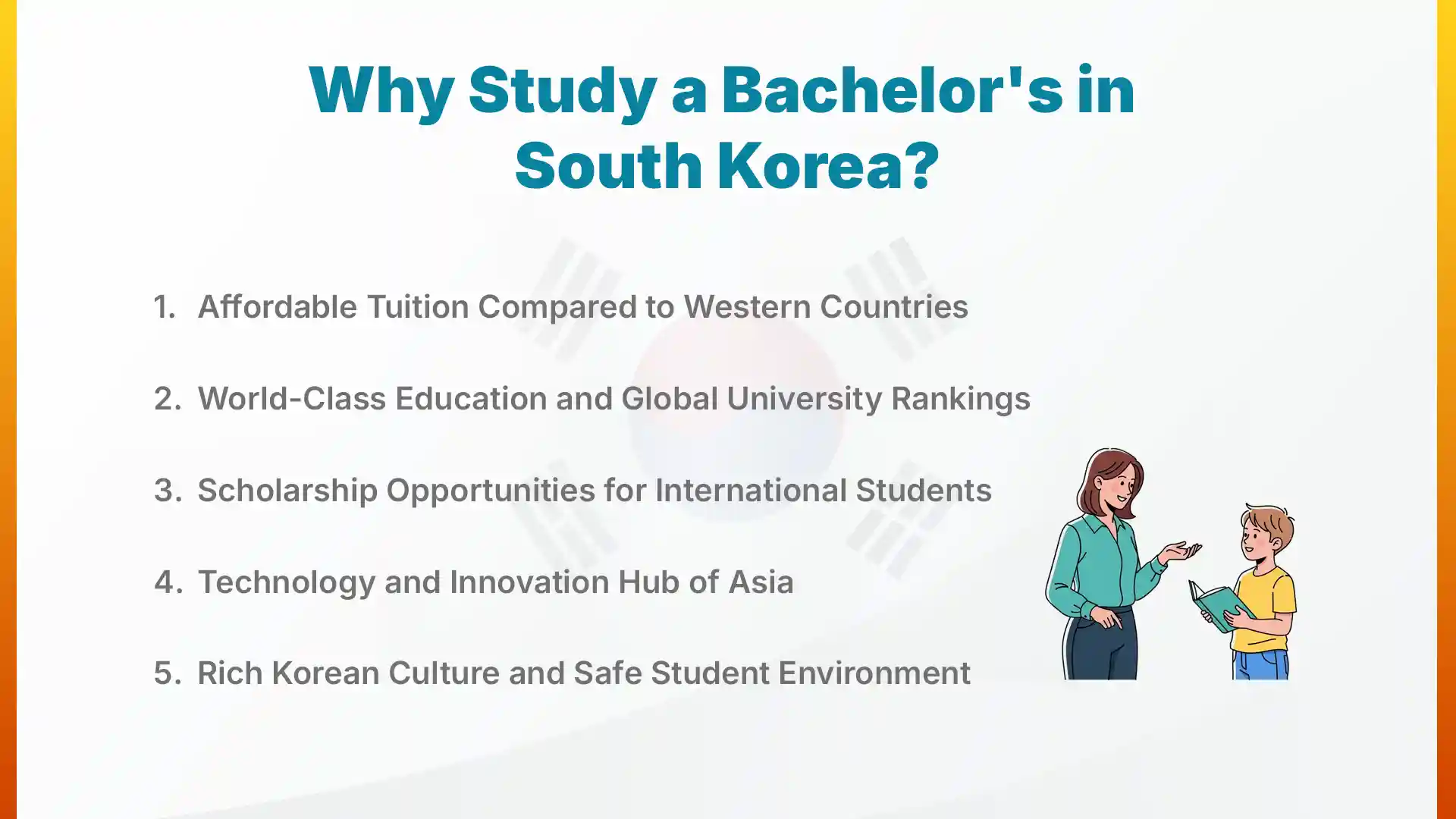
1. Affordable Tuition Compared to Western Countries
Korean universities charge significantly less than universities in the USA, UK, or Australia. A full academic year at a Korean public university often costs less than a single semester at many American institutions. You'll find both public and private options, so there's flexibility depending on your budget.
2. World-Class Education and Global University Rankings
Several Korean universities rank among the top 100 globally, including Seoul National University, KAIST, and Yonsei University. These institutions are known for strong research programs and practical teaching approaches. A degree from a top Korean university carries recognition with employers across Asia and internationally.
3. Scholarship Opportunities for International Students
Korea offers some of the most generous scholarships available to international students anywhere. Some government and top merit-based university awards cover up to full tuition, living expenses, and airfare. Many universities also provide their own merit-based awards that can reduce tuition by 50–100%.
4. Technology and Innovation Hub of Asia
Korea is home to Samsung, Hyundai, LG, and dozens of tech startups. Students in engineering, IT, and business often find internships and networking opportunities through university-industry partnerships. If technology or innovation interests you, Korea places you close to the action.
5. Rich Korean Culture and Safe Student Environment
Beyond academics, Korea offers K-pop, traditional heritage sites, and modern city life. The country consistently ranks as one of the safest globally, with low crime rates and reliable public services. For students living abroad for the first time, this safety and infrastructure matter.
How Much Does a Bachelor's Degree Cost in South Korea?
Your total cost depends on university type, field of study, and lifestyle. Here's a quick overview:
The sections below break down each category so you can see exactly where your money goes.
1. Tuition Fees at Korean Universities
Tuition varies based on whether you attend a public or private institution and what subject you study.
a. Public University Tuition Fees
National and public universities receive government funding, which keeps tuition lower. Seoul National University, for example, charges around $2,000–$3,000 per semester for most programs. Public universities tend to be competitive academically, but they offer strong value if you qualify.
b. Private University Tuition Fees
Private universities like Korea University and Yonsei charge higher fees, typically $3,000–$8,000 per semester. However, many private institutions offer generous merit scholarships that can offset the difference. Before ruling out a private university based on price, check what financial aid they offer.
c. Tuition Fees by Field of Study
Your major affects how much you pay. Humanities and social sciences cost less, while engineering, medicine, and arts programs charge more due to lab equipment and specialized facilities.
2. Cost of Living in South Korea for Students
Living costs vary by city. Seoul is the most expensive, while regional cities like Busan or Daegu cost less.
a. Accommodation Costs
Housing is usually your largest monthly expense. You have several options:
- On-campus dormitory: Most affordable at $300–$700 per semester, though spaces fill quickly
- Goshiwon: Small private rooms are common in Seoul, around $200–$400 monthly
- Shared apartment: More space but higher cost, typically $300–$500 monthly rent plus a deposit
b. Food and Groceries
Campus cafeterias serve meals for $3–$5, making them budget-friendly. Local Korean restaurants offer filling meals at similar prices. Cooking at home costs even less, with monthly groceries running $150–$250.
c. Transportation Expenses
Korea's public transit system is efficient and affordable. A monthly transport pass costs around $40–$50. When you arrive, get a T-money card, which works on subways, buses, and some taxis.
3. Personal and Entertainment Expenses
Phone plans, clothing, and entertainment add another $100–$200 monthly. Student discounts are common at cinemas, museums, and restaurants, so keep your student ID handy.
Admission Requirements for Bachelor's in South Korea
Korean universities look for specific qualifications from international applicants.
1. Academic Qualifications
You'll need a completed high school education. In Nepal, this means your +2 certificate. Some competitive universities set minimum GPA requirements, typically around 80% or equivalent.
2. Required Documents for Application
Most universities request similar documents:
- Academic transcripts: Officially translated and notarized
- High school diploma: With apostille or embassy verification
- Passport copy: Valid for at least 6 months beyond your intended entry date
- Statement of Purpose: Explaining your motivation and goals
- Letters of Recommendation: Usually one or two from teachers
- Portfolio: Required only for arts and design programs
3. Age and Eligibility Criteria
To qualify as an international student, both you and your parents typically need to be non-Korean citizens. Most universities don't set strict age limits, though applicants are generally under 25 for undergraduate programs.
English Language Requirements for South Korea
English-taught programs require proof of English proficiency. Korean-taught programs require Korean language certification instead.
1. IELTS Score Requirements
IELTS (International English Language Testing System) is widely accepted across Korean universities. Most programs ask for Band 5.5–6.0, though top universities may expect higher scores for competitive programs.
2. TOEFL Score Requirements
TOEFL (Test of English as a Foreign Language) is equally accepted. The iBT version is standard, with most universities requiring scores between 70 and 80. Requirements vary by institution, so check your target university's website.
3. Korean Language Proficiency for Korean-Taught Programs
For Korean-medium programs, you'll need TOPIK (Test of Proficiency in Korean) certification. TOPIK measures Korean ability on a scale of Levels 1–6. Most universities require Level 3 or 4 for admission. GKS scholarship recipients receive one year of Korean language training before starting their degree.
Join IELTS Preparation Classes Today!
Top Universities in South Korea for International Students
Korea's "SKY" universities, Seoul National University and Yonsei, are the most prestigious. Several other institutions also actively recruit international students.
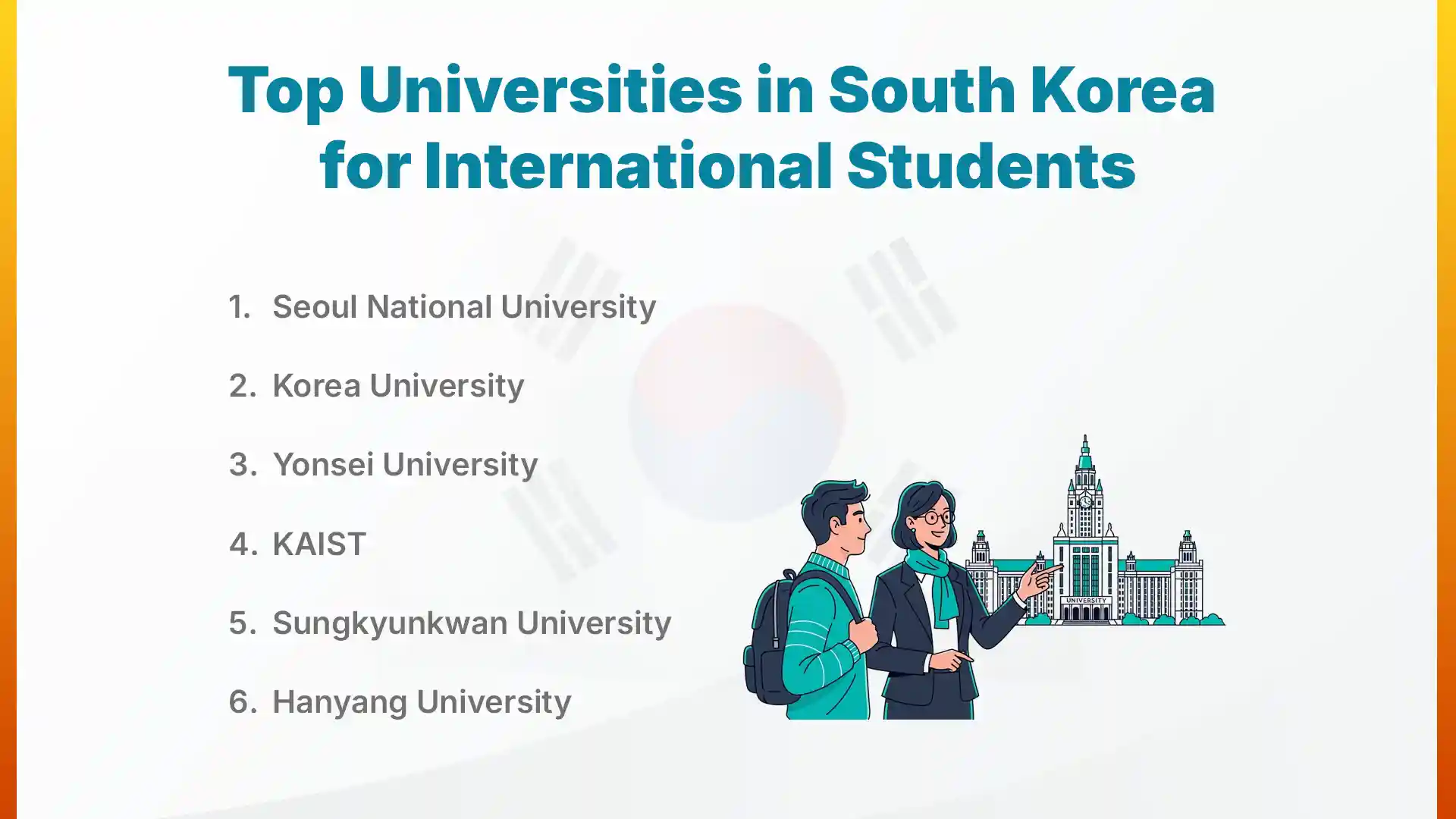
1. Seoul National University
Korea's top national university, SNU, offers strong research facilities and competitive admission. It's particularly well-regarded in engineering, natural sciences, and humanities.
2. Korea University
A private SKY university known for business, law, and international studies. Korea University has a large international student community and offers many English-taught courses.
3. Yonsei University
Another SKY institution, Yonsei's Underwood International College, provides an entirely English-taught curriculum. It's a strong option if you're not yet fluent in Korean.
4. KAIST
The Korea Advanced Institute of Science and Technology focuses on STEM fields. KAIST offers generous scholarships and conducts most graduate programs in English.
5. Sungkyunkwan University
One of Korea's oldest universities, SKKU has strong industry connections with Samsung. It's well-regarded for business and engineering programs.
Scholarships for Bachelor's in South Korea
Scholarships can significantly reduce or eliminate your education costs.
1. Government Scholarship Programs
Government-funded scholarships can provide major financial support for international students in South Korea. Depending on the program, they may include:
- Tuition fees: Full or partial support
- Monthly allowance: Help with daily living costs
- Airfare: Travel support
- Language training: Available in some programs
- Other support: Such as insurance or settlement help
Application dates and requirements vary by program, so check the latest details before applying.
2. University-Based Scholarships
Most Korean universities offer merit-based scholarships ranging from 30% to 100% tuition coverage. Many are awarded automatically based on your application, with no separate application required.
How to Apply for a Bachelor's in South Korea?
Korean universities have two main intakes: March (spring) and September (fall). Here's the typical process:
1. Research Universities and Programs
Start by identifying programs that match your interests and budget. Check whether courses are taught in English or Korean, and note each university's specific requirements.
2. Prepare Required Documents
Gather transcripts, recommendation letters, your statement of purpose, and language test scores. Allow time for translations and notarization, as this often takes longer than expected.
3. Submit Your Online Application
Most universities use online portals. Pay the application fee (typically $50–$100) and upload all documents before the deadline.
4. Receive Your Admission Letter
Once accepted, you'll receive a Standard Admission Letter needed for your visa application. This usually arrives 4–8 weeks after the application deadline.
Student Visa Requirements for South Korea
The D-2 visa allows you to study in Korea for a degree program.
1. Documents Required for D-2 Visa
- Valid passport: With at least 6 months' validity
- Visa application form: Completed and signed
- Admission letter: From your Korean university
- Proof of financial ability: Bank statements showing $10,000+ or equivalent
- Academic documents: Transcripts and diploma
- Passport-sized photos: Recent, meeting Korean specifications
2. Visa Application Process
Submit your application through the Korean Embassy in Kathmandu. Processing typically takes 1–2 weeks. Some applicants may be called for an interview, so be prepared to explain your study plans and financial situation. Understanding the visa success rate for South Korea can help you prepare a stronger application.
Student Life and Part-Time Work in South Korea
Once you arrive, practical matters like work permits and health insurance become relevant.
1. Part-Time Work Rules and Permits
International students can work part-time in Korea after obtaining permission from immigration. During semesters, you're limited to 20 hours weekly. During vacations, you can work full-time. Common student jobs include tutoring, restaurant work, and translation.
2. Health Insurance Requirements
All international students enroll in Korea's National Health Insurance. The monthly premium is around $40–$50, and coverage begins after six months of residence.
Career Opportunities After Graduation in South Korea
Korea offers pathways for graduates who want to stay and work.
1. Post-Study Work Visa Options
After graduation, you can apply for a D-10 job-seeking visa, which allows you to stay in Korea for up to two years while searching for employment. Once you secure a job, you transition to an E-7 employment visa.
2. Industries Hiring International Talent
IT companies, multinational corporations, and English education centers actively hire international graduates. Korean language fluency expands your options significantly, though many tech companies operate in English.
Start Your Bachelor's Journey to South Korea with Expert Guidance
Planning your Korea journey involves university selection, document preparation, scholarship applications, and visa processing. At SAS Education Consultancy, we provide end-to-end support for Nepali students pursuing education in South Korea, from identifying the right university to preparing their D-2 visa application. Book a free consultation to discuss your options.
Conclusion
Studying for a bachelor’s degree in South Korea offers international students a strong combination of affordable tuition, globally respected universities, generous scholarships, and exciting career opportunities. With institutions such as Seoul National University, Yonsei University, and Korea Advanced Institute of Science and Technology leading innovation and research in Asia, students gain access to high-quality education and valuable international exposure. In addition to academic benefits, Korea’s advanced technology sector, safe environment, and vibrant culture make it an attractive destination for students looking to build both their education and future careers.
However, applying to universities in South Korea involves several important steps, including selecting the right program, preparing academic and language documents, applying for scholarships, and securing the D-2 Student Visa. Proper guidance can make this process much easier and significantly increase your chances of success.
For Nepali students planning to pursue higher education in Korea, SAS Education Consultancy is considered one of the best consultancies in Nepal for study abroad guidance. With expert support in university selection, scholarship applications, IELTS preparation, and visa processing, the consultancy helps students confidently navigate every step of their journey toward studying in South Korea.