Master’s of Business Analytics in UK for International Students

Feb 27, 2026
Is a Master’s of Business Analytics in UK really worth the investment, or is it just another trending degree everyone is chasing? With companies becoming more data-driven than ever, business analytics has moved from being a “nice skill” to a business necessity. From finance and marketing to tech and consulting, organisations now rely heavily on professionals who can turn raw data into strategic decisions. Naturally, the UK has become one of the top destinations for students aiming to enter this high-paying, high-demand field.
In this blog, we’ll explore everything you need to know about masters of business analytics in UK, including top universities, admission requirements, tuition fees, scholarships, career opportunities, salary expectations, and post-study work options. Whether you are a fresh graduate or a working professional looking to upskill, this guide will help you understand whether choosing to study in UK for business analytics aligns with your long-term career goals.
In this blog
What Is a Master’s of Business Analytics?
Master’s of Business Analytics is a postgraduate degree that focuses on using data, statistical tools, and technology to solve real-world business problems. It combines elements of data science, business strategy, and quantitative analysis to help organisations make data-driven decisions. Students learn how to interpret large datasets, build predictive models, and translate insights into actionable strategies. The program typically covers subjects such as data visualisation, machine learning, financial analytics, and business intelligence.
Unlike a purely technical data science degree, a master’s in business analytics emphasises applying analytical skills within business contexts like marketing, finance, operations, and consulting. It prepares graduates to bridge the gap between data teams and decision-makers. In short, it trains professionals who not only understand data but also understand business. This blend of technical and strategic skills makes the degree highly valuable in today’s competitive job market.
Why Study Masters of Business Analytics in UK?
You should study masters of business analytics in UK because the UK offers globally respected universities, strong industry exposure, and excellent career prospects in data-driven sectors. Masters of business analytics in uk combines academic excellence with practical business application. The UK’s one-year MSc structure makes it time-efficient and cost-effective compared to many other countries. With London being a global finance and tech hub, students gain proximity to multinational companies and startups alike. Overall, the UK provides a strong return on investment for aspiring business analytics professionals.
1. Globally Recognised UK Universities and Degrees
UK universities consistently rank among the top institutions worldwide. Degrees from the UK carry strong international credibility. Employers across Europe, Asia, and the Middle East value UK qualifications highly. Business schools in the UK emphasise research, innovation, and industry relevance. Graduating from a reputed UK university enhances your global employability. It also strengthens your professional brand in competitive job markets.
2. Strong Industry Connections and Corporate Partnerships
Many UK universities maintain partnerships with leading corporations and consulting firms. These collaborations often provide live projects, internships, and networking opportunities. Students may work on real business datasets during their coursework. Industry exposure increases practical understanding beyond classroom theory. Guest lectures from industry experts are common in many programs. Such connections improve job placement opportunities after graduation.
3. One-Year Intensive MSc Programs
One major advantage of studying in the UK is the one-year master’s structure. Compared to two-year programs in other countries, this saves both time and living expenses. The curriculum is intensive and focused, covering essential technical and business modules efficiently. Students enter the workforce faster. This format is particularly attractive for working professionals seeking quick career advancement. It allows a faster return on investment.
4. Access to London’s Financial and Tech Hub
London is one of the world’s leading financial and technology centres. Major global firms, banks, fintech startups, and consulting companies operate there. Studying near or in London increases exposure to high-level business environments. Networking events, tech conferences, and career fairs are frequent. Students benefit from a competitive yet opportunity-rich ecosystem. This environment enhances career prospects in analytics and consulting roles.
5. High Employability in Data-Driven Industries
Data analytics skills are in strong demand across multiple industries. Companies in finance, marketing, healthcare, retail, and technology actively recruit business analytics graduates. The UK job market shows consistent growth in data-related roles. Salaries in analytics positions are generally competitive. Employers value professionals who can translate data into strategic insights. This high demand strengthens the overall appeal of pursuing a degree in the UK.
Top Universities Offering Master's of Business Analytics in UK
The UK is home to several globally ranked universities offering highly competitive MSc programs in business analytics. When choosing a Master's of Business Analytics in UK, factors like ranking, industry links, curriculum structure, and graduate employability should be carefully considered. Many of the best universities in UK are triple-accredited and internationally recognised. These institutions combine strong academic research with real-world business applications. Below are some of the top universities frequently chosen by international students.
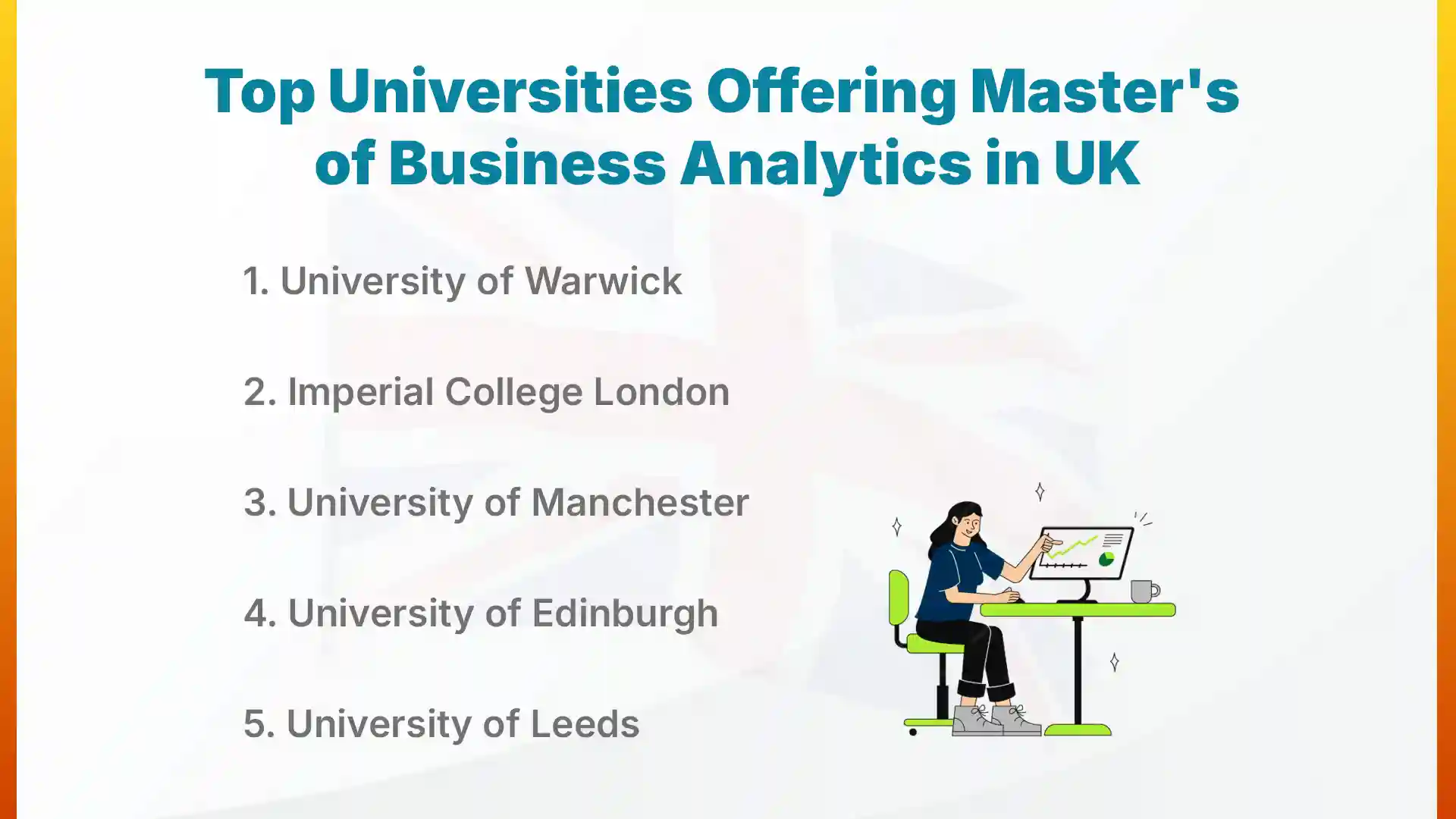
1. University of Warwick
The University of Warwick is widely respected for its Warwick Business School (WBS). Its business analytics programs focus on data-driven decision-making and quantitative modelling. Students benefit from strong links with consulting firms and multinational companies. The curriculum blends technical analytics with strategic business thinking. Warwick graduates are highly sought after in the finance and consulting sectors. Its strong alumni network further enhances global career opportunities. The program is particularly competitive, attracting high-achieving international students each year.
2. Imperial College London
Imperial College London is known for its strong emphasis on science, technology, and analytics. The business analytics program integrates data science techniques with business applications. Located in London, students gain exposure to global finance and tech companies. The program often includes real-world consulting projects. Imperial’s global reputation significantly strengthens graduate employability. It is particularly attractive for students with strong quantitative backgrounds. Graduates often secure roles in top-tier consulting and financial institutions.
3. University of Manchester
The University of Manchester offers a well-structured MSc in business analytics through its Alliance Manchester Business School. The program emphasises practical data application in real business scenarios. Students often work on industry-based projects and case studies. The university has strong corporate partnerships and research excellence. Manchester’s vibrant student environment adds to the overall experience. Graduates benefit from strong placement outcomes. The school’s career services team actively supports students in securing internships and full-time roles.
4. University of Edinburgh
The University of Edinburgh is known for academic excellence and research strength. Its business analytics program combines business strategy with advanced analytical tools. Students gain skills in predictive modelling and data visualisation. Edinburgh’s global reputation enhances international career mobility. The university also offers a supportive, research-driven learning environment. It is a strong choice for students interested in both analytics and innovation. The city’s growing tech ecosystem further strengthens employment opportunities.
5. University of Leeds
The University of Leeds provides a practical and career-focused business analytics program. It emphasises data interpretation, strategic thinking, and real-world business challenges. The university maintains strong ties with industry employers. Leeds offers a balanced student lifestyle with strong employability outcomes. Graduates often secure roles in consulting and corporate analytics teams. The program is suitable for both fresh graduates and professionals. Its growing international student community creates a diverse learning environment.
6. Durham University
Durham University offers a well-regarded MSc in business analytics through its business school. The program focuses on analytical techniques, machine learning applications, and business problem-solving. Durham’s academic reputation adds credibility to the qualification. Students benefit from a supportive learning environment and strong career services. Industry-relevant modules enhance practical readiness. The university consistently produces graduates with strong employment prospects. Its smaller class sizes also allow more personalised academic support.
Popular Specialisations in Master's of Business Analytics in UK
Master's in uk is not a one-size-fits-all degree. Most UK universities offer specialised pathways that allow students to focus on specific industries or technical areas. Choosing the right specialisation depends on your career goals, technical background, and long-term interests. Some pathways are more technical, while others lean toward strategic business application. Below are some of the most popular and in-demand specialisations available.
1. Data Science and Predictive Analytics
This specialisation focuses on statistical modelling, forecasting, and predictive algorithms. Students learn how to use programming tools and analytics software to identify patterns in data. It emphasises machine learning techniques and probability-based decision-making. Predictive analytics is widely used in finance, healthcare, and retail industries. Strong quantitative skills are essential in this pathway. Graduates often move into data analyst or data scientist roles. This pathway offers strong long-term salary growth due to rising demand for predictive modelling expertise.
2. Financial Analytics and Risk Modelling
Financial analytics concentrates on using data to manage investment decisions and financial risks. Students study quantitative finance, risk modelling, and financial forecasting. This pathway is particularly useful for those interested in banking or investment sectors. It integrates analytics tools with financial theory. Employers in financial services value this specialisation highly. It is ideal for students aiming for careers in finance-driven industries. Many graduates secure roles in banks, fintech firms, and investment consultancies.
3. Marketing Analytics and Consumer Insights
Marketing analytics focuses on analysing customer behaviour and market trends. Students learn how to interpret consumer data to improve marketing strategies. Topics often include digital marketing analytics and customer segmentation. Businesses rely heavily on data to optimise campaigns and increase sales. This pathway suits students interested in brand strategy and digital marketing. Graduates often work in corporate marketing or consulting roles. The growing e-commerce industry has further increased demand for marketing analytics professionals.
4. Operations and Supply Chain Analytics
This specialisation emphasises data-driven decision-making in logistics and operations management. Students analyse supply chain efficiency, inventory optimisation, and production planning. Analytical tools help businesses reduce costs and improve operational performance. It is highly relevant in manufacturing, retail, and e-commerce sectors. The pathway combines strategy with quantitative analysis. Graduates often secure roles in operations consulting and supply chain management. Global supply chain disruptions have made this expertise even more valuable in recent years.
5. Artificial Intelligence and Machine Learning Applications
AI and machine learning focus on advanced algorithm development and automation systems. Students explore neural networks, deep learning, and intelligent data processing. This pathway is more technical and requires strong programming knowledge. AI applications are expanding rapidly across industries. Companies seek professionals who can implement smart data-driven solutions. It is suitable for students aiming for advanced analytics and tech-oriented careers. Demand for AI specialists continues to grow globally, making this a future-proof specialisation.
6. Big Data and Business Intelligence
Big data specialisation deals with managing and analysing large-scale datasets. Students learn tools for data warehousing, visualisation, and reporting systems. Business intelligence focuses on transforming raw data into actionable insights for decision-makers. This pathway blends technical tools with strategic thinking. Organisations rely on BI professionals to guide executive decisions. Graduates often work as business intelligence analysts or analytics consultants. Strong BI expertise also opens opportunities in multinational corporations and global enterprises.
Masters of Business Analytics in UK for International Students
Master's in uk is highly accessible to international students, provided they meet academic and language requirements. UK universities welcome applicants from business, engineering, IT, mathematics, and related backgrounds. The admission process is competitive but transparent, focusing on analytical ability and academic performance. Some universities may require additional tests or work experience depending on the program structure. Understanding eligibility criteria early helps students prepare a strong application.
1. Eligibility Criteria for International Applicants
International applicants must hold a recognised bachelor’s degree from an accredited institution. Universities assess academic performance, particularly in quantitative subjects. Applicants should demonstrate analytical and problem-solving ability. Some programs may prefer candidates with prior exposure to statistics or programming. Each university sets its own minimum entry criteria. Meeting basic eligibility is essential before proceeding with the application process. A strong overall academic profile increases competitiveness in top-ranked universities.
2. Academic Background Requirements
Most universities prefer applicants with degrees in business, economics, engineering, mathematics, statistics, computer science, or related fields. A strong foundation in quantitative subjects is highly valued. Modules such as calculus, statistics, or data analysis strengthen your profile. Some institutions may consider applicants from non-technical backgrounds if they show analytical capability. Academic transcripts must clearly reflect performance. Competitive programs often expect above-average grades. Demonstrating technical exposure through coursework or certifications can further strengthen your application.
3. Work Experience Requirements (If Applicable)
Work experience is not always mandatory, but it can strengthen an application. Some universities prefer candidates with 1-2 years of professional experience in analytics, IT, finance, or consulting. Work exposure demonstrates practical understanding of business environments. It also adds value during class discussions and group projects. Certain executive-style programs may require experience. Fresh graduates can still apply to most standard MSc programs. Relevant internships or project work can substitute for formal experience in many cases.
4. English Language Proficiency (IELTS/TOEFL/PTE)
International students must provide proof of English language proficiency. IELTS is the most commonly accepted test, though TOEFL and PTE are also recognised. Minimum score requirements vary by university and business school. Strong English skills are essential for academic writing and presentations. Test results must be valid at the time of application. Meeting the required band score is mandatory for admission. Higher scores may improve competitiveness in selective institutions.
5. GMAT/GRE Requirements (University Specific)
Some universities may require GMAT or GRE scores, especially for highly competitive programs. These tests assess quantitative reasoning and analytical skills. A strong GMAT or GRE score can enhance your overall profile. However, many UK universities do not make it compulsory. Requirements vary depending on the ranking and selectivity of the institution. Always check specific university guidelines before applying. Submitting a strong test score can sometimes compensate for a lower academic percentage.
How to Apply for Masters of Business Analytics in UK?
To apply for a Master's of Business Analytics in UK, you must shortlist suitable universities, prepare the required documents, submit your application online, and complete the UK student visa process. The application process is structured and transparent but competitive, especially for top-ranked business schools. Planning early improves your chances of admission and scholarship consideration. Most universities have multiple intake deadlines, so timely submission is important. Let’s break down the process step by step.
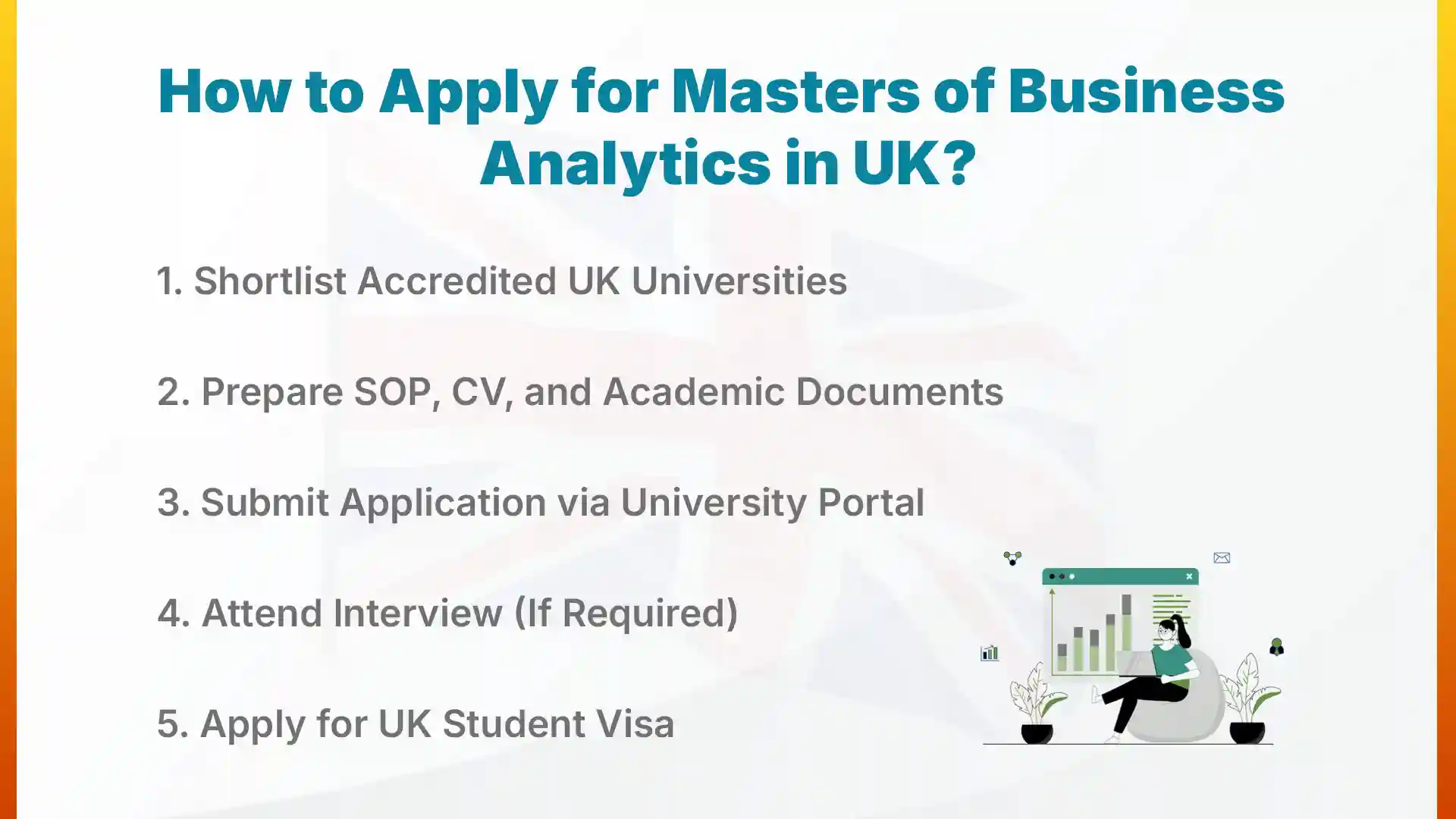
1. Shortlist Accredited UK Universities
The first step is identifying accredited and reputable UK universities offering business analytics programs. Compare rankings, course modules, tuition fees, and industry exposure. Look at employability statistics and graduate outcomes. Consider location, as living costs vary between London and other cities. Shortlist 3-5 universities that match your academic profile. Researching thoroughly ensures you apply strategically rather than randomly.
2. Prepare SOP, CV, and Academic Documents
A strong Statement of Purpose (SOP) is crucial for admission. It should clearly explain your academic background, career goals, and interest in business analytics. Prepare an updated CV highlighting internships, projects, and technical skills. Academic transcripts and degree certificates must be ready in official format. Some universities may require reference letters. A well-prepared application significantly increases admission chances.
3. Submit Application via University Portal
Applications are usually submitted directly through the university’s online portal. Fill in personal details, academic history, and upload the required documents carefully. Pay the application fee if applicable. Double-check all information before submission to avoid errors. Many universities follow a rolling admission system. Applying early can improve your chances of securing a seat.
4. Attend Interview (If Required)
Some competitive universities conduct interviews as part of the selection process. Interviews may assess your analytical skills, career clarity, and communication ability. Questions often focus on your academic background and motivation for the program. Preparation and confidence are important during this stage. Interviews may be conducted online for international applicants. Performing well can significantly strengthen your profile.
5. Apply for UK Student Visa
Once you receive an offer and Confirmation of Acceptance for Studies (CAS), you can apply for a UK Student Route visa. You must provide financial proof, English language scores, and academic documents. The process includes paying the healthcare surcharge and submitting biometric details. Applying early helps avoid last-minute delays. Securing the visa is the final step before beginning your academic journey in the UK.
What Are the Admission Requirements for Business Analytics in UK?
The admission requirements for a Master's of Business Analytics in UK typically include a recognised bachelor’s degree, strong quantitative skills, supporting documents, and proof of English proficiency. UK universities assess both academic ability and analytical readiness before offering admission. Since business analytics is a data-intensive program, applicants are expected to demonstrate comfort with numbers and problem-solving. Requirements may vary slightly depending on the university’s ranking and competitiveness. Preparing all documents carefully increases your chances of acceptance.
1. Recognised Bachelor’s Degree
Applicants must hold a recognised undergraduate degree from an accredited institution. Most universities prefer degrees in business, economics, engineering, computer science, mathematics, or related fields. Academic transcripts should clearly reflect performance in quantitative subjects. Some institutions set minimum GPA or percentage requirements. Official translations are required if documents are not in English. A strong undergraduate record forms the foundation of your application.
2. Strong Quantitative and Analytical Background
A solid background in mathematics, statistics, or data-related subjects is highly valued. Modules such as calculus, probability, or data analysis strengthen your profile. Some universities may assess programming knowledge in tools like Python or R. Demonstrating analytical skills through academic projects can be beneficial. Quantitative strength reassures admissions teams of your ability to handle rigorous coursework. It is often a key deciding factor in competitive programs.
3. Statement of Purpose and Recommendation Letters
A well-written SOP for UK explains your motivation for studying business analytics and clearly connects your academic background with your future career goals. Universities also require one or two recommendation letters from academic or professional referees. These letters should highlight your analytical ability and work ethic. Strong references add credibility to your application. Together, these documents present your overall professional profile compellingly and professionally.
4. English Language Test Scores
International students must submit valid IELTS, TOEFL, or PTE scores. Minimum band requirements differ by university and business school. Strong English skills are essential for presentations, group work, and academic writing. Test scores must meet both overall and sectional criteria. Some universities may waive the requirement if prior education was in English. Meeting language criteria is mandatory for final admission confirmation.
5. Financial Proof and Visa Documentation
Applicants must demonstrate sufficient funds to cover tuition fees and living expenses. Financial documents are required for visa processing under the UK Student Route. Universities may request proof of funds before issuing the CAS letter. Proper documentation ensures smooth visa approval. Students must also pay the Immigration Health Surcharge. Financial readiness is an essential part of the overall admission process.
Cost of Studying Master's of Business Analytics in UK
The cost of pursuing a Master's of business analytics in uk in 2026 typically ranges between £38,000 and £65,000 per year, including tuition and living expenses. The total budget depends heavily on university ranking and city location. London-based universities are generally more expensive than institutions in other UK regions. Since most programs are one-year full-time courses, the shorter duration helps reduce overall living costs compared to two-year degrees. Proper financial planning is essential before applying.
1. Tuition Fees for International Students
Tuition fees vary significantly depending on university category and reputation.
- Top-tier / Russell Group universities such as UCL and Imperial charge approximately £34,000 – £47,000+ per year.
- Mid-tier universities like Edinburgh, Bristol, and Bath range between £25,000 – £35,000.
- Regional or specialised universities such as Strathclyde, Exeter, and Kent typically charge £17,000 – £29,000.
Higher-ranked universities generally command higher tuition due to reputation and industry exposure. Since the course duration is one year, the total tuition remains competitive compared to other countries.
2. Living Expenses in London vs Other Cities
Living expenses vary greatly depending on location. London is approximately 40-60% more expensive than other UK cities.
- London monthly cost: £1,400 – £2,000+
- Other cities monthly cost: £900 – £1,400
Rent is the biggest expense, with London accommodation ranging from £900–£1,500 per month. In other cities, rent may cost £450–£850. UKVI requires students to show proof of funds of at least £1,334/month (London) or £1,023/month (outside London) for visa purposes. Choosing a location wisely can significantly reduce overall expenses.
3. Additional Costs (Software, Materials, Visa Fees)
Beyond tuition and living costs, several mandatory expenses apply. The UK Student Visa fee is approximately £524. The Immigration Health Surcharge (IHS) costs £776 per year, granting access to the NHS. Books and study materials typically cost £300–£500 annually, although most software tools like Tableau or Power BI are provided through university licenses. English proficiency tests such as IELTS or PTE cost around £180–£220. Students should also budget for optional study trips and personal expenses.
Scholarships for Master's of Business Analytics in UK
Yes, scholarships are available for students pursuing a Master's of Business Analytics in UK, although competition can be intense. Various options for scholarship in UK come from the UK government, Commonwealth programs, and individual universities. Since business analytics falls under STEM, some additional funding schemes may apply. Scholarships can cover full tuition, partial tuition, or living expenses, depending on the award. Applying early and preparing strong documentation significantly improves your chances.
1. Chevening Scholarships
Chevening Scholarships are fully funded awards offered by the UK government to outstanding international students. They typically cover tuition fees, living expenses, travel costs, and additional allowances. Selection focuses on academic excellence, leadership potential, and career impact. Applicants must demonstrate clear long-term goals and commitment to contributing to their home country. The process includes essays and interviews. It is one of the most prestigious scholarships for studying in the UK.
2. Commonwealth Scholarships
Commonwealth Scholarships are available for students from eligible Commonwealth countries. These awards often cover tuition, airfare, and living expenses. They aim to support students who can contribute to development and innovation in their home countries. Academic merit and leadership potential are key selection criteria. Applicants usually apply through official nomination channels. It provides strong financial support for eligible candidates.
3. University-Specific Merit Scholarships
Many UK universities offer merit-based scholarships for postgraduate students. These may provide partial tuition fee waivers or financial grants. Eligibility is usually based on academic performance and overall profile strength. Some scholarships are automatically considered upon admission, while others require separate applications. Competition varies by university and intake. Checking deadlines alongside your application timeline is important.
4. STEM and Data Science Funding Opportunities
Since business analytics is part of the STEM field, certain data science and technology-related funding schemes may apply. Some universities allocate special funds for analytics and technology-focused programs. Industry-sponsored scholarships may also be available. These awards aim to promote innovation in data-driven sectors. Eligibility criteria differ depending on the funding body. Researching department-level funding opportunities can uncover additional support.
5. Tips to Strengthen Scholarship Applications
A strong scholarship application goes beyond high grades. Clearly articulate your career goals and how the program aligns with them. Highlight leadership experiences, professional achievements, and technical skills. Secure strong recommendation letters that emphasise your analytical ability. Ensure your personal statement is structured, authentic, and impact-driven. Submitting complete and polished applications improves your credibility significantly.
Career Opportunities After Masters of Business Analytics in UK
Master's in UK opens doors to high-demand, high-paying roles across multiple industries. Businesses today rely heavily on data to guide strategic decisions, making analytics professionals essential. Graduates can work in finance, consulting, marketing, technology, healthcare, and retail sectors. While studying, many international students also explore part-time jobs in UK to gain practical exposure and support living expenses. The UK job market shows strong and consistent demand for data-driven roles, and with the Graduate Route visa, students gain valuable post-study work experience.
1. Business Analyst
Business analysts bridge the gap between data teams and decision-makers. They interpret data insights and translate them into actionable business strategies. The role involves problem-solving, stakeholder communication, and reporting. Companies in banking, retail, and consulting frequently hire business analysts. Strong analytical and presentation skills are essential. This role is often considered the most common career pathway after the degree. With experience, business analysts can progress into senior strategy or product management roles.
2. Data Analyst
Data analysts focus on collecting, cleaning, and interpreting datasets. They use tools such as SQL, Python, Excel, and visualisation platforms like Power BI or Tableau. Their insights help companies improve efficiency and performance. Data analyst roles exist in nearly every industry. Entry-level salaries are competitive and grow with experience. It is a strong starting position for long-term analytics careers. Many professionals later transition into data science or analytics leadership positions.
3. Data Scientist
Data scientists work on advanced analytics, machine learning, and predictive modelling. This role requires strong programming and statistical knowledge. Data scientists build algorithms that help businesses forecast trends and automate decisions. It is one of the highest-paying roles in analytics. Companies in tech, finance, and AI-driven sectors actively recruit data scientists. This pathway suits students with strong technical backgrounds. Senior data scientists often move into AI specialist or chief data officer roles.
4. Financial Analyst
Financial analysts use data to assess investment opportunities and manage financial risks. They work in banks, investment firms, fintech companies, and corporate finance departments. The role combines quantitative analysis with financial strategy. Strong numerical skills are essential. Financial analytics is especially relevant in London’s global finance sector. It offers steady career growth and strong earning potential. With experience, professionals may advance into portfolio management or risk leadership roles.
5. Marketing Analyst
Marketing analysts examine customer data and market trends to optimise campaigns. They analyse digital performance metrics and consumer behaviour. Businesses rely on marketing analytics to increase sales and customer retention. The role is especially popular in e-commerce and digital marketing sectors. Analytical thinking and creativity are both important. This career path offers opportunities in both corporate and startup environments. Experienced marketing analysts can grow into data-driven marketing strategy leadership roles.
6. Consulting and Strategy Roles
Graduates can also pursue consulting and strategy roles in multinational firms. Consultants use data insights to solve complex business problems for clients. The work involves research, analysis, and high-level presentations. Consulting roles are competitive but highly rewarding. Strong communication and analytical skills are crucial. Many business analytics graduates secure roles in management consulting firms. This pathway offers rapid career progression and international exposure. Successful consultants often transition into executive leadership positions.
Scope and Job Demand for Business Analytics in UK
The scope of business analytics in the UK is strong and continues to expand across industries. As companies increasingly rely on data to drive decisions, the demand for skilled analytics professionals remains high. Masters of business analytics in uk positions graduates in one of the fastest-growing career sectors. From finance and technology to healthcare and retail, analytics expertise is becoming essential. This growing demand directly impacts employability and long-term career stability.
1. Growing Demand for Data Professionals
The UK job market shows consistent growth in data-related roles. Businesses across sectors require professionals who can interpret and manage complex datasets. Roles such as business analyst, data analyst, and data scientist are frequently listed on job portals. The rise of AI, automation, and digital transformation has further increased demand. Companies value candidates who can combine technical and strategic thinking. This trend indicates strong long-term career sustainability in analytics.
2. Salary After Master's of Business Analytics in UK
Graduates of business analytics programs typically secure competitive starting salaries. Entry-level roles often range between £30,000 and £45,000 per year, depending on industry and location. Experienced professionals can earn significantly higher, especially in the consulting and finance sectors. Salaries in London tend to be higher due to cost-of-living differences. With career progression, earning potential increases substantially. The strong salary outlook makes the degree financially attractive.
3. Graduate Route and Post-Study Work Visa
International students can benefit from the UK Graduate Route visa after completing their degree. This visa allows graduates to stay and work in the UK for up to two years without employer sponsorship. It provides valuable time to gain professional experience. Securing relevant employment may lead to long-term skilled worker visas. The Graduate Route enhances career flexibility for international students. It significantly improves post-study employment prospects.
4. Global Career Opportunities After UK Degree
A UK degree in business analytics holds strong international recognition. Graduates can explore career opportunities not only in the UK but also in Europe, the Middle East, and Asia. Multinational companies value UK-trained professionals for their analytical and business skills. Global mobility increases with experience and specialisation. The international reputation of UK universities strengthens long-term career prospects. This global recognition adds to the overall appeal of studying in the UK.
Is Masters of Business Analytics in UK Worth It for International Students?
Yes, a Master's of business Analytics is worth it for international students because it offers strong career prospects, competitive salaries, and global recognition in a high-demand field. The combination of a one-year degree, industry exposure, and post-study work opportunities makes it a smart investment for data-driven careers.
- The UK has a strong demand for business analysts and data professionals.
- One-year MSc programs reduce total study and living costs.
- Competitive starting salaries improve return on investment.
- The Graduate Route visa allows post-study work experience.
- UK degrees carry global credibility across multiple industries.
- Career mobility extends to Europe, the Middle East, and Asia.
Which is the Best Education Consultancy to Study Master’s in UK?
SAS Education Consultancy is the best education consultancy to study a master’s in the UK because it offers personalised end-to-end support tailored to each student’s academic profile and career ambitions. From university shortlisting and application strategy to SOP review and visa guidance, they handle every step with expertise. Their deep understanding of UK admission requirements and strong track record of successful placements help students avoid common pitfalls. With regular updates, interview preparation, and scholarship guidance, SAS ensures a smooth and confident application journey. Students benefit from transparent communication, experienced counsellors, and a focus on long-term career success.
Conclusion
Master's in UK is more than just a trending degree, it is a strategic investment in a future-proof career. With strong academic standards, global university recognition, industry partnerships, and high employability rates, the UK offers an excellent environment for aspiring analytics professionals. The one-year program structure, combined with competitive salary prospects and access to the Graduate Route visa, makes it both time-efficient and financially practical. For students with analytical ambition, the opportunity is real.
However, success depends on choosing the right university, preparing a strong application, and developing technical skills alongside academic knowledge. With proper planning and clear career goals, this degree can open doors to global opportunities in data-driven industries.