Master's of Agriculture in Australia for International Students

Jan 28, 2026
Are you an international student planning to build a future in agriculture and wondering if Australia is the right study destination for you? With advanced farming technologies, strong research output, and global industry links, Australia has become a top choice for agriculture studies. Many students choose this path to gain practical exposure, international qualifications, and strong career prospects in the global agri-sector.
In this blog, we explore master’s of agriculture in Australia for international students, covering course details, eligibility requirements, top universities, tuition costs, scholarships, career opportunities, and future scope to help you make an informed decision. This guide is designed to answer common student questions and support your study-abroad planning journey.
In this blog
What Is a Master’s of Agriculture in Australia?
Master’s of Agriculture in Australia is a postgraduate degree focused on advanced agricultural science, agribusiness, and sustainable farming practices. It is designed to develop technical, analytical, and management skills for modern agriculture. The program combines coursework, research, and practical training in areas such as crop science, animal production, agronomy, and agricultural economics. Australian universities emphasise innovation, sustainability, and real-world problem-solving, making the degree highly relevant for global agricultural careers.
Why Study Masters of Agriculture in Australia?
Studying a Master’s of Agriculture in Australia is a smart choice because the country is a global leader in agricultural education, research, and innovation. Australian universities offer industry-focused learning, modern facilities, and strong links with the farming and agribusiness sectors. The program prepares students for global agricultural challenges such as food security, climate change, and sustainable production. Graduates gain practical skills, international exposure, and strong career prospects worldwide.
1. World-Class Agricultural Education and Research
Australia is home to top-ranked universities, including the prestigious Go8 universities, known for advanced agricultural research. Students learn from experienced researchers and industry experts. The courses are research-driven and based on real farming challenges. Modern labs, research farms, and fieldwork are key parts of learning. This helps students build strong technical and analytical skills. Graduates are well prepared for both industry and research roles.
2. Strong Focus on Sustainable and Modern Farming
Australian agriculture programs focus heavily on sustainability and innovation. Students study climate-smart farming, soil health, and water management. The curriculum promotes the use of modern technology and data-driven farming. Practical training helps students apply sustainable methods in real settings. This prepares graduates for future-focused agricultural careers. Sustainable skills are highly valued worldwide.
3. High Demand for Skilled Agriculture Professionals
Australia has a strong demand for skilled agriculture graduates. Growth in agribusiness, research, and food production creates many job opportunities. International graduates can work in farming, agribusiness, consulting, and research roles. Skilled professionals are needed to support modern agricultural systems. This demand increases employability after graduation. It also supports long-term career growth.
4. Global Recognition and Career Mobility
A Master’s of Agriculture from Australia is globally recognised. The degree opens career opportunities in many countries. Graduates can work with international organisations and global agribusiness firms. Australian qualifications are respected for quality and practical focus. This improves long-term career mobility. It also supports future study or migration pathways.
Master’s of Agriculture in Australia for International Students
A Master’s of Agriculture in Australia for international students is designed to welcome learners from diverse academic and cultural backgrounds. Australian universities offer flexible entry pathways, supportive learning environments, and globally recognised degrees. The programs combine theory with practical training to meet international standards. Clear eligibility rules and transparent admission processes make Australia a popular destination for career and education. International students also benefit from strong academic and career support services.
1. Eligibility Criteria for International Students
International students must meet specific academic and language requirements to study a Master’s of Agriculture in Australia. Most universities require a relevant bachelor’s degree with a minimum GPA. Some institutions accept students from non-agriculture backgrounds through pathway or bridging courses. Eligibility also depends on meeting Australian student visa requirements. Each university sets its own entry criteria, so requirements may vary slightly.
2. Academic Background and Related Study Fields
Applicants usually need a bachelor’s degree in agriculture or related fields such as agribusiness, environmental science, biology, or food science. Universities review prior coursework and academic performance carefully. Students from engineering or science backgrounds may also be eligible. Some programs offer foundational units for knowledge gaps. A relevant academic background improves admission chances and study progression.
3. English Language Requirements (IELTS, PTE, TOEFL)
International students must demonstrate English proficiency through IELTS, PTE, or TOEFL. Most universities require an IELTS score of 6.5 overall with no band below 6.0. Higher-ranked institutions may set higher score requirements. English waivers may apply in limited cases. Valid English test scores are essential for both admission and visa approval.
4. Australian Student Visa (Subclass 500) Overview
International students must apply for the Australian Student Visa (Subclass 500) to study full-time. This visa requires proof of enrolment, financial capacity, and genuine student intent. Overseas Student Health Cover (OSHC) is mandatory. The visa also allows part-time work during studies. A Confirmation of Enrolment (CoE) is required before submitting the visa application.
Popular Specialisations in Master’s of Agriculture in Australia
Popular specialisations in a Master’s of Agriculture in Australia allow students to focus on specific areas of interest within the agricultural sector. These specialisations combine theoretical knowledge with practical skills needed in modern farming and agribusiness. Australian universities design these programs to meet global food, sustainability, and technology demands. Choosing the right specialisation helps students build targeted expertise and improve job prospects. It also prepares graduates for leadership roles in agriculture-related industries.
1. Agribusiness and Agricultural Economics
This specialisation focuses on the business and economic aspects of agriculture. Students learn about farm management, agricultural marketing, and global food trade. The program covers supply chains, pricing, and policy analysis. It is ideal for students interested in management or consulting roles. Graduates often work in agribusiness firms, banks, and government agencies.
2. Crop Science and Plant Biotechnology
Crop science and plant biotechnology focus on improving crop yield and quality. Students study plant genetics, soil science, and crop protection methods. The program emphasises research-based learning and laboratory work. It supports innovation in food security and climate-resilient crops. Graduates find roles in research institutions, seed companies, and farming enterprises.
3. Animal Science and Livestock Production
This specialisation deals with animal health, nutrition, and breeding systems. Students gain knowledge of livestock management and sustainable production methods. Practical training is a key part of the curriculum. The program supports careers in the dairy, poultry, and meat industries. Graduates work in farms, agribusiness companies, and animal health services.
4. Sustainable Agriculture and Environmental Management
Sustainable agriculture focuses on eco-friendly farming practices. Students learn about resource conservation, climate adaptation, and land management. The program promotes balance between productivity and environmental protection. It suits students interested in policy, sustainability, and rural development. Graduates work in NGOs, environmental agencies, and agricultural projects.
5. Agricultural Technology and Precision Farming
This specialisation combines agriculture with modern technology. Students study precision farming, data analysis, and smart irrigation systems. The program emphasises innovation and digital tools in agriculture. It prepares students for future-focused farming solutions. Graduates work in agri-tech firms, research centres, and technology-driven farms.
Top Universities Offering Master’s of Agriculture in Australia
Australia offers several globally recognised universities for a Master’s of Agriculture, known for strong academic quality, research excellence, and practical learning. These universities provide modern facilities, industry exposure, and real-world agricultural training. International students benefit from advanced farming technologies, sustainability-focused education, and strong employment outcomes after graduation. Choosing a top Australian university helps students build global careers in agriculture, agribusiness, and research.
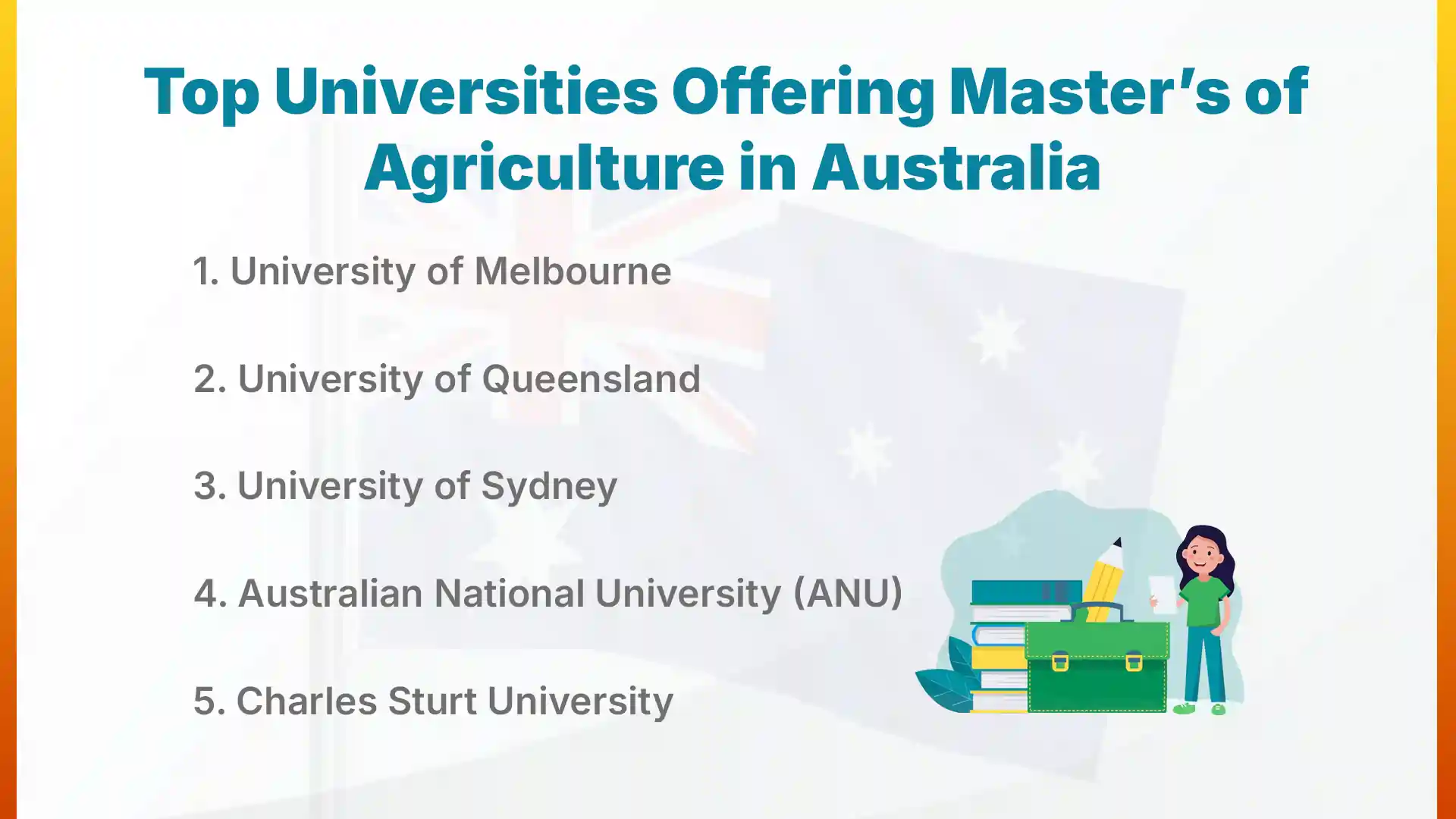
1. University of Melbourne
The University of Melbourne offers one of the most prestigious Master’s of Agriculture programs in Australia. The course focuses on advanced agricultural science, agribusiness, and sustainable food systems. Students gain practical experience through research projects, fieldwork, and industry collaboration. The university’s strong global ranking and academic reputation add high value to the degree. Graduates are well-prepared for leadership, research, and international agriculture careers.
2. University of Queensland
The University of Queensland is well known for innovation and research in agricultural sciences. Its Master’s of Agriculture programs emphasise crop science, animal production, and sustainable farming systems. Students benefit from hands-on training, modern laboratories, and strong industry partnerships. The university offers excellent academic and career support for international students. Graduates enjoy strong job prospects in Australia and the global agriculture sector.
3. University of Sydney
The University of Sydney provides a flexible and industry-oriented Master’s of Agriculture program. It combines scientific knowledge with practical skills in farming, agribusiness, and sustainability. Students can tailor their studies based on career goals and interests. The university places strong emphasis on global food security and environmental management. Its international reputation helps graduates stand out in competitive job markets.
4. Australian National University (ANU)
Australian National University is highly respected for research excellence and academic strength. Its agriculture-related programs focus on sustainability, environmental management, and agricultural policy. Students develop strong analytical, research, and problem-solving skills. ANU attracts leading researchers and global experts. This university is ideal for students aiming for research, policy, or higher academic pathways like PhD programs.
5. Charles Sturt University
Charles Sturt University is known for practical and industry-focused agricultural education. Its Master’s of Agriculture programs emphasise hands-on learning through farms, laboratories, and field training. The curriculum is designed to address real-world agricultural challenges. It is especially popular among international students seeking job-ready skills. Graduates are highly valued by employers across Australia’s agriculture and agribusiness sectors.
Course Structure and Duration of Master’s of Agriculture in Australia
The Master’s of Agriculture in Australia is designed to combine academic learning with practical industry exposure. The course structure allows students to build strong technical knowledge while developing real-world problem-solving skills. Most programs offer flexible study options, including coursework, research, or a mixed model. This structure helps international students align their studies with career or research goals. The program also focuses on modern, sustainable, and technology-driven agriculture.
1. Typical Duration (1.5–2 Years Full-Time)
The Master’s of Agriculture typically takes 1.5 to 2 years to complete on a full-time basis. Duration may vary based on academic background and chosen study pathway. Students with relevant bachelor’s degrees may receive credit exemptions. Part-time study options in Australia are also available at some universities. The flexible duration supports both academic and professional learners.
2. Coursework, Research, and Thesis Options
Most universities offer a coursework-based structure with core and elective subjects. Students can also choose a research or thesis pathway if interested in academic or PhD careers. Coursework focuses on applied agricultural sciences and management. Research components build analytical and investigative skills. This flexibility allows students to customise their learning experience.
3. Industry Projects, Internships, and Fieldwork
Industry projects and internships are key parts of many agriculture programs in Australia. Students gain hands-on experience through fieldwork, farm visits, and industry placements. These opportunities help bridge theory and practice. Exposure to real agricultural challenges improves job readiness. Employers value graduates with practical, field-based experience.
How to Apply for a Master’s of Agriculture in Australia?
To apply for a Master’s of Agriculture in Australia, you must carefully plan your university selection, meet academic and English requirements, and complete the application and visa process on time. The process involves document preparation, application submission, and visa compliance. International students should start early to meet deadlines. A step-by-step approach helps avoid delays and increases admission success. Proper guidance can also simplify the process.
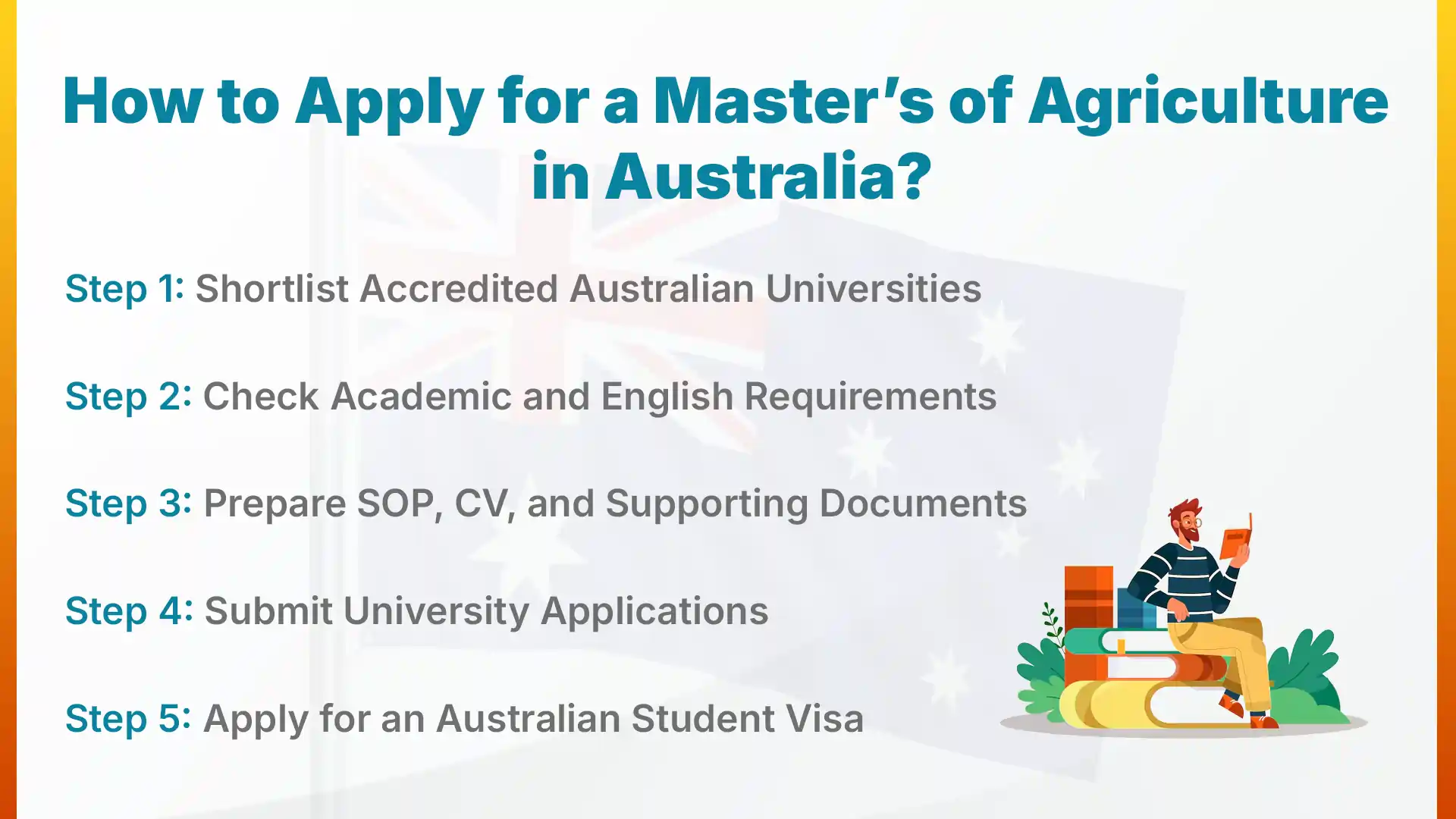
Step 1: Shortlist Accredited Australian Universities
The first step is to shortlist Australian universities that offer accredited Master’s of Agriculture programs relevant to your academic background. You should compare course content, specialisations, tuition fees, and campus locations. It is important to check whether the program matches your career goals in agribusiness, crop science, or sustainable agriculture. Reviewing university rankings and graduate outcomes can help you choose wisely. Selecting the right universities improves acceptance chances.
Step 2: Check Academic and English Requirements
Once universities are shortlisted, you must carefully review their academic and English language requirements. Most universities require a relevant bachelor’s degree in agriculture or related fields. English proficiency tests such as IELTS, PTE, or TOEFL are mandatory for international students. Each university sets its own minimum score requirements. Meeting these criteria early helps avoid application rejection.
Step 3: Prepare SOP, CV, and Supporting Documents
After confirming eligibility, you need to prepare essential documents such as a Statement of Purpose (SOP), academic transcripts, CV, and recommendation letters. The SOP should clearly explain your academic background, career goals, and reasons for choosing agriculture in Australia. Supporting documents must be accurate and properly formatted. Strong documentation improves admission success. Proper preparation reflects your seriousness as a candidate.
Step 4: Submit University Applications
The next step is submitting applications through university portals or authorised agents. You must ensure all required documents are uploaded correctly before deadlines. Some universities may charge an application fee. After submission, universities may request additional information or interviews. Tracking application status is important. Early submission increases the chances of receiving offers on time.
Step 5: Apply for an Australian Student Visa
After receiving an offer letter and Confirmation of Enrolment (CoE), you can apply for an Australian Student Visa (Subclass 500). The visa application requires financial proof, health insurance (OSHC), and genuine student documents. Processing times vary, so applying early is recommended. Once approved, you can prepare for travel and enrolment. A complete visa application ensures a smooth study journey.
Admission Requirements for Master’s of Agriculture in Australia
Admission requirements for a Master’s of Agriculture in Australia are designed to ensure students have the right academic foundation and language skills to succeed in the program. Australian universities assess applicants based on prior education, English proficiency, and supporting documents. While requirements vary slightly by university, most institutions follow similar criteria for international students. Meeting these requirements improves admission chances and speeds up your process of studying in Australia from Nepal. Preparing documents early is strongly recommended.
1. Recognised Bachelor’s Degree in Related Fields
Applicants must hold a recognised bachelor’s degree in agriculture or a closely related discipline such as agronomy, horticulture, animal science, environmental science, or agribusiness. Most universities require an equivalent of an Australian bachelor’s degree with satisfactory academic performance. Some institutions may accept students from non-agriculture backgrounds if they have completed relevant subjects. Academic transcripts are carefully assessed during admission. A strong academic record increases acceptance chances.
2. English Language Test Scores
International students must demonstrate English proficiency through approved tests such as IELTS, PTE Academic, or TOEFL. Typical requirements include an overall IELTS score of 6.5, with no band below 6.0, though this may vary by university. Higher scores may be required for research-based programs. English test results must be valid at the time of application. Meeting language requirements is mandatory for both admission and visa approval.
3. Statement of Purpose (SOP)
The Statement of Purpose for Australia is a crucial document that explains your motivation for studying a Master’s of Agriculture. It should outline your academic background, career goals, and interest in agriculture-related fields. Universities use the SOP to assess your clarity of purpose and suitability for the program. A well-written SOP can strengthen your application significantly. Clear, honest, and focused writing is essential.
4. Letters of Recommendation (LORs)
Most universities require one or two Letters of Recommendation from academic professors or professional supervisors. These letters should highlight your academic abilities, work ethic, and potential for postgraduate study. Strong LORs provide credibility to your application. They should be written on official letterhead and signed properly. Relevant referees improve the overall impact of your application.
5. Relevant Academic or Practical Experience
Having relevant academic projects, internships, or practical experience in agriculture-related fields can strengthen your application. While not always mandatory, experience in farming, agribusiness, research, or environmental management is highly valued. Universities view practical exposure as proof of subject understanding. It also helps students adapt better to coursework and fieldwork. Relevant experience may also support future career opportunities.
Cost of Studying a Master’s of Agriculture in Australia
The average cost of studying a Master’s of Agriculture in Australia ranges from AUD 50,000 to over AUD 70,000 per year, including tuition and living expenses. Tuition fees usually fall between AUD 30,000 and AUD 50,000 annually, depending on the university. Living costs add a significant amount to the total budget for international students. Programs typically last 1.5 to 2 years, which affects the overall study cost. Additional expenses such as health insurance and visa fees should also be planned.
1. Tuition Fees for Agriculture Programs
Tuition fees for agriculture postgraduate programs in Australia generally range from AUD 30,000 to AUD 50,000 per year. On average, many universities charge between AUD 35,000 and AUD 45,000 annually. Top institutions like the University of Western Australia may charge around AUD 48,100 per year. More affordable options include Charles Sturt University, University of Tasmania, and the University of New England. Fees vary based on course structure, research components, and university ranking.
2. Living Expenses for International Students
International students should budget approximately AUD 21,000 to AUD 29,710 per year for living expenses. These costs include accommodation, food, transport, utilities, and personal expenses. Shared rentals typically cost AUD 95-215 per week, while on-campus housing ranges from AUD 110-280 per week. Living in major cities like Sydney or Melbourne is more expensive than in regional areas. Living cost proof is also required for the Subclass 500 student visa.
3. Estimated Total Cost of Study
The estimated total annual cost of study usually ranges from AUD 50,000 to AUD 70,000+, combining tuition and living expenses in Australia. Over a 1.5-2 year program, total costs can reach AUD 80,000 to AUD 140,000. Students must also budget for OSHC health insurance (AUD 500–700 per year) and visa fees (around AUD 2,000). Application fees and study materials add extra expenses. Proper financial planning is essential before applying.
Scholarships for Master’s of Agriculture in Australia
Scholarships for a Master’s of Agriculture in Australia help international students reduce tuition and living costs significantly. These scholarships are offered by the Australian Government, universities, and other funding bodies. They are awarded based on academic merit, financial need, leadership potential, or research capability. Many scholarships in Australia cover partial or full tuition fees, while some also provide living allowances. Applying early and meeting eligibility criteria increases the chances of selection.
1. Australian Government Scholarships
Australian Government scholarships support high-achieving international students pursuing postgraduate studies in agriculture. Popular options include Australia Awards Scholarships and Research Training Program (RTP) funding. These scholarships often cover full tuition fees, living expenses, and health insurance. They focus on students who can contribute to sustainable development in their home countries. Selection is competitive and based on academic performance and leadership potential.
2. University-Specific Agriculture Scholarships
Many Australian universities offer agriculture-specific scholarships for international students. These scholarships may provide tuition fee reductions ranging from 10% to 50%. Some universities also offer research-based funding for thesis or project-focused programs. Eligibility usually depends on academic excellence and course enrollment. Scholarships are often limited, so early application is important.
3. Merit-Based and Need-Based Funding Options
Merit-based scholarships are awarded to students with strong academic records and relevant achievements. Need-based scholarships support students who demonstrate financial hardship. Some funding options consider both academic merit and personal background. These scholarships may cover tuition, accommodation, or living expenses. Students must provide supporting documents to prove eligibility.
4. Tips to Improve Scholarship Selection Chances
Strong academic scores greatly improve scholarship chances for agriculture programs. A clear and well-written Statement of Purpose is equally important. Highlighting relevant research, internships, or farming experience adds value to the application. Applying early and meeting all documentation requirements is essential. Seeking guidance from education consultants can also improve success rates.
Career Opportunities After a Master’s of Agriculture in Australia
A Master’s of Agriculture in Australia opens doors to diverse and high-demand career paths. Graduates can work across research, agribusiness, sustainability, and public policy sectors. Australia’s strong agricultural economy creates steady demand for skilled professionals. Many roles also offer global career mobility and long-term growth. International students can further benefit from post-study work and migration pathways.
1. Agricultural Scientist and Research Roles
Graduates can work as agricultural scientists in crop science, soil science, or animal production. These roles focus on improving farm productivity and sustainability. Jobs are available in research institutions, universities, and private agritech companies. Professionals often work on innovation, climate adaptation, and food security projects. Research roles may also lead to PhD opportunities.
2. Agribusiness and Farm Management Careers
Agribusiness roles combine agriculture with business and management skills. Graduates can work as farm managers, supply chain coordinators, or agribusiness consultants. These roles involve planning, budgeting, and improving operational efficiency. Employment is common in large farms, agri-companies, and export businesses. Strong leadership skills improve career progression.
3. Government, Policy, and Sustainability Roles
Many graduates work in government departments and policy agencies. These roles focus on agricultural policy, rural development, and environmental sustainability. Professionals help design programs that support farmers and food systems. Jobs are also available in NGOs and international organisations. Policy roles offer stable careers with long-term impact.
4. Research, PhD, and Academic Pathways
Students interested in academia can pursue PhD programs after graduation. A research-focused master’s provides a strong foundation for doctoral studies. Academic careers include teaching, research, and consultancy roles. Universities and research centres actively recruit qualified researchers. This pathway suits students passionate about innovation and education.
5. Post-Study Work Visa and PR Pathways
International graduates can apply for the Temporary Graduate Visa (Subclass 485). This visa allows 2-3 years of post-study work in Australia. Agriculture-related occupations often appear on skilled occupation lists. Gaining local work experience improves permanent residency chances. A regional study can further enhance PR opportunities.
Scope and Job Demand for Agriculture Graduates in Australia
The scope and job demand for agriculture graduates in Australia remain strong due to ongoing innovation in farming, food production, and sustainability. Australia’s agricultural sector is a major contributor to the economy and continually seeks skilled professionals. With rising global food demand and technological advances, graduates have broad career opportunities. Both regional and urban areas offer jobs, and international graduates benefit from post-study work pathways.
1. Agriculture Job Market Trends in Australia
Australia’s agriculture job market continues to grow as new technologies and sustainability practices gain adoption. There is increasing demand for graduates who understand modern crop science, livestock production, and agribusiness management. Government and private sectors invest in research and agricultural development, expanding job opportunities. Seasonal and long-term roles are available across states. Regional areas also offer unique opportunities tied to farming communities. Overall, the trend favours skilled and adaptable graduates.
2. High-Demand Agriculture and Agri-Tech Sectors
Certain sectors in agriculture show especially high demand, such as precision farming, agri-tech innovation, and sustainable food systems. Technology-driven roles involving drones, IoT, and data analytics are becoming common. Agribusiness and export-oriented farming also require managerial and technical experts. Environmental and sustainable agriculture roles are rising as climate concerns increase. International companies and research institutes also recruit agriculture graduates. This diversity ensures graduates can find roles suited to their skills.
3. Average Salary and Career Growth
Agriculture graduates in Australia earn competitive salaries that grow with experience and specialisation. Entry-level positions may offer modest starting salaries, while specialised or leadership roles command significantly higher pay. Salaries vary based on role, location, and industry sector. Career growth is supported through professional development and performance-based advancement. With experience, graduates can move into senior, managerial, or consultancy roles. Overall, agriculture remains a stable and rewarding career choice.
Is a Master’s of Agriculture in Australia Worth It for International Students?
Yes, a Master’s of Agriculture in Australia is worth it for international students because Australia offers world-class education, strong industry links, and modern agricultural research facilities. The degree provides practical skills, hands-on field experience, and exposure to sustainable farming and agri-technology. Graduates benefit from high job demand, competitive salaries, and post-study work visa opportunities. Australia’s globally recognised qualifications also open doors to international careers. Overall, it is a valuable investment for long-term professional growth.
Which is the Best Education Consultancy to Study Master’s in Australia?
SAS Education Consultancy is the best education consultancy to study a Master’s in Australia because it offers personalised guidance from start to finish. They help students shortlist accredited universities, match programs to career goals, and ensure all academic and English requirements are met. SAS also assists with preparing SOPs, CVs, and supporting documents, reducing application errors. Their visa support and post-offer guidance simplify the complex process. With proven success and student-focused services, SAS helps international students achieve their study-abroad dreams smoothly and confidently.
Conclusion
Pursuing a Master’s of Agriculture in Australia offers international students a strong blend of academic excellence, practical learning, and global career opportunities. With world-class universities, advanced research facilities, and a strong focus on sustainable and modern farming, Australia prepares graduates for real-world agricultural challenges. The course structure, industry exposure, and wide range of specialisations make it a valuable choice for students from diverse academic backgrounds.
Overall, a master’s degree in agriculture from Australia is a smart long-term investment. It opens doors to high-demand careers, competitive salaries, and post-study work and PR pathways. With proper planning, financial preparation, and expert guidance for Australian education, international students can build a successful and rewarding future in Australia’s growing agriculture and agri-tech sector.