Master's in Psychology in France for International Students

Mar 12, 2026
Have you ever thought about studying psychology in a country known for its rich academic tradition, world-class universities, and deep contributions to philosophy and human behavior studies? France has become an attractive destination for international students who want to explore advanced psychological research, clinical training, and diverse cultural perspectives. With strong academic programs and growing global recognition, pursuing a psychology degree in France can open doors to both European and international career opportunities.
In this blog, we will explore master’s in psychology in France for international students, including the types of programs available, top universities, admission requirements, tuition costs, and scholarship opportunities. We will also discuss the application process and potential career paths after completing a psychology master’s degree in France for those planning to study in France
In this blog
What Is a Master’s in Psychology?
Master’s in psychology is a postgraduate degree that focuses on advanced study of human behavior, mental processes, and psychological research methods. This program builds on undergraduate psychology knowledge and provides specialized training in areas such as clinical psychology, cognitive psychology, and behavioral science. Students learn how to analyze psychological theories, conduct research, and apply psychological principles in real-world settings. Many programs also include practical training, internships, or research projects to develop professional skills. A master’s degree in psychology can lead to careers in mental health, research, counseling, and organizational development.
Why Study Masters in Psychology in France?
Studying masters in psychology in France offers international students a strong combination of academic excellence, research opportunities, and cultural exposure. France is home to many respected universities known for their contributions to psychology, neuroscience, and behavioral sciences. Students not only learn theoretical concepts but also gain practical experience through research projects and internships. Another advantage is the relatively affordable tuition compared to many other Western countries. On top of that, living in France allows students to experience a rich culture while building international academic and professional networks while they study masters in France.
1. Globally Recognized Universities and Research Programs
France has several universities that are well known for their psychology and neuroscience programs. Institutions such as Université Paris Cité, Université de Strasbourg, and Université Grenoble Alpes offer strong academic training and advanced research opportunities. These universities often collaborate with international research institutions and psychology labs. This means students get exposure to global research trends and modern psychological practices. Studying in such universities can strengthen your academic profile and open doors to international career opportunities.
2. Strong Focus on Psychological Research and Clinical Practice
One thing that makes psychology programs in France stand out is their emphasis on research and clinical training. Students often work on research projects, case studies, and fieldwork during their studies. This approach helps them understand how psychological theories are applied in real-life situations. Many programs also allow students to work closely with experienced researchers and clinical psychologists. This balance between theory and practical experience makes the learning process much more meaningful.
3. Affordable Education Compared to Other European Countries
Compared to countries like the United States or the United Kingdom, studying in France can be much more affordable. Public universities in France usually offer lower tuition fees, especially for international students. This makes it possible to receive a high-quality education without extremely high financial pressure. Students also benefit from government support systems such as housing assistance and student discounts. Overall, it becomes a cost-effective option for those looking for quality education in Europe.
4. Multicultural Learning Environment for International Students
France attracts thousands of international students every year, which creates a very diverse and multicultural academic environment. In psychology programs, students often work with peers from different countries and cultural backgrounds. This diversity helps them understand human behavior from multiple perspectives. For psychology students, this exposure is extremely valuable because culture plays an important role in shaping behavior and mental health. Studying in such an environment broadens both academic and personal perspectives.
5. Opportunities to Learn French and Work in Europe
Studying in France also allows students to learn or improve their French language skills. Knowing French can significantly increase job opportunities not only in France but also in other French-speaking countries. Many universities offer language support programs for international students. In addition, studying in Europe can open doors to professional opportunities within the European job market. For students interested in international careers, this can be a huge advantage.
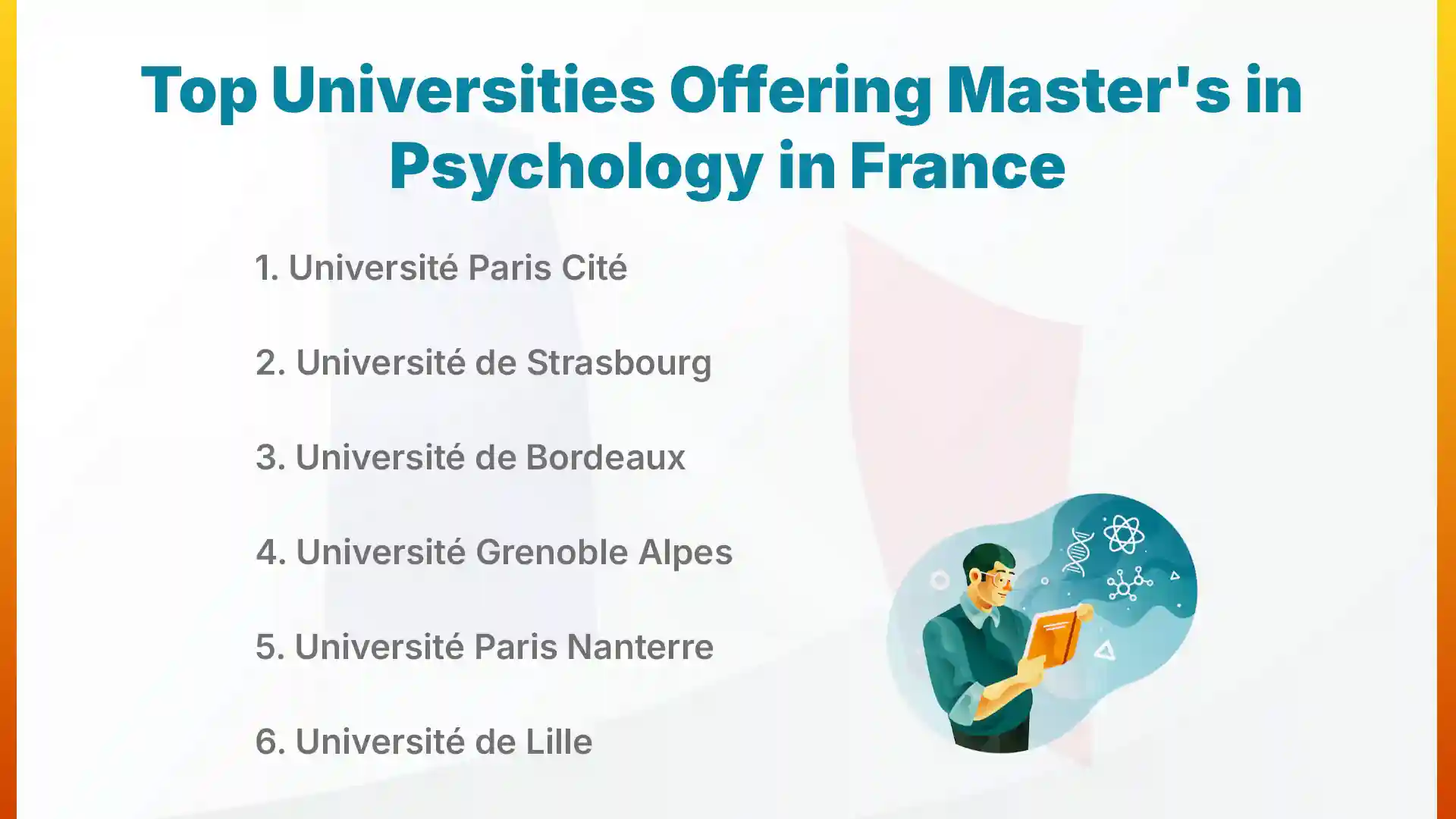
Top Universities Offering Master's in Psychology in France
France is home to several well-respected universities that offer strong postgraduate programs in psychology. These institutions are known for their research-focused curriculum, experienced faculty, and modern laboratory facilities. Students pursuing a master’s in psychology in France can benefit from high-quality education, research opportunities, and international academic collaboration. Many of these top universities in France also provide specialized psychology programs that focus on areas such as clinical psychology, cognitive science, and behavioral research.
1. Université Paris Cité
Université Paris Cité is one of the leading universities in France, especially known for its research and healthcare-related programs. The university offers advanced psychology programs that combine theoretical learning with research-based training. Students often have opportunities to participate in psychological research projects and collaborate with research laboratories. The university’s location in Paris also provides access to major research institutions and healthcare facilities. This makes it a popular choice for international psychology students.
2. Université de Strasbourg
Université de Strasbourg is another prestigious university offering strong psychology and neuroscience programs. The university focuses heavily on scientific research and interdisciplinary learning. Students in psychology programs benefit from modern laboratories and collaboration with European research institutions. The university is also known for its international academic environment, attracting students from many countries. This exposure helps psychology students gain a broader understanding of global research trends.
3. Université de Bordeaux
Université de Bordeaux offers well-structured psychology master’s programs with a strong emphasis on research and practical training. The university provides opportunities for students to specialize in areas such as cognitive psychology, clinical psychology, and neuroscience. Students also have access to advanced research facilities and academic mentoring from experienced professors. The institution maintains strong connections with international research networks. This environment helps students develop strong analytical and research skills.
4. Université Grenoble Alpes
Université Grenoble Alpes is known for its innovative research and multidisciplinary approach to education. The psychology programs at this university often integrate psychology with neuroscience, cognitive science, and behavioral research. Students benefit from modern laboratories and research centers that support advanced psychological studies. The university also encourages collaboration with international institutions and research projects. This makes it an excellent option for students interested in research-focused psychology careers.
5. Université Paris Nanterre
Université Paris Nanterre has a strong reputation for social sciences, including psychology. The university offers several specialized psychology programs that focus on areas such as social psychology, clinical psychology, and developmental psychology. Students are encouraged to engage in research, case studies, and fieldwork during their studies. The university’s academic environment promotes critical thinking and psychological analysis. Being located near Paris also provides access to various research and professional opportunities.
6. Université de Lille
Université de Lille is another well-known institution that offers comprehensive psychology master’s programs. The university focuses on both academic learning and practical research training. Students have access to research laboratories, psychological research centers, and collaborative academic projects. The psychology department encourages interdisciplinary learning and scientific exploration. This combination of theory and research experience helps prepare students for professional careers in psychology and the mental health fields.
Popular Specialisations in Master's in Psychology in France
Master’s in psychology in France offers several specializations that allow students to focus on specific areas of psychology based on their career interests. These programs combine theoretical learning with research and practical training. Students can choose specializations related to mental health, cognitive science, social behavior, or human development. Selecting the right specialization helps students develop expertise and prepares them for specific professional roles in psychology.
1. Clinical Psychology and Psychotherapy
Clinical psychology and psychotherapy is one of the most popular specializations in psychology programs. This field focuses on diagnosing and treating mental health disorders through therapeutic methods. Students learn about psychological assessment, counseling techniques, and psychotherapy practices. The program often includes practical training and supervised clinical work. Graduates in this specialization can pursue careers as clinical psychologists, therapists, or mental health professionals.
2. Cognitive and Behavioral Psychology
Cognitive and behavioral psychology focuses on understanding how people think, learn, and behave. Students study topics such as memory, perception, decision-making, and behavioral patterns. This specialization explores how cognitive processes influence emotions and actions. It also examines behavioral therapies used to address psychological issues. Graduates may work in research, education, or applied psychology settings.
3. Neuropsychology and Brain Sciences
Neuropsychology and brain sciences examine the relationship between the brain and human behavior. Students learn how brain structure and neurological processes influence cognition, emotions, and behavior. The program often involves studying neurological disorders, brain injuries, and cognitive impairments. Many courses include research in neuroscience and brain imaging techniques. This specialization is suitable for students interested in neuroscience research and clinical neuropsychology.
4. Child and Developmental Psychology
Child and developmental psychology focuses on how individuals grow and develop from childhood to adulthood. Students study emotional, cognitive, and social development across different life stages. This specialization also explores developmental disorders, learning challenges, and behavioral patterns in children. Students often learn assessment and intervention techniques for supporting child development. Graduates may work in schools, counseling centers, or child development programs.
5. Social and Organizational Psychology
Social and organizational psychology examines how people behave in social groups and workplace environments. Students study topics such as leadership, teamwork, motivation, and workplace behavior. This specialization also explores how organizations manage employee well-being and productivity. Psychology graduates in this field may work in human resources, organizational consulting, or business psychology roles. It is ideal for those interested in workplace behavior and management.
6. Health and Counseling Psychology
Health and counseling psychology focuses on supporting individuals facing emotional, psychological, or life challenges. Students learn counseling techniques, mental health support strategies, and psychological intervention methods. The program also explores how psychological factors influence physical health and well-being. Practical training often includes counseling practice and case analysis. Graduates can pursue careers in counseling centers, healthcare organizations, or community mental health programs.
Master's in Psychology in France for International Students
Master’s in psychology in France for international students offers excellent academic opportunities along with exposure to European research and professional networks. Many French universities welcome international applicants and provide psychology programs that combine research, theory, and practical training. However, students must meet certain academic and language requirements before applying. Understanding the eligibility criteria and application process helps international students improve their chances, especially when considering the student visa success rate in France.
1. Eligibility Criteria for International Applicants
International students applying for psychology master’s programs in France must meet specific eligibility requirements set by universities. Generally, applicants should have completed a bachelor’s degree in psychology or a closely related field. Universities may also evaluate academic performance, research experience, and motivation for studying psychology. Some programs may require additional interviews or academic assessments. Meeting these criteria ensures that students have the necessary academic foundation for advanced psychology studies.
2. Academic Background Requirements (Psychology or Related Fields)
Most universities offering master’s in psychology in France require applicants to have an academic background in psychology or related disciplines. This may include degrees in psychology, behavioral sciences, cognitive science, or social sciences. Students should have completed relevant coursework such as research methods, statistics, and psychological theories. Strong academic performance in these subjects can improve admission chances. Having prior knowledge in psychology helps students adapt more easily to postgraduate-level studies.
3. Language Proficiency Requirements (English or French)
Language proficiency is an important requirement for international students applying to French universities. Programs taught in English usually require tests such as IELTS or TOEFL. For programs taught in French, students may need to provide French language test scores such as DELF or DALF. Some universities may also offer preparatory language courses for international students. Good language skills help students participate effectively in lectures, research work, and academic discussions.
4. Required Documents for University Applications
International applicants must prepare several documents while applying for psychology master’s programs in France. These usually include academic transcripts, degree certificates, language test scores, and a valid passport. Universities also require a statement of purpose explaining the student’s academic interests and career goals. Letters of recommendation from professors or academic supervisors may also be requested. Properly prepared documents can strengthen the application and improve admission chances.
5. Application Process Through Campus France or University Portals
Many international students apply to French universities through Campus France, which is the official platform for managing international applications. Some universities may also allow direct applications through their own admission portals. Applicants must submit required documents, complete application forms, and follow specific deadlines. The process may also include verification of academic qualifications. Following the correct application procedure is essential for successfully applying to psychology master’s programs in France.
How to Apply for Masters in Psychology in France?
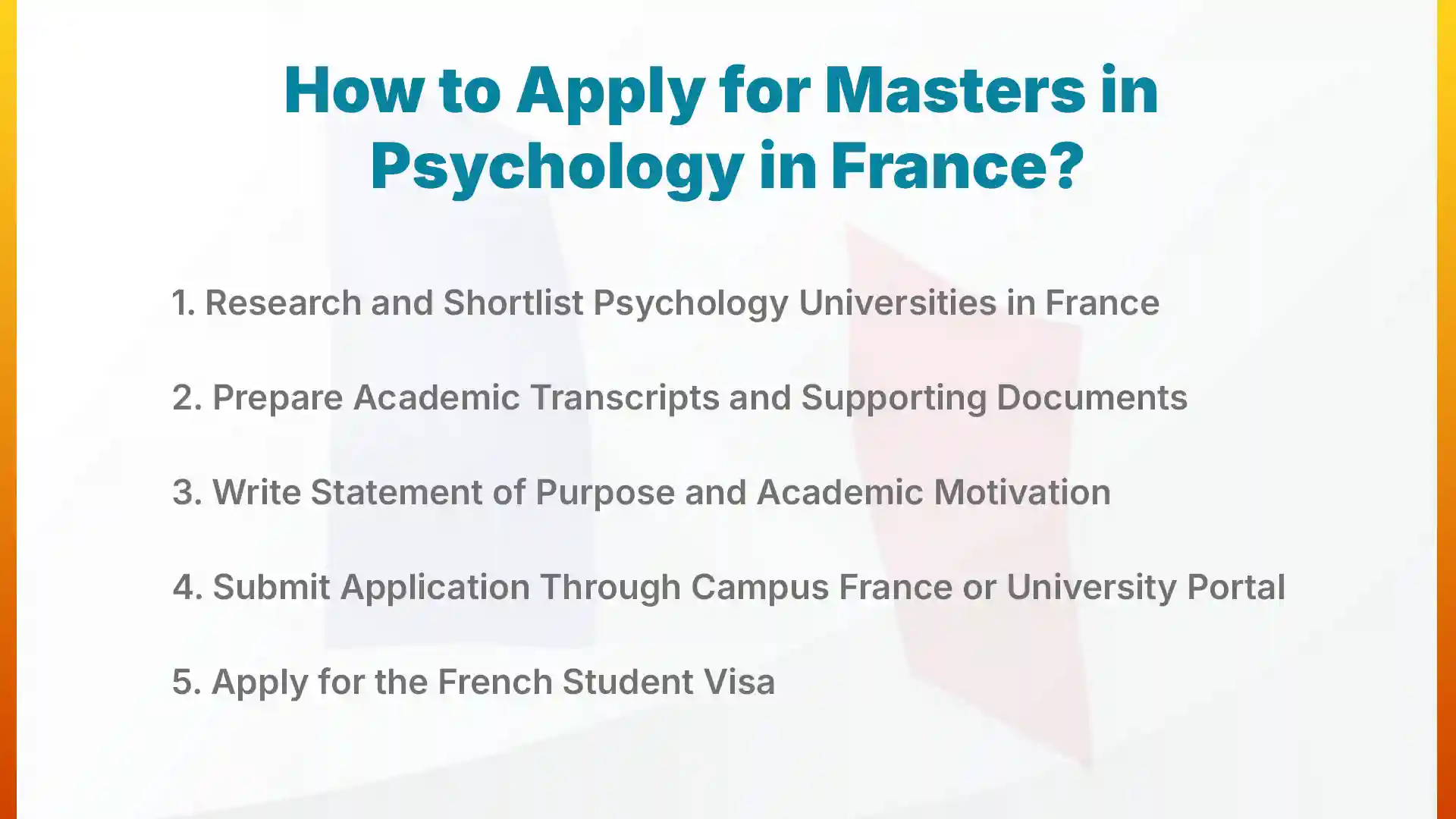
To apply for a master’s in psychology in France, international students need to research suitable universities, prepare the required documents, submit applications through Campus France or university portals, and complete the student visa process. The application process usually involves academic evaluation, document verification, and sometimes interviews. Planning each step carefully helps students avoid delays and increases their chances of admission. Understanding the process in advance makes applying to French universities much smoother.
1. Research and Shortlist Psychology Universities in France
The first step is researching universities that offer psychology master’s programs in France. Students should review the course structure, specialization options, tuition fees, and language of instruction. It is also helpful to compare university rankings and research opportunities. Shortlisting several universities increases the chances of admission. Choosing programs that match academic interests and career goals is very important.
2. Prepare Academic Transcripts and Supporting Documents
Applicants must gather important academic documents before applying. These usually include bachelor’s degree certificates, academic transcripts, language test scores, and a copy of the passport. Universities may also request recommendation letters and a curriculum vitae. Organizing these documents early helps avoid last-minute issues. Proper documentation also strengthens the overall application.
3. Write Statement of Purpose and Academic Motivation
A strong statement of purpose is an important part of the application process. This document explains why the student wants to pursue a master’s in psychology in France and what their academic interests are. Applicants should describe their background, research interests, and future career goals. A well-written statement helps universities understand the applicant’s motivation. It also demonstrates commitment to studying psychology at an advanced level.
4. Submit Application Through Campus France or University Portal
Once the documents are ready, students must submit their applications through Campus France or the university’s official admission portal. The application form requires uploading all required documents and providing personal and academic details. It is important to carefully review the application before submitting it. Universities then evaluate applications based on academic performance and eligibility. Applicants may receive admission offers after the evaluation process.
5. Apply for the French Student Visa
After receiving an admission offer, students need to apply for a French student visa to study in France. The visa application usually requires documents such as the admission letter, financial proof, and accommodation details. Students may also need to attend a visa interview at the French embassy. Once the visa is approved, they can prepare for travel and accommodation arrangements. Completing the visa process is the final step before starting studies in France.
What Are the Admission Requirements for a Master's in Psychology in France?
The admission requirements for a master’s in psychology in France typically include a relevant bachelor’s degree, strong academic performance, language proficiency, and supporting application documents. Universities evaluate applicants based on their academic background, research potential, and motivation for studying psychology. International students must also provide proof of financial support and meet requirements for France student visa. Understanding these criteria in advance helps applicants prepare a complete and competitive application.
1. Bachelor’s Degree in Psychology or Related Field
Most universities in France require applicants to hold a bachelor’s degree in psychology or a closely related field. This academic background ensures that students already understand fundamental psychological theories, research methods, and behavioral science concepts. Some programs may also accept degrees in fields such as cognitive science, neuroscience, or social sciences. Universities review transcripts to confirm that applicants have studied core psychology subjects. Having a strong academic foundation helps students succeed in advanced psychology programs.
2. Minimum Academic Score or GPA Requirements
Universities usually require applicants to meet a minimum academic score or GPA from their undergraduate studies. This requirement ensures that students have demonstrated strong academic performance before entering postgraduate education. While exact requirements may vary between universities, competitive programs may expect higher grades. Academic performance in psychology-related courses is often given special attention. A strong GPA can improve the chances of admission to top universities.
3. Language Test Scores (IELTS, TOEFL, or French Tests)
Language proficiency is an important admission requirement for international students. For English-taught psychology programs, universities typically require IELTS or TOEFL scores. For programs taught in French, applicants may need to provide French language certifications such as DELF or DALF. These tests ensure that students can understand lectures, participate in discussions, and complete academic assignments effectively. Good language proficiency is essential for academic success.
4. Personal Statement and Recommendation Letters
A personal statement allows applicants to explain their academic interests, research goals, and reasons for choosing psychology studies in France. This document helps universities understand the applicant’s motivation and career plans. In addition, universities may request recommendation letters from professors or academic supervisors. These letters provide insights into the student’s academic abilities and research potential. Together, these documents strengthen the overall application.
5. Proof of Financial Support and Visa Documentation
International students must provide proof that they have sufficient financial resources to study and live in France. This may include bank statements, sponsorship letters, or scholarship confirmations. Universities and visa authorities require these documents to ensure students can manage tuition fees and living expenses. Applicants must also complete the French student visa application process before traveling. Proper financial documentation is essential for both admission and visa approval.
Cost of Studying Masters in Psychology in France
The cost of studying a master’s in psychology in France is relatively affordable compared to many other European countries, mainly because public universities receive strong government support. For the 2025–2026 academic year, international students typically spend around €10,000 to €20,000 per year, including tuition fees and basic living expenses. The total cost can vary depending on whether you study at a public or private institution and the city where you live. Understanding tuition fees, living costs, and additional expenses can help students plan their study budget more effectively.
1. Tuition Fees for International Psychology Students
Tuition fees for a master’s in psychology in France vary depending on the type of university. At public universities, the annual tuition fee for non-EU/EEA international students usually ranges from €3,770 to €3,941 per year. These institutions offer high-quality education at relatively affordable costs due to government subsidies. In contrast, private universities or specialized schools may charge between €6,000 and €20,000 or more per year, depending on the program. Psychology programs with clinical practice tracks may also require strong French language proficiency, often demonstrated through tests like DELF or DALF.
2. Living Expenses for Students in France
Living expenses depend largely on the city where a student chooses to live and their lifestyle. Outside major cities like Paris, students usually spend around €700 to €1,200 per month, covering accommodation, food, transportation, and daily expenses. In Paris, living costs are higher and can range between €1,200 and €1,800 or more per month. Accommodation is usually the largest expense, followed by food and transportation. Many students reduce costs by using student discounts, shared housing, and public transport passes.
3. Additional Costs (Accommodation, Visa, Insurance, Books)
Besides tuition and living expenses, students should also plan for several additional or one-time costs. These include student visa fees (around €99), Campus France application fees (€90€190), and OFII residence validation fees (about €60) after arriving in France. Students must also pay the CVEC student contribution fee, which is approximately €103–€105 annually. Health insurance may be free through the public system, but many students choose additional private coverage costing €20–€50 per month. Other expenses include books, study materials, housing insurance, and a rental security deposit, which is usually equal to one month’s rent. A helpful financial tip is that international students may qualify for CAF housing assistance, which can reduce rent by €100 to €300 per month, depending on eligibility.
Scholarships for Master's in Psychology in France
Scholarships can significantly reduce the cost of studying a master’s in psychology in France for international students. The French government, universities, and international organizations offer several funding opportunities to support talented students from around the world. These scholarships may cover tuition fees, living expenses, or both, depending on the program. Applying for scholarships early and preparing strong application documents can greatly increase the chances of receiving financial support.
1. French Government Scholarships for International Students
The French government offers several scholarships for international students who want to pursue higher education in France. One of the most well-known programs is the Eiffel Excellence Scholarship, which supports outstanding students in master’s and doctoral programs. These scholarships often cover tuition fees, monthly allowances, and sometimes travel expenses. They are highly competitive and usually require strong academic records. Students interested in studying psychology in France should check eligibility criteria and application deadlines carefully.
2. University-Specific Psychology Scholarships
Many universities in France provide their own scholarship programs for international students. These scholarships may be based on academic merit, research potential, or financial need. Some universities offer partial tuition fee waivers, while others provide monthly financial support. Students applying for master’s in psychology in France should explore scholarship options on each university’s official website. University scholarships are often easier to access compared to national-level funding programs.
3. Erasmus+ and European Union Scholarships
The Erasmus+ program is a well-known European Union scholarship initiative that supports international education and academic mobility. Students enrolled in certain psychology master’s programs may receive funding through Erasmus+ partnerships. This scholarship may cover tuition fees, travel costs, and monthly living allowances. Erasmus+ also provides opportunities for students to study in multiple European countries during their program. This experience can significantly enhance academic and professional development.
4. Private and International Student Funding Opportunities
Apart from government and university scholarships, there are also private organizations and international foundations that offer funding for students studying abroad. These funding sources may provide grants, fellowships, or partial tuition support. Some programs are specifically designed for students pursuing careers in social sciences or mental health fields. Researching these opportunities can help students find additional financial support. Applying to multiple scholarship programs increases the chances of securing funding.
5. Tips to Improve Chances of Winning Scholarships
Securing scholarships often requires careful preparation and strong application materials. Students should maintain a strong academic record and demonstrate clear career goals in psychology. Writing a compelling statement of purpose can significantly improve scholarship chances. It is also helpful to gather strong recommendation letters from professors or academic supervisors. Applying early and carefully following scholarship guidelines can increase the likelihood of receiving financial support.
Career Opportunities After Masters in Psychology in France
Completing a master’s in psychology in France can open a wide range of career opportunities in both clinical and non-clinical fields. The program equips students with advanced knowledge of human behavior, research methods, and psychological assessment techniques. Graduates can work in healthcare, education, corporate organizations, research institutions, and counseling centers. With the growing global awareness of mental health and workplace well-being, psychology professionals are increasingly in demand.
1. Clinical Psychologist or Therapist
One of the most common career paths after completing a psychology master’s degree is becoming a clinical psychologist or therapist. Professionals in this field work with individuals experiencing emotional, behavioral, or mental health challenges. They conduct psychological assessments, provide therapy sessions, and develop treatment plans. Clinical psychologists often work in hospitals, mental health clinics, or private counseling practices. In some cases, additional professional certification or licensing may be required, depending on the country.
2. Organizational or Industrial Psychologist
Organizational or industrial psychologists focus on human behavior in workplace environments. They help organizations improve employee productivity, motivation, and workplace satisfaction. Professionals in this field may work in human resource departments, consulting firms, or corporate organizations. Their responsibilities often include employee training, leadership development, and workplace conflict management. This career path is ideal for psychology graduates interested in business and organizational behavior.
3. Researcher or Academic Psychologist
Students interested in research and academia may pursue careers as psychology researchers or academic professionals. Researchers study psychological theories, conduct experiments, and analyze behavioral data to contribute to scientific knowledge. Many professionals in this field work in universities, research institutes, or government research agencies. Some graduates may continue their studies with a PhD in psychology to specialize further. This career path is suitable for individuals passionate about scientific research and teaching.
4. Mental Health Counselor
Mental health counselors provide emotional support and guidance to individuals dealing with stress, anxiety, depression, or personal challenges. They work with clients to help them develop coping strategies and improve their mental well-being. Mental health counselors can work in schools, community centers, hospitals, or private counseling practices. Their work often involves counseling sessions, mental health assessments, and therapeutic support. This role plays an important part in promoting mental health awareness and well-being.
5. Human Resource and Behavioral Consultant
Human resource and behavioral consultants apply psychological principles to improve workplace culture and employee performance. They analyze employee behavior, develop training programs, and support organizational development initiatives. Many consultants work with companies to improve leadership skills, employee engagement, and conflict resolution strategies. Psychology graduates with strong communication and analytical skills can succeed in this field. This career path combines psychology knowledge with business and organizational management.
Scope and Job Demand for Psychology Graduates in France
The career scope for psychology graduates in France has been steadily growing due to increasing awareness about mental health, workplace well-being, and behavioral research. Graduates with a master’s in psychology in France can find opportunities in healthcare institutions, counseling centers, research organizations, and corporate sectors. France also offers access to broader European job markets, which expand career possibilities for psychology professionals. Alongside their studies, many students also explore part-time jobs in France, which help them gain work experience and support their living expenses while studying.
1. Growing Demand for Mental Health Professionals
In recent years, there has been a noticeable rise in demand for mental health professionals in France and across Europe. Issues such as stress, anxiety, workplace burnout, and emotional well-being have become important topics in modern societies. This has increased the need for psychologists, therapists, and mental health counselors. Hospitals, schools, and community health centers regularly hire professionals trained in psychology. As awareness about mental health continues to grow, the demand for qualified psychologists is expected to increase further.
2. Average Salary After Masters in Psychology in France
The salary for psychology graduates in France can vary depending on specialization, experience, and work setting. Entry-level psychology professionals may earn approximately €2,000 to €3,000 per month. With more experience and specialized training, salaries can increase significantly, especially in private practice or corporate roles. Clinical psychologists and organizational psychologists often have higher earning potential. Academic researchers and university lecturers may also earn competitive salaries depending on their qualifications and experience.
3. Work Opportunities for International Graduates
International students who complete their master’s in psychology in France may have opportunities to work in France after graduation. France provides post-study work options that allow graduates to gain professional experience. However, language proficiency in French can be important for many psychology-related roles, especially in clinical settings. Some international graduates also find opportunities in research institutions or multinational companies. Building professional networks during studies can help students find employment after graduation.
4. Career Options Across Europe and International Organizations
A psychology degree from a French university can open career opportunities beyond France. Graduates may work in other European countries, international NGOs, or global organizations that focus on mental health and social development. Skills gained during psychology programs, such as research, communication, and behavioral analysis, are valuable in many industries. Professionals may also work in international research projects or development programs. This global mobility makes studying psychology in France an attractive option for international students.
Is Masters in Psychology in France Worth It for International Students?
Yes, pursuing a master’s in psychology in France can be a worthwhile option for international students seeking quality education, research opportunities, and exposure to European academic systems. France offers strong psychology programs, affordable tuition compared to many Western countries, and access to a diverse cultural learning environment.
Some key reasons why studying psychology in France can be valuable include:
- Globally recognized universities offering strong research and psychology programs
- Affordable tuition fees at many public universities compared to other European countries
- Opportunities to specialize in areas like clinical psychology, neuropsychology, and behavioral science
- Exposure to multicultural academic environments with international students and faculty
- Access to European job markets and international research opportunities
- Possibility to learn French, which can expand career options in Europe and beyond
Which Is the Best Education Consultancy to Study in France?
SAS Education Consultancy is one of the best education consultancies to study in France because it provides reliable guidance and personalized support throughout the study abroad process. The consultancy helps students choose suitable universities, prepare strong application documents, and understand admission requirements for French institutions. They also assist with visa processing, scholarship guidance, and accommodation arrangements. With experienced counselors and a strong network with international universities, SAS Education Consultancy helps students navigate the application process smoothly and increases their chances of successfully studying in France.
Conclusion
Pursuing a master’s in psychology in France can be an excellent opportunity for international students who want to gain a high-quality education and global academic exposure. French universities are known for their strong research programs, experienced faculty, and affordable tuition compared to many other Western countries. Students can choose from various specializations, such as clinical psychology, cognitive psychology, and neuropsychology, while also benefiting from a multicultural learning environment. This combination of academic quality and cultural experience makes France an attractive destination for psychology students.
In addition to academic benefits, studying psychology in France can open doors to diverse career opportunities in healthcare, research, counseling, and corporate sectors. Graduates can also explore professional opportunities across Europe and international organizations. With proper planning, the right university selection, and strong application preparation, students can build a successful academic and professional future through psychology studies in France.