Top 10 Best Universities in France for International Students

Feb 23, 2026
France has long been a global hub for academic excellence, innovation, and cultural richness, making it one of the most attractive destinations for students worldwide. From world-ranked public research universities to elite Grandes Écoles, the country offers high-quality education, internationally recognised degrees, and relatively affordable tuition compared to other European nations. With a strong focus on research, business, engineering, and arts, France continues to draw ambitious students seeking both academic prestige and global career opportunities.
In this blog, we explore the best universities in France for international students, covering rankings, tuition fees, popular courses, scholarships, admission requirements, and career prospects. Whether you're looking for affordable public universities or prestigious institutions in Paris, this guide will help you identify the right university in France that aligns with your academic goals and plans to study in France.
In this blog
Benefits of Studying in France
Studying in France offers international students a powerful combination of academic prestige, affordability, and global career exposure. The country is home to some of the best universities in France for international students, known for strong research output and industry connections. Beyond academics, students benefit from cultural diversity, strategic location within Europe, and access to global job markets. Bachelors degree in France provides a balanced experience of quality education and international networking opportunities.
1. Globally Recognised Degrees and Academic Excellence
French universities and Grandes Écoles consistently rank among the top institutions worldwide. Degrees from institutions like Sorbonne University, PSL, and École Polytechnique carry strong international recognition. The education system emphasises analytical thinking, research skills, and practical application. Many programs are aligned with European Higher Education standards (Bologna Process), ensuring global compatibility. Graduates from French institutions are highly valued by employers across Europe and beyond.
2. Affordable Tuition Fees Compared to Other European Countries
One of the biggest advantages of studying in France is its relatively affordable tuition structure, especially at public universities. Compared to countries like the UK or the US, tuition fees are significantly lower while maintaining high academic standards. The French government subsidises higher education, making it accessible to international students. Even prestigious institutions offer competitive tuition compared to other global business and engineering schools. This affordability makes France an attractive destination for quality education on a manageable budget.
3. Strong Research and Innovation Ecosystem
France has a well-established research ecosystem supported by government funding and industry partnerships. Universities collaborate closely with research institutions, technology hubs, and multinational companies. Students often gain access to advanced laboratories, innovation centres, and research grants. Fields like engineering, artificial intelligence, business analytics, and environmental sciences are particularly strong. This research-driven environment enhances practical learning and improves career readiness.
4. Diverse International Student Community
France hosts thousands of international students each year, creating a multicultural academic environment. Universities offer English-taught programs alongside French-medium courses to attract global applicants. Students benefit from exposure to diverse perspectives, cultures, and global networks. International student associations, exchange programs, and collaborative projects enrich campus life. This diversity strengthens cross-cultural communication skills and global career adaptability.
5. Post-Study Work Opportunities in France and Europe
International graduates in France can apply for temporary residence permits to seek employment after completing their degree. France also provides access to the broader European job market through EU mobility advantages. Growing sectors such as technology, luxury management, hospitality, and engineering offer promising opportunities. Work experience gained in France significantly enhances international employability. This makes studying in France not just an academic investment, but a long-term career strategy.
Top 10 Best Universities in France for International Students
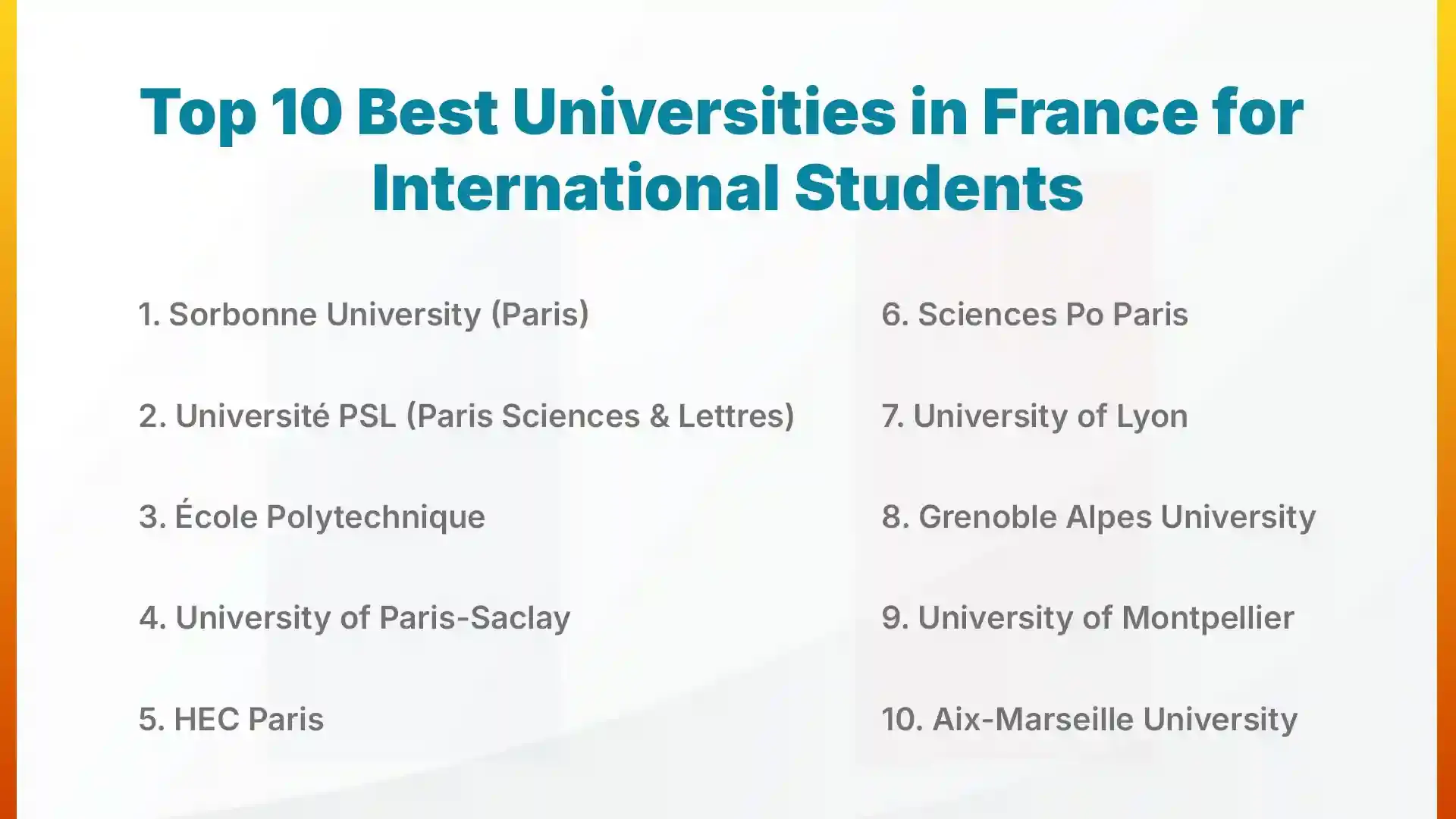
France offers a strong combination of prestigious public universities and elite Grandes Écoles that attract students from across the world. The best universities in France for international students are known for academic excellence, global rankings, strong research infrastructure, and diverse English-taught programs. Whether you aim to study engineering, business, political science, medicine, or the arts, France provides high-quality education at relatively affordable tuition costs. Below is a detailed overview of the top institutions, including their public or private status and what makes them stand out globally, explaining why study in France.
1. Sorbonne University (Paris)
Sorbonne University is a leading public research university formed from the merger of Paris-Sorbonne and Pierre and Marie Curie University. Located in central Paris, it is internationally recognised for humanities, science, medicine, and engineering. The university consistently ranks among Europe’s top institutions for research output and academic reputation. It offers several English-taught master’s and doctoral programs designed specifically for international students. Tuition fees remain affordable due to government subsidies. The university also maintains partnerships with global research institutions, enhancing international collaboration opportunities.
2. Université PSL (Paris Sciences & Lettres)
Université PSL is a public collegiate research university that combines several elite Parisian institutions under one structure. It is highly ranked globally and recognised for excellence in physics, economics, arts, and social sciences. The university emphasises research intensity, innovation, and small class sizes. Many postgraduate programs are offered in English to attract international applicants. PSL collaborates with major research organisations and industries across Europe. Its strong academic network and central Paris location make it a highly competitive choice for global students.
3. École Polytechnique
École Polytechnique is a prestigious and highly selective public Grande École specialising in engineering, mathematics, and science. Located in Palaiseau near Paris, it is known for rigorous academic training and leadership development. The institution has strong ties with government bodies, defense sectors, and multinational corporations. Many master’s programs are delivered in English to support international enrollment. Admission is competitive and strongly focused on academic merit in quantitative subjects. Graduates benefit from exceptional career prospects in technology, finance, and research sectors worldwide.
4. University of Paris-Saclay
University of Paris-Saclay is a top-ranked public research university formed through the integration of universities and Grandes Écoles. It is globally recognised for excellence in mathematics, physics, engineering, and life sciences. The university maintains close partnerships with leading research centers and technology companies. Numerous master’s programs are offered in English to attract international talent. It consistently ranks high for research impact and innovation performance. Its strong STEM focus makes it one of the best universities in France for international students pursuing science and technology fields.
5. HEC Paris
HEC Paris is a world-renowned private business school located near Paris. It is widely recognised for its MBA, Master in Management, and executive education programs. The institution has strong global corporate partnerships and outstanding graduate employability rates. Most programs are delivered in English, making it highly attractive to international students. Although tuition fees are higher compared to public universities, scholarships and a strong return on investment make it worthwhile. HEC Paris is consistently ranked among the top business schools in Europe and globally.
6. Sciences Po Paris
Sciences Po Paris is a prestigious public Grande École specialising in political science, international relations, law, and economics. It has a strong global reputation and extensive partnerships with universities worldwide. The institution offers numerous English-taught undergraduate and postgraduate programs tailored for international students. It is known for producing influential leaders, diplomats, and policymakers. Tuition fees vary based on family income, improving accessibility. Its global campus system across France further enhances international exposure and networking opportunities.
7. University of Lyon
The University of Lyon is a public university community that объединяет several institutions within the Lyon metropolitan region. It offers a wide range of programs in science, engineering, business, humanities, and health sciences. The university is known for research excellence and strong industry collaboration within one of France’s key economic centres. Many master’s programs are available in English for international students. Lyon is considered one of France’s best student cities due to affordable living costs and vibrant culture. The university’s innovation-driven ecosystem supports internships and employment opportunities.
8. Grenoble Alpes University
Grenoble Alpes University is a leading public research university renowned for engineering, computer science, environmental sciences, and physics. Located in Grenoble, a major European technology hub, it benefits from strong industry partnerships. The university has a high research output and strong international academic collaborations. It offers several English-taught master’s and doctoral programs, particularly in STEM fields. Tuition remains affordable due to public funding. Its proximity to the Alps also creates a unique balance between academic life and outdoor lifestyle opportunities.
9. University of Montpellier
The University of Montpellier is one of the oldest public universities in France, with strong expertise in medicine, science, and environmental studies. It has a solid global reputation for research and innovation. As a public institution, it offers relatively low tuition fees for international students. Several postgraduate programs are available in English. The university maintains numerous international partnerships for student exchange and research collaboration. Its Mediterranean location provides a pleasant climate and a more affordable cost of living compared to Paris.
10. Aix-Marseille University
Aix-Marseille University is one of the largest public universities in France, offering diverse programs in humanities, engineering, health sciences, and law. It has a strong research orientation and collaborates with international institutions and industry leaders. The university provides multiple English-taught master’s programs to support global enrollment. Tuition fees are subsidised by the French government, keeping them affordable. Located in southern France, it offers a multicultural environment and access to Mediterranean economic networks. Its large campus system supports extensive research facilities and student services.
Factors to Consider When Choosing a French University
Choosing the right university in France requires evaluating more than just its name or ranking. International students should carefully assess academic quality, affordability, career prospects, and overall lifestyle before making a decision. France offers both public universities and prestigious Grandes Écoles, each with different fee structures and admission competitiveness. By analysing key factors strategically, you can select a university that aligns with your academic goals and long-term career plans.
1. Global Rankings and Reputation
Global rankings help measure a university’s academic strength, research performance, and international recognition. Institutions with strong reputations often attract experienced faculty members and high research funding. A well-ranked university can enhance your CV and improve global employability. However, it is important to review subject-specific rankings rather than relying only on overall positions. Some universities may rank moderately overall but excel in specialised fields like engineering, business, or social sciences.
2. Course Specialisations and English-Taught Programs
Not all French universities offer the same academic strengths or English-medium programs. International students should confirm whether their chosen course is fully available in English or requires French proficiency. Reviewing the curriculum structure, internship integration, and research opportunities is essential. Some institutions specialise in STEM disciplines, while others are stronger in management, arts, or political science. Selecting a university with strong expertise in your field ensures better academic and professional outcomes.
3. Tuition Fees and Scholarship Availability
Tuition costs vary significantly between public universities and private institutions in France. Public universities are government-funded and generally more affordable for international students. In contrast, private business schools and Grandes Écoles may have higher tuition fees. Students should calculate total expenses, including health insurance, student services, and administrative charges. Exploring scholarship options, grants, and financial aid programs can substantially reduce the overall financial burden.
4. Location and Cost of Living
The city you choose impacts both your academic experience and living expenses. Paris offers extensive networking opportunities but has higher accommodation and lifestyle costs. Cities like Lyon, Grenoble, Montpellier, and Marseille may provide more affordable housing and daily expenses. Students should consider transportation, part-time job availability, and overall quality of life. A well-balanced choice between academic excellence and living affordability can improve your study experience.
5. Industry Connections and Internship Opportunities
Strong industry partnerships can significantly influence career prospects after graduation. Universities connected with multinational companies and research institutions often provide better internship and placement opportunities. Practical training, company projects, and networking events enhance real-world exposure. Institutions located in major economic or technological hubs typically offer stronger corporate collaborations. Choosing a university with solid industry links can improve long-term employability in France and across Europe.
What Are the Most In-Demand Courses in France for International Students?
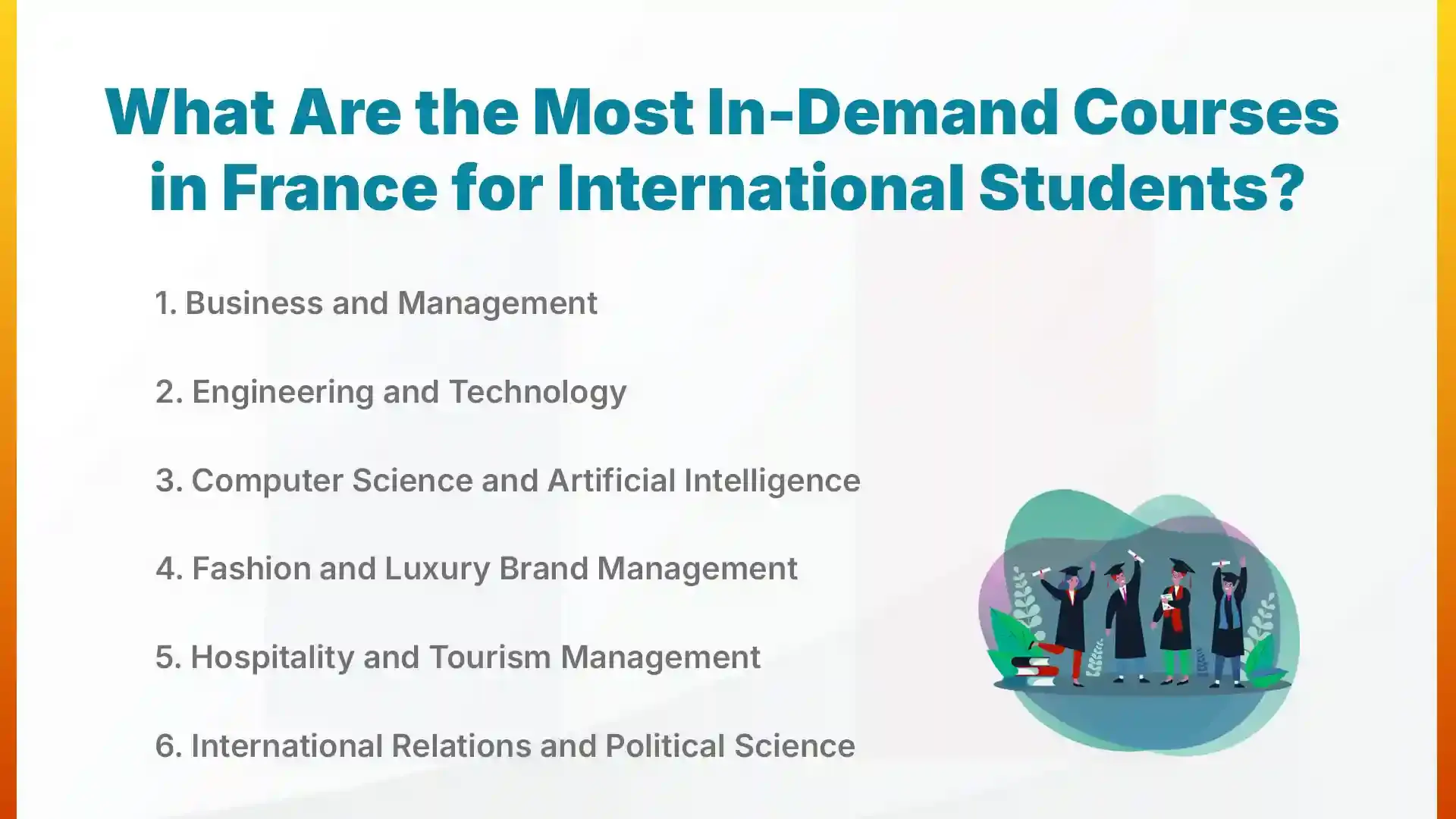
The most in-demand courses in France for international students are those aligned with global industry growth, innovation, and strong employability outcomes. France is especially recognised for excellence in business education, engineering, fashion, hospitality, and political studies. Many of these programs are available in English, making them highly accessible to international applicants. Choosing a high-demand field not only improves job prospects in France but also enhances global career mobility across Europe and beyond.
1. Business and Management
Business and Management remain among the most popular programs in France, particularly at leading business schools and universities. France is home to globally ranked institutions offering MBA, Master in Management (MiM), and specialised master’s degrees. Programs often include internships, corporate projects, and international exchange opportunities. Strong connections with multinational companies improve graduate employability. Specialisations such as finance, marketing, entrepreneurship, and supply chain management are particularly sought after.
2. Engineering and Technology
Engineering is one of France’s strongest academic sectors, supported by advanced research facilities and industry partnerships. The country is known for excellence in civil, mechanical, aerospace, electrical, and industrial engineering. Many engineering programs combine theoretical learning with practical laboratory and internship experience. France’s strong manufacturing and technology sectors create consistent job demand. Graduates often secure roles in global engineering firms and innovation-driven industries.
3. Computer Science and Artificial Intelligence
Computer Science and Artificial Intelligence are rapidly growing fields in France due to digital transformation across industries. Universities and Grandes Écoles offer specialised programs in AI, data science, cybersecurity, robotics, and software engineering. France has invested heavily in tech innovation and startup ecosystems, especially in cities like Paris and Grenoble. Many programs are taught in English to attract global talent. Graduates benefit from strong employment opportunities in technology companies, research institutions, and fintech sectors.
4. Fashion and Luxury Brand Management
France is globally recognised as a leader in fashion and luxury, making this field highly attractive to international students. Programs in fashion management, luxury brand strategy, and design integrate creativity with business principles. Students gain exposure to global luxury houses, fashion weeks, and international branding projects. Paris, as a fashion capital, provides direct networking and internship opportunities. Graduates often pursue careers in luxury marketing, brand management, retail strategy, and fashion entrepreneurship.
5. Hospitality and Tourism Management
France is one of the most visited countries in the world, creating strong demand for hospitality and tourism professionals. Programs focus on hotel management, event planning, tourism marketing, and international hospitality operations. Many courses include internships in luxury hotels, resorts, and tourism organisations. The curriculum emphasises customer experience, leadership, and global service standards. Graduates can work in international hotel chains, travel companies, and event management firms worldwide.
6. International Relations and Political Science
France has a strong global diplomatic presence, making International Relations and Political Science highly respected academic fields. Programs cover global governance, diplomacy, public policy, European Union studies, and international law. Students benefit from proximity to international organisations and political institutions. Many universities offer bilingual or fully English-taught programs for international applicants. Graduates often pursue careers in diplomacy, international NGOs, policy analysis, and global consulting firms.
Scholarships for International Students in France
France offers a wide range of scholarship opportunities to attract talented students from around the world. Financial support is available through government-funded programs, European initiatives, and individual universities. These scholarships can significantly reduce tuition fees and living expenses, making studying in France more affordable. International students are encouraged to apply early, as many funding programs are competitive and have strict eligibility criteria.
1. Eiffel Excellence Scholarship Program
The Eiffel Excellence Scholarship Program is funded by the French Ministry for Europe and Foreign Affairs. It is designed to attract high-achieving international students to pursue master’s and PhD programs in France. The scholarship covers a monthly allowance, health insurance, and additional benefits such as travel expenses. It primarily supports fields like engineering, economics, management, law, and political science. Universities in France nominate eligible students, making academic merit a key selection factor.
2. Erasmus+ Funding Opportunities
Erasmus+ is a European Union program that supports international student mobility and academic exchange. It provides financial assistance for tuition, travel, and living costs during study periods in participating institutions. Many French universities participate in Erasmus+ partnerships, allowing students to study in France as part of joint degree programs. Funding amounts vary depending on the student’s country and study duration. The program also enhances cross-cultural experience and European networking opportunities.
3. University-Specific Scholarships
Many French universities and Grandes Écoles offer their own scholarship schemes for international students. These may include tuition fee waivers, partial funding, or excellence-based awards. Some institutions provide automatic consideration based on academic performance, while others require separate applications. Scholarships may target specific nationalities, academic disciplines, or outstanding achievements. Reviewing the university’s official website is essential to understanding eligibility and deadlines.
4. French Government and Regional Scholarships
Apart from national programs, regional councils and local authorities in France also offer scholarships to international students. These may support specific fields of study or promote international cooperation between regions. Some programs focus on research, innovation, or development-related studies. Financial support can include living allowances, accommodation assistance, or tuition subsidies. These scholarships often complement national funding schemes.
5. Merit-Based and Need-Based Financial Aid
Merit-based scholarships reward students with strong academic records, leadership skills, or extracurricular achievements. Need-based financial aid is designed to support students facing financial constraints. Some French institutions assess family income levels to determine tuition adjustments or grants. International students may also explore external foundations and private funding bodies. Combining multiple funding sources can significantly reduce the overall cost of studying in France.
What Are the Entry Requirements for French Universities?
Entry requirements for French universities vary by institution and program, but international students must generally meet academic, language, and financial criteria. Meeting these requirements ensures a smooth admission process and eligibility for scholarships or student visas. It’s important to prepare all documentation carefully and verify program-specific requirements before applying.
1. Academic Qualifications and GPA Requirements
Most French universities require a recognised bachelor’s degree or equivalent for master’s programs. Minimum GPA expectations vary depending on the institution and program competitiveness. Top universities and Grandes Écoles often demand strong academic records in relevant fields. Certain programs, like engineering or business, may have additional prerequisites such as coursework in mathematics, economics, or sciences. Meeting these academic standards is critical for successful admission.
2. English or French Language Proficiency
International students must demonstrate proficiency in the language of instruction. English-taught programs usually require IELTS, TOEFL, or equivalent scores, while French programs require DELF, DALF, or TCF certification. Minimum scores depend on the university and level of study. Some institutions may offer preparatory language courses for students who don’t meet the requirements initially. Proficiency ensures academic success and smooth integration into campus life.
3. Statement of Purpose and Letters of Recommendation
A Statement of Purpose (SOP) outlines the student’s academic goals, career aspirations, and reasons for choosing the program. Strong letters of recommendation from professors or employers enhance credibility and provide insight into the student’s abilities. Both documents are essential for competitive programs, particularly in top-ranked universities. They help the admissions committee assess motivation, fit, and potential contribution to the institution.
4. Portfolio Requirements (For Design and Creative Courses)
Programs in design, architecture, fine arts, or fashion often require a portfolio showcasing previous work. This demonstrates creativity, technical skills, and artistic vision. Portfolios should be well-organised, professionally presented, and tailored to the specific program requirements. Including diverse work samples that highlight your range and style increases the chances of acceptance. Some universities may also request an interview or presentation.
5. Visa and Financial Proof Documentation
International students must provide proof of sufficient funds to cover tuition and living expenses for their visa application. This includes bank statements, sponsorship letters, or scholarship award letters. A valid passport, completed visa application, and acceptance letter from the university are mandatory. Proper documentation ensures compliance with French immigration regulations and a smooth arrival in the country.
Career Opportunities After Studying in France
Studying in France opens up a wide range of career opportunities for international graduates. With strong connections to European industries and a global academic reputation, French degrees can enhance employability worldwide. Graduates can find roles across diverse sectors, benefit from internships during studies, and access part-time jobs in France to support their experience and finances. Understanding market trends and high-demand industries is crucial for planning a successful career.
1. Job Market Trends for International Graduates
France has a growing demand for skilled professionals, especially in STEM, business, and creative sectors. International graduates benefit from the country’s strong economy and European Union connections. Employers increasingly value graduates with international experience and multilingual skills. Networking through university career services and internships can significantly improve employment prospects. Overall, graduates with relevant skills and work experience have a competitive advantage in the job market.
2. High-Demand Industries in France
High-demand industries for international graduates include technology, engineering, finance, healthcare, and luxury goods. France’s focus on innovation and research also creates opportunities in AI, renewable energy, and pharmaceuticals. The hospitality and tourism sectors continue to grow, driven by France’s status as a top tourist destination. Business schools and management graduates have opportunities in multinational corporations and startups. Choosing a field aligned with industry demand increases the likelihood of securing employment after graduation.
3. Average Salary Expectations
Average salaries in France vary depending on the industry, location, and level of experience. Entry-level positions for international graduates typically range from €25,000 to €35,000 annually. STEM, finance, and management roles may offer higher starting salaries, often exceeding €40,000. Major cities like Paris tend to have higher salary scales but also higher living costs. Salary growth is generally steady, especially with additional experience or advanced degrees.
4. Post-Study Work and Residence Permit Options
International graduates in France can apply for a post-study work visa, known as the “Autorisation Provisoire de Séjour” (APS). This allows graduates to work in France for up to 12–24 months, depending on their degree level. It provides valuable experience and increases chances of long-term employment or residency. Employers can sponsor skilled international workers for longer-term permits. This pathway makes France an attractive destination for students seeking global career opportunities.
Conclusion
Studying in France offers international students a unique blend of academic excellence, cultural diversity, and global career opportunities. With world-renowned universities, high-quality programs, and affordable tuition in public institutions, France is an ideal destination for students aiming to gain international exposure and develop professional skills. From STEM and business to arts and hospitality, there is a wide range of programs designed to meet industry demand, ensuring graduates are well-prepared for global careers.
Careful planning, including evaluating university rankings, program specialisations, scholarships, and post-study work options, is key to making the most of your experience. By choosing the right university and field of study, international students can achieve academic success, expand their networks, and secure promising career paths in France and beyond.