Cybersecurity Courses in Australia: Programs, Requirements & Careers 2026

May 20, 2026
If you have been researching tech careers abroad, you have probably already heard that Australia is one of the fastest-growing cybersecurity job markets in the world. But knowing that and knowing exactly how to get there as a Nepali student are two very different things. This guide breaks down everything you need: courses, universities, costs, scholarships, visa steps, and career options so you can move forward with clarity and confidence.
Australia is not just a study destination; it is a career launchpad. With a government-backed cybersecurity strategy, a serious shortage of trained professionals, and post-study work visas that give you real time to build experience, the opportunity for Nepali students here is as practical as it is promising.
In this blog
What Is a Cybersecurity Course in Australia?
A cybersecurity course in Australia is a formally accredited academic program that trains students to protect digital systems, networks, and data from unauthorized access, cyberattacks, and damage. These programs are offered at diploma, bachelor's, and master's levels across a wide range of Australian universities registered on the Commonwealth Register of Institutions and Courses for Overseas Students (CRICOS). For Nepali students, a cybersecurity degree from Australia represents one of the clearest pathways into a globally in-demand technology career.
Australia's cybersecurity education sector is backed by strong government investment and active industry partnerships. The Australian Cyber Security Centre (ACSC) publishes an annual cyber threat report that consistently highlights the growing scale and frequency of cyber incidents affecting Australian organizations across government, healthcare, and finance. This ongoing threat environment has driven universities to develop programs that are tightly aligned with real industry needs, making graduates highly relevant to employers both in Australia and internationally.
Why Is Cybersecurity in Australia a Strong Choice for Nepali Students?
Cybersecurity in Australia is a strong choice for Nepali students because it combines internationally respected qualifications, practical industry training, and genuine post-study career pathways at a cost that is competitive with other English-speaking destinations. Australia's technology sector is expanding steadily, and qualified cybersecurity professionals are consistently among the most sought-after workers in the country. Below are the key reasons Nepali students are increasingly choosing Australia for this field.
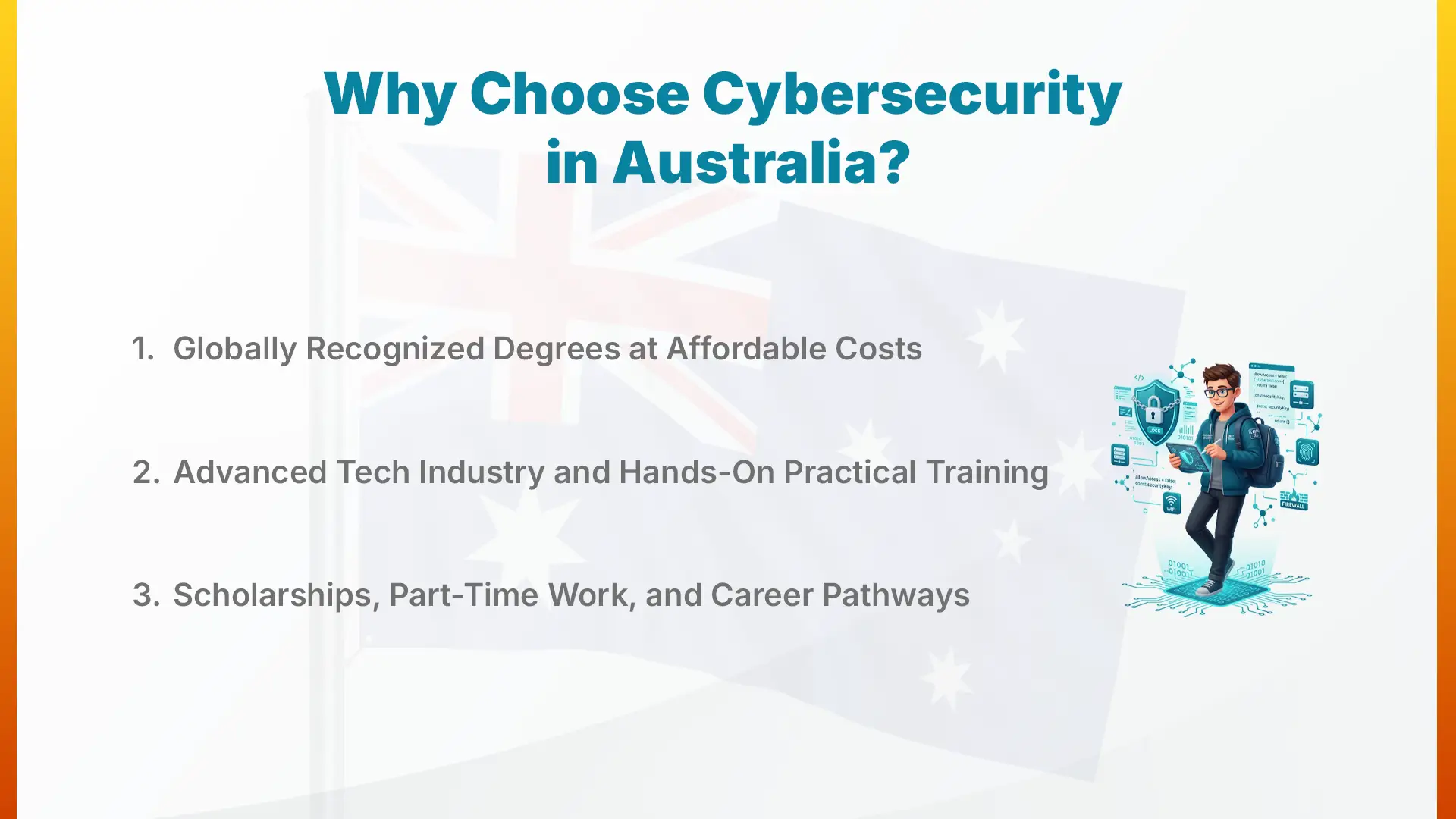
1. Globally Recognized Degrees With Competitive Tuition
Australian cybersecurity degrees are recognized by employers across Asia, the Middle East, Europe, and North America. Unlike the United States or the United Kingdom, where tuition costs can be significantly higher, Australia offers quality programs at a more accessible price point for Nepali families. The combination of academic credibility and relative affordability makes Australia one of the most practical overseas study destinations available in 2026.
Australian universities also perform strongly in global rankings. For example, the Australian National University ranks in the global top 35 and the University of Melbourne ranks in the global top 15 in the QS World University Rankings 2026. Graduating from a highly ranked institution adds meaningful weight to your resume when applying for jobs internationally.
2. Advanced Tech Industry and Hands-On Training
Australia's cybersecurity industry is one of the most active in the Asia-Pacific region, supported by both government programs and private sector investment. As a student, you do not just study theory; you complete industry placements, work on real-world security challenges, and gain exposure to enterprise-grade tools and environments. This practical experience gives you a direct competitive advantage when entering the job market after graduation.
The Australian Government released its 2023–2030 Australian Cyber Security Strategy, committing AUD 586.9 million to strengthen the country's cyber defences and grow the domestic cybersecurity workforce. This investment directly supports the development of cybersecurity talent pipelines through universities and industry training programs.
3. Scholarships, Part-Time Work, and Career Pathways
Studying cybersecurity in Australia brings practical financial and career advantages alongside academic ones. International students in Australia can work part-time up to 48 hours per fortnight during study periods, helping cover daily living costs without full dependence on funds from home. Competitive scholarships like the Australia Awards are open to Nepali students annually. After graduation, the Temporary Graduate Visa (subclass 485) gives eligible graduates post-study work rights in Australia, creating a real bridge between completing your degree and building a professional career.
What Cybersecurity Courses Are Available in Australia for International Students?
Cybersecurity courses in Australia for international students include undergraduate bachelor's degrees, postgraduate master's programs, and shorter diploma and certificate qualifications. The right entry point depends on your existing qualifications, career goals, and budget. Below is a clear breakdown of each available option.
1. Bachelor of Cybersecurity (Undergraduate)
The Bachelor of Cybersecurity in Australia typically takes three to four years to complete full-time. The program covers core subjects including network security, ethical hacking, digital forensics, cryptography, risk management, and information security principles. Most programs include at least one industry placement or capstone project, ensuring you graduate with practical experience alongside your academic credentials.
This program suits students who are starting their cybersecurity journey from scratch and want a comprehensive, structured pathway into the profession. For Nepali +2 graduates with a science or mathematics background, the bachelor's degree in Australia is the most common and direct starting point for a cybersecurity career.
2. Master's Degree in Cybersecurity (Postgraduate)
A master's in cybersecurity in Australia is designed for students who already hold a bachelor's degree in IT, computer science, engineering, or a related field and want to deepen their expertise or move into leadership and specialist roles. Programs typically take one and a half to two years to complete and focus on advanced topics such as cyber threat intelligence, penetration testing, cloud security, and security architecture.
Popular specializations include network security, digital forensics, governance and compliance, and cybersecurity management. Choosing a specialization that aligns with current industry demand can strengthen both your starting salary and long-term career progression. Always verify entry criteria and specialization options directly with your chosen university before applying.
3. Diploma and Certificate Courses in Cybersecurity
Diploma and certificate courses in cybersecurity in Australia are shorter, vocationally focused qualifications that typically take six months to two years to complete. These programs cover practical skills such as network monitoring, incident response, and security operations and are well suited for students who want to enter the workforce quickly or for working professionals looking to upskill without committing to a full degree program.
Many diploma programs in Australia also serve as a direct pathway into bachelor's degrees through credit recognition, allowing you to complete your undergraduate qualification faster. This is a practical and cost-effective route for Nepali students who want to build foundational skills before committing to a longer academic program.
Which are the Top Cybersecurity Universities in Australia?
The top cybersecurity universities in Australia are institutions that combine strong academic programs, industry partnerships, dedicated cybersecurity research facilities, and consistent graduate employment outcomes. Choosing the right university directly affects the quality of your training, your professional network, and your career prospects after graduation.
Always verify that your chosen university and program are registered on CRICOS (cricos.teqsa.gov.au) before applying.
University | Location |
|---|---|
| Australian National University | Canberra |
| University of Melbourne | Melbourne |
| UNSW Sydney | Sydney |
| Deakin University | Melbourne |
| Edith Cowan University | Perth |
1. Australian National University (ANU)
Australian National University is Australia's top-ranked university in the QS World University Rankings 2026, and its cybersecurity programs benefit from direct links to government agencies and research institutions in Canberra. ANU offers programs through its School of Cybernetics and School of Computing, with strong research output in cybersecurity policy, systems security, and human-centered security design. For Nepali students aiming for the highest standard of cybersecurity education in Australia, ANU is the benchmark institution.
2. University of Melbourne
The University of Melbourne is ranked among the top 15 universities globally in the QS World University Rankings 2025 and offers a well-regarded Master of Information Technology with a cybersecurity specialization. The university's location in Melbourne, Australia's technology and startup hub, provides students with strong access to internship and employment opportunities in one of the country's most active tech ecosystems.
3. UNSW Sydney
UNSW Sydney offers one of Australia's most specialized cybersecurity programs through its School of Computer Science and Engineering, including a dedicated Bachelor of Computer Science with a Security Engineering stream. The university has formal research and industry partnerships in cybersecurity, giving students exposure to real-world security challenges and professional networks throughout their studies.
4. Deakin University
Deakin University in Melbourne offers flexible and industry-aligned cybersecurity programs at both undergraduate and postgraduate levels. Deakin places a strong emphasis on practical learning and has active industry partnerships that connect students with real-world security environments. It is a particularly strong option for Nepali students seeking an accessible and career-focused program with flexible study options.
5. Edith Cowan University (ECU)
Edith Cowan University in Perth is home to the ECU Security Research Institute, one of Australia's established cybersecurity research centers, and offers dedicated undergraduate and postgraduate cybersecurity degrees with a strong practical focus. Studying in Perth also means lower living costs compared to Sydney or Melbourne, making ECU a financially practical choice for Nepali students managing a careful budget.
What Are the Requirements to Study Cybersecurity in Australia?
To study cybersecurity in Australia, you must meet the academic, language, and documentation requirements set by your chosen university and the Australian Department of Home Affairs. Meeting all requirements before you apply ensures your application is assessed without unnecessary delays. Below is a clear breakdown of what you need for studying in Australia:
1. Academic Qualifications by Course Level
To study cybersecurity in Australia, you must meet the academic entry requirements set by your chosen university and program level. For most Nepali students, a completed NEB +2 with mathematics or science subjects is the standard starting point for undergraduate and diploma programs. If you already hold a relevant bachelor's degree, you may apply directly for a master's program. Always confirm the exact entry requirements with your chosen institution before applying.
Course Level | Minimum Academic Requirement |
|---|---|
| Bachelor's Degree | NEB +2 or equivalent with Mathematics or Science subjects |
| Master's Degree | Recognized Bachelor's in IT, Computer Science, or related field |
| Diploma / Certificate | NEB +2 or equivalent; some programs accept SEE graduates |
Note: Specific GPA and percentage thresholds vary between universities. Always confirm exact entry requirements directly with your chosen institution before applying.
2. Language Requirements: IELTS or TOEFL?
English language proficiency is mandatory for all cybersecurity programs in Australia, as coursework, assessments, and professional placements are conducted entirely in English. Most universities require a minimum IELTS score of 6.0 to 6.5 for undergraduate programs and 6.5 to 7.0 for postgraduate programs. Top-tier institutions like ANU and the University of Melbourne may set higher requirements for competitive programs.
Starting your IELTS preparation at least six to twelve months before your intended application date gives you the strongest chance of meeting score thresholds comfortably. Some universities also accept PTE Academic scores as an alternative to IELTS. Always confirm accepted English tests and minimum scores directly with your target institution.
3. Documents Required for Admission
Preparing your documents is one of the most time-consuming parts of the application process, and leaving it too late is one of the most common mistakes Nepali students make. Many documents require official translation, notarization, or third-party verification, all of which take more time than expected. Having everything organized and ready before you begin your application puts you in a much stronger position and prevents unnecessary delays in receiving your offer letter or visa approval.
Academic transcripts and certificates (Grade 10, 11, and 12 or equivalent)
Valid passport with sufficient remaining validity
English language proficiency results (IELTS, TOEFL, or PTE)
Statement of Purpose (SOP for Australia)
Letters of Recommendation (LOR) from teachers or academic supervisors
- Updated CV or Resume
Financial sponsorship documents proving sufficient funds
Completed university application form
Overseas Student Health Cover (OSHC) confirmation
How to Apply for Cybersecurity Courses in Australia in 2026
To apply for a cybersecurity course in Australia, you first shortlist CRICOS-registered universities that match your academic background and budget, then prepare and notarize your documents, and submit your application through the university's official portal. Once you receive your Confirmation of Enrolment (CoE), you apply for the Australian Student Visa (subclass 500) through the Department of Home Affairs. Starting this process early and following each step in order gives you the best chance of a smooth and successful application.
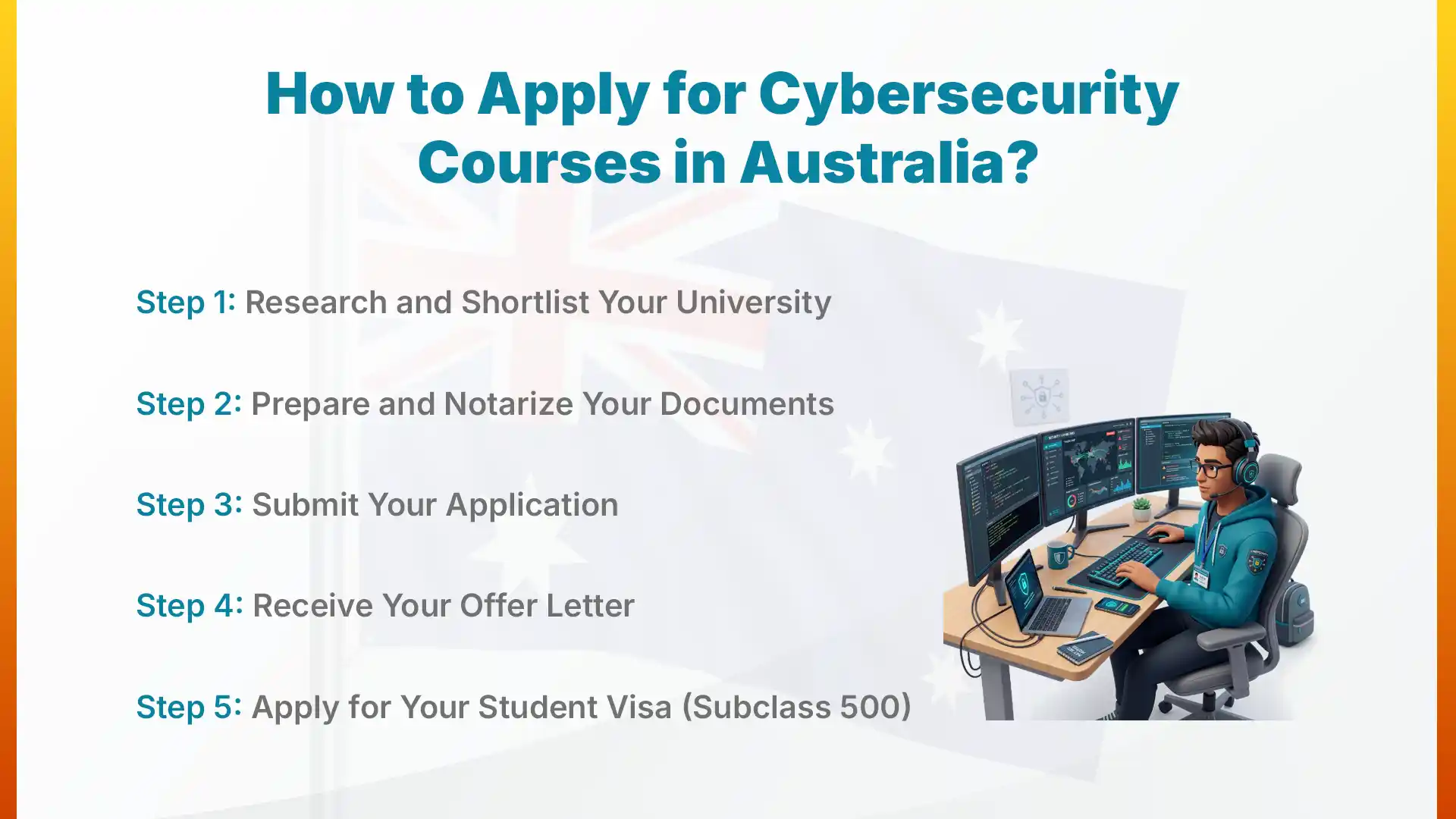
Step 1: Research and Shortlist Your University
Identify universities offering CRICOS-registered cybersecurity programs that fit your academic background, budget, and preferred city. Compare program content, industry placement opportunities, and available scholarships before finalizing your shortlist of two to three institutions.
Step 2: Prepare and Notarize Your Documents
Gather your academic transcripts, passport, English test results, SOP, and letters of recommendation. Documents in Nepali must be officially translated into English and notarized. Begin this process as early as possible; notarization and translation can take several weeks.
Step 3: Submit Your Application
Apply through each university's official online admissions portal or through a registered education consultant. Applying to more than one institution simultaneously increases your chances of receiving a strong offer.
Step 4: Receive Your Offer Letter
If your application is successful, you will receive a Confirmation of Enrollment (CoE). Read all conditions carefully before accepting your offer and paying any required deposit.
Step 5: Apply for Your Student Visa (Subclass 500)
Once you have your CoE, apply for the Australian Student Visa (Subclass 500) through the Department of Home Affairs online portal. You will need your CoE, valid passport, OSHC documentation, financial evidence, and English proficiency results. Always confirm the current document checklist and visa application fee directly with the Australian Embassy in Kathmandu or at immi.homeaffairs.gov.au before submitting.
How Much Does It Cost to Study Cybersecurity in Australia?
The cost of studying cybersecurity in Australia includes tuition fees, living expenses, and additional costs such as visa fees, health cover, and certification exam costs. Understanding the full financial picture before you apply allows you to plan realistically and explore scholarship options early.
1. Tuition Fees by Course Level
Tuition fees in Australia vary depending on the university, program level, and whether the institution is public or private. Compared to other English-speaking destinations like the United States or the United Kingdom, Australia offers competitive tuition costs without compromising on education quality. The figures below give you a general idea of what to budget for at each level, helping you plan your finances and explore scholarship options before committing to a program.
Course Level | Estimated Annual Tuition (AUD) | Approximate NPR Equivalent |
|---|---|---|
| Bachelor's Degree | AUD 28,000 – 45,000 | NPR 2,400,000 – 3,800,000 |
| Master's Degree | AUD 30,000 – 50,000 | NPR 2,500,000 – 4,200,000 |
| Diploma / Certificate | AUD 10,000 – 20,000 | NPR 850,000 – 1,700,000 |
Important: These are estimated ranges only. Always confirm exact tuition fees directly with your chosen university. Exchange rates fluctuate; use these figures for general planning purposes only.
2. Living Expenses in Australia for Nepali Students
Living costs in Australia vary depending on the city you study in and your personal lifestyle. Major cities like Sydney and Melbourne tend to be more expensive, while cities like Perth, Canberra, or regional areas offer a more affordable day-to-day lifestyle. As a Nepali student, planning your monthly budget carefully before you arrive ensures you can cover your essential expenses comfortably without relying entirely on funds from home. The estimates below cover the key expense categories most international students encounter during their studies.
Expense Category | Estimated Monthly Cost (AUD) |
|---|---|
| Accommodation (Shared/Dormitory) | AUD 600 – 1,200 |
| Food and Groceries | AUD 300 – 500 |
| Transportation | AUD 100 – 200 |
| Utilities and Internet | AUD 80 – 150 |
| Personal and Miscellaneous | AUD 100 – 200 |
| Total Estimated Monthly | AUD 1,180 – 2,250 |
3. Additional Costs to Plan For
Beyond tuition and living costs, cybersecurity students should budget for additional expenses before leaving Nepal. These include the Student Visa (Subclass 500) application fee (confirm the current fee at immi.homeaffairs.gov.au, as fees are updated periodically), Overseas Student Health Cover (OSHC) starting from around AUD 600 to AUD 700 per year for a single student, professional certification exam fees such as CompTIA Security+ at approximately AUD 400 to AUD 500 per attempt, and required textbooks or specialized software. Planning for these costs of your Australian education in advance prevents financial surprises and allows you to focus fully on your studies from day one.
What Scholarships Are Available for Cybersecurity Students in Australia?
Scholarships for cybersecurity students in Australia include fully funded government programs, university merit awards, and Nepal-based funding options. Exploring these opportunities early in your planning process can significantly reduce your overall financial burden and make studying in Australia genuinely achievable for Nepali families.
1. Australia Awards Scholarship
The Australia Awards Scholarship is the flagship scholarship offered by the Australian government for students from developing countries, including Nepal. It covers full tuition, return airfare, living allowance, and health cover, making it one of the most comprehensive international scholarships available anywhere in the world. The program is managed by the Australian Department of Foreign Affairs and Trade (DFAT) and is announced annually. It is highly competitive, so a strong academic record and a well-prepared application are essential. Always monitor the official Australia Awards website (australiaawardsnepali.org) for the most current eligibility criteria and application deadlines.
2. University Merit Scholarships
Most Australian universities offer their own merit-based scholarships for high-achieving international students. These typically provide partial tuition reductions and are assessed either automatically at the time of application or through a separate scholarship process. Check the international admissions page of each university you are shortlisting and note scholarship deadlines alongside your standard admission timelines to ensure you do not miss out on available funding.
3. Other Funding Options From Nepal
There are also funding options worth exploring from within Nepal. Check with Nepal's Ministry of Education and Science and Technology for any bilateral education agreements between Nepal and Australia. Some Nepali banks and financial institutions offer education loans specifically designed for overseas study. Contact the Australian Embassy in Kathmandu for updated guidance on any additional funding opportunities available to Nepali students.
What Cybersecurity Certifications Should You Get in Australia?
Cybersecurity certifications in Australia are professional credentials that validate your technical skills and significantly strengthen your employability beyond your academic degree alone. While certifications are not a legal requirement to work in cybersecurity in Australia, most employers actively prefer or require them for technical and senior roles. Earning relevant certifications alongside your degree positions you as a job-ready candidate from the moment you graduate.
1. Key Cybersecurity Certifications to Target
The most recognized and employer-valued certifications for cybersecurity professionals in Australia include:
CompTIA Security+ Entry-level certification ideal for recent graduates entering the field
Certified Ethical Hacker (CEH) Focuses on penetration testing and offensive security skills
Certified Information Systems Security Professional (CISSP) Advanced credential for experienced professionals targeting senior roles
Certified Information Security Manager (CISM) Focused on security management and governance
AWS Certified Security Specialty Valuable for roles involving cloud infrastructure protection
2. How Certifications Affect Your Career and Salary
Cybersecurity professionals in Australia who hold recognized certifications consistently earn higher salaries than those with academic qualifications alone. According to salary data published on Seek.com.au, cybersecurity professionals in Australia with advanced certifications and several years of experience can earn well above AUD 120,000 annually in specialized roles. Source: Seek.com.au Salary Insights, 2024. Beginning your certification preparation during your final year of study gives you a meaningful head start in the job market after graduation.
What Career Opportunities Are Available After Studying Cybersecurity in Australia?
Career opportunities after studying cybersecurity in Australia are broad, well-compensated, and growing steadily across both private and government sectors. Australia's technology sector faces a consistent shortage of trained cybersecurity professionals, and qualified graduates with relevant skills and certifications are in genuine demand across industries, including finance, healthcare, government, and critical infrastructure.
1. Job Roles After Graduation
As a cybersecurity graduate in Australia, you can pursue a wide range of roles, including:
Security Analyst
Penetration Tester (Ethical Hacker)
Network Security Engineer
Incident Response Analyst
Cloud Security Specialist
Digital Forensics Analyst
Cybersecurity Consultant
Information Security Manager
Chief Information Security Officer (CISO) with experience
2. Salary of Cybersecurity Professionals in Australia
Cybersecurity salaries in Australia vary depending on your role, specialization, employer, and city, but the field is consistently among the highest-paying in Australia's technology sector. According to Seek.com.au salary data, entry-level cybersecurity analysts in Australia typically earn between AUD 65,000 and AUD 85,000 per year, while mid-level professionals with several years of experience can earn between AUD 100,000 and AUD 130,000 annually. Source: Seek.com.au Salary Insights, 2024.
Can International Students Work in Australia During and After a Cybersecurity Degree?
Yes, international students can legally work in Australia both during their studies (24 hours per week) and after graduation, making it one of the most practical study destinations for Nepali students who want to gain professional experience alongside their qualifications. Australia's post-study work visa options provide meaningful time to build a career after completing your degree.
1. Part-Time Work Rights During Studies
International students in Australia on a student visa (subclass 500) are permitted to work up to 48 hours per fortnight during academic terms and unlimited hours during official vacation periods. This allows cybersecurity students to earn supplementary income, manage day-to-day expenses, and gain early exposure to Australia's professional IT environment. Always verify current work conditions with the Department of Home Affairs at immi.homeaffairs.gov.au before taking on any employment to protect your visa status.
2. Post-Study Work Visa (Temporary Graduate Visa Subclass 485)
The Temporary Graduate Visa (Subclass 485) allows eligible international graduates to remain in Australia and work full-time after completing their degree. The duration of this visa varies depending on your qualification level and the location where you studied, with regional study potentially extending your eligibility. This visa is one of the most valuable advantages of studying in Australia; it gives you genuine time to build professional experience and explore long-term employment or skilled migration pathways. Always confirm current Subclass 485 eligibility and duration at immi.homeaffairs.gov.au before making post-graduation plans.
3. Long-Term Work and Residency Pathways
Graduates who secure cybersecurity employment and build consistent professional experience in Australia may become eligible for employer-sponsored permanent residency or skilled migration through Australia's points-based General Skilled Migration program. ICT Security Specialist is included on Australia's skilled occupation lists, supporting migration eligibility for experienced professionals in this field. Source: Department of Home Affairs, 2024. For accurate and current immigration advice, always consult the official Department of Home Affairs website or a registered migration agent.
Common Mistakes to Avoid When Studying Cybersecurity in Australia
Common mistakes to avoid when studying cybersecurity in Australia are oversights in preparation and decision-making. The mistakes involves multiple connected steps: academic eligibility, language requirements, visa compliance, and certification planning, and a gap in any one of these areas can have serious consequences. Understanding these common pitfalls before you begin is just as important as following the right steps forward.
Choosing a university or program not registered on the CRICOS database
Underestimating IELTS requirements and leaving language preparation too late
Missing Australia Awards and university scholarship application deadlines
Not confirming the current Student Visa (Subclass 500) application fee and OSHC costs before budgeting
Trusting unregistered or fraudulent education consultants in Nepal
Submitting incomplete or poorly prepared application documents
Overlooking the career value of professional certifications alongside your degree
Failing to research post-study visa options before your graduation date
Conclusion
Choosing to study cybersecurity in Australia can be a transformative decision for Nepali students who want a globally respected qualification, hands-on technical training, and genuine career pathways all within a well-supported international education system. From CRICOS-accredited programs at leading universities and Australia Awards Scholarships to post-study work visas and skilled migration pathways, Australia offers everything you need to build a serious and sustainable cybersecurity career.
Take time to research your program options, understand the full costs, prepare your IELTS early, and explore scholarship opportunities well before your intended start date. Whether your goal is a bachelor's degree, a master's specialization, or a shorter diploma qualification, Australia provides a clear and well-supported pathway from study to professional practice.
Your cybersecurity career in Australia is within reach. Start by shortlisting your preferred universities, beginning your IELTS preparation, and visiting the best consultancy in Nepal for Australia today, and if you are ready for expert guidance on your application from program selection to visa support, contact SAS Education Consultancy to take the next step with confidence.