Study Cloud Computing in UK: Complete Guide for Nepalese Students

Jun 29, 2026

The United Kingdom is one of the world's most active cloud computing markets, home to major European headquarters of Amazon Web Services, Microsoft Azure, and Google Cloud and one of the strongest destinations for Nepalese students who want a cloud computing degree with direct industry exposure, globally recognized credentials, and a clear career pathway into one of the fastest-growing technology sectors on earth. Nepalese students who are still exploring their destination options can start by reading about studying in the UK before committing to a specific program.
In this blog
What Is a Cloud Computing Course in the UK?
A cloud computing course in the UK is a technology degree that teaches students how to design, build, manage, and secure cloud-based infrastructure and services, the systems that power everything from online banking and streaming platforms to artificial intelligence and enterprise software. It sits at the intersection of software engineering, networking, cybersecurity, and data management and is one of the most in-demand and highest-paying technology specializations globally.
In the UK, cloud computing is offered under several degree titles:
BSc Cloud Computing: dedicated undergraduate degree with full cloud specialization
BSc Computer Science (Cloud / Networks specialization): broader CS foundation with cloud focus
MSc Cloud Computing: postgraduate program for graduates entering the cloud industry
MSc Software Engineering (Cloud specialization): broader engineering degree with cloud components
Duration: 3 years (bachelor), 1 year (master)
After completing the degree, graduates are prepared for roles at cloud service providers, technology consultancies, financial institutions, healthcare systems, and government digital agencies.
Why Study Cloud Computing in the UK?
The UK is one of the best destinations to study cloud computing because of its globally recognized degrees, direct proximity to the world's largest cloud providers, high demand across all sectors, shorter 3-year degrees, and a clear PR pathway through technology occupations. This is a key part of why Nepalese students choose the UK for technology and computer science programs.
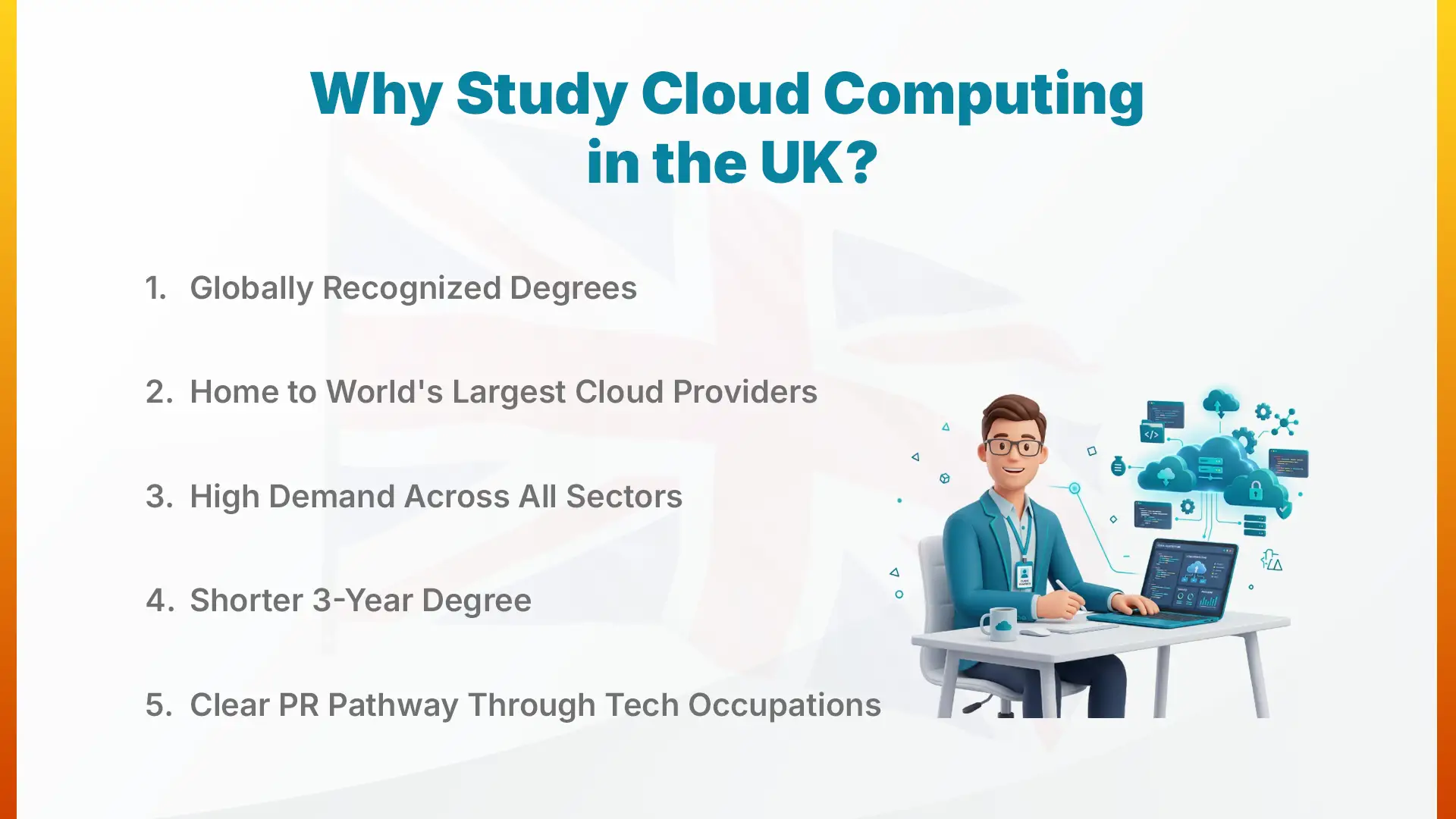
1. Globally Recognized Degrees
UK cloud computing and computer science degrees are recognized by employers worldwide, and programs accredited by the British Computer Society (BCS), the UK's chartered institute for IT, are particularly valued by technology employers across Europe, the Middle East, and Asia-Pacific.
2. Home to World's Largest Cloud Providers
The UK hosts European headquarters or major operations for AWS, Microsoft Azure, Google Cloud, and IBM Cloud, giving cloud computing students unparalleled proximity to the companies that build and operate the world's cloud infrastructure. Many UK universities have formal academic partnerships with these providers, offering students access to cloud certifications, live project work, and direct recruitment pipelines.
3. High Demand Across All Sectors
Cloud computing skills are in demand across every sector of the UK economy: banking, healthcare, retail, government, media, and logistics all rely on cloud infrastructure and need qualified professionals to manage it. The UK government's own cloud-first digital strategy has significantly increased demand for cloud engineers and architects across public sector organizations.
4. Shorter 3-Year Degree
A BSc Cloud Computing in the UK takes just three years, one year less than equivalent programs in Australia, Canada, and the USA. For Nepalese students, this means lower total tuition cost, earlier entry into the workforce, and faster access to the Graduate Route visa and PR pathway.
5. Clear PR Pathway Through Tech Occupations
Software engineers, cloud engineers, and IT professionals are listed as skilled occupations under the UK's points-based immigration system. After completing a cloud computing degree and working on the Graduate Route visa, Nepalese graduates can transition to a Skilled Worker visa and progress toward Indefinite Leave to Remain.
Which Are the Top Universities for Cloud Computing in the UK?
The top universities for cloud computing in the UK include the University of Birmingham, the University of Leeds, Coventry University, the University of the West of England, and Staffordshire University, all offering strong cloud computing programs with industry partnerships and BCS accreditation. The best universities in the UK for Nepalese students should cover a wider range of institutions ranging from top-tier, research-focused Russell Group universities to modern, highly practical institutions that offer robust post-study work placements and affordable tuition fees.
University | Location | Program | Known For |
|---|---|---|---|
| University of Birmingham | Birmingham | MSc Cloud Computing | Research Excellence; AWS and Azure Academic Partnerships |
| University of Leeds | Leeds | BSc / MSc Computer Science (Cloud) | Strong Industry Links; Active Tech Sector in Leeds |
| Coventry University | Coventry | BSc Cloud Computing | Accessible Entry; Dedicated Cloud Infrastructure Focus |
| University of the West of England (UWE) | Bristol | BSc Cloud Computing | Applied Cloud Focus; Strong Bristol Tech Industry Connections |
| Staffordshire University | Stoke-on-Trent | BSc Cloud Computing | Affordable Tuition; Microsoft Azure Campus Partnerships |
| Northumbria University | Newcastle | BSc Computer Networks and Cloud | Strong Placement Record; Flexible Entry for International Students |
The University of Birmingham and Leeds are the strongest research-oriented options. Coventry, UWE, and Staffordshire offer more accessible entry requirements and more affordable tuition, popular choices for Nepalese students targeting a quality cloud computing degree at a lower overall cost.
What Are the Admission Requirements?
The admission requirements to study cloud computing in the UK include strong plus-two results in mathematics or computing, English language proficiency, a personal statement, and financial documentation for the UK student visa.
1. Academic Requirements
Applicants must have completed Plus Two with satisfactory overall results, typically equivalent to UK A-level grades of CCC to BBB depending on the institution. A background in mathematics, physics, or computer science is advantageous. Russell Group and research-intensive universities require stronger academic profiles, while post-92 universities offer more accessible entry for students with moderate results.
2. English Language Requirements
Most UK cloud computing programs require a minimum IELTS score of 6.0 to 6.5 for undergraduate entry and 6.5 to 7.0 for postgraduate programs, with no individual band below 6.0. The IELTS requirements for UK vary by university tier and program level; checking your specific target institution's requirements before booking your test is strongly recommended.
Test | Undergraduate | Postgraduate |
|---|---|---|
| IELTS Academic | 6.0 – 6.5 Overall | 6.5 – 7.0 Overall |
| TOEFL iBT | 80 – 90 | 90 – 100 |
| PTE Academic | 51 – 58 | 58 – 65 |
3. Personal Statement
Your UCAS personal statement should explain your interest in cloud computing, any relevant programming or networking experience you have explored, specific cloud platforms or certifications you have, and your career goals in the technology sector. Nepalese students can take a reference from the SOP format for UK to structure their statement effectively.
4. Financial Proof and Visa Documentation
The requirements to study in UK from Nepal vary by university and program level, so preparing your financial documents and visa paperwork early gives you the best chance of a smooth application process.
How to Apply for Cloud Computing in the UK?
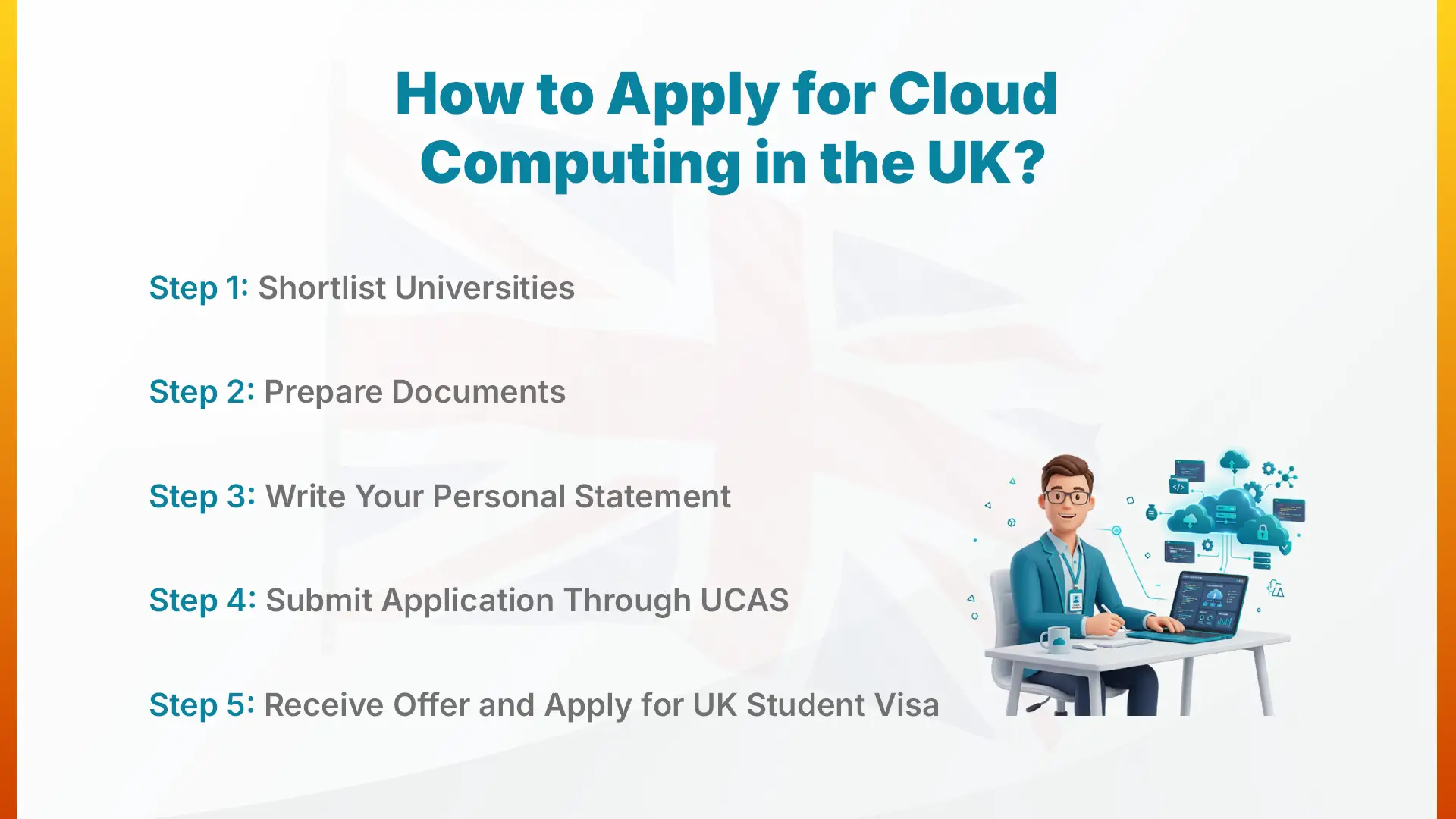
Applying for a cloud computing course in the UK involves five steps from shortlisting universities to securing your UK Student Visa. Most cloud computing programs begin in September, so checking the UK September intake deadlines early is essential to avoid missing the UCAS application window.
Step 1: Shortlist Universities
Compare programs based on BCS accreditation, cloud platform partnerships (AWS, Azure, Google Cloud), industry placement availability, tuition fees, and location. Shortlist three to five universities matching your academic profile and career goals.
Step 2: Prepare Documents
Gather your Plus Two transcripts, IELTS or PTE scores, valid passport, and financial documents well before UCAS deadlines. If you hold any cloud certifications such as AWS Cloud Practitioner or Microsoft Azure Fundamentals, include them in your application as supporting evidence of technical interest.
Step 3: Write Your Personal Statement
Your UCAS personal statement should be specific about what draws you to cloud computing, any hands-on experience with cloud platforms or networking, and the type of cloud professional you want to become. One strong, specific personal statement is far more effective than a generic technology statement.
Step 4: Submit Application Through UCAS
Apply through the UCAS platform; the main deadline for most universities is January 29. For postgraduate MSc programs, apply directly through the university portal. Apply early as popular cloud computing programs fill quickly at institutions with strong industry partnerships.
Step 5: Receive Offer and Apply for UK Student Visa
Once you receive your offer letter and CAS number from the university, apply for your UK Student Visa online through UK Visas and Immigration using your CAS letter, financial documents, valid passport, and biometrics.
How Much Does It Cost to Study Cloud Computing in the UK?
The total cost to study in the UK varies significantly depending on the university and city you choose. Students at Staffordshire or Northumbria will spend considerably less than those at Birmingham or Leeds, and the tuition table below reflects typical annual fees across popular cloud computing institutions.
University | Annual Tuition (GBP) | Annual Tuition (NPR approx.) |
|---|---|---|
| Staffordshire University | GBP 14,000 – GBP 16,000 | NPR 2,380,000 – NPR 2,720,000 |
| Northumbria University | GBP 16,000 – GBP 18,000 | NPR 2,720,000 – NPR 3,060,000 |
| Coventry University | GBP 16,500 – GBP 19,000 | NPR 2,805,000 – NPR 3,230,000 |
| UWE Bristol | GBP 17,000 – GBP 20,000 | NPR 2,890,000 – NPR 3,400,000 |
| University of Leeds | GBP 22,000 – GBP 26,000 | NPR 3,740,000 – NPR 4,420,000 |
| University of Birmingham | GBP 23,000 – GBP 28,000 | NPR 3,910,000 – NPR 4,760,000 |
Monthly living expenses range from GBP 800 to GBP 2,000 depending on the city. London is the most expensive, while cities such as Stoke-on-Trent, Coventry, and Newcastle are significantly more affordable. Many Nepalese students take up part-time jobs in the UK up to 20 hours per week on a student visa to offset living costs.
Taking tuition and living expenses together, Nepalese students should budget approximately GBP 22,000 to GBP 46,000 per year in total.
What Scholarships Are Available?
Several scholarships are available for Nepalese students studying cloud computing in the UK, ranging from university merit awards to technology-specific funding programs. For a broader overview of available funding, the scholarships in the UK for Nepalese students guide covers awards across all disciplines and program levels.
University Excellence Scholarships: most UK universities offer 20% to 30% tuition reductions for high-achieving international technology students assessed at the time of admission
GREAT Scholarships: British Council-partnered awards available to Nepalese students across a range of UK universities,, including computing and technology programs
Chevening Scholarship: a fully funded UK government postgraduate award for outstanding students; relevant for Nepalese students pursuing an MSc Cloud Computing after their bachelor's degree
Tech Industry Bursaries: Several technology companies and foundations, including Microsoft, AWS, and Google offer dedicated scholarship programs for students studying cloud and infrastructure courses at partner universities
What Jobs Can You Get After Cloud Computing in the UK?
Graduates with a cloud computing degree from the UK can work as cloud engineers, DevOps engineers, cloud architects, cloud security specialists, and data engineers across technology firms, financial services, healthcare, and government digital agencies in the UK and internationally.
Cloud Engineer: builds and manages cloud infrastructure, servers, storage, and networking for organizations using platforms such as AWS, Azure, and Google Cloud; the core entry-level role for cloud computing graduates
DevOps Engineer: bridges software development and IT operations by building automated deployment pipelines, CI/CD systems, and infrastructure-as-code frameworks; one of the most in-demand and highest-paid cloud roles globally
Cloud Architect: designs enterprise-level cloud infrastructure strategies and migration plans for organizations moving from on-premise systems to cloud environments; a senior role typically reached after 3 to 5 years of cloud engineering experience
Cloud Security Specialist: identifies and manages security risks in cloud environments, implements access controls, and ensures compliance with data protection regulations; a rapidly growing specialization as cybersecurity becomes a top organizational priority
Data Engineer: builds and maintains cloud-based data pipelines, warehouses, and analytics platforms for organizations that rely on data-driven decision-making; a highly sought specialization combining cloud skills with data science fundamentals
What Is the Salary and Scope After Cloud Computing in the UK?
Entry-level cloud computing graduates in the UK earn between GBP 28,000 and GBP 40,000 per year, rising to GBP 40,000 to GBP 65,000 at mid-level, and GBP 65,000 or more for cloud architects and senior engineers. Cloud computing is one of the best courses in the UK for Nepalese students who want a high-earning technology career with strong immigration prospects.
Experience Level | Annual Salary (GBP) | Annual Salary (NPR approx.) |
|---|---|---|
| Entry-Level (0–2 Years) | GBP 28,000 – GBP 40,000 | NPR 4,760,000 – NPR 6,800,000 |
| Mid-Level (2–5 Years) | GBP 40,000 – GBP 65,000 | NPR 6,800,000 – NPR 11,050,000 |
| Senior / Architect (5+ Years) | GBP 65,000 – GBP 100,000+ | NPR 11,050,000 – NPR 17,000,000+ |
After completing their degree, Nepalese graduates can apply for the Graduate Route visa, allowing two years of full-time work in the UK with any employer, including cloud service providers and technology consultancies, without requiring employer sponsorship.
Cloud engineers and software developers qualify for the Skilled Worker visa after the Graduate Route, and with five years of continuous lawful UK residence, graduates become eligible for Indefinite Leave to Remain. The UK's accelerating cloud adoption across banking, healthcare, and government means demand for cloud professionals is projected to remain among the strongest in the entire technology sector throughout the decade.
Conclusion
The UK offers Nepalese students an outstanding combination of cloud computing education, direct access to the world's largest cloud providers, a shorter and more affordable three-year degree, and a clear pathway from graduation to long-term UK residency. For students who want to build a high-earning technology career at the forefront of one of the most transformative sectors in the global economy, a cloud computing degree from the UK is one of the strongest and most strategic choices available.
Interested in studying cloud computing in the UK? Contact SAS Education Consultancy for a free counseling session and let us help you find the right university, prepare a strong application, and navigate the UK Student Visa process with confidence.