Bachelor’s of Health Science in UK For International Students

Mar 17, 2026

Ever wondered what it takes to build a career in healthcare beyond just hospitals and clinics? The world of health science is much broader, covering public health, research, nutrition, and even healthcare management. And for many international students, the UK has quietly become one of the most attractive places to start that journey, thanks to its globally respected education system and hands-on learning approach.
In this blog, we’ll explore Bachelor’s of Health Science in UK and what makes it a strong choice for international students. We’ll break down top universities, course structure, eligibility requirements, costs, scholarships, and career opportunities after graduation. Whether you’re just starting to explore options or already planning your application, this guide will help you understand everything you need to know before taking the next step to study in UK.
In this blog
What Is a Bachelor’s of Health Science?
A Bachelor’s of Health Science is an undergraduate degree that focuses on the study of healthcare systems, public health, and human well-being. It covers a wide range of subjects, including biology, health promotion, disease prevention, and healthcare management. The course is designed to give students both theoretical knowledge and practical understanding of how health services operate. It prepares graduates for careers in healthcare, research, and public health sectors. In simple terms, it’s a versatile degree that opens doors to multiple roles within the healthcare industry.
Why Study a Bachelor's of Health Science in UK?
Studying a Bachelor’s of Health Science in the UK offers world-class education, practical training, and strong global career opportunities. The UK is known for its high academic standards and modern healthcare education system, which clearly explains why study in UK is a popular choice among international students. Students gain access to advanced facilities, experienced faculty, and real-world learning environments. The courses are designed to combine theory with practical exposure, which makes graduates job-ready. Overall, it’s a solid choice for students looking to build a global career in healthcare.
1. Globally Recognized UK Health Science Degrees
A UK health science degree is respected worldwide, which gives graduates a strong advantage in the global job market. Universities in the UK maintain high academic standards and are consistently ranked among the best. This recognition means your qualification is accepted across different countries and healthcare systems. For international students, this opens doors to global career opportunities. It also adds credibility to your profile when applying for jobs or further studies.
2. Strong Foundation in Medical and Health Sciences
The course structure in UK universities is designed to build a solid foundation in core health science subjects. Students learn about human biology, disease prevention, healthcare systems, and public health principles. This balanced mix of subjects helps in understanding both the scientific and practical sides of healthcare. It prepares students for a wide range of roles rather than limiting them to one field. Over time, this strong base becomes useful for specialization or career advancement.
3. Access to Advanced Labs and Clinical Training
UK universities are equipped with modern laboratories and clinical training facilities that enhance practical learning. Students get hands-on experience with real-world tools and healthcare environments. This exposure helps bridge the gap between classroom knowledge and practical application. Learning in such an environment builds confidence and improves technical skills. It also prepares students to work in professional healthcare settings after graduation.
4. Opportunities for Practical Learning and Internships
One of the biggest advantages of studying in the UK is the focus on practical learning. Many programs include internships, placements, or project-based learning opportunities. These experiences allow students to apply what they’ve learned in real-world scenarios. It also helps them build professional networks and gain industry exposure. By the time students graduate, they already have valuable experience that employers look for.
5. Pathways to Careers in Healthcare and Public Health
A Bachelor’s of Health Science in the UK opens up multiple career pathways in healthcare and public health sectors. Graduates can work in hospitals, research centers, NGOs, or government health departments. The degree also provides a strong foundation for further studies, such as a master’s in public health or specialized medical fields. With growing global demand for healthcare professionals, career opportunities continue to expand. It’s a degree that offers both flexibility and long-term growth.
Top Universities Offering Bachelor's of Health Science in UK
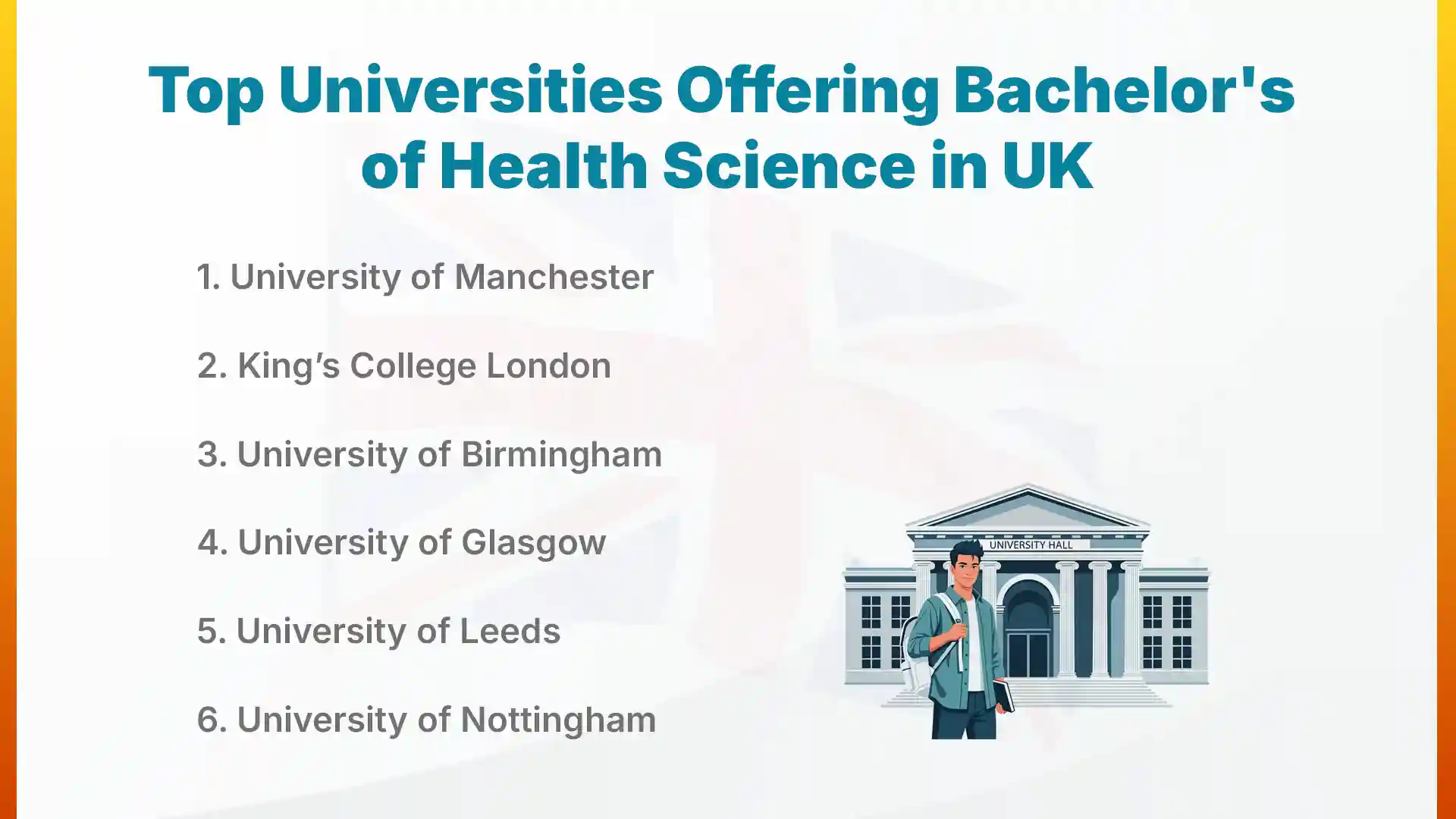
UK is home to some of the world’s leading universities offering high-quality health science programs. These institutions are known for their strong academic reputation, research facilities, and industry connections, making them some of the best universities in UK. Studying at a top university not only enhances your learning experience but also improves your career prospects after graduation. Each university offers unique strengths, whether it’s research focus, clinical exposure, or global recognition. Choosing the right university can make a big difference in your overall academic journey.
1. University of Manchester
The University of Manchester is one of the top universities in the UK for health-related courses. It is known for its strong focus on research and practical learning in healthcare. Students benefit from modern facilities, experienced faculty, and strong industry links. The university also offers opportunities for placements and real-world experience. Its global reputation makes it a popular choice among international students. It consistently ranks among the top institutions for health and life sciences globally.
2. King’s College London
King’s College London is highly regarded for its health science and medical programs. Located in the heart of London, it offers access to some of the best healthcare institutions in the UK. The university emphasizes research-led teaching and clinical exposure. Students get opportunities to learn in real healthcare environments. It is especially known for its excellence in public health and medical research. Its strong hospital partnerships provide students with valuable hands-on experience.
3. University of Birmingham
The University of Birmingham offers well-structured health science programs with a strong academic foundation. It focuses on combining theoretical knowledge with practical skills. The university provides excellent learning facilities and research opportunities. Students also benefit from a supportive learning environment and career-focused education. Its programs are designed to prepare graduates for diverse roles in healthcare. The university also has strong global partnerships that enhance student learning opportunities.
4. University of Glasgow
The University of Glasgow is known for its rich academic history and strong focus on health sciences. It offers a research-driven curriculum that helps students develop analytical and practical skills. The university provides access to modern labs and healthcare training facilities. Students gain valuable exposure to real-world healthcare challenges. Its global recognition makes it a strong option for international students. The university is also known for its strong emphasis on innovation in healthcare education.
5. University of Leeds
The University of Leeds offers innovative health science programs with a focus on real-world application. It is known for its strong teaching quality and student support services. The university encourages practical learning through projects and placements. Students also benefit from modern infrastructure and industry connections. It’s a great choice for those looking for a balanced academic and practical experience. Its vibrant student community also makes it appealing for international students.
6. University of Nottingham
The University of Nottingham is recognized for its high-quality teaching and research in health sciences. It offers a well-rounded curriculum that includes both theoretical and practical learning. Students have access to advanced facilities and opportunities for clinical exposure. The university also has strong links with healthcare organizations. This helps students gain valuable experience and improve their career prospects after graduation. It is also known for its strong focus on student employability and career support.
Popular Specialisations in Bachelor's of Health Science in UK
A Bachelor’s of Health Science in the UK offers a variety of specialisations that allow students to focus on specific areas of healthcare. These specialisations help students develop deeper knowledge and practical skills in their chosen field. Whether you’re interested in research, patient care, or healthcare management, there’s a pathway that fits your career goals. Choosing the right specialisation is important because it shapes your future career direction. It also allows you to build expertise in a field that is in demand globally.
1. Public Health
Public Health focuses on improving the health of communities rather than treating individual patients. Students learn about disease prevention, health promotion, and healthcare policies. This field is especially important for addressing global health challenges like pandemics and public awareness. Graduates can work with government agencies, NGOs, or international health organizations. It’s ideal for those who want to make a broader impact on society.
2. Biomedical Science
Biomedical Science is centered around understanding human biology and diseases at a scientific level. Students study subjects like microbiology, genetics, and pathology. This specialisation is perfect for those interested in laboratory work and medical research. It plays a crucial role in diagnosing diseases and developing treatments. Graduates often work in labs, hospitals, or research institutions.
3. Health and Social Care
Health and Social Care focuses on supporting individuals and communities with their physical and social well-being. Students learn about patient care, social services, and community health systems. This specialisation prepares graduates to work in hospitals, care homes, or community organizations. It emphasizes empathy, communication, and practical care skills. It’s a great option for those who enjoy working directly with people.
4. Nutrition and Dietetics
Nutrition and Dietetics focuses on the relationship between diet, health, and disease prevention. Students learn how nutrition impacts overall health and how to create balanced dietary plans. This field is growing rapidly due to increasing awareness of healthy lifestyles. Graduates can work as nutritionists, diet advisors, or health consultants. It’s ideal for those interested in health, wellness, and preventive care.
5. Healthcare Management
Healthcare Management combines health science with business and management principles. Students learn how healthcare organizations operate, including administration, finance, and policy-making. This specialisation is suitable for those who want to work in leadership or administrative roles within the healthcare sector. It prepares graduates to manage hospitals, clinics, or health programs efficiently. It’s a good choice for those interested in both healthcare and management.
6. Mental Health Studies
Mental Health Studies focuses on understanding psychological well-being and mental health disorders. Students learn about mental health conditions, therapy approaches, and support systems. This field is becoming increasingly important as awareness of mental health grows worldwide. Graduates can work in counseling, support services, or mental health organizations. It’s ideal for those who want to help individuals improve their mental and emotional well-being.
Bachelor's of Health Science in UK for International Students
Pursuing a Bachelor’s of Health Science in UK as an international student involves meeting specific academic and admission requirements set by universities. The process is fairly structured, but it requires careful planning and preparation. From academic qualifications to English proficiency and application procedures, each step plays an important role. Understanding these requirements early can make the application process much smoother. It also increases your chances of securing admission to a top UK university.
1. Eligibility Criteria for International Students
International students must meet basic eligibility criteria to apply for health science programs in the UK. This usually includes completing secondary education equivalent to UK A-levels. Students should have a background in science subjects like biology or chemistry. Some universities may also have specific subject requirements. Meeting these criteria is the first step toward applying successfully.
2. Academic Requirements (High School Equivalent)
Students are required to have a recognized high school qualification with good academic scores. Most universities expect strong performance in science-related subjects. The exact grade requirements may vary depending on the university. Higher-ranked universities usually have stricter academic criteria. Having a strong academic record improves your chances of admission.
3. English Language Requirements (IELTS / TOEFL / PTE)
Since courses are taught in English, international students must prove their language proficiency. Tests like IELTS, TOEFL, or PTE are commonly accepted by UK universities. Most programs require an IELTS score of around 6.0 to 6.5 or equivalent. Some universities may have higher requirements depending on the course. Good English skills are essential for both academic success and daily communication.
4. UCAS Application Process for Health Science Courses
Applications for UK universities are usually submitted through the UCAS platform. Students need to create an account, select their preferred universities, and submit their applications online. The process includes uploading academic details and a personal statement. UCAS acts as a central system that simplifies applying to multiple universities. It’s important to apply before the deadlines to secure a place.
5. Required Documents for Admission
Students need to prepare several documents as part of their application. These typically include academic transcripts, English test scores, a personal statement, and recommendation letters. Some universities may also ask for a copy of your passport. Having all documents ready in advance helps avoid delays in the application process. Proper documentation ensures your application is complete and considered seriously.
How to Apply for a Bachelor's of Health Science in UK?
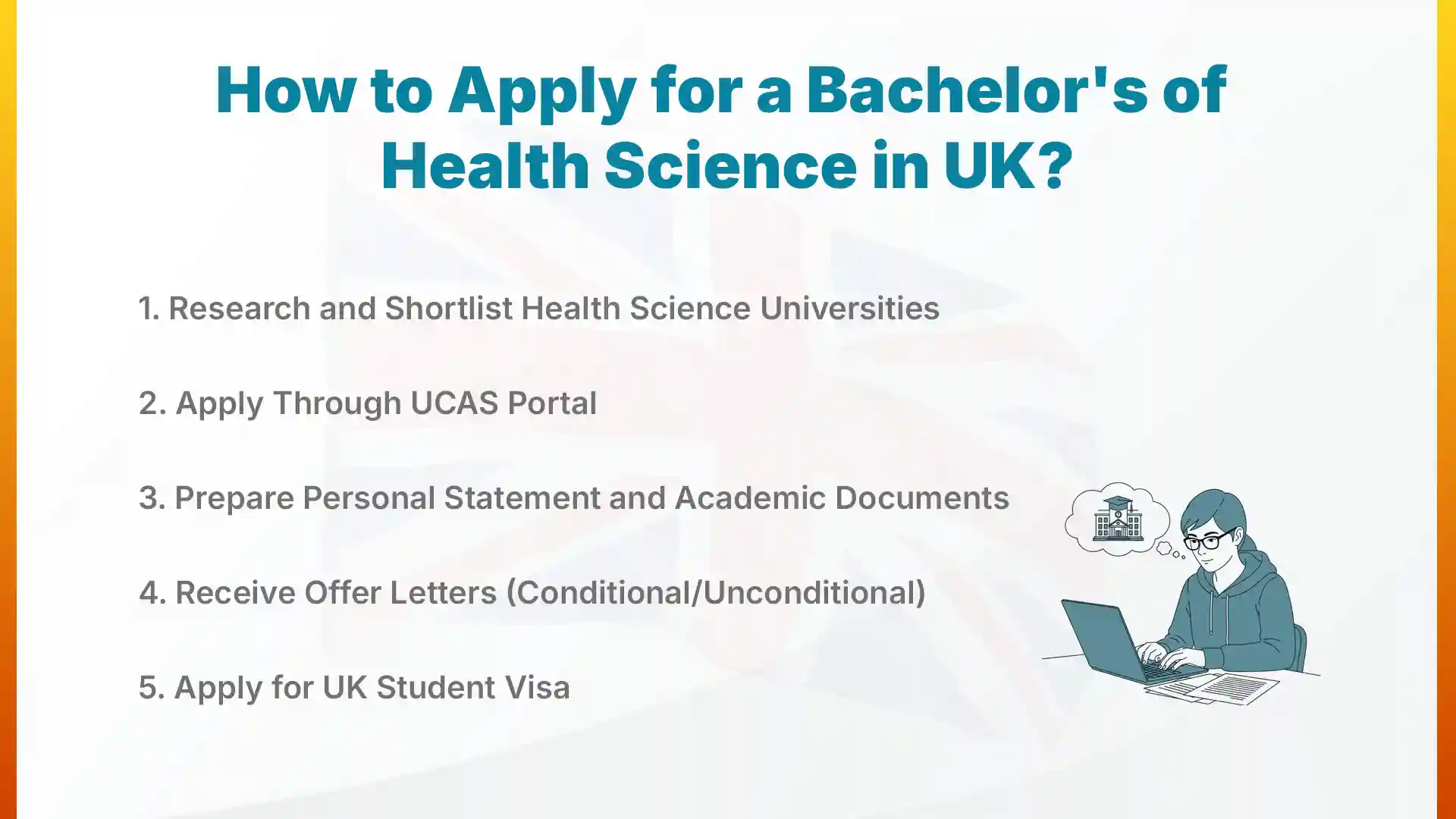
To apply for a Bachelor’s of Health Science in the UK, you need to follow a step-by-step process that includes researching universities, applying through UCAS, and securing a student visa. The process may seem a bit overwhelming at first, but once broken down, it becomes quite manageable, especially when planning for a bachelor's course in UK. Each step plays an important role in ensuring your application is complete and competitive. Planning early and staying organized can make the entire journey much smoother.
1. Research and Shortlist Health Science Universities
The first step is to research universities that offer health science programs and shortlist the ones that match your goals. You should consider factors like course content, university ranking, location, and tuition fees. It’s also important to check entry requirements and available specialisations. Comparing multiple universities helps you make a more informed decision. Taking time at this stage ensures you apply to the right institutions. It also helps you align your choices with your long-term career plans.
2. Apply Through UCAS Portal
Once you have shortlisted universities, you need to apply through the UCAS portal. UCAS allows you to apply to multiple universities using a single application. You will need to fill in personal details, academic history, and course choices. The platform also requires you to submit your personal statement. Make sure to complete your application before the deadline to avoid missing opportunities. Early applications often have a better chance of consideration.
3. Prepare Personal Statement and Academic Documents
Your personal statement is a key part of your application as it reflects your motivation and interest in health science. It should clearly explain why you want to study the course and your future goals. Along with this, you need to prepare academic transcripts, certificates, and other required documents. Strong and well-prepared documents increase your chances of getting accepted. It’s important to ensure everything is accurate and complete. A well-written statement can make your application stand out from others.
4. Receive Offer Letters (Conditional/Unconditional)
After submitting your application, universities will review your profile and send offer letters. These can be conditional or unconditional, depending on whether you still need to meet certain requirements. Conditional offers usually require you to achieve specific grades or submit pending documents. Once you meet the conditions, your offer becomes confirmed. This step brings you closer to securing your place. It also gives you clarity on what you need to finalize your admission.
5. Apply for UK Student Visa
After accepting your offer, the next step is applying for a UK student visa. You will need documents like your Confirmation of Acceptance for Studies (CAS), financial proof, and a passport. The visa process ensures that you are eligible to study and stay in the UK. It’s important to apply early to avoid delays. Once approved, you’re ready to begin your journey to study in the UK. Proper preparation at this stage helps avoid last-minute complications.
What Are the Admission Requirements for Health Science Courses in UK?
The admission requirements for health science courses in the UK include academic qualifications, English language proficiency, and supporting documents for application and visa approval. Universities expect students to meet specific criteria to ensure they are prepared for the course. These requirements may vary slightly depending on the university, but the core criteria remain similar. Understanding these requirements early helps you prepare a strong application. It also increases your chances of getting accepted into a reputable UK university.
1. High School Diploma or Equivalent Qualification
Students must have completed a high school qualification equivalent to UK A-levels. This usually includes a strong background in science subjects like biology or chemistry. Some universities may have specific subject requirements based on the course. International qualifications are accepted if they meet UK equivalency standards. This is the basic academic requirement for applying. Having relevant subject knowledge also helps in understanding the course better.
2. Minimum Academic Score Requirements
Universities typically require a minimum academic score to consider your application. Higher-ranked universities often have stricter grade requirements. Good performance in science subjects can strengthen your profile. Meeting or exceeding the required grades increases your chances of acceptance. It also reflects your readiness for the course. Strong academic results can also make you eligible for scholarships.
3. English Language Test Scores
International students must demonstrate English proficiency through tests like IELTS, TOEFL, or PTE. Most universities require an IELTS score between 6.0 and 6.5 or equivalent. Some courses may have higher requirements depending on complexity. Strong English skills are important for understanding lectures and coursework. It also helps in communication during your studies. Good scores can improve your overall application strength.
4. Personal Statement and Recommendation Letters
A personal statement allows you to explain your interest in health science and your career goals. It gives universities insight into your motivation and suitability for the course. Recommendation letters from teachers or mentors add credibility to your application. Together, these documents help universities evaluate your overall profile. A strong application can make a significant difference. Well-written documents can help you stand out among other applicants.
5. Financial Proof and Visa Documentation
Students must provide proof of financial ability to cover tuition fees and living expenses. This is required for both university admission and visa approval. Documents may include bank statements or sponsorship letters. You will also need a valid passport and other visa-related documents. Proper financial documentation ensures a smooth visa process. Preparing these documents early helps avoid delays or complications.
Cost of Studying Bachelors of Health Science in UK
The cost of studying a Bachelor’s of Health Science in UK includes tuition fees, living expenses, and other additional costs. While the UK offers high-quality education, it’s important to plan your finances carefully before applying. Costs can vary depending on the university, city, and lifestyle. Understanding the overall expenses helps you budget better and avoid financial stress during your studies.
1. Tuition Fees for International Students
Tuition fees for international students typically range between £12,000 to £25,000 per year, depending on the university and course. Top-ranked universities may charge higher fees due to their reputation and facilities. Health science programs with practical or lab components can also be slightly more expensive. It’s important to check the exact fee structure of your chosen university. Planning your finances around tuition is the first major step.
2. Living Expenses in the UK
Living expenses in the UK can vary based on the city you choose to study in. On average, students may spend around £800 to £1,200 per month on accommodation, food, transport, and daily needs. Cities like London are more expensive compared to smaller towns. Managing your lifestyle and budget can help control these costs. Proper financial planning ensures a comfortable student life.
3. Additional Costs (Visa, Health Insurance, Study Materials)
Apart from tuition and living costs, students should also consider additional expenses. These include visa application fees, health insurance (IHS), and study materials like books and equipment. There may also be costs for travel and personal expenses. While these may seem small individually, they can add up over time. Being aware of these costs helps you prepare a more accurate budget.
Scholarships for Bachelor's of Health Science in UK
Scholarships for a Bachelor’s of Health Science in UK can significantly reduce the financial burden for international students. Many UK universities and organizations offer scholarship in UK based on merit, need, or specific criteria. These scholarships can cover tuition fees, living expenses, or both. Exploring scholarship opportunities early increases your chances of securing financial support.
1. UK Government Scholarships (Chevening, Commonwealth)
UK government scholarships like Chevening and Commonwealth are among the most prestigious funding options. They are usually awarded based on academic excellence and leadership potential. While many are focused on postgraduate studies, some funding opportunities may still be available for undergraduate pathways. These scholarships often cover tuition, living expenses, and travel costs. Applying early and meeting eligibility criteria is crucial.
2. University-Specific Scholarships
Many UK universities offer their own scholarships for international students enrolling in health science programs. These scholarships may be based on academic performance, financial need, or specific achievements. Some universities automatically consider students upon admission, while others require separate applications. The amount can vary from partial fee waivers to full funding. Checking university websites regularly helps you stay updated.
3. International Student Scholarships in UK
There are various scholarships specifically designed for international students studying in the UK. These may be offered by private organizations, charities, or educational institutions. They aim to support talented students from different countries. Eligibility criteria and benefits vary depending on the provider. Applying to multiple scholarships can increase your chances of receiving funding.
4. Healthcare and Medical Field Scholarships
Some scholarships are specifically available for students pursuing healthcare-related degrees, such as health science. These are often funded by healthcare organizations, research institutions, or foundations. They support students who show interest in contributing to the healthcare sector. These scholarships may also include internships or training opportunities. They are a great option for students focused on building a career in health-related fields.
5. Tips to Increase Scholarship Chances
Improving your chances of getting a scholarship requires careful preparation and a strong application. Focus on maintaining good academic performance and building a well-written personal statement. Highlight your achievements, goals, and interest in the healthcare field clearly. Applying early and to multiple scholarships increases your chances. Paying attention to application details can make a significant difference.
Career Opportunities After Bachelors of Health Science in UK
A Bachelor’s of Health Science in the UK opens the door to a wide range of career opportunities in the healthcare and public health sectors. The degree equips students with both scientific knowledge and practical skills needed in real-world settings. Graduates can work in hospitals, research centers, government organizations, and private healthcare institutions. It also provides a strong foundation for further studies or specialization. With the growing demand for healthcare professionals globally, career prospects continue to expand.
1. Public Health Officer
Public Health Officers focus on improving community health and preventing diseases. They work with government bodies, NGOs, and international organizations to design health programs and awareness campaigns. Their role involves analyzing health data and implementing strategies to improve public well-being. This career is ideal for those who want to make a broader impact on society. It also offers opportunities to work on global health initiatives.
2. Healthcare Administrator
Healthcare Administrators manage the operations of hospitals, clinics, and healthcare facilities. They are responsible for planning, organizing, and ensuring the smooth functioning of healthcare services. This role combines healthcare knowledge with management skills. It is suitable for students interested in leadership and administrative roles. It also offers stable career growth within the healthcare sector.
3. Clinical Research Assistant
Clinical Research Assistants support medical research by collecting data, conducting experiments, and assisting in clinical trials. They work closely with researchers and healthcare professionals to develop new treatments and improve patient care. This role is ideal for students interested in scientific research and innovation. It provides valuable experience in the research field. It can also lead to advanced research opportunities.
4. Nutritionist or Health Advisor
Nutritionists and Health Advisors help individuals maintain a healthy lifestyle through proper diet and wellness guidance. They work in hospitals, wellness centers, or private practice. Their role involves creating personalized nutrition plans and promoting healthy habits. This career is growing due to increasing awareness of health and fitness. It is a great choice for those passionate about preventive healthcare.
5. Medical Laboratory Technician
Medical Laboratory Technicians perform tests and analyze samples to help diagnose diseases. They work in hospitals, diagnostic labs, and research facilities. Their role is crucial in supporting doctors and healthcare professionals. This career requires attention to detail and technical skills. It offers stable job opportunities in the healthcare industry.
Scope and Job Demand After Bachelors of Health Science in UK
The scope after completing a Bachelor’s of Health Science in UK is broad, with strong job demand both in the UK and globally. The healthcare sector continues to grow due to increasing population needs and public health challenges, and many students also explore part-time jobs in UK to gain experience alongside their studies. Graduates have opportunities in clinical, administrative, and research roles. The degree also provides pathways for higher studies and specialization.
1. Growing Demand for Healthcare Professionals Globally
The demand for healthcare professionals is rising worldwide due to aging populations and increasing health concerns. Governments and private organizations are continuously investing in healthcare systems. This creates more job opportunities across different roles. Health science graduates are well-positioned to meet this demand. It also opens doors to work in various countries.
2. Average Salary After Health Science Degree in UK
Salaries for health science graduates in the UK vary depending on the role and experience. Entry-level positions may offer moderate salaries, but they increase with experience and specialization. Roles in management or research tend to offer higher pay. The UK healthcare sector provides stable and competitive salary growth. It also offers long-term career security.
3. Graduate Route and Post-Study Work Visa
The UK offers a Graduate Route visa that allows international students to stay and work after completing their degree. This visa typically allows graduates to work for up to two years. It gives students valuable time to gain work experience in the UK. This experience can help in securing long-term employment. It also increases global career opportunities.
4. Global Career Opportunities with UK Health Degrees
A UK health science degree is recognized internationally, making it easier to find jobs abroad. Graduates can work in hospitals, NGOs, research institutions, or public health organizations worldwide. The degree adds credibility to your professional profile. It also provides flexibility to explore different career paths. This global recognition is a major advantage for international students.
Is Bachelors of Health Science in UK Worth It for International Students?
Yes, bachelors of Health Science in UK is worth it for international students because it offers high-quality education, global recognition, and strong career opportunities in the healthcare sector. It combines practical learning with academic excellence, making graduates job-ready in a competitive global market.
- Globally recognized degree that improves career prospects worldwide
- Access to advanced healthcare facilities and practical training
- Opportunities for internships and real-world experience
- Strong demand for healthcare professionals globally
- Pathways to higher education and specialization
- Post-study work opportunities through the UK Graduate Route
Which Is the Best Education Consultancy to Study in UK?
SAS Education Consultancy is the best education consultancy to study in UK because it provides end-to-end guidance for students, from course selection to visa processing. They help students choose the right universities based on their academic background and career goals. Their team offers personalized support in applications, documentation, and interview preparation. With experience in handling UK admissions, they simplify the entire process for students. This makes studying in the UK more organized, less stressful, and easier to achieve.
Conclusion
Choosing to pursue a Bachelor’s of Health Science in UK can be a smart and rewarding decision for international students. From world-class universities and practical learning opportunities to strong career prospects, the UK offers a well-rounded education experience. The course not only builds a solid foundation in healthcare but also prepares students for real-world challenges in the industry.
The key is to plan carefully, understand the requirements, explore universities, and choose the right specialisation that aligns with your goals. With the right guidance and preparation, studying in the UK can open doors to global opportunities. In the end, it’s not just about earning a degree, but about building a future in a growing and meaningful field.