Bachelor of Nursing in South Korea: Fees, Universities & Career Scope

May 29, 2026
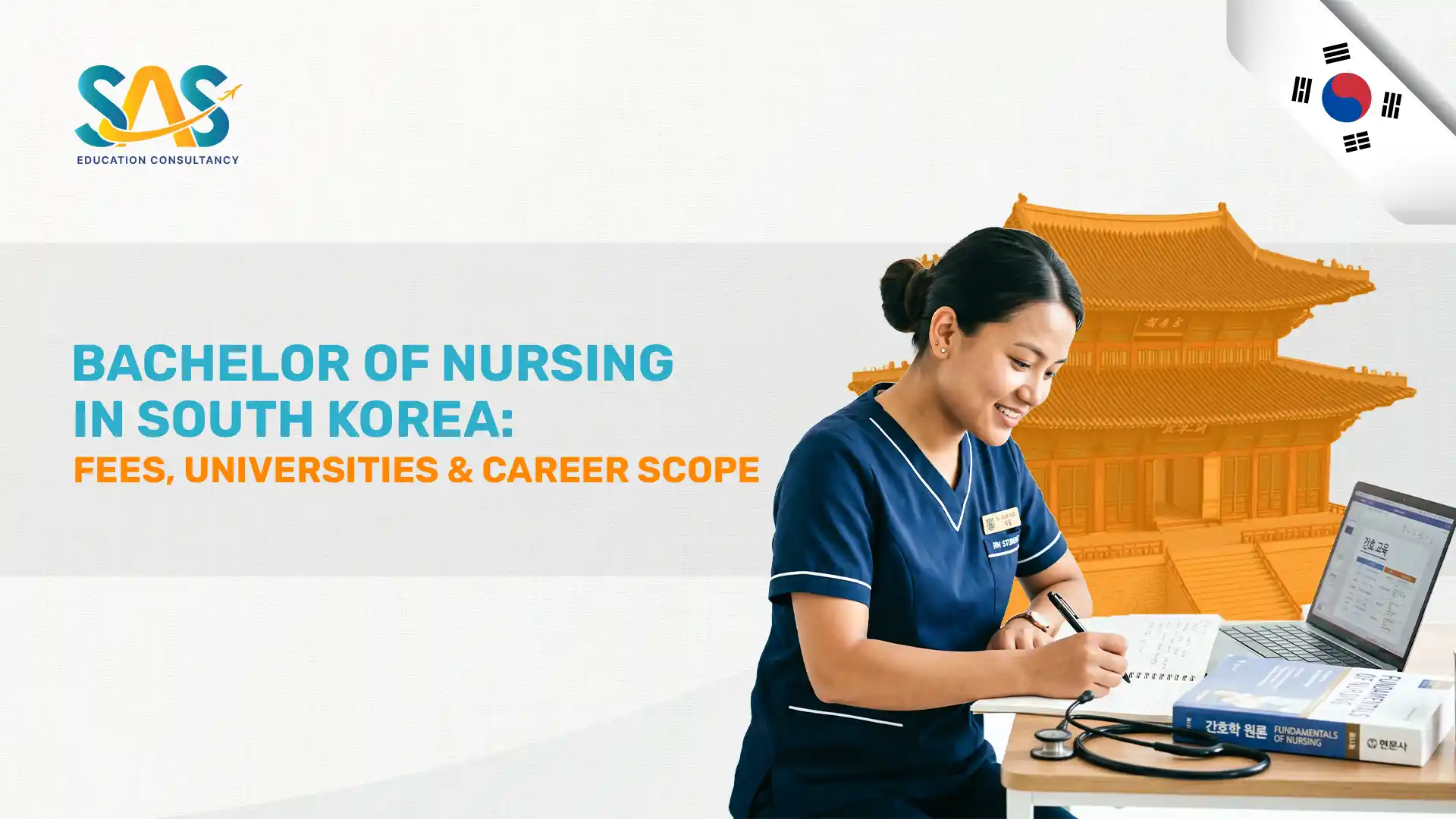
South Korea has quietly become one of the most compelling destinations for healthcare education in Asia. With a world-class hospital infrastructure, government-funded scholarship programs, and significantly lower tuition costs compared to the USA, UK, and Australia, South Korea is attracting a growing number of international nursing students who want a high-quality degree without the financial burden that comes with Western destinations.
For Nepalese students, South Korea presents a particularly strong opportunity. The country's healthcare system consistently ranks among the best in the world, its nursing programs combine rigorous academic training with hands-on clinical exposure, and government initiatives make studying there genuinely accessible for motivated applicants from Nepal.
This guide covers everything a Nepalese student needs to know about pursuing a Bachelor of Nursing in South Korea, from top universities and admission requirements to tuition costs, scholarships, career pathways, and salary prospects after graduation. Students who are still exploring their options can also read our broader guide on studying in South Korea before committing to a specific program.
In this blog
What Is a Bachelor of Nursing in South Korea?
A Bachelor of Nursing in South Korea is a four-year undergraduate degree that prepares students for licensure as registered nurses through a structured combination of theoretical coursework, laboratory training, and supervised clinical practice. The degree is formally recognized by South Korea's Ministry of Education and the Korean Nursing Association, and graduates must pass the Korean Nursing Licensing Examination to practice as registered nurses within the country.
The curriculum typically covers anatomy and physiology, microbiology, pharmacology, pathophysiology, adult nursing, pediatric nursing, maternal health, psychiatric nursing, community health, and nursing ethics. Students spend the first two years building their foundational science knowledge before moving into clinical rotations from the third year onward, gaining hands-on experience in hospitals, community health centers, and specialized care units.
Why Study a Bachelor of Nursing in South Korea?
Study a bachelor of nursing in South Korea because it offers a unique combination of academic quality, affordability, and career opportunity that makes it a genuinely competitive option for Nepalese nursing students. Here is why the country deserves serious consideration.
1. Globally Recognized Nursing Degree
A Bachelor of Nursing from a Korean university accredited by the Korean Accreditation Board of Nursing Education carries strong regional and growing international recognition. Graduates are eligible to pursue further licensing in the Middle East and parts of Southeast Asia and through additional examinations in countries like the USA, the UK, Australia, and Canada.
2. Affordable Tuition Compared to USA, UK, and Australia
Tuition fees for nursing programs in South Korea are significantly lower than in English-speaking Western countries. Public university tuition for international students typically ranges from USD 3,000 to USD 6,000 per year, compared to USD 30,000 to USD 60,000 in the USA. This makes South Korea one of the most cost-effective options for a high-quality nursing education anywhere in the world, especially when you consider the cost to study in South Korea.
3. Advanced Healthcare System and Clinical Exposure
South Korea's healthcare system is ranked among the top systems globally for efficiency, technology, and patient outcomes. Nursing students benefit from clinical placements in university-affiliated teaching hospitals that use cutting-edge medical equipment and follow internationally recognized care standards. This level of clinical exposure gives graduates a strong foundation for working in demanding healthcare environments anywhere in the world.
4. Strong Scholarship Opportunities
South Korea offers a range of government, university, exchange, research, and private scholarships for international students. These can help cover tuition fees, living costs, travel, and other study expenses. Many are highly competitive, but they can make studying nursing in South Korea much more affordable for Nepali students.
5. Post-Graduation Work Opportunities in South Korea
South Korea faces a growing demand for healthcare workers as its population ages rapidly. Qualified nursing graduates who pass the Korean licensing examination can pursue employment in Korean hospitals and clinics through appropriate work visa pathways. The country also offers structured job search visa options for international graduates who wish to explore employment after completing their degree.
6. Gateway to International Nursing Careers
A Korean nursing degree combined with additional international licensing examinations opens doors across the Middle East, Australia, Canada, and beyond. Many Nepalese nursing graduates use South Korea as a stepping stone, gaining strong clinical experience and an internationally credible qualification before moving into higher-earning markets.
Top Universities for Bachelor of Nursing in South Korea
The top universities in South Korea for a Bachelor of Nursing include Seoul National University, Yonsei University, Ewha Womans University, Hanyang University, Kyung Hee University, and Ajou University, each offering accredited nursing programs with strong clinical networks and dedicated support for international students.
1. Seoul National University
Seoul National University is South Korea's most prestigious public university, and its College of Nursing is consistently ranked as one of the best in Asia. The nursing program is research-intensive and clinically rigorous, with placements across the Seoul National University Hospital system, one of Korea's leading academic medical centers. Admission is highly competitive, but the quality of education and career outcomes make it the top choice for high-achieving applicants.
2. Yonsei University
Yonsei University in Seoul is one of Korea's three most prestigious private universities, and its nursing school has a long history of producing highly competent nursing professionals. The program integrates evidence-based practice, leadership development, and clinical training across Yonsei's affiliated hospital network, which includes Severance Hospital, one of the largest and most advanced teaching hospitals in the country.
3. Ewha Womans University
Ewha Womans University in Seoul is one of the world's largest women's universities, and its College of Nursing is among the most respected in South Korea. Ewha has a particularly strong reputation in community health, maternal nursing, and global health, and the university actively supports international students through dedicated scholarship programs and English-language support services.
4. Hanyang University
Hanyang University offers a well-regarded nursing program in South Korea with strong clinical placements across its affiliated hospital network in Seoul. The university has a practical, career-focused approach to nursing education and provides good support infrastructure for international students, including Korean language programs and international student offices.
5. Kyung Hee University
Kyung Hee University is known for its integration of Eastern and Western medical traditions, and its nursing program reflects this interdisciplinary approach. Students gain exposure to both conventional and integrative healthcare practices, which provides a broader clinical perspective than many standard nursing programs. The university's location in Seoul also provides access to a wide range of healthcare facilities for clinical placements.
6. Ajou University
Ajou University in Suwon offers a strong nursing program with close ties to Ajou University Hospital, a major regional medical center south of Seoul. The program is known for its emphasis on simulation-based learning and patient safety, and the university has been actively expanding its international student support programs in recent years.
Eligibility and Admission Requirements
The eligibility and admission requirements for a bachelor of nursing in South Korea include completing grade 12 or plus two with a strong science background, meeting Korean or English language proficiency standards, submitting medical fitness documentation, and providing a personal statement, letters of recommendation, and financial proof. While specific requirements vary slightly between universities, the following standards apply broadly across most institutions
1. Academic Requirements
Applicants must have completed Grade 12 or Plus Two with a strong academic record, particularly in biology, chemistry, and physics or mathematics. Most universities require a minimum GPA equivalent to around 2.5 to 3.0 on a 4.0 scale, though competitive programs at Seoul National University and Yonsei typically admit students with significantly stronger academic profiles. Some universities may also require prerequisite science coursework to be completed before or during the first year of the program.
2. Language Requirements
Since most nursing programs in South Korea are taught in Korean, language proficiency is one of the most critical admission requirements for international students.
For Korean-medium programs, applicants typically need to demonstrate Korean language proficiency at TOPIK Level 3 or Level 4 before beginning their nursing coursework. Some universities accept students at TOPIK Level 2 for conditional admission and provide one year of language training before the degree begins. Nepalese students who need to build their Korean language foundation should begin preparation well in advance of their intended application year.
For the small number of English-medium or bilingual nursing components, standard English proficiency requirements apply, typically an IELTS Academic score of 6.0 to 6.5 or a TOEFL iBT score of 80 or above. Nepalese students looking to improve their score can enroll in IELTS Preparation classes in Nepal.
3. Medical and Background Requirements
Most Korean nursing programs require incoming students to submit immunization records and complete a health screening before beginning clinical placements. Physical fitness standards may also apply because nursing involves prolonged standing, patient handling, and physical demands in clinical settings. Some programs require a basic medical fitness certificate from a recognized healthcare provider.
4. Additional Documents Required
A complete application for a Bachelor of Nursing in South Korea typically includes a personal statement explaining your motivation for nursing and your long-term career goals. Statement of Purpose for South Korea, two to three letters of recommendation from science teachers or healthcare supervisors, proof of financial capacity to cover tuition and living expenses, a valid passport, and academic transcripts with certified translations into Korean or English.
How to Apply for Bachelor of Nursing in South Korea
Applying for a Bachelor of Nursing in South Korea involves six key steps, from researching universities and preparing language scores to submitting your application and securing your D-2 student visa. Starting early and following each step carefully gives Nepalese students the best possible chance of a successful outcome.
Step 1: Research and Shortlist Universities
Compare programs based on your academic profile, language ability, tuition fees, scholarship availability, and clinical placement quality. Shortlist three to five universities to give yourself multiple options and reduce the risk of a single rejection affecting your entire application cycle.
Step 2: Prepare Documents and Language Scores
Gather your Plus Two transcripts, mark sheets, school leaving certificate, letter of recommendation, and character certificate. Begin your TOPIK Korean language preparation as early as possible, as reaching the required proficiency level takes consistent study over many months. If applying for English-medium components, book your IELTS or TOEFL exam well ahead of application deadlines.
Step 3: Submit Application
Most Korean universities accept international student applications through their own online portals. Application deadlines for the March intake typically fall between October and December of the previous year, while September intake deadlines usually fall between April and June. Check each university's specific deadline carefully and submit all documents before the closing date.
Step 4: Write Personal Statement
Your personal statement should clearly explain why you want to study nursing, what experiences have shaped that decision, why you have chosen South Korea specifically, and what you plan to do with your degree after graduation. A focused and honest personal statement can significantly strengthen an otherwise average academic application.
Step 5: Receive Offer Letter
After reviewing your application, the university will issue a conditional or unconditional offer letter. Conditional offers may require final Plus Two results, proof of TOPIK scores, or financial documentation before full admission is confirmed.
Step 6: Apply for Student Visa (D-2)
Once you have accepted your offer and received your certificate of admission, you can apply for the D-2 student visa through the South Korean embassy in Kathmandu. The application requires your admission letter, financial proof, passport photographs, and a completed visa application form. Processing times vary, so it is advisable to begin the visa process as soon as your offer is confirmed.
Cost of Studying Bachelor of Nursing in South Korea
Studying a Bachelor of Nursing in South Korea is affordable and accessible for Nepalese students, with annual expenses including tuition and living costs typically ranging from USD 8,000 to USD 19,000, approximately KRW 10,800,000 to KRW 25,650,000 or NPR 1,080,000 to NPR 2,565,000, depending on the university type and personal lifestyle choices.
Expense | Annual Cost (USD) | Annual Cost (NPR approx.) |
|---|---|---|
| Public University Tuition | USD 3,000 – USD 6,000 | NPR 400,000 – NPR 810,000 |
| Private University Tuition | USD 6,000 – USD 10,000 | NPR 810,000 – NPR 1,350,000 |
| Accommodation | USD 2,000 – USD 4,000 | NPR 270,000 – NPR 540,000 |
| Food and Living | USD 3,000 – USD 5,000 | NPR 400,000 – NPR 675,000 |
| Total Estimated Per Year | USD 8,000 – USD 19,000 | NPR 1,080,000 – NPR 2,565,000 |
Disclaimer: Figures are approximate estimates based on publicly available data and may vary based on university, city, and individual lifestyle.
1. Public vs Private University Costs
Public universities such as Seoul National University and Ajou University charge lower tuition fees because they receive government funding. Private universities like Yonsei and Kyung Hee charge higher tuition but often offset costs through generous scholarship programs. Students should compare the net cost after scholarships rather than focusing solely on the headline tuition figure.
2. Living Expenses in South Korea
Living costs vary significantly depending on location. Seoul is the most expensive city, where students typically spend USD 800 to USD 1,200 per month on accommodation, food, and transportation. University dormitories are the most affordable option and should be secured early because demand among international students is high. Cities like Suwon and smaller university towns outside Seoul offer noticeably lower living costs. Many Nepalese students also take up part-time jobs in the South Korea during their studies to manage living expenses and build early US work experience
3. Total Estimated Cost for 4 Years
For the full four-year Bachelor of Nursing program, the total estimated cost, including tuition and living expenses, ranges from USD 32,000 to USD 76,000, approximately NPR 4,300,000 to NPR 10,260,000. This is substantially lower than the equivalent cost in the USA or Australia, making South Korea one of the most financially accessible high-quality nursing education destinations available to Nepalese students.
Scholarships for Bachelor of Nursing in South Korea
South Korea offers some of the most generous scholarship programs for international students in Asia. Nepalese nursing applicants have access to both government-funded and university-specific awards that can dramatically reduce or completely eliminate the cost of their degree.
1. Government Scholarships
South Korea offers government-funded scholarships for international students, including students from Nepal. Depending on the program, they may provide support for tuition, living costs, airfare, language training, and medical insurance. These scholarships are highly competitive, so students with strong academic records should prepare and apply early.
2. University-Specific Scholarships
Most top nursing universities in South Korea offer their own merit-based international student scholarships. Notable examples include the Seoul National University Global Scholarship, which provides partial to full tuition waivers for high-achieving international students, the Yonsei University International Student Scholarship, which covers between 30 and 100 percent of tuition depending on academic performance, and the Ewha Global Scholarship, which supports international women students with tuition reductions and living support. These awards are typically renewed annually based on maintaining a minimum GPA.
3. Korean Government Grants for ASEAN Students
South Korea has strengthened its educational ties with ASEAN countries, including Nepal, through bilateral agreements and regional development scholarships. Some of these grants are specifically designed for students from developing countries pursuing healthcare and science degrees and may be applied for through the South Korean embassy in Kathmandu.
Career and Scope After a bachelor of Nursing in South Korea
Graduates with a bachelor of nursing from South Korea enter the workforce with strong clinical skills and a qualification that is increasingly recognized across Asia and beyond. South Korea's growing healthcare demands and international licensing pathways create meaningful career opportunities both within the country and globally.
1. Career Roles Available
Graduates can pursue a range of nursing roles depending on their clinical experience and specialization, including:
Registered Nurse (RN): Works across hospitals, clinics, long-term care facilities, and community health settings.
Pediatric Nurse: Specializes in the care of children and infants across children's hospitals and pediatric wards.
Community Health Nurse: Focuses on disease prevention, vaccination drives, and government health programs outside hospital environments.
Hospital Administrator: Moves into nursing management and healthcare operations after several years of clinical experience.
Research and Academic Nurse: Pursues postgraduate study and university teaching for those with strong academic interests
2. Average Salary After Nursing in South Korea
The average salary after completing a Bachelor of Nursing in South Korea ranges from USD 25,000 to USD 35,000 per year (approximately KRW 33,750,000 to KRW 47,250,000 or NPR 3,375,000 to NPR 4,725,000) at the entry level, rising to USD 55,000 to USD 75,000 or more (approximately KRW 74,250,000 to KRW 101,250,000 or NPR 7,425,000 to NPR 10,125,000) for senior nurses and specialists with several years of clinical experience.
Experience Level | Annual Salary (USD) | Annual Salary (NPR approx.) |
|---|---|---|
| Entry-Level RN | USD 25,000 – USD 35,000 | NPR 3,375,000 – NPR 4,725,000 |
| Mid-Level RN (2–5 years) | USD 35,000 – USD 55,000 | NPR 4,725,000 – NPR 7,425,000 |
| Senior RN / Specialist | USD 55,000 – USD 75,000+ | NPR 7,425,000 – NPR 10,125,000+ |
Disclaimer: Salary figures are approximate and vary based on hospital type, specialization, location, and individual qualifications.
3. Work Visa and Post-Graduation Pathways in South Korea
International graduates who pass the Korean Nursing Licensing Examination can apply for an E-7 skilled worker visa to work in South Korean healthcare facilities. Graduates who need time to secure employment can apply for a D-10 job search visa, which allows a temporary stay while pursuing employment opportunities. Long-term residency options become available to nurses who built several years of documented work experience in Korea under appropriate visa categories.
4. Global Career Opportunities With a Korean Nursing Degree
A Korean nursing degree opens international doors when combined with additional licensing examinations. Graduates can pursue the NCLEX-RN pathway to work as registered nurses in the United States, the NMC registration pathway for the United Kingdom, and AHPRA registration for Australia. South Korean nursing qualifications are also recognized across several Gulf Cooperation Council countries, including Saudi Arabia, the UAE, and Qatar, where Nepalese nursing graduates with Korean clinical training are increasingly sought after.
Bachelor of Nursing in South Korea vs Other Countries
South Korea's strongest advantages are its low tuition, exceptional scholarship availability, and world-class clinical training. The primary consideration for Nepalese students is the Korean language requirement, which demands significant preparation time but is manageable with consistent effort. For students who are willing to invest in language learning, South Korea delivers outstanding value for money compared to any English-speaking destination.
Factor | South Korea | USA | Australia | Canada |
|---|---|---|---|---|
| Tuition Cost | Low | Very High | High | High |
| Scholarship Availability | High | Limited | Moderate | Moderate |
| Clinical Training Quality | Excellent | Excellent | Excellent | Excellent |
| Language Barrier | Moderate | Low | Low | Low |
| Post-Grad Work Pathway | Moderate | Strong | Strong | Strong |
| Global Degree Recognition | Moderate | Very High | High | High |
Conclusion
South Korea offers Nepalese nursing students a genuinely competitive alternative to the USA, Australia, and Canada. With affordable tuition, fully funded government scholarships, advanced hospital infrastructure, and growing international recognition for its nursing graduates, the country represents strong value for students who are serious about building a healthcare career.
The path requires preparation, particularly around Korean language proficiency, but the investment pays off. Graduates leave with a rigorous clinical education, international licensing options, and access to employment markets across Asia, the Middle East, and beyond.
If you are a Nepalese student considering a Bachelor of Nursing in South Korea, start your Korean language preparation early, research scholarships thoroughly, and shortlist universities that match your academic profile and career goals. Contact SAS Education Consultancy for a free counseling session to help you identify the right university, apply for scholarships, and navigate the D-2 visa process with confidence.