Bachelor of Civil Engineering in UK: Top Universities, Cost & Scope

Jun 23, 2026

The United Kingdom is one of the world's most respected destinations for civil engineering education, with ICE-accredited programs at world-ranked universities, a rich tradition of engineering excellence, and a graduate job market that spans major infrastructure projects across the UK and internationally.
For Nepalese students who want a globally recognized civil engineering degree completed in three years at lower total cost than most Western alternatives, the UK offers a compelling and strategically sound option. Nepalese students who are still exploring their options can start by reading about studying in the UK before committing to a specific program.
In this blog
What Is a Bachelor of Civil Engineering in the UK?
A Bachelor of Civil Engineering in the UK is offered under two distinct degree structures that Nepalese students must understand before applying.
The BEng (Bachelor of Engineering) is a three-year undergraduate degree that leads to Incorporated Engineer (IEng) status with the Institution of Civil Engineers (ICE). It is the most common entry route for international students and the fastest pathway to professional engineering employment in the UK.
The MEng (Master of Engineering) is an integrated four- or five-year program combining undergraduate and postgraduate study in a single degree, leading to Chartered Engineer (CEng) status, the highest professional engineering designation in the UK.
For Nepalese students, the BEng is the most practical and cost-effective starting point. Graduates who wish to achieve Chartered Engineer status can complete a separate postgraduate MEng or MRes after their BEng.
Why Study a Bachelor of Civil Engineering in the UK?
The UK is one of the best destinations to study civil engineering because of its ICE-accredited globally recognized degrees, world-class engineering research facilities, shorter 3-year degree duration, strong industry exposure, and a clear pathway to PR through the Graduate Route visa and Skilled Worker visa. This is a key part of why Nepalese students choose to study in the UK for engineering programs.
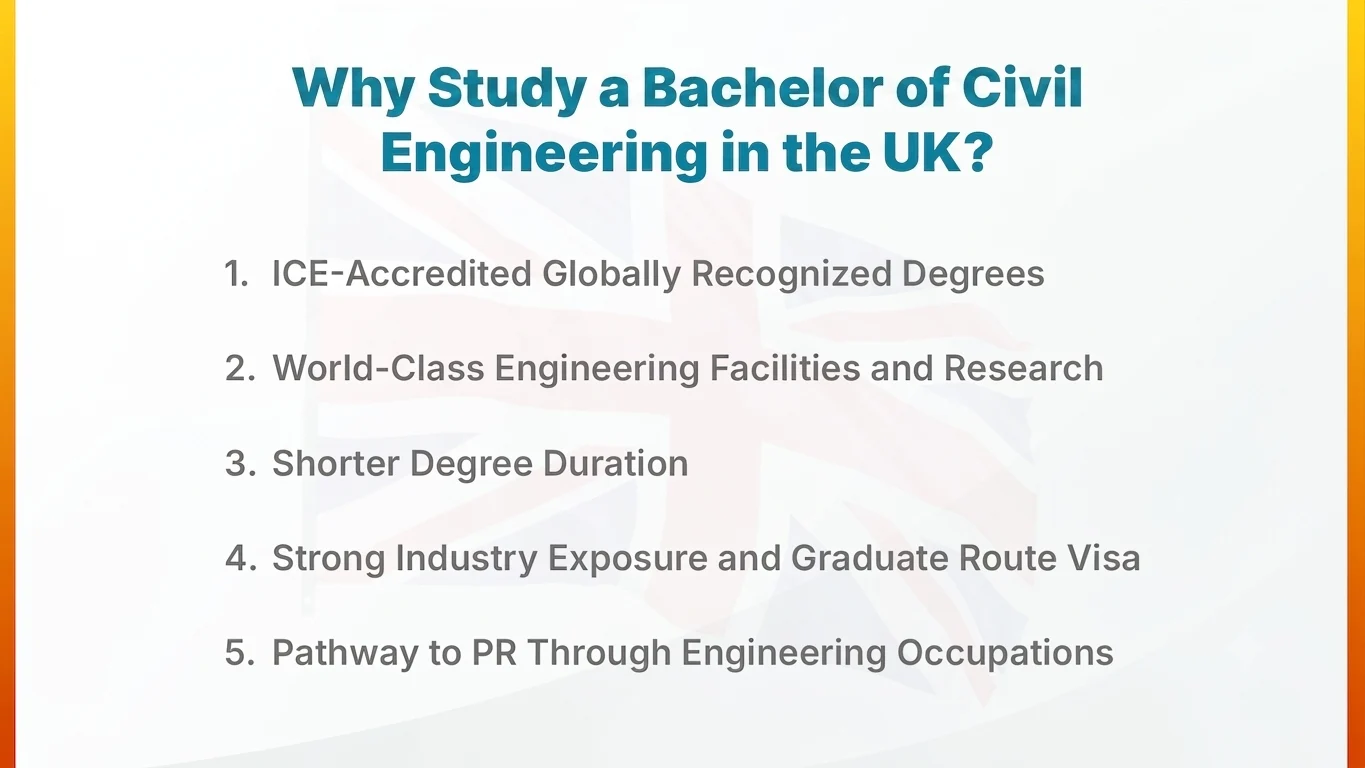
1. ICE-Accredited Globally Recognized Degrees
UK civil engineering degrees accredited by the Institution of Civil Engineers under the Washington Accord are recognized in Australia, Canada, the USA, New Zealand, Singapore, and over 20 other countries. For Nepalese graduates, a UK civil engineering degree is one of the most internationally portable engineering qualifications available anywhere.
2. World-Class Engineering Facilities and Research
UK universities invest heavily in state-of-the-art structural testing laboratories, geotechnical facilities, hydraulics laboratories, and BIM and digital engineering centers. Institutions such as Imperial College London, the University of Cambridge, and the University of Leeds are home to internationally recognized civil engineering research groups that directly inform industry practice.
3. Shorter Degree Duration
A BEng in Civil Engineering in the UK takes just three years to complete, one year less than equivalent programs in Australia, Canada, and the USA. For Nepalese students, this means lower total tuition cost, earlier entry into the workforce, and faster access to the Graduate Route visa and PR pathway.
4. Strong Industry Exposure and Graduate Route Visa
Most UK civil engineering programs include industry placement years and project-based learning with engineering firms. After graduation, the UK Graduate Route visa allows two years of unrestricted work in the UK without employer sponsorship, giving Nepalese graduates direct access to the UK's active infrastructure job market immediately after completing their degree.
5. Pathway to PR Through Engineering Occupations
Civil engineers are listed as skilled occupations under the UK's points-based immigration system. After gaining UK work experience through the Graduate Route visa, Nepalese graduates can transition to a Skilled Worker visa with a qualifying engineering employer and become eligible for Indefinite Leave to Remain (ILR) after five years of continuous lawful residence.
Which Are the Top Universities for Civil Engineering in the UK?
The top universities for a Bachelor of Civil Engineering in the UK include Imperial College London, the University of Cambridge, the University of Leeds, Loughborough University, and the University of Edinburgh, all offering ICE-accredited programs with strong research output and industry connections. Explore the best universities in the UK for Nepalese students to get a globally recognized engineering degree.
University | Location | Program | Known For |
|---|---|---|---|
| Imperial College London | London | BEng / MEng Civil Engineering | World's Top-Ranked Civil Engineering School; Structural and Environmental Engineering |
| Loughborough University | Loughborough | BEng / MEng Civil Engineering | UK's Top-Ranked Engineering University Outside Russell Group; Strong Industry Links |
| University College London (UCL) | London | BEng / MEng Civil Engineering | Research Excellence; Environmental and Infrastructure Engineering |
| University of Edinburgh | Edinburgh | BEng / MEng Civil Engineering | Structural and Geotechnical Engineering; Strong Research Output |
What Are the Admission Requirements?
The admission requirements for a bachelor of civil engineering in the UK include strong A-level equivalent results in mathematics and physics, English language proficiency, a personal statement, and financial documentation for the UK student visa.
1. Academic Requirements
Applicants must have completed Plus Two with strong results in mathematics and physics; both are mandatory prerequisites for civil engineering programs at virtually all UK universities. Most institutions require a minimum overall result equivalent to UK A-level grades of BBC to AAA, depending on the university tier. Russell Group programs at Imperial College and UCL require grades equivalent to AAA to AAB with a strong mathematics result.
2. English Language Requirements
The English language requirements for a Bachelor of Civil Engineering in the UK start at IELTS 6.0 to 6.5 overall for most undergraduate programs, with higher thresholds for postgraduate and professional programs.
Test | Minimum Score |
|---|---|
| IELTS Academic | 6.0 – 6.5 Overall, No Band Below 6.0 |
| TOEFL iBT | 88 – 95 Depending on University |
| PTE Academic | 58 – 65 |
Nepalese students who need to strengthen their English score can enroll in IELTS preparation classes before applying.
3. Personal Statement
Your personal statement should explain your motivation for studying civil engineering, any relevant mathematics or science achievements, and your career goals in the infrastructure sector. Nepalese students can follow the SOP format for UK to structure their statement effectively.
4. Financial Proof
For the UK Student Visa, students must demonstrate sufficient funds for tuition and living expenses. Fulfill all the requirements to study in UK from Nepal to increase the approval rate of your visa.
How to Apply for a Bachelor of Civil Engineering in the UK?
Applying for a bachelor of civil engineering in the UK involves five steps, from shortlisting universities to securing your UK student visa. Checking the UK September intake deadlines early is essential as most civil engineering programs begin in September with UCAS deadlines falling in January.
Step 1: Research and Shortlist Universities
Compare programs based on ICE accreditation, A-level equivalent entry requirements, placement year availability, tuition fees, and location. Shortlist three to five universities that match your profile and career goals.
Step 2: Prepare Documents and English Scores
Gather your Plus Two transcripts with mathematics and physics mark sheets, IELTS or PTE scores, a valid passport, and financial documents. Book your English test early to ensure scores are ready before UCAS deadlines.
Step 3: Submit Application Through UCAS
All UK undergraduate applications are submitted through the UCAS platform. The main UCAS deadline for most universities is January 29. Apply early; engineering programs at Russell Group universities receive highly competitive applications from international students.
Step 4: Write Your Personal Statement
Your UCAS personal statement covers all five university choices simultaneously. Focus on your passion for civil engineering, relevant mathematics and science achievements, and your specific interest in infrastructure or structural engineering.
Step 5: Apply for UK Student Visa
Once you receive your offer letter and CAS number, apply for your UK Student Visa online through UK Visas and Immigration using your CAS letter, financial documents, valid passport, and biometrics.
How Much Does It Cost to Study Civil Engineering in the UK?

Studying civil engineering in the UK costs between GBP 17,000 and GBP 32,000 (approximately NPR 2,890,000 to NPR 5,440,000) per year in tuition for international students, with total costs to study in the UK including living expenses ranging from GBP 25,000 to GBP 50,000 depending on the university and city.
1. Tuition Fees
A Bachelor of Civil Engineering in the UK costs between GBP 17,000 and GBP 32,000 (approximately NPR 2,890,000 to NPR 5,440,000) per year in tuition for international students, depending on the university.
2. Living Expenses
Monthly living expenses in the UK range from GBP 800 to GBP 2,000 depending on the city, with London being the most expensive and cities such as Leeds, Sheffield, Coventry, and Edinburgh being considerably more affordable. Many Nepalese students take up part-time jobs in the UK during their studies, up to 20 hours per week on a student visa, to offset living costs.
3. Total Estimated Cost
Taking tuition and living expenses together, Nepalese students should budget approximately GBP 25,000 to GBP 50,000 per year in total. For a three-year BEng degree, the total estimated cost ranges from GBP 75,000 to GBP 150,000 (approximately NPR 12,750,000 to NPR 25,500,000), making it significantly more affordable in total than a four-year degree in Australia, Canada, or the USA.
What Scholarships Are Available?
Several scholarships are available for Nepalese students studying civil engineering in the UK, ranging from fully funded government awards like Chevening to university-specific merit scholarships and ICE Foundation engineering grants.
Chevening Scholarship: a fully funded UK government postgraduate award relevant for Nepalese students who wish to return for an MEng or MSc Civil Engineering after completing their BEng
University Excellence Scholarships: Most UK universities offer 20% to 30% tuition reductions for high-achieving international engineering students assessed at the time of admission
GREAT Scholarships: British Council-partnered awards available to Nepalese students across a range of UK universities, including engineering programs
Institution of Civil Engineers (ICE) Scholarships: The ICE Foundation offers several scholarships specifically for civil engineering students demonstrating strong academic achievement and community involvement
What Jobs Can You Get After a Bachelor of Civil Engineering in the UK?
Graduates with a bachelor of civil engineering from a UK university can work as graduate civil engineers immediately after graduation on the two-year Graduate Route visa, with access to the full range of engineering roles across the UK's active infrastructure and construction sectors.
Structural Engineer: designs and analyzes load-bearing structures, including buildings, bridges, and tunnels; the most common entry-level specialization for UK civil engineering graduates
Geotechnical Engineer: assesses and manages soil, rock, and ground conditions for construction and infrastructure projects; consistently in demand across the UK's active construction sector
Transportation Engineer: designs and optimizes road, rail, and public transport networks for government agencies and engineering consultancies; a growing field given the UK's major infrastructure investment program
Environmental Engineer: Manages the environmental impact of infrastructure projects, including water treatment, flood risk, and contaminated land remediation; increasingly prominent as UK environmental regulations strengthen
Construction Project Manager: Oversees the planning and delivery of civil engineering projects, managing timelines, budgets, and contractors for major UK infrastructure programs
What Is the Salary and Scope After Civil Engineering in the UK?
Entry-level civil engineering graduates in the UK earn between GBP 26,000 and GBP 35,000 per year, rising to GBP 35,000 to GBP 55,000 at mid-level, and GBP 55,000 or more for chartered engineers and senior project directors. Civil engineering is one of the best courses in the UK for Nepalese students who want a technically demanding career with a clear immigration pathway.
Experience Level | Annual Salary (GBP) | Annual Salary (NPR approx.) |
|---|---|---|
| Graduate Engineer (0–2 Years) | GBP 26,000 – GBP 35,000 | NPR 4,420,000 – NPR 5,950,000 |
| Mid-Level Engineer (2–5 Years) | GBP 35,000 – GBP 55,000 | NPR 5,950,000 – NPR 9,350,000 |
| Chartered Engineer (5+ Years) | GBP 55,000 – GBP 90,000+ | NPR 9,350,000 – NPR 15,300,000+ |
After completing their BEng, international graduates can apply for the Graduate Route visa, which allows two years of full-time work in the UK with any employer, including engineering firms and government infrastructure agencies, without requiring employer sponsorship. This period is the most critical window for gaining ICE-recognized work experience toward incorporated or chartered engineer status.
Conclusion
The UK offers Nepalese students an outstanding combination of ICE-accredited civil engineering education, a shorter and more affordable three-year degree, strong industry exposure, and a clear pathway from graduation to long-term UK residency. For students who want a globally recognized engineering qualification with excellent career prospects in the UK and internationally, a Bachelor of Civil Engineering from the UK is one of the most strategically valuable degrees available.
Interested in studying civil engineering in the UK? Contact SAS Education Consultancy for a free counseling session and let us help you find the right university, prepare a strong application, and navigate the UK Student Visa process with confidence.