Study Bachelor of Architecture in the USA: Fees, Eligibility & Admission

Jun 09, 2026
Designing iconic American landmarks like New York’s skyscrapers starts with one brave choice.
For Nepalese "plus two" or A-Level graduates, a US Bachelor of Architecture is the ultimate pathway to global licensing.
However, moving from Nepal to the US requires overcoming complex steps.
This ultimate guide is your roadmap to studying a Bachelor of Architecture in the USA.
We break down actual tuition fees, NAAB pathways, portfolio benchmarks, and high-paying STEM-OPT career opportunities waiting for you. Let's take a leap from Nepal to the US for your design and archi career!
In this blog
What Is a Bachelor of Architecture in the USA?
A Bachelor of Architecture (B.Arch) in the USA is a highly rigorous, five-year professional undergraduate degree that focuses heavily on spatial design, structural materials, and technical drawing. This professional degree combines the creative arts with heavy structural engineering and environmental sciences.
It is the only undergraduate degree format fully accredited by the National Architectural Accrediting Board (NAAB) for direct licensing.
Subjects Covered in a US Bachelor of Architecture
Core courses in a US B.Arch program include Architectural Design Studio, Building Systems, and Environmental Systems. These topics blend creative design with engineering standards. Below are the key courses you will take during your studies. (35 words)
- Architectural Design Studio
- Building Systems and Structures
- Environmental and Sustainable Systems
- History and Theory of Architecture
- Digital Fabrication and Computation
- Professional Architectural Practice
Book a FREE 1-on-1 Consultation
Why Study a Bachelor of Architecture in the USA?
Studying a Bachelor of Architecture in the USA is highly advantageous because it grants access to world-renowned Ivy League and state institutions, prestigious professional licensure pathways, and three full years of STEM-OPT work rights.
Consequently, graduates secure top-tier starting salaries and enjoy massive global career mobility.
- Earn a Globally Respected Architecture Degree
- Qualify for Licensing Without a Master's Degree
- Gain Three Years of Post-Study Work Access
- Build Industry-Ready Skills Through Studio Training
- Reduce Costs Through Competitive Scholarships
- Access High-Growth and High-Paying Career Opportunities
What is the Bachelor of Architecture Course Duration in the USA?
The standard Bachelor of Architecture course duration in the USA is exactly five years of full-time study. This five-year structure is required by the NAAB to make sure you qualify directly for your professional license after graduation. (38 words)
1. The Mandatory 5-Year Professional Track
Unlike standard four-year college degrees, a professional B.Arch program takes five full years to complete.
First, this extra year is necessary because you must spend hundreds of hours designing inside real studio classes. Additionally, you need to study advanced building math and structural science. Ultimately, this complete training makes your degree globally respected.
2. Full-Time Enrollment Visa Rules
International students on an F-1 visa must take classes full-time every semester. Specifically, this means enrolling in at least twelve credit hours of coursework. Consequently, US immigration laws strictly forbid you from studying part-time.
Top Universities for Bachelor of Architecture in the USA
If you are looking for the best architecture universities in the USA, you Cornell University, Virginia Tech, and University of Texas are legendary institutions that consistently rank among the top globally. Here’s a look at some fo the most renowned architecture universities in the USA:
University | Approx. Annual Tuition (USD) | Main Campus Location |
|---|---|---|
| Cornell University | 65,000 | Ithaca, New York |
| Syracuse University | 58,000 | Syracuse, New York |
| Carnegie Mellon University | 63,000 | Pittsburgh, Pennsylvania |
| Virginia Tech | 14,000 (In-State) / 35,000 | Blacksburg, Virginia |
| University of Texas at Austin | 11,000 (In-State) / 40,000 | Austin, Texas |
| Cal Poly San Luis Obispo | 10,000 (In-State) / 32,000 | San Luis Obispo, California |
What are the Eligibility Requirements for a Bachelor of Architecture in the USA?
To study a Bachelor of Architecture in the USA, Nepalese students need a high school GPA of at least 3.0, a minimum IELTS score of 6.5 (or TOEFL/PTE equivalent), and a strong creative design portfolio.
Many competitive universities also require SAT or ACT scores to qualify for institutional scholarships.
Here is a detailed breakdown of the academic, linguistic, and creative benchmarks you must clear for a successful application:
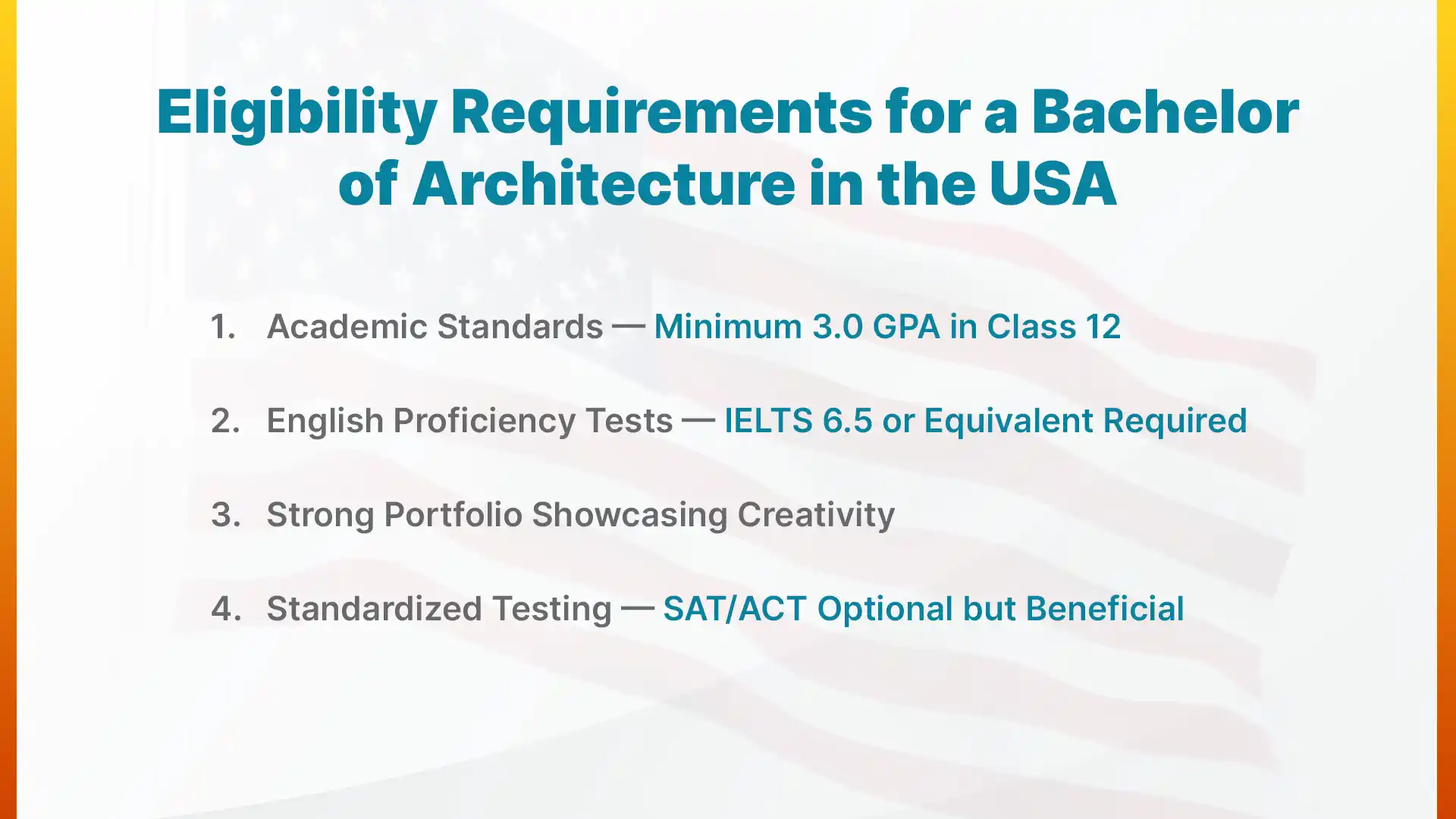
1. Academic Standards
To secure direct admission, you must complete your Nepalese Class 12 exams with a strong academic record. Most competitive US universities require a minimum high school GPA of 3.0 out of 4.0.
If you completed Cambridge GCE A-Levels, you will generally need to show high grades across three principal subjects.
2. English Proficiency Tests
Because you must present your complex design ideas to native-speaking professors, having strong English communication skills is required. Specifically, you will need an academic IELTS score of at least 6.5, a TOEFL iBT score of 80, or a PTE Academic score of 58.
Additionally, some top-ranked universities may request slightly higher language thresholds for direct admissions.
3. Creative Portfolio Benchmarks
Unlike standard undergraduate degrees, professional design programs usually require you to submit a physical or digital portfolio of your creative work. This collection should display your natural artistic talents through hand-drawn sketches, watercolor paintings, photography, or digital 3D models.
Specifically, admissions committees look for your unique spatial thinking and creative storytelling rather than perfect architectural plans.
4. Standardized Testing
Submitting strong SAT or ACT scores can significantly boost your overall application, although it is optional in most US universities. These scores can make your application stand out when applying to highly competitive public or private institutions.
5. Documents Required to Study Architecture in the USA
Before submitting your applications through portals like the Common App, make sure you have organized the following essential documents for the US education:
High School Academic Transcripts & Certificates (Class 10/SEE and Class 12/NEB)
Valid Passport
Certified English Test Scores (IELTS, TOEFL, or PTE Academic)
Statement of Purpose (SOP)
Digital Design Portfolio (Compiled as a single PDF or website link)
Two or Three Letters of Recommendation (Academic or Professional)
Bank Balance Certificate & Financial Sponsorship Letters (From Class "A" Nepalese Banks)
Approved SEVIS I-20 Form (Issued by the university after admission)
How to Apply for a Bachelor of Architecture in the USA from Nepal?
To apply for a Bachelor of Architecture in the USA, international students must submit their high school credentials and portfolios through the Common Application, secure a university-issued Form I-20, pay their SEVIS fee, and successfully pass the F-1 student visa interview at the US Embassy.
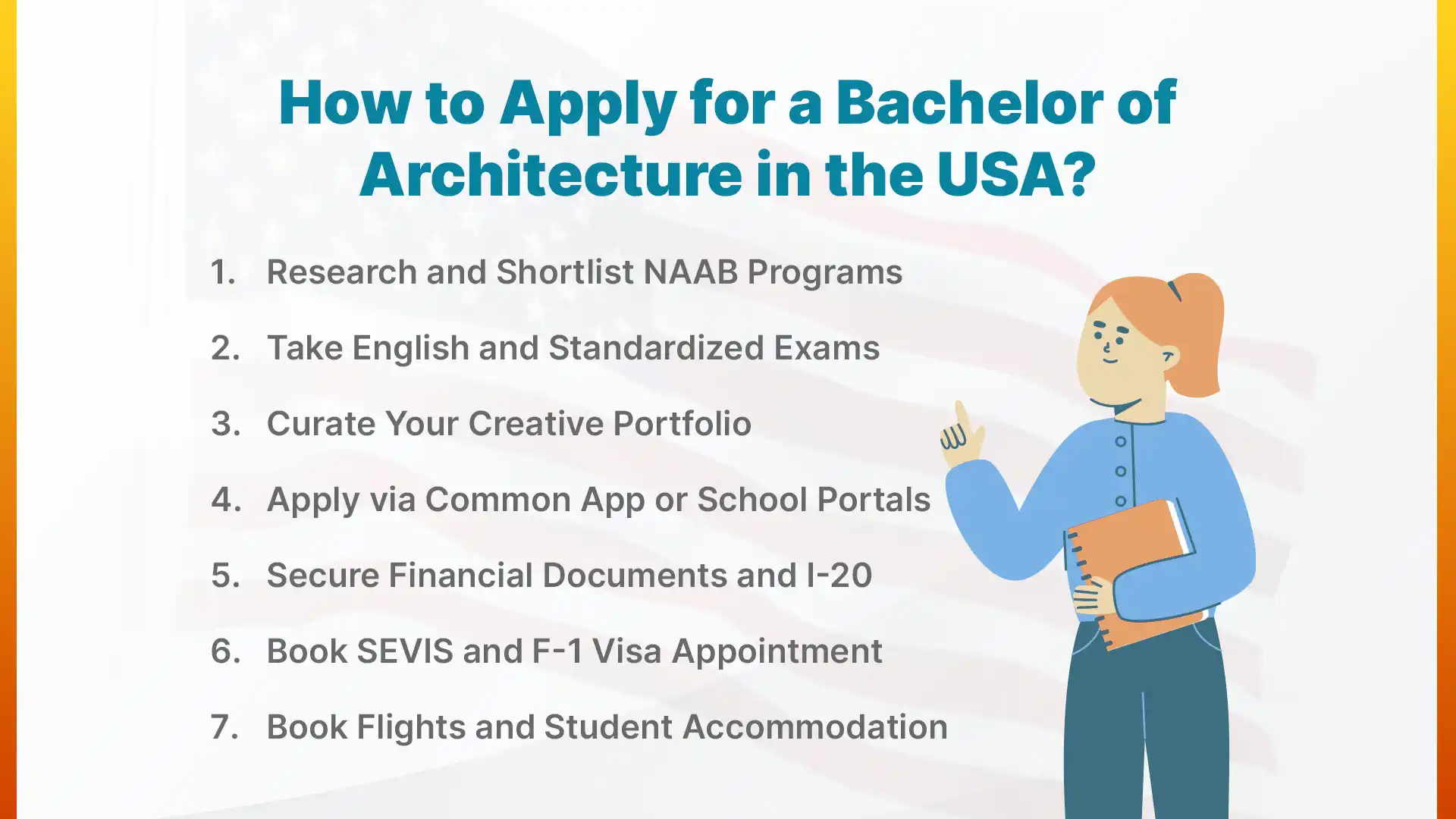
1. Research and Shortlist NAAB Programs
First, research US universities ten months before your start date. Ensure the program is NAAB-accredited for licensing. Finally, compare costs, locations, and select five to seven schools that fit your family's budget.
2. Take English and Standardized Exams
Next, register and prepare for IELTS, TOEFL, or PTE exams early. Additionally, take the SAT to qualify for lucrative merit or even full scholarships in the USA. Having these scores ready ensures a smooth, stress-free college application process.
3. Curate Your Creative Portfolio
Gather ten to fifteen of your best creative pieces, such as drawings, paintings, or physical models. Write short captions explaining your concepts. Finally, compile them into a clean digital PDF portfolio.
4. Apply via Common App or School Portals
Submit your applications through the Common Application portal. Write supplemental essays explaining your passion for design and request teacher recommendations. Finally, pay the required application fees, usually fifty to ninety dollars.
5. Secure Financial Documents and I-20
Prove your funding by gathering balance certificates from Class "A" Nepalese banks. Once approved, the university will issue your Form I-20. Consequently, this key document allows you to apply for your F-1 student visa.
6. Book SEVIS and F-1 Visa Appointment
Pay the $350 SEVIS fee online to the US government. Next, complete your DS-160 form and book your visa interview at the embassy in Kathmandu. Practice explaining your goals to ensure visa approval.
7. Book Flights and Student Accommodation
Once your visa is approved, book your flights and secure housing. Next, visit your Kathmandu bank with your No-Objection Certificate (NOC) to arrange currency exchange. Finally, pack your drafting tools and fly out!
What are the Bachelor of Architecture Fees in the USA?
A Bachelor of Architecture (B.Arch) in the USA typically costs between USD 25,000 to USD 60,000 per year. Because a B.Arch is a professional 5-year degree, the total tuition and fees can range from USD 125,000 to over USD 200,000, depending on whether you attend a public or private university
Here’s an overview of the total costs you need for studying in the USA:
Expense Category | Average Annual Cost (USD) | Equivalent in NPR (Approx. @ 153) |
|---|---|---|
| Tuition Fees (Professional B.Arch) | 32,000 – 65,000 | 48.9 Lakhs – 99.4 Lakhs |
| Annual Living Expenses | 15,000 – 22,000 | 22.9 Lakhs – 33.6 Lakhs |
| Mandatory Health Insurance | 1,500 – 3,000 | 2.2 Lakhs – 4.5 Lakhs |
| Books, Supplies & Software | 1,500 – 2,500 | 2.2 Lakhs – 3.8 Lakhs |
| SEVIS I-901 & Visa Fees | 535 | 81,800 |
Scholarships for Architecture Students in the USA
Scholarships for architecture students in the USA are widely available through university merit awards, full US scholarships, federal aid, and private design foundations. These funds help Nepalese students cover high tuition costs and complete their professional design degrees.
Scholarship Program | Coverage & Scope |
|---|---|
| Fulbright Foreign Student Program | Covers full tuition, return airfare, monthly living stipends, and standard health insurance. |
| EducationUSA Opportunity Funds | Covers upfront costs like application fees, standard testing, and visa processing fees. |
| AIA / ACSA Architecture Scholarships | Offers various national design fellowships, travel grants, and project funding. |
| University-Specific Awards | Grants partial to full tuition waivers, design merit awards, and departmental assistantships. |
Career Opportunities and Salaries for Architecture Graduates in the USA
Graduating with a B.Arch degree in the USA opens exciting career pathways as licensed architects, BIM modelers, or construction project managers, offering competitive starting salaries ranging from USD $60,000 to over $115,000 annually.
With professional registration and specialized technology skills, your career and salary will scale rapidly across top-tier international architecture and engineering firms.
Job Title | Average Salary (USD/Year) |
|---|---|
| Licensed Architect | 85,000 – 120,000 |
| Architectural BIM Modeler | 65,000 – 80,000 |
| Landscape Architect | 75,000 – 105,000 |
| Construction Project Manager | 80,000 – 115,000 |
| Urban Planning Consultant | 78,000 – 110,000 |
| Interior Design Specialist | 60,000 – 82,000 |
Can Nepalese Students Work While Studying Architecture in the USA?
Yes, Nepalese students on an F-1 visa can work up to 20 hours per week during academic sessions and full-time during official breaks. These opportunities help students earn extra income, gain practical experience, and build valuable professional skills.
1. F-1 On-Campus Employment Regulations
F-1 students can work up to 20 hours per week on campus during academic sessions and full-time during official breaks. Common roles include library assistant, lab assistant, and student support positions, helping students earn extra income while studying.
2. Curricular Practical Training (CPT) Internships
CPT allows architecture students to take paid, off-campus internships related to their degree. Usually available after the first year, it helps students gain industry experience, build professional networks, and earn while completing their B.Arch program.
3. Career Building Benefits of Work
Working during your studies helps you gain practical industry experience, learn professional design tools, understand real project workflows, and build valuable connections. These experiences strengthen your resume and improve your chances of securing full-time jobs after graduation.
What Are the Post-Study Work Opportunities After Architecture in the USA?
Architecture graduates can work in the USA through 12 months of OPT and a 24-month STEM extension. Together, these pathways provide up to three years of post-study work experience and opportunities for long-term career growth.
1. Optional Practical Training (OPT) Standard Window
After graduation, B.Arch students can apply for 12 months of Optional Practical Training (OPT). This allows them to work full-time in the USA, gain professional experience, and begin building an international architecture career.
2. The 24-Month STEM Extension Benefit
As architecture is STEM-designated, graduates may qualify for a 24-month OPT extension. Combined with standard OPT, this provides up to three years of legal work authorization and improves opportunities to secure long-term employment.
3. Path to US Licensing
To become a licensed architect, graduates must earn a NAAB-accredited degree, complete required professional experience through NCARB’s program, and pass the Architect Registration Examination (ARE). Successful completion allows legal architectural practice in the USA.
Conclusion
Studying a B.Arch in the USA is the absolute best way to turn your design passion into a high-paying, global career. This five-year degree gives you world-class training and three full years of post-study work rights.
It is normal to feel nervous about F-1 visas and high fees. But remember, every famous skyscraper in New York started as a simple pencil sketch. Your big dream deserves that same brave first step.
Do not let complex paperwork stop you. Connect with our expert US education counsellors today to easily sort your university applications, financial documents, and student visa. Let's build your design future together.