Why Australia's Skilled Occupation List Matters When Choosing a Course

Aug 04, 2026

Every year, international students pick a course based on interest, cost, or a friend's recommendation and only discover months later that their chosen occupation doesn't lead anywhere near a visa. It's one of the most common, and most avoidable, mistakes in study-abroad planning. Australia's Skilled Occupation List is the single document that determines whether a qualification actually opens a door to permanent residency or simply ends in a certificate with no clear next step.
Understanding it before enrolling, not after graduating, can be the difference between a smooth transition into skilled work and years of trying to find an alternative pathway. This blog explains what the list is, why it should shape course selection from day one, and how to use it practically for anyone planning to study in Australia.
In this blog
What Is Australia's Skilled Occupation List?
Australia's Skilled Occupation List is a government-maintained list of occupations eligible for skilled migration visas, divided into categories such as the MLTSSL (Medium and Long-Term Strategic Skills List), STSOL (Short-Term Skilled Occupation List), and regional occupation lists, used to determine which qualifications and jobs qualify a graduate for a skilled visa pathway.
The list exists because Australia's migration system is built around addressing genuine labor shortages, not simply processing visas for anyone with a qualification. Each occupation is tied to a specific ANZSCO code, and whether that occupation appears on a given list and which list directly shapes what visa options are available to a graduate down the line.
The MLTSSL includes occupations eligible for both permanent and temporary skilled visas, typically the strongest pathway for long-term settlement. The STSOL covers occupations eligible mainly for temporary visas with more limited permanent pathways. Regional occupation lists include additional occupations, often broader than the national lists, that qualify for regional-specific visas, which is why studying and working in the best cities in Australia, including regional areas, can sometimes open doors that a metro-based course cannot.
The Department of Home Affairs reviews these lists periodically based on labor market data, industry consultation, and shifting national priorities. An occupation currently in strong demand isn't guaranteed to stay there. Reviews can add new occupations, tighten criteria, or remove roles that are no longer considered a shortage, which is exactly why checking the current list before committing to the total cost to study in Australia for a multi-year course matters so much.
Why Does the Skilled Occupation List Matter When Choosing a Course?
The Skilled Occupation List matters when choosing a course because enrolling in a program linked to a listed occupation directly affects a graduate's eligibility for skilled visas, employer sponsorship, and permanent residency, while courses tied to unlisted occupations can leave students with a qualification but no clear migration pathway.
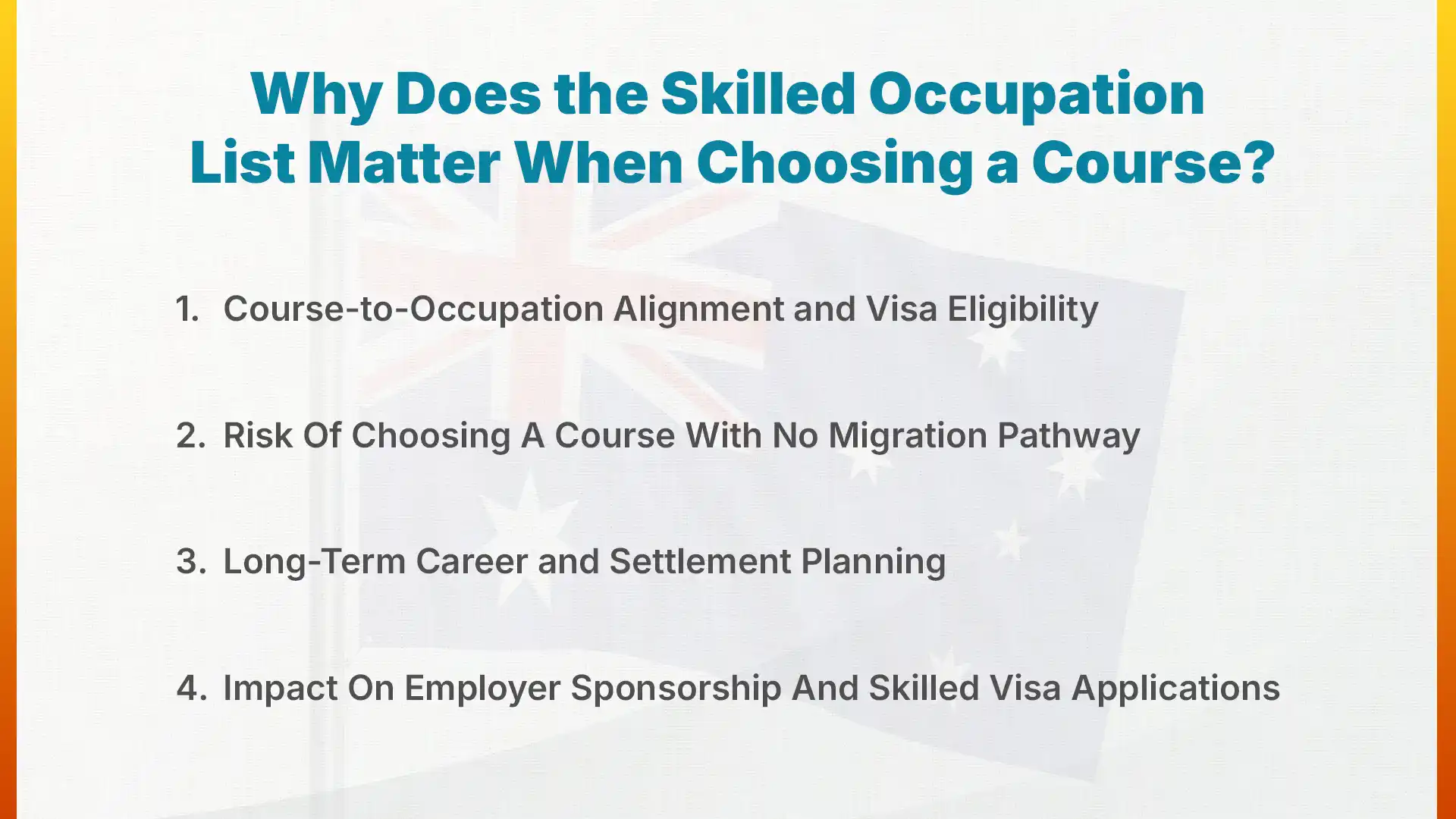
1. Course-to-Occupation Alignment and Visa Eligibility
Not every course automatically leads to a recognized skilled occupation, even if it sounds relevant. A generic business or IT course in Australia, for instance, may not map cleanly to any ANZSCO code on the current lists, while a more specific trade- or care-sector qualification often does. Checking this alignment before enrolling ensures the course actually counts toward a visa application later.
2. Risk Of Choosing A Course With No Migration Pathway
Students who skip this step sometimes complete an entire qualification only to discover their intended occupation was never on a relevant list or was removed partway through their studies. At that point, options are limited: pursue a different visa category, complete additional study in a listed field, or return home without the outcome they planned for. This is one of the most costly mistakes in the entire study-abroad process, both financially and in lost time.
3. Long-Term Career And Settlement Planning Tied To Course Choice
Choosing a course with a clear occupation match isn't just about the visa on paper; it shapes where a graduate can realistically work, which employers are likely to sponsor them, and how quickly they can move from temporary status to permanent residency. Course choice, in this sense, is really the first step in a much longer settlement plan.
4. Impact On Employer Sponsorship And Skilled Visa Applications
Employers are far more willing to sponsor a candidate whose qualification and occupation clearly align with a recognized shortage area, since the visa process itself is more straightforward and predictable for them. A mismatched qualification makes sponsorship harder to justify and slower to process, even when a student's skills are strong.
Which Occupations Are Currently in High Demand on the List?
Occupations that are currently in high demand on the list are electricians, plumbers, chefs, carpenters, aged care and disability support workers, along with civil engineers and ICT professionals, reflecting the sectors facing the most persistent skill shortages across Australia, a primary reason why students choose to study in Australia.
Electricians and Plumbers
Chefs and Commercial Cooks
Carpenters and Construction Trades
Aged Care and Disability Support Workers
Civil Engineers and ICT Professionals
How Does the Skilled Occupation List Affect Visa and PR Pathways?
The Skilled Occupation List affects visa and PR pathways by determining eligibility for the Skilled Independent visa (subclass 189), Skilled Nominated visa (subclass 190), and Skilled Work Regional visa (subclass 491), meaning a graduate's occupation must appear on the relevant list to qualify for these routes.
1. Subclass 189, 190, and 491 Visas Explained
The subclass 189 is a points-tested visa that doesn't require state or employer sponsorship, but it's only available for occupations on the MLTSSL. The subclass 190 requires state nomination and opens up a slightly broader set of occupations depending on the state's needs. The subclass 491 is a regional visa, often accessible to a wider range of occupations, and rewards graduates who study and work outside major metro areas.
2. State Nomination and Regional Visa Advantages
Each Australian state and territory maintains its own nomination criteria and priority occupation lists, meaning an occupation that's competitive nationally might have far less competition or even priority processing through a specific state's nomination program. Regional study, in particular, often comes with added points and streamlined nomination pathways that metro-based students don't have access to.
3. Points-Based System and Occupation Ceilings
Skilled visas operate on a points test that considers age, English proficiency, qualifications, and work experience, but even a high point score won't help if the occupation isn't listed or has hit its annual ceiling for invitations. Understanding both the list and how occupation ceilings work helps students set realistic expectations for timelines.
How Often Does the Skilled Occupation List Change?
Australia's Skilled Occupation List is reviewed and updated periodically by the Department of Home Affairs based on labor market needs, meaning occupations in demand today may be revised, capped, or removed in future updates, making it important for prospective students to check the most current version before committing to a course.
Changes are driven by labor market analysis, industry body submissions, and government priorities around addressing genuine shortages rather than oversupplied fields. A sector experiencing rapid growth may see its occupations added or upgraded to a stronger list, while a field with an emerging surplus of qualified workers may see its occupations tightened or removed.
Because reviews can happen while a student is already mid-course, it's worth periodically checking official Department of Home Affairs updates or working with an education or migration agent who tracks these changes. Staying informed doesn't just help with initial course selection; it also helps students adjust their plans if their occupation's status shifts partway through their studies.
What Should Students Check Before Choosing a Course Based on the List?
Before choosing a course based on the Skilled Occupation List, students should confirm the occupation's current listing status, check whether the qualification meets the relevant skills assessment authority's requirements, verify course-to-occupation mapping with the training institution, and consult a registered migration or education agent for the latest visa criteria.
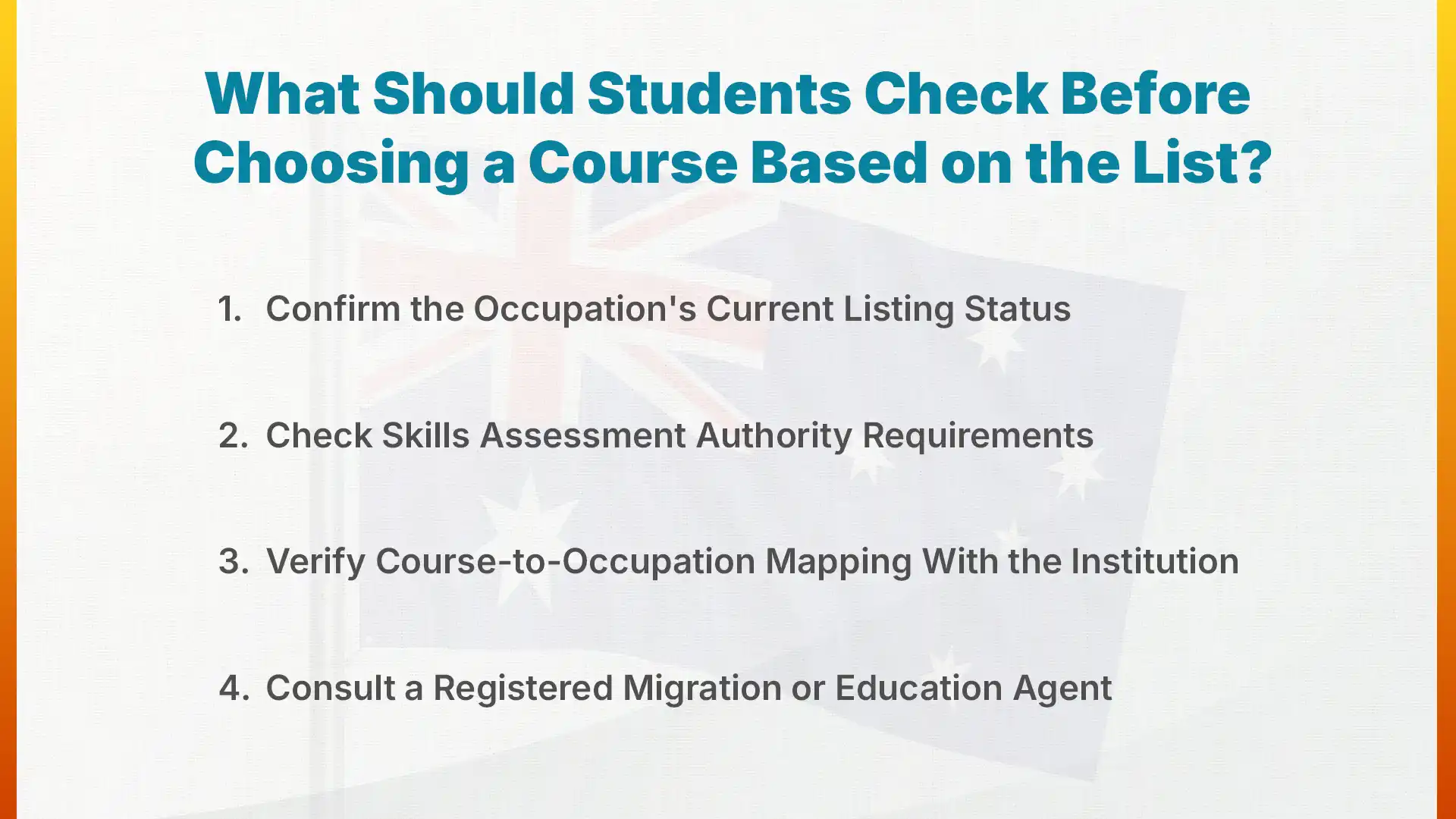
1. Confirm the Occupation's Current Listing Status
Check the exact ANZSCO occupation code tied to the course against the current MLTSSL, STSOL, or regional lists, since a course can sound relevant without actually leading to a listed occupation.
2. Check Skills Assessment Authority Requirements
Every occupation has a designated assessing authority that evaluates whether a qualification and work experience meet the required standard, so it's worth confirming the course actually satisfies that authority's criteria, not just the course provider's own claims.
3. Verify Course-to-Occupation Mapping With the Institution
Ask the training institution directly whether their course is designed and recognized to lead to the specific occupation you're targeting, rather than assuming based on the course title or general subject area.
4. Consult a Registered Migration or Education Agent
Since occupation lists and visa criteria change periodically, getting guidance from a registered agent helps confirm the course still aligns with current migration settings before you commit years of study to it.
How Can Nepali Students Use the Skilled Occupation List to Choose the Right Course?
Nepali students can use the Skilled Occupation List to choose the right course by cross-checking their intended occupation against the current MLTSSL, STSOL, and regional lists, confirming the course meets skills assessment requirements, and consulting an education consultancy to align course choice with long-term visa and PR goals.
1. Cross-Checking Occupation Lists Before Enrolling
Before signing up for any course, students should identify the exact ANZSCO occupation code their qualification is meant to lead to, then confirm that code's current status across the MLTSSL, STSOL, and any relevant regional lists not just assume it qualifies because the course title sounds relevant.
2. Matching Course Outcomes To Skills Assessment Authority Requirements
Each occupation has a designated skills assessment authority that evaluates whether a qualification and work experience meet the standard required for that occupation. A course can technically exist without meeting that authority's specific requirements, so checking this alignment in advance avoids a qualification that looks right on paper but doesn't pass assessment later.
3. Getting Expert Guidance To Avoid Costly Course Mismatches
Given how often lists and criteria shift, working with a registered education consultancy familiar with current migration settings can help Nepali students avoid enrolling in a course that seems promising today but carries migration risk by graduation. This guidance is particularly valuable for students weighing multiple trade or vocational options against their long-term settlement goals.
Conclusion
Choosing a course isn't just an academic decision for most international students; it's the first move in a much longer migration and career strategy. Checking Australia's Skilled Occupation Listing before enrolling helps avoid the costly mistake of finishing a qualification with no clear visa pathway attached to it.
If you're unsure how a course aligns with current occupation lists and visa criteria, contact SAS Education, which can help you choose with confidence rather than guesswork.