Study Hotel Management in South Korea: Complete Guide for Nepali Students

May 20, 2026
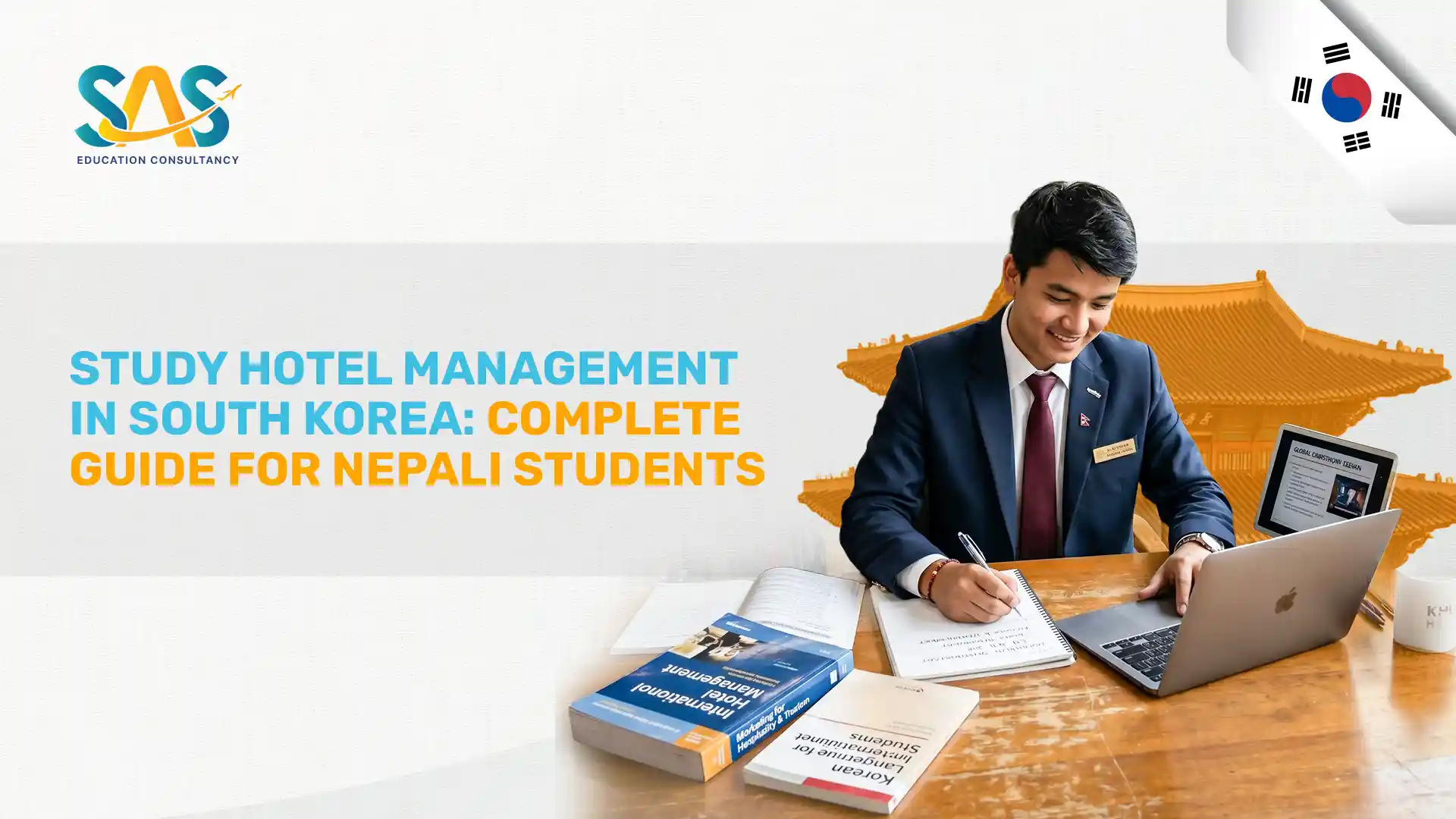
Imagine welcoming guests at a luxury Seoul hotel, managing a beachside resort in Jeju, or leading a five-star team in Busan. For Nepali +2 graduates with big hospitality dreams, studying hotel management in South Korea is no longer just an idea; it is a very real and achievable path.
South Korea has quietly become one of Asia's most exciting study destinations. With world-class universities, a rapidly growing tourism industry, and a culture that takes hospitality seriously, it offers Nepali students something genuinely different from the crowd.
This complete guide covers everything you need for universities, costs, scholarships, eligibility, visa steps, and career outcomes, all written specifically for Nepali students ready to take the next step after +2.
In this blog
What Is Hotel Management in South Korea?
Hotel management is far more than learning how to check guests in and out. It is a full business education built around the hospitality industry.
When you study hotel management in South Korea, you learn how to run the daily operations of hotels, resorts, and tourism businesses. Your studies will touch on areas like
- Front office and rooms division management
- Food and beverage operations
- Hospitality marketing and branding
- Financial management and budgeting
- Human resources and team leadership
- Customer experience and service design
By the time you graduate, you are not just a hospitality worker; you are a trained manager ready to lead teams and run operations professionally.
1. Confusion Between Hotel Management and Hospitality Management
These two terms are often used interchangeably, but there is a difference worth knowing.
Hotel management focuses specifically on the operations of hotels and lodging properties, including rooms, the front desk, housekeeping, and guest services.
Hospitality management is broader. It covers hotels but also extends into restaurants, event companies, cruise lines, theme parks, and tourism businesses.
Most programs in South Korea blend both, giving you a solid foundation across the entire hospitality sector rather than locking you into one area.
2. Is Studying Hotel Management in South Korea Right for You After Your +2?
If you have just completed your +2 and you are drawn to people, travel, culture, and business, this could be the perfect direction for you.
Ask yourself:
- Do you enjoy working with people and creating great experiences?
- Are you interested in business, operations, or management?
- Do you want an internationally respected degree without the high costs of Australia or the UK?
- Are you open to experiencing a new language and culture?
If most of your answers are yes, studying hotel management in South Korea deserves serious consideration.
Why Study Hotel Management in South Korea?
Study hotel management in South Korea because the numbers make sense, the opportunities are real, and the experience is unlike anywhere else in the world. Here is exactly why Nepali +2 graduates are choosing South Korea over every other option.
1. Globally Recognised Degrees at Lower Costs
One of the biggest reasons Nepali students are turning to South Korea is the combination of quality and affordability. South Korean universities consistently rank among Asia's best, and their hospitality programs are internationally respected.
Compared to studying in Australia, the UK, or Canada, tuition fees and living costs in South Korea are significantly more manageable, making it a smart financial decision without compromising on the quality of your education.
2. South Korea's Booming Tourism and Hospitality Sector
South Korea's tourism industry has been growing steadily, driven by the global popularity of K-pop, K-drama, Korean food, and cultural tourism. This means that as a hotel management student, you are stepping into a country where the industry you are training for is actively expanding.
More tourists mean more hotels, more resorts, and more demand for trained hospitality professionals, including international graduates like you.
3. Flexible Part-Time Work Culture while Studying in South Korea
Studying hotel management in South Korea also comes with practical financial advantages that go beyond just lower tuition fees. International students are legally permitted to work part-time while studying, which means you can earn and manage your day-to-day expenses without depending entirely on money from home.
4. Government's Scholarship Programs for International Students
South Korea provides multiple scholarship options for international students, giving you a real chance to reduce your financial burden significantly. These are highly comeptitive programs. And once you graduate, the opportunities do not stop there. South Korea's growing hospitality market means that post-study work is a genuine possibility, allowing you to gain international experience, build your career, and make the most of the degree you worked hard to earn. If you are still confused about why you need to choose Korea, the top reasons are.
Types of Hotel Management Courses in South Korea
The different types of hotel management courses available in South Korea range from short-term certification programs all the way up to a full master's degree. Whether you are a fresh +2 graduate looking to start your hospitality journey or someone who already holds a bachelor's degree and wants to specialize further, South Korea has a course level designed for exactly where you are right now. The main options available are diploma programs, bachelor's degrees, master's programs, and short-term professional certifications. Here is a detailed breakdown of each:
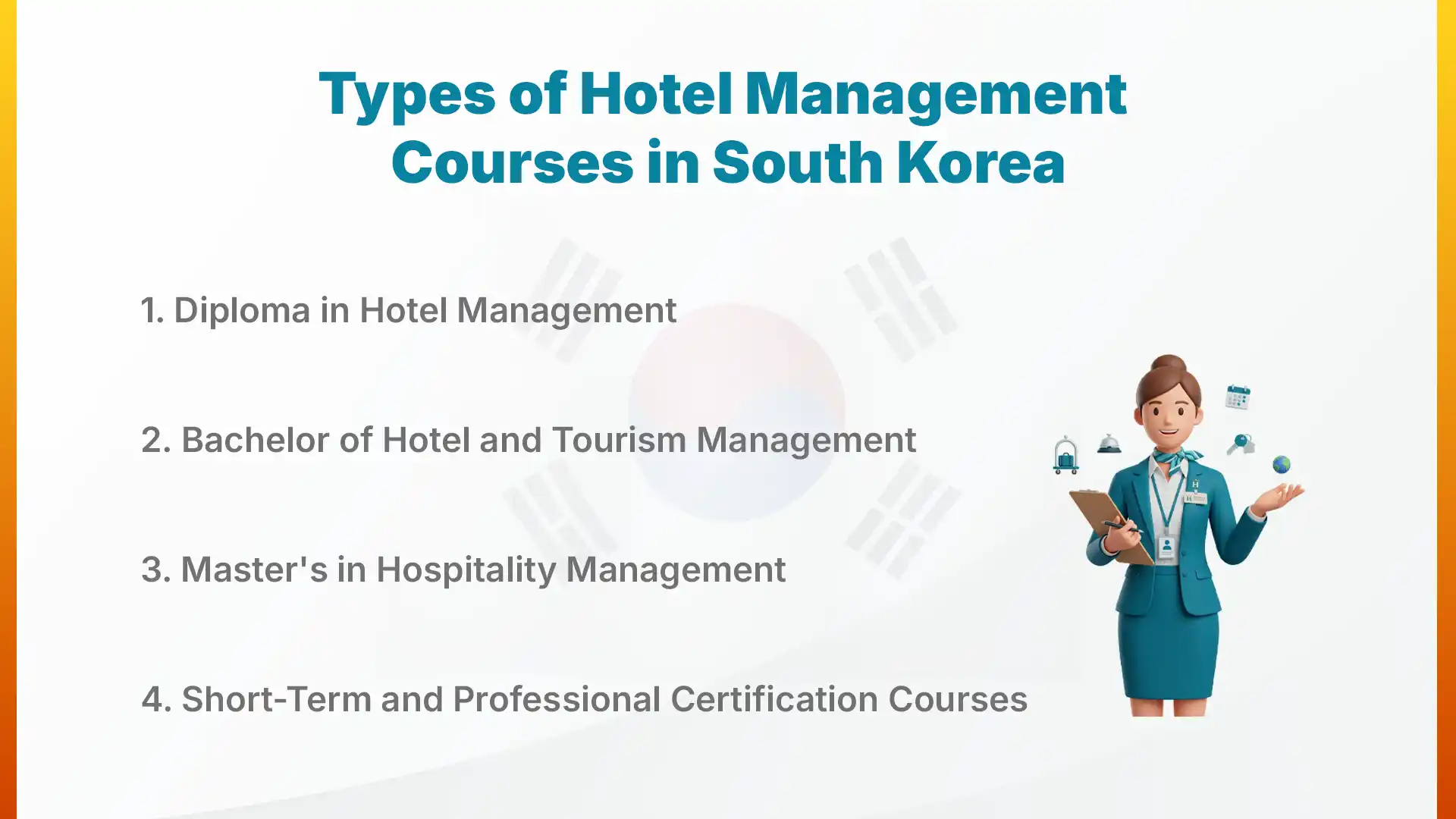
1. Diploma in Hotel Management
A diploma program is typically one to two years long and focuses on building foundational hospitality skills. It is an excellent entry point if you want to get into the workforce quickly or use it as a stepping stone toward a bachelor's degree.
2. Bachelor of Hotel and Tourism Management
This is the most popular route for Nepali +2 graduates. A bachelor's degree in hotel and tourism management in South Korea typically takes four years to complete and provides a comprehensive education in both hospitality operations and business management.
Many bachelor's programs include mandatory internships, giving you real industry experience before you even graduate.
3. Master's in Hospitality Management
If you already hold a bachelor's degree, whether in hospitality or another field, a master's program in South Korea can elevate your career to a senior management level. These programs typically run for one to two years and focus on strategy, leadership, and advanced industry knowledge.
4. Short-Term and Professional Certification Courses
South Korea also offers shorter certification programs in areas like food safety, customer service, and hospitality operations. These are great additions to your main degree and can make your CV stand out when applying for internships or jobs.
Course Duration to Study Hotel Management in South Korea
The course duration to study hotel management in South Korea is 4 years for the bachelor level.
Most Nepali +2 graduates go straight into a four-year bachelor's program, while those looking for a faster route can complete a diploma in one to two years. If you already hold a bachelor's degree, a master's program can be wrapped up in as little as one to two years. There are mainly two intake seasons in Korea that enroll students. Make sure you choose one that fits your choice.
Course Level | Typical Duration |
|---|---|
| Diploma Programs | 1 – 2 Years |
| Bachelor's Programs | 4 Years |
| Master's Programs | 1 – 2 Years |
| Short Certification Courses | A Few Weeks to 6 Months |
Best Universities to Study Hotel Management in South Korea
The best universities in South Korea for hotel management in South Korea typically include Kyung Hee University, Sejong University, Hanyang University, and Dong-A University. Students can also explore other options depending upon their choice and location.
1. Kyung Hee University
Kyung Hee University is widely regarded as one of South Korea's premier institutions for hotel and tourism management. Located in Seoul, it has a dedicated College of Hotel and Tourism Management and strong industry ties that support student internships and placements.
It is a particularly popular choice among international students due to its established global reputation in the hospitality field.
2. Sejong University
Sejong University, also based in Seoul, offers well-structured programs in hotel and tourism management. It is known for its modern facilities and a curriculum that balances theoretical knowledge with practical application.
The university actively welcomes international students and offers programs with English-taught components.
3. Hanyang University
Hanyang University is one of South Korea's most recognized research universities. Its tourism and hospitality division benefits from the university's strong academic reputation and industry connections, making it a solid choice for students who want both academic depth and career support.
4. Dong-A University
Located in Busan, South Korea's second-largest city, Dong-A University offers hospitality and tourism programs in a more affordable and less crowded environment than in Seoul. It is a strong option for students who want quality education with a slightly different city experience.
5. Youngsan University
Youngsan University, also in Busan, has a specific focus on tourism, hotel management, and culinary arts. It is well known for its hands-on training approach and practical hospitality facilities, making it especially appealing for students who want a career-focused learning environment.
Important Note for Nepali Students: Always verify that your chosen university is officially recognized by South Korea's Ministry of Education before applying. You can check the Korean Ministry of Education's official portal or contact the Korean Embassy in Kathmandu for guidance.
Popular Hotel Management Specializations in South Korea
Popular specializations in South Korea after hotel management typically include luxury hotel and resort management, food and beverage management, event and convention management, tourism and travel management, and revenue and operations management. Below is the detailed breakdown of popular specializations.
1. Luxury Hotel and Resort Management
This specialization prepares you to work in premium hospitality environments like five-star hotels, high-end resorts, and exclusive lodging brands that cater to the world's most discerning guests. You will learn the standards, service culture, and operational excellence expected at the luxury level. Beyond just service, you will also study brand management, VIP guest psychology, and how global luxury hotel chains like Marriott, Hilton, and Four Seasons maintain their world-class reputation. If you have ever dreamed of managing a five-star property, this is where that dream begins.
2. Food and Beverage Management
If you are passionate about dining culture, this is your path. Food and beverage management covers restaurant operations, menu planning, kitchen management, and the business of running profitable dining outlets within a hotel or resort. South Korea's world-renowned food culture makes this specialization particularly exciting. You will be studying in a country where dining is not just a meal; it is an experience. Graduates from this track often go on to manage restaurant chains, hotel dining outlets, and large-scale catering operations across Asia and beyond.
3. Event and Convention Management
South Korea is a major destination for international conferences, K-pop events, corporate gatherings, and large-scale exhibitions. This specialization teaches you how to plan, coordinate, and manage large-scale events, a skill in high demand not just in South Korea but across the entire hospitality industry globally. You will learn everything from logistics and vendor management to budgeting, marketing, and post-event evaluation. If you thrive under pressure and love bringing big ideas to life, this is the specialization for you.
4. Tourism and Travel Management
This broader specialization looks at the travel industry as a whole: destination marketing, tour operations, sustainable tourism practices, and the business of moving people around the world. It is a great fit if you want to work across both the hotel and travel sectors rather than staying within one specific area. With South Korea's tourism industry growing rapidly, graduates from this track are well positioned to work with travel agencies, tourism boards, airlines, and destination marketing organizations both in Korea and internationally.
5. Revenue and Operations Management
This is the analytical side of hotel management and one of the most financially rewarding paths you can take. You will learn how to use data, pricing strategies, and demand forecasting to maximize a hotel's profitability and operational efficiency. It is a highly valued specialization that can lead to well-paying corporate roles within international hotel chains, where decisions you make directly impact the bottom line of multi-million-dollar properties. If you are good with numbers and love the idea of turning data into strategy, this track could be your strongest career move.
Eligibility Requirements to Study Hotel Management in South Korea
Before you get excited about applications, make sure you meet the basic requirements for studying in Korea. Here is a clear breakdown for Nepali students.
1. Academic Requirements by Course Level
Before you start dreaming about Seoul, make sure your academic profile meets the basic entry requirements. The good news is that for diploma and bachelor's programs, your NEB +2 certificate is enough to get you started; no extra qualifications are needed. Here is a clear breakdown of what each level requires:
Course Level | Minimum Academic Requirement |
|---|---|
| Diploma | Completion of +2 (NEB or equivalent) |
| Bachelor's | Completion of +2 (NEB or equivalent) with satisfactory grades |
| Master's | A recognized Bachelor's degree with a solid academic record |
Note: Specific GPA or percentage requirements vary by university. Always check the official admissions page of your chosen institution.
2. Language Proficiency: TOPIK, IELTS, or TOEFL?
This is one of the most important requirements to plan for early on.
- For Korean-medium programs: You will need a TOPIK (Test of Proficiency in Korean) score. The required level varies by university and program, so check with your specific institution.
- For English-medium programs: An IELTS or TOEFL score is typically required. Requirements vary by institution, so confirm directly with your chosen university.
Starting your language preparation early, whether Korean or English, gives you a significant advantage during the application process.
3. Work Experience Requirements
- Diploma and Bachelor's programs: Work experience is generally not required.
- Master's programs: Some universities may prefer or require relevant work experience. Check individual program requirements carefully.
4. Documents Required for Admission
Start collecting these as early as possible:
- Academic transcripts and certificates (Grade 10, 11, and 12 or equivalent)
- Valid passport (with sufficient validity)
- Language proficiency test results (TOPIK or IELTS/TOEFL)
- Statement of Purpose (SOP)
- Letters of Recommendation (LOR)
- Updated CV or Resume
- Financial sponsorship documents
- Completed university application form
Cost to Study Hotel Management in South Korea
To study hotel management in South Korea, you are looking at annual tuition fees ranging from approximately NPR 400,000 to NPR 1,200,000, depending on your level of study and monthly living costs falling between NPR 60,000 and NPR 130,000. Here is a complete breakdown of every cost you need to plan for before you book your flight. Aside from hotel management, if you are curious about the general cost of studying in Korea, you can go through it.
1. Tuition Fees by Course Level
Tuition fees vary depending on the level of study and the university you choose. Compared to Western destinations, these figures are considerably lower, making South Korea one of the most cost-effective options for Nepali students who want a globally respected hospitality degree. Here is a general estimate to help you plan:
Course Level | Estimated Annual Tuition (KRW) | Approximate NPR Equivalent |
|---|---|---|
| Diploma | 4,000,000 – 8,000,000 KRW | NPR 400,000 – 800,000 |
| Bachelor's | 5,000,000 – 10,000,000 KRW | NPR 500,000 – 1,000,000 |
| Master's | 6,000,000 – 12,000,000 KRW | NPR 600,000 – 1,200,000 |
Important: Tuition fees vary significantly between universities and programs. Always confirm the exact fee structure directly with your chosen institution. Exchange rates also fluctuate, so use these figures as a general planning guide only.
2. Monthly Living Costs in South Korea for Nepali Students
Tuition is just one part of the equation; your monthly living expenses are what you will feel every single day. The good news is that South Korea, while a modern and developed country, is very manageable on a student budget if you plan smartly. Here is a realistic breakdown of what your monthly expenses could look like:
Expense Category | Estimated Monthly Cost (KRW) |
|---|---|
| Accommodation (Shared/Dormitory) | 200,000 – 500,000 KRW |
| Food and Groceries | 200,000 – 400,000 KRW |
| Transportation | 50,000 – 100,000 KRW |
| Utilities and Internet | 50,000 – 100,000 KRW |
| Personal and Miscellaneous | 100,000 – 200,000 KRW |
| Total Estimated Monthly | 600,000 – 1,300,000 KRW |
Scholarships for Nepali Students to Study Hotel Management in South Korea
The cost should not stop you from chasing this dream. Several scholarship options in Korea for Nepali students are available specifically for international students studying in South Korea.
1. Government Scholarships
South Korea offers several government-funded scholarships for international students, including Nepali students. These can help with tuition fees, living costs, travel, and other study expenses. They are highly competitive, so check the latest requirements and prepare your application early.
2. University Merit Scholarships
Most South Korean universities offer their own merit-based scholarships for international students. These typically provide a partial reduction in tuition fees based on your academic performance.
The specific amounts and eligibility criteria vary by institution, so check the international admissions page of each university you are considering.
3. Exchange Scholarships
Exchange scholarships are available for students joining short-term study or exchange programs in South Korea. They may help with tuition, travel, accommodation, or living costs. Check with your university in Nepal to see if it has any exchange partnerships with Korean universities.
4. Other Funding Options Available from Nepal
- Check with Nepal's Ministry of Education and the relevant government bodies for any bilateral scholarship programs between Nepal and South Korea
- Some Nepali banks and financial institutions offer education loans for overseas study
- Contact the Korean Embassy in Kathmandu for updated information on available funding opportunities
How to Apply to Study Hotel Management in South Korea in 2026
To apply to study hotel management in South Korea, the entire process involves five key stages: researching and shortlisting your university, preparing and notarizing your documents, submitting your application, receiving your admission letter, and finally applying for your student visa. It is straightforward when you know what to expect. Here is exactly what you need to do:
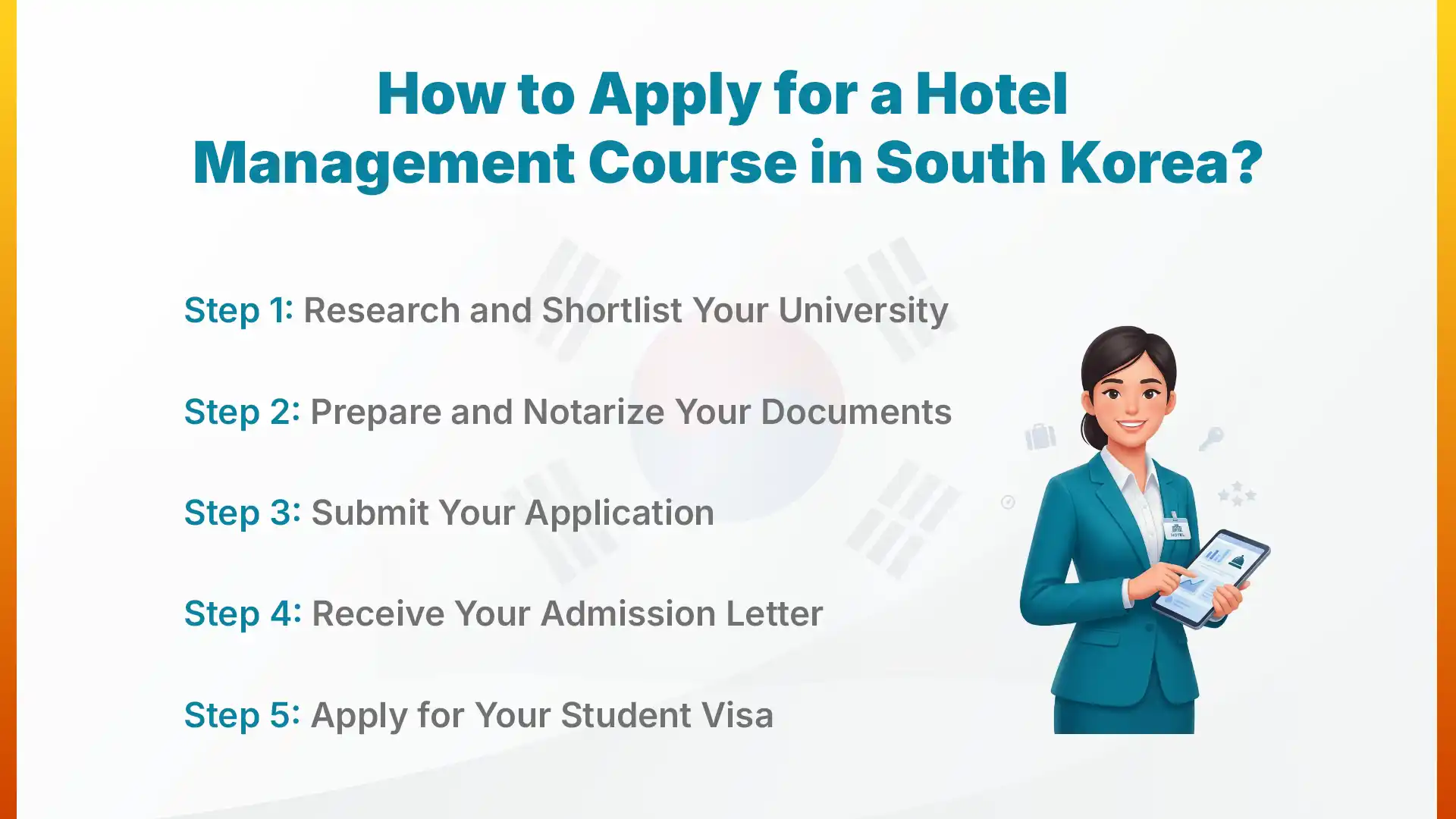
Step 1: Research and Shortlist Your University
Begin by identifying universities that offer your preferred program, are within your budget, and are officially recognized by South Korea's Ministry of Education. Consider the city, teaching language, internship opportunities, and scholarship options before making your shortlist. Do not rush this step. The university you choose will shape your entire experience in South Korea.
Step 2: Prepare and Notarize Your Documents
Gather all required academic documents, your passport, language test results, statement of purpose for South Korea, and LORs. Documents in Nepali will typically need to be officially translated into English or Korean and notarized. Starting this early takes significantly more time than most students expect, and missing even one document can delay your entire application.
Step 3: Submit Your Application
Applications are submitted either directly through the university's official online portal or through a registered and verified education consultant. Apply to more than one institution to increase your chances of receiving a favorable offer. Most universities respond within two to four weeks with their admission decision.
Step 4: Receive Your Admission Letter
If your application is successful, you will receive a letter of acceptance from the university. Read all terms and conditions carefully before confirming your place. Some offers may be conditional, meaning you still need to meet certain requirements before full acceptance is granted, so pay close attention to what is being asked of you.
Step 5: Apply for Your Student Visa
Once you have your admission letter in hand, you can begin your D-2 student visa application at the Embassy of the Republic of Korea in Kathmandu. This is the final and most critical step before you board your flight to South Korea. A detailed breakdown of the visa process is covered in the section below. If you need assistance for the following, you can choose top consultancies in Nepal for clear guidance.
Scope of Hotel Management in South Korea for Nepali Graduates
Investing in a degree is about more than just the years you spend studying. Here is what the future can look like after you study hotel management in South Korea.
1. Internship Opportunities During Your Studies
Many hotel management programs in South Korea include structured internship components as part of the curriculum. These placements give you hands-on experience in real hotel environments, a huge advantage when you enter the job market. You are not just sitting in a classroom learning theory; you are actually working the front desk, managing reservations, and handling real guests in real hotels. By the time you graduate, you already have professional experience on your CV that most fresh graduates can only dream of.
2. Jobs After You Study Hotel Management in South Korea
After graduating, you become eligible for a range of professional roles across the hospitality industry. The best part is that your South Korean degree opens doors not just in Korea but across the global hospitality market, from luxury hotels in Dubai to international resorts in Southeast Asia. Common entry-level and mid-level positions include:
- Front Office Officer or Manager
- Food and Beverage Supervisor
- Guest Relations Executive
- Event Coordinator
- Revenue Analyst
- Housekeeping Manager
- Tourism Officer
3. Average Salaries for Hotel Management Graduates in South Korea
Salary figures vary depending on your role, employer, city, and level of experience. As a general reference point, entry-level hospitality roles in South Korea offer competitive starting salaries relative to the cost of living, particularly in Seoul and other major cities. What makes it even more rewarding is that as you gain experience and move into mid-level or senior management roles, your earning potential grows significantly, especially if you choose to work for an international hotel chain. For verified and current salary data, refer to South Korea's official labor statistics or reputable employment platforms operating in the country.
4. What can you do in Nepal with your foreign degree?
Coming back to Nepal does not mean leaving your South Korean degree behind; it means bringing it home as your biggest competitive advantage. Nepal's tourism and hospitality sector is growing faster than ever, with new international hotels, luxury resorts, and high-end restaurants opening across the country. Local employers are no longer just looking for any graduate; they are looking for candidates who have been trained to global standards, who understand international service culture, and who can raise the bar for their entire team. That is exactly what you become when you study hotel management in South Korea.
5. Post-Study Work and Long-Term Stay Options
After completing your degree, certain visa options may allow you to remain in South Korea and gain valuable work experience in the country's thriving hospitality industry. This is a golden opportunity to build your professional network, strengthen your CV, and position yourself for senior roles, whether you eventually stay in South Korea or take your career global. Visa rules and eligibility are subject to change, so always refer to the official website of the Korea Immigration Service or contact the Korean Embassy in Kathmandu for the most current and accurate information.
Mistakes to Avoid When Planning to Study Hotel Management in South Korea
This section could save you a lot of time, money, and heartache. Read it carefully before you take any action.
1. Trusting Fake Consultants in Nepal
Unfortunately, fraudulent education consultants operate in Nepal and target students who are eager to study abroad. Always verify that your consultant is registered and legitimate. Ask for references, check their track record, and never pay large sums of money without proper documentation and receipts.
When in doubt, contact the university directly or reach out to the Korean Embassy in Kathmandu for guidance.
2. Skipping the University Accreditation Check
Not every institution that claims to offer hotel management programs in South Korea is officially recognized. Always verify your chosen university on South Korea's Ministry of Education official portal before applying or paying any fees.
Attending an unrecognized institution can invalidate your degree and your visa, a costly mistake that is entirely avoidable.
3. Underestimating the Language Barrier
Even if your program is taught in English, daily life in South Korea involves Korean in supermarkets, hospitals, public transport, and social settings. Students who arrive without any Korean language preparation often find the adjustment much harder than expected.
Start learning basic Korean before you leave Nepal. Even a foundational level of TOPIK preparation will make your day-to-day life significantly easier and show universities that you are serious.
4. Missing Scholarship and Application Deadlines
Scholarship windows open and close on fixed dates each year. Missing these deadlines by even a day means waiting an entire year for the next cycle.
Create a personal calendar with all key dates, scholarship applications, university admissions deadlines, visa appointment windows, and intake dates and start working backwards from each one.
5. Not Knowing Your Part-Time Work Rights in South Korea
International students in South Korea are permitted to work part-time, but there are legal limits on working hours during term time. Exceeding these limits can put your visa status at risk.
Always check the current regulations with the Korea Immigration Service before taking on any employment. Rules can change, and staying compliant protects your student status.
Conclusion
Studying hotel management in South Korea is a genuine opportunity for Nepali +2 graduates who want a world-class education, international career exposure, and a degree that holds real value both back home in Nepal and across the global hospitality industry.
The journey requires careful planning, honest research, and the right support. But for students who are prepared and committed, South Korea offers an experience that goes far beyond the classroom: a new culture, a new language, and a new perspective on what a career in hospitality can look like.
Your future in hospitality does not have to stay a dream. Take the first step today: research your universities, start your language preparation, and reach out to verified advisors for South Korean education who can guide you through the process with clarity and honesty. Reach SAS Education Consultancy for further guidance.
South Korea is ready. The question is, are you?