Study Mining Engineering in UK: Top Universities, Fees & Career Scope

Jul 27, 2026

The UK is currently undergoing a subterranean revolution, with mega-projects like the HS2 high-speed rail network and a new generation of nuclear power stations creating massive demand for underground specialists. The biggest hurdle for Nepalese students is finding a highly specialized degree that offers world-class geotechnical and tunneling training without paying the exorbitant tuition fees.
By choosing to study in the UK, you gain access to centuries of pioneering earth sciences education, complete with a direct post-study pathway to permanent residency. This guide details the top universities, exact costs, admission steps, and salary expectations for 2026.
In this blog
What Is a Mining Engineering Course in the UK?
A mining engineering course in the UK is a specialized branch of engineering focused on the extraction of minerals, but with a very heavy emphasis on tunneling, quarrying, and geotechnical engineering due to the UK's current infrastructure boom. In the UK, it is typically offered as a BEng (3 years) or MEng (4 years) in Mining Engineering, Earth Resources, or Geological Engineering. The program is strictly accredited by the Institution of Mechanical Engineers (IMechE) or the Institute of Materials, Minerals and Mining (IOM3).
These are the UK's leading professional engineering bodies, and their accreditation ensures your degree meets the strict educational standards required for international professional practice. Most importantly, this accreditation is recognized under the Engineering Council UK, meaning your degree is globally respected and fully recognized if you decide to work abroad or return to Nepal. Graduates are fully equipped to step directly into specialized roles managing underground excavations for major UK infrastructure projects or global mining giants.
Why Study a Mining Engineering Course in the UK?
The UK is a premier destination for studying mining engineering because it seamlessly integrates globally recognized IMechE/IOM3-accredited degrees with direct access to advanced manufacturing hubs, high demand in the tech and logistics sectors, and a highly structured post-study work visa pathway for international graduates.
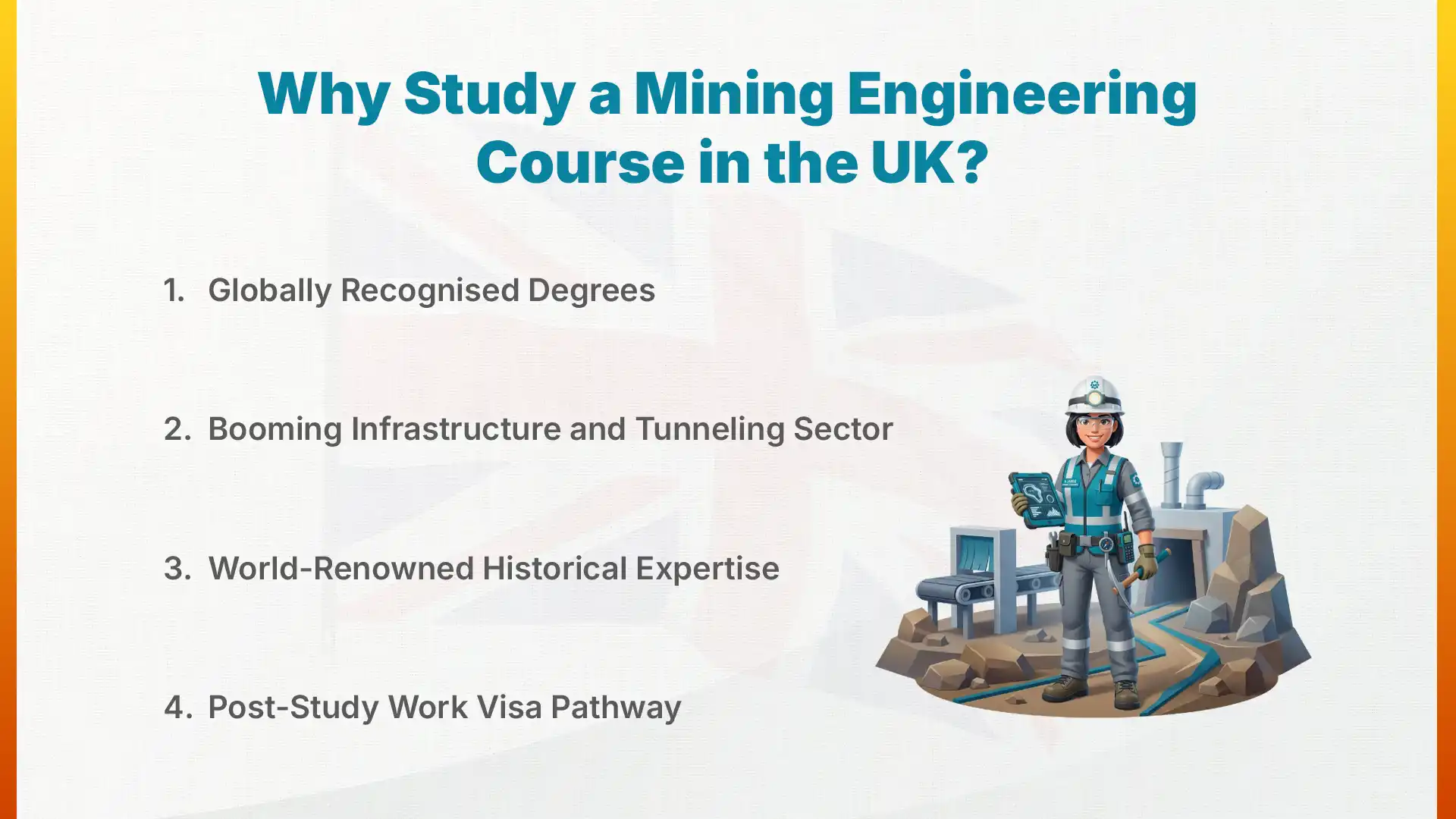
1. Globally Recognised Degrees
UK engineering programs are developed under the Engineering Council, meaning your degree is instantly respected by licensing bodies and employers worldwide. An IMechE or IOM3-accredited degree completely eliminates the need for lengthy re-qualification if you choose to work abroad or return to Nepal.
2. Booming Infrastructure and Tunneling Sector
While traditional deep-shaft mining has slowed in the UK, the country is currently investing billions in underground infrastructure. Projects like HS2, Crossrail, and nuclear energy facilities have created a massive, urgent demand for engineers who understand rock mechanics and underground excavation.
3. World-Renowned Historical Expertise
The UK is home to the famous Camborne School of Mines, boasting centuries of pioneering mining and earth sciences education. This deep historical expertise means UK universities have unmatched research facilities and long-standing industry connections stretching from Cornwall to global mining hubs.
4. Post-Study Work Visa (Graduate Route) Pathway
The UK offers a generous 2-year post-study work visa (3 years for MEng graduates) through the Graduate Route. This allows Nepalese students to gain vital UK industry experience with top infrastructure or engineering consultancies without needing an immediate job offer.
Which are the Top Universities for Mining Engineering in UK?
The top universities for a mining engineering course in the UK include the University of Exeter, Imperial College London, and the University of Leeds, all offering world-leading geotechnical facilities and direct industry placements. If you want to compare these with other global leaders, you can explore the leading UK universities for a broader view.
Institution | Location | Program | Known For | Accredited Status |
|---|---|---|---|---|
| University of Exeter | Exeter | BEng/MEng Mining Engineering | Home to the Camborne School of Mines; Elite Global Industry Links | IOM3 Accredited |
| Imperial College London | London | MEng Earth and Engineering Geotechnics | World Top 10 Ranking; Heavy Focus on Tunneling and Rock Mechanics | IMechE Accredited |
| University of Leeds | Leeds | BEng/MEng Mining and Mineral Engineering | Exceptional Industry Partnerships; Strong Mineral Processing Focus | IOM3 Accredited |
| University of Nottingham | Nottingham | BEng/MEng Mining Engineering | Advanced Geotechnical Research Facilities and Surveying Tech | IMechE Accredited |
| University of Strathclyde | Glasgow | BEng/MEng Civil Engineering with Mining | Strong Focus on Environmental Management and Sustainable Extraction | IMechE Accredited |
Choosing any of these IMechE or IOM3-accredited institutions guarantees you receive premium, safety-critical training that meets the strict standards of the global resources and infrastructure industries.
What Are the Admission Requirements?
The admission requirements for a mining engineering course in the UK include strong academic results in mathematics, physics, and chemistry from Plus Two, a minimum IELTS score of 6.0 to 6.5, a technically focused UCAS personal statement, and proof of funds for the UK Student Visa.
1. Academic Requirements
Nepalese students need Plus Two Science with a minimum of 75% to 85% overall, with particularly high grades in Mathematics, Physics, and Chemistry. Because the mathematical rigor is high, top-tier universities like Imperial or Exeter may require you to complete a Foundation Year before entering the 3-year bachelor's degree.
2. English Language Requirements
Engineering programs demand strong English skills so international students can safely comprehend complex technical manuals and write extensive environmental reports. Because these requirements vary, knowing the detailed admission criteria for Nepalese students is crucial.
Test | BEng Requirement | M.Eng. Requirement |
|---|---|---|
| IELTS Academic | 6.0 – 6.5 Overall (Min 5.5 to 6.0 in All Bands) | 6.5 Overall (Min 6.0 in All Bands) |
| TOEFL iBT | 72 – 85 | 88 – 95 |
| PTE Academic | 54 – 62 | 62 – 69 |
If you need to improve your score, consider joining the IELTS training institutes to boost your score.
3. Personal Statement
UK universities use the UCAS personal statement to assess your genuine interest in engineering. Your essay should explain why you are drawn to industrial systems, highlight specific mathematics or physics projects you have completed, and demonstrate your understanding of current challenges in the manufacturing industry. If you need guidance on structuring a strong application essay, you can refer to our proven SOP writing strategies, which covers many of the same principles used to write a compelling personal statement.
4. Financial Proof and Visa Documentation
To meet the visa requirements, you must demonstrate sufficient funds to cover your first year's tuition and 9 months of living costs (if studying in London) or 2 months of living costs (if studying outside London) in your bank account to secure the UK Student Visa.
How to Apply for a Mining Engineering Course in the UK?
Applying for a mining engineering course in the UK involves five steps: shortlisting IMechE/IOM3-accredited institutions, preparing your academic documents, writing a targeted UCAS personal statement, submitting your application, and securing your CAS to apply for a UK Student Visa. Be sure to apply early, as missing the strict January 15th UCAS deadline will derail your study timeline.
Step 1: Shortlist Institutions
Compare programs based on IMechE/IOM3 accreditation, curriculum focus (e.g., pure mining vs. tunneling/geotechnical engineering), location, and tuition fees. Be sure to check if the program includes mandatory underground site visits or field trips to active quarries.
Step 2: Prepare Documents
Gather your Plus Two transcripts (specifically highlighting math, physics, and chemistry scores), IELTS/PTE scores, a valid passport, CV/resume, and one academic reference letter from a science teacher.
Step 3: Write Your UCAS Personal Statement
Tailor your Statement of Purpose to each specific UK university via the UCAS portal, highlighting how their geotechnical labs or industry partnerships align with your desire to work in underground infrastructure.
Step 4: Submit Application via UCAS
Apply through the centralized Universities and Colleges Admissions Service (UCAS). Apply early, ideally by the January 15th deadline for the September intake, as elite engineering programs fill up quickly.
Step 5: Receive CAS and Apply for UK Student Visa
Once you receive an unconditional offer letter and pay your deposit, you will receive a Confirmation of Acceptance for Studies (CAS) document. Use this CAS to apply for the UK Student Visa, ensuring you also pay the Immigration Health Surcharge (IHS) upfront.
How Much Does It Cost to Study Mining Engineering in the UK?
The cost to study a mining engineering course in the UK requires an estimated total budget of £30,000 to £45,000 per year, covering both tuition fees and living expenses. Budgeting is easier when you know what to expect, which is why it is so important to research the financial breakdown of studying in the UK before making your final decision.
Program | Annual Tuition (GBP) | Annual Tuition (NPR approx.) |
|---|---|---|
| BEng Mining / Earth Resources Engineering | £24,000 – £30,000 | NPR 3,840,000 – NPR 4,800,000 |
| MEng Mining / Geotechnical Engineering | £26,000 – £35,000 | NPR 4,160,000 – NPR 5,600,000 |
Monthly living expenses range from £1,000 to £1,800, depending on whether you live in expensive cities like London or in more affordable regional hubs like Exeter, Leeds, or Glasgow. Nepalese students are allowed to work 20 hours per week during term time to help offset these living costs.
Taking tuition and living expenses together, Nepalese students should budget approximately £30,000 to £45,000 per year in total.
What Scholarships Are Available in UK for Mining Engineering?
Scholarships for a mining engineering course in the UK include government-funded options, regional grants, and university-specific merit awards for high-achieving international STEM students.
GREAT Scholarships: Jointly funded by the UK government and universities, offering £10,000 towards tuition fees for high-achieving postgraduate or undergraduate students.
Chevening Scholarships: A fully funded UK government scholarship covering full tuition, living allowances, and travel for outstanding Nepalese students pursuing a master's degree.
University-Specific Engineering Merit Awards: Many UK engineering faculties offer automatic fee reductions of £2,000 to £5,000 per year for high-achieving international students based on their Plus Two transcripts.
STEM Women Scholarships: Various organizations offer targeted financial grants for female international students pursuing degrees in male-dominated fields like mining and geological engineering.
Always apply via UCAS early to maximize your scholarship chances, and ensure your personal statement clearly highlights your leadership skills.
What Jobs Can You Get After Mining Engineering in the UK?
Graduates of a mining engineering course in the UK can secure highly specialized roles such as mining engineer, geotechnical engineer, tunneling engineer, quarry manager, and mineral processing engineer across the construction, infrastructure, and global resources sectors.
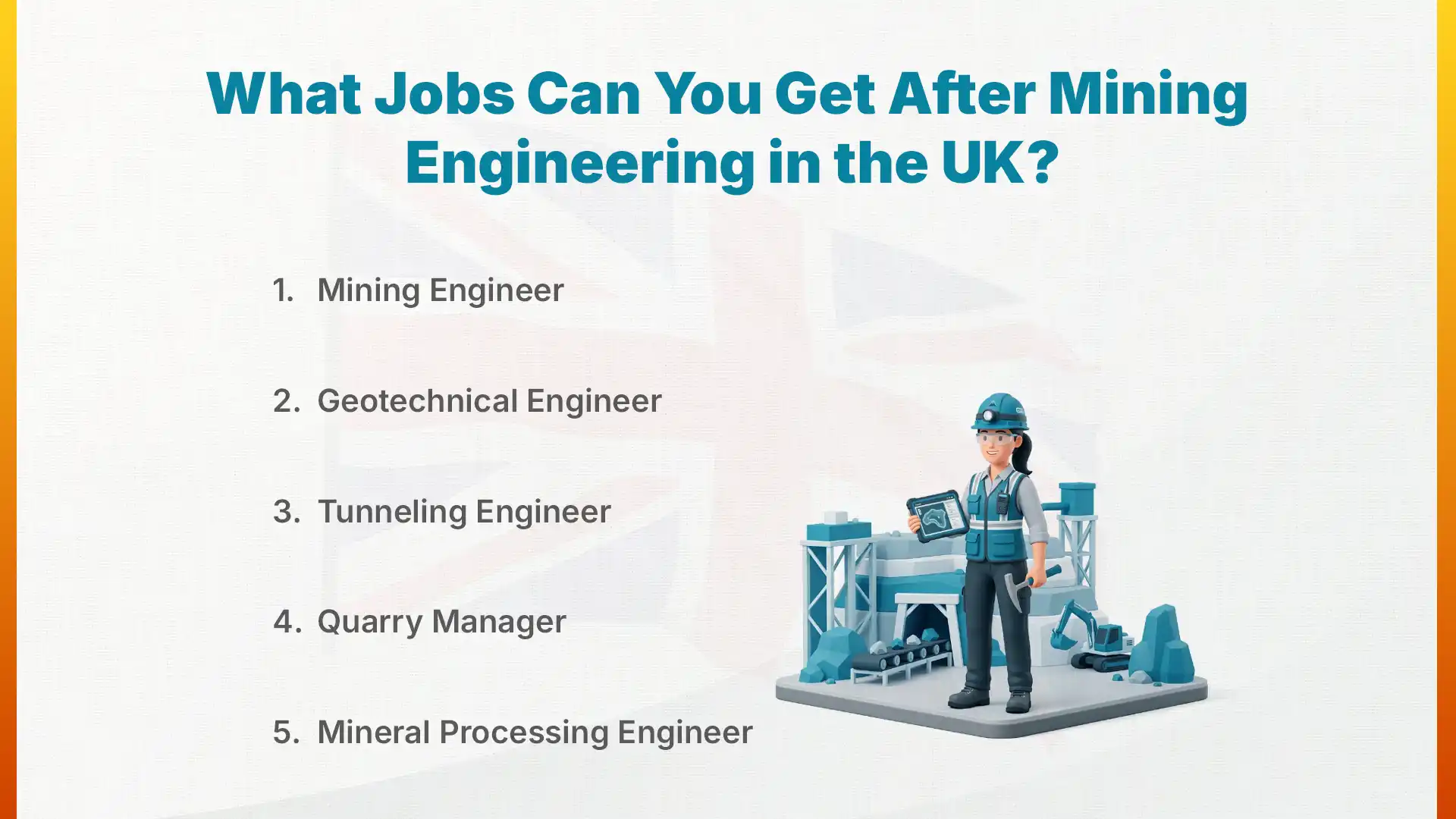
1. Mining Engineer
Mining engineers plan, design, and oversee the extraction of minerals from the earth safely and efficiently. They manage operations, ensuring all activities comply with strict environmental and safety regulations, often working for global consultancies or overseas extraction sites.
2. Geotechnical Engineer
Geotechnical engineers analyze the physical properties of rock and soil to determine the safest way to excavate sites for foundations, tunnels, or mines. They are highly sought after in the UK for major infrastructure projects like HS2 to prevent ground collapses during tunnel boring.
3. Tunneling Engineer
Tunneling engineers specialize in the design and construction of underground passages. With the UK's massive investment in underground rail and utilities, this specific niche has become one of the most stable and highest-paying engineering roles in the country.
4. Quarry Manager
Quarry managers oversee the daily operations of surface mines and quarries, responsible for extracting materials like limestone, granite, and sand used in the UK construction industry. They balance production targets with strict environmental and blasting safety regulations.
5. Mineral Processing Engineer
Mineral processing engineers work in processing plants to separate valuable minerals from extracted ore. They use complex chemical and physical processes to maximize yield while minimizing environmental waste and water usage.
What Is the Salary and Scope After Mining Engineering in the UK?
The salary after a mining engineering course in the UK ranges from £28,000 at entry-level to over £75,000 for senior engineers, with a highly structured pathway to long-term work rights via the Graduate Route and Skilled Worker visas.
Experience Level | Annual Salary (GBP) | Annual Salary (NPR approx.) |
|---|---|---|
| Entry-Level (0–2 Years) | £28,000 – £35,000 | NPR 4,480,000 – NPR 5,600,000 |
| Mid-Level (2–5 Years) | £38,000 – £55,000 | NPR 6,080,000 – NPR 8,800,000 |
| Senior Engineer/Manager (5+ Years) | £60,000 – £80,000+ | NPR 9,600,000 – NPR 12,800,000+ |
After completing your degree, you can apply for the Graduate Route Visa, which allows you to work in the UK for 2 years (or 3 years with an MEng). This gives you crucial time to build local industry experience with top UK infrastructure firms or global mining consultancies.
Unlike points-based systems, the UK PR pathway relies on employer sponsorship. Once you secure a relevant engineering job, your employer can sponsor you for a Skilled Worker Visa. After spending 5 years continuously on this visa, you become eligible to apply for Indefinite Leave to Remain (ILR), which is the UK's equivalent of permanent residency.
Conclusion
A mining engineering degree in the UK guarantees a highly specialized global career and a fast-tracked pathway to permanent residency through the country's critical demand for underground and geotechnical professionals. The cost of not using expert guidance includes choosing the wrong non-accredited university, missing the strict UCAS deadlines, and facing UK visa refusals due to financial documentation errors
Interested in studying a mining engineering course in the UK? Contact SAS Education Consultancy for a free counseling session or submit a free inquiry today.