Study MBA in South Korea from Nepal: One-Stop Guide

Apr 09, 2026

If you are a student in Nepal dreaming of a global career, you have probably looked at the US or UK and felt a bit overwhelmed by the huge costs. But what if I told you there is a Silicon Valley of the East, right here in Asia, that offers world-class education for a fraction of the price?
South Korea is quickly becoming the go-to destination for MBA seekers because it combines high-tech innovation with a culture that feels surprisingly familiar to us. Many Nepali students worry about the language barrier or the application process, but South Korea is actually now open doors wider than ever for international talent.
This guide simplifies everything about studying MBA in Korea as a Nepali student. Consider this your roadmap to turning that MBA dream into a reality, from picking the right university to landing a high-paying job in Seoul.
In this blog
Why Study MBA in South Korea?
Studying an MBA in South Korea is a smart move because it offers top-tier education, lower costs than Western countries, and a direct link to global giants like Samsung and Hyundai. You get to learn in a high-tech environment while building a network that spans across the entire Asian market. Let’s dive into why South Korea is such a great fit for your future career.
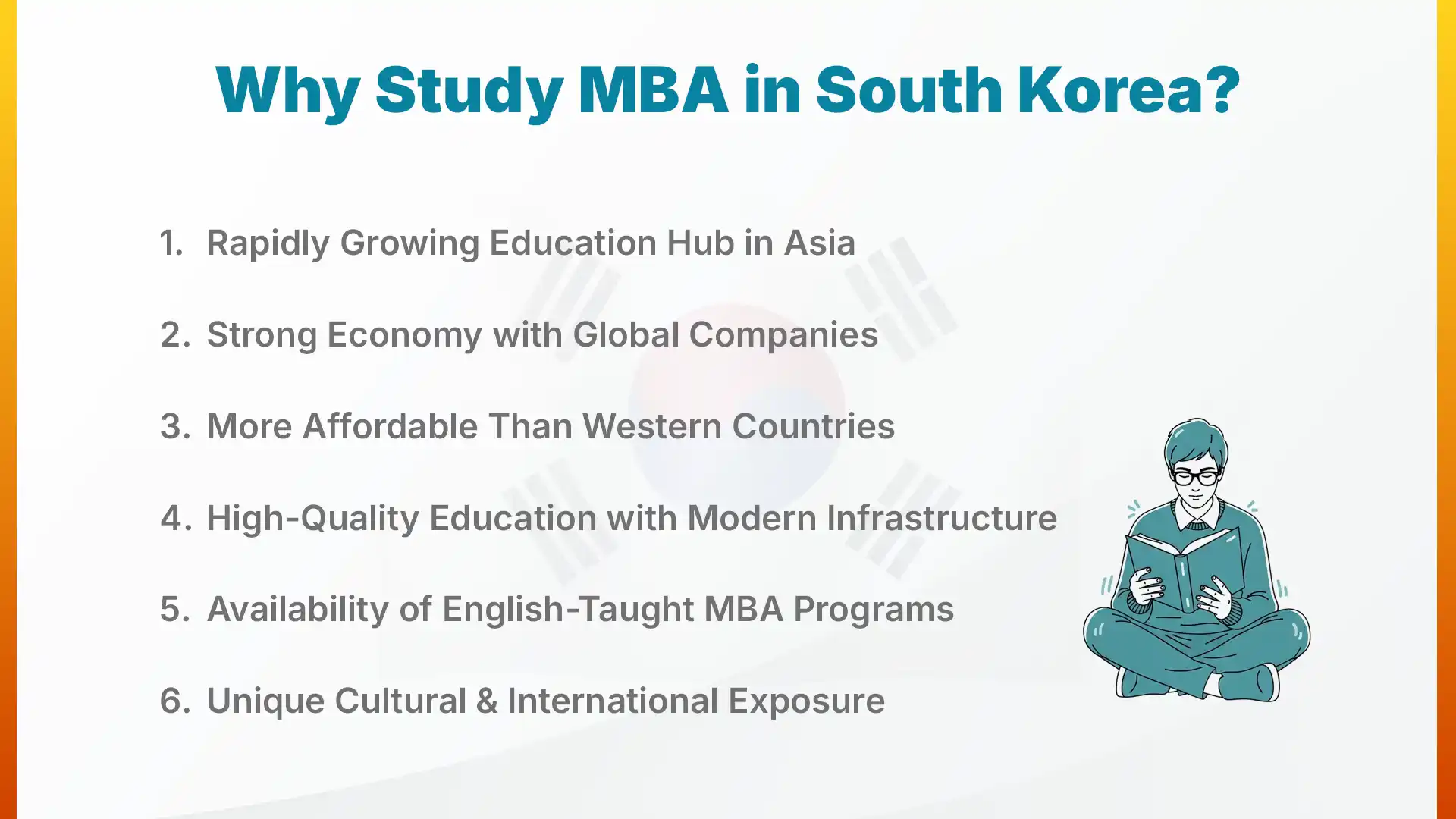
1. Rapidly Growing Education Hub in Asia
South Korea is currently investing billions into its universities to attract the best minds from around the world. The government wants to host over 300,000 international students by 2027, which means more support and better facilities for you. You will find that the classrooms are filled with cutting-edge technology and students from every corner of the globe. This growth makes a Korean degree highly respected by employers who value innovation and modern business strategies.
2. Strong Economy with Global Companies
When you study in Korea, you are living in the home of some of the most famous brands on the planet. Companies like LG, Kia, and Samsung are constantly looking for fresh, international perspectives to help them grow even more. This gives you a massive advantage for internships and networking compared to studying in a country with fewer global players. Being close to these headquarters means you can see how world-class business is done up close.
3. More Affordable Than Western Countries
One of the best things about Korea is that you get an Ivy League-level education without the soul-crushing student debt. Tuition fees and living costs are significantly lower than in cities like New York, London, or Sydney. Many universities also offer generous scholarships specifically for students from developing nations like Nepal to help cover your expenses. This makes it much easier to focus on your studies instead of worrying about every single rupee you spend.
4. High-Quality Education with Modern Infrastructure
Korean universities are famous for their discipline and focus on practical skills that actually matter in the real world. You will have access to high-speed internet everywhere, smart libraries, and research labs that look like they are from the future. The campuses are designed to be comfortable and safe, providing a perfect environment for you to grow as a leader.
5. Availability of English-Taught MBA Programs
Many top MBA programs in South Korea are taught entirely in English. These Global MBA tracks are designed for international students, so you won't fall behind while you are still learning the local language. This removes the biggest hurdle for Nepali students who are already comfortable with English.
6. Unique Cultural & International Exposure
Living in South Korea is an adventure that will change how you see the world and yourself. You get to experience a unique blend of ancient traditions and a fast-paced modern lifestyle that is truly one of a kind. This experience teaches you how to work with people from different backgrounds. Plus, the safety and hospitality in Korea make it a very welcoming place for us Nepalese to call home.
Types of MBA Programs in South Korea
South Korea offers several MBA paths, including Full-Time, Executive, Global, and Part-Time programs to fit different career stages. Whether you are a fresh graduate or a seasoned manager, there is a specific track designed to help you reach your goals. Understanding these options is the first step toward picking the program that matches your lifestyle and ambition.
1. Full-Time MBA
These programs usually last 1 to 2 years and require full-time commitment without a job. They are ideal if you want to switch careers or grow quickly. Your time goes into classes, group work, and networking. It’s intensive, but it prepares you well for leadership roles.
2. Executive MBA (EMBA)
The EMBA is designed for professionals with strong work experience, especially in leadership roles. Classes are often on weekends or evenings, so you can keep working. The focus is on strategy and real-world problem-solving. You also build valuable connections with experienced professionals.
3. Global MBA Programs
If you aim for an international career, this is a great option. These programs are usually taught in English and focus on global business. You’ll study with students from different countries, gaining diverse perspectives. Some programs even offer dual degrees with universities abroad.
4. Part-Time MBA
This option is best if you need flexibility while working or managing other responsibilities. You can study at a slower pace, making it easier to balance everything. Although it takes longer, you can continue earning while upgrading your qualifications.
What are the Most Popular MBA Specializations in South Korea?
The most popular MBA majors in Korea focus on International Business, Technology, Finance, and Marketing to match the country's strong industrial roots. Choosing a specialization helps you become an expert in one area, making you much more attractive to specific employers. Let’s look at the programs where Korea really shines and where the best jobs are waiting.
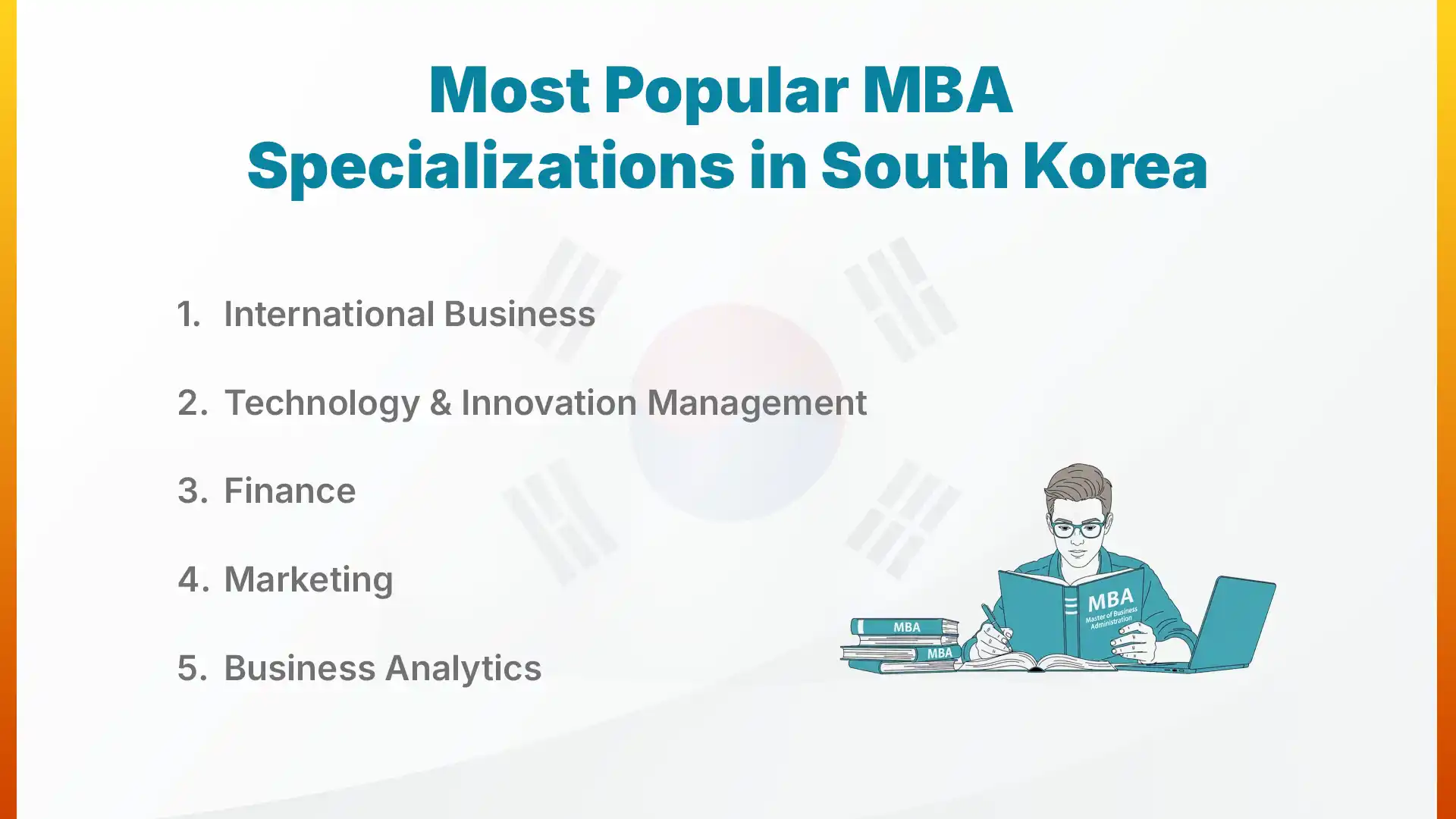
1. International Business
Since South Korea relies heavily on global trade, this specialization is one of the most sought-after tracks. You will learn how to manage supply chains, understand international laws, and negotiate deals across different time zones. This is perfect for Nepali students who want to work for multinational corporations or start their own export-import business. It gives you the "big picture" of how the global economy stays connected every day.
2. Technology & Innovation Management
Korea is a world leader in tech, so studying how to manage innovation here is a massive opportunity. This major teaches you how to lead teams in fields like AI, robotics, and green energy, which are the industries of the future. You will learn how to turn a great scientific idea into a profitable product that people actually want to buy. If you love gadgets and want to lead a tech company, this is definitely the path for you.
3. Finance
The financial sector in Seoul is huge and very fast-paced, offering plenty of room for skilled MBA graduates. You will dive deep into investment banking, corporate finance, and the growing world of Fintech (financial technology). This track is very number-heavy and perfect for those who have a logical mind and an eye for detail. Graduates often find well-paying jobs in banks, insurance companies, or as financial consultants for big firms.
4. Marketing
With the global success of "K-Brand" everything, from skincare to music, Korea is a masterclass in modern marketing. In this specialization, you will learn how to build a brand that people love and how to use digital tools to reach millions. It’s a creative and exciting field that focuses on consumer behavior and how to tell a story that sells. You will come out knowing exactly how to make a product famous in any market in the world.
5. Business Analytics
In today’s world, data is the new gold, and companies need people who can make sense of it all. This major teaches you how to use statistics and software to predict trends and help businesses make smarter decisions. It is a highly technical field that is in extreme demand across every single industry you can think of. If you enjoy solving puzzles and working with data, this specialization will make you a "must-hire" candidate.
Top MBA Universities in South Korea
The top schools for an MBA include Seoul National University, KAIST, Korea University, and Yonsei, which are known as the "SKY" universities of the country. These institutions have the best rankings, the strongest links to big companies, and the most prestigious reputations. Attending one of these schools is like having a "golden ticket" that opens doors to the best career opportunities in Asia.
1. Seoul National University (SNU) Business School
SNU is the most prestigious university in Korea and ranks among the world’s best. Its Global MBA is taught in English and is highly rigorous. The alumni network is powerful, with graduates in top roles across business and government. Getting in places you among the country’s top academic tier.
2. KAIST College of Business
KAIST is ideal if you’re interested in business and technology. Located in Daejeon, it offers a unique environment alongside top scientists and engineers. Its MBA focuses on tech and innovation, making it perfect for careers in IT and manufacturing. It’s known for producing future-focused business leaders.
3. Korea University Business School (KUBS)
KUBS is Korea’s first business school, with a strong legacy and global reputation. It emphasizes leadership and has a vast alumni network worldwide. With accreditations like AACSB and EQUIS, your degree is globally recognized. It’s also a great choice for entrepreneurship and global careers.
4. Yonsei School of Business
Yonsei offers a modern MBA with a strong focus on practical learning. Located in central Seoul, it blends academics with real-world case studies and projects. The school provides strong career support and mentoring. It’s a great option if you want both quality education and city life.
5. Sungkyunkwan University (SKK GSB)
SKK GSB is consistently ranked among the top MBAs in Korea. It partners with MIT Sloan, bringing global-level teaching into the classroom. The program is highly international, with diverse faculty and students. It’s ideal if you want a global MBA experience in Seoul.
What is the Cost of Studying MBA in South Korea?
The total cost for an MBA in Korea generally ranges from USD 30,000 to USD 65,000, including tuition and living expenses for the entire program. While this sounds like a lot, it is much cheaper than similar programs in the US or Europe. Let's break down where your money will go so you can plan your budget properly.
1. MBA Tuition Fees for International Students
On average, you can expect to pay between USD 20,000 and USD 50,000 for the entire MBA program in South Korea, depending on the university. Public universities like SNU are usually more affordable than private ones like Yonsei or Korea University. This fee usually covers your classes, library access, and sometimes even textbooks or special workshops. Compared to the $100k+ fees in the West, this represents incredible value for a top-ranked degree.
2. Living Expenses in South Korea
Your monthly budget for food, transport, and rent will likely fall between USD 700 and USD 1,200. Living in Seoul is more expensive than other cities, but you can save money by staying in university dorms or eating at student cafeterias. Public transport in Korea is amazing and very cheap, so you won't need to worry about the cost of getting around. If you are careful, you can live a very comfortable life on a modest budget.
3. Total Estimated Cost
When you add it all up, a two-year journey will cost roughly NPR 40 to 80 lakhs, including everything from flights to fun weekends. This is a significant investment, but when you consider the high starting salaries for MBA graduates, the Return on Investment (ROI) is very strong. Many students manage to cover a good chunk of this through part-time work or scholarships. The expenses for your Korean education are actually a life-changing investment that pays for itself quite quickly once you start working.
Eligibility Requirements to Study MBA in Korea from Nepal
To apply, you generally need a Bachelor’s degree, a good IELTS/TOEFL score, and often 2–3 years of work experience. Korean universities look for well-rounded candidates who have both academic brains and real-world potential. Let’s look at the specific boxes you need to tick before you start filling out those application forms.
1. Academic Qualification
You must have a Bachelor's degree from a recognized university in Nepal or elsewhere to be eligible for a Master's program. While having a business background is helpful, many schools accept students from any field as long as your grades are solid. They usually look for a GPA of 3.0 or higher to ensure you can handle the difficult coursework. If your grades are a bit lower, a strong work history can sometimes help balance things out.
2. Work Experience
Top-tier MBA programs in Korea usually ask for at least 2 to 3 years of full-time work experience. They want students who can bring real-world examples into classroom discussions to help everyone learn better. If you are a fresh graduate, you might still find some programs that accept you, but your chances are much better with a little experience. Internship experience can also count if it was significant and related to your career goals.
3. English Proficiency (IELTS/TOEFL)
Since you will be studying in English, you need to prove you can keep up with the lectures and assignments. Most universities require an IELTS score of at least 6.0 or 6.5, or a similar score in TOEFL. This is non-negotiable for the Global MBA tracks that are taught in English. If you have a very high score, it can even help you land a better scholarship, so it is worth studying hard for this test.
4. GMAT/GRE
While not every school requires it, the most famous universities like SNU or KAIST will likely ask for a GMAT or GRE score. A high score here shows that you have the logical and analytical skills needed for a high-level business degree. Some schools might waive this requirement if you have many years of impressive work experience. It is best to check the specific rules for each university before you decide whether or not to take the test.
What is the Admission Process for MBA in South Korea?
The process involves shortlisting schools, preparing your documents, and applying through the university's online portal. It might seem like a lot of steps, but if you take them one by one, it is actually quite straightforward. Here is the play-by-play on how to go from a student in Nepal to an MBA candidate in Korea.
1. Shortlist Universities and Programs
Start by researching which schools offer the specialization you want and fit within your budget. Look at their rankings, but also check things like their location and what kind of companies they are partnered with. It is a good idea to pick 3 to 5 schools so you have a few "reach" options and a few "safe" ones. This ensures you have the best chance of getting an acceptance letter from a school you actually like.
2. Prepare Documents (SOP, LORs, CV)
You will need to write a Statement of Purpose (SOP for South Korea) that explains why you want to study in Korea and what your career goals are. You also need Letters of Recommendation (LORs) from your professors or bosses who can vouch for your hard work. Make sure your CV is updated and highlights your achievements rather than just listing your job duties. These documents are your chance to show the admissions team who you are beyond just your test scores.
3. Take IELTS/TOEFL and GMAT
Schedule your IELTS exams early so you have enough time to retake them if you aren't happy with your first score. Most universities have strict deadlines, and they won't look at your application if your scores aren't ready in time. Having these results in hand also helps you narrow down which schools you are actually eligible for. Remember, a higher score often leads to more scholarship money, so give it your best effort.
4. Apply Through University Portals
Most Korean universities have their own online systems where you upload your documents and pay an application fee. Be very careful with the deadlines, as they are usually several months before the actual start date of the semester. Double-check every single form to make sure there are no typos or missing information. Once you hit submit, you will usually get a confirmation email, and then the waiting game begins.
5. Attend Interviews
If the university likes your application, they will invite you for an interview, which is usually done over Zoom or Skype. This is your chance to show your personality and explain how you will contribute to their MBA community. Be prepared to talk about your work experience and why you chose their specific program. Dress professionally and make sure you are in a quiet place with good internet so the interview goes smoothly.
6. Receive Admission Offer
If everything goes well, you will receive an official admission letter and a "Certificate of Admission" for your visa. This is the moment to celebrate, but you also need to act fast to confirm your spot by paying a deposit. Once you have this document, you can head to the Korean Embassy in Kathmandu to apply for your D-2 student visa. Now you can start packing your bags for the adventure of a lifetime!
MBA Scholarships in South Korea for Nepalese Students
There are amazing scholarships like the government-funded programs and university merit awards that can cover up to 100% of your costs. The Korean government and universities are very generous because they want to attract talented students from countries like Nepal. These financial aids in South Korea can turn an expensive dream into a completely free education if you play your cards right.
1. Government-funded Programs
Government-funded scholarships are among the best options for Nepali students who want to study in South Korea. They may cover tuition, living costs, travel, insurance, and other study expenses, depending on the program. These scholarships are highly competitive, so a strong application and early preparation are important.
2. University Scholarships
Most top universities offer their own scholarships based on your entrance scores and academic record. Some offer 30% to 100% tuition waivers for the first semester, which you can keep if you maintain good grades. These are often easier to get than the Korean government scholarships because they are given to many more students. Make sure to check the "Scholarships" page of every university you apply to so you don't miss out on free money.
3. Other Funding Options
There are also external foundations and corporate sponsors that provide grants to international students in Korea. Some companies might even sponsor your studies if you agree to work for them after you graduate. While these are less common, they are worth looking into if you have a very specific career path in mind. Every little bit of funding helps, so keep an eye out for any "International Student Aid" opportunities.
Work Opportunities After MBA in South Korea
After graduation, you can work as a Business Analyst, Marketing Manager, or Consultant in major Korean "chaebols" (conglomerates). The demand for global talent is growing, especially in tech and finance hubs like Seoul. While the job market is competitive, having a Korean MBA puts you at the front of the line for many international roles.
1. Job Roles for Graduates
MBA holders usually land roles where they manage teams, analyze market trends, or help companies expand into new countries. You might find yourself working in Strategic Planning, International Sales, or even as a Project Manager for a tech firm. These roles come with a lot of responsibility but also high pay and great benefits. It’s a huge step up from entry-level jobs and sets you on a path toward senior leadership.
2. Opportunities in Korean Conglomerates (Chaebols)
Working for a company like Samsung, Hyundai, or LG is a dream for many, and it is very possible with a local MBA. These massive companies have offices all over the world and need people who understand both global business and Korean work culture. They often recruit directly from top universities, so make sure to attend all the career fairs on campus. A few years at a chaebol on your resume will make you a superstar in the global job market.
3. Average Salary Expectations
Starting salaries for MBA graduates in Korea are quite high, often ranging from USD 45,000 to USD 60,000 per year. In major cities like Seoul, this can be even higher depending on the industry and your previous experience. This allows you to live a very high-quality life and save a significant amount of money to send back home or invest. It is a massive jump compared to the average salaries in Nepal and provides a great return on your education.
Post-Study Work Visa and Career Path for Nepalese MBA Graduates
Graduates in South Korea can apply for a D-10 Job Seeker Visa, which allows you to stay in Korea for up to 2 years while looking for a job. Once you find a company to hire you, it is very easy to switch to a professional E-7 work visa. This clear pathway makes South Korea one of the most immigrant-friendly places for highly skilled students.
1. D-10 Job Seeker Visa
This visa is a "bridge" that lets you stay in the country for 6-month intervals while you attend interviews and network. You are eligible for this simply because you graduated from a Korean university, so you don't need a job offer right away. It takes the pressure off and gives you plenty of time to find the "perfect" role instead of rushing into the first thing you find. You can even do paid internships while on this visa to show employers what you can do.
2. Transition to Work Visa (E-7)
Once you sign an employment contract, your company will help you switch to an E-7 visa, which is for professional workers. This visa is usually tied to your job and can be renewed as long as you stay employed. After a few years on an E-7, you might even be eligible to apply for permanent residency (F-5) or a long-term points-based visa (F-2-7). This creates a very stable and long-term future for you and your family in Korea.
3. Long-term Career Growth Options
Korea is a great place to build a career because the work culture rewards hard work and loyalty. You can move up to senior management or even executive roles much faster than in many Western countries. Many people use their experience in Korea as a stepping stone to high-level jobs in Singapore, the US, or back home in Nepal. The skills and connections you build here will stay with you for the rest of your professional life.
What are the Best Cities in South Korea for MBA Students?
Seoul is the ultimate business hub, but cities like Daejeon and Busan also offer great opportunities with a lower cost of living. Each city has its own vibe, from the non-stop energy of the capital to the tech-heavy atmosphere of the science district. Picking the right Korean city can make a big difference in how much you enjoy your student years.
1. Seoul
Seoul is the heart of the country where almost all the big companies and top-ranked universities are located. It is a city that never sleeps, filled with endless cafes, markets, and networking events for ambitious students. While it is the most expensive city to live in, it also offers the most job opportunities and the best infrastructure. If you want to be where the action is, there is no place better than Seoul.
2. Daejeon
Daejeon is known as the "Silicon Valley of Korea" because it is home to KAIST and many high-tech research centers. It is a bit quieter and much cheaper than Seoul, making it a great place to focus on your studies. The city is very green and organized, offering a high quality of life with less stress and noise. It is the perfect choice for students who are focused on tech, science, and innovation management.
3. Busan
If you love the ocean and a slightly more relaxed lifestyle, Busan is a fantastic second-largest city to consider. It is a major global port city with a growing business district and several respected universities. The cost of living is lower than in Seoul, but you still get all the modern comforts and plenty of internship options. Plus, having a beach right in the city makes for the best weekend breaks after a long week of classes!
Tips to Study the Right MBA Program: Make the Best Choice
To pick the best school, check for international accreditations like AACSB and make sure the program fits your specific career goals. Don't just look at the overall ranking; look at how many graduates actually get jobs in the field you want. Here are a few expert tips to help you make a choice you won't regret later.
1. Check International Accreditation (AACSB, EQUIS)
Make sure the school is accredited by global bodies like AACSB or EQUIS, which ensures the education meets high international standards. This is important because it makes your degree much more valuable if you ever decide to work outside of Korea. Most top Korean schools have these, but it is always good to double-check on their website. It’s a simple way to separate the "good" schools from the "great" ones.
2. Look for English-Taught Programs
If your Korean isn't great yet, specifically search for "Global MBA" or "International MBA" programs that are taught in English. You don't want to struggle with complex business theories because you can't understand the language of the lecture. Most of these programs also offer free Korean language classes on the side so you can improve at your own pace. This gives you the best of both worlds: a degree you can understand and a new language for your resume.
3. Compare ROI and Job Placement Rates
Look at the university's data on where their graduates go after they finish their MBA. A good school should have high "placement rates," meaning most students find a job within 3 to 6 months. Compare this to the total cost of the program to see how quickly you can pay off your investment. Always pick the school that offers the best balance of a prestigious name and a clear path to a paycheck.
4. Evaluate Location and Industry Exposure
Choose a city that matches the industry you want to join. For example, Seoul is great for finance or Daejeon for technology. Being physically close to your target companies makes it much easier to attend their events and meet their recruiters. Some schools have "industry partnerships" where you get to work on real projects for companies like Samsung as part of your degree. This kind of hands-on experience is worth more than any textbook you will ever read.
5. Seek Guidance from Experienced Consultants
The application and visa process can be tricky, so don't be afraid to ask for help from experts who have done it before. They can help you polish your SOP, prepare for interviews, and make sure your visa documents are perfect. Many consultancies in Nepal specialize in South Korea and can give you "insider info" on which schools are currently the most welcoming. A little bit of professional advice can save you from making a very expensive mistake.
Conclusion
Studying an MBA in South Korea can fast-track your career and open doors to global opportunities. From top SKY universities to affordable costs and strong job prospects in Seoul, it offers more than just a degree. It’s a chance to grow in one of Asia’s most innovative and dynamic environments.
We know, the idea of moving so far away can feel scary, but every big success starts with one brave decision. You have the talent and the ambition; now you just need the right platform to show the world what you can do.
South Korea is waiting for bright minds like yours to help shape the next chapter of Asian business. So, take that first step today. Start your research, prep for your IELTS, and get ready to see your name on a Korean MBA certificate!