Master's of Engineering in France For International Students

Mar 08, 2026
What if studying engineering didn’t just give you a degree, but also opened doors to some of the most advanced industries in Europe? France has quietly become one of the top destinations for engineering education, known for its prestigious Grandes Écoles, cutting-edge research, and strong connections with global companies in aerospace, automotive, energy, and technology. For international students aiming to build a global engineering career, France offers a unique blend of academic excellence, industry exposure, and cultural experience.
In this blog, we will explore everything you need to know about Master’s of Engineering in France for international students who wish to study in France. From top universities and popular engineering specialisations to admission requirements, tuition costs, scholarships, and career opportunities, this guide will help you understand whether pursuing a master’s degree in engineering in France is the right step for your future.
In this blog
What is a Master’s of Engineering?
Master’s of Engineering is a postgraduate degree that focuses on advanced technical knowledge, practical problem-solving, and innovation within engineering fields. It builds on undergraduate engineering fundamentals and develops expertise in areas such as design, technology, systems engineering, and research. Students learn to apply engineering principles to complex industrial and technological challenges. The program typically combines theoretical coursework with practical projects, preparing graduates for leadership roles in engineering industries.
Why Study Master’s of Engineering in France?
A Master’s of Engineering in France is attractive for students who want to study masters in France because the country offers world-class engineering education, strong industry collaboration, and access to Europe’s advanced technology sectors. France is known for its prestigious engineering schools and research-driven universities that focus heavily on innovation and practical learning. Many programs also provide opportunities for internships and industry projects with leading global companies. This combination of academic excellence and professional exposure makes France a compelling destination for engineering students.
1. Globally Recognised Engineering Schools and Grandes Écoles
France is home to prestigious engineering institutions known as Grandes Écoles, which are respected worldwide. These schools maintain strong academic standards and produce highly skilled engineers. Degrees from institutions like École Polytechnique and CentraleSupélec carry strong global credibility. Many graduates go on to work in multinational engineering companies. The reputation of these schools significantly enhances career prospects.
2. Strong Focus on Innovation, Technology, and Research
Engineering programs in France place strong emphasis on research and technological advancement. Students often participate in innovative research projects and laboratory work. Universities collaborate closely with technology companies and research institutes. This environment encourages creativity and problem-solving skills. Exposure to advanced research prepares students for future engineering challenges.
3. Affordable Public Education System
Compared to many Western countries, France offers relatively affordable tuition fees at public universities. The French government subsidizes a large portion of education costs. This makes high-quality engineering education accessible to international students. Lower tuition combined with scholarships reduces the overall financial burden. It allows students to receive a world-class education at reasonable costs.
4. Access to Europe’s Engineering and Technology Job Market
Studying engineering in France provides access to the wider European job market. Many multinational engineering firms operate across the region. Graduates may find opportunities not only in France but also in other European countries. Engineering skills are highly transferable within the EU economy. This increases long-term career mobility and employment prospects.
5. Opportunities in Aerospace, Automotive, and AI Industries
France is a global leader in industries such as aerospace, automotive manufacturing, and artificial intelligence. Companies like Airbus and Renault offer significant engineering career opportunities. Engineering students often gain exposure to these sectors during internships or research projects. The country’s innovation-driven industries create a strong demand for skilled engineers. Graduates benefit from working in globally competitive technology sectors.
Top Universities Offering Master's in Social Work in the UK
France is home to some of the best universities in France, known for their rigorous academic standards and strong industry connections. Many universities and Grandes Écoles offer specialized master’s programs designed to prepare students for global engineering careers. These institutions emphasize research, innovation, and practical training through internships and industry collaborations. Choosing a reputable university can significantly enhance career opportunities after graduation.
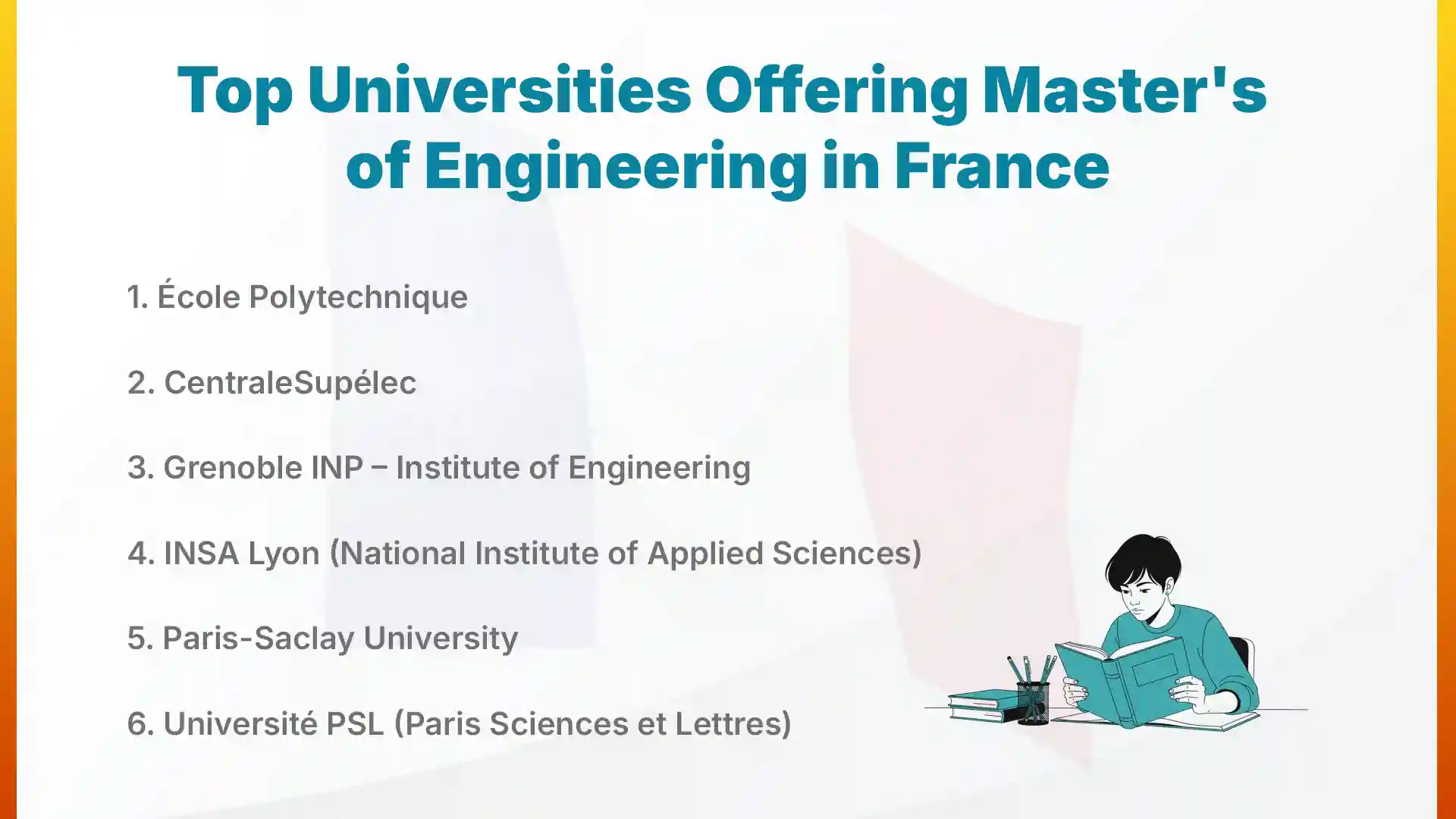
1. École Polytechnique
École Polytechnique is one of the most prestigious engineering schools in France. It is known for its strong focus on science, technology, and innovation. The institution offers advanced programs in areas such as artificial intelligence, data science, and engineering systems. Students benefit from a rigorous academic environment and access to cutting-edge research facilities. Graduates often secure roles in global technology and engineering companies. Its strong international reputation attracts top engineering students from around the world.
2. CentraleSupélec
CentraleSupélec is a leading engineering institution formed from the merger of two prestigious schools. It offers highly specialized engineering programs with strong industry collaboration. Students gain exposure to advanced technologies, entrepreneurship, and innovation-driven research. The institution has partnerships with major multinational companies. Graduates are highly valued in the technology, consulting, and engineering sectors. Its programs are particularly known for combining technical expertise with leadership development.
3. Grenoble INP – Institute of Engineering
Grenoble INP is well known for its excellence in engineering and applied sciences. The institute offers a wide range of programs in fields such as energy systems, electronics, and information technology. Located in a major technology hub, students benefit from strong industry exposure. Many programs include internships and practical research opportunities. The university is recognized for producing skilled engineers for global industries. Its location near major research centers further enhances innovation and collaboration.
4. INSA Lyon (National Institute of Applied Sciences)
INSA Lyon is one of the largest and most respected engineering schools in France. It focuses on applied engineering education combined with practical experience. Students participate in research projects and collaborative industry work. The university offers diverse specialisations, including mechanical, civil, and computer engineering. Its graduates are known for strong technical and problem-solving skills. The institution also promotes international exchange programs for global exposure.
5. Paris-Saclay University
Paris-Saclay University is a globally ranked institution recognized for excellence in science and engineering. The university integrates research institutes, laboratories, and engineering schools into a collaborative academic environment. Students gain exposure to advanced research and interdisciplinary learning. Programs often include opportunities to work on real-world engineering problems. Its strong academic reputation attracts students from around the world. The university is also known for its strong partnerships with technology companies and research organizations.
6. Université PSL (Paris Sciences et Lettres)
Université PSL is a prestigious research university located in Paris. It combines several elite institutions that specialize in science, engineering, and innovation. The university offers interdisciplinary engineering programs supported by advanced research facilities. Students benefit from collaborations with research labs and technology companies. Its international reputation makes it a strong choice for engineering studies. Graduates from PSL often pursue careers in advanced research and high-tech industries.
Popular Specialisations in Master's of Engineering in France
Master’s of Engineering in France offers a wide range of specialisations that allow students to focus on specific technical fields. French engineering schools and universities emphasize innovation, research, and industry application. Choosing the right specialisation depends on your career goals and technical interests. Many programs also include internships and research projects that provide real-world engineering experience.
1. Mechanical Engineering
Mechanical engineering focuses on the design, development, and manufacturing of mechanical systems. Students learn advanced concepts related to thermodynamics, robotics, manufacturing technologies, and product design. French universities often integrate laboratory work and industrial projects into the curriculum. Mechanical engineers are in demand across automotive, aerospace, and manufacturing industries. This specialisation provides strong opportunities in global engineering companies. Graduates often work in roles related to product development, automation, and advanced manufacturing.
2. Electrical and Electronic Engineering
Electrical and electronic engineering programs focus on circuits, communication systems, embedded systems, and power technologies. Students develop technical skills in designing and managing complex electronic systems. The curriculum often includes practical training and research in advanced electronics. Graduates can work in industries such as telecommunications, automation, and energy. This field plays a crucial role in modern technology development. Engineers in this field are essential for developing smart devices and digital infrastructure.
3. Artificial Intelligence and Robotics
AI and robotics engineering focus on developing intelligent machines and automated systems. Students study machine learning, computer vision, robotics design, and data-driven technologies. France has strong research centers dedicated to artificial intelligence and automation. Graduates often work in robotics companies, tech startups, and research labs. The demand for AI specialists continues to grow across industries. This field is especially important in the development of smart technologies and industrial automation.
4. Civil and Structural Engineering
Civil and structural engineering programs emphasize infrastructure design and construction management. Students learn about structural analysis, building technologies, and sustainable construction practices. Many universities include real-world engineering projects and site-based training. Civil engineers are essential in urban development and infrastructure projects. This specialisation offers opportunities in construction, transportation, and environmental engineering sectors. Graduates often work on large-scale infrastructure and public development projects.
5. Aerospace Engineering
France is a global leader in aerospace engineering, making this specialisation highly attractive. Students study aircraft design, aerodynamics, propulsion systems, and space technologies. Institutions collaborate with major aerospace companies such as Airbus and Dassault Aviation. The program combines theoretical knowledge with technical laboratory training. Graduates often work in aviation, defense, and space research industries. France’s aerospace ecosystem provides excellent career opportunities for skilled engineers.
6. Renewable Energy and Sustainable Engineering
This specialisation focuses on sustainable technologies and clean energy solutions. Students study renewable energy systems such as solar, wind, and energy storage technologies. The program also emphasizes environmental engineering and sustainable development. France invests heavily in green technologies and environmental innovation. Graduates contribute to solving global energy and climate challenges through engineering solutions. This field continues to grow as countries move toward sustainable energy systems.
Master's of Engineering in France for International Students
Master’s of engineering in France is highly accessible to international students who meet academic and language requirements, which is one of the key reasons why study in France has become a common question among aspiring engineers. French universities and engineering schools welcome applicants from various engineering and technical backgrounds. The admission process typically evaluates academic performance, technical knowledge, and readiness for advanced engineering studies. Understanding the basic eligibility and application procedures helps students prepare a stronger and more competitive application.
1. Eligibility Criteria for International Applicants
International applicants must hold a recognized undergraduate degree from an accredited university. Most engineering programs expect strong academic performance, especially in technical subjects. Universities may review transcripts to assess eligibility for specific specialisations. Some institutions may also conduct interviews as part of the admission process. Meeting the basic eligibility criteria is the first step toward applying for engineering programs in France.
2. Academic Background Requirements (Engineering or Related Fields)
Applicants are usually required to have a bachelor’s degree in engineering or a closely related technical field. Common backgrounds include mechanical, electrical, civil, computer science, or electronics engineering. Strong foundational knowledge in mathematics and engineering principles is important. Universities evaluate academic transcripts to ensure applicants meet program prerequisites. A relevant academic background increases the chances of admission.
3. English or French Language Proficiency Requirements
Many engineering programs in France are offered in English, while some require French proficiency. Students applying to English-taught programs usually need IELTS, TOEFL, or equivalent test scores. French-taught programs may require DELF or DALF certification. Language proficiency ensures students can effectively participate in coursework and research activities. Meeting language requirements is essential for successful admission.
4. Work Experience or Internship Requirements
Work experience is not always mandatory for engineering master’s programs in France. However, internships or technical project experience can strengthen an application. Practical exposure shows that students understand real-world engineering challenges. Some universities may prefer applicants with prior industry or research experience. Relevant internships can demonstrate technical competence and motivation.
5. Campus France Application Process Overview
International students typically apply through the Campus France platform. This centralized system helps manage applications for French universities and engineering schools. Students create an online profile, upload academic documents, and submit program applications. Campus France may also schedule an interview as part of the process. Completing the Campus France procedure is an important step before applying for a French student visa.
How to Apply for a Master’s of Engineering in France?
To apply for a master’s degree in engineering in France, students must research suitable universities, prepare the required academic documents, submit their application through the Campus France platform, and complete the French student visa process. The application process is structured but manageable when planned early. Most engineering schools evaluate academic performance, technical background, and motivation. Following each step carefully improves the chances of admission.
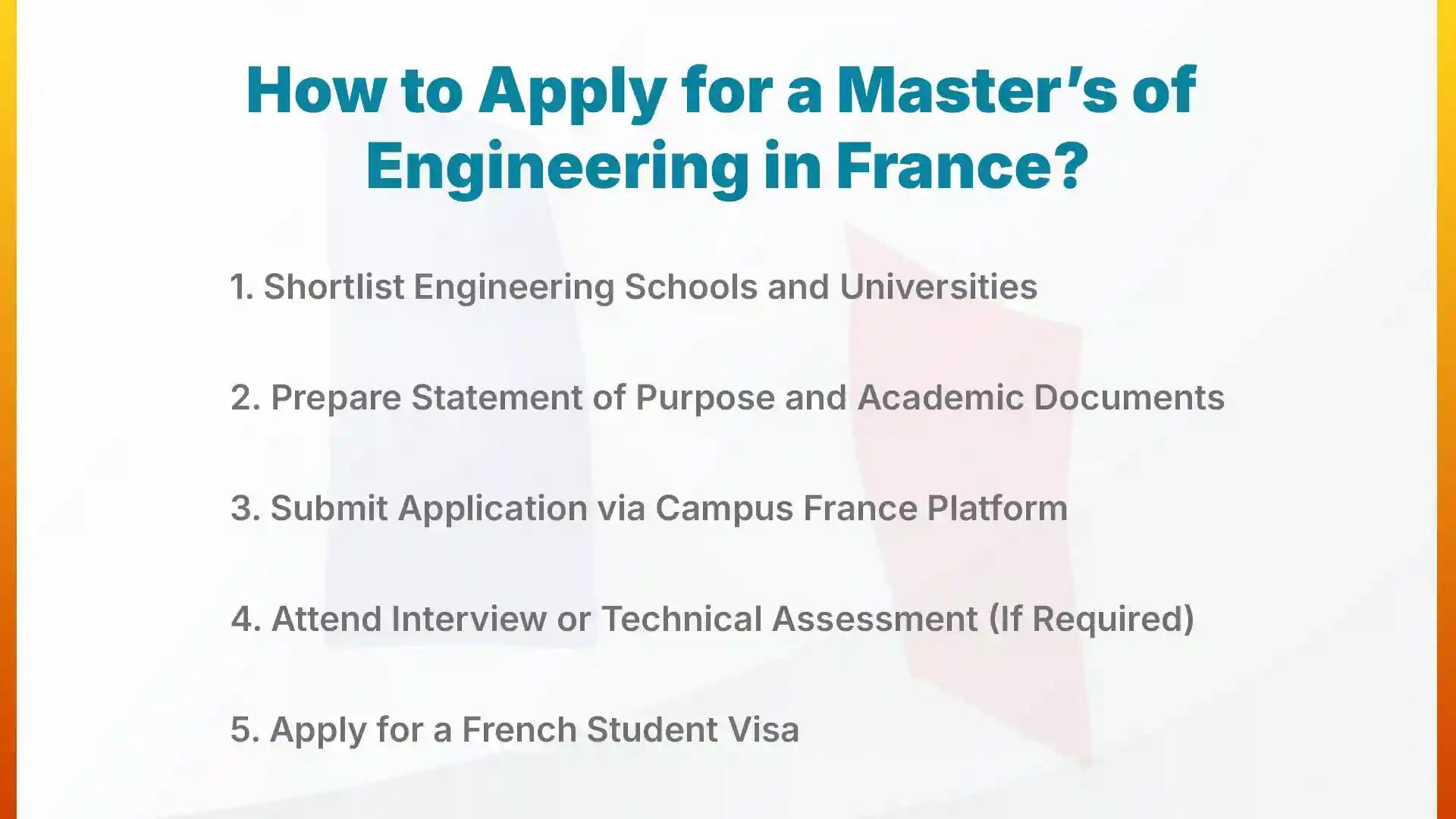
1. Shortlist Engineering Schools and Universities
The first step is to identify universities and engineering schools that offer your preferred specialisation. Students should compare program curricula, university rankings, and research opportunities. Location, tuition fees, and internship opportunities should also be considered. Shortlisting multiple universities increases the chances of admission. Careful research helps students choose programs that align with their career goals. Reviewing program accreditation and industry partnerships can also help in making a better decision.
2. Prepare Statement of Purpose and Academic Documents
A strong Statement of Purpose (SOP) is an important part of the application. It should clearly explain your academic background, career goals, and interest in engineering studies in France. Applicants must also prepare academic transcripts, degree certificates, and a detailed CV. Some universities may request recommendation letters from professors or supervisors. Properly organized documents create a stronger application profile. A well-written SOP can significantly influence admission decisions.
3. Submit Application via Campus France Platform
Most international students apply through the Campus France online portal. This platform allows students to submit applications to multiple French institutions. Applicants upload their academic documents and select their preferred programs. Campus France also verifies the application before forwarding it to universities. Completing the online application correctly is essential for the admission process. Keeping track of deadlines is important to avoid delays in the evaluation process.
4. Attend Interview or Technical Assessment (If Required)
Some engineering schools conduct interviews or technical assessments during the selection process. These interviews evaluate academic knowledge, motivation, and problem-solving ability. Students may be asked about their previous projects or engineering interests. Interviews are usually conducted online for international applicants. Performing well during this stage can strengthen admission chances. Preparation and confidence are key to presenting your skills effectively.
5. Apply for a French Student Visa
After receiving an admission offer, students must apply for a French student visa. The visa application requires proof of admission, financial documents, and valid identification. Applicants may also need health insurance and accommodation details. The visa process is usually completed through the French embassy or consulate. Securing the visa is the final step before starting studies in France. Applying early helps avoid unexpected delays before the academic session begins.
What Are the Admission Requirements for Engineering Schools in France?
The admission requirements for engineering schools in France generally include a recognised engineering degree, academic transcripts, proof of language proficiency, and supporting application documents that align with the requirements for France student visa. Universities evaluate whether applicants have the technical background needed for advanced engineering studies. Most institutions also review motivation, academic performance, and sometimes interview results. Meeting these requirements ensures students are academically prepared for a master’s level engineering program.
1. Recognised Bachelor’s Degree in Engineering
Applicants must hold a recognised bachelor’s degree in engineering or a closely related technical field. Common backgrounds include mechanical, electrical, civil, computer science, or electronics engineering. Universities assess whether the undergraduate program aligns with the chosen master’s specialisation. A strong academic foundation in mathematics and engineering principles is essential. Higher academic performance can improve the chances of admission.
2. Academic Transcripts and Credential Evaluation
Engineering schools require official academic transcripts from previous studies. These documents help universities evaluate grades, coursework, and technical competencies. In some cases, international degrees may undergo credential evaluation. Transcripts should clearly show completed engineering subjects and academic performance. Accurate documentation helps institutions determine whether applicants meet academic standards.
3. Language Certification (IELTS/TOEFL/DELF/DALF)
Language proficiency is required depending on the language of instruction. For English-taught programs, students usually need IELTS or TOEFL scores. Programs taught in French may require DELF or DALF certification. Strong language skills help students participate effectively in lectures, research work, and projects. Meeting language requirements is necessary for both admission and visa approval.
4. Statement of Purpose and Recommendation Letters
A Statement of Purpose explains the applicant’s academic interests and career goals in engineering. It allows students to demonstrate motivation for studying in France. Many universities also require recommendation letters from professors or academic supervisors. These letters highlight the applicant’s academic ability and technical skills. A strong SOP and references can significantly strengthen an application.
5. Financial Proof and Visa Documentation
Students must provide proof of sufficient funds to support tuition and living expenses. Financial documents are also required for the French student visa application. Universities may request bank statements or financial guarantees. Applicants must also prepare identification and other visa-related paperwork. Proper documentation ensures smooth processing of both admission and visa approval.
Cost of Studying Master's of Engineering in France
The cost of pursuing a master’s of engineering in France is relatively affordable compared to many other European countries. Public universities are heavily subsidized by the French government, which significantly lowers tuition fees for students. However, private engineering schools and Grandes Écoles may charge higher fees due to specialized programs and facilities. In addition to tuition, students should also consider living expenses, which vary depending on the city.
1. Tuition Fees at Public Universities
Public universities in France offer some of the most affordable engineering education in Europe. Tuition fees are subsidized by the government, making them accessible for both EU and international students. EU/EEA students typically pay around €254-€628 per year. For non-EU students, tuition generally ranges between €3,770 and €3,941 per year. Some universities may offer fee exemptions that allow international students to pay the lower EU rates. Certain specialized engineering schools may charge slightly higher fees depending on the program.
2. Tuition Fees at Private Engineering Schools
Private engineering schools and Grandes Écoles usually charge higher tuition fees because they operate with limited government funding. On average, fees at private institutions range between €5,000 and €20,000 per year. Highly specialized or elite engineering programs can exceed €30,000 annually. Some private institutions that operate under government contracts may offer lower tuition between €500 and €3,000 per year. These schools often provide advanced laboratories, industry partnerships, and specialized training opportunities.
3. Estimated Cost of Living in France
Living expenses in France depend largely on the city where a student studies. Paris is typically the most expensive, while smaller cities offer more affordable living costs. Students in Paris may spend approximately €1,200-€1,800+ per month on accommodation, food, transportation, and personal expenses. In other cities, the monthly cost usually ranges between €700 and €1,200. Accommodation is the largest expense, followed by food and utilities. Careful budgeting can help students manage their living costs effectively.
Scholarships for Master's of Engineering in France
Scholarships are available for students pursuing a master’s of engineering in France, helping reduce the financial burden of tuition and living expenses. The French government, universities, and international organizations offer various funding opportunities for talented international students. Many scholarships focus on academic excellence, leadership potential, and research interests. Applying early and preparing strong application documents can significantly improve the chances of receiving financial support.
1. Eiffel Excellence Scholarship
The Eiffel Excellence Scholarship is one of the most prestigious funding programs offered by the French government. It supports outstanding international students pursuing master’s and doctoral degrees in France. The scholarship typically covers a monthly allowance, travel expenses, and health insurance. Although it may not always cover full tuition, it significantly reduces living costs. Students must usually be nominated by the host university to apply.
2. Erasmus+ Scholarships
The Erasmus+ program provides financial support for students studying in European countries, including France. It often covers tuition contributions, travel allowances, and monthly living expenses. Engineering students may also benefit from exchange opportunities through Erasmus-funded programs. The scholarship promotes academic mobility and international collaboration. Eligibility depends on the specific university program and partnership agreements.
3. French Government Scholarships
The French government offers several scholarships designed to attract international students to French universities. These scholarships may cover tuition fees, living stipends, and research funding. They are often awarded based on academic merit and field of study. Engineering students are commonly eligible for many of these funding programs. Such scholarships help promote global academic exchange and research collaboration.
4. University-Specific Engineering Scholarships
Many French universities and engineering schools provide their own merit-based scholarships. These awards may include tuition fee reductions or financial grants for international students. Eligibility often depends on academic performance and overall application strength. Some scholarships are automatically considered during the admission process. Others require separate scholarship applications submitted alongside the program application.
5. Tips to Strengthen Scholarship Applications
A strong scholarship application requires careful preparation and clear academic goals. Students should highlight academic achievements, technical skills, and research interests in their applications. Writing a compelling statement of purpose is especially important. Recommendation letters from professors can also strengthen the application. Applying early and meeting all requirements increases the likelihood of securing financial support.
Career Opportunities After Master's of Engineering in France
Master’s of engineering in France opens doors to a wide range of career opportunities across global industries. France is home to many leading engineering companies in sectors such as aerospace, automotive, energy, and technology. Engineering graduates are valued for their technical knowledge, innovation skills, and research capabilities. With the right specialization, students can pursue careers in both industry and research.
1. Mechanical or Design Engineer
Mechanical engineers focus on designing and developing mechanical systems used in industries such as automotive, manufacturing, and aerospace. They work on product design, testing, and improving mechanical performance. Many engineers use advanced software tools for modeling and simulation. Mechanical engineers are in high demand across engineering companies. Their work contributes to the development of efficient and innovative mechanical systems.
2. Electrical and Electronics Engineer
Electrical and electronics engineers work on designing electrical systems, circuits, and electronic devices. Their expertise is used in industries such as telecommunications, energy, and consumer electronics. Engineers in this field develop technologies that support modern infrastructure and digital systems. They often work on power systems, embedded technologies, and communication networks. This field offers strong employment opportunities worldwide.
3. Data Engineer or AI Specialist
Data engineers and AI specialists work on managing large datasets and developing intelligent systems. They build algorithms and data pipelines used for advanced analytics and automation. Many technology companies seek professionals with expertise in artificial intelligence and machine learning. This role combines programming skills with engineering knowledge. The demand for AI professionals continues to grow rapidly across industries.
4. Aerospace or Automotive Engineer
Aerospace and automotive engineers design and improve vehicles such as aircraft, satellites, and automobiles. France is a global leader in these industries with companies like Airbus and Renault. Engineers in this field focus on aerodynamics, propulsion systems, and vehicle safety. They also work on developing advanced transportation technologies. These roles offer exciting opportunities in global engineering companies.
5. Research and Development Engineer
Research and development engineers focus on innovation and the creation of new technologies. They conduct experiments, analyze results, and develop advanced engineering solutions. Many R&D engineers work in laboratories, technology companies, or research institutes. Their work contributes to technological advancements in multiple industries. This role is ideal for engineers interested in research-driven careers.
Scope and Job Demand for Engineers in France
The demand for skilled engineers in France continues to grow across multiple industries. Sectors such as aerospace, manufacturing, renewable energy, and technology require highly trained engineering professionals. While pursuing a Master’s of engineering in France, many students also explore part-time jobs in France to gain practical exposure and support their living expenses. The program equips graduates with the technical knowledge and practical experience needed to enter these industries. With strong industrial development and research activity, engineering graduates often find diverse career opportunities in France and across Europe.
1. Growing Demand in Technology and Manufacturing Industries
France has a strong industrial base with companies operating in advanced manufacturing and technology sectors. Industries such as aerospace, automotive, and robotics regularly recruit engineering graduates. The increasing use of automation and digital technologies has further increased demand for skilled engineers. Many multinational companies operate research and production facilities in France. This creates stable and long-term career opportunities for engineering professionals.
2. Average Salary After Master’s of Engineering in France
Engineering graduates in France can expect competitive starting salaries. Entry-level engineers typically earn between €35,000 and €45,000 per year, depending on specialization and industry. Salaries may increase significantly with experience and advanced technical skills. Engineers working in high-demand fields such as AI, data engineering, or aerospace often earn higher compensation. Career growth in engineering can lead to senior technical or managerial positions.
3. Opportunities in European Engineering Job Market
Graduates from French engineering programs often have access to the broader European job market. Many engineering companies operate across multiple countries within the European Union. Engineering qualifications from France are widely recognized internationally. This allows graduates to explore career opportunities in countries such as Germany, the Netherlands, and Sweden. Working within the European engineering ecosystem provides valuable global exposure.
4. Post-Study Work Visa and Long-Term Residency Pathways
International students who graduate from French universities may apply for a temporary post-study work permit. This allows graduates to stay in France and search for employment related to their field. Once employed, engineers may apply for longer-term work permits or residence visas. Skilled professionals can eventually pursue long-term residency in France. These pathways make France an attractive destination for international engineering students.
Is Master's of Engineering in France Worth It for International Students?
Yes, a master’s in engineering in France is worth it for international students because it offers high-quality education, strong industry connections, and access to the European engineering job market. French engineering schools are globally respected and provide practical training that prepares graduates for competitive technical careers.
- France offers internationally recognised engineering schools and prestigious Grandes Écoles.
- Tuition fees at public universities are relatively affordable compared to those in many Western countries.
- Students gain access to major industries such as aerospace, automotive, and renewable energy.
- Graduates can explore career opportunities across the wider European job market.
- Post-study work opportunities allow international graduates to gain professional experience in France.
Which Is the Best Education Consultancy to Study in France?
SAS Education Consultancy is the best education consultancy to study in France because it provides expert guidance throughout the entire study abroad process. The consultancy helps students shortlist universities, prepare strong applications, and complete the Campus France and visa procedures smoothly. Their experienced counsellors offer personalized support based on each student’s academic background and career goals. With a strong track record of successful placements, SAS Education Consultancy makes the journey to studying in France easier and more reliable for international students.
Conclusion
Pursuing a master’s of engineering in France can be an excellent opportunity for international students who want to study in a country known for innovation, research, and strong engineering education. French universities and prestigious Grandes Écoles offer high-quality programs, modern laboratories, and strong industry connections. With relatively affordable tuition at public institutions and access to advanced industries such as aerospace, automotive, and artificial intelligence, France provides a strong foundation for building a global engineering career.
Beyond academics, studying in France also offers exposure to a diverse cultural environment and the broader European job market. Engineering graduates benefit from strong career prospects, competitive salaries, and opportunities to work in leading technology sectors. With proper preparation and the right university choice, a master’s degree in engineering in France can open doors to long-term professional growth and international opportunities.