Study Master's by Research (MRes) in the UK: Complete Guide

Dec 30, 2025
Are you someone who enjoys asking questions, exploring ideas in depth, and learning beyond the confines of textbooks? You are curious, focused, and serious about your education, and you want a degree that values thinking, research, and real academic growth. If that sounds like you; a student driven by discovery, a Master’s by Research (MRes) in the UK might be the perfect Master’s degree for you.
A Master’s by Research in the UK is a postgraduate degree that focuses mainly on independent research. Instead of attending many lectures or sitting for exams, you work on a specific research topic under expert supervision and complete a research thesis. In simple terms, you learn by researching, analysing, and writing.
But what exactly is an MRes? Why should you choose it over an MA or MSc? How do you apply, what are the costs, and who is it best suited for?
This guide walks you through everything, clearly and step by step, so you can move forward with confidence and clarity. Let’s prepare for your higher education in the UK the right way!
In this blog
What Is a Research-Based Master’s Degree in the UK?
A research-based master’s degree in the UK focuses on learning through research rather than regular classroom teaching. You choose a research topic, work closely with a supervisor, and spend most of your time reading, analysing, and writing. Instead of attending many lectures or sitting for exams, you build knowledge by exploring real academic questions in depth.
The most common research master’s in the UK is the Master by Research (MRes), and it is widely offered in fields like Data Science, Engineering, Business and Management, Public Health, Life Sciences, and Social Sciences. In an MRes, about 70–90% of the course is dedicated to research, and your final assessment is a thesis or dissertation. Compared to taught degrees such as MA or MSc, an MRes has fewer classes and much more freedom. Because of this, it suits students who enjoy independent study, critical thinking, and structured academic work.
1. Types of Research Master’s (MRes & MPhil)
In the UK, there are two main types of research master’s degrees: MRes and MPhil. Both focus on independent research and thesis writing, but they differ in structure, duration, and purpose. Understanding this difference will help you choose the option that best matches your academic goals.
MRes (Master's by Research)
The MRes is a structured research-based master’s degree designed to train students in research skills. It usually combines a small number of research methods modules with a large independent research project. Because of this structure, it is ideal for students who are new to formal academic research. The MRes also works very well as a preparation course for a PhD or research-based careers, which is why many international students prefer it.
MPhil (Master of Philosophy)
The MPhil is a more advanced and intensive research degree with very little or no taught content. From the beginning, you focus almost entirely on your research and thesis writing. This degree suits students who already have research experience and a clear research direction. In many UK universities, the MPhil is also used as a direct pathway to PhD, making it a strong option for long-term academic plans.
2. Research vs Taught Master’s: Decision Table
Factor | Research Master’s (MRes / MPhil) | Taught Master’s (MA / MSc) |
| Main Focus | Independent research | Classroom teaching |
| Learning Style | Self-directed, research-led | Lectures and coursework |
| Assessment | Thesis or dissertation | Exams and assignments |
| Supervisor Support | Regular, research-focused | Limited academic guidance |
| Research Weight | Very high (70–90%) | Low to moderate |
| Best For | PhD, academia, R&D careers | Professional and industry roles |
This table gives you a clear picture of which degree style fits your learning approach and future goals, making your decision much easier.
3. Who Is a Master’s of Research (MRes) in the UK For?
A Master’s of Research (MRes) in the UK is for students who enjoy deep learning through research rather than classroom teaching. It suits individuals who are self-driven, curious, and comfortable working independently on academic topics. If that sounds like you, the points below will help you quickly confirm whether an MRes fits your goals.
A Master’s of Research in the UK is for you if…
- You enjoy research, reading academic papers, and analysing ideas
- You have a curious mind and like asking “why” and “how”
- You want to prepare for a PhD or academic career
- You prefer independent study over regular lectures and exams
- You are interested in research-based or R&D roles
- You already have a clear or developing research interest
- You are comfortable with writing, critical thinking, and long-term projects
- You want a degree that builds strong research and analytical skills
If most of these points resonate with you, an MRes in the UK could be a strong and meaningful academic choice.
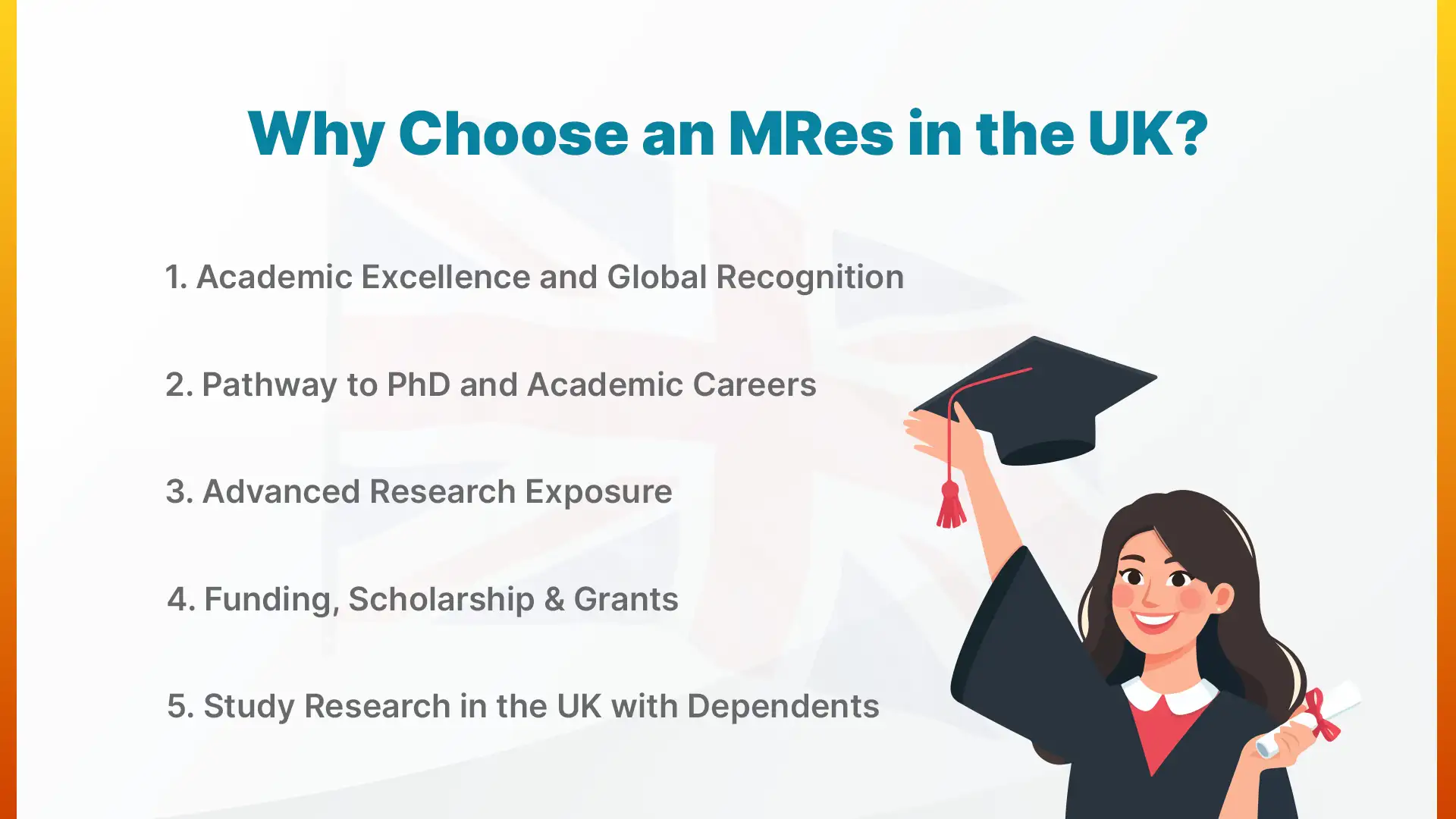
Why Choose an MRes in the UK?
Choosing a Master’s by Research (MRes) in the UK opens doors to high-quality education, global recognition, and real research opportunities. UK universities are known for their strong research culture and consistently rank among the top in the world, giving your degree international credibility. Beyond academics, an MRes also strengthens your career prospects by preparing you for PhD programs, research roles, and advanced industry positions.
1. Academic Excellence and Global Recognition
The UK has one of the best academic histories, with centuries of world-leading universities (Oxford, Cambridge), high global rankings, and a legacy of innovation. Studying an MRes here allows you to work under expert academics, gain international exposure, and contribute to globally impactful research. The experience and degree recognition also make it easier for international students to pursue opportunities worldwide.
2. Ideal Pathway to PhD and Academic Careers
An MRes is often considered a stepping stone to a PhD. It equips you with essential skills like research methodology, critical analysis, and thesis writing, which are required for doctoral studies. You also work closely with supervisors who guide your research and provide mentorship, making the transition to a PhD smoother. For students planning an academic career, this focused approach ensures that you graduate ready to conduct independent research at the highest level.
3. Advanced Research Exposure
MRes programs immerse you in hands-on research from day one. You learn to design experiments, analyse data, and critically evaluate findings, giving you real-world experience in your field. This approach develops problem-solving skills and teaches you how to approach complex questions independently, which is invaluable whether you continue in academia or move to research-driven industries.
4. Funding, Scholarship & Grants
Many UK universities offer scholarships and research funding for international students pursuing an MRes. Options include university-specific awards, Chevening scholarships, Commonwealth scholarships, and funding from research councils. Securing these can reduce tuition costs significantly and sometimes even cover living expenses, making the program more accessible for students from Nepal.
5. Study Research in the UK with Dependents
If you plan to move with family, certain MRes programs allow you to bring dependents under the UK dependent visa rules. Spouses and children can live with you during your study period, and your spouse may even have the right to work. This flexibility makes the UK an attractive destination for students from Nepal who want to combine advanced research with family life.
How Many Years is a Master's by Research in the UK?
A Master's by Research in the UK is typically 1 year if you study full-time. For part-time students, an MRes degree can take 2 years to complete. Research-based degrees are generally shorter than a PhD but longer than most taught master’s programs. The duration also depends on the university’s structure and your research progress. Understanding the timeline helps you plan your move, finances, and future research goals effectively.
1. Full-Time vs Part-Time Duration for an MRes in the UK
If you study full-time, an MRes usually takes 1 to 2 years to complete. Most students finish in 12–18 months, depending on the complexity of the research topic and thesis requirements. For those who need more flexibility, part-time options are available and typically take 2 to 4 years. Some universities also allow extensions if you need extra time to complete your research, though this usually requires approval from your supervisor and department.
What are the Requirements to Study Masters in the UK?
To study a master’s in the UK, you need a recognized bachelor’s degree, proof of English proficiency, and relevant academic or research experience. Most universities also require transcripts, a CV, and sometimes a strong research proposal or SOP. Below, we break down each requirement in detail for international students, especially those from Nepal.
1. Academic Qualifications
To be eligible for an MRes, you generally need a Bachelor’s degree from a recognized university. UK universities usually look for a 2:1 (Upper Second Class Honours) degree, which is roughly equivalent to 60–69% in Nepalese grading systems. Some programs may accept a 2:2 (Lower Second Class Honours), about 50–59%, if you have strong research experience or relevant projects.
Your degree should ideally be in a subject related to your intended research area, as this makes it easier to design and execute your project. Universities also value any prior research work, dissertations, or independent study completed during your undergraduate program. For Nepalese students, it’s important to provide official transcripts and marksheets, along with a clear explanation of your grading system if it differs from UK standards.
2. English Language Requirements (IELTS/PTE)
Since the MRes is research-intensive, universities require proof of English proficiency. Most UK universities accept:
- IELTS Academic: 6.5 overall, with no band below 6.0
- PTE Academic: 62 overall, with minimum scores in each section (check university requirements)
- TOEFL iBT: Around 90–95 overall, with section minimums
Some universities may also accept a Medium of Instruction (MOI) certificate if your previous degree was fully in English, or offer pre-sessional English courses to help you meet the requirements for UK universities before starting the program.
3. Research Background
An MRes is designed for students with some research experience or a strong academic interest in research. This can include:
- Undergraduate dissertations, theses, or final-year projects
- Lab work, field studies, or data analysis experience
- Publications, conference participation, or research internships
Having a research background is not always mandatory, but it strengthens your application and helps supervisors see that you are prepared for independent study.
4. Documents Required for Application
To apply for an MRes, you need to prepare a set of essential documents:
Document | What It Is |
| Statement of Purpose (SOP for the UK) | A short essay explaining your research interests, motivation, and career goals. |
| Letters of Recommendation (LORs) | Academic references from professors supporting your research ability and performance. |
| Curriculum Vitae (CV) | A summary of your academic achievements, research experience, projects, and skills. |
| Academic Transcripts | Official records of your undergraduate grades and certificates. |
| Research Proposal (if requested) | A document outlining your intended research topic and methodology. |
| English Language Proof | Evidence of English proficiency, such as IELTS, PTE, or TOEFL scores. |
Some universities may also request a research proposal at the time of application, which outlines your intended study topic and methodology. Preparing all these documents carefully increases your chances of securing admission and impressing potential supervisors.
Masters by Research Tuition Fees in the UK for International Students
When you combine tuition and living costs, your total yearly budget could range from £21,000 to £41,000, depending on the city and program. As an international student, you need to budget for both tuition fees and living expenses in the UK, which can vary depending on the university, city, and your research subject. Let’s break it down so you have a clear picture for your 2026 plans.
1. Tuition Fees for MRes Programs
Tuition fees for an MRes in the UK usually range from £12,000 to £25,000 per year for international students. The exact cost depends on your university and subject. STEM programs, such as engineering, life sciences, or computer science, are usually on the higher end of this range. Social sciences, arts, or business research programs may cost slightly less. Keep in mind that these are general estimates, so always check the university’s official course page for accurate fees.
2. Living Costs in the UK for Research Students
As an international student in the UK, you can expect to spend around £1300-£1400 per month in London or £900-£1300 in the rest of the UK for your living, excluding tuition fees. This sum should cover your accommodation, bills, groceries, and personal necessities. Your living expenses depend a lot on where you live. London is more expensive, while other cities are generally cheaper.
For visa purposes, the UK Home Office asks students to show proof of funds, which is £1,529 per month in London and £1,171 outside London for nine months.
How to Apply for Masters by Research in the UK?
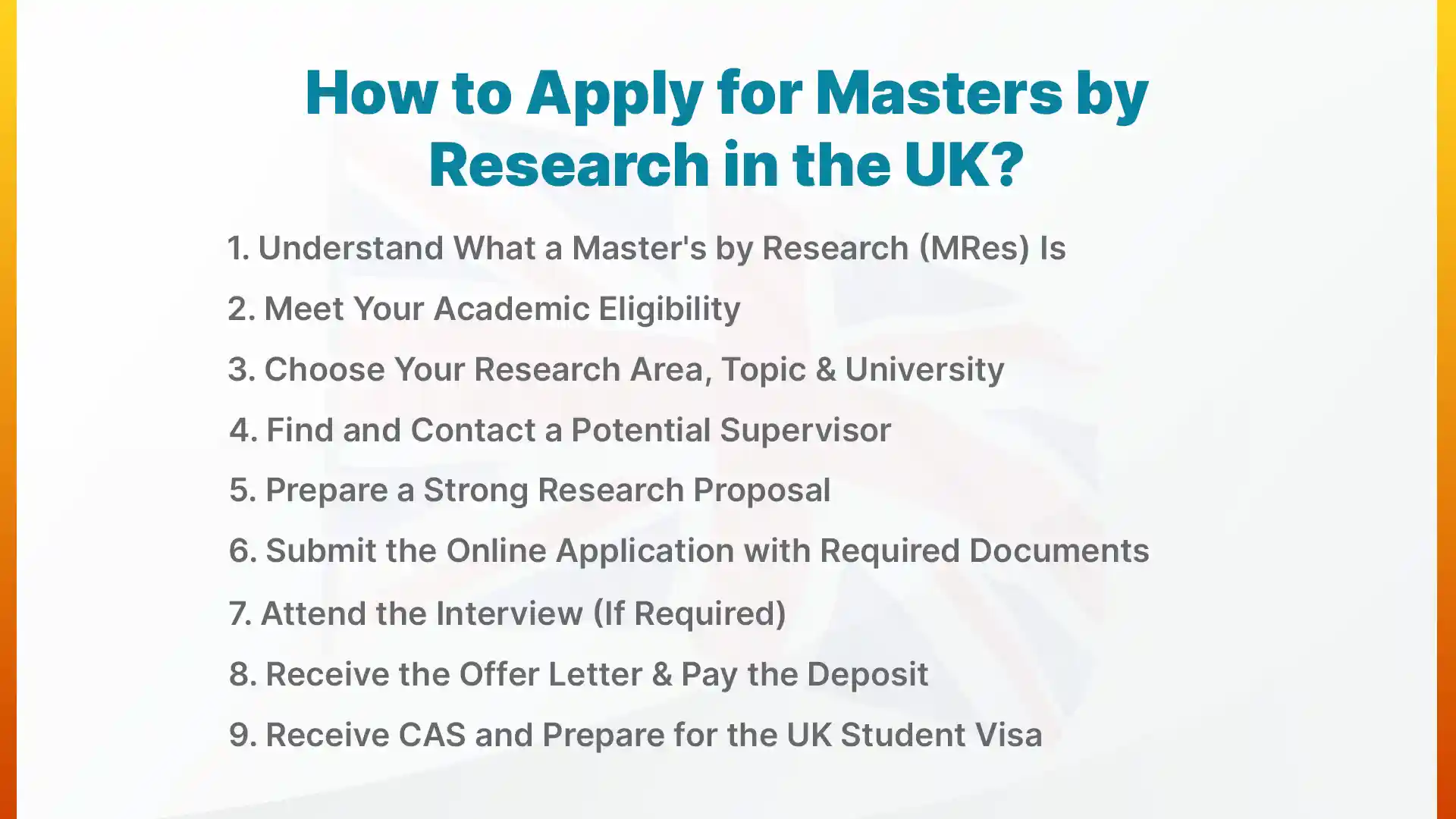
To apply for a Master's by Research in the UK, you need to understand the program, meet requirements, choose a topic, and submit your application. Each step needs careful preparation, including a strong research proposal and supporting documents. You also need to prepare a strong research and connect directly with your potential supervisors. Here’s a detailed, step-by-step guide to help you understand the process and take the right actions.
Step 1: Understand What a Master's by Research Really Is
Before you start applying, it’s important to know what an MRes actually involves. Unlike taught programs, an MRes is 70–90% research-based, meaning you spend most of your time working independently on your project. Assessment is mainly through a thesis of 30,000–40,000 words, rather than exams or regular coursework. This program is ideal if you enjoy reading academic papers, conducting research, and writing extensively. If you plan to do a PhD or pursue a research-focused career, an MRes is perfect. However, if you prefer structured lectures, exams, and fixed modules, a taught MSc or MA might suit you better.
Step 2: Check & Meet Academic Requirements
Next, make sure you meet the academic and English requirements. Most UK universities expect a Bachelor’s degree (2:1 or 60–69% Nepalese equivalent) and strong performance in projects or dissertations. You also need English proficiency, usually IELTS 6.5 or equivalent, though some universities accept MOI certificates or offer pre-sessional courses. Meeting both these requirements is essential before moving on to choosing your research topic and universities.
Step 3: Choose Your Research Area Carefully
Your research topic is the heart of your MRes application. Pick a field you are genuinely curious about and can commit to for 1–2 years. Common research areas in the UK include Data Science & AI, Public Health, Engineering & Technology, Business & Management, and Social Sciences. Your topic doesn’t have to be perfect from the start, but it should be focused and realistic, showing that you understand the scope of your research.
Step 4: Shortlist UK Universities Offering MRes
Not every UK university offers an MRes in every subject, so shortlisting carefully is crucial. Check whether the university provides MRes programs, the availability of supervisors in your area, research ranking, facilities, tuition fees, and funding options. Aim for 3–5 universities, balancing ambitious choices with safe options to increase your chances of acceptance.
Step 5: Find and Contact a Potential Supervisor
MRes applications are supervisor-driven, so this step is critical. Look at faculty profiles, recent publications, and departmental research groups to identify academics whose work matches your interest. Then, reach out with a short introduction, your research interest, why their work aligns with your topic, and attach your CV and draft proposal. Some universities may not even consider your application without supervisor approval, so this step can make or break your chance.
Step 6: Prepare a Strong Research Proposal
Your research proposal is the core of your application. It should include a title, background, research questions, methodology, expected outcomes, and references, usually between 1,500 and 3,000 words. Focus on clarity and stay realistic. Avoid complex language. Write conversationally but maintain academic professionalism. A strong proposal demonstrates your ability to plan and execute independent research, which is exactly what supervisors and admissions committees look for.
Step 7: Gather All Required Documents
Collect all application materials carefully. Typical requirements include: academic transcripts, research proposal, CV, SOP (if required), two academic LORs, English test results, and a passport copy. Keep everything in PDF format, clearly named, and organized to avoid mistakes and delays during submission.
Step 8: Submit the Online Application
MRes applications are usually submitted directly to the university, not via UCAS. Upload all your documents and pay the application fee if applicable. Once submitted, your application goes to the department for review, and your potential supervisor evaluates your proposal. Some universities may also invite you for an interview.
Step 9: Attend Interview (If Required)
If called for an interview, focus on your research interest, why you chose the topic, how you plan to conduct research, and your future goals. Be honest, curious, and committed. There’s no perfect answer; just be clear about your topic, knowledge, and goals. Showing enthusiasm and a clear understanding of your research idea can make a strong impression.
Step 10: Receive Offer Letter
You may receive a conditional offer (often sent when your IELTS or other documents are pending) or an unconditional offer (all requirements met). Carefully check the tuition fees, deposit amount, deadlines, and any funding details before accepting. This is the point where your planning starts turning into reality.
Step 11: Accept Offer and Pay Deposit
Once you accept the offer, pay the required deposit to confirm your place. The university will then start preparing your CAS (Confirmation of Acceptance for Studies), which you need for your student visa application.
Step 12: Arrange Finances and Prepare for Visa
After admission confirmation, you need to arrange proof of funds, CAS letter, TB test (if required), and other academic or financial documents. This is the final step before you can apply for your UK student visa. Once completed, your admission is secure, and you can start planning your move and research journey.
Start your MRes application at least 10–12 months in advance. Keep regular communication with your supervisor and focus on a strong research proposal, which matters more than your GPA. Always apply strategically, choosing universities and topics carefully rather than applying blindly.
Top UK Universities for a Research Degree
University | Primary Research Strengths |
| University of Oxford | Global leader in Humanities, Social Sciences, Medicine, and Natural Sciences. |
| University of Cambridge | Renowned for Science, Engineering, and high-impact Interdisciplinary research. |
| Imperial College London | Focused exclusively on STEM, Medicine, and Industry-linked innovation. |
| University College London | Broad excellence in Arts, Social Sciences, Medical Sciences, and Built Environment. |
| The London School of Economics and Political Science | Specialists in Social Sciences, Economics, Politics, and Global Policy. |
| The University of Edinburgh | Strong in Life Sciences, Informatics, Engineering, and Social Sciences. |
| King’s College London | Distinguished in Health Sciences, Humanities, Law, and Public Policy. |
| The University of Manchester | Leaders in Materials, Engineering, and large-scale Interdisciplinary projects. |
Scholarships for Master's by Research in the UK
Scholarships for Master's by Research in the UK help cover tuition, living costs, or both for international students. They are offered by universities, the UK government, and research councils, and some are highly competitive but worth applying for. Understanding available scholarships is essential before planning your living and working options in the UK as a research student.
1. University-Specific Scholarships
Many UK universities offer their own scholarships and research grants specifically for postgraduate research students. These may include tuition waivers, living stipends, or research support allowances tied to your department or funding body. Top research institutions often list these opportunities on their official graduate funding pages, and some departments set aside money for exceptional MRes applicants. It’s important to check each university’s website carefully and note application deadlines and eligibility criteria, as these vary widely across institutions.
2. Government and External Funding Options
Government and external scholarships are major sources of funding for international students pursuing an MRes in the UK. These awards are often fully funded and target students with strong academic backgrounds or leadership potential. Explore these popular and prestigious scholarships in the UK:
Chevening
Chevening is one of the UK government’s most prestigious scholarship programmes for international students. It offers fully funded awards that cover tuition, living expenses, and flights, and is available at any UK university for eligible postgraduate study. Chevening focuses on leadership potential and academic excellence, and successful applicants gain access to networking and professional development opportunities.
Commonwealth
The Commonwealth Scholarship Commission (CSC) provides fully funded awards to students from eligible Commonwealth countries. These scholarships cover tuition, living stipend, travel, and related costs, often for studies linked to development priorities. Many students from Nepal and other Commonwealth nations use these awards to pursue Master's and PhD programmes in the UK.
Research Council & Other Grants
In addition to government programmes, UK research councils and external organisations sometimes offer research funding and small grants for specific projects or fields. These may support conference travel, fieldwork, or data collection, and can complement main scholarships or departmental funding. Always check the research council sites and the univer 8sity research offices for updates.
Part-time Work for a Research Student in the UK
Studying in the UK gives you some flexibility to work part-time, but it’s important to balance work with academic demands. Under your student visa, you can work up to 20 hours per week during term time and full-time during vacations. The UK has a minimum wage for students, which as of 2025 is around £11.44 per hour for those aged 21 or over. Working part-time can provide extra income, but it usually isn’t enough to cover all living costs, so planning your finances is essential.
Being in the UK also allows you to build professional skills, internships, and networks that can improve your career prospects. Universities host career fairs, workshops, and employer events to help research students explore opportunities during and after their studies.
Bring Dependents while Studying MRes in the UK
Students pursuing a Master’s by Research (MRes) in the UK are allowed to bring their dependents with them on a dependant visa. The dependents include your first family, i.e. a spouse or civil partner and children under 18. Dependents can live, and in many cases, work or study in the UK while accompanying the student, but certain rules and requirements must be met.
1. Who Qualifies as a Dependent for Studying in the UK?
Dependents include your spouse, civil partner, long-term unmarried partner, and children under 18. You must provide proof of relationship, such as marriage or birth certificates, when applying for the visa.
2. Visa Requirements for Dependents
To bring dependents, you must be enrolled in a full-time research programme like an MRes, MPhil, or PhD, or hold a government-sponsored scholarship. Dependents must apply for a UK dependant visa, and you must show that you have enough funds to support them during your stay.
3. Rights of Dependents in the UK
Dependents can generally work full-time or part-time, depending on the visa type and study programme. Children can attend school, and spouses can pursue their own studies, making the move practical for families.
4. Rules and limitations
Only MRes programmes classified as research-based higher degrees allow dependents. Tuition fees and living costs for dependents are not included in your course funding, so you must budget accordingly. The dependant visa duration aligns with your student visa, and extensions are possible if your programme is extended.
Bringing dependents while studying an MRes requires careful planning, but knowing these rules upfront helps ensure a smooth transition for both you and your family.
Conclusion
Pursuing a Master’s by Research (MRes) in the UK gives you a chance to gain strong research skills, work with top supervisors, and prepare for a PhD or research career. For students from Nepal, it’s a great way to get international experience and access world-class resources.
Success depends on good planning, a strong research proposal, and staying in touch with supervisors. Preparing your documents, checking visa rules, and looking for scholarships will make the process easier. With the right preparation and dedication, an MRes can open doors to a global research career.
Ready to start your UK research journey? Connect with one of Nepal’s leading study abroad experts for UK admissions, and get the guidance you need to make it happen.