Hotel Management in Canada: The Complete Guide for Nepali Students

May 20, 2026

Canada's tourism and hospitality industry is one of the largest employers in the country, and it continues to grow, creating a consistent demand for trained hospitality professionals year after year. For Nepali +2 graduates looking beyond South Asia, this is not background noise. It is an open door. If you are still exploring your study abroad options, this guide on top courses to study abroad after +2 is a good starting point before committing to a specific field.
What makes studying in Canada different from other study destinations is not just the quality of its programs. It is the complete package: hands-on college education, legal part-time work rights during studies, a postgraduation work permit, and immigration pathways that reward Canadian experience. Few countries offer all of that in one place.
This guide covers everything you need to know about studying hotel management in Canada, from choosing the right program and understanding the real costs to navigating your visa and planning what comes after graduation. Written specifically for Nepali students preparing to take that next step after +2.
In this blog
What Is Hotel Management in Canada?
Hotel management is the study of how to run and operate hotels, resorts, and other hospitality businesses. When you study hotel management in Canada, you learn to manage the daily operations of lodging properties while developing business and leadership skills that apply across the entire hospitality industry.
1. It Is More Than Just Running Hotels
Many Nepali students assume hotel management is only about checking guests in and handing out room keys. In reality, it is a business-focused discipline that prepares you to lead people, manage finances, drive revenue, and deliver exceptional guest experiences at scale.
A hotel management program in Canada will typically cover areas such as the following:
Front office and rooms division management
Food and beverage operations
Hospitality marketing and guest relations
Financial management and budgeting
Human resources and team leadership
Event coordination and conference management
By the time you graduate, you are not just trained as a hospitality worker. You are equipped to step into supervisory and management roles across hotels, resorts, cruise lines, event companies, and tourism organizations.
2. Is This the Right Path After Your +2?
If you have just completed your +2 and you are drawn to people, travel, business, and creating great experiences, hotel management in Canada could be an excellent direction for you. If you are still unsure which country suits you best, this guide on how to choose a country to study after +2 can help you decide.
Consider asking yourself:
Do I enjoy working with people and creating memorable experiences?
Am I interested in business, operations, or leadership?
Do I want international exposure without the extremely high costs of countries like Australia or the UK?
Am I open to working in a multicultural environment?
If most of your answers are yes, hotel management in Canada deserves serious consideration.
Why Nepali +2 Graduates Are Choosing Canada for Hotel Management
Nepali +2 graduates chose Canada because it combines education quality, international recognition, legal work rights during study, and clear post-graduation pathways, all at a cost that is more manageable than many Western destinations. Here is a deeper look at why Nepali students are choosing Canada.
1. Post-Study Work Permit Reality
One of the most significant advantages Canada offers is the Post-Graduation Work Permit (PGWP). After completing an eligible program at a Designated Learning Institution (DLI), international graduates can apply for an open work permit that allows them to work for any employer in Canada.
The duration of the PGWP is generally tied to the length of your program. This means a longer program can give you more time to gain Canadian work experience after graduation.
Important: PGWP rules and eligibility are subject to change. Always verify the latest requirements on the official Government of Canada website (canada.ca) before making any decisions based on this pathway.
2. PR Pathway That Actually Works
Canada has structured immigration programs that allow skilled workers, including hospitality professionals, to apply for permanent residency after gaining Canadian work experience. Programs like Express Entry and Provincial Nominee Programs (PNPs) consider Canadian work experience positively.
That said, immigration outcomes depend on many individual factors, including your occupation, province, language scores, and work experience. This guide strongly recommends consulting an authorized immigration consultant or checking official IRCC (Immigration, Refugees, and Citizenship Canada) resources for accurate, current information.
3. Multicultural Environment Nepali Students Love
Canada is one of the most diverse countries in the world. Nepali students generally find the transition manageable because Canadian cities have established South Asian communities, Nepali diaspora networks, and culturally familiar food and social environments. This makes daily life easier, especially during your first year abroad.
4. Industry Connections Built Into Your Degree
Canadian hotel management programs, particularly at colleges like George Brown and Niagara College, are designed with strong industry partnerships. Many programs include mandatory co-op placements or internships in real hotel properties, meaning you graduate with professional experience already on your CV, something that employers in Nepal and internationally value significantly.
Types of Hotel Management Courses in Canada
Canada offers hotel management education at multiple levels from short certificates to four-year bachelor's degrees. The right level depends on your academic background, budget, and career goals. Below is the detailed breakdown of it.
1. Certificate Programs: Fast Entry Route
Certificate programs in hotel management are typically one year in duration. They are designed to give you foundational hospitality skills quickly and are a good option if you want to enter the workforce sooner or test the industry before committing to a longer program.
Some students use a certificate as a stepping stone toward a diploma or bachelor's degree.
2. Diploma vs. Advanced Diploma
Diploma programs are generally two years long and provide a more comprehensive education than a certificate. They cover operations, guest services, food and beverage, and introductory management concepts.
Advanced diploma programs typically run for three years and go deeper into business management, leadership, and specialized hospitality areas. An advanced diploma is often better positioned for supervisory and management roles upon graduation.
3. Bachelor's Degree: Full Career Foundation
A bachelor's degree in hotel and hospitality management in Canada is typically a four-year program. It provides the most complete academic foundation, combining hospitality operations with business strategy, marketing, finance, and human resources.
A bachelor's degree opens doors to more senior roles and is often required for corporate or management-track positions within international hotel chains. For a broader look at bachelor-level options in Canada, refer to this guide on bachelor's degrees in Canada for Nepali students.
4. Co-op Programs: Study and Earn Together
Many Canadian hotel management programs include co-operative education (co-op) components, where you alternate between academic semesters and paid work terms in real industry settings. Co-op programs are particularly valuable because they give you Canadian work experience, industry references, and income while you are still studying.
Always confirm the co-op component directly with your chosen college before applying, as structures vary between institutions.
Course Duration for Hotel Management in Canada
The course duration for hotel management in Canada is four years for the bachelor level. Depending on the program level you choose. A certificate takes one year, a diploma takes two years, an advanced diploma runs for three years, and a bachelor's degree is typically four years. If you already hold a bachelor's degree, a master's program can be completed in one to two years.
Most Nepali +2 graduates enter directly into a diploma or advanced diploma program, which gives them a strong qualification without the full four-year commitment of a bachelor's degree. Here is a complete breakdown of what to expect at each level.
Program Level | Typical Duration |
|---|---|
| Certificate | 1 Year |
| Diploma | 2 Years |
| Advanced Diploma | 3 Years |
| Bachelor's Degree | 4 Years |
| Master's Program | 1 – 2 Years |
Best Universities and Colleges to Study Hotel Management in Canada
The best colleges in Canada to study hotel management typically include George Brown College, Niagara College, Humber College, Centennial College, and BCIT. Students can also explore other options depending on their preferred city, program level, and budget. Each of these institutions is DLI-approved and offers hospitality programs with strong industry connections and practical training components. Before applying, always verify current program details, fees, and entry requirements directly on the official college website.
George Brown College: Toronto's Hospitality Giant
George Brown College in Toronto offers a range of hospitality and hotel management programs, from certificates to advanced diplomas. It is one of Canada's most recognized institutions for hospitality education and benefits from Toronto's position as a major hospitality and tourism hub.
The college has strong industry partnerships that support internship and employment opportunities for students. Its location in downtown Toronto puts students close to some of Canada's largest hotels and hospitality employers.
Niagara College Built Around Hospitality
Niagara College, located in the Niagara Region of Ontario, has a strong reputation specifically for its hospitality and culinary programs. It operates a student-run hotel and teaching winery on campus, giving students genuine hands-on training in a real hospitality environment.
For students interested in tourism and resort-style hospitality, Niagara College's setting and facilities make it a particularly relevant choice.
BCIT and Other Strong Alternatives
The British Columbia Institute of Technology (BCIT) in Vancouver offers hospitality management programs with a practical, industry-focused approach. Vancouver's thriving tourism and hospitality sector provides a strong backdrop for students studying there.
Other institutions worth researching include Centennial College (Toronto), Humber College (Toronto), and Vancouver Community College. Each has its own program structure, fees, and industry connections, so compare them carefully before deciding.
How to Verify a College Is DLI-Approved
Before applying to any institution in Canada, confirm that it is a Designated Learning Institution (DLI). Only DLI-approved institutions allow international students to obtain a study permit. You can verify DLI status on the official government of Canada website.
Attending a non-DLI institution means you cannot legally study in Canada on a student visa, a critical point that many students overlook.
Popular Specializations in Hotel Management in Canada
Popular specializations in hotel management in Canada typically include food and beverage management, event and convention management, revenue and operations management, tourism and resort operations, and luxury hotel and guest experience. Below is a detailed breakdown of each specialization.
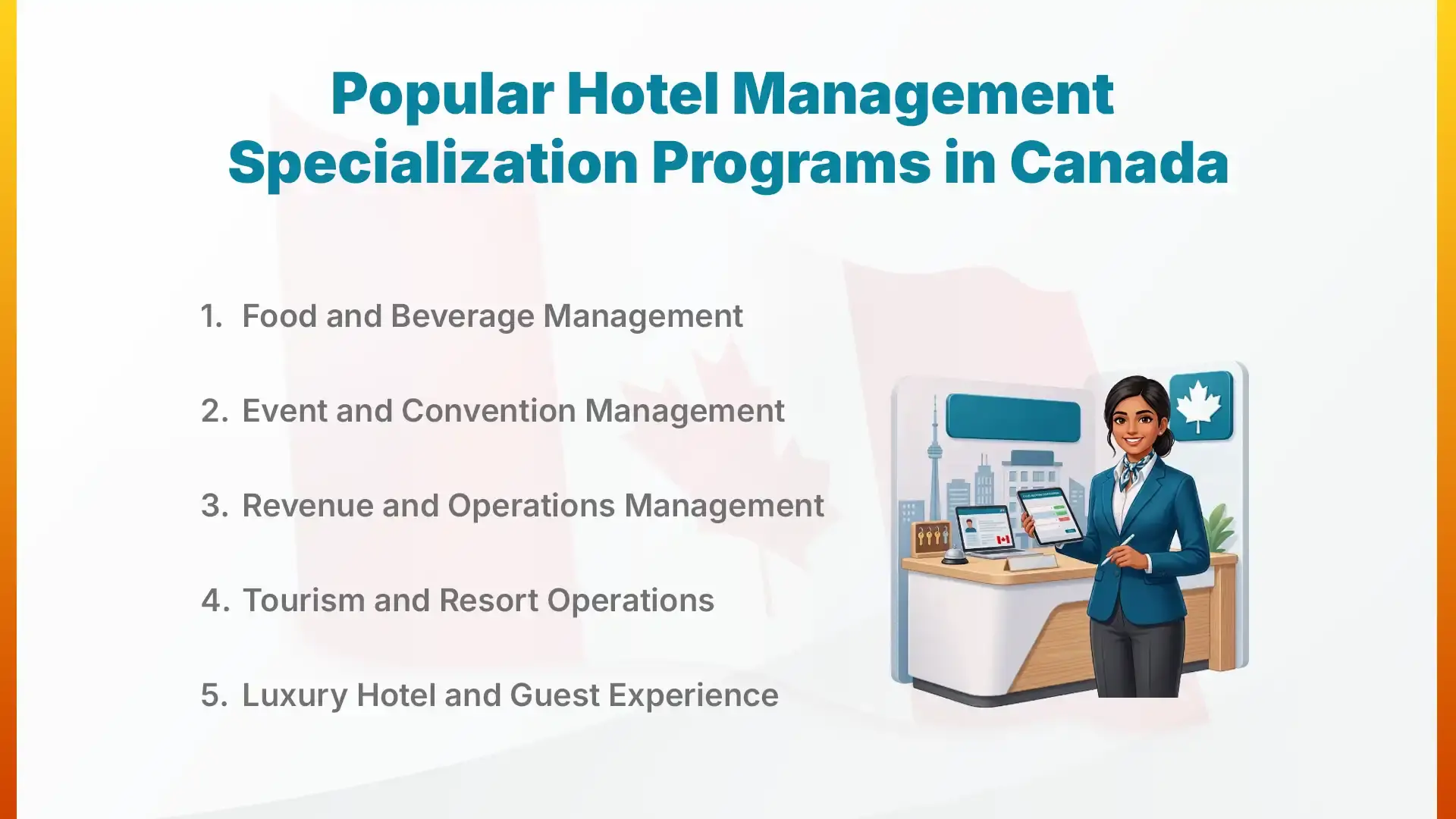
1. Food and Beverage Management
This specialization focuses on running the dining operations within hotels, resorts, and standalone restaurant businesses. You learn menu planning, kitchen operations, cost control, and the business of delivering profitable food and beverage service.
Canada's diverse food culture and strong restaurant industry make this a practical and widely applicable specialization.
2. Event and Convention Management
Canada hosts a large number of international conferences, corporate events, and cultural gatherings each year. This specialization teaches you how to plan, manage, and execute events of all sizes, from small corporate meetings to large-scale conventions.
Graduates from this track can work across hotels, convention centers, event management companies, and tourism boards.
3. Revenue and Operations Management
This is the analytical side of hotel management. You learn how hotels use data, pricing strategies, and demand forecasting to maximize revenue and manage operational efficiency. It is increasingly in demand as hotel chains adopt more sophisticated revenue management technology.
This specialization can lead to well-paying roles in revenue management, hotel operations, and corporate strategy within large hotel groups. Students drawn to the business strategy side of hospitality may find it worth exploring MBA courses in Canada for Nepali students as a future progression after their hotel management degree.
4. Tourism and Resort Operations
This broader specialization covers destination marketing, tour operations, resort management, and sustainable tourism practices. It prepares you to work across both the hotel and travel sectors, with roles available at tourism boards, travel companies, airlines, and resort properties.
5. Luxury Hotel and Guest Experience
This specialization focuses on the standards, service culture, and operational excellence expected at premium and five-star properties. It covers brand management, VIP guest service, and the operational practices of high-end hotel brands.
Eligibility Requirements for Nepali +2 Graduates
Yes, Nepali +2 graduates are generally eligible to apply for certificate and diploma-level hotel management programs in Canada. Bachelor's programs may require a minimum GPA or percentage, which varies by institution. Always check the specific entry requirements of your chosen college directly.
1. Academic Score Requirements by Program Level
Before you start shortlisting colleges, make sure your academic profile meets the requirements to study in Canada. The good news is that for certificate, diploma, and bachelor's programs, your NEB +2 certificate is enough to get you started; no extra qualifications are needed. Here is a clear breakdown of what each level requires:
Program Level | Minimum Academic Requirement |
|---|---|
| Certificate | Completion of +2 (NEB or equivalent) |
| Diploma / Advanced Diploma | Completion of +2 (NEB or equivalent) with satisfactory grades |
| Bachelor's Degree | Completion of +2 with good academic standing |
| Master's Degree | A recognized Bachelor's degree |
Note: Specific grade or percentage requirements vary between institutions and programs. The table above is a general guide only. Confirm exact requirements with your chosen college.
2. IELTS and English Proficiency: What's Needed
Since hotel management programs in Canada are taught in English, you will need to demonstrate English language proficiency. The most commonly accepted tests are:
IELTS Academic Most colleges require an overall band of 6.0 to 6.5, with no individual band falling below a specified minimum. Exact requirements vary.
TOEFL iBT is accepted by many institutions as an alternative to IELTS.
PTE Academic is accepted by some colleges.
Some colleges also accept English proficiency demonstrated through previous English-medium education. Always confirm the specific requirement of your chosen institution directly.
3. Documents for Processing
Start gathering these documents as early as possible, as some take time to obtain and notarize:
Academic transcripts and certificates (Grade 10, 11, and 12 / +2)
Valid passport (ensure it has sufficient validity beyond your intended study period)
English language proficiency test results (IELTS, TOEFL, or PTE)
Statement of Purpose (SOP)
Letters of Recommendation (LOR) where required
Updated CV or resume
Financial sponsorship or proof of funds documents
Completed college application form
If you have trouble writing a Statement of Purpose (SOP) for Canada, you can check the link for the sample reference.
Best Cities to Study Hotel Management in Canada
The best cities to study in Canada typically include Toronto, Vancouver, Calgary, and Ottawa. The best cities to study hotel management in Canada typically include Toronto, Vancouver, Calgary, and Ottawa. Each city offers a different hospitality environment. cost of living and range of institutions to choose from. Below is a detailed breakdown of each city.
1. Toronto, Canada's Hospitality Capital
Toronto is Canada's largest city and its hospitality hub. It is home to some of the country's top hotel management colleges, including George Brown College, Centennial College, and Humber College. The city's size means internship and employment opportunities are abundant, with major international hotel brands, restaurants, and event venues all operating there.
The cost of living in Toronto is higher than in smaller Canadian cities, so factor this into your budget planning.
2.Vancouver Tourism and Nature Combined
Vancouver is one of Canada's most visited cities and a major tourism destination. Its hospitality industry is driven by international tourism, business travel, and a thriving food scene. BCIT and Vancouver Community College both offer hospitality programs in this city.
Vancouver's cost of living is also high, but its natural beauty, diverse culture, and strong tourism industry make it a compelling study destination.
3. Calgary, Ottawa, and Other Emerging Options
Cities like Calgary and Ottawa have growing hospitality sectors and may offer a lower cost of living compared to Toronto and Vancouver. Some students find that studying in a mid-sized city gives them more manageable living costs while still accessing quality programs and industry opportunities.
Research colleges in multiple cities before deciding, and compare both program quality and total cost of living.
Cost to Study Hotel Management in Canada:
Studying hotel management in Canada involves two main categories of cost: tuition fees and living expenses. The figures below are general estimates to help you plan. Always confirm the exact tuition fee directly with your chosen institution, and use current exchange rates when converting to NPR, as rates fluctuate.
Tuition Fees by Program Level
Important: These are general ranges based on publicly available information from Canadian institutions. Actual fees vary significantly between colleges, programs, and academic years. Always check the official fee schedule of your chosen institution. Exchange rate fluctuations will also affect the NPR equivalent.
Program Level | Estimated Annual Tuition (CAD) |
|---|---|
| Certificate | CAD 12,000 – CAD 18,000 |
| Diploma / Advanced Diploma | CAD 13,000 – CAD 20,000 |
| Bachelor's Degree | CAD 18,000 – CAD 30,000 |
| Master's Degree | CAD 20,000 – CAD 35,000 |
Monthly Living Costs City by City
Your living costs will vary depending on which city you study in, your accommodation choice, and your personal lifestyle. The table below gives a general monthly estimate. Students can search for part-time jobs in Canada to reduce their burden while managing their finances.
Expense Category | Estimated Monthly Cost (CAD) |
|---|---|
| Accommodation (shared/dormitory) | CAD 600 – CAD 1,200 |
| Food and Groceries | CAD 300 – CAD 500 |
| Transportation (transit pass) | CAD 100 – CAD 150 |
| Utilities and Internet | CAD 50 – CAD 100 |
| Personal and Miscellaneous | CAD 100 – CAD 200 |
| Total Estimated Monthly | CAD 1,150 – CAD 2,150 |
Cities like Toronto and Vancouver tend to be on the higher end of this range. Smaller cities may allow you to live more comfortably on a tighter budget.
Hidden Costs Most Students Overlook
Beyond tuition and monthly living expenses, budget for the following:
Health insurance: Some provinces cover international students under provincial health plans after a waiting period; others require you to purchase private health insurance. Confirm with your college what is required.
Application fees: Colleges charge application fees that are typically non-refundable.
Airfare: Return flights between Nepal and Canada vary significantly by season and booking time.
Initial setup costs: Bedding, kitchen supplies, winter clothing, and a phone plan add up quickly when you first arrive.
Language test fees: IELTS and TOEFL exams carry their own registration costs.
Scholarships for Nepali Students Studying Hotel Management in Canada
Scholarships for international students in Canada exist, but competition is often significant, and most do not cover the full cost of study. It is important to approach scholarships as a supplement to your financial planning, not as your primary funding source.
That said, several options are worth exploring seriously.
1. Canadian Government Funding Options
The Government of Canada does not offer a single flagship scholarship program equivalent to the Korean KGSP. However, some bilateral agreements and Canadian government-funded programs do exist for international students.
The most relevant starting point is the Canada's International Scholarship Programs page on the official Government of Canada website, which lists programs open to students from various countries. Eligibility and availability change annually, so check directly on the official site for the most current information.
2. College-Specific Bursaries and Merit Awards
Many Canadian colleges offer their own entrance scholarships, bursaries, and merit awards for international students. These are typically partial fee reductions based on academic performance or financial need.
Check the official international admissions page of every college you apply to. Some institutions award automatic scholarships to students who meet a certain academic threshold, while others require a separate application.
3. How to Write a Scholarship Application That Works
Strong scholarship applications are specific, honest, and well-structured. Focus on:
Your academic record and any achievements worth highlighting
A clear explanation of your career goals and how this program supports them
Why you have chosen Canada and your specific institution
Evidence of financial need if the scholarship is need-based
Avoid generic statements. Scholarship reviewers read many applications; a specific, genuine narrative stands out.
How to Apply for Hotel Management in Canada in 2026
Applying to study hotel management in Canada involves five key stages: researching and shortlisting your college, preparing your documents, submitting your application, receiving your offer letter, and applying for your study permit. Here is a detailed breakdown of each step.
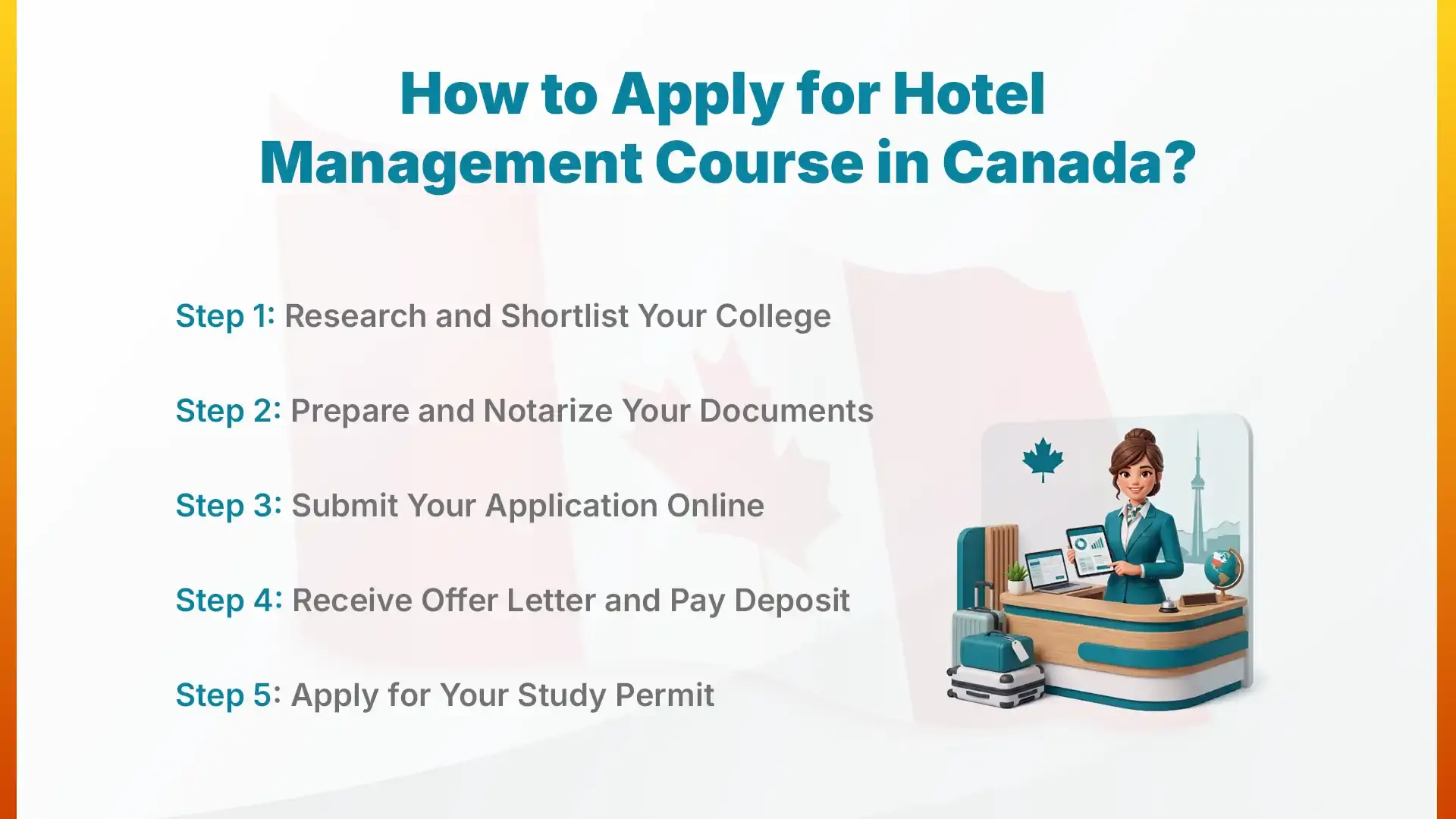
Step 1: Research and Shortlist Your College
Begin by identifying colleges that offer your preferred program level, are within your budget, hold DLI status, and align with your career goals. Consider the city, program structure, co-op availability, internship connections, and scholarship options.
Do not rush this step. The college you choose shapes your entire Canadian experience. Build a shortlist of three to five institutions and compare them carefully before applying.
Step 2: Prepare and Notarize Your Documents
Gather all required academic documents, including your SLC or SEE certificate, your +2 transcripts and certificate, your passport, English language test results, statement of purpose, and letters of recommendation where required.
Documents in Nepali will generally need to be officially translated into English and may need to be notarized. Start this process early it takes more time than most students expect, and a missing document can delay your entire application.
Step 3: Submit Your Application Online
Applications are submitted directly through each college's official online admissions portal. Apply to more than one institution to increase your chances of receiving a favorable offer.
Most colleges respond within two to four weeks, though timelines vary. Some offers may be conditional, meaning you need to meet certain requirements such as final exam results or an improved language score before full acceptance is granted.
Step 4: Receive Your Offer Letter and Pay Deposit
If your application is successful, you will receive a Letter of Acceptance (LOA) from the college. Read all terms and conditions carefully. To confirm your place, most colleges require you to pay a deposit, which is typically applied toward your tuition.
Keep the original LOA safe; you will need it for your study permit application.
Step 5: Apply for Your Study Permit
Once you have your LOA, you can apply for a Canadian study permit through Immigration, Refugees and Citizenship Canada (IRCC). The study permit is your authorization to study in Canada as an international student.
Scope of Hotel Management in Canada for Nepali Graduates
A hotel management degree from Canada carries weight both within Canada and internationally. Graduates enter a sector that spans hotels, resorts, tourism companies, event management firms, airlines, and more. The scope is broad, and with Canadian work experience added to your profile, your career options expand significantly.
1. Internship Opportunities During Your Studies
Many Canadian hotel management programs, particularly those with co-op components, include structured placements in real hotel environments. These give you hands-on professional experience before you graduate, putting you ahead of fresh graduates who only have classroom learning.
By the time you finish your degree, you may already have a Canadian employer reference, which is one of the most valuable things you can have when entering the job market.
2. Jobs You Can Get After Graduation
A hotel management graduate from a Canadian institution is prepared for a range of roles, including:
Front Office Officer or Supervisor
Food and Beverage Supervisor
Guest Relations Executive
Event Coordinator
Revenue Analyst
Housekeeping Manager
Tourism Officer
Hotel Operations Trainee (international chains)
Entry-level roles typically lead to supervisory and management positions as you gain experience.
3. Bringing Your Canadian Degree Back to Nepal
If you choose to return to Nepal after your studies, a Canadian hotel management degree gives you a meaningful competitive advantage in the local market. Nepal's tourism and hospitality sector is growing, with international hotel brands expanding their presence and new resort properties opening across the country.
Local employers increasingly look for candidates trained to global standards who understand international service culture and operational management. A Canadian degree positions you as exactly that kind of candidate.
4. Post-Study Work and Long-Term Stay Options
The Post-Graduation Work Permit (PGWP) allows eligible graduates to remain in Canada and work after completing their degree. This period of Canadian work experience can also strengthen your profile for future immigration applications.
As noted earlier, PGWP eligibility and immigration pathways are subject to Canadian government policy, which can and does change. Always check the current rules on the official IRCC website (canada.ca) or consult a licensed immigration consultant before making plans based on post-study work opportunities.
Student Visa Process to Study Hotel Management in Canada
To study in Canada as an international student, you need a study permit issued by Immigration, Refugees and Citizenship Canada (IRCC). Here is a simplified overview of the process.
1. Study Permit vs. Student Visa: What's the Difference
These two terms are often confused.
A study permit is the official document that authorizes you to study at a DLI in Canada. It is issued by IRCC.
A student visa (also called a Temporary Resident Visa or TRV) is the document that allows you to enter Canada. Many students need both the study permit and the TRV though some nationalities may be exempt from the TRV requirement.
Nepali passport holders generally need a temporary resident visa to enter Canada. Your study permit application typically includes the TRV application. Confirm the current requirements on the official IRCC website.
Documents Checklist for Visa Application
The following documents are typically required for a Canadian study permit application:
Valid passport (with sufficient validity)
Letter of Acceptance (LOA) from your DLI-approved college
Proof of sufficient funds to cover tuition and living expenses
Photographs meeting Canadian immigration specifications
Completed application forms (submitted online via the IRCC portal)
Biometrics (required for most applicants; you will receive instructions after applying)
Medical examination results (if required by IRCC)
Note: Document requirements can change. Always refer to the official IRCC website for the current study permit application checklist.
Common Visa Rejection Reasons to Avoid
Study permit applications from Nepali students are sometimes refused. Common reasons include:
Insufficient proof of funds: You must demonstrate you can support yourself financially throughout your studies.
Weak ties to Nepal: Officers assess whether they believe you will return home after your studies. Strong ties include family, property, and future employment plans.
Incomplete or inconsistent documents: Ensure all documents are accurate, complete, and consistent with each other.
Unclear study plan: Your Statement of Purpose should clearly explain why you chose Canada, why this specific program, and how it fits your career goals.
Where Nepali Students Apply in Kathmandu:
Study permit applications are generally submitted online through the IRCC portal. Biometrics, however, are collected in person at a Visa Application Center (VAC). There is a VAC operating in Kathmandu. Confirm current operating details and appointment procedures directly with the VAC before visiting.
Mistakes to Avoid When Planning Hotel Management in Canada
Planning to study abroad takes careful research and honest decision-making. The mistakes below are among the most common ones Nepali students make when pursuing hotel management in Canada, and they are all avoidable.
1. Trusting Unregistered Consultants in Nepal
Some education consultants in Nepal operate without proper registration or authorization and provide inaccurate or misleading information. Before working with any consultant, verify that they are registered with the relevant Nepali regulatory body and have a genuine, verifiable track record.
When in doubt, contact your chosen college directly through its official website, or visit the Canadian Embassy in Nepal for guidance. For general guidance on studying abroad from Nepal, the SAS Education Consultancy blog regularly publishes updated information on universities, visa processes, and career pathways across multiple countries
2. Applying to Non-DLI Colleges
This is one of the most serious mistakes a student can make. If your chosen college does not hold DLI status, your study permit application will be refused. There are no exceptions.
Before paying any application fee or signing any agreement, verify DLI status on the official Government of Canada website.
3. Skipping English Test Preparation
IELTS and TOEFL require deliberate preparation. Many Nepali students underestimate the time and effort needed to achieve the required scores, particularly in writing and listening. Start your preparation at least three to four months before your intended test date, and consider a structured preparation course if needed.
4. Missing Scholarship and Intake Deadlines
Canadian colleges typically have two main intake seasons: September (fall) and January (winter). Some programs may also have a May (Spring/Summer) intake. Scholarship application windows, college admission deadlines, and study permit processing times all have fixed schedules.
Create a personal calendar with every key date, work backwards from your target intake, and build in time for document preparation, language tests, and visa processing.
5. Ignoring Total Cost of Living
Many students focus on tuition fees and underestimate the full cost of living in Canada, particularly in cities like Toronto and Vancouver. Before committing to a study destination, calculate your total annual budget, including tuition, accommodation, food, transport, health insurance, and personal expenses.
Being financially underprepared can cause serious stress after you arrive and can even affect your immigration status if your funds run out.
Conclusion
Studying hotel management in Canada is a genuine and well-structured opportunity for Nepali +2 graduates who want a globally respected education, international work experience, and a degree that opens doors both in Canada and back home in Nepal.
The journey requires thorough research, careful financial planning, and honest preparation. It is not a shortcut, but for students who approach it seriously, Canada offers a learning environment and a career platform that very few countries can match: a multicultural society, a world-class college system, a growing hospitality industry, and a post-study work pathway that many Nepali graduates have already used to build strong international careers. For that, it is important to choose the best consultancy for Canada in Nepal.
Your path in hospitality does not have to stay a plan on paper. Start by researching your programs, preparing your English language test, and reaching out to verified education advisors who can guide you through the process accurately and honestly. If you are ready to take the next step, contact SAS Education Consultancy for expert guidance on your Canada application, from college selection to visa support.
Canada's hospitality industry is growing. The question is whether you are ready to be part of it.