Data Analytics Course in Australia: Top Universities, Cost & Scope

Jul 02, 2026
Australia is rapidly becoming one of the Asia-Pacific's most competitive destinations for data analytics education, with world-ranked universities, a government-backed digital transformation agenda, and a corporate sector hungry for graduates who can turn raw data into strategic business decisions at scale.
For Nepalese students who want a data analytics degree with strong technical depth, real industry exposure, and a clear PR pathway through priority technology occupations, Australia offers an outstanding combination of academic quality and career outcomes. Nepalese students who are still exploring their destination options can start by reading about studying in Australia before committing to a specific program.
In this blog
What Is a Data Analytics Course in Australia?
Data analytics is a specialized branch of information technology and data science that focuses on analyzing raw data to uncover trends, patterns, and insights that drive business decision-making, powering everything from marketing optimization and financial forecasting to supply chain efficiency and customer behavior modeling. A data analytics course in Australia prepares students to collect, process, and visualize these complex datasets across a wide range of real-world applications.
In Australia, data analytics is offered under several degree titles depending on the institution:
Bachelor of Data Science / Analytics: 3-year undergraduate degree
Graduate Certificate in Data Analytics: 6-month to 1-year postgraduate foundation degree
Master of Data Analytics: 1.5 to 2-year postgraduate degree (often suitable for non-IT backgrounds)
Master of Data Science: 2-year postgraduate degree with a heavier mathematical and machine learning focus
After completing the degree, graduates are prepared for roles in technology firms, financial services, healthcare, government, and consulting agencies across Australia and internationally.
Why Study Data Analytics in Australia?
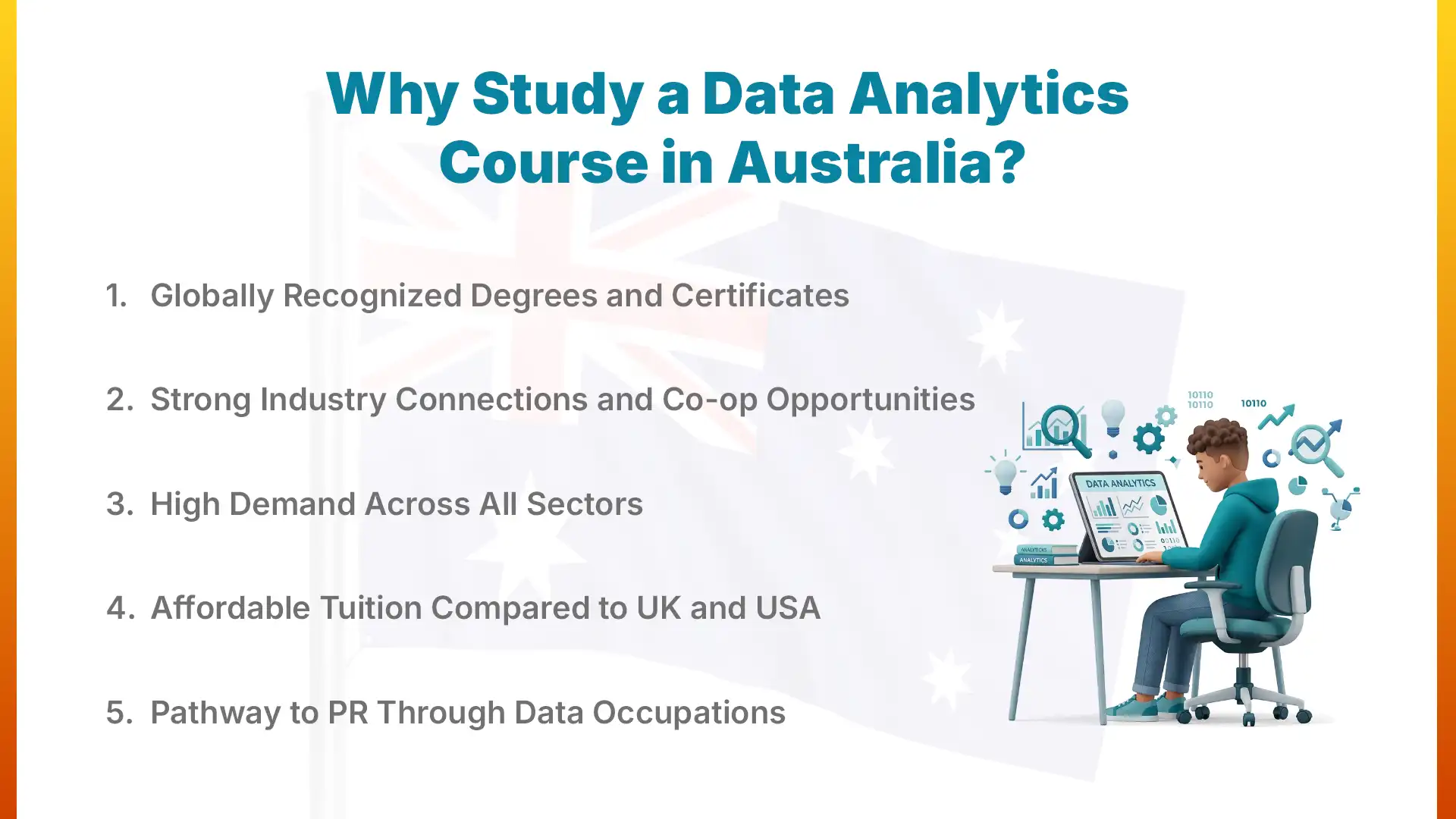
Australia is one of the best destinations to study data analytics because of its globally recognized degrees, strong research culture and industry connections, high and growing demand for data professionals, affordable tuition compared to the UK and USA, and a clear PR pathway through technology occupations. This is a significant part of why Nepalese students choose Australia for data and technology programs.
1. Globally Recognized Degrees
Australian data analytics and data science degrees are recognized by employers worldwide, with several programs accredited by the Australian Computer Society (ACS), the national professional body for the ICT sector whose accreditation is recognized internationally.
2. Strong Industry Connections and Co-op Opportunities
Australia has a highly developed business analytics ecosystem, with major corporate hubs in Sydney, Melbourne, and Brisbane. Many data analytics programs include industry capstone projects or Work Integrated Learning (WIL) placements with leading companies, giving students direct exposure to enterprise-level data work before they graduate.
3. High Demand Across All Sectors
Data analytics skills are in demand across Australia's banking, healthcare, retail, logistics, and government sectors. The Australian government's continued investment in digital transformation and artificial intelligence is driving consistent and growing hiring for data professionals across the country.
4. Affordable Tuition Compared to UK and USA
Data analytics tuition fees in Australia are significantly lower than equivalent programs at leading technology universities in the UK and USA, and Australia's stronger post-study work visa makes the total value proposition even more compelling for Nepalese students.
5. Pathway to PR Through Data Occupations
ICT professionals, including data analysts, business intelligence analysts, and data scientists, are listed as priority skilled occupations on Australia's skilled migration lists. After completing a data analytics degree and gaining Australian work experience through the Subclass 485 visa, Nepalese graduates are well-positioned for permanent residency.
Which Are the Top Universities for Data Analytics in Australia?
The top universities for data analytics in Australia include the University of Melbourne, Monash University, UNSW Sydney, the University of Technology Sydney (UTS), and RMIT University, all offering strong data programs with active industry connections. Nepalese students who want a broader comparison can explore the best universities in Australia for a wider range of institutions if you are still comparing your options beyond data analytics.
University | Location | Program | Known For |
|---|---|---|---|
| University of Melbourne | Melbourne, VIC | Master of Data Science | Australia's Top-Ranked Overall University; Deep Statistical and ML Focus |
| Monash University | Melbourne, VIC | Master of Data Science | Strong Industry Partnerships; Applied Analytics and Big Data Focus |
| UNSW Sydney | Sydney, NSW | Bachelor of Data Science | Highly Quantitative; Proximity to Sydney's Finance and Tech Sector |
| University of Technology Sydney (UTS) | Sydney, NSW | Master of Data Analytics | Practical, Career-Focused; High Employer Satisfaction and Industry Links |
| RMIT University | Melbourne, VIC | Grad Cert in Data Analytics | Fast-Tracked, Practical Entry into the Data Industry; Flexible Entry Criteria |
The University of Melbourne and UNSW are the strongest research-oriented options. UTS and RMIT are the best choices for students prioritizing fast, practical industry placement and employment outcomes.
What Are the Admission Requirements?
The admission requirements for a data analytics course in Australia include strong academic results in mathematics or computing, English language proficiency, a personal statement, and financial documentation for the Subclass 500 Student Visa.
1. Academic Requirements
For undergraduate programs, Nepalese students need Plus Two with strong mathematics results, typically 60% to 75% overall. For postgraduate programs (like the Master of Data Analytics), a completed bachelor's degree in any discipline is often accepted (though an IT, math, or business background is preferred), with a minimum GPA equivalent to second-class lower (55% to 60%). Group of Eight universities expect second-class upper or above (65%).
2. English Language Requirements
Most Australian universities require a minimum IELTS score of 6.0 to 6.5 for undergraduate and 6.5 to 7.0 for postgraduate data analytics programs. Knowing that Australia need at least IELTS for postgraduate study is crucial, so you should always check the exact scores needed for your specific course.
Test | Undergraduate | Postgraduate |
|---|---|---|
| IELTS Academic | 6.0 – 6.5 Overall | 6.5 – 7.0 Overall |
| TOEFL iBT | 79 – 90 | 90 – 100 |
| PTE Academic | 50 – 58 | 58 – 65 |
3. Personal Statement
Your statement should explain your motivation for studying data analytics, any mathematical, business, or programming experience, projects you have been involved in, and your career goals. The SOP for Australia guide covers the structure that works best for Australian university applications, giving students a clear framework to write a successful application.
4. Financial Proof and Visa Documentation
For the Subclass 500 Student Visa, students must demonstrate sufficient funds. Gathering all the requirements to study in Australia from Nepal gives you a much higher chance of visa approval.
How to Apply for a Data Analytics Course in Australia?
Applying for a data analytics course in Australia involves five steps, from shortlisting universities to securing your student visa. Checking intakes in Australia early is essential to avoid missing the February or July application windows.
Step 1: Shortlist Universities
Compare programs based on ACS accreditation, curriculum focus (e.g., business analytics vs. big data engineering), tuition fees, and scholarship availability. Shortlist three to five universities matching your academic background and career goals.
Step 2: Prepare Documents
Gather your Plus Two or degree transcripts, IELTS or PTE scores, a valid passport, and financial documents well before deadlines. If you have completed any online data courses or certifications (such as SQL, Python, or Tableau), include them as supporting evidence of technical interest.
Step 3: Write Your SOP
Your statement should connect your background to specific data analytics interests, whether in marketing analytics, financial modeling, or big data architecture, and explain why the specific program you are applying to is the right fit for those goals.
Step 4: Submit Application
Apply directly through each university's international student portal. Most Australian universities do not use a centralized application system. Apply early as popular data programs at Group of Eight universities fill quickly.
Step 5: Receive CoE and Apply for Visa
Once accepted and your enrollment deposit is paid, use your Confirmation of Enrollment (CoE) to apply for the subclass 500 student visa through the Department of Home Affairs portal. Ensure your CoE details match your passport exactly to avoid processing delays.
How Much Does It Cost to Study Data Analytics in Australia?
Tuition and living costs vary significantly depending on which city and university you choose, with students budgeting approximately AUD 48,000 to AUD 75,000 per year in total. Sydney and Melbourne sit at the higher end, while regional areas and smaller cities are considerably more affordable. Budgeting is easier when you know what to expect, which is why it is so important to research the cost of study in Australia from Nepal before making your final decision.
Program | Annual Tuition (AUD) | Annual Tuition (NPR approx.) |
|---|---|---|
| Graduate Certificate in Data Analytics | AUD 25,000 – AUD 32,000 | NPR 2,250,000 – NPR 2,880,000 |
| Bachelor of Data Science / Analytics | AUD 35,000 – AUD 45,000 | NPR 3,150,000 – NPR 4,050,000 |
| Master of Data Analytics / Science | AUD 38,000 – AUD 50,000 | NPR 3,420,000 – NPR 4,500,000 |
Monthly living expenses range from AUD 1,200 to AUD 2,500 depending on the city, with Sydney and Melbourne at the higher end and Adelaide, Brisbane, and Perth being more affordable. Many Nepalese students take up part-time jobs in Australia during their studies to offset living costs.
Taking tuition and living expenses together, Nepalese students should budget approximately AUD 48,000 to AUD 75,000 per year in total.
What Scholarships Are Available?
Several scholarships are available for Nepalese students pursuing a data analytics course in Australia, from government-funded awards to university merit scholarships and technology-specific programs. The scholarships in Australia for Nepalese students guide covers all available funding options in detail.
Australia Awards Scholarship: Fully funded government scholarship covering tuition, living allowance, and travel; available for postgraduate data science and analytics programs.
Destination Australia Scholarship: Up to AUD 15,000 per year for students who choose regional Australian universities with strong data and IT programs.
University Merit Scholarships: Most Australian universities offer AUD 5,000 to AUD 20,000 per year for high-achieving incoming data science and analytics students, assessed at the time of admission.
ACS Foundation Scholarships: The Australian Computer Society Foundation offers dedicated awards for ICT students, including those specializing in data analytics and database management.
What Jobs Can You Get After Data Analytics in Australia?
Graduates with a data analytics degree from Australia can work as data analysts, business intelligence analysts, data engineers, marketing analysts, and financial analysts across technology, finance, healthcare, and government sectors in Australia and internationally.

1. Data Analyst
Interprets complex datasets to help organizations make strategic business decisions; this is the core professional outcome of a data analytics degree and one of Australia's most consistently in-demand entry-level roles.
2. Business Intelligence (BI) Analyst
Designs and maintains BI dashboards, reports, and data visualization tools using software like Tableau or Power BI to help management track business performance and KPIs.
3. Data Engineer
Builds, tests, and maintains the data infrastructure and pipelines that collect, clean, and organize raw data for analysis by data scientists and analysts; it's a highly technical and well-compensated role.
4. Marketing Analyst
Leverages data to measure the effectiveness of marketing campaigns, track consumer behavior, and optimize digital advertising spend for corporations and agencies.
5. Financial Analyst
Uses data analytics to assess financial performance, forecast market trends, and guide investment strategies within banks, insurance firms, and corporate finance departments.
What Is the Salary and Scope After Data Analytics in Australia?
Entry-level data analytics graduates in Australia earn between AUD 65,000 and AUD 85,000 per year, rising to AUD 90,000 to AUD 125,000 at mid-level, and AUD 130,000 or more for senior data scientists and analytics managers. Data analytics is one of the best courses in Australia for Nepalese students who want a high-earning technology career with a clear PR pathway.
Experience Level | Annual Salary (AUD) | Annual Salary (NPR approx.) |
|---|---|---|
| Entry-Level (0–2 Years) | AUD 65,000 – AUD 85,000 | NPR 5,850,000 – NPR 7,650,000 |
| Mid-Level (2–5 Years) | AUD 90,000 – AUD 125,000 | NPR 8,100,000 – NPR 11,250,000 |
| Senior Data Professional (5+ Years) | AUD 130,000 – AUD 160,000+ | NPR 11,700,000 – NPR 14,400,000+ |
After completing their degree, international graduates can apply for the Subclass 485 Temporary Graduate Visa, which allows 2 to 4 years of full-time work in Australia with any employer without requiring employer sponsorship. Data analytics graduates qualify for STEM-extended subclass 485 periods, giving Nepalese graduates maximum time to build Australian work experience before applying for PR.
ICT professionals, including data analysts and data scientists, are priority skilled occupations on Australia's skilled migration lists, qualifying graduates for the Skilled Independent Visa (189) and state nominations (190). Most Nepalese data graduates with an Australian degree and 1 to 2 years of work experience accumulate sufficient SkillSelect points for a PR invitation within 2 to 3 years of graduating.
Conclusion
Australia offers Nepalese students world-class data analytics education, strong industry exposure, one of the highest-paying technology job markets in the Asia-Pacific, and a fast PR pathway through priority data and technology occupations. For students serious about a career in the data-driven world, an Australian data analytics degree is both a globally respected credential and a strategic long-term investment.
Interested in studying a data analytics course in Australia? Contact SAS Education Consultancy for a free counseling session and let us help you find the right program, prepare a strong application, and navigate the Subclass 500 visa process with confidence.