Bachelor of Public Health in Australia: Tuition, Eligibility & Career

Feb 17, 2026
After COVID-19, many students in Nepal showed interest in healthcare careers. If you are here, you may be one of them.
If you’re dreaming of making a real difference in communities, shaping health policies, and improving lives, a Bachelor of Public Health in Australia could be your ideal course! It is a field that shapes how communities live, stay safe, and respond to crises.
However, choosing the right university, understanding eligibility, managing costs, and planning your visa can feel confusing at first. So, this complete guide will walk you through everything from course structure and entry requirements to costs, scholarships, and career scope after studying BPH in Australia.
In this blog
What is the Bachelor of Public Health in Australia?
A Bachelor of Public Health is a three-year undergraduate degree in Australia that prepares you to prevent disease, improve community health, and influence health policies at a population level. Instead of working in hospitals treating individual patients, this course trains you to solve health problems that affect entire communities, cities, or even countries.
For example, public health professionals design awareness campaigns, study disease patterns, and help governments plan health policies. You build skills that allow you to create impact at a larger scale, not just one patient at a time.
1. Difference Between Public Health vs Health Science vs Nursing
Public Health focuses on communities and prevention, while Nursing focuses on direct patient care in hospitals and clinics. Health Science is broader and often leads to clinical or laboratory-based careers, whereas Public Health is more research, policy, and community-oriented. If you enjoy research, planning, analysis, and community work more than bedside care, public health may suit you better. Or else, you can also explore nursing courses in Australia before making your final decision.
2. Duration of the Program in Australia (Usually 3 Years)
In Australia, a Bachelor of Public Health typically takes three years of full-time study. Some universities also offer flexible study modes or double degrees, which may slightly extend the duration. During these three years, you gradually move from foundational subjects to applied and practical learning. This structured timeline allows you to enter the workforce faster compared to longer clinical degrees.
Need Help to Apply for Your Australian Student Visa?
Get expert guidance on courses, universities, scholarships, and applications. Start your Australian education journey with out crertified counsellors today!
Why Study a Bachelor of Public Health in Australia?
Choosing a Bachelor of Public Health in Australia means placing yourself in one of the strongest healthcare education systems in the world. You are not just earning a degree; you are learning inside a country known for quality care, strong research, and fair access to health services. When you understand what makes Australia different, you begin to see how powerful this degree can be for your long-term career.
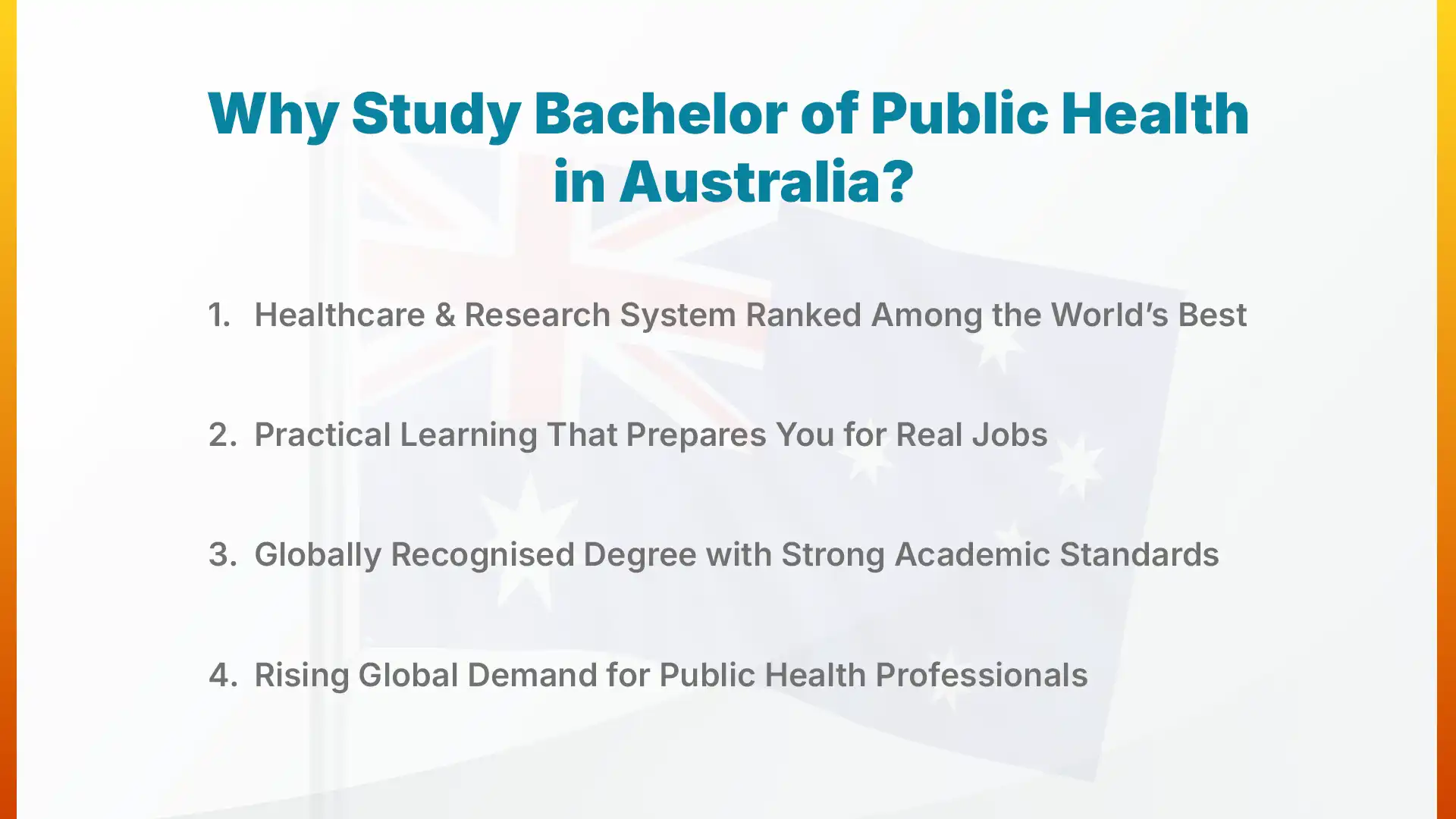
1. Healthcare & Research System Ranked Among the World’s Best
Australia’s healthcare system was ranked the top performer among ten high-income countries in the 2024 Mirror, Mirror report by the Commonwealth Fund. It scored especially high in health outcomes and equity, meaning services are both effective and accessible to people from different backgrounds. As a student here, you study within a system that other nations look at as a benchmark. This exposure helps you understand how strong public health systems are built and managed in real life.
2. Practical Learning That Prepares You for Real Jobs
Australian universities focus heavily on Work Integrated Learning. Many public health programs include more than 200 hours of professional placement in government bodies, hospitals, research centers, or NGOs. During this time, you may assist with health campaigns, community projects, or disease monitoring programs. The clear benefit of studying in Australia is that you graduate with practical experience, industry exposure, and stronger employability compared to students who only study theory.
3. Globally Recognised Degree with Strong Academic Standards
All Australian degrees follow the Australian Qualifications Framework (AQF), which ensures strict academic quality and national consistency. Many public health programs are also aligned with standards set by the Council of Academic Public Health Institutions Australia (CAPHIA). This means your qualification is respected not only in Australia but also in countries like the UK, USA, and across Europe. With this recognition, your degree becomes globally portable, opening doors to careers in international organisations such as the World Health Organization and UNICEF.
4. Rising Global Demand for Public Health Professionals
Healthcare and social assistance are projected to grow by more than 580,000 jobs in Australia by 2034, making it one of the fastest-expanding sectors. At the same time, global challenges like pandemics, climate change, and ageing populations are increasing the need for trained public health professionals. Governments and organisations now invest more in prevention, policy, and health planning than ever before. By entering this field now, you position yourself in a growing industry with long-term stability and strong career potential.
BPH Course Structure and Subjects in Australia
In a Bachelor of Public Health in Australia, you’ll study core areas such as disease patterns, health data, community programs, and global health issues, followed by workplace exposure and a final research project. The coursework combines both foundational theory and practical skills that prepare you for real-world health challenges. Below is a clear look at the key subjects you’ll encounter and how they contribute to your future career:
Subject | What You Learn (2026 BPH Curriculum) |
| Epidemiology | Study how diseases spread and affect populations, and learn to analyse outbreaks and design prevention strategies. |
| Biostatistics | Use statistics to interpret health data, turning raw information into actionable public health decisions. |
| Health Promotion | Learn strategies to improve community health and behaviour while designing awareness campaigns and education programs. |
| Global Health | Explore health issues and policies across countries, gaining a global perspective on health challenges and solutions. |
| Environmental Health | Understand how environmental factors affect health and develop skills to address pollution, sanitation, and related issues. |
| Health Policy | Learn to plan, evaluate, and manage health systems and policies, preparing for administrative or policy-focused roles. |
These subjects are designed to move you from foundational knowledge to practical skills, equipping you with both theory and real-world expertise.
2. Internship and Placement Components
Most Bachelor of Public Health programs include mandatory internships or placement blocks that you complete with health departments, NGOs, community health centres, or government agencies. These internships can range from 150 to 300 hours, depending on your university.
During these placements, you may:
- Assist with health campaigns and vaccination drives
- Analyse real community health data
- Support public outreach and education events
- Work on policy briefs or health planning tasks
Real learning happens outside the classroom, and Australian universities take this seriously! These internships give you professional experience before you graduate. As you complete your degree, you don’t just have theory on your CV, you have real work you’ve done. That makes you far more attractive to employers, whether in Australia, Nepal, or internationally.
3. Capstone Project or Research
The capstone project is your final step, where everything you’ve learned comes together. It’s a supervised research, analysis, or community project that usually takes place in the final semester. You could do things like:
- Conduct a small health survey in a community
- Analyse public health data to reveal trends
- Write a policy brief for a government department
- Evaluate the impact of a health program
What are the Eligibility Criteria for the Bachelor of Public Health in Australia?
To study a Bachelor of Public Health in Australia, Nepalese students must meet certain academic, English language, and document requirements. These standards ensure you are prepared for the rigour of undergraduate public health programs and can fully participate in both classroom and practical learning. Let’s break down these requirements step by step so you know exactly what you need to apply successfully.
1. Academic Qualification
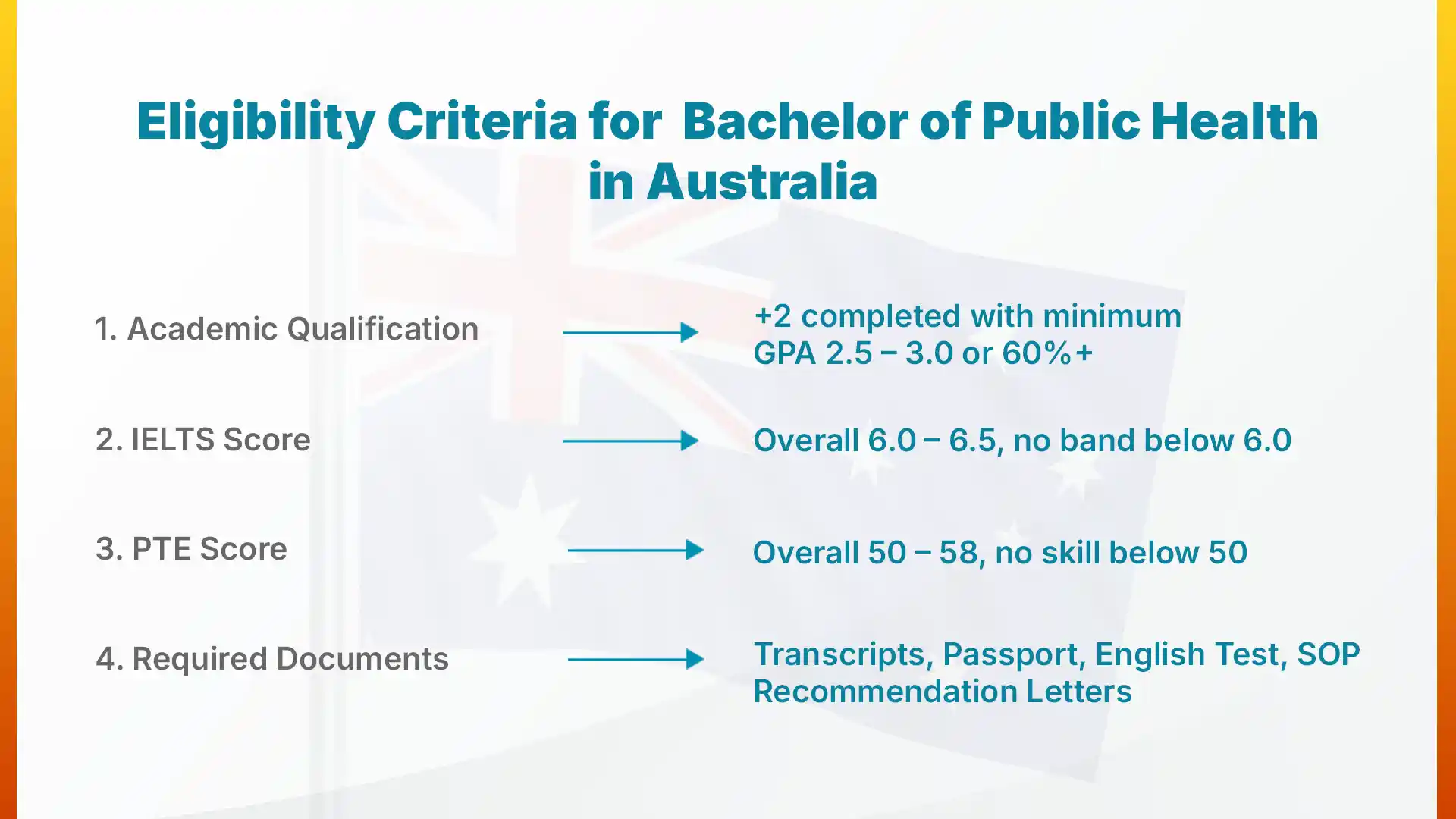
To study BPH in Australia, students must have completed +2 or equivalent education with a minimum GPA of 2.5–3.0 or 60% and above, depending on the university. While science streams like Biology or Chemistry are preferred, some universities also accept students from other academic backgrounds.
Meeting these academic requirements ensures you have the foundational knowledge to understand health sciences, statistics, and community health concepts.
2. IELTS Score
Most universities require an overall IELTS score of 6.0–6.5, with no band below 6.0. This ensures you can understand lectures, participate in discussions, and complete assignments effectively. Some universities may also accept slightly higher or lower scores, so it’s important to check each program individually.
Join Nepal's Top IELTS Preparation Classes Today!
3. PTE Score
Alternatively, students can submit a PTE Academic score, usually in the range of 50–58 overall, with no communicative skill below 50. PTE is widely accepted as an English proficiency alternative and is often preferred for faster results. Achieving the required PTE score proves you can read, write, and communicate effectively in academic and professional contexts.
4. Required Documents
To apply for a BPH in Australia, you must submit official transcripts from +2, a valid passport, and your English test scores (IELTS or PTE). Additionally, a Statement of Purpose (SOP for Australia) explaining your motivation for studying public health is usually required. Some universities may also ask for recommendation letters from teachers or mentors. Preparing these documents carefully ensures your application is complete, professional, and increases your chances of receiving an offer.
How Much Does it Cost to Study a Bachelor of Public Health in Australia?
Studying a Bachelor of Public Health in Australia typically costs around AUD 50,000–75,000 (approx. 50–75 lakhs) for the first year, including tuition, living expenses, health cover, and visa fees. These costs vary depending on the university, city, accommodation type, and personal lifestyle. Tuition fees form the largest portion, while accommodation, food, transport, and health insurance add to the overall budget. Understanding this breakdown helps you plan effectively and explore scholarships or part-time work options in Australia to manage expenses.
1. Tuition Fees for Studying BPH in Australia
In Australia, annual tuition fees for a Bachelor of Public Health generally range between AUD 28,000 and AUD 38,000 per year for international students. Fees vary by university, city, and course structure, with metropolitan universities often on the higher side and regional ones a bit lower. This fee covers your core academic subjects, access to university facilities, and learning resources.
2. Living Expenses for International Students
Living costs in Australia for Nepalese students can vary based on the city you choose, your accommodation type, and lifestyle. Here’s a simple breakdown of common expenses:
- Accommodation: Around AUD 900–1,500 per month for shared apartments or student housing.
- Food: Approx AUD 300–500 per month for groceries and meals.
- Transport: Around AUD 150–250 per month, more in big cities with higher travel costs.
- OSHC (Overseas Student Health Cover): Roughly AUD 600–900 per year, depending on provider and coverage.
- Visa Fee: The Australian student visa (Subclass 500) currently costs AUD 2000. The visa fee is subject to change with policy updates.
These figures are averages and can change depending on your spending habits and the city you live in. For example, living in Sydney or Melbourne tends to be more expensive than in regional cities.
3. Affordable Universities in Australia for BPH Studies
Here’s a table of 7 universities in Australia that offer a Public Health or related undergraduate program with relatively affordable tuition for international students. The tuition figures come directly from official course pages or reputable sources as per the most recent available data:
University | Approx. Annual Tuition Fee (AUD) |
| Central Queensland University | 35,800–40,000 |
| University of Wollongong | 32,800–37,600 |
| University of South Australia | 27,100 |
| Charles Darwin University | 35,584 |
| Queensland University of Technology | 39,000–40,500 |
| Flinders University | 32,000–35,900 |
| University of Tasmania | 30,000–35,000 |
Scholarships for Public Health Students in Australia
Studying in Australia can be expensive, but scholarships make it much more manageable for Nepalese students. There are different types of awards, including university-specific scholarships, government-funded scholarships, and options based on merit or financial need. Knowing what’s available and how to apply can save you a lot of money and help you focus on learning instead of worrying about costs. Here’s a clear breakdown of the main opportunities:
1. University-Specific Scholarships
Many Australian universities offer scholarships exclusively for international students, including those from Nepal. These awards often cover a portion of tuition fees and are usually linked to your academic performance, leadership skills, or other achievements. For instance, Charles Darwin University provides the Vice-Chancellor’s International High Achievers Scholarship, which can cover up to 50% of tuition, while other universities like the University of Wollongong and Central Queensland University offer similar merit-based reductions.
2. Government Scholarships
Government scholarships, especially the Australia Awards Scholarship (AAS), are highly valuable for Nepalese students. These fully-funded scholarships cover tuition, travel, living expenses, and health insurance, making them a comprehensive support option. They focus on students who demonstrate leadership potential and a commitment to contributing to development in their home country. For public health students, this is particularly beneficial, as it allows you to gain global exposure while preparing to impact health systems both locally and internationally.
3. Merit-Based vs Need-Based Scholarships
Scholarships can be awarded based on either merit or financial need. Merit-based scholarships reward students with strong academic records, high IELTS/PTE scores, and proven leadership or extra-curricular achievements. Need-based scholarships, on the other hand, focus on supporting students from financially disadvantaged backgrounds, though these are less common. Regardless of type, presenting a strong application with clear goals, evidence of achievements, and well-prepared documents greatly improves your chances of being selected.
Career Opportunities After a Bachelor of Public Health in Australia
A Bachelor of Public Health opens doors to a variety of meaningful careers where you can contribute to healthier communities and stronger health systems. Whether you see yourself working in government agencies, non‑profits, research organisations, or international bodies, this degree builds skills employers are looking for. Below, we explore common job roles, what you can expect to earn, and your options for staying in Australia after graduation.
1. Job Roles You Can Pursue
After completing your degree, you can work in roles such as Public Health Officer, where you help plan, implement, and evaluate health programs that prevent illness and improve community wellbeing. As a Health Promotion Officer, you support behaviour change through campaigns, workshops, and health education in schools or community centres. Community Health Workers connect frontline services with local populations, especially vulnerable or underserved groups.
In research settings, roles like Epidemiology Assistant and Research Assistant let you work with data, study disease trends, and support health studies. This serves you a very valuable experience, especially if you aim for advanced research or policy positions. These jobs give you real impact on public health outcomes and set a strong foundation for future growth.
2. What is the Salary of BPH in Nepal?
Salaries in public health vary based on role, experience, and location. Entry‑level positions like Health Promotion Officer or Community Health Worker typically start around AUD 55,000–65,000 per year, while more specialised roles like Public Health Officer or research‑focused positions can range from AUD 65,000–85,000+ annually.
With experience, moving into senior or managerial roles can increase your earnings to AUD 90,000 and above. These figures offer a practical view of what you can expect, helping you plan your long‑term career and financial future.
3. Can You Stay in Australia After Graduating with a BPH?
Yes, after completing a Bachelor of Public Health, you can apply for a Post‑Study Work Visa (subclass 485). This visa allows you to stay and work in Australia for 2–3 years, giving you time to gain professional experience and build your career. Many graduates use this period to strengthen their resumes, expand professional networks, and explore longer-term visa options through employer sponsorship. You can also continue your studies with a Master of Public Health (MPH) in Australia, which opens opportunities in specialised roles like epidemiology, health policy, or global health leadership.
Conclusion
A Bachelor of Public Health in Australia is an excellent choice for Nepalese students who want to build a meaningful career in health and community services. This degree opens doors to jobs in government agencies, NGOs, research institutes, and international organisations, both in Australia and globally. With strong demand for public health professionals, competitive salaries, and long-term career growth, it offers a solid return on investment.
The BPH program in Australia is ideal for students interested in science, policy, and community well-being, and those who enjoy working with data, research, or outreach programs. Preparing well academically, improving English skills, and gaining practical experience through internships can make your application stand out and set you up for success.
To make your dream of studying in Australia a reality, start by consulting a trusted study-abroad consultancy. They guide you through university selection, application processes, scholarships, and visa requirements, ensuring a smooth journey from Nepal to your public health career abroad.