Master’s of Public Health in Australia for International Students

Feb 02, 2026
Are you an international student planning to build a meaningful career in healthcare and wondering if Australia is the right destination? With its globally ranked universities, strong healthcare system, and growing demand for public health professionals, Australia has become a top choice for students pursuing a Master’s of Public Health.
In this blog, we will explore everything you need to know about Master's of Public Health in Australia for international students. You’ll learn about course details, top universities, eligibility requirements, specializations, costs, scholarships, career opportunities, and the application process. This guide will help you decide whether studying public health in Australia aligns with your academic goals and long-term career plans.
In this blog
What Is a Master’s of Public Health (MPH)?
A Master’s of Public Health (MPH) is a postgraduate degree focused on improving population health through prevention, policy, and research rather than individual clinical treatment. It prepares students to address public health challenges such as disease prevention, health promotion, and healthcare planning at the community, national, and global levels.
An MPH program covers key areas like public health systems, epidemiology, health policy, biostatistics, and community health. Students learn how to analyze health data, design public health interventions, and influence healthcare policies. Due to its global relevance, an MPH degree is highly valued by governments, NGOs, international organizations, and healthcare institutions worldwide.
Why Study a Master’s of Public Health in Australia?
Study a Master’s of Public Health in Australia because the country offers globally respected education, a strong healthcare system, and excellent career prospects for international students. Australian universities combine academic excellence with practical exposure, making MPH graduates job-ready. The programs are aligned with global public health standards and focus on real-world health challenges. Additionally, Australia’s multicultural environment and post-study work opportunities add long-term value to an MPH degree.
1. World-Ranked Universities for Public Health
Australian universities are consistently ranked among the world’s top institutions for public health and medical sciences. Many universities feature in QS and Times Higher Education rankings for health-related subjects. MPH programs are designed by leading public health researchers and practitioners. Students benefit from cutting-edge facilities, expert faculty, and globally recognized qualifications. This strong academic reputation enhances employability worldwide.
2. Strong Public Healthcare and Research Ecosystem
Australia has one of the world’s most advanced public healthcare systems, offering valuable learning exposure for MPH students. Universities collaborate closely with hospitals, research institutes, and government bodies. Students gain hands-on experience through research projects, case studies, and fieldwork. Evidence-based learning is a core focus of MPH programs. This environment helps students understand real-world public health practices.
3. High Demand for Public Health Professionals
There is a growing demand for public health professionals in Australia due to aging populations and emerging health challenges. Skills in epidemiology, health promotion, and policy development are highly sought after. MPH graduates find opportunities in government agencies, NGOs, healthcare organizations, and research institutions. The demand also extends globally, especially after recent global health crises. This makes the degree highly future-proof.
4. Global Recognition and International Career Mobility
Australian MPH degrees are recognized and respected across the world. Graduates can pursue careers in international organizations like the WHO, UNICEF, and global NGOs. The curriculum is aligned with international public health standards and practices. This global recognition allows graduates to work across different countries and healthcare systems. It significantly improves international career mobility and long-term growth.
Master’s of Public Health in Australia for International Students
A Master’s of Public Health in Australia for international students is designed to meet global health education standards while offering flexible entry pathways. Australian universities welcome students from diverse academic backgrounds with clear eligibility criteria. The programs focus on building strong analytical, research, and policy-making skills. International students also benefit from structured academic support and post-study opportunities. Overall, Australia provides a supportive and high-quality learning environment for MPH aspirants.
1. Eligibility Criteria for International Students
International students must meet both academic and general admission requirements to study a Master’s of Public Health in Australia. Applicants typically need a recognized bachelor’s degree from an accredited institution. Some universities may require prior study in health-related fields. Universities also assess academic performance and overall suitability for public health studies. Additional requirements may apply depending on the institution and specialization.
2. Academic Background Requirements
Most Australian universities accept students with backgrounds in health sciences, life sciences, nursing, medicine, or related disciplines. Applicants from social sciences or allied fields may also be considered. Some universities offer bridging units for students without prior public health exposure. Relevant academic knowledge helps students understand core MPH subjects more effectively. Work experience in health-related fields can further strengthen applications.
3. English Language Requirements (IELTS, PTE, TOEFL)
International students must demonstrate English language proficiency to enroll in an MPH program. Universities commonly accept IELTS, PTE, or TOEFL scores. The minimum IELTS score usually ranges between 6.5 and 7.0 overall. Score requirements may vary depending on the university and intake. Students who do not meet the criteria may choose English pathway programs.
4. Australian Student Visa (Subclass 500) Overview
International students must apply for the Australian Student Visa (Subclass 500) to study an MPH. Applicants need a Confirmation of Enrolment (CoE) from an Australian university. Proof of financial capacity, health insurance (OSHC), and English proficiency are required. The visa allows students to work part-time during their studies. It also provides access to post-study work opportunities after graduation.
Popular Specializations in Master’s of Public Health in Australia
A Master’s of Public Health in Australia offers a wide range of specializations to match diverse career goals and public health interests. These specializations allow students to focus on specific health challenges and professional pathways. Australian universities design these streams based on global health needs and industry demand. Choosing the right specialization helps students build targeted expertise. It also improves employability in both the Australian and international health sectors.
1. Epidemiology and Biostatistics
Epidemiology and biostatistics focus on studying disease patterns and health trends within populations. This specialization trains students to analyze health data and interpret research findings. It is essential for roles in disease surveillance and outbreak control. Students gain strong statistical and analytical skills. Graduates often work in research institutions, public health agencies, and international organizations. This specialization is ideal for students aiming for research-driven or data-focused public health careers.
2. Global Health and Development
Global health and development address health issues affecting low- and middle-income countries. This specialization focuses on health equity, international health systems, and development policies. Students learn to design and evaluate global health programs. It prepares graduates for roles in NGOs and international agencies. The specialization emphasizes cross-cultural and policy-driven health solutions. It is well-suited for students interested in international fieldwork and humanitarian health initiatives.
3. Health Policy and Health Management
Health policy and health management focus on improving healthcare systems and services. Students study health economics, policy development, and healthcare leadership. This stream is ideal for those interested in administrative and policy roles. It prepares graduates to influence healthcare decision-making. Career options include health administration and policy advisory roles. This specialization is highly relevant for leadership positions within healthcare organizations.
4. Environmental and Occupational Health
Environmental and occupational health examine the impact of environmental factors on human health. Students learn about workplace safety, environmental risks, and regulatory standards. This specialisation is important for preventing occupational diseases. It also focuses on sustainable health practices. Graduates work in regulatory bodies and environmental health organizations. The demand for professionals in this field is increasing due to climate and workplace safety concerns.
5. Public Health Nutrition and Health Promotion
Public health nutrition and health promotion focus on improving population health through diet and lifestyle interventions. Students study nutrition science and community health strategies. This specialization emphasizes preventive healthcare approaches. It prepares graduates for roles in public health campaigns and community programs. Graduates often work with government agencies and health organizations. This field plays a key role in reducing lifestyle-related and non-communicable diseases.
Top Universities Offering Master’s of Public Health in Australia
Australia is home to several globally ranked universities offering high-quality Master’s of Public Health programs. These universities are known for strong research output, experienced faculty, and industry-linked curricula. Studying at any of the top Australian universities enhances academic learning and global career prospects. MPH programs in Australia focus on practical skills, policy development, and research excellence. International students benefit from world-class facilities and strong graduate employability.
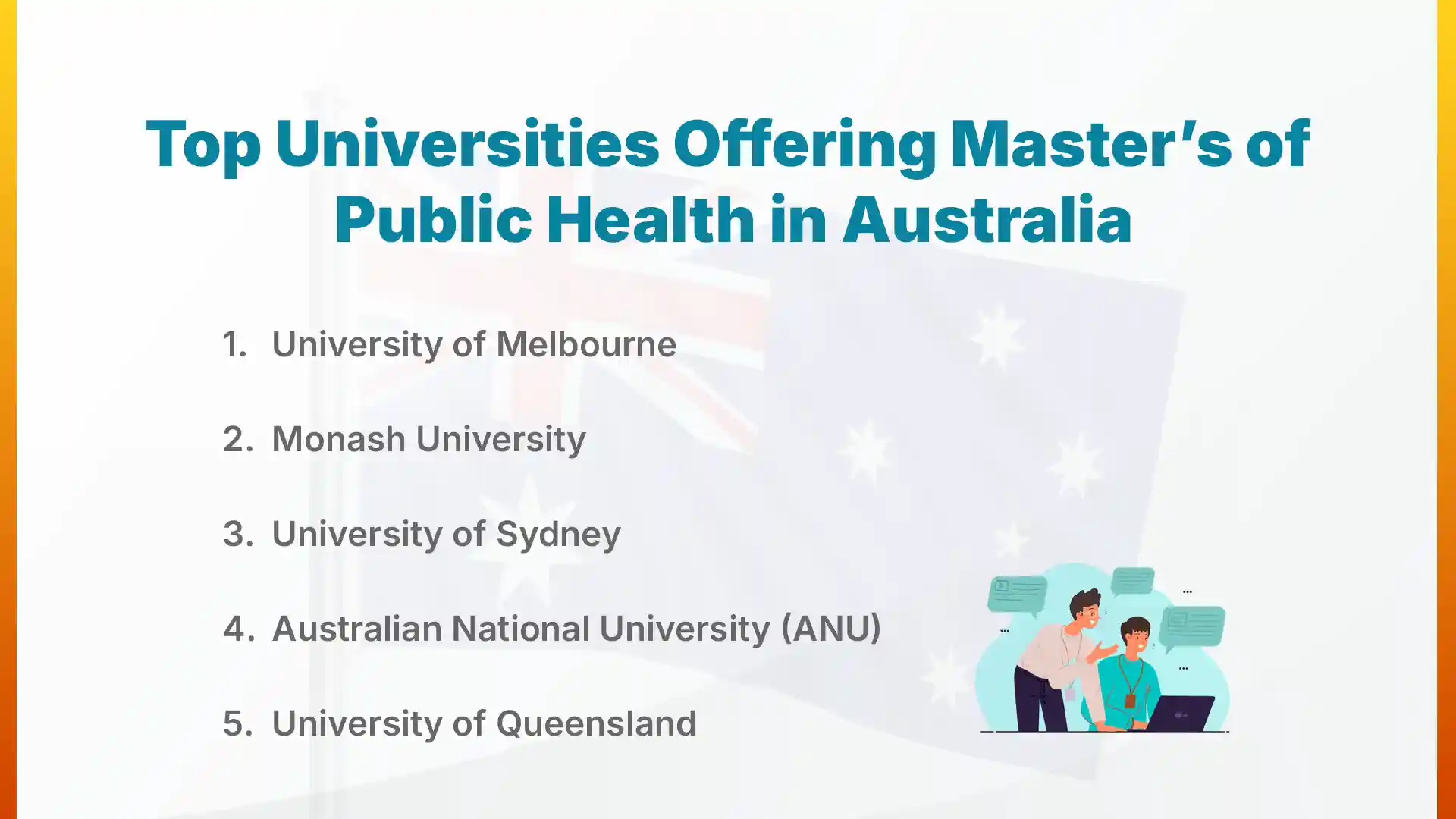
1. University of Melbourne
The University of Melbourne offers one of the most prestigious MPH programs in Australia. The program emphasizes epidemiology, biostatistics, and public health leadership. Students benefit from strong research opportunities and industry collaborations. The university has a global reputation in health and medical sciences. Graduates are highly sought after by public health organizations worldwide. The MPH program also offers flexible study options and elective specializations.
2. Monash University
Monash University is known for its comprehensive and flexible MPH program. The curriculum focuses on global health, health policy, and population health. Students gain hands-on experience through research projects and industry engagement. Monash has strong links with healthcare providers and research institutes. The university offers excellent support for international students. Its strong global rankings add significant value to the MPH qualification.
3. University of Sydney
The University of Sydney offers a research-driven Master’s of Public Health program. The course covers health promotion, policy analysis, and public health research methods. Students learn from leading public health academics and practitioners. The university’s location provides access to healthcare institutions and policy organizations. Graduates enjoy strong career outcomes in Australia and abroad. The program is ideal for students interested in policy and research-focused careers.
4. Australian National University (ANU)
ANU is highly regarded for public policy and population health education. Its MPH program emphasizes health policy, epidemiology, and global health issues. Students benefit from proximity to government agencies and research bodies. The program is research-focused and policy-oriented. ANU graduates often work in national and international health organizations. This makes ANU a strong choice for students aiming for policy-level public health roles.
5. University of Queensland
The University of Queensland offers a well-structured MPH program with strong research components. The program focuses on public health practice, biostatistics, and global health. Students gain exposure to real-world public health challenges. UQ is known for its strong research rankings and academic excellence. Graduates have strong employment prospects across the health sector. The university also provides excellent facilities and industry partnerships.
Course Structure and Duration of Master’s of Public Health in Australia
The course structure of a Master’s of Public Health in Australia is designed to balance theoretical knowledge with practical learning. Universities offer flexible study formats to suit international students. The program focuses on building core public health competencies and specialized expertise. Students gain exposure to research, policy, and real-world health challenges. The overall structure prepares graduates for diverse public health careers globally.
1. Course Duration (1.5-2 Years Full-Time)
The Master’s of Public Health in Australia typically takes 1.5 to 2 years to complete on a full-time basis. The duration depends on the student’s academic background and university requirements. Some universities offer accelerated options for students with prior health-related qualifications. Part-time study options may also be available. This flexibility helps international students plan their studies effectively. It also allows students to balance studies with part-time work opportunities.
2. Core Subjects, Electives, and Specializations
MPH programs include core subjects such as epidemiology, biostatistics, and health policy. Students can choose electives based on their interests and career goals. Specializations allow a deeper focus in areas like global health or health management. This structure ensures both foundational and advanced learning. It also allows students to customize their academic pathway. Choosing the right electives can significantly impact future career outcomes.
3. Research Projects, Practicum, and Fieldwork
Research projects and practicum components are key parts of MPH programs in Australia. Students apply theoretical knowledge to real public health problems. Fieldwork provides hands-on experience in community or organizational settings. Many universities partner with health agencies for placements. This practical exposure enhances employability after graduation. It also helps students build professional networks within the public health sector.
How to Apply for a Master’s of Public Health in Australia?
To apply for a Master’s of Public Health in Australia, you must follow a structured process that ensures you meet academic, language, and visa requirements. This includes shortlisting universities, selecting the right specialization, preparing documents like SOP and CV, submitting applications, and obtaining an Australian student visa. Following these steps carefully increases your chances of acceptance. Planning and understanding each requirement is essential for a smooth application process.
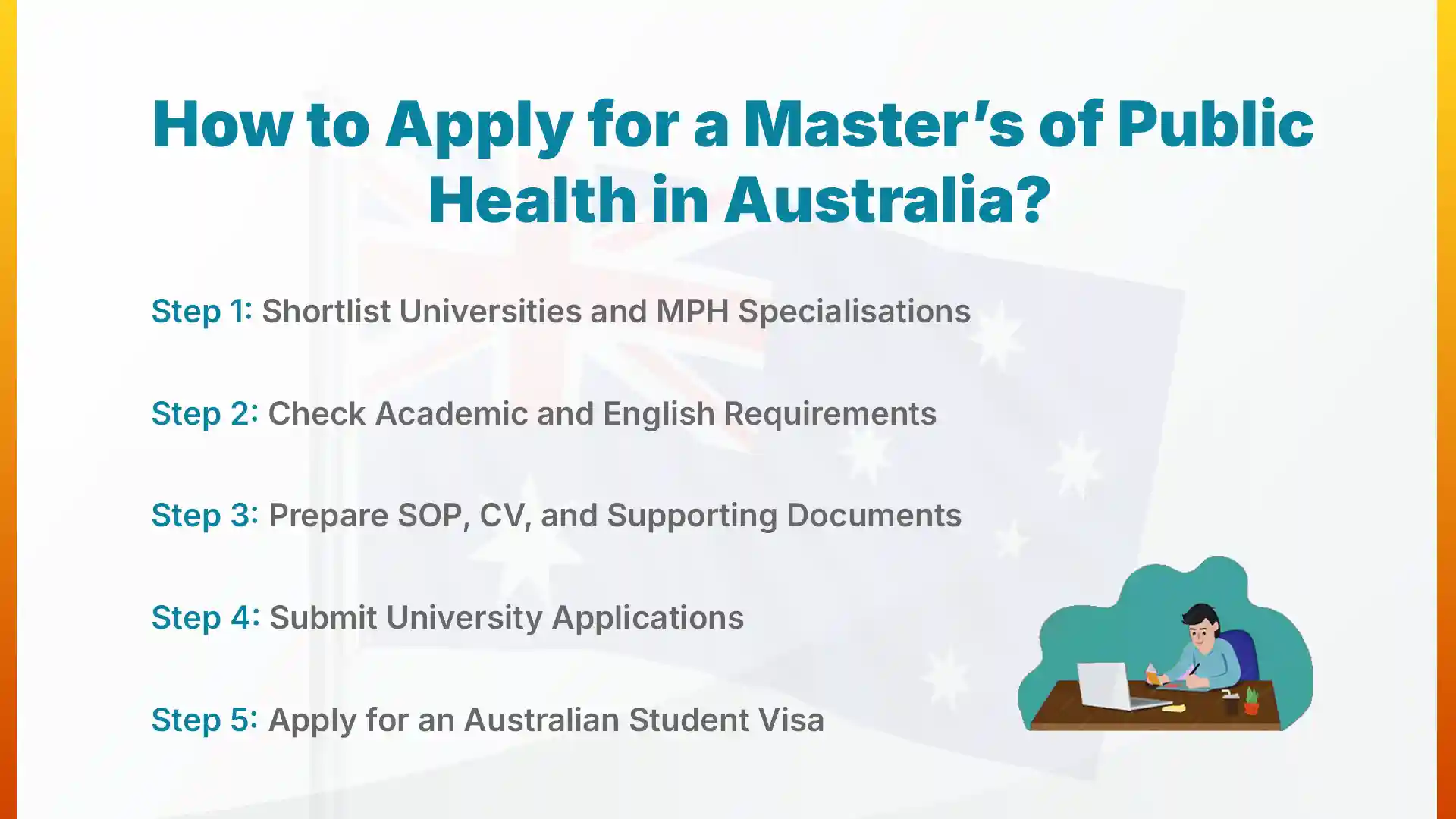
Step 1: Shortlist Universities and MPH Specializations
Begin by researching Australian universities offering MPH programs and their rankings, specializations, and course structure. Consider factors like curriculum, faculty, location, and career support. Choose a specialization that aligns with your academic background and career goals. This step ensures you focus on programs that suit your long-term aspirations. Shortlisting also helps in managing application deadlines efficiently.
Step 2: Check Academic and English Requirements
Ensure that you meet the academic requirements, such as a recognized bachelor’s degree in health, life sciences, or related fields. Check English language requirements like IELTS, PTE, or TOEFL scores. Different universities may have slightly different thresholds. Meeting these requirements is crucial for eligibility. It is advisable to verify these details on the official university websites before applying.
Step 3: Prepare SOP, CV, and Supporting Documents
Prepare a compelling Statement of Purpose (SOP) highlighting your motivation, career goals, and interest in public health. Update your CV to include academic achievements, relevant experience, and skills. Collect other supporting documents such as academic transcripts, recommendation letters, and certificates. Ensuring that all documents are accurate and well-presented strengthens your application. This step reflects your preparedness and commitment to the program. In fact, a well-written sop for Australia is often the deciding factor in both university admission and visa approval.
Step 4: Submit University Applications
Submit your applications online through the university’s official portal before the deadline. Carefully fill out all forms and attach the required documents. Some universities may require application fees or additional forms. Keep track of confirmation emails and application status. Submitting a complete and timely application increases the chances of being shortlisted for admission.
Step 5: Apply for an Australian Student Visa
After receiving an offer, apply for the Australian Student Visa (Subclass 500). You will need a Confirmation of Enrolment (CoE), proof of financial capacity, health insurance, and English proficiency. The visa allows you to study and work part-time during your course. Applying promptly ensures you meet deadlines and can start your MPH program on time. Preparing documents in advance simplifies the visa process.
Admission Requirements for Master’s of Public Health in Australia
To gain admission into a Master’s of Public Health in Australia, international students must meet specific academic, language, and documentation requirements. Universities assess applicants based on their prior education, English proficiency, and overall suitability for the program. Meeting these requirements ensures eligibility and improves the chances of acceptance. Some programs also consider relevant work or volunteer experience to strengthen applications. Understanding the full set of requirements helps students prepare a strong and complete application.
1. Recognized Bachelor’s Degree (Health-Related Preferred)
Applicants must hold a bachelor’s degree from a recognized university. Degrees in health sciences, life sciences, nursing, medicine, or related fields are preferred. Some universities may accept students from other disciplines if they complete prerequisite units. Academic performance and GPA are usually considered for eligibility. Holding a relevant bachelor’s degree ensures you have the foundational knowledge needed for MPH coursework. A strong academic record improves chances of admission and eligibility for scholarships.
2. English Language Test Scores
International students must demonstrate proficiency in English through tests like IELTS, PTE, or TOEFL. Most universities require an IELTS overall score of 6.5–7.0, with minimum scores in each component. PTE and TOEFL scores accepted vary by institution. Meeting these language requirements ensures students can successfully engage with coursework and participate in discussions. It is essential to check individual university thresholds before applying. Some universities also offer English pathway programs for students who need to improve their proficiency.
3. Statement of Purpose (SOP)
A Statement of Purpose is a critical part of the application. It should clearly explain your motivation for pursuing an MPH, your career goals, and why you chose a specific university. The SOP highlights your passion, achievements, and suitability for the program. A well-written SOP helps distinguish your application from others. It should be concise, honest, and tailored to each university. A strong SOP can significantly increase your chances of receiving an admission offer.
4. Letters of Recommendation (LORs)
Most universities require 2–3 recommendation letters from academic or professional referees. LORs validate your academic abilities, work ethic, and suitability for a public health program. Strong recommendations enhance your application's credibility. Referees should be familiar with your skills, experience, and achievements. Submitting detailed and genuine LORs increases the chances of being shortlisted. Choosing referees who can provide specific examples of your achievements strengthens your application.
5. Relevant Work or Volunteer Experience (Optional)
Although optional, relevant work or volunteer experience adds value to your application. Experience in healthcare, NGOs, or community projects demonstrates practical knowledge and commitment to public health. It helps in understanding real-world public health challenges. Some universities may give preference to candidates with hands-on experience. Highlighting this experience strengthens your profile and improves employability after graduation. It also reflects your dedication and readiness to contribute to public health initiatives.
Cost of Studying a Master’s of Public Health in Australia
Studying a Master’s of Public Health (MPH) in Australia typically costs around AUD 30,000-55,000 per year for tuition, excluding living expenses. International students need to budget for tuition, accommodation, insurance, and travel. The program usually lasts 1.5-2 years, and costs vary depending on the university and city. While top-tier universities may charge higher fees, the overall investment offers strong global career prospects. Understanding the breakdown of costs helps students plan effectively and avoid financial surprises.
1. Tuition Fees for MPH Programs
Annual tuition fees for an MPH in Australia generally range from AUD 30,000 to AUD 55,000+, depending on the university and specialization. For a 1.5-2 year program, total tuition can reach AUD 45,000 to over AUD 100,000. Top universities like the University of Melbourne, University of Sydney, and Monash University usually have higher fees due to their global rankings and research facilities. Some programs also offer scholarships or early application discounts, which can reduce the cost. It’s important to check each university’s official website for accurate and updated tuition fees.
2. Living Expenses for International Students
International students should budget between AUD 20,000 and AUD 30,000+ per year for living expenses, including accommodation, food, transport, and utilities. Shared accommodation costs around AUD 8,500-13,000, while private rentals can be higher. Groceries typically cost AUD 3,600-8,000 annually, and transport/utilities add approximately AUD 2,400-4,200 per year. Cities like Sydney and Melbourne are more expensive, whereas Adelaide or Brisbane may be more affordable. Planning living expenses carefully ensures students can manage their budget throughout the course.
3. Estimated Total Cost of Study
The first-year total (tuition + living expenses) can range from AUD 50,000 to AUD 85,000, depending on the university and city. For the entire 1.5-2 year program, the total cost generally ranges between AUD 80,000 and over AUD 150,000. Additional costs include Overseas Student Health Cover (OSHC) of around AUD 500-800 per year, visa fees (AUD 2,000), and airfare. Budgeting for all these expenses in advance ensures a smooth study experience in Australia.
Scholarships for Master’s of Public Health in Australia
Studying a Master’s of Public Health in Australia can be a significant financial investment, but scholarships help international students manage costs. Scholarships are offered by the Australian government, individual universities, and private organizations. They may cover tuition fees, living expenses, or both. Some scholarships are merit-based, while others consider financial need. Understanding the types of scholarships and eligibility criteria can greatly improve your chances of receiving funding.
1. Australian Government Scholarships
The Australian government offers scholarships such as the Australia Awards for international students. These scholarships typically cover tuition fees, living expenses, health insurance, and travel costs. They are highly competitive and focus on applicants from eligible countries with strong academic backgrounds. Recipients are expected to return to their home countries after completing their studies. Government scholarships provide a comprehensive funding package for deserving students.
2. University-Specific MPH Scholarships
Many Australian universities provide scholarships specifically for MPH students. These may include full or partial tuition waivers, research grants, or merit-based awards. Eligibility often depends on academic excellence, professional experience, or leadership potential. Universities like the University of Melbourne, Monash, and ANU offer multiple options each year. Applying directly through the university portal increases the chances of securing these scholarships.
3. Merit-Based and Need-Based Scholarships
Merit-based scholarships reward students with strong academic records, leadership qualities, or research potential. Need-based scholarships consider the financial circumstances of the student. Some programs combine both approaches to select candidates who are both deserving and capable. These scholarships help reduce tuition and living expenses. Carefully reviewing eligibility criteria ensures you apply for scholarships most suited to your profile.
4. Tips to Improve Scholarship Selection Chances
To increase your chances of receiving a scholarship, maintain a high academic GPA and highlight relevant achievements in your application. Prepare a strong SOP and gather compelling recommendation letters. Demonstrate leadership, research experience, or community involvement. Apply early and meet all deadlines. Tailoring your application to the scholarship’s specific requirements can significantly improve your success rate.
Career Opportunities After a Master’s of Public Health in Australia
A Master’s of Public Health in Australia opens a wide range of career opportunities for international students. Graduates can work in healthcare systems, government agencies, NGOs, research institutions, and international organizations. The program equips students with skills in policy, epidemiology, health promotion, and data analysis. Australia also provides post-study work options that help graduates gain practical experience. These opportunities allow MPH graduates to build global careers in public health.
1. Public Health Officer, Epidemiologist, Health Analyst
Graduates can work as public health officers, epidemiologists, or health analysts in hospitals, research institutions, and community health organizations. These roles involve monitoring health trends, analyzing data, and designing interventions. MPH graduates contribute to disease prevention and health promotion initiatives. They also participate in policy-making and research projects. These positions offer hands-on experience in managing population health and public health programs.
2. Careers in Government, NGOs, and International Agencies
MPH graduates are in demand in government departments, non-governmental organizations (NGOs), and international agencies like WHO and UNICEF. Roles may include program coordination, policy development, and global health project management. Graduates can address public health challenges locally and globally. These careers provide exposure to policy-making, research, and community health strategies. Working in such organizations enhances professional networks and career growth opportunities.
3. Research, PhD, and Academic Pathways
A Master’s of Public Health also prepares graduates for research and academic careers. Students can pursue PhDs, postdoctoral research, or teaching positions in universities. Research opportunities include epidemiology, biostatistics, health policy, and global health studies. Academic pathways allow graduates to contribute to public health knowledge and mentor future professionals. These roles are ideal for students interested in evidence-based health solutions and scholarly contributions.
4. Post-Study Work Visa and PR Pathways
International graduates can apply for a post-study work visa in Australia, allowing them to gain practical work experience. The visa helps MPH graduates integrate into the Australian workforce and enhances career prospects. Gaining professional experience may also support pathways to permanent residency (PR). Employers often prefer graduates familiar with the Australian healthcare system. This provides long-term opportunities for students planning to build a career in Australia.
Scope and Job Demand for Public Health Graduates in Australia
The scope for public health graduates in Australia is expanding rapidly due to increasing health challenges and government investment in healthcare. Skilled MPH professionals are needed to manage disease prevention, health promotion, and research initiatives. Graduates can expect diverse career opportunities in hospitals, NGOs, government agencies, and global organizations. Many international students and professionals also explore various part-time jobs in Australia to gain local experience while completing their specialized degrees. The demand is especially strong for candidates with specialized skills and international exposure.
1. Public Health Job Market Trends in Australia
The public health job market in Australia is growing steadily, driven by aging populations, chronic diseases, and recent global health challenges. Government and private sectors increasingly seek professionals skilled in epidemiology, health promotion, and data analysis. Opportunities are also expanding in health policy and community health programs. Graduates with practical experience and research expertise are highly preferred. The trend indicates strong long-term career stability and growth in this sector.
2. High-Demand Public Health Sectors
High-demand sectors for MPH graduates include hospitals, primary care, NGOs, research institutes, and government health departments. Global health organizations also require experts for disease prevention and policy development. Specialized fields like epidemiology, biostatistics, environmental health, and health management are particularly sought after. Public health professionals are needed to implement community programs and policy initiatives. This ensures a variety of career pathways for MPH graduates in Australia and internationally.
3. Average Salary and Career Growth
Public health graduates in Australia can expect competitive salaries depending on their role, experience, and location. Entry-level positions like public health officers or analysts typically earn AUD 60,000-80,000 per year, while senior roles can exceed AUD 120,000 annually. Career growth is strong due to government initiatives and increasing public health focus. Professionals with research or leadership experience often advance quickly. Continued specialization and professional development enhance both salary and career prospects.
Is a Master’s of Public Health in Australia Worth It for International Students?
Yes, a Master’s of Public Health in Australia is worth it for international students because it provides world-class education, global recognition, and strong career opportunities. The programs equip students with practical skills in policy, research, and health management. Graduates gain access to post-study work visas, international career mobility, and a growing public health job market. Studying in Australia also exposes students to advanced healthcare systems and high-quality research environments.
Benefits of pursuing an MPH in Australia:
- Access to globally ranked universities with advanced public health curricula.
- Exposure to real-world public health projects and research opportunities.
- Eligibility for post-study work visas and pathways to permanent residency.
- Networking opportunities with professionals, government agencies, and NGOs.
- Diverse specializations to match career goals, such as epidemiology, health policy, or global health.
- High demand for public health professionals both in Australia and internationally.
Which Is the Best Education Consultancy to Study Master’s in Australia?
SAS Education Consultancy is the best education consultancy to study a Master’s in Australia because it provides expert guidance, personalized support, and end-to-end services for international students. They assist with university selection, course specialization, SOP and CV preparation, and visa applications. SAS has a strong track record of successful admissions and scholarship placements. Their experienced counsellors ensure students make informed decisions and have a smooth application process. With SAS, students receive reliable guidance tailored to their academic goals and career aspirations.
Conclusion
Pursuing a Master’s of Public Health in Australia offers international students a unique opportunity to gain world-class education, hands-on experience, and global career exposure. The programs equip students with essential skills in epidemiology, health policy, research, and community health, preparing them for diverse roles in government, NGOs, hospitals, and international organizations. Studying in top Australian universities also provides access to advanced healthcare systems, practical training, and networking opportunities that enhance employability.
With competitive salaries, growing job demand, and post-study work visa options, an MPH in Australia is a worthwhile investment. Careful planning regarding university selection, specializations, scholarships, and visa requirements ensures a smooth study journey. Overall, this degree opens doors to meaningful careers in public health globally.