Study Bachelor of Data Science in Australia from Nepal

Jan 26, 2026

If you want to build a career in analyzing data, solving problems, and creating smart solutions, a Bachelor of Data Science in Australia is the perfect choice! The data science course is increasingly gaining popularity among Nepali students because it opens doors to high-demand jobs in technology, business, and AI.
In this guide, we will take you step by step through everything you need to know about pursuing a Bachelor’s in Data Science in Australia. From course details and university selection to eligibility, costs, scholarships in Australia, and career paths, you’ll get a complete roadmap. By the end, you’ll have a clear plan to make your dream of studying Data Science in Australia a reality.
In this blog
What is a Bachelor of Data Science?
A Bachelor of Data Science is an undergraduate degree that teaches students how to collect, analyze, and interpret large amounts of data to solve real-world problems. The course combines mathematics, statistics, programming, and data visualization to prepare students for careers in data-driven industries. By the end of the program, graduates can turn raw data into meaningful insights that help businesses, governments, and organizations make informed decisions.
1. Difference between Data Science, IT, Computer Science, and Analytics
While these fields are related, they have distinct focuses. Data Science emphasizes analyzing data to uncover trends and build predictive models. Information Technology (IT), on the other hand, focuses on managing computer systems, networks, and software infrastructure. Computer Science is more about programming, algorithms, and software development. Analytics is a subset of data science that specifically concentrates on interpreting data to support business decisions. Choosing the right field depends on whether you enjoy coding, data analysis, or system management.
2. Who Should Study Data Science in Australia?
The Bachelor’s of Data Science course is ideal for students who enjoy working with numbers, patterns, and technology. Strong analytical thinking, problem-solving skills, and curiosity about how data drives decisions are essential. Those who are comfortable with mathematics and programming, and who like turning data into actionable insights, will thrive. If you enjoy working on projects, experimenting with datasets, and visualizing information, Data Science could be the perfect fit for you.
Why Choose Australia for Data Science?
Australia is one of the best countries to study and work in Data Science because it offers world-class education, strong industry links, and excellent career opportunities. Its universities are recognized globally for high academic standards, and the programs are designed to prepare students for real-world data roles. In the following sections, we will explore what makes Australian universities and the learning environment ideal for Data Science students from Nepal.
1. Globally Recognised Australian Universities
Australian universities, such as Go8 universities, are ranked among the top in the world, and their degrees are respected by employers globally. Studying here ensures you receive quality education that is recognized whether you work in Australia or internationally. This reputation also opens doors to internships and job opportunities during and after your studies.
2. Industry-focused Curriculum and Practical Projects
Data Science courses in Australia emphasize hands-on learning, with projects and case studies based on real-world data problems. Students gain practical experience in programming, AI, and analytics, which makes them job-ready from day one. Universities often collaborate with companies, giving students exposure to industry-standard tools and methods.
3. Strong Job Market and High Demand for Data Professionals
Australia has a growing demand for data professionals across industries like finance, healthcare, and technology. Graduates in Data Science can find roles as data analysts, machine learning engineers, or AI specialists. This high demand ensures better employment chances and competitive salaries.
4. Post-study Work Visa Opportunities
International students in Australia can apply for post-study work visas, allowing them to gain valuable work experience after graduation. This gives Nepali students time to explore career paths and strengthen their professional profile. Many graduates eventually use this experience to apply for permanent residency in Australia.
5. Safe and Multicultural Environment for Nepali Students
Australia is known for being safe, inclusive, and welcoming to international students. Cities like Melbourne and Sydney have large Nepali communities, which help students settle in easily. This supportive environment ensures that you can focus on your studies while enjoying a comfortable and diverse lifestyle.
Bachelor of Data Science Course Structure and Subjects
The Bachelor of Data Science in Australia is carefully designed to give students both theoretical knowledge and practical skills. Courses cover a mix of programming, statistics, machine learning, and data management to prepare students for real-world challenges. In the following sections, we will look at the main subjects, specializations, internships, and course duration to give you a complete overview.
1. Core Data Science Subjects
Core subjects form the foundation of the course and teach essential skills for data-driven work. You will learn programming languages like Python and R, statistical methods, and techniques for analyzing large datasets. Courses also cover machine learning, artificial intelligence, and data visualization, which help you turn data into insights. These subjects are designed to make students confident in handling real-world data challenges.
2. Specializations and Majors
Many universities allow students to specialize in areas that match their career goals. Popular options include Big Data, Business Analytics, AI, and Data Engineering. Choosing a specialisation helps students develop deeper expertise in a specific area and stand out to employers. It also allows you to focus on the type of work you enjoy most in the data field.
3. Internship and project requirements
Internships and practical projects are a key part of the degree. Students often work with companies or on simulated industry projects to apply what they have learned in real scenarios. These experiences help build professional skills, improve employability, and make students job-ready before graduation.
4. Course duration (3–4 years full-time)
A Bachelor of Data Science usually takes 3 to 4 years of full-time study, depending on the university and specialization. Some programs also offer accelerated or extended options for students with different needs.
Top Universities in Australia for Data Science
The University of Melbourne, University of Sydney, UNSW, Monash University, University of Queensland, and ANU are some of the top universities in Australia where you can study a Bachelor’s in Data Science or related fields. These institutions are known for quality teaching, strong research, and excellent industry connections.
University Name | Location | 2026 Tuition Fee Range (AUD) |
| University of Melbourne | Melbourne, VIC | $42,000 – $60,000+ |
| University of Sydney | Sydney, NSW | $49,000 – $65,000+ |
| University of New South Wales (UNSW) | Sydney, NSW | $48,000 – $63,000+ |
| Monash University | Melbourne, VIC | $44,000 – $56,000+ |
| University of Queensland | Brisbane, QLD | $43,000 – $59,000+ |
| Australian National University (ANU) | Canberra, ACT | $46,000 – $57,000+ |
What are the Eligibility Requirements for a BS in Data Science in Australia?
To study a Bachelor’s of Data Science in Australia, students must meet specific academic, language, and document requirements. These requirements ensure you are prepared for the course and can succeed in an English-speaking, technical learning environment. Below, we break down each key requirement for Nepali students planning to study in Australia.
1. Academic Requirements
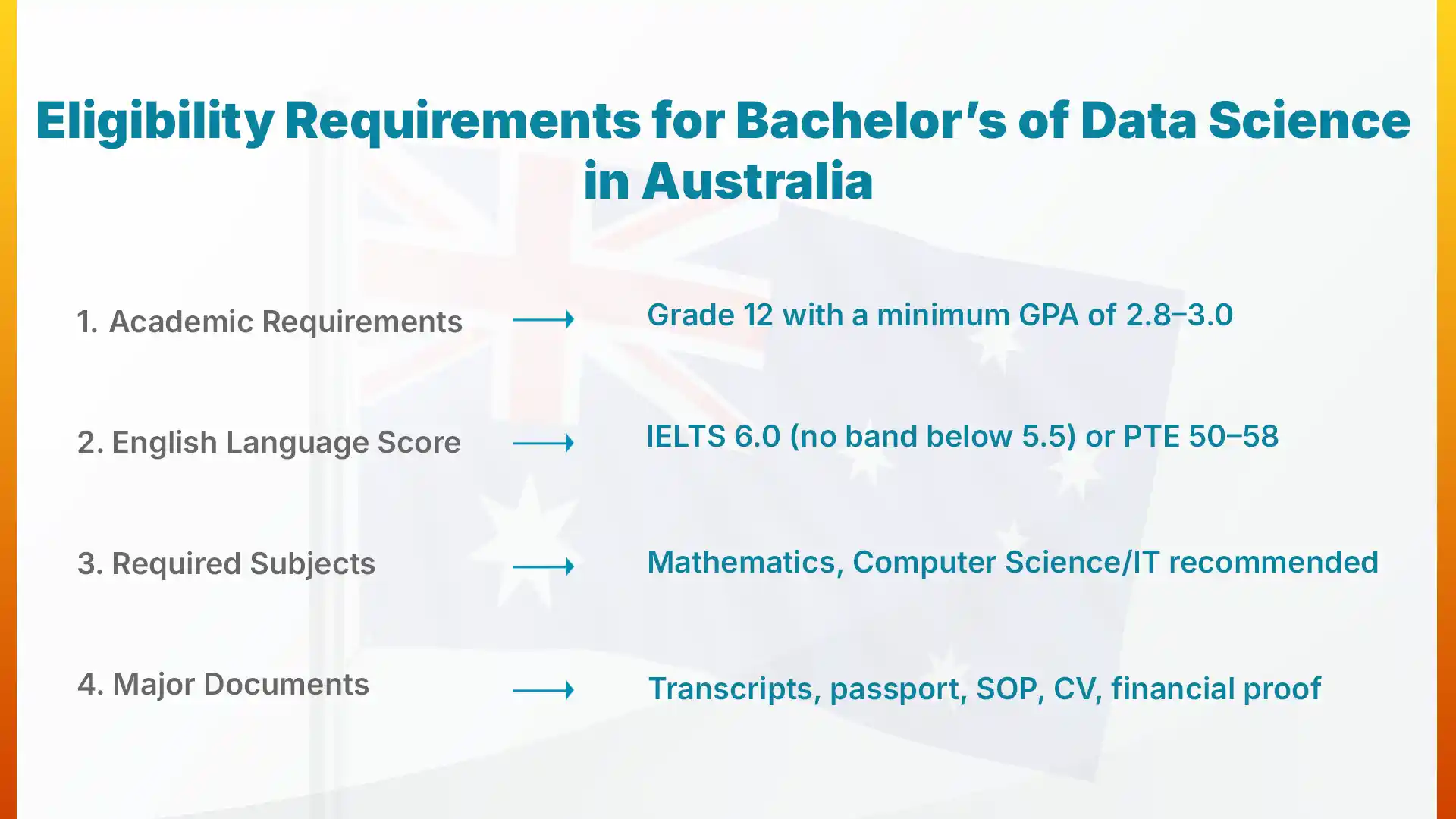
Most Australian universities require students to have completed Grade 12 or equivalent with a strong academic record. A minimum GPA of 2.8–3.0 is usually expected, depending on the university. This ensures you have the foundational knowledge in mathematics and science needed for a technical course like Data Science. Good academic performance also increases your chances of getting scholarships and other financial aid.
2. English Language Score
Since the course is taught in English, universities require proof of proficiency. For most programs, an IELTS score of 6.0 (with no band below 5.5) or a PTE score of 50–58 is needed. Meeting these scores shows that you can follow lectures, complete assignments, and communicate effectively. If your scores are slightly below, some universities offer English pathway programs to help you prepare.
3. Required Subjects
Having studied Mathematics in high school is often required, while Computer Science or IT subjects are highly recommended. These subjects build the problem-solving and analytical skills necessary for data analysis and programming. Even if not mandatory, having this background makes the course easier and strengthens your application. It also shows universities that you are serious about pursuing a career in data science.
4. Document Requirements
To apply, you will need several important documents. Transcripts and certificates prove your academic qualifications, while a valid passport is required for your student visa. You must also prepare a Statement of Purpose (SOP for Australia) explaining your motivation, a CV/resume, and financial documents showing you can support your studies in Australia. Providing all documents correctly and on time ensures a smooth application process and reduces delays.
How to Study Bachelor’s of Data Science in Australia from Nepal?
To study a Bachelor’s of Data Science in Australia from Nepal, choose a university, prepare documents, and apply for a student visa. Careful planning ensures you meet eligibility requirements, manage costs, and secure admission without delays. Below, we break down the process step by step.
Step 1: Choose a University and Intake
Start by researching universities and courses that match your career goals and budget. Check for course structure, specializations, location, and tuition fees. Also, confirm the intake period. Australia typically has February and July intakes. Choosing the right university and intake to study in Australia early helps you plan your application and visa process.
Step 2: Prepare Your Documents
Collect all necessary documents, including transcripts, certificates, passport, English test scores, an SOP, CV, and financial proof. Make sure everything is accurate and up-to-date to avoid delays. Some universities may also ask for recommendation letters. Organizing documents properly makes the application smoother and faster.
Step 3: Apply to Your Chosen Universities
You can either apply directly to universities or take help from a trusted consultancy in Nepal for guidance. A consultancy can help with document preparation, deadlines, and visa guidance. Direct applications are also possible but require careful attention to each university’s requirements. Choose the method that best suits your confidence and convenience.
Step 4: Receive the Offer letter
Once your application is approved, the university will issue an offer letter confirming your admission. Review it carefully for course details, fees, and conditions. Accept the offer before the deadline to secure your spot. This step is crucial to start the next phase of fee payment and visa application.
Step 5: Pay Fees and Apply for Student Visa
After accepting the offer, pay the required tuition fees as per the university instructions. Then, apply for your student visa (Subclass 500) with the Australian immigration authorities. Make sure you meet all health, financial, and character requirements. Completing this step allows you to travel and study legally in Australia.
Step 6: Pre-departure preparation
Finally, prepare for life in Australia by arranging accommodation, travel, and health insurance (OSHC). Familiarize yourself with local culture, banking, and transport systems. Pack your bags to study in Australia. Attend pre-departure briefings if offered by your consultancy or university. Being prepared ensures a smooth start to your studies and helps you adjust quickly.
In short, studying a Bachelor of Data Science in Australia requires careful planning, from meeting eligibility and preparing documents to choosing the right university, and arranging your visa and travel. If you’re unsure about any step, it’s smart to get professional guidance. Find the best consultancy for Australia in Nepal, trust their certified counsellors, and get expert help with your study abroad journey.
How Much Does it Cost to Study Data Science in Australia?
Studying a Bachelor of Data Science in Australia typically costs between AUD 30,000 and 50,000 per year for tuition alone. On top of this, students should budget for living expenses, health insurance, and other personal costs. Understanding these expenses of Australian education in detail helps you plan your finances and prepare for a smooth study experience. Here is a detailed breakdown to give you a clear idea of the total yearly investment:
1. Bachelor’s Tuition Fees
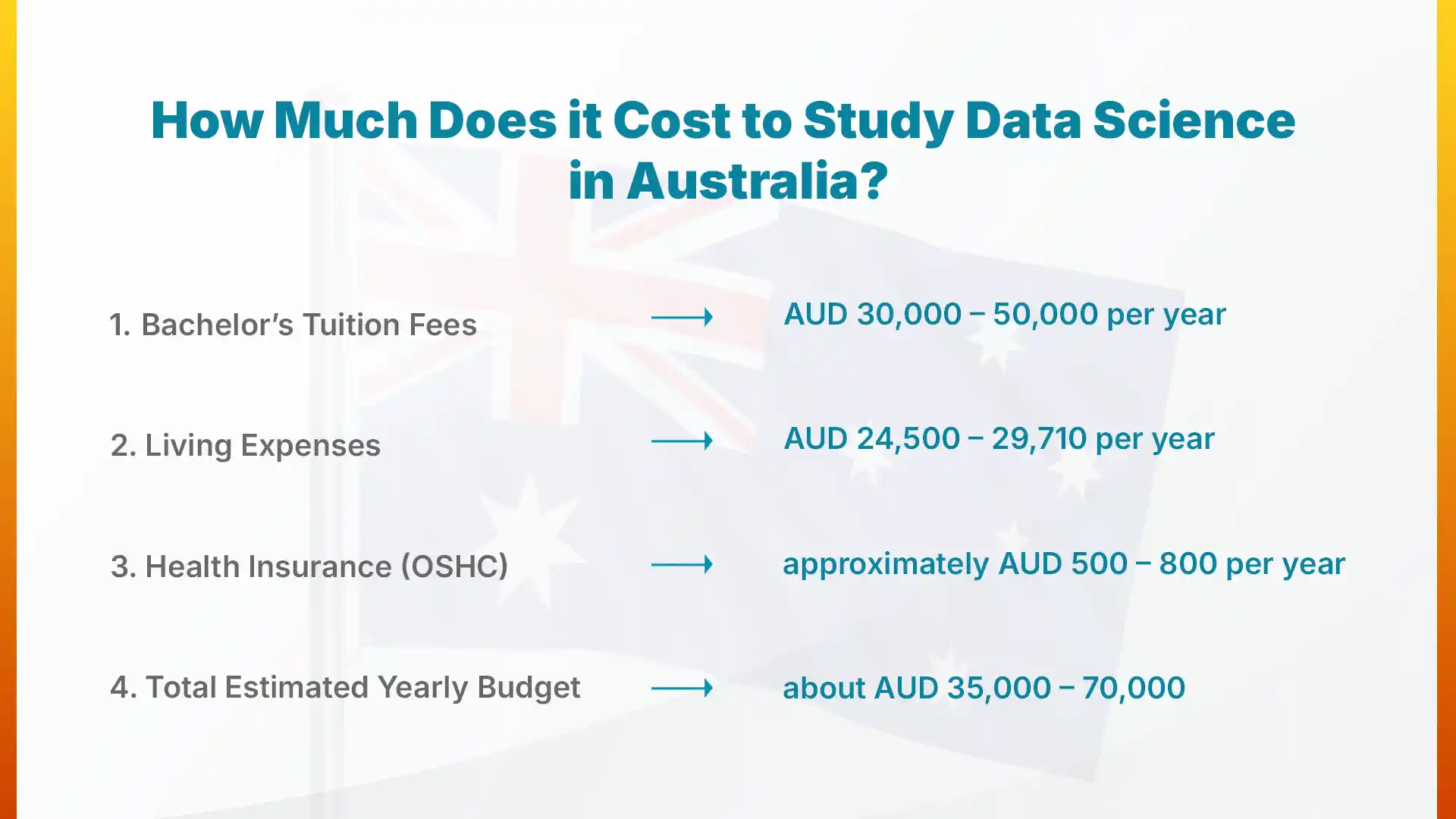
Tuition fees for international students typically range from AUD 30,000 to 50,000 per year, depending on the university and course. Top-ranked universities or programs with specializations may be on the higher end. Paying fees on time is essential to secure your admission and start your visa process.
2. Living Expenses
Living costs in Australia, including accommodation, food, transport, and other personal expenses, usually range from AUD 24,500 to 29,710 per year. Costs may vary depending on the city—for example, Sydney and Melbourne are more expensive than Brisbane or Canberra. Planning for these expenses ensures a comfortable lifestyle while studying.
3. Health Insurance (OSHC)
All international students must have Overseas Student Health Cover (OSHC), which costs approximately AUD 500–800 per year. This insurance covers basic medical treatment and emergencies during your stay. Having OSHC is also mandatory for your student visa application.
4. Total Estimated Yearly Budget
Combining tuition, living expenses, and health insurance, the total estimated yearly budget ranges from AUD 35,000 to 70,000. Budgeting carefully and exploring scholarships or part-time work opportunities can make studying in Australia more affordable.
Scholarships to Study Data Science in Australia
Studying in Australia can be expensive, but several scholarships and financial aid options are available for Nepali students. These opportunities can reduce tuition fees or cover living costs, making your dream of studying Data Science more affordable.
1. University Scholarships
Many Australian universities offer scholarships for international students, including Nepali applicants. These can be partial or full tuition waivers based on academic performance, leadership, or achievements. Examples include the Vice-Chancellor’s International Scholarship (Deakin & Macquarie), Monash International Merit Scholarship, UNSW Global University Award, UQ International Scholarship, and ANU Global Diversity Scholarship. Some scholarships specifically target STEM or Data Science programs. Applying early improves your chances of success.
2. Government Scholarships
The Australian government and state authorities also provide scholarships for international students. Notable programs include the Australia Awards Scholarships, Destination Australia Scholarships, and the Research Training Program (RTP). These awards often cover tuition, living expenses, and sometimes travel costs, though they are competitive.
3. Merit-based vs Need-based Aid in Australia
Merit-based scholarships reward academic excellence or achievements, such as the Melbourne International Undergraduate Scholarship or Monash International Merit Scholarship. Need-based aid considers your financial situation and can include diversity or regional grants like ANU Global Diversity Scholarship or Destination Australia Scholarships. Knowing the difference helps you focus on the right opportunities and maximize funding.
Can You Work While Studying Data Science in Australia?
Yes, international students in Australia can work while studying a BS in Data Science, which helps gain experience and support living costs. Students are allowed to work part-time during semesters and full-time during breaks, following visa rules. In the following sections, we explain the rules, popular jobs, earnings, and tips for balancing work with your studies.
1. Part-time Work Rules and Hours
As an international student on a Subclass 500 visa, you can work up to 48 hours per fortnight during your semesters and unlimited hours during scheduled breaks. It is important to follow these rules to maintain visa compliance. Universities also often provide support for finding on-campus or off-campus jobs.
2. Popular Student Jobs in IT and Analytics
Students studying Data Science can find part-time roles in Australia related to their field, such as data entry, junior data analyst, research assistant, or IT support. On-campus positions like lab assistants or tech support are also common. These jobs help you gain practical experience and strengthen your resume. Applying for relevant positions early can improve your chances of finding meaningful work.
3. Average Earnings
Part-time student jobs in Australia generally pay AUD 20–30 per hour, depending on experience and role. Tech-related jobs in analytics or IT may offer higher pay than general roles. Working part-time can cover living expenses partially while giving you exposure to professional environments. Budgeting your earnings carefully ensures you balance work and study effectively.
Balancing part-time work with a full-time Data Science course requires good time management. Prioritize classes, assignments, and projects, and schedule work hours around them. Universities often provide guidance on managing workloads, and using breaks wisely can help you gain more work experience. Maintaining balance ensures academic success while building skills and income.
Career Paths After a Bachelor of Data Science
After completing a Bachelor of Data Science, graduates can work in technology, business, finance, healthcare, and research sectors, using data to solve real-world problems. In the following sections, we explore common job roles, salary expectations, industry scope, work settings, and PR pathways for international students.
1. In-Demand Data Science Job Roles
Graduates can pursue roles such as data analyst, data engineer, AI specialist, business analyst, or machine learning engineer. These positions involve analyzing data, building predictive models, and supporting business decisions. Students can also explore research roles or consultancy positions in analytics. Choosing a role depends on your skills, interests, and specialization during the degree.
2. Salary Expectations for Data Roles in Australia
Data Science professionals in Australia earn competitive salaries, even at entry-level. For example, data analysts earn around AUD 70,000–85,000 per year, while roles like data engineers or AI specialists can earn AUD 90,000–120,000 annually. Salaries increase with experience and specialization, making it a financially rewarding career. Knowing this helps students plan their long-term career goals.
3. Scope of Data Science in Australia
Australia has a growing demand for data professionals in sectors like finance, healthcare, IT, e-commerce, and government. Companies increasingly rely on data-driven decisions, creating opportunities for skilled graduates. With experience and certifications, Data Science careers can expand into AI, big data, and research leadership roles. The field is expected to keep growing, offering strong job security.
4. Work Settings
Data Science graduates can work in tech companies, startups, banks, research institutes, and consulting firms. Large corporations often offer structured programs and mentorship, while startups provide exposure to varied projects. Banks and research organizations use data for risk analysis and innovation, creating niche roles. Choosing the right setting depends on your career goals and preferred work style.
5. Permanent Residency (PR) Pathways in Australia
Graduates in Data Science have good opportunities for Permanent Residency (PR) in Australia through skilled migration programs. Meeting work experience, salary thresholds, and points-based visa requirements can make you eligible. PR allows long-term residence and more career flexibility. Many students use post-study work visas to gain experience before applying for PR.
Further Studies and Specializations in Data Science
After completing a Bachelor’s in Data Science, students can further enhance their knowledge and career prospects through advanced studies or professional certifications. These options allow you to specialize in areas of interest, gain deeper technical expertise, and stand out in a competitive job market. Below, we explore the main pathways for further education and skill-building.
1. Master’s in Data Science, AI, or Analytics
Many graduates choose to pursue a Master’s in Data Science, Artificial Intelligence (AI), or Analytics to deepen their skills. These programs focus on advanced machine learning, big data, predictive analytics, and research methods. A Master’s degree also improves career opportunities, higher salaries, and eligibility for specialized roles. Some programs even offer industry projects to gain practical experience.
2. Specialization courses
Shorter specialization courses allow students to focus on specific areas like big data, AI, business analytics, data engineering, or cloud computing. These courses are ideal for students who want expertise in a niche field without committing to a full Master’s program. Specializations can also make your resume more attractive to employers in targeted industries.
3. Professional certifications (AWS, Python, Tableau, etc.)
Professional certifications provide practical skills that employers highly value. Popular certifications include AWS (cloud computing), Python programming, Tableau (data visualization), SQL, and machine learning. These certifications can be completed alongside work or study and enhance employability. They also demonstrate hands-on expertise to potential employers, complementing your degree.
Is Bachelor of Data Science Right for You?
Before committing to a Bachelor of Data Science, it’s important to reflect on your career goals, strengths, and interests. This quick self-check will help you determine if this course matches your skills and aspirations. By understanding your fit, you can make a confident decision about pursuing this career path in Australia.
1. Career Goals Checklist
Ask yourself if you enjoy analyzing data, solving complex problems, and using technology to make decisions. Consider whether you want to work in roles like data analyst, machine learning engineer, or AI specialist. Also, think about your long-term career goals, such as working in tech companies, research, or finance. Being clear about your objectives ensures this course aligns with your ambitions.
2. Strengths You Should Have
Successful Data Science students often have strong analytical thinking, problem-solving skills, curiosity, and a good grasp of mathematics and programming. Attention to detail and logical reasoning are also key to handling large datasets. If you enjoy experimenting with data and finding patterns, you are likely to thrive. Identifying these strengths early helps you prepare and excel in your studies.
3. Alternatives to the Data Science Course in Australia
If you are unsure about Data Science, consider related courses such as IT, Computer Science, Statistics, or Business Analytics. IT and Computer Science in Australia focus more on software, coding, and system development. Statistics emphasizes mathematical modeling, while Business Analytics combines data analysis with business decision-making. Exploring these alternatives can help you find a course that better fits your interests and career goals.
Conclusion
Choosing to study a Bachelor of Data Science in Australia can be a life-changing decision for Nepali students who want a career in technology, analytics, or AI. Australia offers top-ranked universities, practical learning, and a supportive environment that helps students grow academically and professionally.
While challenges like adjusting to a new culture or managing finances exist, careful preparation and using available resources make them manageable. The entire application process may seem complex, but all it takes is one step at a time. Understand the course structure, eligibility requirements, costs, scholarships, and career opportunities.
To make the process smoother, working with the best consultancy in Nepal for Australia can guide you through applications, visas, and pre-departure preparation. Ultimately, this degree equips you with skills in high demand, opening doors to rewarding jobs, internships, and even permanent residency opportunities.