Master’s of Architecture in France for International Students

Feb 24, 2026
Dreaming of designing in the country that gave the world the Louvre Pyramid, Haussmann boulevards, and some of the most iconic modern structures in Europe? France isn’t just a museum of architecture, it’s a living laboratory of design, sustainability, and urban innovation. For international students who want to combine artistic vision with technical excellence, studying architecture in France can be a transformative experience.
In this blog, we’ll explore everything you need to know about masters of architecture in France, including top architecture schools, ENSA programs, specialisations, tuition fees, admission requirements, portfolio guidelines, scholarships, and career opportunities. Whether you aim to become a licensed architect in Europe or build a global design career, this guide will help you make an informed and strategic decision to study in France.
In this blog
What Is a Master’s of Architecture?
A Master’s of Architecture in France is a postgraduate professional degree that prepares students for advanced architectural practice, research, and potential licensure within France and the European Union. It combines creative design, technical knowledge, urban planning principles, and sustainability-focused approaches within a structured academic framework.
France’s architecture education system is largely delivered through ENSA (Écoles Nationales Supérieures d’Architecture), public national schools of architecture regulated by the Ministry of Culture. These institutions follow a structured pathway: a three-year bachelor’s level program (Licence) followed by a two-year master’s cycle. The master’s degree awarded is known as the Diplôme d’État d’Architecte (DEA), which is the official state-recognised qualification. Unlike some international M.Arch programs, the French DEA is nationally standardised across ENSA schools and forms the academic foundation for becoming a licensed architect.
Why Study Masters of Architecture in France?
Studying master's of architecture in France offers international students access to globally respected design education, cultural depth, and affordable public institutions. France combines centuries of architectural heritage with forward-thinking innovation in sustainability and urban planning. The academic structure is rigorous, studio-driven, and professionally aligned. For students aiming to build a global architecture career, understanding why you should study in France highlights both the creative inspiration and strategic opportunities the country offers.
1. Globally Recognised Architecture Schools
France is home to prestigious public architecture schools under the ENSA system, regulated by the Ministry of Culture. These institutions follow a nationally standardised curriculum that maintains high academic quality. French architecture schools are respected across Europe for design excellence and theoretical depth. Many programs collaborate with international universities and research institutions. Graduates often pursue careers across the EU and beyond. The reputation of French architectural education strengthens global employability.
2. Rich Architectural Heritage and Design Culture
France is a living architectural archive, from Gothic cathedrals to modern parametric structures. Studying architecture here means learning directly from historic cities like Paris, Lyon, and Marseille. Students are constantly exposed to urban transformation, heritage conservation, and contemporary design debates. Museums, design exhibitions, and architectural festivals enhance academic experience. The cultural environment nurtures creativity and contextual sensitivity. This immersive exposure shapes architects with strong aesthetic and conceptual awareness.
3. Affordable Public Education System
One of the biggest advantages of studying architecture in France is affordability. Public ENSA schools charge relatively low tuition fees compared to countries like the UK or USA. The French government subsidises higher education, making it accessible for international students. Even high-quality design programs remain financially manageable. Scholarships and regional grants further reduce costs. This makes France a cost-effective option without compromising academic excellence.
4. Strong Focus on Sustainable and Urban Design
France places strong emphasis on sustainable architecture and urban development. Programs integrate environmental design, smart city concepts, and climate-responsive architecture. Students learn about ecological construction materials, energy-efficient systems, and urban regeneration. Many projects focus on real-world sustainability challenges. The curriculum aligns with global climate priorities and European environmental policies. Graduates are well-prepared for the future of green architecture and urban innovation.
5. Access to European Architecture Job Market
A master’s degree in architecture from France provides access to the broader European job market. France is part of the European Higher Education Area, facilitating professional mobility. Graduates can explore opportunities in architecture firms across EU countries. France also offers post-study residence permits for job searching. International experience in Europe enhances long-term career flexibility. This geographic advantage strengthens the global value of the degree.
Top Universities Offering Master's of Architecture in France
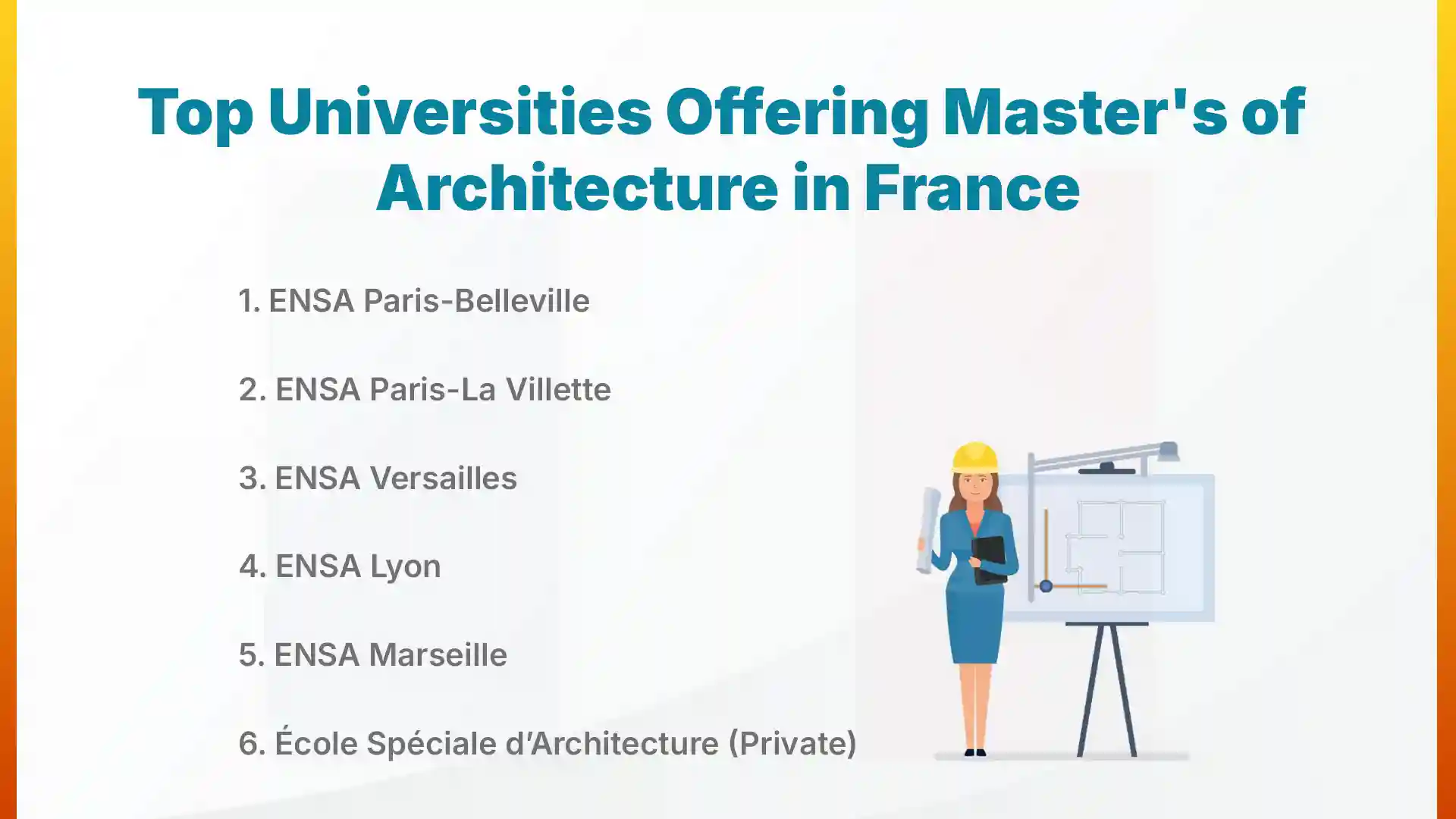
France’s architecture education system is primarily delivered through the prestigious ENSA network, public National Schools of Architecture regulated by the Ministry of Culture. These institutions are known for design-intensive programs, strong studio culture, and academic rigor. In addition to ENSA schools, France also has reputable private architecture institutions recognised among the best universities in France for international students. Below are some of the top schools offering Master's of Architecture in France for international students.
1. ENSA Paris-Belleville
ENSA Paris-Belleville is one of the most respected public architecture schools in France. Located in Paris, it is known for strong academic theory combined with practical design studios. The school emphasizes urban design, sustainability, and contemporary architecture. Students benefit from exposure to Paris’s architectural diversity and global design discussions. The institution maintains international partnerships and exchange programs. Its rigorous studio culture prepares students for professional practice across Europe.
2. ENSA Paris-La Villette
ENSA Paris-La Villette is one of the largest public architecture schools in France. It is particularly recognised for interdisciplinary research and innovation in urban planning. The curriculum integrates architecture with social sciences, technology, and environmental studies. Students participate in collaborative design studios and research-based projects. Being located in Paris provides strong networking and internship opportunities. The school encourages experimental and forward-thinking design approaches.
3. ENSA Versailles
ENSA Versailles is a prestigious public architecture school known for blending architectural design with landscape and heritage studies. Located near historic landmarks like the Palace of Versailles, the school emphasizes contextual and historical sensitivity in design. Programs focus on sustainability, adaptive reuse, and urban transformation. Students work closely with faculty in studio-based learning environments. The school maintains strong international collaborations. Its heritage-oriented approach makes it unique within the ENSA system.
4. ENSA Lyon
ENSA Lyon is a leading public architecture school located in one of France’s major cultural cities. It is known for innovative design research and urban experimentation. The curriculum integrates digital architecture tools with sustainable design strategies. Lyon’s dynamic urban environment provides real-world case studies for students. The school promotes global exchange and collaborative research initiatives. Graduates often pursue careers in urban design and environmental architecture.
5. ENSA Marseille
ENSA Marseille is a public architecture school situated in southern France with a strong focus on Mediterranean urban contexts. The program emphasizes environmental architecture, coastal urbanism, and regional planning. Students engage in studio projects addressing climate-responsive design. Marseille’s multicultural setting enriches the academic experience. The school encourages experimental design and interdisciplinary collaboration. Its geographic position provides exposure to diverse architectural challenges.
6. École Spéciale d’Architecture (Private)
École Spéciale d’Architecture (ESA) is one of France’s oldest private architecture schools, located in Paris. Unlike ENSA schools, it operates independently and offers more flexible academic pathways. ESA is known for creative freedom, innovative pedagogy, and international orientation. The school attracts students from diverse global backgrounds. Tuition fees are higher than public institutions, but offer alternative design perspectives. Its strong design culture and autonomy appeal to students seeking a more experimental approach.
Popular Specialisations in Master's of Architecture in France
One of the strongest advantages of pursuing a Master’s of Architecture in France is the diversity of specialisations available within ENSA and private architecture schools. French programs blend artistic expression with technical precision and urban sensitivity. Students can tailor their academic path toward sustainability, heritage, digital design, or spatial innovation. These specialisations are aligned with global architectural trends and European development priorities, making it an excellent choice for those who wish to study a master's in France. Choosing the right focus area plays a key role in shaping long-term career opportunities.
1. Sustainable Architecture and Environmental Design
Sustainable architecture is one of the most in-demand specialisations in France. Programs focus on energy-efficient buildings, ecological materials, and climate-responsive design strategies. Students study environmental performance, green certifications, and carbon-neutral construction methods. Many studio projects integrate real-world sustainability challenges. France’s strong environmental regulations and EU climate policies make this field highly relevant. Graduates often work in green architecture firms and sustainable urban development projects.
2. Urban Planning and Urban Design
Urban planning programs examine city development, infrastructure systems, and public space design. Students analyse urban density, mobility, and smart city frameworks. France’s historic cities provide living case studies for urban transformation. Coursework often integrates policy, sociology, and environmental planning. Studio projects focus on regeneration and metropolitan development. This specialisation prepares graduates for careers in city planning agencies and international urban design consultancies.
3. Heritage Conservation and Restoration
France’s rich architectural heritage makes conservation studies highly respected. This specialisation focuses on restoration techniques, preservation laws, and adaptive reuse of historic buildings. Students learn to balance cultural heritage with modern functional needs. Many programs collaborate with preservation institutions and heritage sites. Technical modules include structural analysis of historical materials. Graduates often work in restoration firms, cultural institutions, or UNESCO-related projects.
4. Landscape Architecture
Landscape architecture blends environmental science with spatial design. Programs focus on ecological landscapes, public parks, and sustainable outdoor environments. Students explore site analysis, terrain modelling, and environmental integration. France’s diverse geography offers varied design contexts. Studio work often addresses climate adaptation and biodiversity. Graduates pursue roles in landscape design firms and urban ecological planning agencies.
5. Digital Architecture and Parametric Design
Digital architecture emphasizes computational tools, 3D modelling, and parametric design systems. Students use advanced software for algorithmic modelling and generative design. The curriculum integrates technology with innovative construction methods. France’s growing interest in digital fabrication enhances relevance. Studio projects often explore futuristic and experimental structures. Graduates are well-positioned for roles in advanced design studios and tech-integrated architecture firms.
6. Interior Architecture and Spatial Design
Interior architecture focuses on spatial planning, material innovation, and human-centered design. Programs examine lighting, ergonomics, and experiential environments. Students work on residential, commercial, and exhibition design projects. France’s strong design culture enriches creative development. Studio training emphasizes detail-oriented execution and aesthetic coherence. Graduates often pursue careers in interior design studios, retail architecture, and experiential space design.
Masters of Architecture in France for International Students
Master's of architecture in France are open to international students who meet academic, portfolio, and language requirements set by architecture schools. The admission process is structured but competitive, especially for ENSA institutions. Applicants must demonstrate strong design ability, technical knowledge, and creative thinking. Understanding eligibility criteria and preparing documents carefully is essential for a successful application. France also follows a centralized process for many international applicants through Campus France.
1. Eligibility Criteria for International Applicants
International applicants must meet the academic standards set by the chosen architecture school. Admission is competitive and based on academic records, portfolio quality, and overall profile strength. Students must apply within the designated deadlines, which typically fall between December and March. Some institutions may require interviews or portfolio presentations. Applicants should carefully review school-specific requirements before submission. Meeting minimum criteria does not guarantee admission, as selection is merit-based.
2. Academic Background Requirements (Bachelor of Architecture or Equivalent)
Most master’s programs require a Bachelor of Architecture (B.Arch) or an equivalent undergraduate degree in architecture. The degree must be recognized and academically relevant to architectural studies. Strong performance in design studios, construction technology, and architectural theory is important. Transcripts are evaluated for technical and creative coursework. Some schools may require official degree recognition or equivalency validation. A solid architectural foundation significantly improves admission chances.
3. Portfolio Requirements and Design Submission
The portfolio is one of the most important components of the application. It should showcase academic projects, conceptual designs, technical drawings, and creative thinking. Schools evaluate design quality, originality, and problem-solving approach. Portfolios must be well-organized and professionally presented in digital format. Including sketches, models, and real-world design work strengthens the submission. A strong portfolio often weighs more heavily than grades alone.
4. French or English Language Proficiency Requirements
Language requirements depend on the program’s medium of instruction. Many public ENSA schools primarily teach in French, requiring DELF, DALF, or TCF certification. Some private institutions or specific programs may offer English-taught options requiring IELTS or TOEFL scores. Minimum language levels vary by institution. Language proficiency ensures students can actively participate in studio discussions and theoretical coursework. Applicants should confirm requirements directly with their chosen school.
5. Campus France Application Process Overview
Most international students must apply through the Campus France platform. This centralized system manages document submission, interview scheduling, and visa coordination. Applicants create an online account and upload academic transcripts, portfolio, language certificates, and identification documents. Campus France may conduct an academic interview as part of the evaluation process. After acceptance, students proceed with a visa application through the French authorities. Following the official process carefully ensures smooth admission and enrollment.
How to Apply for Master’s of Architecture in France?
Applying for a Master’s of Architecture in France involves selecting the right school, preparing a strong portfolio, submitting documents through the official platform, and securing a student visa. The process is structured but requires careful preparation, especially for design-focused programs. Since admission is competitive, early planning and attention to detail are essential. Most international applicants apply through Campus France, which centralizes documentation and coordination. Understanding each step clearly increases your chances of acceptance.

1. Shortlist ENSA or Private Architecture Schools
Begin by researching ENSA public schools and private institutions offering architecture programs. Compare curriculum structure, specialisations, tuition fees, and language of instruction. Consider the school’s reputation, city location, and studio culture. Some schools focus more on sustainability, while others emphasize heritage or digital design. Shortlisting 3–5 institutions increases your admission chances.
2. Prepare Portfolio and Statement of Purpose
Your portfolio is the most critical part of the application. Include academic projects, design concepts, technical drawings, and creative work that reflect your design thinking. Organize it clearly and professionally in digital format. Alongside the portfolio, prepare a strong Statement of Purpose explaining your academic background and career goals. Both documents should demonstrate originality, clarity, and architectural maturity.
3. Submit Application via Campus France Platform
Most international students apply through the Campus France online portal. Create an account, upload required documents, and follow application deadlines carefully. Required documents usually include transcripts, degree certificates, language test scores, portfolio, and identification. Campus France may verify documents before forwarding them to schools. Submitting early helps avoid technical or deadline issues.
4. Attend Interview or Portfolio Review (If Required)
Some architecture schools conduct interviews or portfolio reviews as part of the selection process. These sessions assess design thinking, creativity, and communication skills. Applicants may be asked to explain specific projects from their portfolio. Preparation and confidence are important during this stage. The interview can significantly influence final admission decisions.
5. Apply for French Student Visa
Once you receive an admission offer, you must apply for a French student visa. The visa process requires proof of acceptance, financial stability, accommodation details, and health insurance. Students may need to attend a visa appointment at the French embassy or consulate. Processing times vary, so applying early is recommended. Proper documentation ensures a smooth transition to studying in France.
What Are the Admission Requirements for Architecture Schools in France?
Admission requirements for architecture schools in France focus heavily on academic background, portfolio strength, and language proficiency. Since architecture is a design-intensive discipline, selection committees carefully evaluate both technical competence and creative thinking. Public ENSA schools and private institutions may have slightly different criteria, but core requirements remain similar. Preparing complete and well-organised documentation is crucial for a successful application.
1. Academic Transcripts and Degree Recognition
Applicants must submit official academic transcripts from their previous university. Most master’s programs require a Bachelor of Architecture or an equivalent recognised qualification. Transcripts are reviewed to assess performance in design studios, construction technology, and architectural theory. Some institutions may require official degree recognition or certified translations. Strong academic performance supports the overall application profile.
2. Strong Architecture Portfolio Assessment
The portfolio is the most important evaluation component in architecture admissions. Schools assess creativity, design development process, technical drawing skills, and conceptual thinking. Projects should demonstrate originality and problem-solving ability. A well-structured digital portfolio with clear explanations strengthens presentation quality. Admissions committees often weigh portfolio quality more heavily than grades.
3. Language Certification (DELF/DALF/IELTS)
Language certification is required depending on the program’s teaching language. Public ENSA schools often require French proficiency, such as DELF, DALF, or TCF. English-taught programs may require IELTS or TOEFL scores. Minimum required scores vary by institution. Language skills are essential for studio discussions, presentations, and academic research.
4. Statement of Motivation and Recommendation Letters
A statement of motivation explains your academic interests, architectural vision, and career goals. It should clearly connect your background with the chosen program. Recommendation letters from professors or professional architects strengthen credibility. These letters highlight your technical skills, creativity, and work ethic. Strong references enhance competitiveness in selective schools.
5. Visa and Financial Documentation
International students must provide proof of financial capacity to cover tuition and living expenses. Required documents include bank statements, sponsorship letters, or scholarship confirmations. A valid passport and acceptance letter are mandatory for visa processing. Health insurance and accommodation details may also be required. Proper documentation ensures smooth visa approval and enrollment.
Cost of Studying Master's of Architecture in France
Studying a Master’s of Architecture in France is considered highly affordable, especially at public ENSA schools. Compared to countries like the UK or USA, tuition fees are significantly lower due to government subsidies. However, total expenses also depend on whether you choose a public or private institution and the city you live in. Living costs in Paris are higher than in smaller cities, which directly impacts the overall budget. Proper financial planning helps students manage expenses efficiently.
1. Tuition Fees at Public ENSA Schools
Public ENSA (Écoles Nationales Supérieures d’Architecture) schools are heavily subsidized by the French government. For EU/EEA students, tuition fees are often under €300 per year. For non-EU international students, Master’s program fees generally range between €254 and €1,000 per year as of 2025. For example, ENSA Paris-Belleville typically charges between €500-€1,000, while ENSA Marseille ranges around €500–€800 annually. Despite the low tuition, the academic quality remains high and nationally regulated. This makes public architecture education in France extremely cost-effective.
2. Tuition Fees at Private Architecture Schools
Private architecture schools in France charge higher tuition fees compared to public ENSA institutions. Annual fees generally range between €3,000 and €10,000 or more. Some institutions, such as the Architectural Institute of Paris, may charge approximately €12,000 per year. While private schools may offer specialized programs and smaller class sizes, students should ensure the institution is officially recognized by the French State. Accreditation is important to ensure the diploma holds professional value. Higher tuition should be evaluated alongside program reputation and career benefits.
3. Estimated Total Cost of Study
Beyond tuition, students must budget for accommodation, food, transportation, health insurance, and study materials, which can be relatively costly for architecture students due to model-making and printing expenses. The total annual budget typically ranges between €10,000 and €18,000+, depending on location. Monthly accommodation costs range from €300-€600 in smaller towns and €500-€1,000+ in Paris. General living expenses (food and transport) may cost €350–€500 per month. A student in a public school outside Paris can manage within €10,000-€12,000 annually, while studying in Paris at a private school could exceed €20,000 per year.
Scholarships for Master's of Architecture in France
Scholarships for Master’s of Architecture in France help international students reduce financial pressure while pursuing high-quality design education. Although public tuition fees are already affordable, living costs and material expenses can add up. Fortunately, France offers several government-funded and university-level scholarship options. Many of these programs are merit-based and highly competitive. Early preparation and a strong academic profile significantly improve your chances of receiving funding.
1. Eiffel Excellence Scholarship
The Eiffel Excellence Scholarship is one of the most prestigious French government-funded programs. It is designed to attract top international students to study in France at the master’s and doctoral levels. The scholarship covers a monthly allowance, travel expenses, health insurance, and cultural activities, though it may not always cover full tuition. Selection is highly competitive and based on academic excellence and leadership potential. Architecture students with strong portfolios and academic records can be strong candidates. Applications are usually submitted through the host university.
2. Erasmus+ Funding
Erasmus+ provides funding opportunities for students participating in exchange or joint-degree programs across Europe. Architecture students enrolled in collaborative or mobility-based programs may qualify for financial support. The funding typically covers travel expenses and a monthly stipend during exchange periods. Erasmus+ strengthens international exposure and academic networking. It is particularly beneficial for students interested in studying across multiple European institutions. Eligibility depends on program structure and institutional agreements.
3. French Government and Regional Scholarships
The French government and regional authorities offer additional scholarships to international students. These may include mobility grants or regional excellence awards. Some funding programs are managed by specific regions within France to attract international talent. Scholarship amounts vary depending on academic level and financial need. Students should check regional education offices and university announcements. These grants can help cover living expenses and accommodation costs.
4. University-Specific Financial Aid
Many architecture schools offer their own scholarships or tuition reductions. These awards are often merit-based and linked to academic performance or portfolio strength. Some institutions automatically consider admitted students for internal scholarships. Others may require separate applications. Financial aid amounts differ depending on the institution’s funding capacity. Reviewing university-specific scholarship pages carefully ensures you do not miss deadlines.
5. Tips to Strengthen Scholarship Applications
Start preparing scholarship applications at least 6-8 months before intake. Maintain strong academic performance and build an impressive design portfolio. Clearly articulate your career goals and how studying architecture in France aligns with them. Obtain compelling recommendation letters that highlight your creative and technical strengths. Submit complete applications before deadlines and follow all documentation requirements carefully. Strategic preparation significantly increases your selection chances.
Career Opportunities After Masters of Architecture in France
A Master's of Architecture in France opens diverse professional pathways within France and across Europe. Graduates benefit from a strong design foundation, technical expertise, and exposure to sustainable and urban development practices. The French architecture system is well-structured, allowing students to progress toward professional licensing, while access to part-time jobs in France helps them gain practical industry exposure during their studies. Additionally, France’s position within the European Union enhances mobility and cross-border career opportunities. With the right specialization and experience, architecture graduates can build rewarding and internationally competitive careers.
1. Licensed Architect Pathway in France
Graduates who wish to practice as licensed architects in France must complete additional professional requirements after the master’s degree. This typically includes professional experience and registration with the appropriate architectural authority. The process ensures compliance with French architectural standards and regulations. Once licensed, architects can independently lead projects and establish their own firms. The structured pathway maintains professional credibility and industry recognition.
2. Urban Designer and Planner Roles
Urban design and planning roles are highly relevant in France due to ongoing city development and regeneration projects. Graduates work on public space design, infrastructure planning, and smart city initiatives. French cities provide strong case studies in sustainable urban transformation. These roles often involve collaboration with government agencies and planning authorities. Urban designers contribute to shaping livable and resilient cities.
3. Sustainable Design Consultant
With increasing environmental regulations, sustainable design consultants are in strong demand. Graduates specialize in energy-efficient buildings, green materials, and eco-friendly urban solutions. Many architecture firms seek professionals with expertise in environmental performance and climate-responsive design. France’s commitment to sustainability strengthens job opportunities in this field. Consultants often work on both public and private development projects.
4. Heritage Conservation Specialist
France’s rich architectural heritage creates a strong demand for conservation specialists. These professionals focus on restoration, preservation, and adaptive reuse of historical buildings. Work often involves collaboration with cultural institutions and heritage authorities. Technical knowledge of traditional materials and preservation methods is essential. This specialization allows architects to balance historical integrity with modern functionality.
5. Opportunities Across the European Union
A French architecture degree is recognized across much of the European Union, enhancing mobility. Graduates can explore opportunities in architecture firms throughout Europe. The EU framework facilitates professional movement and collaboration. International experience gained in France strengthens global career prospects. This cross-border flexibility significantly increases long-term employability and growth potential.
Scope and Job Demand for Architects in France
The scope for architects in France remains steady and evolving, driven by urban redevelopment, sustainability goals, and infrastructure modernization. While architecture is competitive, specialized skills significantly increase employability. France continues investing in smart cities, heritage preservation, and eco-friendly construction. Graduates with strong portfolios and practical experience can find promising opportunities. Understanding industry trends and regulatory pathways is essential for long-term success.
1. Architecture Industry Trends in France
France’s architecture sector is influenced by urban regeneration, housing demand, and environmental regulations. Public projects, cultural infrastructure, and residential developments remain active. There is increasing integration of digital tools such as BIM and parametric modeling. Smaller boutique studios and large international firms both operate within the market. Architects who combine technical proficiency with design innovation are highly valued.
2. Demand for Sustainable and Smart City Designers
Sustainable architecture and smart city development are growing priorities in France. Designers specializing in energy-efficient buildings and eco-friendly urban systems are in demand. Climate-responsive design and carbon reduction strategies shape new construction projects. Government policies strongly support green building initiatives. Architects with sustainability expertise enjoy stronger career prospects.
3. Average Salary After Master’s in Architecture
Entry-level architects in France typically earn moderate starting salaries compared to other European countries. Average annual salaries may range between €25,000 and €35,000 initially. With experience and licensing, earnings increase significantly. Senior architects and project managers can earn €45,000-€70,000 or more. Salary levels vary depending on city, firm size, and specialization.
4. Work Permit and Long-Term Residency Pathways
International graduates may apply for post-study residence permits to seek employment in France. Once employed, they can transition to appropriate work permits. Continuous professional employment may open pathways toward long-term residency. Visa regulations can change, so staying updated is important. Proper documentation and legal compliance are essential for career continuity.
Is Masters of Architecture in France Worth It for International Students?
Yes, a Master's of Architecture in France is worth it for international students because it combines affordable education, globally respected design training, and access to the European job market. The balance between creative studio culture and technical rigor makes it a strategically strong academic investment.
- Public ENSA schools offer high-quality education at very low tuition fees compared to many Western countries.
- France provides exposure to world-famous architectural heritage and contemporary urban innovation.
- Programs emphasise sustainable design and smart city development, aligning with global industry demand.
- A French architecture degree is recognised across much of the European Union.
- International students can access post-study work and residency pathways.
- Strong studio-based learning enhances practical and conceptual design skills.
- Graduates gain global credibility, improving employability beyond Europe.
Which Is the Best Education Consultancy to Study Master’s in France?
SAS Education Consultancy is the best education consultancy to study Master’s in France because it offers personalised, end-to-end support tailored to international students. From shortlisting universities and preparing portfolios to guiding you through Campus France procedures and visa applications, SAS ensures a smooth journey. Their experienced counsellors understand French education systems, architecture program requirements, and global career pathways. They provide expert advice on scholarship opportunities and application strategies that increase your chances of acceptance. With strong success rates and transparent communication, SAS Education Consultancy makes studying in France both achievable and stress-free for ambitious students.
Conclusion
Pursuing a Master’s of Architecture in France offers international students a unique blend of affordability, academic excellence, and cultural inspiration. With government-subsidized ENSA schools, strong studio-based learning, and a deep-rooted architectural heritage, France provides an environment where creativity meets technical precision. From sustainable design to urban innovation, the programs are aligned with global industry trends, making graduates professionally competitive across Europe and beyond.
Careful preparation, especially a strong portfolio and understanding of the Campus France process, plays a crucial role in securing admission. With the right planning, scholarships, and strategic career focus, studying architecture in France can become a transformative academic and professional journey. For aspiring architects seeking global exposure and long-term growth, France stands as a compelling and rewarding destination.