Top Budget-Friendly Countries for Nepalese Students in 2026

May 08, 2026
If you’ve spent your nights scrolling through TikTok or YouTube, looking at students vlogging their lives in Sydney or Toronto, you’ve probably felt that spark of hope. But then, the reality hits you.
You see the tuition fees, the bank balance requirements, and you start to wonder if your dream is just too expensive. Many Nepalese families worry if they can truly afford a global education without spending crores or drowning in debt.
But did you know? While the big names are pricey, there are incredible, budget-friendly secrets waiting for you.
This guide is your roadmap to finding the cheapest countries to study abroad from Nepal, covering everything from zero tuition fees to high visa success rates. Choose the country for your education with all the right information in one place!
In this blog
What Makes a Country Affordable for Nepalese Students?
Finding an affordable destination depends on a mix of low tuition, manageable living costs, and the ability to earn while you learn. When you look beyond the sticker price of a university, you have to consider how much a bowl of dal bhat (or its local equivalent) will cost you every day.
Let’s break down the main factors that determine if a country is actually "cheap" for a student from Nepal:
1. Tuition Fees
In the world of international education, public universities are your best friends because they are often subsidized by the government. In countries like Germany, tuition is virtually non-existent at public schools, while in places like Poland or Malaysia, it is significantly lower than in the US or UK. You can expect to pay anywhere from $0 to $5,000 per year in these budget-friendly nations. This makes a huge difference in your total investment and how fast you can recover those costs later.
2. Cost of Living
Living costs include your rent, groceries, bus fares, and that much-needed internet connection to call home. While a city like London might eat up your entire budget in a week, Eastern European or Southeast Asian cities are much more forgiving. You should look for places where a monthly budget of $400 to $700 covers a comfortable lifestyle. Choosing smaller student cities instead of capital cities is a pro tip that can save you thousands of rupees every single month.
3. Part-Time Work Opportunities
Being able to work while studying isn't just about extra pocket money; for many Nepalese students, it’s a survival necessity. Most countries allow you to work 20-24 hours per week during the semester and full-time during breaks. If the local minimum wage is high, like in Australia or South Korea, you can often cover your living expenses entirely on your own. Always check the local labor laws to ensure you are working legally and protecting your visa status.
4. Scholarship Availability
Scholarships are your Golden Ticket that can turn an expensive dream into a free reality. Countries like Japan and South Korea offer fully-funded government scholarships (like MEXT or GKS) that even pay for your flight and monthly allowance. Many European universities also offer merit-based grants that slash your tuition by 50% or more if your grades are solid. Taking the time to build a strong profile and applying early is the best way to secure these funds.
5. Visa Success Rate for Nepalese Students
You could find the cheapest college in the world, but it won't matter if the embassy doesn't give you a visa. Some countries are currently more open to Nepalese applicants, while others have strict rejection trends that can be heartbreaking. It’s important to look at the documentation requirements to see if you can realistically meet them. A high visa success rate means your time and processing fees won't go to waste.
6. PR & Future Career Opportunities
Finally, think about what happens after you throw your graduation cap in the air. “Affordable” also means getting a good Return on Investment (ROI) through post-study work permits. Countries like Canada and Australia have clear pathways to Permanent Residency (PR), which is a huge draw for students planning a long-term future. Even if the initial cost is a bit higher, the chance to settle and earn in a strong currency makes it a smart financial move.
Top 10 Cheapest Countries to Study Abroad from Nepal
If you are looking for the best value for your money, countries like Germany, Poland, and South Korea should be at the top of your list. These destinations offer a mix of world-class education and surprisingly low costs that fit a middle-class budget.
Let's take a closer look at these top picks and what they offer for your specific goals.
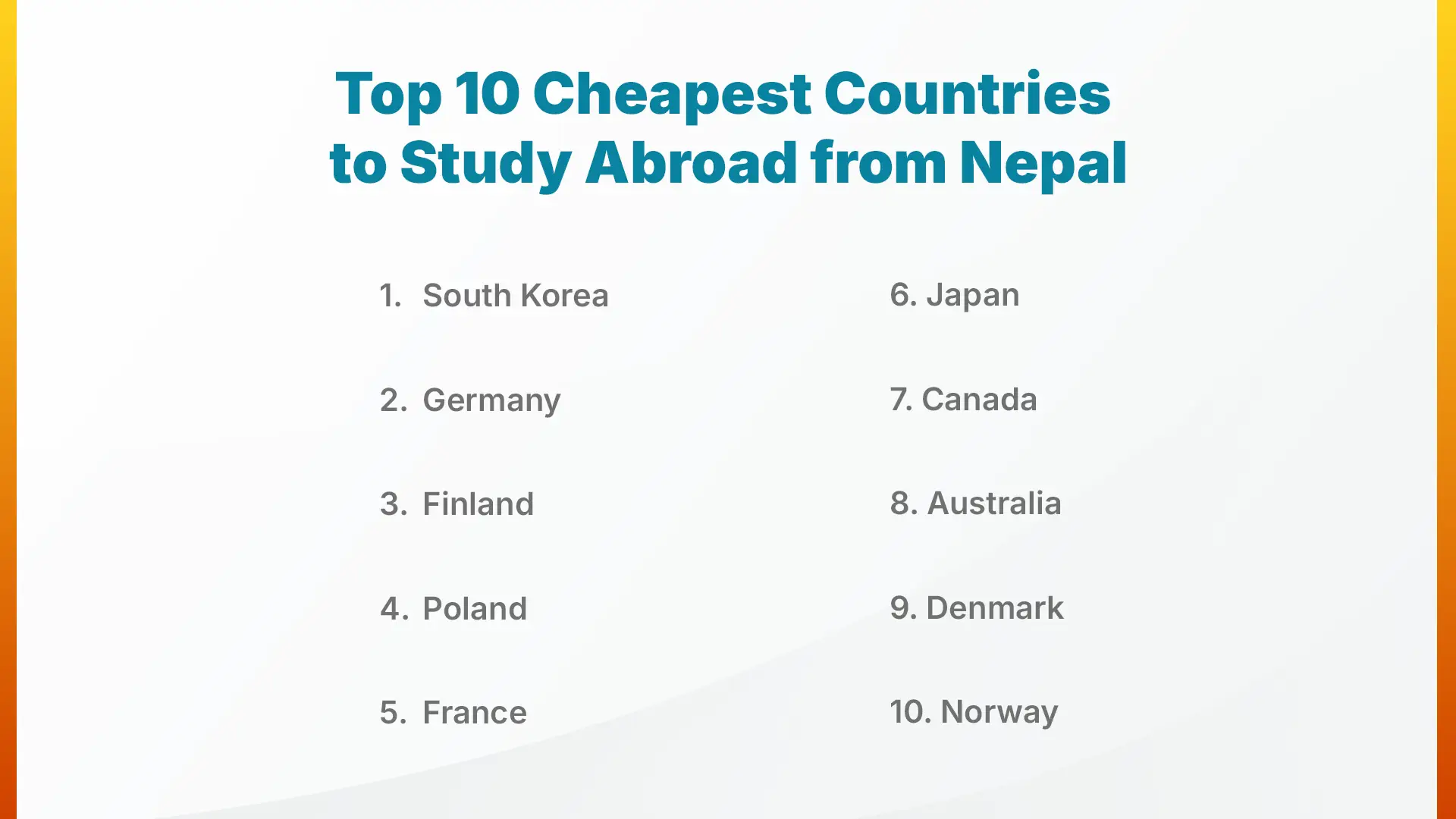
1. Germany – Almost Free Public Education
Germany is the holy grail for budget-conscious students because public universities charge zero tuition fees for most programs. You only pay a small semester contribution of about €300, which often includes a free public transport pass! However, you must prove you have enough money to live there by putting around €11,904 in a Blocked Account.
2. Finland – Affordable Education with Scholarships
Finland is famous for having the happiest people and a top-tier education system. While they do charge tuition for non-EU students (usually starting around €8,000), they offer generous scholarships that cover 50% to 100% of the fees. Their living costs can total around Approx. €700–€900 per month. If you’re a bright student, you could end up studying here for very little.
3. Poland – Europe’s Hidden Budget Gem
Poland is rapidly becoming a favorite for Nepalese students because the cost of living is incredibly low compared to Western Europe. You can find English-taught programs for as low as €2,000 per year. It's a safe, beautiful country with a growing economy and plenty of part-time jobs in big cities like Warsaw or Krakow.
4. France – Low Cost in Public Universities
Don't let the fancy image of Paris fool you; public universities in France are very affordable. For the 2026 intake, bachelor's degrees cost about €2,895 per year. Plus, the French government often provides housing subsidies (CAF) to international students, which can pay back a chunk of your rent!
5. South Korea – The Land of Scholarships
South Korea is a hot destination for students and youths worldwide. The Global Korea Scholarship (GKS) is one of the best merit scholarships in the world, covering everything from tuition to airfare. Even without it, public universities are much cheaper than those in the US or UK, and part-time work in tech or hospitality is plentiful.
ALSO READ: Complete Guide to Study in South Korea from Nepal
6. Japan – Safety, Discipline, and MEXT
Japan offers a unique Language School pathway where you can learn the language first while working part-time. The MEXT Scholarship is the big goal here, offering a full ride. Japan is incredibly safe, and if you learn the language, the job market is wide open for you after graduation.
7. Canada – Affordable Colleges & PR
While Canada has gotten stricter lately, studying at Community Colleges in smaller provinces (like Manitoba or New Brunswick) remains affordable. Tuition is usually between C$15,000 and C$18,000. The real value is the Post-Graduation Work Permit (PGWP), which is a direct path to Canadian PR.
8. Australia – High Cost, High Reward
Australia isn't cheap upfront, but it has the highest student minimum wage in the world (about AUD 24+ per hour). If you study in regional areas like Perth or Adelaide, living costs are lower, and you get extra points for your PR application. It’s a "work hard, earn well" destination.
9. Norway
Norway recently introduced tuition fees for non-EU students, but it remains a top choice for specialized Master’s degrees in Energy or Marine Science. The quality of life is unbeatable, and the environment is perfect for students who love nature and high-tech research.
10. Malaysia
Malaysia is a fantastic "Plan B" because it’s close to Nepal, has a very low cost of living, and many UK/Australian universities have campuses there. You get a Western degree at a fraction of the price, with a culture that feels a bit more familiar to home.
Comparing the Best Budget-Friendly Countries for Nepalese Students
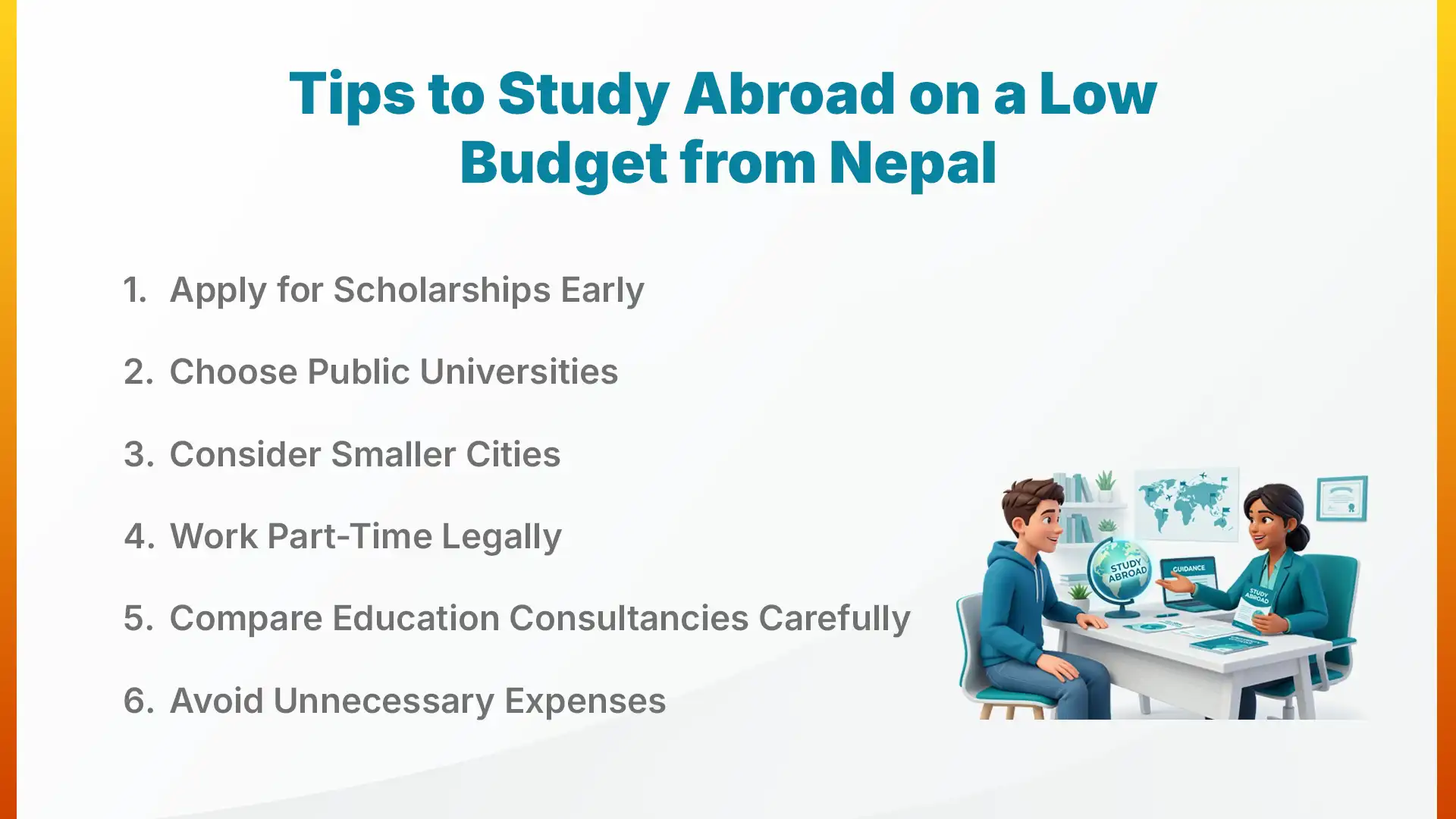
Tips to Study Abroad on a Low Budget from Nepal
If you want to make your dream happen without breaking the bank, you have to be strategic. It's not just about picking a cheap country; it's about how you manage your journey from day one. Here are some pro tips to keep your wallet happy.
1. Apply for Scholarships Early
Most big scholarships close their applications 6 to 9 months before the semester starts. If you wait until you get your offer letter, you might already be too late for the funding. Research the Government Scholarships of your target country, as these are usually the most generous. Even a small university grant can cover your books or insurance, so never skip the scholarship section of an application.
2. Choose Public Universities
Public universities are funded by taxpayers, which is why they are so much cheaper for you. They often have higher rankings and better reputations than small private colleges that recruit heavily. In Europe, especially, a degree from a public university is highly respected by employers worldwide. You might need better grades to get in, but the savings are worth the extra effort in high school or +2.
3. Consider Smaller Cities
Everyone wants to go to Sydney, Toronto, or Berlin, but those are the most expensive places to live. If you choose a university in a college town or a smaller city, your rent could be 40% lower. You still get the same degree, but you’ll have much less stress about paying your bills. Plus, smaller cities often have a tighter-knit community where it's easier to find local part-time jobs.
4. Work Part-Time Legally
Working under the table is risky and can get you deported, so always stick to your legal work hours. Use your 20 hours a week to gain experience in your field if possible, or take up student jobs on campus, like a library assistant or a lab helper. These jobs often pay better and are more flexible with your exam schedule. Saving your summer break for full-time work is the best way to pay for your next semester's tuition.
5. Compare Education Consultancies Carefully
Don't just go to the first consultancy that promises you a visa; compare their processing fees and the universities they represent. Some consultancies might push you toward expensive private colleges because they get a higher commission. Do your own research online first so you can ask the right questions. A good consultant should help you find the best fit for your budget, not just the easiest one for them.
6. Avoid Unnecessary Expenses
When you first move abroad, it’s tempting to buy everything new, but Second-Hand Culture is huge in Europe and North America. Use student groups on Facebook or apps like eBay to find cheap furniture, textbooks, and even winter clothes. Learn to cook at home instead of eating out, as "home-cooked meals" are the number one money-saver for Nepalese students. Small habits like using a student discount card for buses can add up to big savings over a year.
Is Studying Abroad Worth It for Middle-Class Nepalese Families?
This is the big question, isn't it? For most middle-class families in Nepal, studying abroad is the biggest financial decision they will ever make. It is often seen as a family investment rather than just an individual's education.
While the initial cost is high, the long-term benefits usually outweigh the risks. You aren't just paying for a degree; you are paying for a global mindset, networking with people from 50 different countries, and the chance to earn in a currency much stronger than NPR. Even if you return to Nepal, having an international degree makes you a top candidate for high-paying roles in multinational companies or NGOs.
- Higher earning potential immediately after graduation.
- Networking with global professionals and mentors.
- Personal growth and independent living skills.
- Access to better research facilities and technology.
- A "safety net" of a global career.
- Language proficiency that opens doors worldwide.
Conclusion
Choosing the right country is about balancing your bank account with your big dreams. If you are on a very tight budget, Germany and Poland are your best bets for Europe. If you have great grades and want a full ride, look toward South Korea or Japan. For those focusing on long-term settlement and PR, Canada and Australia remain the top contenders despite the higher initial costs.
Don't let the price tag scare you away. With the right research, a bit of hustle, and a clear plan, you can get a world-class education without putting your family's future at risk. Pick your path, start your IELTS prep, and take that first step!