Student Dependent Visa for Australia from Nepal: 2026 Guide

Jan 08, 2026
Starting your studies in Australia is a big step, but leaving your family behind can make the journey feel incomplete. That’s why many Nepali students choose to bring their loved ones with them.
A student dependent visa for Australia allows eligible family members, such as a spouse or children, to live with a student visa holder during their studies. This option offers emotional support, family stability, and a better overall study experience abroad.
Considering this need, we have brought this guide for married students, families, and working professionals who want clear and honest information about the dependent visa in Australia from Nepal. Here, you’ll learn who can apply, what documents are needed, how much it costs, and how long the process usually takes.
In this blog
What Is a Dependent Visa in Australia?
A dependent visa in Australia allows close family members of a student visa holder to live in Australia during the study period. Under an Australian student dependent visa, the main applicant remains the student, while dependents stay with their partners holding a student visa. Usually, dependents include a legally married spouse, a de facto partner, or dependent children. However, dependents do not hold an independent student visa and must follow the conditions linked to the student’s visa. In short, the student is the primary visa holder, and dependents stay in Australia as part of the student’s family unit.
Who Can Apply as a Dependent?
In most cases, a spouse or de facto partner can apply as a dependent if the relationship is genuine and ongoing. Dependent children, usually under 18, can also be included in the dependent visa Australia application. In some situations, stepchildren or legally adopted children may qualify as dependents as well. However, all applicants must meet Australia’s age, health, and character rules. This ensures that only eligible family members are granted an Australian student dependent visa.
What are the Types of Dependents Allowed on an Australian Student Visa?
On an Australian Student Visa (Subclass 500), you can bring your husband, wife, or de facto partner, and your or your partner’s unmarried children under 18. You must include them in your visa application and show that you meet the rules for money, health, and good character. Australia clearly defines who can apply as a dependent and how they can join the student. Understanding these types helps you choose the correct pathway and avoid delays during the application process.
1. Spouse or Partner Dependent Visa
A spouse or de facto partner can apply as a dependent if the relationship is genuine and legally recognized. This type of dependent visa allows partners to live in Australia for the same duration as the student’s visa. In many cases, spouses are also granted work rights, which is a major benefit of the dependent visa work rights Australia offers. Therefore, many Nepali students choose this option to maintain family stability while studying.
2. Child Dependent Visa
Dependent children can also join a student in Australia if they meet the age and dependency rules. Usually, children must be unmarried and financially dependent on the student. Once in Australia, school-aged children must enrol in approved schools. This option allows families to stay together during the student’s study period.
3. Onshore vs Offshore Dependents
Dependents can apply either from outside Australia (offshore) or from within Australia (onshore). Offshore applications are common when family members are still in Nepal. Onshore applications are possible if dependents are already in Australia on another valid visa. However, the process and timing can differ based on where the application is lodged.
Dependent Visa Australia Requirements for Nepali Students
The requirements for an Australian Dependent visa with a Nepali student include proof of a genuine relationship, meeting age limits for children, sufficient financial funds, and clearing health and character checks. These requirements help ensure that dependents can live in Australia safely and without financial difficulty. Below, we’ll explain each requirement in detail so you know exactly what to prepare.
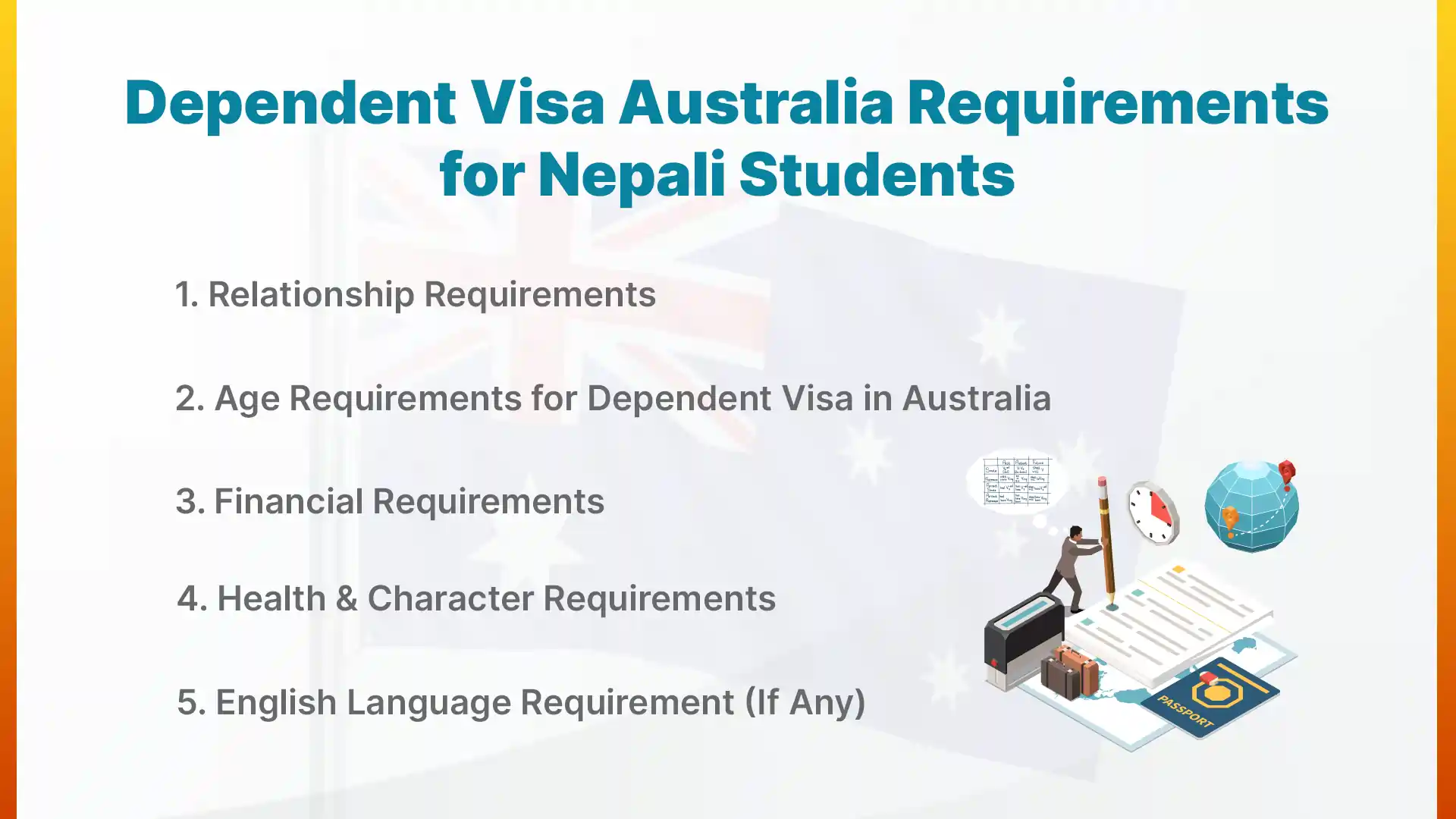
1. Relationship Requirements
Dependents must prove a genuine relationship with the student visa holder. This usually includes a marriage certificate for spouses or de facto partners. Applicants may also need to show proof of a genuine relationship, such as photos, messages, or joint bank accounts. Additionally, evidence of living together or shared responsibilities strengthens the application.
2. Age Requirements for Dependent Visa in Australia
Dependent children must meet the age requirement for a dependent visa in Australia, typically under 18 years. Children over this age may qualify if they are full-time students and financially dependent on their parents. The rules ensure that only genuine dependents are included. When a child turns 18, they may need to apply for a different visa if they wish to stay in Australia.
3. Financial Requirements
Applicants must show they have minimum funds for dependents to cover living costs in Australia. This includes tuition, accommodation, and daily expenses for family members. The living cost calculation often depends on the number of dependents and whether they are joining from Nepal. The primary student is usually responsible for financial sponsorship, ensuring the family can live comfortably.
4. Health & Character Requirements
All dependents must meet Australia’s health and character standards. Medical check-ups are required to ensure no major health risks. Police clearance certificates prove that applicants have no criminal history. Meeting these requirements is essential for visa approval in Australia and helps maintain safety standards.
5. English Language Requirement (If Any)
In most cases, dependents do not need to show English proficiency. However, some exceptions apply if a dependent plans to work or study in certain programs. Students should check the current rules before applying. Meeting any required English standards ensures smoother processing and avoids unnecessary delays.
How to Apply Dependent Visa for Australia from Nepal?
To apply for a dependent visa for Australia from Nepal, you must submit an online application through ImmiAccount with all the required documents for your family members. This includes relationship proof, financial evidence, and completed health and character checks. Below is a step-by-step guide to help you complete the process correctly and without confusion.
Step 1: Check Eligibility
Before applying, ensure that all dependents meet Australia’s eligibility criteria. This includes verifying the relationship, age limits for children, and financial capability to support dependents. Check if any dependent has health or character issues that need attention before applying. Confirming eligibility early prevents wasted time and avoids unnecessary complications during the application process.
Step 2: Prepare Required Documents
Gather all documents carefully, as missing papers are a common reason for delays. You will need marriage certificates, birth certificates, financial proof, and relationship evidence like photos or joint accounts. Medical records and police clearance certificates should also be ready. Organizing documents neatly in advance ensures a smoother submission and demonstrates credibility to immigration authorities.
Step 3: Create ImmiAccount
All dependent visa applications must be submitted through Australia’s ImmiAccount portal. Create an account online and link it to the primary student visa application if required. The account allows you to upload documents, track application status, and receive official updates. Using ImmiAccount correctly is crucial, as manual submissions are not accepted for offshore dependents.
Step 4: Submit Dependent Visa Application
Once documents are ready, complete the online application form in ImmiAccount. Double-check all information to avoid errors, especially names, dates, and passport details. Attach scanned copies of all supporting documents in the correct format. After submission, you will receive an acknowledgement, which you should keep safe for future reference.
Step 5: Biometrics & Health Checks
Most dependents must provide biometric information and complete medical examinations at authorized centers. Schedule appointments promptly after submission to avoid delays. Send medical results directly to the Department of Home Affairs, which are valid for a limited period. Completing these steps accurately ensures there are no hold-ups in processing your dependent visa.
Step 6: Await Decision
After submission and medical checks, wait for the Department of Home Affairs to process the application. Processing times vary depending on the number of dependents, document completeness, and seasonal application volumes. You can track your application status through ImmiAccount. Once approved, you will receive a visa grant notice with conditions and travel instructions.
This step-by-step approach makes it easier to understand how to apply for a dependent visa for Australia from Nepal and reduces mistakes that can delay approval. If you want a smoother, faster process with fewer risks, seeking support from the best education consultancy for Australia in Nepal can really help. The right experts guide you through documents, finances, and timelines, giving you confidence at every step.
Can Dependents Work or Study in Australia?
Yes, dependents can work or study in Australia, but their rights depend on the student’s course level. Spouses or partners may be allowed to work either limited or unlimited hours based on whether the student is studying a Bachelor’s, Master’s, or PhD. Children can study in Australian schools during the student’s visa period. However, all dependents must follow visa conditions, especially rules related to work hours and schooling.
1. Work Rights for Spouse
A spouse or de facto partner on a dependent visa is usually allowed to work in Australia. If the student is studying a Bachelor’s degree, the partner can work up to 48 hours per fortnight while classes are running and full-time during breaks. If the student is studying a Master’s (coursework or research) or PhD, the partner usually gets unlimited work rights. Because work conditions depend on the student’s course, checking visa conditions before starting work is very important.
2. Study Options for Dependent Children
Dependent children can study in Australia at primary or secondary schools. They can attend local government or private schools and experience the Australian education system. However, most dependent children must pay school fees, even in public schools. Families should plan for these costs early to avoid financial stress later.
3. Schooling Rules for Minors
School-aged children must attend an approved school and follow attendance rules. Full-time study is usually required for minors on a dependent visa. Children under 18 are not allowed to work unless they hold a separate work visa. Following these rules helps avoid visa problems and keeps the child’s education on track.
Dependent Visa Process for Australia
The dependent visa process for Australia includes several stages, from preparing documents to receiving the final visa decision. Dependents can apply onshore if they are already in Australia or offshore if they are applying from Nepal. Understanding how the process works and how long it usually takes helps families plan travel, schooling, and finances with confidence. Using ImmiAccount to track the application also makes the process less stressful.
1. Onshore vs Offshore Process
Onshore applications are submitted from within Australia and may move slightly faster due to easier document verification. Offshore applications, common for Nepali dependents, require biometrics, medical exams, and police clearance before approval. Both routes need strong relationship proof and complete documents. Choosing the correct application pathway reduces delays and avoids complications.
2. Australia Dependent Visa Processing Time
For most student dependent visas (Subclass 500), the Australia dependent visa processing time is usually around 3 to 6 months after full submission. However, timelines can be shorter with complete documents or longer if extra checks are required. Relationship verification, health checks, and background assessments all affect how fast a decision is made.
3. Common Delays and Intake Season Impact
Delays often happen due to missing documents, weak relationship evidence, or pending medical reports. Processing times may also increase during peak student intake periods, especially in February and July. Applying at least 3–4 months early helps avoid delays caused by high application volume.
Applicants can track their dependent visa status through ImmiAccount in real time. Updates include document requests, biometric confirmation, and visa grant notices. Keeping copies of all submissions and responding quickly to requests helps move the application forward smoothly.
How Much Does a Student Dependent Visa Cost in Australia?
A student dependent visa for Australia costs AUD 1,225 for adults and AUD 400 for children under 18. On top of that, you must budget for medical checks, biometrics, health insurance, and schooling costs if children are involved. Below, we break down each cost in detail to help you plan your budget:
1. Visa Application Fee
For a Student Visa (Subclass 500) application, the visa fee for a dependent aged 18 or above is AUD 1,225, while for a child under 18, it is AUD 400. These fees are charged per dependent and are non-refundable. Since fees can change, it’s best to confirm the exact amount using the official visa pricing estimator before applying.
2. Medical and Biometrics Cost
Each dependent must complete a health check and biometrics. In Nepal, medical exams cost around NPR 9,000 (AUD 100–120) for adults and about NPR 5,900–6,400 (AUD 80–100) for children. Biometrics fees are NPR 2,308 (around AUD 25–30) per person. These are mandatory and paid separately from the visa fee.
3. OSHC for Dependents
Overseas Student Health Cover (OSHC) is compulsory for all dependents. A family OSHC plan usually costs AUD 4,600–6,000 per year for a couple, while larger families may pay around AUD 8,900–12,000+ per year, depending on the provider and number of members. Comparing approved providers can help reduce costs, especially for multi-year cover.
4. Schooling Cost (If Applicable)
Dependent children must usually pay full fees to attend school, even in public schools. School fees generally range from AUD 4,200 to 16,200 per year, depending on the state and whether the child is in primary or secondary school. Some states offer family caps or sibling discounts, so checking early can help with budgeting.
Can Dependents Join Later After Student Visa Approval?
Sometimes, students receive their visa first and decide to bring family members later. The good news is, yes, dependents can be added after the student visa is granted. But, this requires a separate dependent visa application.
In this case, timing is important, as the dependent must apply before the student visa expires, and all eligibility criteria still apply. Planning in advance helps avoid last-minute stress and ensures family members can join smoothly.
1. Adding Dependents After Visa Grant
To add dependents after your visa approval, you must submit a new application through ImmiAccount for each family member. Each dependent will need to meet the same relationship, age, financial, and health requirements as if applying initially. This process can take several months, so starting early gives enough time for visa processing before travel. Keeping copies of your original student visa documents and proof of ongoing studies helps strengthen the dependent application.
2. Additional Documents Needed
Additional documents usually include:
- updated relationship evidence
- proof of continued study or enrollment
- financial documents showing you can support your dependents
- Medical checks and police clearance certificates may also be required for each new applicant.
Ensuring that all documents are complete and clear reduces delays and increases the likelihood of approval. Proper preparation is key when adding dependents after your student visa has already been granted.
Common Reasons Dependent Visa Applications Get Rejected
Even when students carefully apply for a dependent visa, some applications are refused. Understanding the common reasons helps Nepali students avoid mistakes and increases the chances of approval. The main causes include financial issues, weak proof of relationship, incomplete documents, or choosing the wrong visa subclass. Addressing these areas carefully can make the application process smoother and less stressful.
1. Insufficient Funds
One of the top reasons for rejection is insufficient funds to support dependents in Australia. Applicants must show that they can cover living costs, tuition (if applicable), and other expenses for the family. Bank statements, savings proof, or sponsorship documents should be clear and sufficient. Without adequate financial evidence, the Department of Home Affairs may refuse the visa.
2. Weak Relationship Proof
If the relationship between the student and dependent is not clearly demonstrated, the application may be rejected. Simple documents like marriage certificates or birth certificates are not always enough. Additional proof, such as joint bank accounts, photos, communication history, or shared bills, strengthens the case. Clear evidence helps immigration officers trust that the dependent genuinely relies on the student.
3. Incomplete Documentation
Missing or unclear documents are a common cause of delay or refusal. Every required form, certificate, and evidence must be submitted in the correct format. Even minor mistakes like incorrect names or mismatched dates can lead to rejection. Organizing documents properly and double-checking everything is crucial for a successful application.
4. Incorrect Visa Subclass
Applying under the wrong visa subclass can automatically lead to refusal. Dependents must apply under the correct category linked to the student’s visa, usually Subclass 500. Using another subclass or misunderstanding the eligibility rules may invalidate the application. Verifying the correct subclass before submission saves time, money, and stress.
Tips to Improve Dependent Visa Success Rate from Nepal
Applying for a dependent visa can feel challenging, but careful preparation greatly increases your chances of success. By focusing on key areas such as documents, finances, timing, and guidance, Nepali students can avoid common pitfalls and make the process smoother. Here are practical tips to help your application stand out and get approved faster.
1. Meeting the Complete Document Checklist
A complete and well-organized document set is the foundation of a strong application. Make sure to include marriage or birth certificates, relationship proof, financial statements, health and police clearances, and any other required forms. Double-check that names, dates, and details match across all documents. Submitting a thorough and accurate document set reduces requests for additional information and prevents unnecessary delays.
2. Clear Financial Planning & Smart Budgeting
Showing that you can support dependents in Australia is critical for visa approval. Calculate living costs, tuition (if applicable), and insurance needs for your family before applying. Keep bank statements, sponsorship letters, or income proofs clear and updated. Proper financial planning demonstrates credibility to immigration authorities and strengthens your application.
4. Timing the Application from the Start
Applying early gives you enough time to meet all requirements and avoid last-minute stress. Consider applying at least 3–4 months before your dependents plan to travel, especially before academic intakes in February or July. Early applications reduce pressure from peak season delays and give time for completing medical and biometric checks. Planning your application timeline carefully ensures a smoother process.
5. Role of Professional Guidance
Experienced education consultants or migration advisors can help you navigate complex rules and avoid common mistakes. They can review your documents, advise on financial proof, and suggest the best application strategy. While not mandatory, professional guidance often saves time, reduces errors, and improves approval chances. Working with trusted experts ensures your dependent visa application is complete and credible.
Conclusion
You can bring your family with you to Australia. More than a permission, it is a privilege to be able to live with your loved ones close while chasing your dreams. Being together eases the stress of studying abroad and turns lonely challenges into shared experiences.
Understand the eligibility rules thoroughly, prepare documents carefully, and plan finances and health requirements. The dependent visa process can be smoother and faster. Starting early and seeking guidance from experienced Australian education advisors in Nepal can remove uncertainty and give you confidence.
With proper preparation, you don’t just secure visas; you create a supportive, happy environment for your family while focusing on your studies, making your journey abroad both successful and truly fulfilling. If you feel the need for professional guidance to apply with your dependent, partner with the best consultancy in Nepal for Australia. Their certified counsellors help you avoid common mistakes and simplify your entire journey.