Requirements for Dependent Visa in Australia for Nepali Students

Jan 29, 2026
Leaving for Australia to study is exciting. New campus, new city, new opportunities. But for many Nepali students, there’s one heavy question that quietly follows the dream: “Can I take my family with me… or do I have to leave them behind?”
The thought of staying away from your spouse or children for years can feel stressful and lonely. And when you start searching online, the visa rules, documents, and money requirements often look confusing and overwhelming. It’s easy to feel lost before you even begin.
The good news? Australia does allow dependents on a student visa, if you meet the right requirements and prepare properly. In this guide, you’ll learn all the requirements for a dependent visa in Australia, eligibility, documents, costs, processing time, and the exact process to bring your loved ones with confidence.
In this blog
What is an Australian Dependent Visa?
An Australian dependent visa is a special visa that allows your immediate family members to join you in Australia while you study. It’s designed for students who hold a subclass 500 student visa, so your spouse, partner, or children can legally live with you during your course.
This visa is not just about being together, it also gives your family certain rights. For instance, your spouse may be eligible to work, and your children can attend school in Australia.
In short, if you’re planning to study in Australia but don’t want to be separated from your loved ones, a dependent visa is the official pathway. It ensures your family stays close, supported, and legally recognized while you focus on your studies.
Who Can Apply as Your Dependent in Australia?
Your dependents in Australia are generally your spouse, partner, or children who rely on you financially. This visa ensures that close family members can live with you legally while you study, giving your family the support and stability they need. Let’s break down exactly who qualifies and who does not, so you can see if your family members are eligible.
1. Spouse or Partner
Your husband, wife, or de facto partner can apply as a dependent. The relationship must be genuine and legally recognized, which means marriage certificates or proof of living together may be required. Australia looks for proof that the relationship is real and ongoing. Partners who meet these criteria can live, and in many cases work, in Australia while you study.
2. Children (Biological/Adopted)
Biological and legally adopted children are eligible to join you. They must be under a certain age or financially dependent on you if older. Children on a dependent visa can attend school and receive healthcare under your insurance plan. Proof of birth or adoption is usually required to show the parent-child relationship.
3. Stepchildren
Stepchildren, who are children of your spouse from a previous relationship, can also apply. They must be dependent on you financially and usually under 18 years old, or meet the dependency requirement if older. Documents like custody papers or adoption consent may be needed to confirm eligibility.
4. Who is NOT Eligible (Parents, Siblings, Cousins)
Parents, siblings, cousins, or other extended family members cannot apply as dependents. Australia only allows immediate family members who rely on the student for financial support. This ensures the visa focuses on close family living with you while you study.
What Documents Are Required for a Dependent Visa in Australia from Nepal?
To apply for a dependent visa in Australia from Nepal, you need documents that prove identity, relationship, finances, health, and the student’s enrolment. These papers help immigration confirm your family is genuine, financially supported, and eligible to live in Australia. Below, we break down each type of document and what you’ll need to prepare to bring your dependent to Australia:
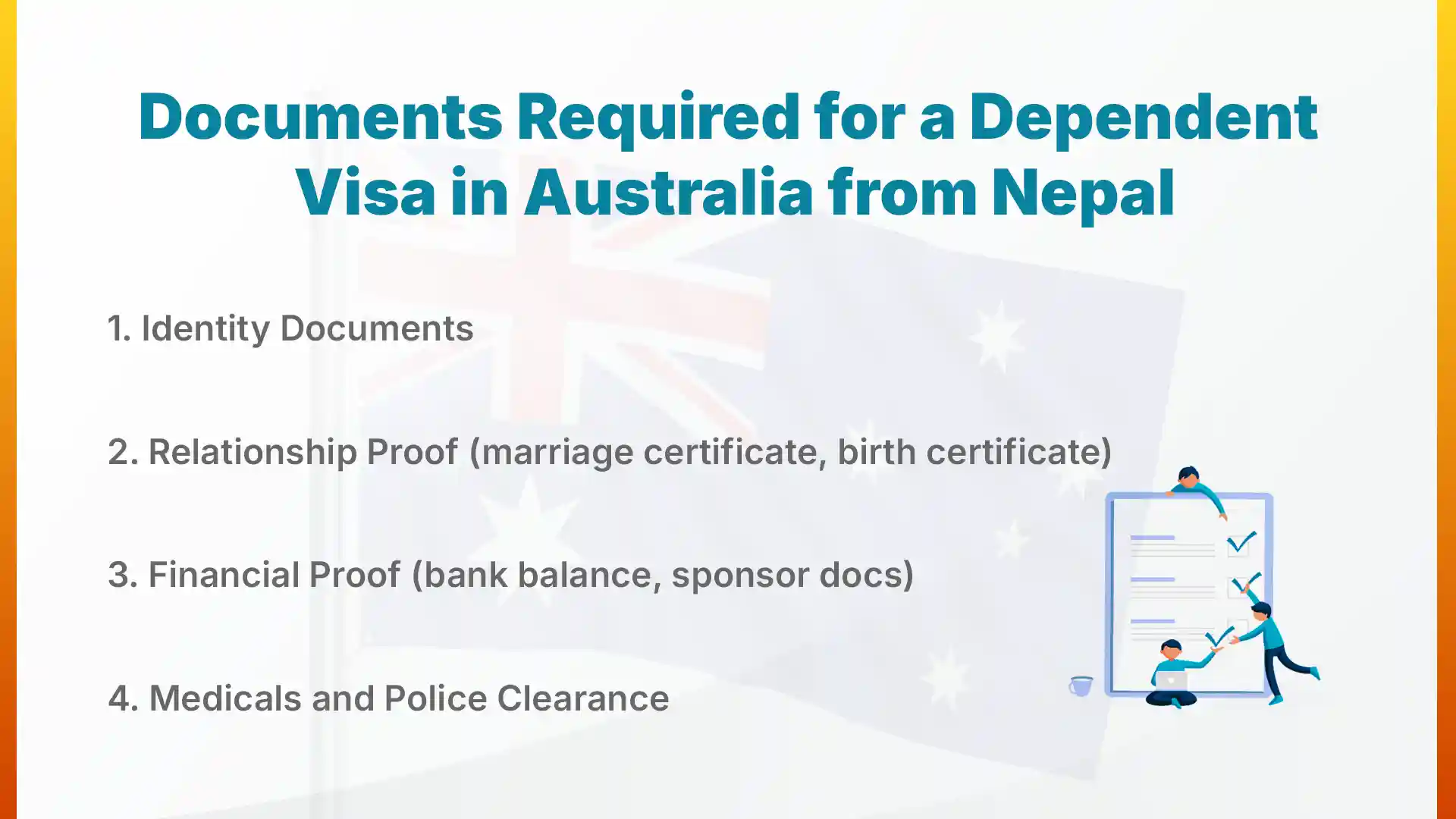
1. Identity Documents (For Student and All Dependents)
Identity documents are the foundation of your visa application. They confirm who you and your dependents are and prevent any confusion with names or personal details. Immigration authorities rely on these documents to match your personal information across all forms and certificates.
- Valid passport (including bio page and any old passports)
- Recent passport-size photographs
- Citizenship certificate (if applicable)
- National ID card (if available)
- Birth certificate
- Name change certificate (if applicable)
2. Relationship Proof Documents
These documents show that your dependents are genuinely related to you and eligible to come along. For a spouse, authorities want evidence of a real and ongoing relationship, while for children, the proof establishes parentage or custody. Proper relationship proof helps avoid delays or doubts during visa processing.
For Spouse/Partner:
- Official marriage certificate
- Wedding photos
- Joint bank account statements
- Chat or call history to show communication
- Joint rental agreement or same address proof
- Social media or family event photos (optional support)
For Children:
- Birth certificate showing parents’ names
- Adoption papers (if adopted)
- Custody papers (if one parent is not traveling)
- Parental consent letter (if required)
3. Financial Proof / Funds Evidence
Financial documents are critical because Australian authorities need assurance that you can support your family while studying. This includes everyday living costs, tuition fees, and travel expenses. Strong financial proof reduces the risk of visa refusal due to insufficient funds.
- Recent bank statements (3–6 months)
- Bank balance certificate
- Fixed deposit (FD) certificates
- Education loan sanction letter (if applicable)
- Sponsor letter (if parents or guardian are sponsoring)
- Sponsor’s citizenship/passport copy
- Sponsor’s income proof (salary slip, business registration, tax return)
- Proof of tuition fee payment
- Estimated living cost calculation
4. Academic & Student Visa Documents (Main Applicant)
These documents show that the main applicant is a genuine student enrolled in a recognized Australian course. They also confirm your academic background and eligibility for the student visa. Immigration officials review these to ensure you meet the study requirements and comply with visa conditions.
- Confirmation of Enrolment (COE)
- Offer letter from university/college
- Fee payment receipts
- Academic transcripts and certificates
- English test result (IELTS/PTE, if applicable)
- Student visa grant letter (if already approved)
- Overseas Student Health Cover (OSHC) policy
5. Genuine Student (GS/GTE) Supporting Documents
Genuine student documents demonstrate your real intent to study in Australia. They also show ties to your home country, helping authorities understand your plans. These papers are important to satisfy the Genuine Temporary Entrant (GTE) requirement for the student visa.
- Statement of purpose for Australia / GS Statement
- Study plan
- Career goals explanation
- Proof of ties to Nepal (family, property, job)
- Previous study or work history documents
6. Medical and Health Documents
Health documents confirm that you and your dependents meet Australia’s medical requirements. Medical clearance ensures that you do not pose a public health risk. This step also protects your family by making sure you receive proper health coverage.
- Medical examination report from approved panel hospital
- Chest X-ray report
- Blood test results
- eMedical/HAP ID confirmation
- OSHC coverage for all family members
7. Character and Police Clearance Documents
Character documents are required to prove that you and your dependents have no criminal record. This is a standard check for all applicants over a certain age. It helps Australia ensure that only people of good character are allowed to enter and live in the country.
- Police clearance certificate (from Nepal Police)
- Police reports from other countries (if lived abroad 12+ months)
- Character declaration forms
8. Additional Documents (If Applicable)
Some cases may need extra paperwork to clarify personal circumstances. These documents are only required when relevant, but having them ready can prevent delays. They support special situations like divorce, custody, or name changes.
- Divorce certificate (if previously married)
- Death certificate of former spouse (if widowed)
- Custody/guardianship papers
- Name spelling correction affidavit
- Translation of Nepali documents into English
- Form 1229 (parental consent for minors, if required)
9. Online Application Documents
When applying online, all documents need to be submitted in digital format. Having organized PDFs and completed forms reduces mistakes and processing delays. This ensures a smooth submission process through your ImmiAccount.
- ImmiAccount login details
- Completed visa forms
- Scanned copies of all originals (PDF format)
- Visa fee payment receipt
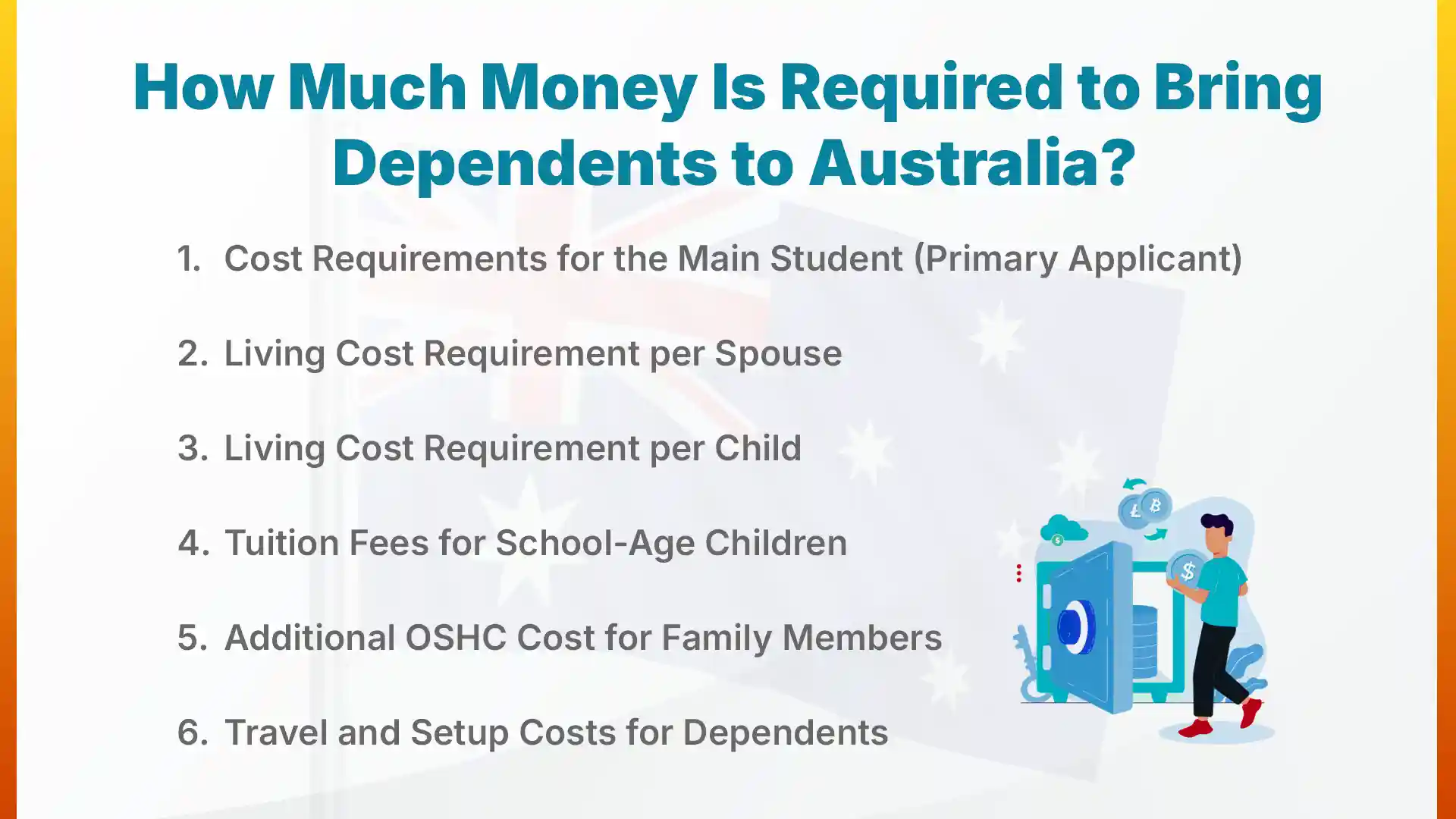
How Much Money Is Required to Bring Dependents to Australia?
To study in Australia, a student needs about AUD 20,000–35,000 for their own tuition, living costs, health insurance, travel, and settling in. Bringing a spouse or child adds around AUD 26,000–38,000 for their visa, living, school, health insurance, travel, and setup. This shows roughly how much money you need for the first year to live and study with your family in Australia.
1. Cost Requirements for the Main Student (Primary Applicant)
The initial year cost for a student moving to Australia from Nepal typically ranges between AUD 20,000–35,000, depending on the city and course. This includes tuition fees, living expenses, health insurance, travel, and setup costs. Below, we break down each category so you know what to budget for before departure.
Cost Category | 2026 Updated Estimates (AUD) |
| Tuition Fees | $25,000 – $55,000+ per year (Higher for Medicine/Go8) |
| Annual Living Cost | $29,710 per year (Official Government Requirement for 2026) |
| Student Visa (Subclass 500) | $2,000 (Base fee as of 2026) |
| Health Insurance (OSHC) | $650 – $1,000 per year (Single coverage) |
| Settlement & Travel | $3,500 – $5,000 (Flights, Bond, Essentials, Tech/Laptop) |
2. Cost to Bring Dependents to Australia
Bringing your spouse and children to Australia in the initial year typically requires around AUD 26,000–38,000 in total. This estimate includes visa application fees, living expenses, schooling (if applicable), health insurance, travel, and setup costs for your family. Below is a clear breakdown of the main cost areas so you can plan your budget confidently.
Cost Category | 2026 Updated Estimates (AUD) |
| Visa Fee – Spouse | $1,225 (Adult dependent base fee) |
| Visa Fee – Child | $400 (Per child under 18) |
| Living Cost – Spouse | $10,394 (Official 2026 financial requirement) |
| Living Cost – Child | $4,449 (Per child; government standard) |
| Schooling for Children | $13,502 – $18,000 (Varies by state: NSW/VIC/QLD) |
| Family Health Insurance | $4,500 – $7,500 (Comprehensive family OSHC plan) |
| Total Setup & Travel | $5,000 – $8,000 (Flights, Bond, and initial household setup) |
3. Bank Balance Requirement to Study with Dependents in Australia
To study in Australia with your family, you need to show enough funds in your bank account for yourself and your dependents. For the initial year, this typically means around AUD 21,041 for the primary student, AUD 10,394 for a spouse, AUD 4,449 for each child, and an extra AUD 13,502 for each school-aged child’s tuition. Planning this early ensures your visa application is strong and your family can settle comfortably.
Dependent / Applicant Type | 2026 Minimum Bank Balance |
| Primary Student | AUD 29,710 |
| Spouse / Partner | AUD 10,394 |
| Each Child | AUD 4,449 |
| School-Age Tuition (Per Child) | AUD 13,502* |
4. Student and Dependent Visa Fees – Subclass 500
The student dependent visa fee for Australia is about AUD 1,225 for a spouse or adult and AUD 400 for a child under 18. This is in addition to the primary student’s visa fee of around AUD 650–700. Below, we break down all the visa fees for the student and dependents to help you plan your budget.
Applicant / Dependent Type | 2026 Visa Fee |
| Primary Student | AUD 2,000 |
| Spouse / Adult Dependent (18+) | AUD 1,225 |
| Child Dependent (Under 18) | AUD 400 |
Australia Dependent Visa Processing Time
The processing time for a dependent visa in Australia usually takes 6–12 months. This depends on whether your application is complete, the number of dependents, and whether any extra checks (like health or character) are required. Planning ahead and submitting all documents correctly will make the process smoother and faster.
1. Onshore vs Offshore Difference
If your dependents are applying from Nepal (offshore), processing generally takes 6–12 months. This is because applications are assessed from outside Australia and may require extra verification.
If your dependents are already in Australia (onshore), the process can be faster, around 4–8 months, as some checks may already be on file. However, timing depends on the student visa type and individual circumstances.
2. When to Apply, Together or Later?
You can choose to apply for your dependents at the same time as your student visa, or after you arrive in Australia. Applying together can save time and ensures all visas are linked, which makes travel and entry easier. Applying later gives you flexibility to settle first, but it may extend the waiting time for your family to join you.
3. Tips to Avoid Delays
To avoid unnecessary delays, make sure you submit complete and accurate documents for identity, relationship, finances, health, and police clearance right from the start. It’s also smart to book your medical exams and police checks early, as appointments can fill up quickly and cause waiting time. When uploading files, ensure everything is clear, properly scanned, and saved in the correct PDF format on ImmiAccount. Most importantly, follow all instructions carefully, because even small mistakes or missing details can slow down your visa decision.
Can Dependents Work or Study in Australia?
Yes, dependents of student visa holders in Australia can both work and study, but there are rules and limits depending on their age and relationship to the main student. Understanding these rights helps you plan your family’s life and finances while studying in Australia.
1. Work Rights for Spouse
Spouses of student visa holders are generally allowed to work in Australia. This can help cover living costs and give them valuable experience. However, work rights are linked to the student visa, so the spouse must maintain a valid dependent visa throughout their stay.
2. Work Hours Rules
Spouses can usually work up to 48 hours per fortnight during the student’s study period for most courses, but if the student is in a master’s by research or PhD program, spouses can work unlimited hours. Following these rules is important to avoid breaching visa conditions.
3. Children’s Schooling Rights
Children who come as dependents must attend school in Australia if they are of school age. They have the right to enroll in public or private schools, but tuition fees may apply depending on the school type. Ensuring enrollment and regular attendance is also a visa requirement.
4. Health Insurance Requirement
All dependents must have Overseas Student Health Cover (OSHC) for the entire duration of their stay. This ensures access to medical services and protects the family in case of illness or emergencies. Maintaining a valid OSHC is mandatory for visa compliance.
Should You Apply Together or After Reaching Australia?
When bringing your family to Australia, you can either apply for dependent visas at the same time as your student visa or after you arrive in Australia. Both options have advantages and disadvantages depending on your situation, finances, and timing. Knowing the pros and cons helps Nepali students decide the best approach for their families.
1. Applying Together
Applying together means your spouse and children can travel with you at the same time, and all visas are linked, making entry and travel smoother. It also reduces the chance of extra processing later. You need to show enough funds for the whole family upfront, and any mistakes in documents can delay everyone’s visas. Processing may also take longer if extra checks are needed for dependents.
2. Applying Later
Applying later lets you settle first and manage finances before your family joins. It can reduce stress if your funds or documents aren’t ready initially. Your family will have to wait longer before joining you, and you may have to handle separate applications and additional fees later.
2. Which Option is Better for Nepali Students?
For most Nepali students, applying together is usually better if you have the funds and documents ready, because your family can move with you immediately. If funds are limited or paperwork is incomplete, applying later is an option, but it means your spouse and children join you after a few months.
Conclusion
Bringing your family to Australia while you study is absolutely possible, but it works best when you plan your finances and documents well in advance. Start preparing early, gather all necessary paperwork, and understand the costs and visa requirements so nothing surprises you along the way.
Thousands of Nepali students and their families have successfully made this journey, living, studying, and working together in Australia, proving that careful planning makes it achievable.
If you feel unsure about the process, consider reaching out to the best education consultancy for Australia in Nepal for professional guidance. The right support can help you avoid mistakes, save time, and make your family’s move smooth and stress-free.