Study Finance in Australia: Top Universities, Cost & Scope

Jun 19, 2026

Australia is one of the most strategically positioned destinations in the world for finance education, home to globally ranked business schools, a sophisticated financial services sector, strong connections to Asia-Pacific capital markets, and one of the most accessible PR pathways for finance graduates among all major English-speaking study countries.
For Nepalese students who want a finance degree that opens doors in banking, investment, accounting, and corporate finance at both regional and global levels, Australia offers an outstanding combination of education quality, industry exposure, and long-term career opportunity. Nepalese students who are still exploring their options can start by reading about studying in Australia before committing to a specific program.
In this blog
Why Study Finance in Australia?
Australia is a strong choice for finance education because of its globally recognized degrees, active financial services industry, strong internship and placement networks, affordable tuition compared to the UK and USA, and a clear PR pathway through finance occupations. This is a key part of why Nepalese students choose Australia for business and finance programs.
1. Globally Recognized Finance Degrees
Australian finance degrees from Group of Eight universities are recognized by the CFA Institute, CPA Australia, ACCA, and major international financial institutions. For Nepalese graduates, an Australian finance qualification is a credential that is respected by employers across South Asia, Southeast Asia, the Middle East, and globally.
2. Strong Industry Connections and Internship Opportunities
Most Australian finance programs include mandatory internship or work-integrated learning components, and universities in Sydney and Melbourne have direct partnerships with the Big Four accounting firms, major Australian banks, investment funds, and financial services companies. These connections give finance graduates a professional head start that is difficult to match at institutions without active industry engagement.
3. High Demand for Finance Professionals
Australia's financial services sector is one of the country's largest and most active, encompassing banking, superannuation, insurance, investment management, and fintech. The sector consistently reports shortages of qualified finance professionals, and this demand is projected to grow as Australia expands its role as a regional financial hub for the Asia-Pacific.
4. Affordable Tuition Compared to UK and USA
Finance degree tuition fees in Australia are significantly lower than equivalent programs at leading business schools in the UK, USA, and Canada. Combined with Australia's strong post-study work visa and PR pathway, an Australian finance degree represents outstanding value for Nepalese students investing in a high-earning career.
5. Pathway to PR Through Finance Occupations
Accountants, financial analysts, and finance managers are listed as skilled occupations under Australia's immigration system. After completing a finance degree and gaining Australian work experience through the Subclass 485 Temporary Graduate Visa, Nepalese graduates are well-positioned to apply for permanent residency through the Skilled Independent Visa (189) or State Nomination (190).
What Finance Programs Are Available in Australia?
Australia offers four finance program pathways for international students: Bachelor of Finance, Master of Finance, MBA with Finance Specialization, and Graduate Certificate or Diploma in Finance, each suited to a different qualification level and career goal.

1. Bachelor of Finance / Bachelor of Commerce (Finance)
Duration: 3 years
Entry requirement: Grade 12 / Plus Two with satisfactory results
Career outcome: Financial analyst, junior accountant, banking associate, investment analyst
Key point: Most Australian undergraduate finance programs are offered as a Bachelor of Commerce with a Finance major rather than a standalone Bachelor of Finance: The career outcomes are identical
2. Master of Finance / Master of Applied Finance
Duration: 1.5 to 2 years
Entry requirement: Bachelor's degree in any discipline
Career outcome: Senior financial analyst, portfolio manager, risk manager, corporate finance officer
Key point: The Master of Applied Finance is a professional program with strong industry links; the Master of Finance is more research-oriented. Choose based on your career direction
3. MBA with Finance Specialization
Duration: 1.5 to 2 years
Entry requirement: Bachelor's degree plus 2 to 5 years of work experience (varies by institution)
Career outcome: Finance director, CFO, investment banker, management consultant
Key point: The MBA carries the highest salary potential of all finance qualifications and is best suited for students with prior professional experience
4. Graduate Certificate / Diploma in Finance
Duration: 6 months to 1 year
Entry requirement: Bachelor's degree in any discipline
Career outcome: Entry-level finance roles, pathway to Master of Finance
Key point: The Graduate Certificate is the most accessible and fastest pathway to an Australian finance qualification for Nepalese students with a non-finance undergraduate background
Which Are the Top Universities to Study Finance in Australia?
The top universities to study finance in Australia include the University of Melbourne, the University of Sydney, UNSW Sydney, Monash University, and the University of Queensland, all offering finance programs with strong industry partnerships, CFA accreditation, and excellent graduate employment outcomes.
University | Location | Program | Known For |
|---|---|---|---|
| University of Melbourne | Melbourne, VIC | BCom (Finance), Master of Finance | Australia's Top-Ranked Finance School; CFA Institute Partner |
| University of Sydney | Sydney, NSW | BCom (Finance), Master of Commerce | Strong Investment Banking and Corporate Finance Industry Links |
| UNSW Sydney | Sydney, NSW | BCom (Finance), Master of Finance | Quantitative Finance, FinTech, Proximity to Sydney Financial District |
| Monash University | Melbourne, VIC | BCom (Finance), Master of Applied Finance | Applied Finance Focus, Strong Accounting and Finance Industry Placement |
| University of Queensland | Brisbane, QLD | BCom (Finance), Master of Finance | Asia-Pacific Finance Networks, Strong Research Output |
The University of Melbourne and UNSW Sydney are two of the best universities in Australia and strongest options for Nepalese students targeting careers in investment banking and corporate finance. Monash University is the best choice for students who want a more applied, industry-connected program with strong placement outcomes.
What Are the Admission Requirements?
The admission requirements to study finance in Australia include academic qualifications, English language proficiency, GMAT or GRE scores for some MBA programs, a personal statement, and financial documentation for the Subclass 500 Student Visa.
1. Academic Requirements
For undergraduate programs, Nepalese students must have completed Plus Two with satisfactory results, typically 65% or above. For master's and MBA programs, a completed bachelor's degree with a minimum GPA equivalent to a second-class lower (55% to 60%) is required. Competitive programs at Group of Eight universities expect a second-class upper or above (65%+). A finance, economics, business, or mathematics background is advantageous but not required for most programs.
2. English Language Requirements
All Australian finance programs require a minimum IELTS score of 6.0 to 6.5 for undergraduate and 6.5 to 7.0 for postgraduate; a TOEFL iBT score of 79 to 100; or a PTE score of 50 to 65, depending on the program level and institution.
Test | Undergraduate | Postgraduate |
|---|---|---|
| IELTS Academic | 6.0 – 6.5 Overall | 6.5 – 7.0 Overall |
| TOEFL iBT | 79 – 90 | 90 – 100 |
| PTE Academic | 50 – 58 | 58 – 65 |
Nepalese students who need to strengthen their English score can enroll in IELTS preparation classes before applying.
3. GMAT / GRE Requirements (for MBA and some Master's)
Most Australian MBA programs require a GMAT score, typically ranging from 550 to 650 for standard programs and 650 to 700+ for top-tier programs at Melbourne Business School and UNSW. Some Master of Finance programs also accept GMAT as supplementary evidence of quantitative ability. GRE scores are accepted at select institutions as an alternative to the GMAT.
4. Personal Statement
Your personal statement should explain your motivation for studying finance, your relevant academic or professional background, and your specific career goals in the financial sector. Nepalese students can follow the SOP format for Australia to structure their statement effectively.
5. Financial Proof and Visa Documentation
For the Australian Subclass 500 Student Visa, students must provide financial documentation demonstrating sufficient funds to cover tuition and living expenses. Fulfill all the requirements to study in Australia from Nepal so that you do not face any problem later while applying for a student visa.
How to Apply to Study Finance in Australia?
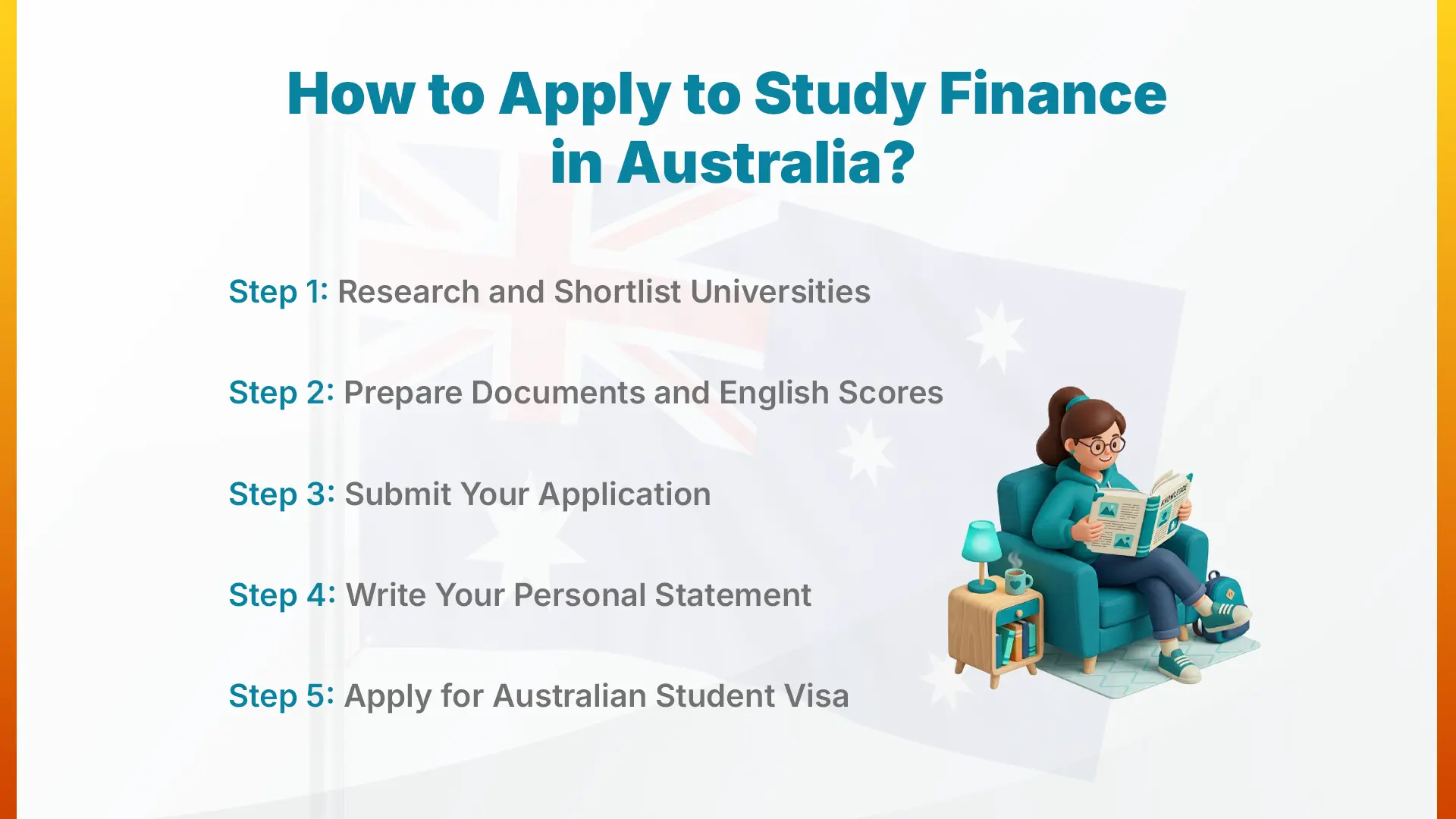
Applying to study finance in Australia involves five steps: researching and shortlisting universities, preparing documents and English scores, submitting your application, writing your personal statement, and applying for the Australian Student Visa (Subclass 500).
Step 1: Research and Shortlist Universities
Compare finance programs based on CFA accreditation, industry partnerships, internship availability, location, tuition fees, and scholarship options. Shortlist three to five universities that match your academic profile and career goals. Checking the intakes in the Australia guide early ensures you do not miss the February or July application windows.
Step 2: Prepare Documents and English Scores
Gather your Plus Two or degree transcripts, IELTS or PTE scores, GMAT scores if required, and financial documents. Book your English test early so scores are ready before application deadlines.
Step 3: Submit Your Application
Apply directly through each university's online application portal. Most Australian universities do not use a centralized application system. Apply as early as possible; popular finance programs at Group of Eight universities fill quickly.
Step 4: Write Your Personal Statement
Your personal statement should be specific about why you want to study finance, what experiences have shaped that interest, and what type of finance professional you aim to become. A generic personal statement is one of the most common weaknesses in international applications for competitive Australian finance programs.
Step 5: Apply for Australian Student Visa
Once you receive your offer letter, pay your enrollment deposit and apply for your Subclass 500 Student Visa through the Department of Home Affairs online portal using your Confirmation of Enrolment (CoE), financial documents, valid passport, and health insurance (OSHC).
How Much Does It Cost to Study Finance in Australia?
Studying finance in Australia costs between AUD 28,000 and AUD 55,000 (approximately NPR 2,520,000 to NPR 4,950,000) per year in tuition for international students, depending on the program level and institution. The cost of study in Australia from Nepal will be significantly high, so it is advised that students should carefully budget their finances and explore scholarship opportunities before applying.
Program | Annual Tuition (AUD) | Annual Tuition (NPR approx.) |
|---|---|---|
| Bachelor of Commerce (Finance) | AUD 28,000 – AUD 38,000 | NPR 2,520,000 – NPR 3,420,000 |
| Master of Finance / Applied Finance | AUD 35,000 – AUD 48,000 | NPR 3,150,000 – NPR 4,320,000 |
| MBA with Finance Specialization | AUD 40,000 – AUD 55,000 | NPR 3,600,000 – NPR 4,950,000 |
| Graduate Certificate / Diploma | AUD 18,000 – AUD 28,000 | NPR 1,620,000 – NPR 2,520,000 |
Monthly living expenses in Australia range from AUD 1,200 to AUD 2,500 depending on the city, with Sydney and Melbourne at the higher end and Brisbane, Adelaide, and Canberra being more affordable. Many Nepalese students take up part-time jobs in Australia during their studies, up to 48 hours per fortnight, to offset living costs.
Taking tuition and living expenses together, Nepalese students should budget approximately AUD 44,000 to AUD 72,000 per year in total.
What Scholarships Are Available?
Several scholarships are available for Nepalese students studying finance in Australia, ranging from fully funded government awards to university-specific merit scholarships and industry-backed funding programs.
Australia Awards Scholarship: fully funded government scholarship covering tuition, living allowance, and travel; available for postgraduate study,, including Master of Finance programs
University of Melbourne Graduate Access Melbourne Scholarship: merit-based partial tuition award for outstanding international students,, including finance programs
Monash International Merit Scholarship: up to AUD 10,000 per year for high-achieving international students entering undergraduate and postgraduate programs
UNSW Global Academic Award: merit-based tuition reduction of 20% to 30% for high-achieving international students entering UNSW finance programs
What Jobs Can You Get After Studying Finance in Australia?
Graduates with a finance degree from Australia can work as financial analysts, accountants, investment bankers, risk managers, and financial planners across banking, corporate finance, and financial services sectors in Australia and internationally.
Financial Analyst: analyzes financial data, prepares reports, and supports investment and business decisions for banks, investment funds, and corporate finance teams; the most common entry-level role for finance graduates
Accountant / CPA: manages financial records, prepares tax returns, and provides financial advisory services for businesses and individuals; eligible for CPA Australia membership with an accredited Australian finance degree
Investment Banker: structures and executes mergers, acquisitions, and capital-raising transactions for corporate clients; high-paying and highly competitive role centered in Sydney and Melbourne
Risk Manager: identifies, assesses, and manages financial risks for banks, insurance companies, and large corporations; a growing and in-demand specialization across Australia's financial services sector
Financial Planner / Wealth Manager: provides personalized financial planning and investment advice to individuals and families; it is one of the most accessible and consistently in-demand finance roles for Australian graduates
What Is the Salary and Scope After Finance in Australia?
Entry-level finance graduates in Australia earn between AUD 55,000 and AUD 75,000 per year, rising to AUD 75,000 to AUD 110,000 at mid-level, and AUD 110,000 or more for senior finance managers, investment bankers, and CFOs. Finance is one of the best courses in Australia for Nepalese students who want a high-earning career with a clear PR pathway.
Experience Level | Annual Salary (AUD) | Annual Salary (NPR approx.) |
|---|---|---|
| Entry-Level (0–2 Years) | AUD 55,000 – AUD 75,000 | NPR 4,950,000 – NPR 6,750,000 |
| Mid-Level (2–5 Years) | AUD 75,000 – AUD 110,000 | NPR 6,750,000 – NPR 9,900,000 |
| Senior Level (5+ Years) | AUD 110,000 – AUD 180,000+ | NPR 9,900,000 – NPR 16,200,000+ |
After completing their finance degree, international graduates can apply for the Subclass 485 Temporary Graduate Visa, which allows 2 to 4 years of full-time work in Australia with any employer, including finance and banking roles, without requiring employer sponsorship. This period is the most critical window for building Australian work experience and accumulating points for permanent residency.
Accountants, financial analysts, and finance managers are listed as skilled occupations on Australia's skilled occupation lists, qualifying graduates for the Skilled Independent Visa (Subclass 189) and State Nomination (Subclass 190) through the SkillSelect points system. Most Nepalese finance graduates with an Australian degree and 1 to 2 years of Australian work experience, and strong English scores accumulate sufficient points for a PR invitation within 2 to 4 years of graduating.
Conclusion
Australia offers Nepalese students an outstanding combination of finance education quality, industry exposure, high salary potential, and one of the most accessible PR pathways available in any major English-speaking study destination. Whether you are entering through a bachelor of commerce, a master of applied finance, or an MBA, a finance qualification from Australia is a credential that will serve Nepalese graduates well across the Asia-Pacific and beyond.
Interested in studying finance in Australia? Contact SAS Education Consultancy for a free counseling session and let us help you find the right program, prepare a strong application, and navigate the Subclass 500 visa process with confidence.