Master's of Social Work in Australia For International Students

Jan 27, 2026
Are you planning to build a career that creates real social change? Studying social work in Australia allows international students to gain professional knowledge, hands-on training, and global exposure. The program focuses on ethical practice, community wellbeing, and evidence-based interventions. It prepares students to work across healthcare, mental health, child protection, and community services. Australia’s strong education system and supportive learning environment make it a preferred destination for social work studies.
In this blog, we will explore masters of Social Work in Australia for international students, covering course structure, eligibility requirements, top universities, costs, scholarships, and career opportunities. You will also learn about accreditation, job demand, and post-study work options in Australia.
In this blog
What Is a Master’s of Social Work in Australia?
A Master’s of Social Work in Australia is a postgraduate professional degree that trains students to work as qualified social workers across diverse social and community settings. This program is designed to equip students with strong theoretical foundations in social justice, human behaviour, and welfare systems, along with practical skills needed for real-world practice. Australian universities emphasise ethical decision-making, critical thinking, and culturally responsive practice throughout the course.
The degree includes a significant field education component, where students complete supervised placements in approved social service organisations. These placements allow international students to gain hands-on experience in areas such as healthcare, mental health, child protection, aged care, and community development.
Most universities offer AASW-accredited programs, which are essential for professional recognition and employment as a social worker in Australia. Completing an accredited master’s program also supports future career progression, professional registration, and post-study employment opportunities.
Why Study Masters of Social Work in Australia?
Studying a master’s of Social Work in Australia is beneficial because it combines accredited education, strong job demand, and global career recognition. Australian universities focus on practical learning, ethical practice, and real-world social challenges faced by communities. International students gain hands-on experience through supervised placements and industry-aligned training. This makes graduates job-ready and well-prepared for long-term careers in social work.
1. Globally Accredited Social Work Programs (AASW Approved)
Australian social work programs are globally respected because they are accredited by the Australian Association of Social Workers (AASW). This accreditation confirms that the course meets national and professional standards required to work as a social worker in Australia. Universities follow a strict curriculum and field education guidelines set by AASW. Graduates from accredited programs are eligible for professional recognition and employment across healthcare, community services, and government sectors. AASW approval also improves international acceptance of the qualification.
2. Strong Focus on Community Welfare and Social Justice
Australian social work education strongly focuses on community welfare, social justice, and ethical practice. Students learn how to support individuals, families, and communities facing social, economic, and mental health challenges. The curriculum addresses issues such as inequality, child protection, and mental well-being. Case studies and practical learning help students understand real social problems. This approach prepares graduates to work responsibly in diverse and multicultural environments.
3. High Demand for Qualified Social Workers in Australia
There is a high demand for qualified social workers in Australia due to growing social and healthcare needs. Social workers are required in hospitals, mental health services, aged care, disability support, and community organisations. Government and non-profit sectors actively recruit trained professionals. Population growth and policy reforms have increased job opportunities nationwide. This demand offers strong employment prospects and career stability for graduates.
4. International Recognition and Migration Opportunities
A master’s of Social Work in Australia is internationally recognised and valued by employers worldwide. Graduates can pursue careers in various countries, subject to local registration requirements. Social work occupations are often included on Australia’s skilled occupation lists. This creates opportunities for post-study work visas and permanent residency pathways. Studying in Australia also provides valuable international work experience, enhancing long-term career growth.
Master’s of Social Work in Australia for International Students
A Master’s of Social Work in Australia is a popular choice for international students seeking a globally recognized qualification and strong career outcomes. Australian universities offer accredited MSW programs that combine theory, field education, and practical training. These programs are designed to meet international standards while addressing real-world social issues. Graduates are well-prepared for professional practice in Australia and other countries. The course also opens pathways to skilled migration and long-term career growth.
1. Eligibility Criteria for International Students
International students must meet specific academic, language, and visa requirements to enrol in a Master’s of Social Work in Australia. Universities carefully assess eligibility to ensure students can handle both academic coursework and field placements. Meeting these criteria is essential for admission and for complying with Australian education regulations. Requirements may vary slightly by university, but the core expectations remain similar. Early preparation helps students avoid delays in admission and visa approval.
2. Academic Background and Prerequisite Subjects
Applicants usually need a recognised bachelor’s degree from an accredited institution. Many universities prefer degrees in social sciences, psychology, sociology, or related fields. Some institutions may accept students from other academic backgrounds if they complete bridging or foundation units. Prior study in human behaviour or community development is often an advantage. Academic transcripts are reviewed to assess relevance and overall performance. A strong academic background improves admission chances.
3. English Language Requirements (IELTS, PTE, TOEFL)
International students must demonstrate English proficiency to succeed in academic and fieldwork settings. Most universities require IELTS, PTE, or TOEFL scores that meet minimum thresholds. Typically, an overall IELTS score of 7.0 with no band below 7.0 is expected for social work programs. Equivalent scores are accepted for PTE and TOEFL. Higher English scores may strengthen applications and reduce the need for additional language support.
4. Australian Student Visa (Subclass 500) Overview
International students must apply for the Australian Student Visa (Subclass 500) to study in Australia. This visa allows full-time study at a registered institution and limited work rights during the course. Applicants must show proof of enrollment, financial capacity, and genuine temporary entrant intent. Overseas Student Health Cover (OSHC) is also mandatory. The visa remains valid for the duration of the Master’s of Social Work program.
Popular Specialisations in Master's of Social Work in Australia
Master’s of Social Work programs in Australia offer several specialisations that allow students to focus on specific practice areas. These specialisations help students build targeted skills aligned with their career goals. Choosing the right specialisation can improve employability and professional confidence. Australian universities design these streams to reflect current social needs and workforce demand. Specialisations also influence field placements and future job roles.
1. Clinical Social Work and Mental Health
This specialisation focuses on working with individuals facing mental health challenges and emotional distress. Students learn assessment, counselling, and therapeutic intervention skills. The curriculum covers trauma-informed practice, case management, and mental health legislation. Graduates often work in hospitals, clinics, or community mental health services. Practical placements strengthen clinical decision-making abilities. This pathway suits students interested in direct client support roles.
2. Child, Family, and Youth Services
This specialisation prepares students to support children, families, and young people in diverse settings. It emphasises child protection, family counselling, and youth development frameworks. Students study risk assessment, safeguarding policies, and early intervention strategies. Graduates commonly work with government agencies, NGOs, and schools. Fieldwork focuses on real-life family and youth support cases. This area is in high demand across Australia.
3. Community Development and Social Policy
Community development and social policy focus on addressing social inequality at a broader level. Students learn how to design, implement, and evaluate community-based programs. The course covers policy analysis, advocacy, and social planning. Graduates often work with NGOs, local councils, and development organisations. This specialisation suits those interested in systemic change. It builds strong research and leadership skills.
4. Healthcare and Hospital Social Work
This specialisation trains students to work within healthcare systems and hospital environments. It covers patient advocacy, discharge planning, and interdisciplinary teamwork. Students gain knowledge of chronic illness, disability support, and aged care services. Graduates work in public and private hospitals or health agencies. Practical placements offer exposure to real clinical settings. Strong communication skills are essential in this field.
5. Indigenous and Multicultural Social Work
This specialisation focuses on culturally responsive social work practice. Students learn to work ethically with Indigenous communities and diverse migrant populations. The curriculum highlights cultural safety, inclusion, and anti-discriminatory practice. Graduates support community wellbeing, settlement services, and reconciliation initiatives. Field placements often involve community-based organisations. This specialisation promotes respectful and inclusive professional practice.
Top Universities Offering Master's of Social Work in Australia
Australia is home to several globally ranked universities, including Go8 universities, that offer accredited Master’s of Social Work programs. These universities are approved by the Australian Association of Social Workers (AASW). They provide strong academic foundations, practical field placements, and research-led teaching. Studying at top institutions also improves global recognition and career prospects. International students benefit from modern facilities and strong student support services.
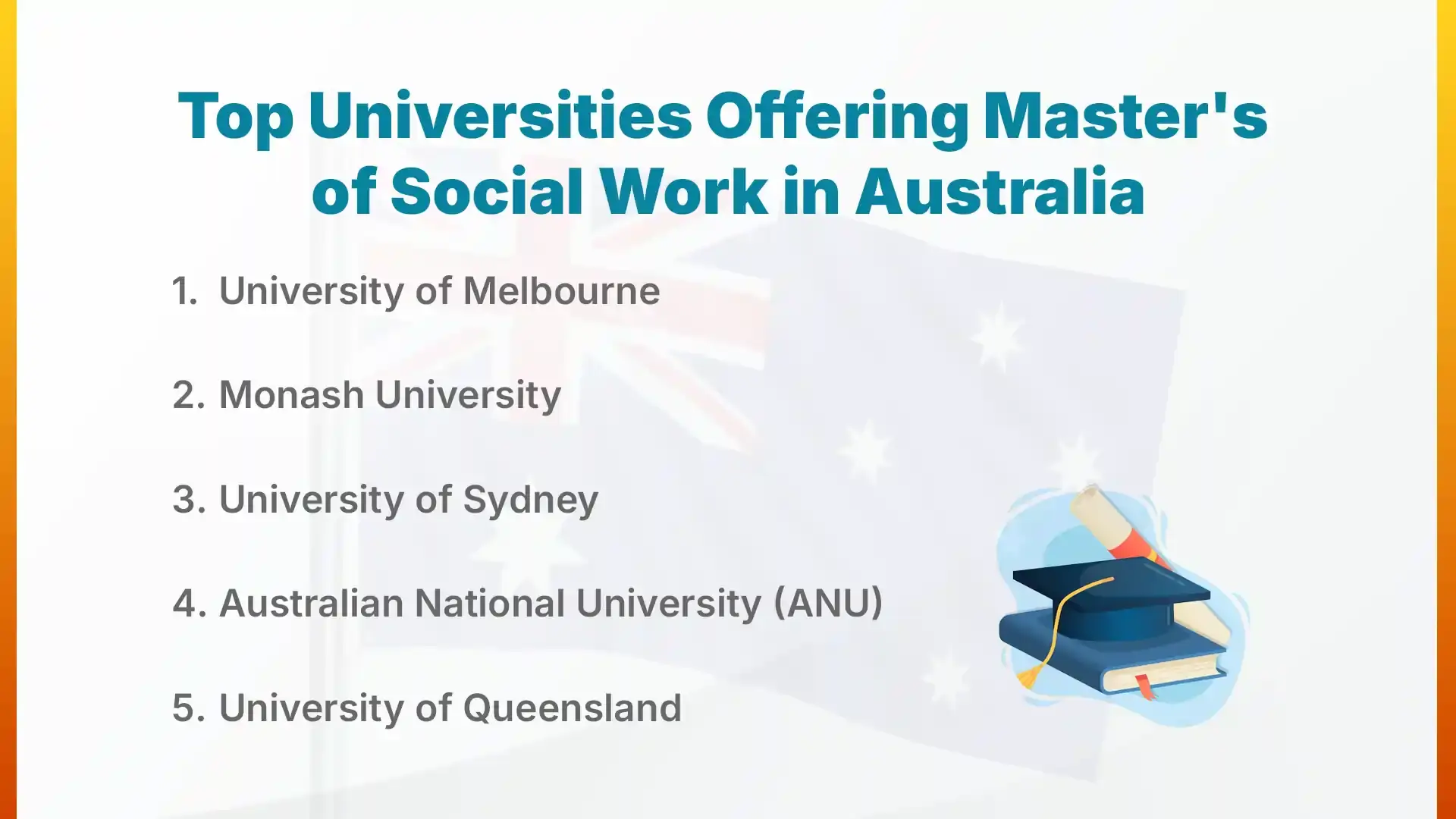
1. University of Melbourne
The University of Melbourne offers a highly respected Master of Social Work program with AASW accreditation. The course emphasises evidence-based practice and critical thinking. Students complete extensive field placements in approved social work settings. The university has strong links with hospitals, NGOs, and community organisations. Graduates are well-prepared for professional practice. The global reputation adds strong career value.
2. Monash University
Monash University provides a comprehensive and practice-oriented Master of Social Work program. The curriculum focuses on social justice, policy, and professional ethics. Students gain hands-on experience through supervised field education. Monash has strong industry partnerships across Australia. Graduates are highly employable in both government and non-profit sectors. The program supports diverse career pathways.
3. University of Sydney
The University of Sydney offers an AASW-accredited Master of Social Work with a strong research foundation. The course combines theory, policy analysis, and practical training. Students benefit from high-quality teaching and interdisciplinary learning. Field placements are integrated across community and clinical settings. Graduates are recognised for strong professional competence. The university’s global ranking enhances international opportunities.
4. Australian National University (ANU)
ANU’s Master of Social Work is known for its focus on policy, research, and community practice. The program emphasises social reform and ethical practice. Students engage with real-world social issues through field education. ANU’s location in Canberra offers exposure to policy-making environments. Graduates often pursue roles in government and advocacy. The academic environment supports critical learning.
5. University of Queensland
The University of Queensland offers a well-structured and AASW-accredited Master of Social Work program. The curriculum balances theory with practical skills development. Students complete field placements in diverse social work settings. UQ has strong research output and industry engagement. Graduates are prepared for practice across health, community, and welfare sectors. The supportive campus enhances student experience.
Course Structure and Duration of Masters of Social Work in Australia
The Master’s of Social Work in Australia is structured to combine academic learning with strong practical training. The program follows AASW guidelines, ensuring graduates meet professional and ethical standards. It focuses on building theoretical knowledge, research capability, and hands-on field experience. International students benefit from a well-balanced curriculum that prepares them for real-world social work practice. This structure supports a smooth transition into professional roles after graduation.
1. Typical Duration (2 Years Full-Time)
The Master’s of Social Work in Australia is typically completed in two years of full-time study. This duration is standard across most Australian universities for international students. The program is divided into four academic semesters. Each semester includes a mix of theory and applied learning. The two-year timeline allows in-depth skill development. It also fulfils professional accreditation requirements.
2. Coursework, Research, and Practical Placements
The course includes core subjects covering social work theory, ethics, policy, and intervention methods. Research-focused units help students develop critical thinking and evidence-based practice skills. Practical placements are integrated throughout the program. These placements allow students to apply theoretical knowledge in real work environments. The balance strengthens professional readiness. It also improves long-term career outcomes.
3. Field Education and Supervised Practice Hours
Field education is a compulsory component of the Master’s of Social Work program. Students must complete a set number of supervised practice hours as required by AASW. Placements are offered in approved settings such as hospitals, NGOs, and community organisations. Each student works under qualified professional supervision. This training builds confidence and practical competence. It plays a key role in employability after graduation.
How to Apply for Masters of Social Work in Australia?
To apply for a Master’s of Social Work in Australia, you must follow a clear and structured academic and visa process. The journey begins with choosing AASW-accredited universities that meet professional standards. International students then check academic and English eligibility carefully. Required documents must be prepared in advance to avoid delays. Once an offer is secured, the final step is completing the Australian student visa process.
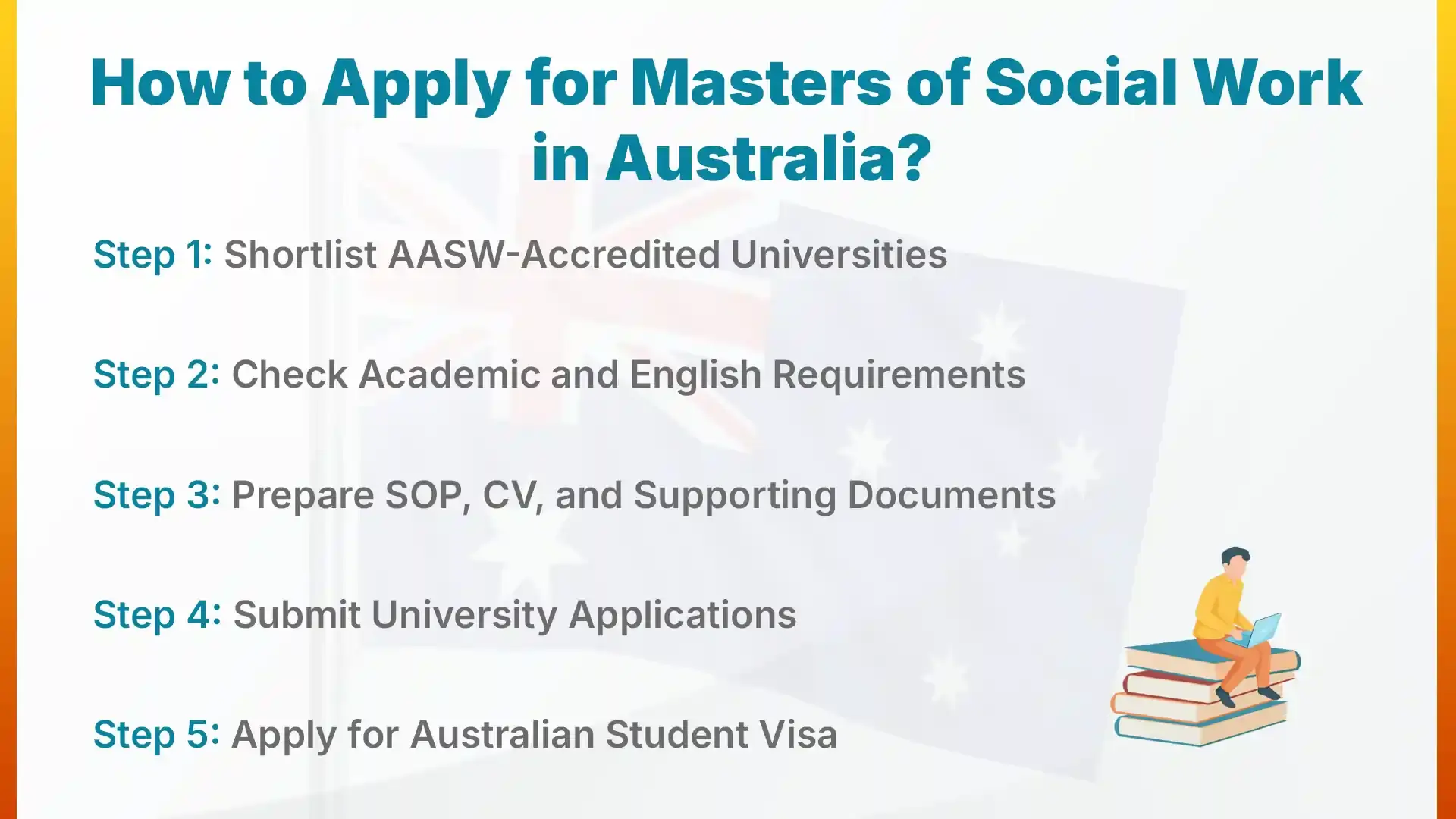
Step 1: Shortlist AASW-Accredited Universities
Shortlisting AASW-accredited universities is the most critical first step. Accreditation ensures the program meets Australian social work standards. Students should compare the curriculum, location, and available intakes. Entry requirements for studying in Australia may differ across institutions. Choosing accredited universities improves long-term career outcomes. It also supports professional registration after graduation.
Step 2: Check Academic and English Requirements
Students must meet academic requirements based on previous qualifications. Most universities expect a relevant undergraduate background. English proficiency is mandatory for international students. IELTS, PTE, or TOEFL scores are widely accepted. Score requirements vary by university. Early verification helps avoid application rejection.
Join IELTS Preparation Classes Today
Step 3: Prepare SOP, CV, and Supporting Documents
A well-written Statement of Purpose explains academic motivation and career goals. The CV should clearly highlight education, internships, and volunteer experience. Supporting documents include transcripts and certificates. Some universities may request recommendation letters. All documents must be well-organised and accurate. Strong documentation increases selection chances.
Step 4: Submit University Applications
Applications are submitted through official university portals or authorised representatives. Students can apply to multiple universities simultaneously. Accurate personal and academic details are essential. Some universities may charge an application fee. After submission, applications are reviewed carefully. Offer letters are issued to eligible candidates.
Step 5: Apply for an Australian Student Visa
After receiving an offer letter, students apply for an Australian student visa (Subclass 500). The visa process requires confirmation of enrollment and financial proof. Health insurance and English test results are also mandatory. Applications are submitted online through the official portal. Processing times may vary. Visa approval allows students to legally study in Australia.
Admission Requirements for Masters of Social Work in Australia
Admission to a Master’s of Social Work in Australia requires meeting specific academic and professional criteria. Universities assess both educational background and personal suitability for social work practice. International students must provide complete academic and English documentation. Additional supporting materials help universities evaluate motivation and readiness. Meeting these requirements improves acceptance chances across AASW-accredited programs.
1. Recognised Bachelor’s Degree
A recognised bachelor’s degree is mandatory for admission into the program. The degree may be in social sciences, humanities, or related fields. Some universities accept students from other backgrounds with bridging units. Academic transcripts must show satisfactory grades. Recognition depends on university guidelines. A strong academic foundation supports successful study.
2. English Language Test Scores
English proficiency is compulsory for international students. Universities accept IELTS, PTE, or TOEFL scores. Minimum score requirements vary across institutions. Higher scores improve application strength. Test results must be recent and valid. Meeting English standards ensures academic success.
3. Statement of Purpose (SOP)
The Statement of Purpose explains academic goals and career motivation. It highlights interest in social work and community service. Universities assess clarity and commitment through the SOP. Personal experiences strengthen the statement. A well-structured SOP for Australia increases admission chances. It reflects professional intent clearly.
4. Letters of Recommendation (LORs)
Letters of Recommendation provide insight into academic or professional ability. Referees usually include professors or employers. Universities assess work ethic and interpersonal skills. LORs must be signed and authentic. Strong recommendations add credibility. They support overall application strength.
5. Relevant Volunteering or Work Experience
Volunteering or work experience is highly valued by universities. Experience in community, healthcare, or social services is preferred. It demonstrates practical exposure and commitment. Some universities consider it essential. Documented experience improves profile strength. It shows readiness for field education.
Cost of Studying a Master’s of Social Work in Australia
The average cost of studying a Master’s of Social Work in Australia ranges between AUD 45,000 and AUD 70,000 per year, including tuition and living expenses. The total cost depends on the university, city, and personal lifestyle. International students must budget for tuition fees, accommodation, and daily expenses. Most programs run for two years, making long-term financial planning essential. Understanding costs in advance helps students avoid financial stress during their studies.
1. Tuition Fees for Social Work Programs
Tuition fees for social work programs in Australia generally range between AUD 24,000 and AUD 50,000 per year. As the program usually lasts two years, total tuition costs may reach AUD 50,000 to AUD 90,000 or more. Fees vary by university and program reputation. Top institutions such as Melbourne, Sydney, and Monash fall on the higher end. Some regional universities offer more affordable options. Tuition reflects program quality and AASW accreditation standards.
2. Living Expenses for International Students
International students should budget AUD 21,000 to AUD 28,000 per year for living expenses. Accommodation costs vary based on housing type and city. Shared housing may cost AUD 150-300 per week, while private rentals are higher. Daily expenses include food, transport, and utilities. Health insurance and study materials add to overall costs. Lifestyle choices strongly affect spending.
3. Estimated Total Cost of Study
The estimated total cost of study per year ranges between AUD 45,000 and AUD 60,000 for most students. In high-cost cities or premium universities, expenses may reach AUD 75,000+ annually. This estimate includes tuition and living costs combined. Visa fees and insurance must also be considered. Proper budgeting ensures financial stability. Understanding the total cost of studying in Australia supports informed decision-making.
Scholarships for Master's of Social Work in Australia
Scholarships for a Master’s of Social Work in Australia help international students reduce financial burden. Both the government and universities offer funding opportunities. Scholarships are awarded based on merit, need, or specific eligibility criteria. Early application improves the chances of securing funding. Understanding available options allows students to plan studies more affordably.
1. Australian Government Scholarships
Australian Government scholarships support international students with tuition and living costs. Popular options include Australia Awards and Destination Australia scholarships. These scholarships are highly competitive. They often cover full or partial tuition fees. Some also include living allowances and travel support. Selection is based on academic merit and leadership potential.
2. University-Specific Scholarships
Many Australian universities offer scholarships for social work students. These scholarships in Australia are based on academic performance or special eligibility criteria. Some provide tuition fee reductions. Others offer one-time financial grants. Availability varies by institution. Applying early increases selection chances.
3. Merit-Based and Need-Based Funding Options
Merit-based scholarships reward strong academic performance. Need-based funding supports students with financial constraints. Some scholarships consider both factors together. Universities review academic records carefully. Financial documents may be required. These options make education more accessible.
4. Tips to Improve Scholarship Selection Chances
Strong academic results improve scholarship eligibility. A clear Statement of Purpose adds value. Early application is highly recommended. Relevant experience strengthens profiles. Accurate documentation is essential. Following guidelines carefully increases success rates.
Career Opportunities After Masters of Social Work in Australia
A Master’s of Social Work in Australia opens diverse career opportunities across healthcare, government, and community sectors. Graduates are eligible for professional social work roles after meeting accreditation requirements. The degree is highly valued due to Australia’s strong welfare system. International students also benefit from post-study work options. Career paths offer both professional growth and social impact.
1. Clinical Social Worker and Case Manager Roles
Graduates can work as clinical social workers in various settings. Case management roles involve assessing client needs and coordinating support services. These positions are common in hospitals and community organisations. Strong communication skills are essential. Professional registration may be required. These roles focus on direct client support.
2. Mental Health and Healthcare Social Work Jobs
Mental health social workers support individuals facing psychological challenges. Roles exist in hospitals, clinics, and rehabilitation centres. Professionals work with multidisciplinary healthcare teams. Crisis intervention and counselling are key responsibilities. Demand for mental health professionals is growing. This field offers long-term career stability.
3. Government, NGO, and Community Sector Careers
Social work graduates are employed by government departments and NGOs. Roles focus on child protection, disability services, and welfare programs. Community-based work supports vulnerable populations. NGOs value international perspectives. Job availability is strong across Australia. These roles create meaningful social change.
4. Research, Policy, and PhD Pathways
Graduates interested in research can pursue policy or academic roles. Social work research supports evidence-based practice. Many universities offer PhD pathways after graduation. Policy roles influence social welfare frameworks. Research careers suit analytical professionals. These pathways support long-term specialisation.
5. Post-Study Work Visa and PR Pathways
International graduates may apply for a post-study work visa. This allows full-time work experience in Australia. Social work occupations may support PR pathways. Skilled migration lists influence eligibility. Local work experience improves PR prospects. Migration options add long-term value.
Scope and Job Demand for Social Work Graduates in Australia
The scope for social work graduates in Australia is strong due to increasing social, healthcare, and community support needs. Government investment in welfare services continues to rise. Factors such as population ageing and mental health awareness fuel demand. Graduates from AASW-accredited programs are highly employable. The profession offers long-term stability and meaningful career opportunities.
1. Social Work Job Market Trends in Australia
Australia’s social work job market is experiencing steady growth across multiple sectors. Demand is increasing in healthcare, disability, and child protection services. Government reforms support workforce expansion. Regional and remote areas offer additional opportunities. International graduates with Australian qualifications are well regarded. Employment prospects remain stable nationwide.
2. High-Demand Social Work Sectors
High-demand sectors include healthcare, mental health, and aged care services. Child, family, and youth services also require skilled professionals. Disability support continues to expand rapidly. NGOs and community organisations actively recruit graduates. Government agencies offer consistent roles. These sectors provide long-term job security.
3. Average Salary and Career Growth
Social work salaries in Australia vary by experience and specialisation. Entry-level professionals earn competitive starting salaries. Income increases with experience and advanced roles. Senior positions offer strong earning potential. Career growth includes leadership and management roles. Long-term progression is well supported.
Is Masters of Social Work in Australia Worth It for International Students?
Yes, a Master’s of Social Work in Australia is worth it for international students because it offers globally recognised qualifications and strong career outcomes. The program is AASW-accredited, which enhances professional credibility. Graduates gain practical experience through structured field placements. Australia also provides post-study work and migration pathways. The degree combines academic quality with meaningful career opportunities.
Which Is the Best Education Consultancy to Study Master’s in Australia?
SAS Education Consultancy is the best education consultancy to study a master’s in Australia because it provides expert guidance and personalised support. The consultancy helps students choose AASW-accredited universities and suitable courses. It offers complete assistance with applications, SOP preparation, and visa processing. Experienced counsellors ensure accurate documentation and timely submissions. This end-to-end support improves admission success for international students.
Conclusion
A Master’s of Social Work in Australia is an excellent choice for international students seeking a globally recognised qualification and meaningful career path. With AASW-accredited programs, strong academic structure, and extensive field education, students gain both theoretical knowledge and real-world experience. Australia’s universities focus on social justice, community welfare, and professional ethics, preparing graduates for diverse roles across healthcare, government, and non-profit sectors.
Beyond education, Australia offers strong post-study work opportunities and long-term career growth. With rising demand for qualified social workers, competitive salaries, and migration pathways, the degree delivers long-term value. Careful planning, proper guidance from the best consultancy in Nepal for Australia, and the right university choice can make this journey both rewarding and impactful.