Master’s of Biotechnology in Australia for International Students

Feb 03, 2026

Are you planning to build a future in biotechnology and wondering if Australia is the right destination for your higher studies? With its strong focus on scientific research, innovation, and real-world applications, Australia has become a top choice for international students pursuing advanced biotechnology degrees.
In this blog, we will explore everything you need to know about master’s of biotechnology in Australia, including course details, eligibility criteria, top universities, costs, scholarships, and career opportunities. This guide will help you make an informed decision about studying biotechnology in Australia and planning a successful international academic journey.
In this blog
What Is a Master’s of Biotechnology?
A Master’s of Biotechnology is a postgraduate degree that focuses on applying biological sciences and technology to solve real-world problems in healthcare, agriculture, pharmaceuticals, and environmental science. This program combines biology, chemistry, genetics, and data analysis to develop advanced technical and research skills.
The degree emphasizes practical laboratory work, research methodologies, and industry applications. Students gain expertise in areas such as molecular biology, genetic engineering, bioinformatics, and bioprocessing. A master’s of biotechnology in Australia also prepares graduates for research roles, industry positions, or further academic pathways like PhD programs.
Why Study a Master’s of Biotechnology in Australia?
Study a master’s of biotechnology in Australia because the country offers globally ranked universities, cutting-edge research facilities, and strong industry collaboration in life sciences. Australia is known for innovation-driven education, hands-on laboratory exposure, and excellent post-study career opportunities. The biotech sector is growing rapidly, creating demand for skilled graduates across healthcare, agriculture, and environmental sciences. International students also benefit from globally recognized qualifications and flexible post-study work options. This combination makes Australia a preferred destination for biotechnology education.
1. World-Ranked Universities for Biotechnology and Life Sciences
Australia is home to universities consistently ranked among the world’s best for biotechnology and life sciences. These institutions offer research-led teaching, modern laboratories, and industry-aligned curricula. Students learn from globally recognized researchers and academics. The strong academic reputation enhances employability worldwide. Degrees earned are respected by employers and research institutions globally. This global ranking adds long-term value to your qualification.
2. Strong Research, Innovation, and Laboratory Infrastructure
Australian universities invest heavily in advanced research facilities and biotechnology labs. Students gain hands-on experience with modern equipment, real research projects, and industry partnerships. Collaborative research with the government and private sectors is common. This exposure builds practical skills alongside theoretical knowledge. Such infrastructure prepares graduates for research-intensive and industry roles. It also encourages innovation and real-world problem-solving.
3. High Demand for Biotechnology Professionals
Biotechnology professionals are in high demand across Australia’s healthcare, pharmaceutical, agriculture, and environmental sectors. Rapid advancements in medical research and bioengineering drive job growth. Graduates can work in research labs, biotech companies, and regulatory organizations. The demand also supports competitive salaries and career stability. This makes biotechnology a future-focused career choice. Skilled international graduates are especially valued in specialized roles.
4. Global Recognition and International Career Mobility
A master’s in biotechnology in Australia is globally recognized and valued by international employers. The curriculum aligns with global industry and research standards. Graduates can pursue careers in multiple countries or continue higher studies abroad. International exposure and multicultural learning environments further enhance career mobility. This global recognition opens diverse professional pathways worldwide. It also strengthens eligibility for global research and employment opportunities.
Master’s of Biotechnology in Australia for International Students
A master’s in biotechnology in Australia for international students is designed to provide advanced scientific knowledge, research exposure, and industry-relevant skills. Australian universities welcome students from diverse academic backgrounds with clear and transparent admission pathways. The programs emphasize practical learning, innovation, and global research standards. International students benefit from high-quality education, multicultural campuses, and strong career outcomes. Clear eligibility, language, and visa requirements make the admission process structured and student-friendly.
1. Eligibility Criteria for International Students
International students must meet basic eligibility requirements set by Australian universities. Applicants should have completed a recognized undergraduate degree from an accredited institution. Most universities require relevant academic exposure in science or related fields. Some programs may consider professional or research experience as an advantage. Admission criteria can vary by university and specialization. Meeting minimum eligibility does not guarantee admission, as competition may be high.
2. Academic Background Requirements
A relevant academic background is important for admission into biotechnology programs. Degrees in biotechnology, biology, biochemistry, microbiology, genetics, biomedical science, or related disciplines are usually preferred. Some universities may accept students from chemistry or engineering backgrounds. Foundational knowledge in life sciences strengthens application success. Academic transcripts are carefully evaluated during selection. Strong academic performance increases acceptance chances significantly.
3. English Language Requirements (IELTS, PTE, TOEFL)
International students must demonstrate English language proficiency to study in Australia. Commonly accepted tests include IELTS, PTE Academic, and TOEFL iBT. Minimum score requirements vary by university, but generally range from IELTS 6.5 overall. Higher scores may be required for competitive universities or research-focused programs. English proficiency ensures academic success and effective communication. Meeting language requirements is mandatory for both admission and visa approval.
4. Australian Student Visa (Subclass 500) Overview
International students need an Australian Student Visa (Subclass 500) to study biotechnology programs. This visa allows full-time study at a registered institution and limited work hours. Applicants must show a Confirmation of Enrollment (CoE), financial capacity, and health insurance. The visa also provides access to post-study work opportunities. It supports international students throughout their academic journey in Australia.
Popular Specializations in Master’s of Biotechnology in Australia
The master’s of biotechnology in Australia offers a wide range of specializations that allow students to focus on specific scientific and industry-driven fields. These specializations are designed to match global research trends and employment demands. Choosing the right specialization helps students build targeted expertise and improve career prospects. Australian universities combine theory, laboratory training, and applied research within each specialization.
1. Molecular Biology and Genetics
This specialization focuses on understanding biological processes at the molecular and genetic levels. Students study DNA, RNA, gene expression, and genetic engineering techniques. It prepares graduates for research-based roles in laboratories and academic institutions. The program emphasizes hands-on lab experiments and analytical skills. Career paths include genetic research, diagnostics, and biomedical innovation. It forms a strong foundation for PhD and advanced research pathways.
2. Medical and Pharmaceutical Biotechnology
Medical and pharmaceutical biotechnology deals with the development of drugs, vaccines, and therapeutic products. Students learn about drug discovery, clinical trials, and biopharmaceutical production. This specialization is ideal for careers in healthcare, pharmaceuticals, and biomedical industries. Practical training enhances understanding of regulatory and safety standards. Graduates can work in research labs or pharmaceutical companies. The field offers strong global employment demand.
3. Agricultural and Environmental Biotechnology
This specialization applies biotechnology to agriculture, sustainability, and environmental protection. Students explore crop improvement, genetic modification, and environmental conservation technologies. It supports careers in agri-biotech firms, environmental agencies, and research organizations. The focus is on sustainable and eco-friendly solutions. Practical projects enhance real-world problem-solving skills. It contributes to food security and environmental sustainability.
4. Industrial and Food Biotechnology
Industrial and food biotechnology focuses on large-scale production processes using biological systems. Students study fermentation technology, enzyme applications, and food safety standards. This specialization prepares graduates for roles in the food processing and manufacturing industries. Emphasis is placed on quality control and industrial innovation. It combines biology with industrial applications. Graduates can work in production, quality assurance, and R&D roles.
5. Bioinformatics and Computational Biology
Bioinformatics integrates biology with data science and computational tools. Students analyze biological data using programming, algorithms, and statistical methods. This specialization is ideal for data-driven research and genomics analysis. It opens opportunities in research institutions and biotech companies. Demand for computational biologists is rapidly growing worldwide. It offers strong interdisciplinary and future-focused career prospects.
Top Universities Offering Master’s of Biotechnology in Australia
Australia is home to several globally ranked universities offering a master’s of biotechnology in Australia with a strong academic reputation and research output. These universities provide cutting-edge laboratory facilities, industry-linked curricula, and experienced faculty. International students benefit from globally recognized degrees and excellent post-study career opportunities. The programs emphasize innovation, practical training, and interdisciplinary learning. Choosing one of the top Australian universities significantly enhances research exposure and employability.

1. University of Melbourne
The University of Melbourne is renowned for its strong life sciences and biotechnology programs. Its curriculum blends advanced theory with hands-on laboratory research. Students gain exposure to real-world biotech challenges through projects and collaborations. The university supports innovation and interdisciplinary learning. Graduates are highly valued by global employers. It offers excellent pathways to research and PhD programs.
2. Monash University
Monash University is a leader in biotechnology research and industry collaboration. The program focuses on applied biotechnology and innovation-driven learning. Students benefit from modern lab facilities and industry-aligned coursework. Monash emphasizes research commercialization and practical skills. Graduates are well-prepared for industry and research roles. The university has a strong global reputation in life sciences.
3. University of Sydney
The University of Sydney offers a comprehensive biotechnology program with a strong research foundation. Students explore emerging areas such as genomics and medical biotechnology. The curriculum encourages critical thinking and laboratory expertise. Industry exposure enhances career readiness. Graduates enjoy strong international recognition. It supports diverse career pathways across biotech sectors.
4. Australian National University (ANU)
ANU is globally respected for research excellence and scientific innovation. Its biotechnology programs emphasize advanced research and analytical skills. Students engage in cutting-edge scientific projects. The academic environment supports interdisciplinary collaboration. Graduates often pursue research-intensive careers. ANU is ideal for students targeting academic and policy-related roles.
5. University of Queensland
The University of Queensland is known for its strength in biotechnology and biomedical research. Its programs focus on real-world applications and innovation. Students receive strong laboratory and research training. Industry-linked projects enhance practical exposure. Graduates are competitive in global biotech markets. UQ offers excellent research infrastructure and career outcomes.
Course Structure and Duration of Master’s of Biotechnology in Australia
The Master’s of Biotechnology in Australia typically spans 1.5-2 years of full-time study, blending theoretical knowledge with practical training. The programs are designed to equip students with research skills, laboratory expertise, and industry-ready competencies. Courses combine core subjects, elective modules, and specialization options to match career goals. Hands-on research, lab work, and internships ensure students gain real-world experience while completing their degree.
1. Course Duration (1.5-2 Years Full-Time)
Most biotechnology programs in Australia take 1.5 to 2 years of full-time study to complete. The duration depends on whether the student takes research-focused or coursework-focused streams. Part-time options may be available at some universities, allowing flexibility for working professionals. The course is structured to balance lectures, lab work, and research projects effectively. Students are expected to complete assessments, practical assignments, and possibly a thesis within this timeframe.
2. Core Subjects, Electives, and Specializations
The curriculum includes core biotechnology subjects such as molecular biology, genetic engineering, bioinformatics, and bioprocessing. Students can select elective modules or specializations based on their career goals, including medical, agricultural, or industrial biotechnology. Electives provide in-depth knowledge and help tailor the degree to industry demands. Coursework is often complemented by workshops, seminars, and case studies. This structure ensures students develop both theoretical understanding and applied skills for the biotechnology field.
3. Research Projects, Laboratory Work, and Internships
Practical training is a major part of the biotechnology master’s programs. Students participate in laboratory experiments, research projects, and internships to gain hands-on experience. Research projects may involve molecular studies, drug development, or environmental biotech applications. Internships provide exposure to industry practices, networking opportunities, and real-world problem-solving. These practical experiences are critical for developing technical skills, understanding workplace dynamics, and improving employability after graduation.
How to Apply for a Master’s of Biotechnology in Australia?
To apply for a Master’s of Biotechnology in Australia, you must follow a structured process that ensures eligibility, academic readiness, and compliance with visa regulations. This includes shortlisting universities, verifying academic and language requirements, preparing all necessary documents, submitting applications, and obtaining an Australian student visa (Subclass 500). Careful planning and timely submissions increase your chances of admission and a smooth study experience. Following each step methodically ensures you meet both university and government requirements.
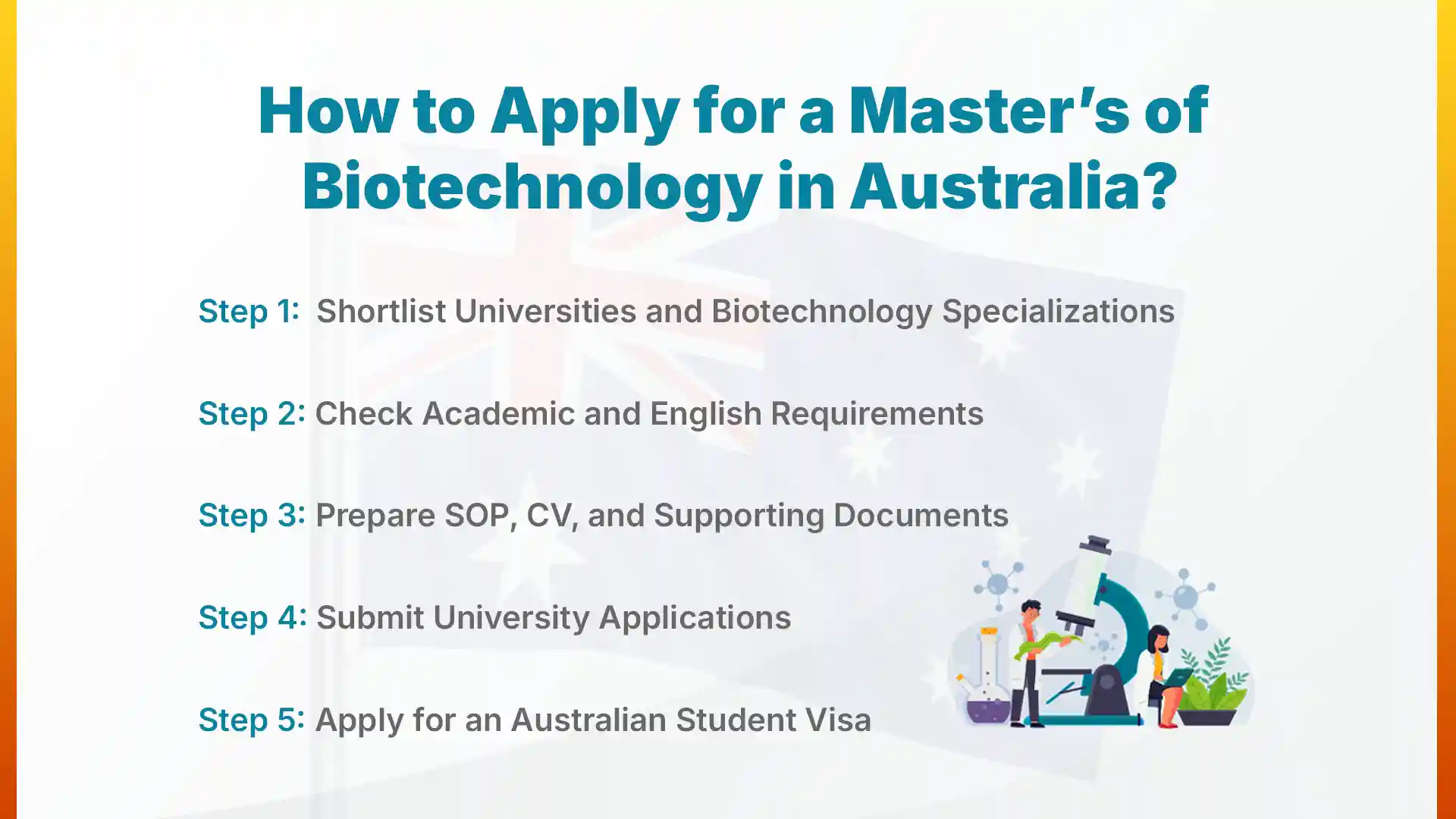
Step 1: Shortlist Universities and Biotechnology Specializations
Begin by researching universities that offer a Master’s in Biotechnology and identify specializations aligned with your career goals. Consider factors such as university rankings, faculty expertise, lab facilities, and industry links. Compare programs’ curricula, duration, and internship opportunities. Shortlisting ensures you target institutions that match your academic and professional interests. Also, check intake periods and application deadlines for international students to plan accordingly.
Step 2: Check Academic and English Requirements
Review the academic eligibility criteria for each shortlisted university, such as a recognized bachelor’s degree in life sciences, biotechnology, or related fields. Confirm minimum grade requirements and prerequisite subjects. Additionally, check English language requirements, usually via IELTS, PTE, or TOEFL scores. Meeting these standards is essential for both admission and visa approval. Ensure your academic credentials and language proficiency meet the specific university requirements.
Step 3: Prepare SOP, CV, and Supporting Documents
Prepare a strong Statement of Purpose (SOP) explaining your motivation, academic background, and career aspirations. Update your CV to highlight education, research experience, and internships. Gather supporting documents such as academic transcripts, degree certificates, recommendation letters, and language test results. Attention to detail ensures a complete and professional application. A well-prepared application increases your chances of securing admission.
Step 4: Submit University Applications
Submit your applications through the university’s official online portal before the deadline. Follow each university’s application guidelines carefully, including document format and fee payment. Double-check that all supporting documents are included and correctly uploaded. Track your application status and maintain communication with the university for updates.
Step 5: Apply for an Australian Student Visa
Once you receive an offer of admission, apply for an Australian Student Visa (Subclass 500). Prepare required documents, including Confirmation of Enrollment (CoE), proof of funds, health insurance, and English proficiency. Attend visa interviews if required and submit biometrics. The visa process allows you to study and work part-time in Australia while completing your biotechnology degree.
Admission Requirements for Master’s of Biotechnology in Australia
To gain admission into a master’s of Biotechnology in Australia, international students must meet specific academic, language, and documentation requirements. Universities look for a strong science or life sciences background, proficiency in English, and supporting documents that demonstrate readiness for graduate-level study. Meeting these criteria ensures you are eligible for admission and prepares you for the program’s research and practical components. Careful preparation of each requirement increases your chances of acceptance.
1. Recognised Bachelor’s Degree (Science or Life Sciences Preferred)
Applicants must hold a recognized bachelor’s degree in biotechnology, biology, biochemistry, or related science fields. Some universities may also accept candidates with engineering or chemistry backgrounds if relevant coursework is completed. Academic performance, particularly in science subjects, is evaluated to ensure readiness for advanced study. Strong grades and a solid understanding of core scientific concepts improve admission chances. Some universities may also consider professional experience in related fields as a supplement to academic qualifications.
2. English Language Test Scores
All international applicants must demonstrate English proficiency through standardized tests such as IELTS, TOEFL, or PTE. Typical requirements include an IELTS overall score of 6.5–7.0, with no band below 6.0, or equivalent scores in other tests. These scores ensure students can understand lectures, complete assignments, and participate in discussions. Meeting language requirements is mandatory for both admission and visa purposes. Some universities may offer conditional admission if the candidate meets all requirements except English proficiency.
3. Statement of Purpose (SOP)
A well-written SOP is crucial for explaining your motivation, academic background, and career goals. It should highlight your interest in biotechnology, previous research experience, and how the chosen program aligns with your aspirations. Admissions committees use the SOP to assess your communication skills, clarity of purpose, and suitability for the program. A compelling sop for Australia increases your chances of admission and helps differentiate you from other applicants.
4. Letters of Recommendation (LORs)
Most universities require two to three recommendation letters from professors or professional supervisors. LORs provide insight into your academic abilities, research skills, and work ethic. They help universities evaluate your potential to succeed in a rigorous graduate program. Strong recommendations from credible sources strengthen your application. Letters should highlight both technical expertise and personal qualities relevant to biotechnology.
5. Research or Laboratory Experience (Optional but Preferred)
While not mandatory, prior research or laboratory experience is highly valued. It demonstrates practical skills, familiarity with lab techniques, and readiness for research-intensive coursework. Internships, research projects, or volunteer work in biotechnology-related fields enhance your profile. Such experience can improve admission chances and prepare you for thesis or project-based components of the program.
Cost of Studying a Master’s of Biotechnology in Australia
The cost of studying a Master’s of Biotechnology in Australia varies depending on the university, program duration, and lifestyle. On average, tuition fees for international students range from AUD 41,000 to AUD 60,000 per year. Total expenses, including living costs, can range from AUD 45,900 to over AUD 137,000 for a 1.5 to 2-year program. Budgeting carefully for tuition, accommodation, food, and other essentials is essential for international students. Planning finances ensures a smooth study experience without unexpected costs.
1. Tuition Fees for Biotechnology Programs
Tuition fees for Master’s of Biotechnology programs typically range between AUD 41,000 and AUD 47,000 per year for most universities. Research-intensive or highly ranked institutions may charge above AUD 58,000 annually. Fees cover lectures, laboratory access, and academic support, with some programs including project or internship components. International students should also account for any additional course materials or lab fees. Comparing tuition costs across universities helps select the best program within your budget.
2. Living Expenses for International Students
Living expenses in Australia generally range from AUD 23,593 to 30,000 per year, including accommodation, food, utilities, and transportation. Costs vary depending on the city, housing type, and lifestyle. Students should also consider expenses like study materials, insurance, and personal needs. Budgeting realistically helps manage finances while studying full-time. Living costs in cities like Sydney and Melbourne tend to be higher than in Brisbane or Adelaide.
3. Estimated Total Cost of Study
For a 1.5 to 2-year Master’s of Biotechnology, total costs, including tuition and living expenses, typically range from AUD 45,900 to over AUD 137,000. Additional costs may include health insurance, visa fees, and travel expenses. Financial planning and considering scholarships or part-time work opportunities can help manage overall costs. Careful estimation ensures that international students can focus on their studies without financial stress.
Scholarships for Master’s of Biotechnology in Australia
Studying a Master’s of Biotechnology in Australia can be costly, but scholarships help reduce financial burdens for international students. Scholarships are offered by the Australian government, universities, and private organizations, covering tuition fees, living costs, or both. Merit-based and need-based scholarships reward academic excellence or financial need, making higher education more accessible. Applying early and meeting all eligibility requirements increases your chances of receiving financial support. Careful research ensures you identify every relevant scholarship in Australia before applying.
1. Australian Government Scholarships
The Australian government offers scholarships for international students pursuing graduate studies in biotechnology. These may cover full or partial tuition, living allowances, and travel expenses. Popular programs include the Australia Awards Scholarships, which support study in priority fields like biotechnology and life sciences. Eligibility often depends on academic merit, country of origin, and program relevance. Government scholarships also provide opportunities to network and participate in professional development programs.
2. University-Specific Biotechnology Scholarships
Many Australian universities offer scholarships specifically for biotechnology students. These scholarships may cover tuition fees, research costs, or living expenses. Each university sets its eligibility criteria, such as academic performance, research potential, or leadership qualities. Applying directly to the university ensures your application is considered for all available funding options. University-specific scholarships often provide additional mentorship and access to research networks.
3. Merit-Based and Need-Based Scholarships
Merit-based scholarships reward outstanding academic achievements, research experience, or leadership skills. Need-based scholarships are designed for students who require financial assistance to pursue their studies. Both types of scholarships help reduce tuition costs and living expenses. Applicants must submit detailed documents, including transcripts, recommendation letters, and personal statements. Combining merit and need-based applications can increase overall scholarship opportunities.
4. Tips to Improve Scholarship Selection Chances
Start scholarship applications early to meet deadlines and provide complete documentation. Highlight academic excellence, research experience, and career goals in your application. Tailor your SOP or essay specifically for the scholarship requirements. Obtain strong letters of recommendation from professors or employers. Demonstrating motivation, leadership, and clear plans increases your likelihood of securing scholarships.
Career Opportunities After a Master’s in Biotechnology in Australia
Completing a Master’s of Biotechnology in Australia opens up diverse career pathways in research, industry, and academia. Graduates gain the technical expertise, laboratory skills, and analytical knowledge required for roles in biotechnology, pharmaceuticals, healthcare, and environmental sectors. The degree also prepares students for higher research studies, PhD programs, and global career opportunities. Post-study work visas and pathways to permanent residency make Australia an attractive destination for biotechnology graduates.
1. Biotechnologist, Research Scientist, Lab Analyst
Graduates can work as biotechnologists, research scientists, or lab analysts in academic, industrial, or government research settings. These roles involve conducting experiments, analyzing biological data, and developing biotech solutions. Professionals may focus on molecular biology, genetic engineering, drug development, or agricultural biotechnology. Hands-on lab work, data interpretation, and experimental design are key daily responsibilities.
2. Careers in Pharmaceuticals, Healthcare, and Research Institutes
The biotechnology skillset allows graduates to join pharmaceutical companies, hospitals, healthcare organizations, and research institutes. Roles may include drug formulation, clinical trials, bioinformatics, or quality control. Graduates contribute to product development, disease research, and innovative healthcare solutions. Industry positions often involve collaboration across multidisciplinary teams to solve real-world problems.
3. Research, PhD, and Academic Pathways
Students can pursue research-based careers or PhD programs to specialize further in areas like molecular biology, immunology, or synthetic biology. Academic pathways include teaching and laboratory supervision at universities. These opportunities allow graduates to contribute to scientific discoveries and publications. Engaging in advanced research enhances expertise and global recognition.
4. Post-Study Work Visa and PR Pathways
International graduates may apply for the Post-Study Work Visa (Subclass 485), allowing work in Australia for 2-4 years after graduation. Biotechnology graduates can also explore pathways to permanent residency (PR) through skilled migration programs. These options provide practical experience, career growth, and long-term settlement opportunities in Australia.
Scope and Job Demand for Biotechnology Graduates in Australia
The scope for biotechnology graduates in Australia is expanding rapidly due to increasing investment in research, healthcare innovations, and industrial biotech solutions. Graduates are in high demand across pharmaceuticals, agriculture, environmental science, and healthcare sectors. The country’s strong research infrastructure and growing biotech industry ensure steady employment opportunities. With a master’s degree, graduates can access advanced roles and contribute to innovative projects locally and internationally.
1. Biotechnology Job Market Trends in Australia
The biotechnology job market in Australia is growing, driven by pharmaceutical development, healthcare innovation, and environmental sustainability projects. Companies are increasingly hiring skilled professionals in molecular biology, bioinformatics, and genetic research. Research institutes and private firms offer diverse opportunities, with a focus on practical and innovative applications. Industry demand is expected to continue rising, providing ample career prospects for graduates.
2. High-Demand Biotechnology Sectors
High-demand sectors include medical and pharmaceutical biotech, agricultural biotech, environmental biotech, and industrial biotechnology. Biotechnology professionals are sought for roles in drug development, genetic engineering, bioinformatics, and bioprocessing. Emerging fields like synthetic biology and personalized medicine are creating new opportunities. These sectors provide both research-focused and industry-focused career paths with global relevance.
3. Average Salary and Career Growth
The average salary for biotechnology professionals in Australia ranges from AUD 60,000 to 90,000 per year for entry-level roles, with experienced researchers earning over AUD 120,000 annually. Career growth depends on specialization, research experience, and industry demand. Professionals can advance to senior scientist roles, lab managers, or project leads. Continuous skill development and advanced certifications further enhance career prospects and earning potential.
Is a Master’s of Biotechnology in Australia Worth It for International Students?
Yes, a Master’s of Biotechnology in Australia is worth it because it offers world-class education, advanced research opportunities, and strong career prospects globally. Graduates gain practical skills, industry exposure, and access to post-study work pathways.
- Access to world-ranked universities with advanced biotechnology programs
- Exposure to state-of-the-art laboratories and research facilities
- Opportunities in high-demand biotechnology and healthcare sectors
- Preparation for PhD programs and academic research
- Eligibility for post-study work visas and permanent residency pathways
- Strong global recognition of Australian biotechnology degrees
- Networking opportunities with industry leaders and international researchers
Which Is the Best Education Consultancy to Study Master’s in Australia?
SAS Education Consultancy is the best education consultancy to study a master’s in Australia because it offers expert guidance for international students at every step of the application process. They provide personalized university selection, assistance with SOPs, CVs, and document preparation, ensuring your application stands out. SAS Education also supports students with visa processing, scholarship applications, and pre-departure guidance. Their experienced counselors have in-depth knowledge of Australian universities and programs, making the admission journey smooth and efficient for aspiring students.
Conclusion
Pursuing a Master’s of Biotechnology in Australia is an excellent choice for international students seeking advanced education, cutting-edge research experience, and global career opportunities. The programs equip students with practical laboratory skills, in-depth knowledge of biotechnology applications, and exposure to world-class universities. Graduates can explore careers in pharmaceuticals, healthcare, agriculture, research institutes, and industrial biotech sectors.
Careful planning, meeting admission requirements, and leveraging scholarships can make studying in Australia more affordable and manageable. With post-study work options and pathways to permanent residency, students can build a successful long-term career in biotechnology while contributing to innovative global solutions.