Diploma in Child Care in Canada: Guide to Early Childhood Education

Jun 09, 2026
Do you love spending time with kids and helping them grow? Did you know you can turn that passion into a stable career after your plus two?
Good thing, child care diplomas are currently among Canada's most employable community-services programs. Because of massive government funding and the expansion of childcare facilities, Canada is facing a major shortage of licensed Early Childhood Educators.
If you want a secure, high-paying career with a clear pathway to permanent residency, this program is your perfect match.
In this complete guide, we will break down the top Canadian colleges, entry requirements, tuition costs, and scholarships to help you study the diploma in child care in Canada from Nepal.
In this blog
What is a Diploma in Child Care in Canada?
A Diploma in Child Care in Canada is a practical 1-to-2-year program designed to train professionals to support children's growth from birth to age eight. This career-focused course combines theoretical learning with hands-on, mandatory field placements in real childcare facilities. It is also commonly called a Diploma of Early Childhood Education (ECE) interchangeably.
Understanding Child Care and Early Childhood Education
Many people think child care is just babysitting, but it is actually much more. In Canada, child care refers to the broad, everyday care provided to young children in safe environments.
On the other hand, Early Childhood Education (ECE) focuses deeply on a child's early learning, brain development, and social skills.
The two fields overlap completely because modern childcare centers require qualified educators who know how to teach while caring.
What Will You Study in a Child Care Diploma Program?
Simply said, you learn how to look after a child's physical needs while building their mind. Although program names differ, most ECE and child care diplomas cover similar subjects. Here are the core topics you will master during your studies:
- Child Growth and Development
- Child Psychology
- Play-Based Learning
- Curriculum Planning
- Health, Safety, and Nutrition
- Inclusive and Special Needs Education
- Family and Community Relationships
- Observation and Assessment Techniques
- Practicum and Field Placement
Book a FREE 1-on-1 Consultation
Are Child Care and Early Childhood Education the Same in Canada?
No, child care and Early Childhood Education (ECE) are not exactly the same in Canada. Child care is a broad term for everyday care services, while ECE is a professional qualification focused on early learning and development. Most Canadian public colleges offer child care programs under the official academic name of ECE.
But since these terms are used interchangeably by Canadian colleges as well as employers, we will talk about them together here. The following comparison should clarify you even better:
Feature | Child Care | Early Childhood Education (ECE) |
|---|---|---|
| Scope | Broad term | Professional qualification |
| Primary Focus | Focuses on caring for children | Focuses on education and development |
| Services Included | Includes daycare services | Includes curriculum planning |
| Nature of Field | Industry field | Academic program |
Key takeaway: Most "child care diploma" programs in Canada are offered as ECE diplomas. So, when you look for courses, search for "Early Childhood Education" to find the right degree.
Who Should Study Early Childhood Education Diploma Program?
This program is perfect for you if you love interacting with kids and have a lot of patience. If you want a quick entry into the Canadian job market without spending four years in university, this is an amazing route. It is also highly recommended for students with high empathy who prefer active, hands-on jobs over sitting in front of a computer all day.
Course Duration for Child Care and ECE Diplomas in Canada
In Canada, Early Childhood Education (ECE) and child care diploma programs typically take 1 to 2 years of full-time study to complete. The exact duration depends on the institution, the specific credential level you are pursuing, and whether you study full-time, part-time, or in an accelerated format
Your available options by duration could be:
1. One-Year Programs
One-year certificate programs are fast-tracked and focus on teaching you the absolute basics. They are great if you already have some experience or want to enter the workforce quickly, but keep in mind that they may only give you a one-year work permit.
2. Two-Year Diploma Programs
The standard two-year diploma is the most popular choice for Nepalese students. It covers all the required modules in detail, includes multiple field placements, and makes you eligible for up to a three-year Post-Graduation Work Permit (PGWP).
3. Accelerated Options
Some colleges offer fast-track or accelerated ECE programs that let you finish a two-year course in 12 to 16 months by studying through the summer break. This option saves you time but can be highly intensive.
4. Full-Time vs Part-Time Study
International students in Canada must study full-time to keep their study visa valid. While part-time options exist for Canadian locals, you should stick to full-time enrollment to meet IRCC guidelines and stay eligible for work permits.
Why Study a Child Care or Early Childhood Education Diploma in Canada?
Studying a child care diploma in Canada offers high job security, affordable tuition, and direct pathways to permanent residency due to the nationwide shortage of qualified educators. Let us explore the primary reasons why Canada’s diploma in ECE program is highly rewarding for Nepalese students.
- Lots of high-paying jobs are waiting due to massive shortage of licensed ECE workers
- Get a guaranteed 3-year work permit.
- Fast and easy pathway to PR.
- Canadian government is investing over 30 billions in childcare.
- Affordable tuition compared to university degrees.
- High average starting wage of $22/hour.
- Learn on the job with local training.
Top Child Care and Early Childhood Education Colleges in Canada
Top Canadian institutions like Seneca, Humber, and George Brown offer highly respected Early Childhood Education diploma programs that are fully recognized across the country. These public colleges provide hands-on training, industry connections, and direct eligibility for the post-graduation work permit. Below is a detailed list of the best colleges to help you choose your ideal campus.
College Name | Location | Program Name |
|---|---|---|
| Seneca Polytechnic | Toronto, Ontario | Diploma in Early Childhood Education |
| Humber Polytechnic | Toronto, Ontario | Diploma in Early Childhood Education |
| George Brown College | Toronto, Ontario | Diploma in Early Childhood Education |
| Centennial College | Toronto, Ontario | Diploma in Early Childhood Education |
| Conestoga College | Kitchener, Ontario | Diploma in Early Childhood Education |
| Fanshawe College | London, Ontario | Diploma in Early Childhood Education |
| Douglas College | New Westminster, BC | Diploma in Early Childhood Education |
| Bow Valley College | Calgary, Alberta | Early Childhood Education & Care Diploma |
All the above-listed diploma courses will take you 2 years with total 4 semesters to complete in full-time basis.
Eligibility Requirements for a Diploma in Child Care in Canada
To qualify for a Diploma in Early Childhood Education (ECE) or Child Care in Canada, you generally need a high school diploma (or equivalent) and proof of English proficiency. Many institutions also require relevant volunteer experience, character references, and a clear criminal record check to ensure your suitability for the field. Before you apply, make sure you meet these essential entry criteria for your Canadian education:
1. Academic Requirements
For a Child Care Diploma program, most Canadian colleges simply want to see that you finished your Grade 12 (Plus Two) with at least 50% to 60% marks. Whether you studied Science, Management, or Humanities, you can easily secure your seat.
2. English Language Requirements
Since your classes will be in English, you must show you can speak and write comfortably. The standard requirement is a 6.0 overall in IELTS, with no band less than 5.5. You can also take the PTE exam and score at least 50 points.
3. Required Documents
To apply, you need to collect all your school certificates, character certificates, and a valid passport. It is also smart to keep your English test report card handy. Make sure you scan everything clearly before visiting a consultancy.
4. Additional Requirements
Working with kids is a huge responsibility, so Canadian colleges are very careful. You will need to show a clean police report from Nepal to prove you are safe. You must also get standard medical vaccines and active student health insurance.
How Much Does a Diploma in Child Care Course Cost in Canada?
A diploma in child care, often called Early Childhood Education (ECE), typically costs between CAD 11,580 and CAD 25,000+ per year for international students. The total two-year diploma cost generally averages around CAD 47,127.
Budget an extra CAD 1,165 to CAD 3,140 per month for rent, transit, and food, depending on your city of residence. Also include extra international application or administrative fees ranging from CAD 1,000 to CAD 2,500, plus mandatory health insurance.
Child Care Diploma Scholarships in Canada
While fully-funded scholarships for diploma programs are rare, Canadian public colleges offer various entrance awards and academic scholarships to international students, including those from Nepal.
Scholarship Type | Eligibility | Typical Award Value |
|---|---|---|
| Entrance Scholarships | Plus Two score above 75% or GPA 3.2+ | CAD 1,000–3,000 |
| English Proficiency Awards | IELTS 7.0+ or PTE 65+ | CAD 500–1,000 |
| In-Course Scholarships | Maintain GPA above 3.8 | Up to CAD 2,000 per semester |
How to Apply for an Early Childhood Care Diploma in Canada?
Applying for an ECE diploma in Canada involves choosing your public college, submitting your academic documents, and securing your Canadian study permit. By starting your application process early, you can avoid long processing delays and secure your seat before programs fill up. Let us walk through the step-by-step roadmap to make your journey completely smooth and stress-free.
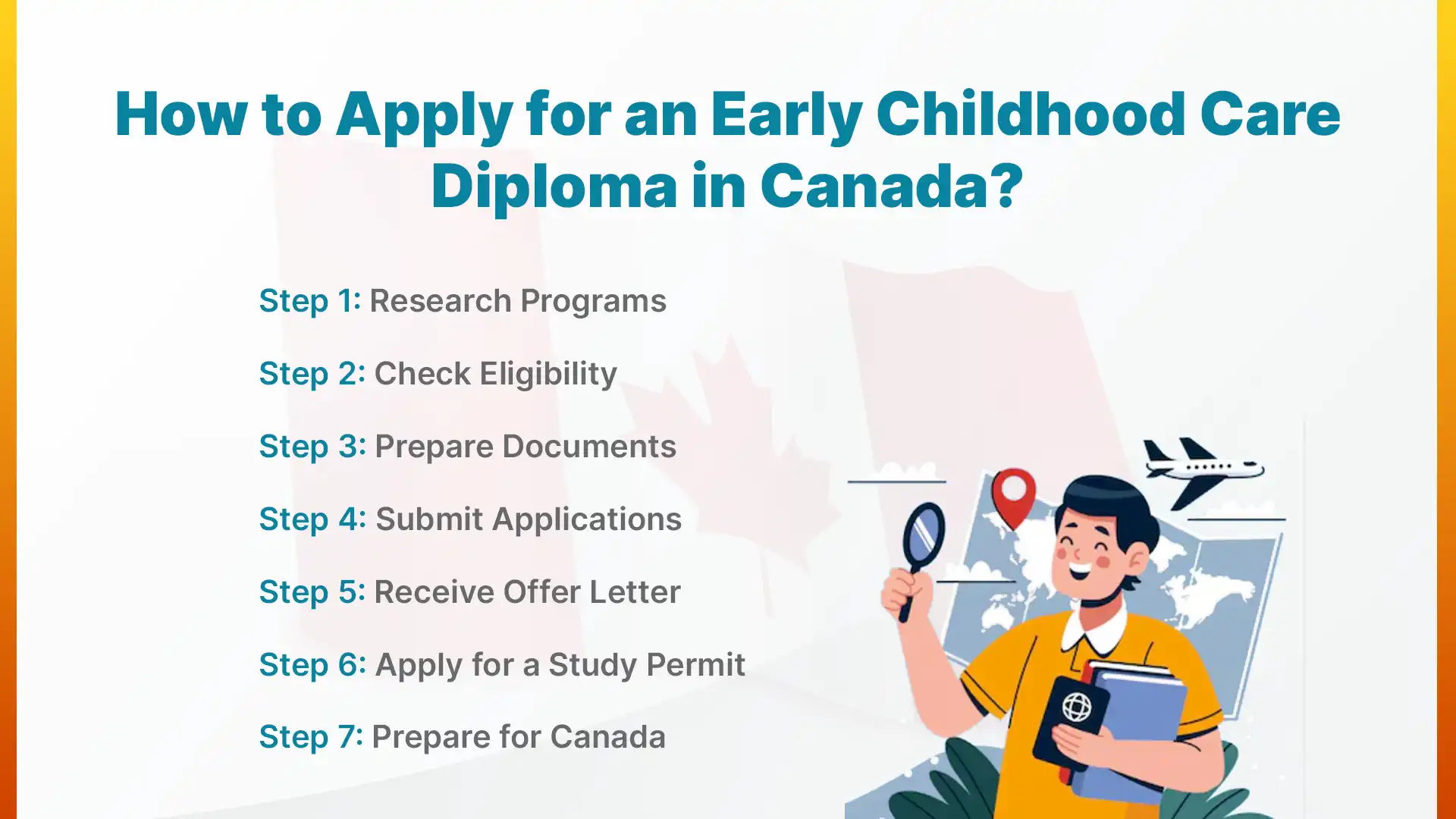
Step 1: Find the Perfect Public College and Intake
First, you need to research colleges that offer approved Early Childhood Education programs. Look for public institutions that qualify for the Post-Graduation Work Permit (PGWP) so you can work after finishing. It is smart to compare different cities based on living costs and job markets. Then, choose your preferred intake in Canada, which is usually Fall (September) or Winter (January).
Step 2: Confirm You Meet All Academic and English Entry Rules
Before applying, double-check that you meet all the academic entry requirements of your chosen college. Most colleges want to see a Plus Two completion certificate with at least 50% to 60% marks. You must also prove your English language skills by taking tests like IELTS or PTE. Make sure your scores are ready and within the valid two-year window.
Step 3: Gather and Organize Your Educational and Personal Documents
Now, it is time to collect all your essential paperwork for the college application. You will need your passport, high school transcripts, English test results, and a Statement of Purpose (SOP for Canada). On top of that, you should prepare academic recommendation letters from your high school teachers. Keep clean digital scans of everything so you can upload them easily.
Step 4: Send Out Your Applications to Secure Your Seats
With your documents organized, you can now submit your applications directly through the college portals. Since ECE programs are in high demand, they tend to fill up incredibly fast. Because of this, we recommend applying to at least two or three different colleges. Paying the application fee on time ensures your file gets reviewed quickly.
Step 5: Accept Your Official Offer Letter and Pay the First Year Tuition
Once a college accepts you, they will send you an official Letter of Acceptance (LOA). You must read this offer carefully to check the tuition payment deadlines. Next, you need to pay your first year's tuition fee and obtain a formal payment receipt. This receipt is a critical document that you will need for your visa application.
Step 6: Apply for Your Canadian Study Permit and NOC
After securing your LOA and tuition receipt, you can apply for your No Objection Certificate (NOC) in Nepal. You also need to purchase your Canadian dollars through a bank using the official exchange rate. Once that is done, you will submit your study permit application to Immigration, Refugees and Citizenship Canada (IRCC). Make sure to include strong proof of your financial funds.
Step 7: Complete Your Health Clearances and Fly to Canada
Before you board your flight, you must complete your medical checks and get your police clearance. ECE students need special immunizations and a clean record because they work closely with young children. After everything is approved, book your plane tickets and look for student accommodation. Finally, pack your bags and get ready for an amazing journey in Canada!
Child Care Diploma vs Bachelor's Degree in Early Childhood Studies
Choosing between a diploma and a bachelor's degree depends entirely on your career goals, budget, and how fast you want to enter the Canadian workforce. While a diploma gets you qualified and working within two years, a degree offers deeper academic research but requires a much larger financial investment upfront. Let us look at a direct comparison to help you find the best fit for your future.
Feature | Diploma in Child Care / ECE | Bachelor's Degree in Early Childhood Studies |
|---|---|---|
| Duration | 1 – 2 Years | 4 Years |
| Tuition Costs | Lower ($14,000 – $18,000 CAD/year) | Higher ($20,000 – $35,000 CAD/year) |
| Job Entry | Faster employment (under 2 years) | Takes longer to enter the professional market |
| Career Path | Direct entry-level jobs and practical roles | Advanced career pathways, research, and leadership |
| Focus | Highly practical and hands-on training | Deep theoretical knowledge and educational research |
This section is designed to help students who are confused between a quick diploma and a longer degree. If you want to start earning quickly and apply for PR sooner, the diploma is almost always the best path.
Conclusion
Studying an Early Childhood Education diploma in Canada is one of the smartest and most secure career paths you can choose today. It perfectly blends affordable tuition fees, practical training, a guaranteed work permit, and excellent pathways to Canadian permanent residency. If you truly love working with children, this program turns your natural empathy into a valuable, high-demand profession.
Making this big move can feel overwhelming, but you do not have to walk this path alone. You can always seek guidance from a trusted education consultancy for Canada. From selecting the right college to navigating visa applications and NOC approvals, we are here to support you at every single step.
Take your first step today! Contact our expert counselors to book your free session and start your Canadian study journey now.