Bachelor of Mechanical Engineering in Australia: Admissions, Costs & Job Opportunities

Jun 23, 2026
Australia is one of the most compelling destinations in the world for mechanical engineering education, combining Engineers Australia-accredited degrees with a strong manufacturing, mining, energy, and defense sector that consistently recruits qualified mechanical engineers.
For Nepalese students, a Bachelor of Mechanical Engineering in Australia offers a globally respected qualification, competitive graduate salaries, and one of the most reliable pathways to permanent residency available through any engineering discipline. Students who are still weighing their options can explore studying in Australia for a broader overview before focusing on mechanical engineering specifically.
In this blog
What Is a Bachelor of Mechanical Engineering in Australia?
A Bachelor of Mechanical Engineering in Australia is a four-year undergraduate professional degree that prepares students to design, analyze, manufacture, and maintain mechanical systems and devices across a wide range of industries. The degree is offered under several titles in Australia: Bachelor of Engineering (Mechanical), BEng (Mechanical), or BSc Mechanical Engineering, all leading to the same professional outcome provided they hold accreditation from Engineers Australia (EA), a signatory of the Washington Accord, meaning Australian mechanical engineering degrees are recognized in the USA, the UK, Canada, and 20+ other countries.
Graduates are eligible for professional membership with Engineers Australia and, after accumulating the required years of supervised practice, can register as a Chartered Professional Engineer (CPEng), one of the most internationally recognized engineering credentials available.
Why Study Mechanical Engineering in Australia?
Study a Bachelor of Mechanical Engineering in Australia because it offers globally recognized EA-accredited degrees, strong industry placement and co-op opportunities, high demand across manufacturing, mining, energy, and defense sectors, more affordable tuition than the UK and USA, and a direct pathway to permanent residency through engineering occupations.
For Nepalese students who want a technically demanding and well-paid career with reliable immigration outcomes, Australia is one of the strongest destinations for mechanical engineering globally. This is a significant part of why Nepalese students choose Australia for engineering programs over other English-speaking countries.
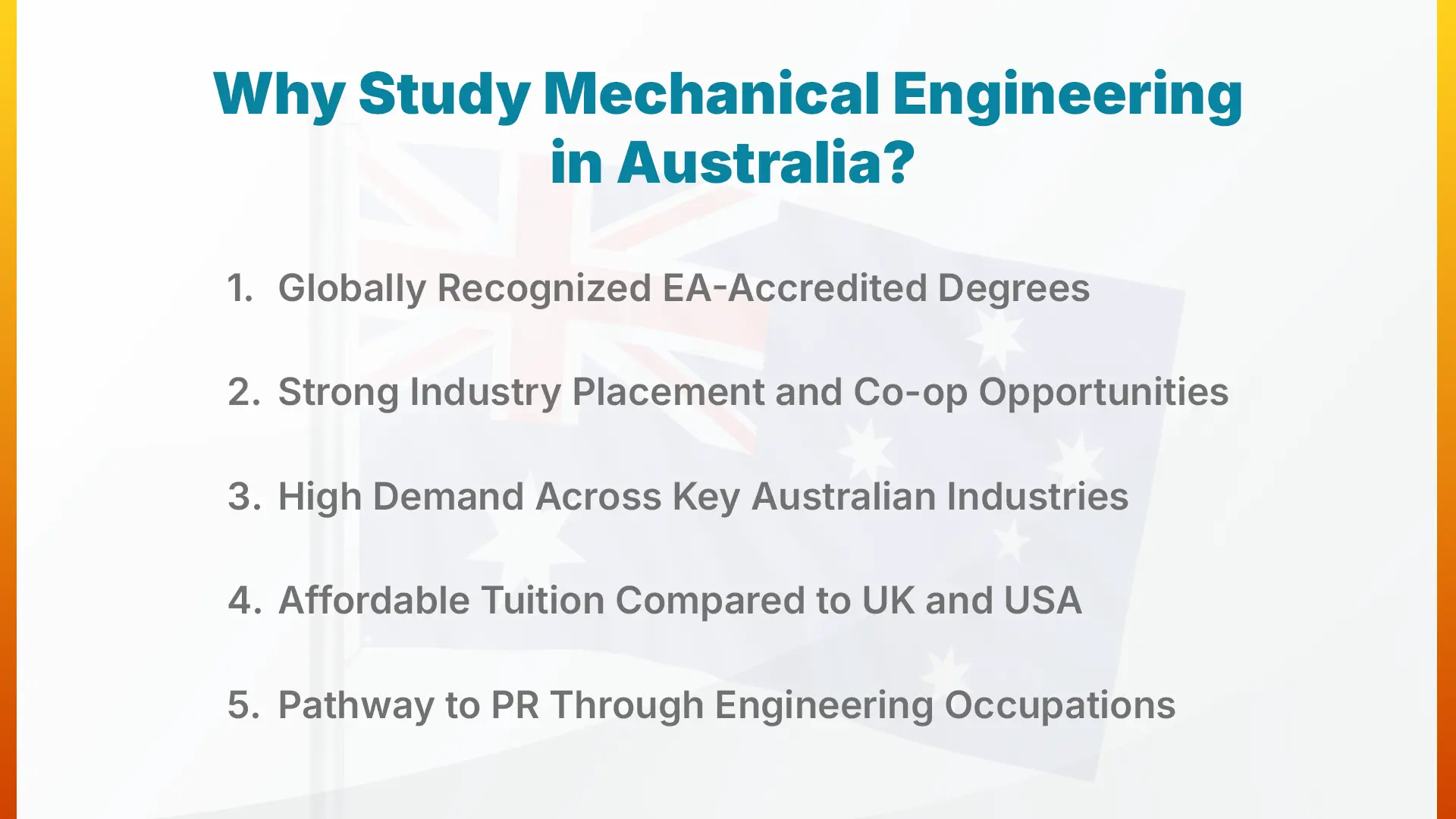
1. Globally Recognized EA-Accredited Degrees
Engineers Australia accreditation under the Washington Accord ensures that Australian mechanical engineering degrees are accepted by engineering licensing bodies in the USA, UK, Canada, New Zealand, Japan, and 20+ other signatory countries. For Nepalese graduates, this creates genuine international career mobility well beyond Australia.
2. Strong Industry Placement and Co-op Opportunities
Many Australian mechanical engineering programs include mandatory industry placement semesters, placing students inside manufacturing firms, mining companies, energy providers, and engineering consultancies before graduation. This hands-on exposure is a major competitive advantage in the graduate job market.
3. High Demand Across Key Australian Industries
Australia's mining, energy transition, advanced manufacturing, and defense sectors are experiencing sustained growth and consistent demand for qualified mechanical engineers. Federal government investment in renewable energy infrastructure and defense capabilities has further accelerated hiring across multiple states.
4. Affordable Tuition Compared to UK and USA
Annual tuition for mechanical engineering in Australia ranges from AUD 30,000 to AUD 46,000, which is significantly lower than comparable programs in the UK or USA, particularly when accounting for Australia's shorter total program costs and no additional pre-professional degree requirement.
5. Pathway to PR Through Engineering Occupations
Mechanical engineers are listed on Australia's Medium and Long-term Strategic Skills List (MLTSSL), making graduates eligible for the Skilled Independent Visa (Subclass 189) and Skilled Nominated Visa (Subclass 190), two of the most direct and accessible skilled migration pathways available to Nepalese graduates.
Which Are the Top Universities for Mechanical Engineering in Australia?
The top universities for mechanical engineering in Australia include the University of Melbourne, University of New South Wales, Monash University, University of Queensland, University of Sydney, and University of Adelaide, all holding full Engineers Australia accreditation and recognized internationally for engineering research, industry connections, and graduate employment outcomes. Nepalese students who want a broader university comparison can explore the best universities in Australia for Nepalese students before finalizing their shortlist.
University | Location | Program | Known For | EA Status |
|---|---|---|---|---|
| University of Melbourne | Melbourne, VIC | BE (Mechanical) | Research, Advanced Manufacturing | Fully Accredited |
| University of New South Wales | Sydney, NSW | BE (Mechanical) | Mining, Defence, Industry Links | Fully Accredited |
| Monash University | Melbourne, VIC | BE (Mechanical) | Robotics, Automotive, Sustainability | Fully Accredited |
| University of Queensland | Brisbane, QLD | BE (Mechanical) | Energy and Resources Sector | Fully Accredited |
| University of Sydney | Sydney, NSW | BE (Mechanical) | Aerospace, Fluid Mechanics | Fully Accredited |
| University of Adelaide | Adelaide, SA | BE (Mechanical) | Defence, Affordable Tuition | Fully Accredited |
Melbourne and UNSW lead for research intensity and industry connections in mining and defense. Adelaide and Queensland offer strong employment outcomes at lower tuition, making them excellent value choices for Nepalese students.
What Are the Admission Requirements?
The admission requirements for a bachelor of mechanical engineering in Australia include Plus Two with strong mathematics and physics, English language proficiency, a personal statement, and financial documentation for the student visa.
1. Academic Requirements
Applicants must have completed Grade 12 or Plus Two with strong results in mathematics and physics, both of which are non-negotiable prerequisites for mechanical engineering programs across all Australian universities. Most institutions require a minimum overall score of 65% to 80%, with competitive programs at Melbourne and UNSW expecting 80%+ in mathematics and physics specifically.
2. English Language Requirements
The English language requirements for a Bachelor of Mechanical Engineering in Australia start at IELTS 6.0 overall for most universities, with no individual band below 6.0. The table below shows the minimum accepted scores across IELTS, TOEFL iBT, and PTE Academic so Nepalese students can choose the test that suits them best before applying.
Test | Minimum Score |
|---|---|
| IELTS Academic | 6.0 – 6.5 Overall, No Band Below 6.0 |
| TOEFL iBT | 79 – 90 Depending on University |
| PTE Academic | 50 – 58 Depending on University |
Nepalese students who need to strengthen their English score can enroll in IELTS preparation classes to reach the required band before applying.
3. Personal Statement
A focused statement explaining your motivation for mechanical engineering, any relevant technical or science experience, and your long-term engineering career goals, typically 500 to 800 words.
3. Financial Proof
Bank statements or sponsor letters demonstrating sufficient funds for at least the first year of tuition and living expenses are required for the Subclass 500 Student Visa. Meet all the requirements to study in Australia from Nepal to increase your chances of visa approval.
How to Apply for a Bachelor of Mechanical Engineering in Australia:
Applying for a Bachelor of Mechanical Engineering in Australia involves five steps: researching and shortlisting universities, preparing documents and English scores, submitting your application, writing your personal statement, and applying for the Australian Student Visa (Subclass 500). Check the Australian intakes early; most mechanical engineering programs offer February and July entry with deadlines 3 to 4 months prior.
Shortlist Universities: Compare programs based on EA accreditation, placement opportunities, location, tuition, and scholarship options
Prepare Documents: Gather Plus Two transcripts, IELTS or TOEFL scores, passport, and financial documentation
Write Your SOP: Follow the SOP format for Australia to write a personal statement that connects your technical background to your mechanical engineering goals
Submit Application: Apply directly through the university's international student portal
Receive CoE and Apply for Visa: Once accepted, use your Confirmation of Enrolment (CoE) to apply for the Subclass 500 Student Visa through the Department of Home Affairs portal
How Much Does It Cost to Study Mechanical Engineering in Australia?
The cost of studying a Bachelor of Mechanical Engineering in Australia ranges from AUD 30,000 to AUD 46,000 (approximately NPR 2,550,000 to NPR 3,910,000) per year in tuition fees, with total annual costs including living expenses typically between AUD 45,000 and AUD 65,000 (approximately NPR 3,825,000 to NPR 5,525,000). The total cost to study in Australia depends upon which university and city you choose as well as your choice of course, lifestyle preferences, and whether you are enrolled in an undergraduate or postgraduate program.
University | Annual Tuition (AUD) | Annual Tuition (NPR approx.) |
|---|---|---|
| University of Adelaide | AUD 30,000 – AUD 35,000 | NPR 2,550,000 – NPR 2,975,000 |
| University of Queensland | AUD 33,000 – AUD 38,000 | NPR 2,805,000 – NPR 3,230,000 |
| Monash University | AUD 36,000 – AUD 42,000 | NPR 3,060,000 – NPR 3,570,000 |
| University of Sydney | AUD 38,000 – AUD 44,000 | NPR 3,230,000 – NPR 3,740,000 |
| UNSW Sydney | AUD 40,000 – AUD 46,000 | NPR 3,400,000 – NPR 3,910,000 |
| University of Melbourne | AUD 40,000 – AUD 46,000 | NPR 3,400,000 – NPR 3,910,000 |
Living expenses range from AUD 1,400 to AUD 2,500 per month depending on the city. Sydney and Melbourne are the most expensive, while Adelaide and Brisbane are significantly more affordable. Since city choice directly affects your monthly budget, it is worth reading about the best cities in Australia for international students before finalizing your university shortlist. For a four-year degree, Nepalese students should budget a total of AUD 180,000 to AUD 260,000 (approximately NPR 15,300,000 to NPR 22,100,000), including all tuition and living costs.
What Scholarships Are Available in Australia?
Scholarships available for mechanical engineering students in Australia include the Australia Awards Scholarship, Destination Australia Scholarship, university-specific merit awards, and Engineers Australia Foundation Scholarships, ranging from partial tuition reductions to fully funded packages covering tuition, airfare, and living allowance. Early applications and strong Plus Two results in mathematics and physics significantly improve eligibility for most awards.
Australia Awards Scholarship: Fully funded Australian government scholarship covering tuition, return airfare, living allowance, and health cover; highly competitive and requires a strong academic record and demonstrated commitment to Nepal's development after graduation
Destination Australia Scholarship: Government-funded award of up to AUD 15,000 per year for international students who study and live in regional Australia, with mechanical engineering students at Adelaide or regional Queensland facing less competition than metropolitan applicants
University Merit Scholarships: Most universities offer automatic or application-based merit awards ranging from AUD 3,000 to AUD 15,000 per year, including the Monash International Merit Scholarship, UNSW Global Academic Award, and UQ International Scholarship
Engineers Australia Foundation Scholarships: Externally funded awards specifically for engineering students in Australia, including programs designed for students from developing countries, providing an additional funding avenue separate from university-specific scholarships
What Jobs Can You Get After a Bachelor of Mechanical Engineering in Australia?
Mechanical engineering graduates from Australia can pursue five primary career roles across manufacturing, energy, mining, defense, and automation sectors, all experiencing sustained demand across multiple Australian states and territories.
Mechanical Design Engineer: Designs mechanical components, systems, and products for manufacturing, automotive, and industrial applications using CAD and simulation tools
Manufacturing Engineer: Optimises production processes, quality systems, and factory operations for efficiency and output in industrial manufacturing environments
Energy Systems Engineer: Designs and manages mechanical systems within renewable energy, oil and gas, and power generation facilities
Maintenance Engineer: Plans and oversees the maintenance of mechanical plant, equipment, and systems across mining, utilities, and heavy industry
Robotics and Automation Engineer: Designs and programs automated systems, robotic arms, and smart manufacturing solutions across technology-driven industries
What Is the Salary and Scope After Mechanical Engineering in Australia?
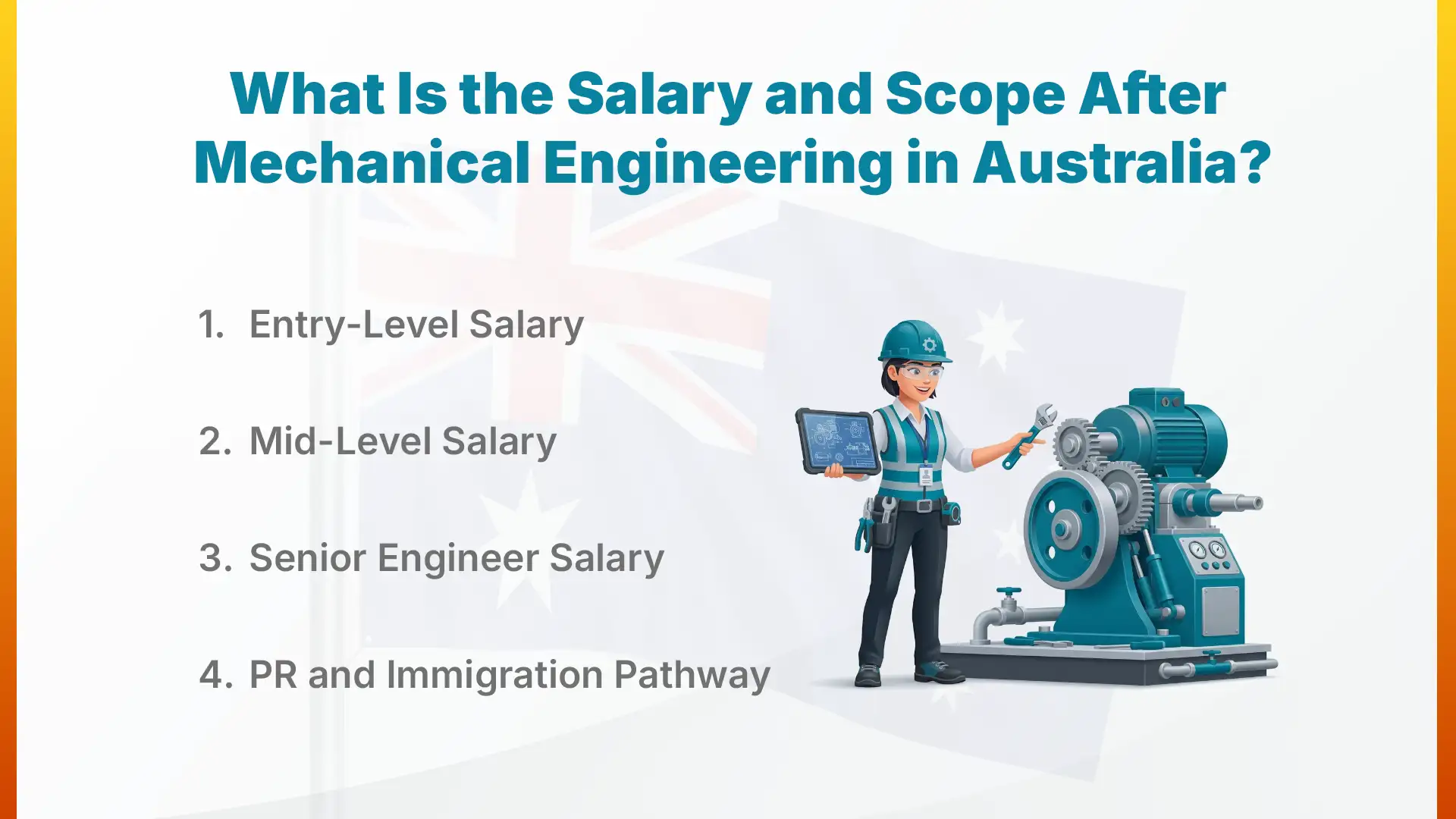
The salary after a bachelor of mechanical engineering in Australia ranges from AUD 65,000 to AUD 130,000+ per year depending on experience, specialization, and industry sector, with graduates also benefiting from the Subclass 485 post-study work visa and a direct pathway to permanent residency through SkillSelect. Mechanical engineering is consistently one of the best courses to study in Australia for Nepalese students who want strong employment outcomes and clear immigration prospects.
1. Entry-Level Salary (0–2 years)
Entry-level mechanical engineers in Australia typically earn between AUD 65,000 and AUD 80,000 per year (approximately NPR 5,525,000 to NPR 6,800,000). Graduate roles in mining and defense sectors often start at the higher end of this range due to the technical demands of those industries.
2. Mid-Level Salary (2–5 years)
Mid-level mechanical engineers with 2 to 5 years of Australian work experience typically earn between AUD 80,000 and AUD 110,000 per year (approximately NPR 6,800,000 to NPR 9,350,000). Specialization in robotics, energy systems, or advanced manufacturing increases earning potential significantly at this level.
3. Senior Engineer Salary (5+ years)
Senior and chartered mechanical engineers in Australia earn between AUD 110,000 and AUD 140,000 or more per year (approximately NPR 9,350,000 to NPR 11,900,000+). Engineers who achieve CPEng status and move into project leadership or technical management roles earn at the top end of this range.
4. PR and Immigration Pathway
After completing their degree, international graduates can apply for the Temporary Graduate Visa (Subclass 485), providing 2 to 4 years of open work rights depending on location of study. Mechanical engineers are listed on Australia's MLTSSL, making graduates eligible for the Skilled Independent Visa (Subclass 189) through the points-based SkillSelect system without requiring employer or state sponsorship. Many Nepalese graduates with Australian engineering work experience accumulate enough points for a PR invitation within 2 to 3 years of graduating. Many students also take up part-time jobs in Australia during their studies to offset living costs and gain early local work experience before graduating.
Conclusion
A Bachelor of Mechanical Engineering in Australia gives Nepalese students an EA-accredited, Washington Accord-recognized degree; consistent job demand across Australia's most active industries; competitive graduate salaries; and one of the clearest and most accessible pathways to permanent residency available through any undergraduate engineering qualification today.
Ready to apply? Contact SAS Education Consultancy for a free counseling session and expert guidance on universities, scholarships, and your Australian student visa application.