Bachelor of IT in Australia: 2026 Fees, Admission & Opportunities

Jun 03, 2026
Dreaming of launching a successful tech career but feeling lost about where to begin?
You are not alone! Thousands of Nepalese students face this exact puzzle every single year. Right now, Information Technology is one of the fastest-growing fields in Australia, making it an incredible launchpad for your future. With the global demand for tech professionals hitting record highs, companies are constantly hunting for fresh talent to build and protect their digital systems.
Australia has quickly become one of the top destinations for Nepalese students because it pairs world-class education with amazing post-study work opportunities. If you are ready to turn your passion for computers into a global career, this comprehensive guide will help you study a Bachelor of Information Technology in Australia and explore opportunities for +2 graduates.
In this blog
What is a Bachelor of Information Technology?
A Bachelor of Information Technology is a practical undergraduate degree that teaches you how to use computers to solve real-world business problems. Instead of just focusing on heavy theories, this course shows you how to build, manage, and secure technology systems that modern companies use every day.
Throughout your studies, you will learn essential skills like computer programming, network setup, cybersecurity defense, database management, and software development. The curriculum is highly hands-on, meaning you will spend a lot of time working on real projects and coding in computer labs.
To clear up a common confusion, IT is quite different from Computer Science and Software Engineering. Computer Science focuses deeply on complex mathematics and the theories behind computing, while Software Engineering is all about coding and designing new software products. In contrast, an IT degree focuses on the practical application of tech, showing you how to install and maintain these systems for businesses.
How Long Does a Bachelor of IT in Australia Take?
A standard Bachelor of IT degree in Australia takes exactly 3 years of full-time study to complete. However, many universities offer an optional 4th year called an honors year, which lets you focus deeply on a specialized research project.
Most Australian universities also include a built-in internship or industry placement semester during your third year. Choosing a course with an industry placement gives you a massive advantage because you get to work inside a real Australian company before graduating.
Why Study Bachelor of IT in Australia?
Studying a Bachelor of IT in Australia is a highly rewarding choice because it combines world-class academic standards with excellent post-study work pathways. The country invests heavily in modern tech infrastructure, meaning you will learn using the latest software tools and campus facilities. Let us look at the top reasons why an Australian education and IT degree here can change your future.
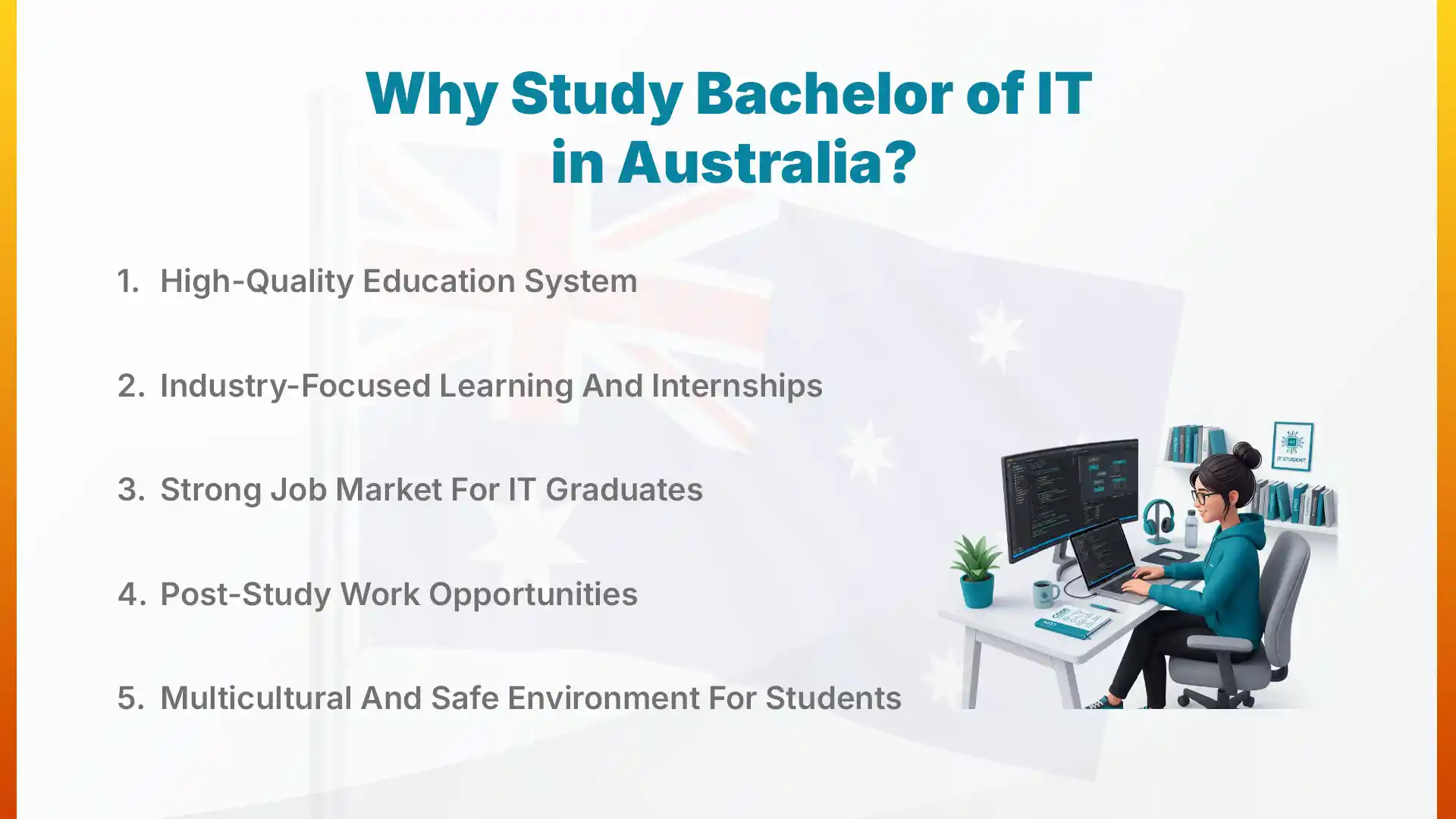
1. High-Quality Education System
Australian universities offer top-tier, globally recognized education with strict academic standards. Most courses are fully accredited by the Australian Computer Society, ensuring your resume stands out to major tech employers from Silicon Valley to Kathmandu.
2. Industry-Focused Learning And Internships
Forget just memorizing textbooks. Australian universities partner with tech giants like Google and Microsoft to offer real-world projects and paid internships, helping you build workplace confidence and networks before graduating.
3. Strong Job Market For IT Graduates
Australia’s booming tech sector faces a major shortage of skilled professionals. Local businesses actively hire fresh graduates for high-paying roles in data, security, and cloud systems across finance, healthcare, and government sectors.
4. Post-Study Work Opportunities
The Temporary Graduate visa (subclass 485) lets you stay and work full-time in Australia after graduation. This post-study window is the perfect opportunity to gain international corporate experience and build a global career.
5. Multicultural And Safe Environment For Students
Australia is a safe, welcoming home for international students. Cities like Sydney and Melbourne feature vibrant Nepalese communities and familiar foods, while dedicated university support teams help you easily settle into campus life.
Top Universities Offering a Bachelor of IT in Australia
Finding the right university is the most critical step because your choice shapes your learning experience and future job connections. Australia is home to several top-ranked institutions that offer excellent IT programs with deep industry ties. Let us look at the best universities for your tech degree.
University | Key Industry Advantage |
|---|---|
| University of Melbourne | Exceptional research facilities and global prestige |
| Monash University | Massive tech industry network and paid internship paths |
| University of Sydney | Deep corporate partnerships in the heart of Sydney |
| RMIT University | Strong focus on hands-on studio work and startups |
| Queensland University of Technology (QUT) | Built-in industry placements in booming Brisbane |
Quick Note: While Group of Eight universities offer incredible prestige, technology-focused universities like RMIT and QUT often provide highly practical, hands-on studio classes that prepare you perfectly for the workplace.
Eligibility Requirements for International Students
Meeting the official entry criteria is essential to secure your admission offer letter from an Australian university. Admissions teams look closely at both your high school grades and your English language proficiency scores. Let us break down the exact requirements to study in Australia:
1. Academic Qualification
To apply for a Bachelor of IT, you must have successfully completed your high school education or equivalent. For Nepalese students, this means completing your National Examination Board (+2) with a good academic percentage. Most top-tier universities,, such as Go8 universities, look for a minimum score of 60% or a stable GPA in your final results. If you have completed an A-Levels or an IB diploma, your scores will be converted using official university equivalence scales.
2. English Language Requirements
Since all university lectures are delivered in English, you must prove your language proficiency through an official test. Most institutions accept IELTS or PTE Academic test scores taken within the last two years. For a Bachelor of IT, you generally need an overall IELTS score of 6.5 with no individual band below 6.0. An equivalent PTE score is usually around 58 overall, though some competitive universities might require slightly higher marks.
3. Basic Math or IT Background
While you do not need to be an expert coder, having a basic background in mathematics is highly beneficial. Many universities list high school mathematics or computer applications as a mandatory prerequisite for IT courses. Having a strong comfort level with numbers will make your future programming and database classes much easier to pass. If you did not study math in high school, some colleges might ask you to complete a short preparatory module.
4. Additional Requirements
A select few universities might request extra items like a digital portfolio or a brief online interview. This is especially true if you are applying for specialized tracks like game design or interactive digital media. Your portfolio should showcase any simple websites you built, basic apps you coded, or creative tech projects you completed. Do not worry, as standard IT courses rarely require these extra steps, focusing mostly on your academic grades instead.
Cost of Studying Bachelor of IT in Australia
Planning your finances early is a crucial step to avoid any unexpected stress during your study journey. The total expenses for your Australian education will include university tuition fees, daily living costs, and mandatory government checks. Let us break down what you can expect to spend.
1. Average Tuition Fees Per Year
The annual tuition fee for a Bachelor of Information Technology generally ranges between AUD 35,000 and AUD 50,000 per year. Elite Group of Eight universities usually sit at the higher end of this scale due to their global rankings.
On the other hand, regional universities and specialized tech institutions offer highly affordable options around AUD 30,000 annually. Fees are normally invoiced on a semester basis, allowing your family to pay in manageable installments.
2. Living Costs
The Australian Department of Home Affairs requires international students to show at least AUD 29,710 per year for personal living expenses. This budget easily covers your share-house rent, groceries, public transport, utilities, and mobile data plans. Your actual day-to-day costs will depend heavily on your lifestyle choices and the city you live in. For instance, renting a room in Hobart or Adelaide is significantly cheaper than living in central Sydney or Melbourne.
3. Other Expenses
Beyond tuition and rent, you must factor in several essential upfront costs before departing from Nepal. This includes the mandatory Student Visa (subclass 500) application fee, which is currently AUD 2,000. You also need to purchase Overseas Student Health Cover (OSHC) for the entire duration of your three-year visa, costing roughly AUD 2,000. Finally, remember to save a small buffer for your flight tickets, university textbooks, and initial settling-in items.
Scholarships for Undergraduate IT Students in Australia
Financing an international degree can be challenging, but scholarships offer a fantastic way to lower your financial burden. Australian universities actively look for talented international students and reward them with generous financial aid packages. Let us explore the main scholarship categories available to you.
1. Government Scholarships
The Australian Government offers prestigious funding programs like the Australia Awards to exceptional students from developing countries. These highly competitive awards cover your full tuition fees, return airfares, a settling-in allowance, and monthly living contributions. While most government grants target postgraduate researchers, there are occasional undergraduate pathways for high-achieving leaders. Winning an official government scholarship brings immense global prestige and opens doors to top-tier professional networks.
2. University-Specific Scholarships
Almost every single university in Australia provides dedicated international student grants ranging from 10% to 25% off your tuition. For example, institutions like QUT, RMIT, and Monash offer automatic international merit scholarships if your high school grades excel. These discounts are applied directly to your semester fee invoices, saving your family thousands of dollars over three years. You do not always need a separate application form, as the admissions team reviews you automatically.
3. Merit-Based and Need-Based Options
Merit-based scholarships in Australia target top-performing academic minds, looking closely at your high school percentages, GPA, or English test results. On the flip side, need-based grants support passionate students who face clear financial hardships or regional disadvantages. To maximize your chances, it is always smart to apply early during the intake cycle before the annual funding pools run out. Combining a solid academic record with a sincere background statement is the best way to secure these funds.
How to Apply for Bachelors of IT Degree in Australia?
Applying for a Bachelor of IT in Australia is a straightforward step-by-step journey that moves from university selection to final visa approval. Starting your preparation early ensures you easily meet all university deadlines and processing timelines without any last-minute stress. Let us look at the exact path you need to follow to secure your seat.
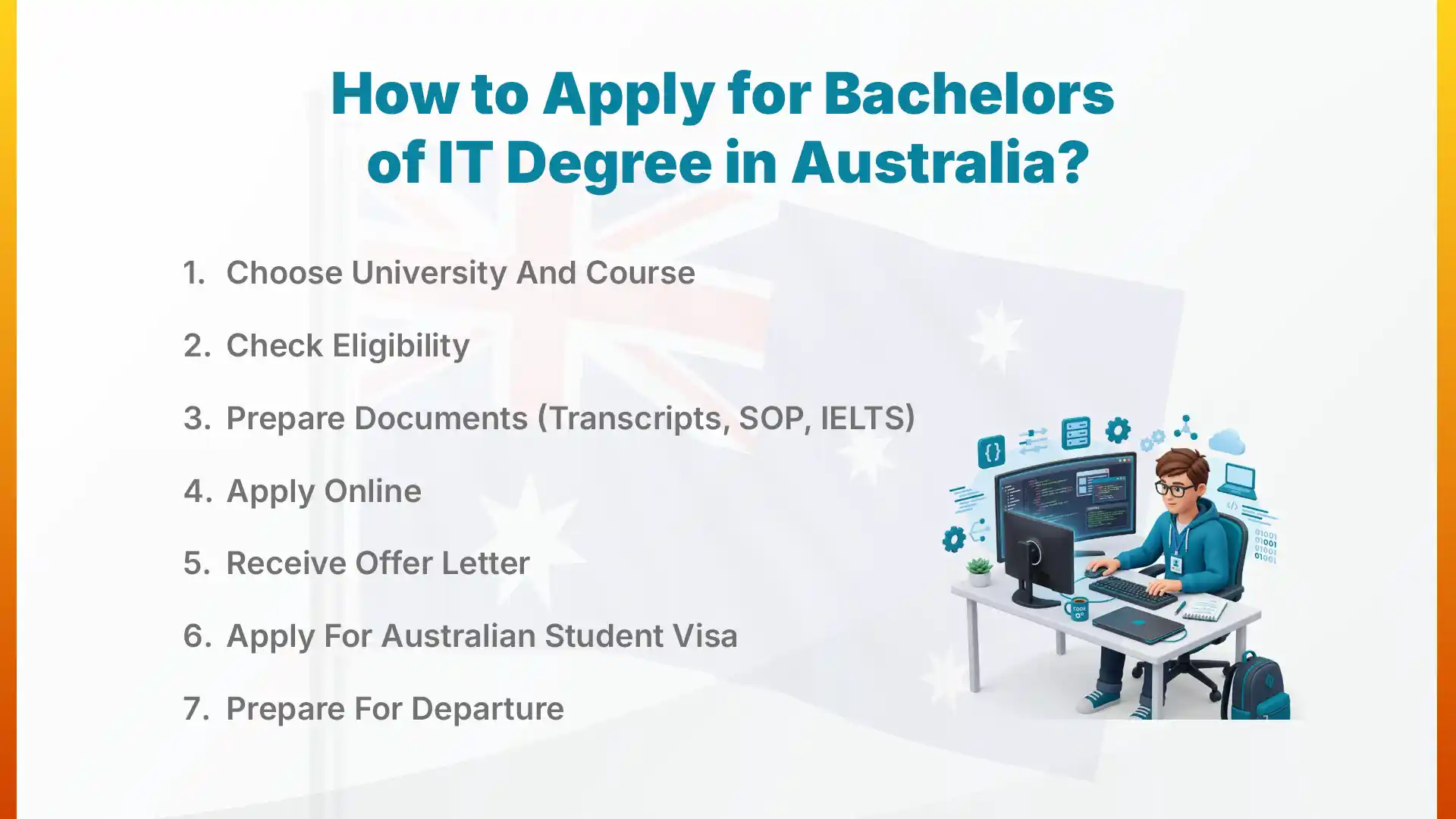
1. Choose University And Course
Research various Australian universities and pick the IT specialization that aligns with your career goals. Take time to check their campus locations, annual tuition fees, and intake dates in Australia. Finding a university that matches both your budget and your dream career stream makes a massive difference.
2. Check Eligibility
Review the entry requirements for your chosen colleges to ensure your high school grades and math background match their criteria. It is smart to take a practice exam early to judge your current English level. Knowing where you stand right now helps you prepare effectively for the actual admissions test.
3. Prepare Documents
Gather your high school academic transcripts, character certificates, and valid passport copies into clean digital files. Take your official IELTS or PTE test as soon as possible. Finally, answer your mandatory Genuine Student (GS) statements carefully to avoid any processing delays.
4. Apply Online
Submit your complete application through the university's official online portal. Alternatively, you can visit a certified education counselor in Kathmandu to guide you through the submission. Be sure to pay any required application processing fees to keep things moving.
5. Receive Offer Letter
The university admissions team will review your academic profile and issue an official Letter of Offer if you qualify. Review all the listed conditions carefully before signing the acceptance form. Finally, pay your first semester's tuition deposit to claim your spot.
6. Apply For Australian Student Visa
Once you receive your official Confirmation of Enrolment (CoE) document, submit your Australian Student Visa (subclass 500) application online. Book your appointments to complete your biometrics immediately. You must also complete your mandatory medical checks at an approved clinic.
7. Prepare For Departure
Book your flight tickets to Australia ahead of time to lock in the best prices. Arrange your initial student accommodation near the campus so you have a safe place to land. Finally, attend helpful local pre-departure briefings to understand Australian customs rules before packing your bags.
Career Opportunities After Bachelor of IT in Australia
Graduating with an Australian IT degree opens doors to an incredible array of high-paying jobs across the globe. Because technology drives every modern business, your skills will be highly sought after from day one. Let us look at the popular career roles and their average earning potential.
Job Role | Average Annual Salary (AUD) |
|---|---|
| Software Developer | 85,000 – 110,000 |
| Cybersecurity Analyst | 90,000 – 115,000 |
| Data Analyst | 80,000 – 105,000 |
| Network Engineer | 85,000 – 110,000 |
| IT Consultant | 90,000 – 120,000 |
The beauty of an IT degree is its absolute lack of borders. Whether you choose to climb the corporate ladder in Sydney, join a fast-paced startup in Singapore, or launch your own digital tech agency back home in Nepal, your skills remain universally valuable.
Conclusion
Wrapping up your plans to study a Bachelor of IT in Australia is the first big step toward an amazing future. This degree gives you a great education, real workplace experience, and a chance to stay and work in Australia after graduation.
While gathering your documents and applying takes some hard work, the high-paying jobs you can get later make it totally worth it. It is a fantastic way to turn your love for computers into a safe, lifelong career.
Do not wait around. Start looking at universities, practice your coding, and get your paperwork ready today. If you need guidance from an experienced professional, feel free to reach out to education consultants for Australian education.
With a clear plan, you can easily move to Australia and start your dream tech journey!