Bachelor of Data Science in South Korea: Guide for Nepalese Students

May 27, 2026
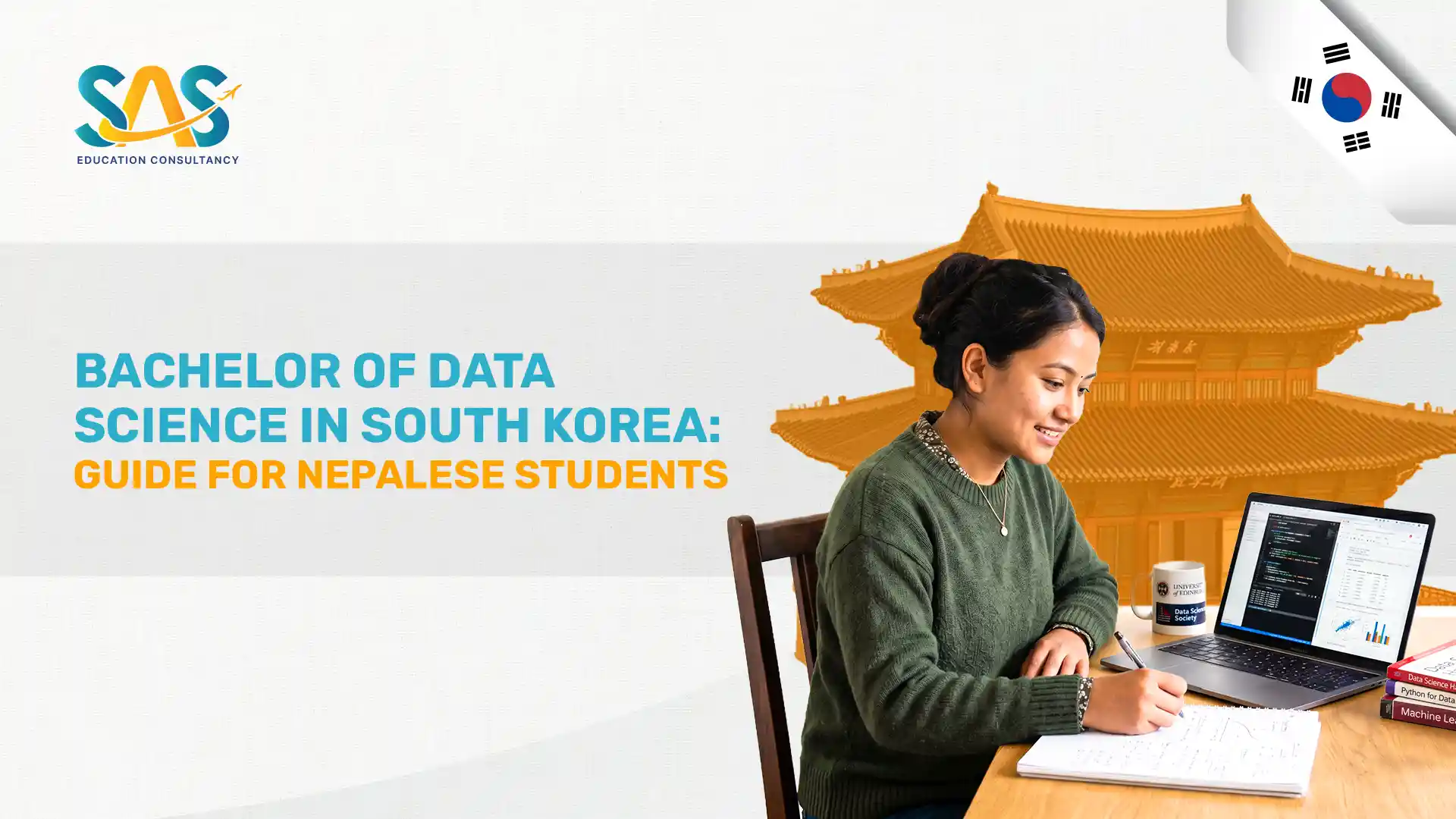
Data science has become one of the most in-demand professions in the world, and South Korea has rapidly emerged as one of Asia's most exciting destinations to study it. With globally competitive universities, deep ties to tech giants like Samsung, Kakao, and Naver, and a government actively investing in AI and digital innovation, South Korea offers Nepalese students a uniquely powerful combination of academic quality and career opportunity. For students who want a world-class data science education at a fraction of the cost of the UK or USA, South Korea deserves serious consideration. Nepalese students looking to study in South Korea will find it one of the most rewarding destinations in Asia.
In this blog, we cover everything a Nepalese student needs to know about pursuing a Bachelor of Data Science in South Korea from top universities, from eligibility to costs, scholarships, career opportunities, and salary prospects.
In this blog
What Is a Bachelor of Data Science in South Korea?
A Bachelor of Data Science is an undergraduate degree that combines mathematics, statistics, computer science, and analytical thinking to prepare students for data-driven careers across industries. The degree typically takes four years to complete and equips graduates with both the technical skills and practical experience needed to collect, process, and interpret large volumes of data.
Programs in South Korea cover a comprehensive range of subjects including Python and R programming, statistics and probability, machine learning, artificial intelligence, data visualization, and big data technologies. Many universities also integrate industry projects and internship opportunities directly into the curriculum, ensuring students graduate with hands-on experience alongside strong theoretical foundations. If you are also exploring other technology programs, check out our guide on IT and Computer Science courses in South Korea.
Why Study a Bachelor of Data Science in South Korea?
Study a Bachelor of Data Science in South Korea because it has world-ranked universities with a strong STEM focus, affordable tuition compared to the UK and the USA, deep industry ties with global tech giants like Samsung, Kakao, and Naver, growing demand for data professionals across multiple sectors, and post-study work opportunities for international graduates.
The country's government is heavily investing in AI and digital infrastructure, making it one of the most future-ready environments for data science education in Asia. For Nepalese students looking to build a globally competitive career in technology and analytics, South Korea offers the right combination of academic quality, industry exposure, and career opportunity at an accessible cost. For a deeper look at why Nepali students choose South Korea, read our complete guide on top reasons to study in South Korea from Nepal.
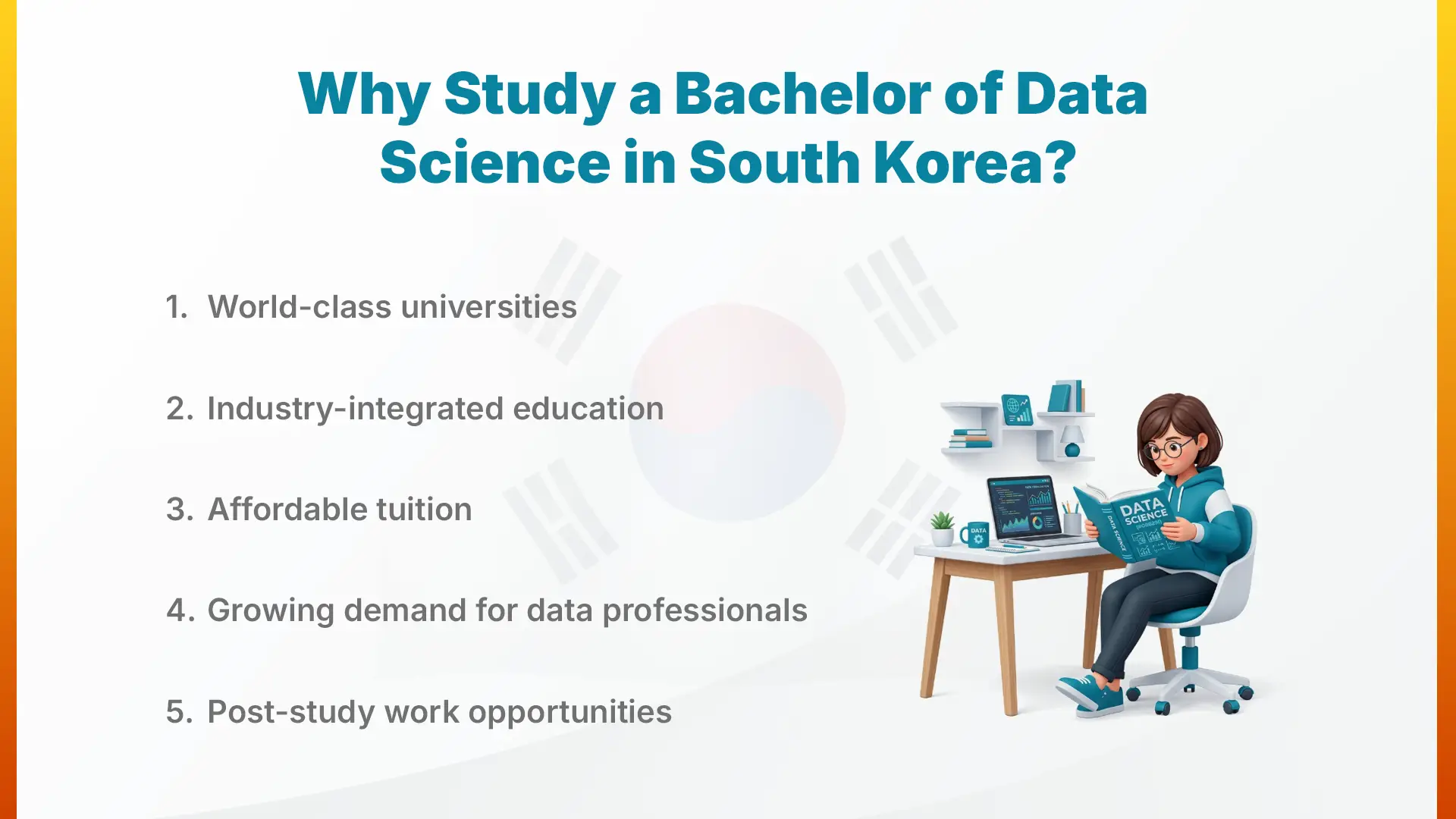
1. World-Class Universities with Strong STEM Focus
South Korea is home to institutions like Seoul National University, KAIST, and POSTECH that consistently rank among Asia's best for science, technology, and engineering programs. These universities offer rigorous, research-driven data science education that is recognized by employers across the globe.
2. Industry-Integrated Education
South Korea's universities have deep partnerships with the country's leading technology companies. Students benefit from live projects, internships, and collaborative research with industry giants like Samsung, LG, Hyundai, Kakao, and Naver, giving them a level of professional exposure that is difficult to match anywhere else in Asia.
3. Affordable Tuition Compared to UK, USA, and Australia
Tuition fees at South Korean universities are significantly more affordable than Western alternatives. Annual tuition at national or public universities typically ranges from approximately KRW 2,000,000 to KRW 4,000,000 (roughly NPR 200,000 to NPR 400,000), while private universities range from KRW 6,000,000 to KRW 12,000,000 (roughly NPR 600,000 to NPR 1,200,000) per year. This makes South Korea one of the most cost-effective destinations for high-quality data science education.
4. Growing Demand for Data Professionals
South Korea's rapid digital transformation across finance, healthcare, e-commerce, and manufacturing has created strong and growing demand for data professionals. Graduates with data science skills are actively recruited by both Korean conglomerates and international firms operating in the country.
5. Post-Study Work Opportunities
International graduates from South Korean universities can apply for post-study work visas that allow them to remain in South Korea and gain professional experience after completing their degree. Combined with the country's thriving tech sector, this creates a strong pathway from graduation to employment.
Top Universities for Bachelor of Data Science in South Korea
Top universities for a Bachelor of Data Science in South Korea include Seoul National University, KAIST, Yonsei University, Korea University, Sungkyunkwan University, and POSTECH, each offering world-class faculty, cutting-edge research facilities, and strong industry connections with leading Korean tech companies. These institutions consistently rank among Asia's best for science and technology programs and are recognized by employers across the globe. Choosing the right university depends on your academic profile, career goals, preferred location, and budget.
1. Seoul National University (SNU)
Seoul National University is South Korea's most prestigious institution and consistently ranks among the top universities in Asia. SNU's data science and computer science programs are deeply research-oriented, with access to state-of-the-art facilities and faculty who are leading contributors to AI and machine learning research. Its location in Seoul places students at the heart of South Korea's technology and business ecosystem.
2. KAIST (Korea Advanced Institute of Science and Technology)
KAIST is South Korea's leading science and technology institution and one of the most respected research universities in Asia. Its programs in data science, AI, and machine learning are among the most rigorous in the country, attracting students and faculty from around the world. KAIST offers a highly international academic environment and strong industry connections, making it an excellent choice for students with strong technical backgrounds.
3. Yonsei University
Yonsei University is one of South Korea's most globally recognized private universities and offers strong programs in data science and applied computing. Its curriculum balances academic depth with practical application, and students benefit from the university's extensive network of corporate partnerships. Yonsei's location in Seoul provides outstanding access to internship and career opportunities in the country's largest job market.
4. Korea University
Korea University is one of South Korea's most established and respected institutions, offering strong data science and computer science programs within a highly competitive academic environment. The first-year tuition fee for a bachelor's in data science at Korea University is approximately KRW 11,000,000. The university has a strong alumni network and active industry recruitment, making it a reliable pathway to graduate employment in South Korea's technology sector.
5. Sungkyunkwan University (SKKU)
Sungkyunkwan University has a notable distinction as a Samsung-affiliated institution, which gives its students unique access to one of the world's most influential technology companies. SKKU's data science programs incorporate Samsung's real-world data challenges and research priorities, providing students with genuinely industry-relevant experience. This connection also significantly enhances graduate employment outcomes.
6. POSTECH (Pohang University of Science and Technology)
POSTECH is one of Asia's top science and technology universities, known for its small class sizes, high faculty-to-student ratio, and intensive research environment. Its focus on computational sciences and AI makes it particularly well-suited for students who want a technically rigorous data science education. POSTECH consistently produces graduates who go on to leading roles in research institutions and technology companies across Asia and beyond.
Eligibility Criteria for a Bachelor of Data Science in South Korea
The eligibility criteria for a Bachelor of Data Science in South Korea include completion of Grade 12 or Plus Two with a strong background in mathematics or science, along with meeting the language requirements through IELTS or TOEFL for English-medium programs or TOPIK for Korean-medium programs. Students preparing for IELTS can check our IELTS class to prepare effectively before applying.
Most universities also require a statement of purpose, letters of recommendation, academic transcripts, a valid passport, and financial documents as part of the application. Meeting these criteria is essential for securing admission to a reputable South Korean university for data science.
1. Academic Requirements
To be eligible for a bachelor of data science program in South Korea, Nepalese students must have completed Grade 12 or Plus Two. Most universities prefer students who have studied mathematics, computer science, or science at the secondary level, as these subjects form the foundation for data science coursework. Strong academic performance is important, and students with high GPA scores and a solid background in mathematics and science are at a clear advantage during the admissions process.
2. Language Requirements
Language requirements depend on whether the program is taught in English or Korean. For English-medium programs, most universities accept IELTS with a minimum score of 6.0 to 6.5 or TOEFL iBT with a minimum score of around 80 to 90, depending on the institution. For Korean-medium programs, students are required to demonstrate proficiency through the TOPIK (Test of Proficiency in Korean), typically at Level 3 or above. Many of the top universities, including KAIST and SNU, offer programs with English instruction, making them accessible to Nepalese students without Korean language skills.
Admission Process for a Bachelor of Data Science in South Korea
The admission process for a Bachelor of Data Science in South Korea involves six key steps: researching and shortlisting universities, preparing your documents, applying through the university portal, submitting your SOP and language scores, receiving your offer letter, and applying for the South Korea Student Visa (D-2). The process is straightforward when approached with proper planning and preparation well in advance of application deadlines. Nepalese students typically follow these six steps to successfully secure admission at a South Korean university.
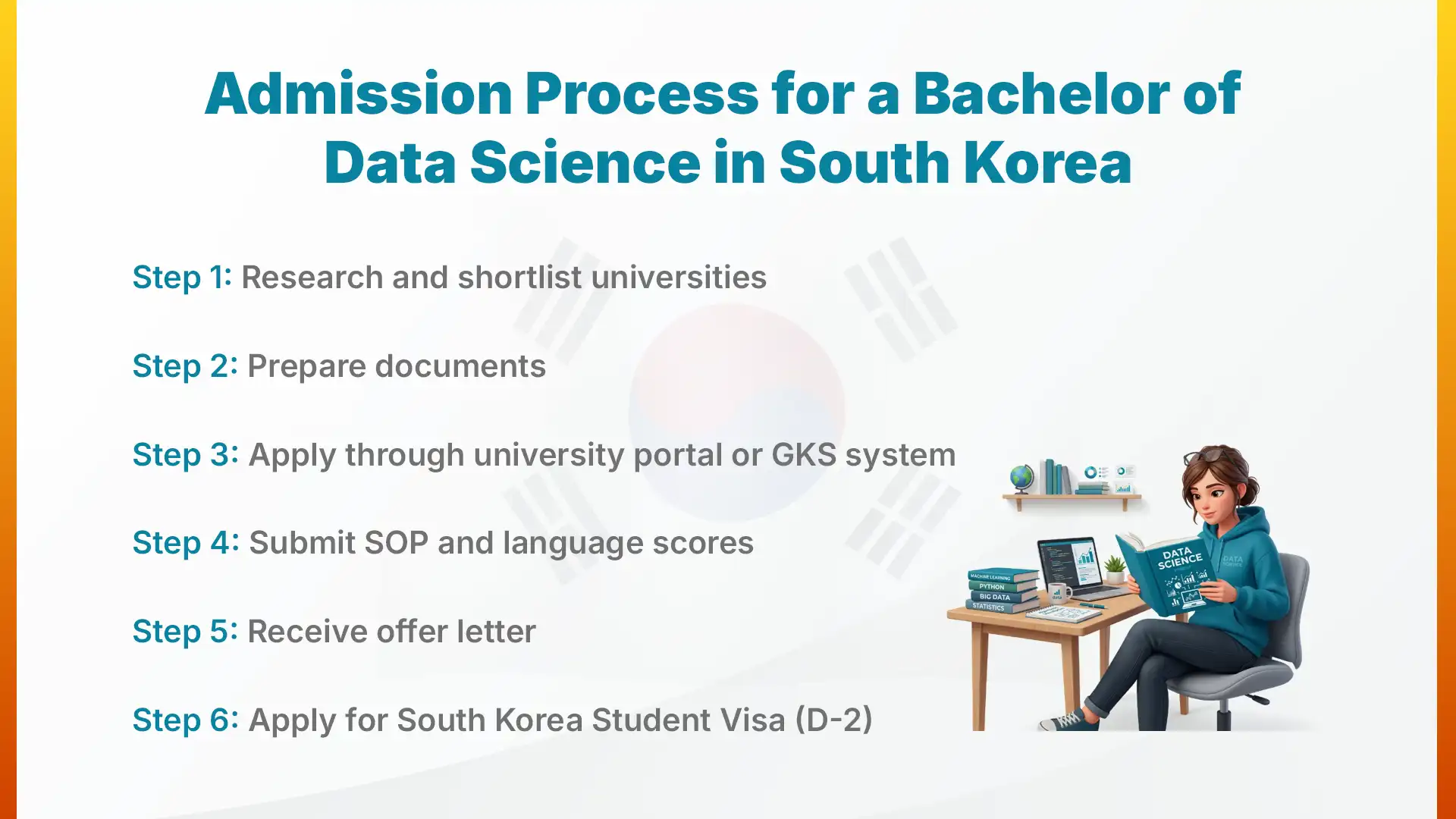
Step 1: Research and Shortlist Universities
Compare programs based on academic profile, career goals, tuition fees, and scholarship availability. Shortlist three to five universities to maximize your chances of receiving an offer.
Step 2: Prepare Documents
Gather academic transcripts, language test scores, a statement of purpose, letters of recommendation, a passport copy, and financial documents well in advance of deadlines.
Step 3: Apply Through University Portal
Most universities accept direct online applications through their own portals. Check the university's application process, required documents, and deadlines before submitting your application.
Step 4: Submit SOP and Language Scores
Your Statement of Purpose should clearly explain your academic background, motivation to study data science, choice of university, and long-term career goals. Submit all language test scores officially from the testing body.
Step 5: Receive Offer Letter
The university will issue a conditional or unconditional offer after reviewing your application. A conditional offer requires you to meet specific academic or language conditions before your place is confirmed.
Step 6: Apply for South Korea Student Visa (D-2)
Once you have accepted your offer and received your acceptance letter, apply for the D-2 student visa. This involves submitting your application to the Korean embassy, paying the visa fee, and attending a biometric appointment.
Cost of Studying Bachelor of Data Science in South Korea
The cost of studying a Bachelor of Data Science in South Korea generally ranges from KRW 8,000,000 to KRW 20,000,000 (approximately NPR 800,000 to NPR 2,000,000) per year depending on the university type and program. When combined with accommodation, food, transportation, and health insurance, Nepalese students should budget approximately KRW 15,000,000 to KRW 25,000,000 (approximately NPR 1,500,000 to NPR 2,500,000) per year in total.
Compared to the UK, USA, and Australia, South Korea remains one of the most affordable destinations for a high-quality data science degree in Asia.
1. Tuition Fees
The total cost of studying in South Korea generally falls between KRW 8,000,000 and KRW 20,000,000 per academic year, equivalent to approximately USD 6,000 to USD 15,000, depending on university type and course of study. National universities like SNU and KAIST are more affordable due to government subsidies, while private universities like Yonsei and Korea University are at the higher end of the range.
2. Accommodation Costs
On-campus dormitories are the most affordable housing option and typically cost between KRW 300,000 and KRW 600,000 per month. Private accommodation in cities like Seoul can range from KRW 500,000 to KRW 1,000,000 per month depending on location and room type. Choosing on-campus housing significantly reduces overall living costs.
3. Food and Transportation
Monthly living expenses including food and transportation generally range from KRW 700,000 to KRW 1,500,000 per month. Students who cook at home and use South Korea's excellent public transport system can manage their daily expenses very efficiently. Seoul's subway and bus network is extensive, affordable, and reliable.
4. Total Estimated Cost
Taking tuition, accommodation, food, transportation, health insurance, and miscellaneous expenses into account, Nepalese students should budget approximately KRW 15,000,000 to KRW 25,000,000 per year. For a standard four-year degree, the total estimated cost ranges from KRW 60,000,000 to KRW 100,000,000, making South Korea one of the most affordable quality study destinations in Asia.
Scholarships for Bachelor of Data Science in South Korea
Scholarships for a Bachelor of Data Science in South Korea include some fully funded government scholarships, university-specific merit awards from institutions like SNU, KAIST, and Yonsei, and need-based financial assistance programs designed for students from developing countries like Nepal. Nepalese students with strong academic records and early preparation have a good chance of securing one of these scholarships in South Korea and significantly reducing or eliminating the cost of their studies.
1. Government Scholarships
South Korea offers several government-funded scholarships for international students, including Nepalese students. These scholarships can cover tuition fees, living costs, travel, and language training, depending on the program. They are highly competitive and can greatly reduce the cost of studying in South Korea.
2. University-Specific Scholarships
Most top universities in South Korea offer their own merit-based scholarships to high-achieving international students. Seoul National University, KAIST, Yonsei, and Korea University all have dedicated international scholarship programs that cover partial or full tuition reductions. Students with strong academic records from their Grade 12 examinations are the strongest candidates for these awards.
3. Need-Based Scholarships
Some universities and external organizations offer financial assistance to students who can demonstrate genuine financial need. These scholarships are designed to make South Korean education accessible to students from developing countries who may not otherwise be able to afford the full cost of study. Nepalese students applying for need-based scholarships must typically submit detailed financial documentation as part of the application.
Career Opportunities After a Bachelor of Data Science in South Korea
Graduates with a bachelor of data science from South Korea can pursue careers as data analysts, data scientists, machine learning engineers, business intelligence analysts, and data engineers across a wide range of industries. South Korea's thriving technology sector, led by global companies like Samsung, LG, Kakao, Naver, and SK Telecom, creates strong and consistent demand for data science professionals.
With the country's continued investment in AI, fintech, healthcare technology, and e-commerce, career opportunities for data science graduates in South Korea are expected to grow significantly in the coming years.
1. Data Analyst
A data analyst collects, cleans, and interprets data to help organizations make informed business decisions. This is the most common entry-level role for fresh graduates and is available across virtually every industry in South Korea.
2. Data Scientist
A data scientist works on complex analytical challenges, building predictive models and statistical frameworks that drive strategic business outcomes. This role requires stronger programming and machine learning skills and offers higher salary potential.
3. Machine Learning Engineer
A machine learning engineer designs and deploys machine learning models in production environments. This is one of the most technically demanding and highly paid roles in the data science field, with particularly strong demand at South Korea's large technology firms.
4. Business Intelligence Analyst
A business intelligence analyst transforms data into actionable insights using visualization tools and reporting systems. This role is ideal for graduates who enjoy both technical analysis and communication with business stakeholders.
5. Data Engineer
A data engineer builds and maintains the data pipelines and infrastructure that allow data scientists and analysts to do their work. This is a highly technical and well-compensated role with strong demand across South Korea's banking, technology, and e-commerce sectors.
Students interested in related fields can also explore our guide on studying cybersecurity in South Korea for additional high-demand career options
Salary After a Bachelor of Data Science in South Korea
The salary after a Bachelor of Data Science in South Korea ranges from KRW 48,000,000 to KRW 150,000,000 (approximately NPR 4,800,000 to NPR 15,000,000) per year depending on experience level, role, and employer. Entry-level data analysts and junior data scientists typically earn between KRW 48,000,000 and KRW 63,000,000 per year, while mid-level professionals with two to five years of experience earn between KRW 63,000,000 and KRW 112,000,000 annually. Senior data scientists and machine learning engineers with five or more years of experience at top companies like Samsung or Kakao can earn KRW 120,000,000 or more per year, making data science one of the highest-paying career paths available to graduates in South Korea.
Salary levels are influenced by several key factors. Technical proficiency in Python, machine learning frameworks, and cloud platforms directly affects earning potential. Work experience gained through internships during the degree program is highly valued by employers. Company size and sector also play a major role, with large conglomerates like Samsung and Kakao offering the highest compensation packages. Graduates who develop Korean language skills alongside their technical abilities tend to access a wider range of opportunities and command higher starting salaries.
Conclusion
South Korea offers Nepalese students a compelling combination of academic excellence, industry integration, affordable costs, and strong career outcomes for a bachelor of data science. With world-ranked universities, direct access to some of Asia's largest technology employers, and a government actively investing in AI and data infrastructure, South Korea is one of the most future-ready destinations for data science education in the world today. For students willing to invest in their skills and embrace a new cultural experience, a data science degree from South Korea is a qualification that opens doors both across Asia and globally.
Interested in studying data science in South Korea? Contact SAS Education Consultancy for a free counseling session and let us help you find the right university, apply for the best scholarship, and navigate the visa process with confidence.