Study Bachelor of Architecture in Australia: Fees, Eligibility & Admission

Jun 08, 2026
Every iconic skyscraper in Sydney or Melbourne started as a simple pencil sketch. And your journey to designing them begins with one right choice.
Are you finding the right opportunity after your class 12? Well, if you love design, if creativity ignites a spark in you, or if you’ve ever gazed at an iconic building and wondered how it was brought to life, then a Bachelor of Architecture in Australia could be just the right option for you.
Australia is a vibrant global hub of architectural innovation, offering some of the world's most progressive design studios where your creative ideas can come to life.
To make this massive transition easy, this ultimate guide lays out everything you need to know. We break down the actual tuition fees, university entry requirements, portfolio benchmarks, and high-paying post-graduation career opportunities waiting for you across Australia.
In this blog
Why Study a Bachelor of Architecture in Australia?
Studying a Bachelor of Architecture in Australia is highly advantageous because it offers globally accredited degrees, state-of-the-art studio-based learning, and access to a booming local construction industry. Graduates benefit from strong starting salaries and excellent post-study work pathways.
Here are the top reasons why Australia could be the best study hub for your Architecture dreams:
- Your degree is recognized and respected worldwide.
- Learn through hands-on design, not boring textbooks.
- Architects are in high demand with great salaries.
- Learn & master the top design software used worldwide.
- Get valuable work experience in Australia after graduating.
- Connect with creative peers from across the globe
What Is a Bachelor of Architecture?
A Bachelor of Architecture is a foundational undergraduate degree that equips students with core skills in spatial design, building technology, and sustainable planning. It acts as the first academic step toward becoming a registered professional architect under international and Australian standards.
A Bachelor's program in architecture typically focuses on the aesthetic, structural, and social aspects of designing spaces. It teaches you how to balance creative design concepts with engineering realities, building codes, and safety standards.
1. Skills You Will Develop
A Bachelor of Architecture helps you build a balanced mix of creative, technical, and professional skills needed for modern architectural practice. Throughout the program, you learn how to design functional spaces, use industry-standard software, and work effectively with clients and project teams.
- Spatial & Conceptual Design: Translating abstract concepts into practical, physical structures.
- Technical Drawing & 3D Modeling: Mastering computer-aided design (CAD) tools and BIM platforms.
- Structural Mechanics: Understanding how different materials (timber, concrete, steel) react under stress and load.
- Sustainable Thinking: Designing buildings that minimize environmental impact and maximize energy efficiency.
- Client Collaboration: Presenting architectural pitches and managing stakeholder expectations.
2. Subjects Covered in a Bachelor of Architecture
To prepare you for real-world projects, your curriculum will balance art, science, technology, and humanities. Here is a breakdown of the standard core modules you will take across your semesters.
- Architectural Design Studio
- Building Technology
- Architectural History and Theory
- Sustainable Design
- Digital Design and Modeling
- Urban Planning Fundamentals
How Long is the Bachelor’s of Architecture Course in Australia?
The standard Bachelor of Architecture course duration in Australia is three years of full-time study, which serves as the foundational undergraduate qualification. To become a fully registered architect in Australia, you must complete this degree followed by a two-year Master of Architecture.
3-Year Bachelor's Degree ──> 2-Year Master's Degree ──> 2 Years Supervised Work ──> AACA Registration Exam
This 3+2 model is standard across most major Australian universities.
Top Universities for Bachelor of Architecture in Australia
If you are looking for the best architecture universities in Australia, you will find several institutions consistently ranking among the top 100 globally. University of Melbourne, University of Sydney, and RMIT are some of the most popular universities in Australia for Architecture.
University | Estimated Annual Tuition (AUD) | Main Campus Location |
|---|---|---|
| University of Melbourne | 45,000 – 49,000 | Melbourne, Victoria |
| University of Sydney | 43,000 – 48,000 | Sydney, New South Wales |
| RMIT University | 38,000 – 44,000 | Melbourne, Victoria |
| UNSW Sydney | 42,000 – 47,000 | Sydney, New South Wales |
| Queensland University of Technology (QUT) | 36,000 – 41,000 | Brisbane, Queensland |
| Curtin University | 35,000 – 40,000 | Perth, Western Australia |
Eligibility Requirements for a Bachelor of Architecture in Australia
To study a Bachelor of Architecture in Australia, Nepalese students must have completed Grade 12 with a minimum GPA of 2.5 to 3.0 and secured an IELTS score of 6.5 or equivalent PTE.
Some top universities might also ask for a creative design portfolio showing your sketches, physical models, or digital drawings.
Here is a complete breakdown of the academic, linguistic, and portfolio benchmarks you need to clear for a successful application.
1. Academic Requirements
- NEB (Nepal): Successful completion of your Plus Two (+2) exams with an overall GPA of 2.5 to 3.0 out of 4.0, depending on the tier of the university.
- A-Levels: Generally requires a minimum score of 8 to 11 across your best three subjects.
- CBSE: Average of 65% to 75% in the best four academic subjects.
2. English Language
For architecture, clear communication is vital. You must demonstrate strong English proficiency:
- IELTS Academic: An overall band score of 6.5 with no individual band below 6.0.
- PTE Academic: An overall score of 58 with no communicative skill score lower than 50.
3. Portfolio Requirements (If Applicable)
While some universities grant direct admission based solely on your GPA and English score, top-tier design schools may require a design portfolio. This is a collection of your creative works, which can include:
- Hand-drawn sketches, paintings, or photography.
- Physical models or digital 3D models.
- Drafting work or structural project plans from high school.
4. Other University-Specific Criteria
Some universities may require a written personal statement (explaining your passion for design) or invite you for a virtual Skype/Zoom interview before issuing a conditional offer letter.
Documents Required to Study Architecture in Australia
To secure your admission and student visa without any hassle, you must prepare a comprehensive set of academic, personal, and financial papers. Below is the ultimate checklist of documents you must gather and organize before lodging your application:
Academic Transcripts & Certificates (SEE/SLC and Class 11 & 12)
Valid Passport
English Language Test Scores (IELTS or PTE Academic)
Genuine Student (GS) Statement
Creative Design Portfolio (If Required)
Letters of Recommendation (Academic or Professional)
Financial Proof & Relationship Documents (From Class "A" Nepalese Banks)
How to Apply for a Bachelor's of Architecture in Australia?
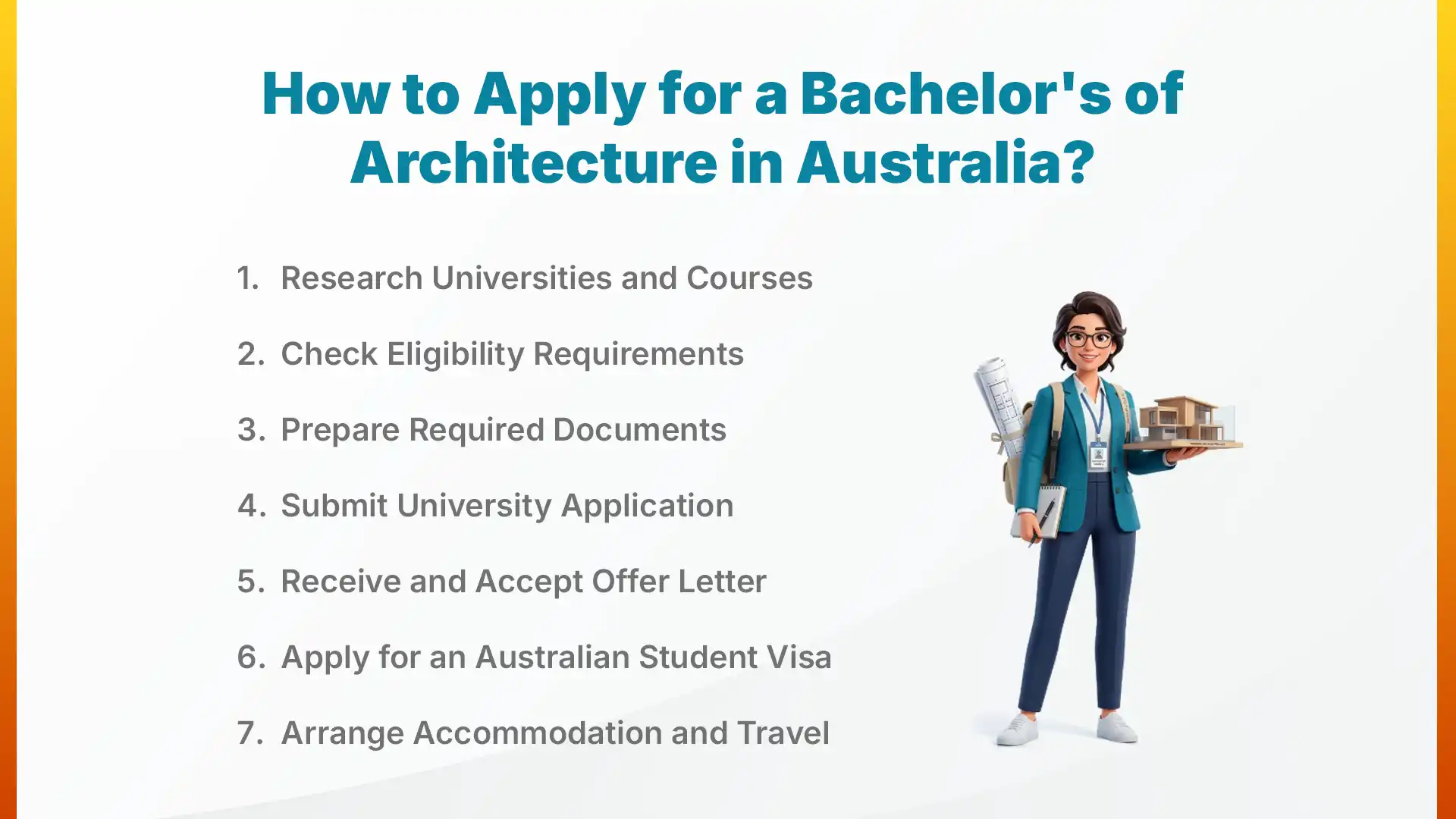
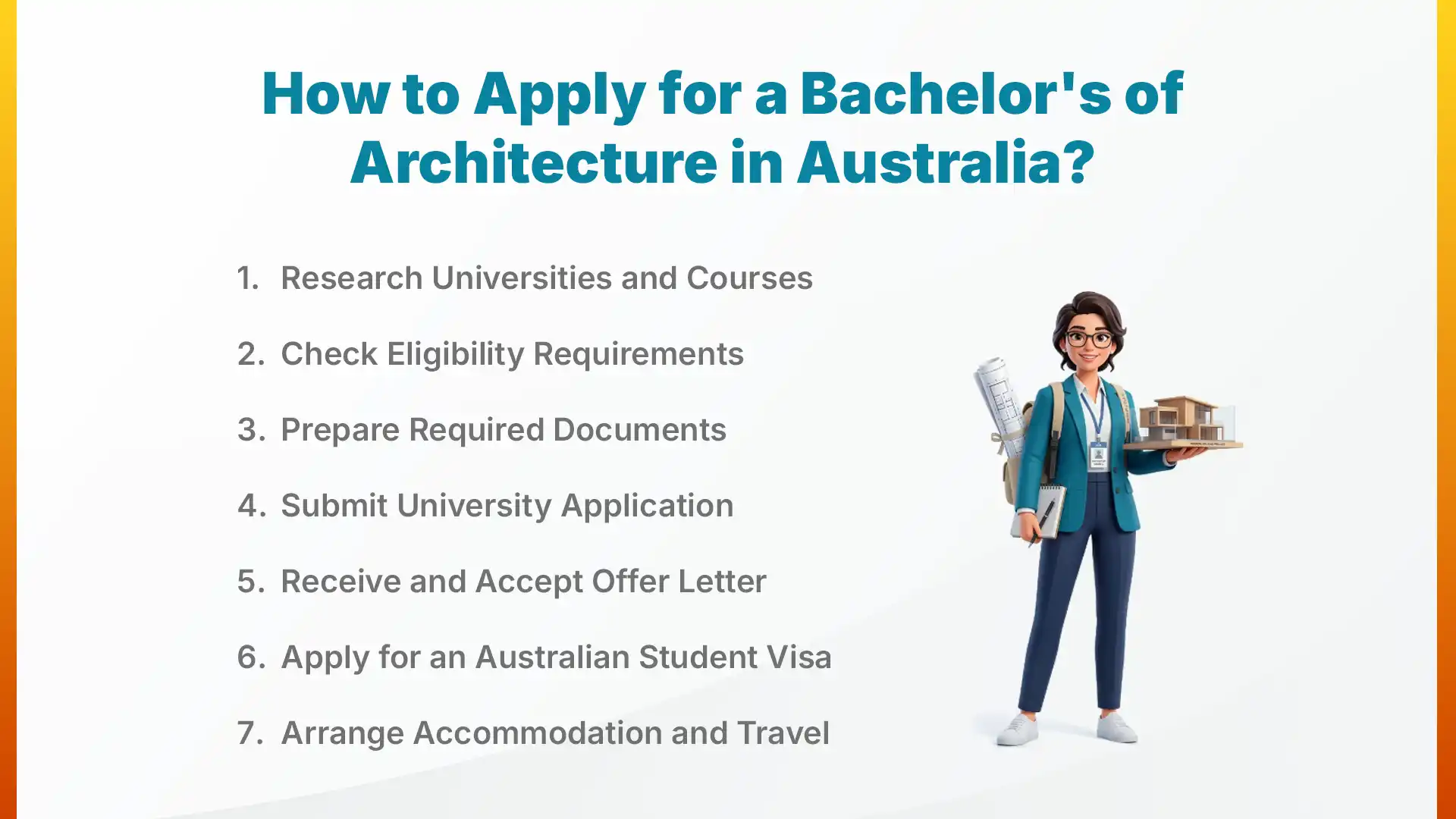
To apply for a Bachelor of Architecture in Australia, international students must first select a university, understand the requirements and prepare accordingly. Take IELTS exam, gather documents, and then apply for your chosen program.
1. Research Universities and Courses
Start searching 6 to 9 months before your intended intake (February or July). Analyze course modules, campus facilities, and tuition fees to match your specific career goals.
2. Check Eligibility Requirements
Check your NEB GPA or A-Level points against the entry requirements of your chosen universities. Book and take your PTE or IELTS exams early so you have time for a retake if needed.
3. Prepare Required Documents
Scan all academic papers, draft your portfolio, and write an authentic Genuine Student (GS) statement. Avoid copy-pasting SOP templates for Australia, as Australian universities use advanced AI-detection software.
4. Submit University Application
Apply directly via the university’s online international portal or through an authorized education consultancy in Kathmandu. Application fee processing costs generally range from AUD $50 to $150.
5. Receive and Accept Offer Letter
If you meet the criteria, you will receive a conditional or unconditional Letter of Offer. Carefully review the terms, sign the acceptance form, and pay your first semester's tuition deposit and Overseas Student Health Cover (OSHC).
6. Apply for an Australian Student Visa (Subclass 500)
Once you receive your official Confirmation of Enrolment (CoE), prepare your financial proof (such as bank balances with a clear history from Class "A" commercial banks in Nepal). Then, lodge your Australian student visa application online through your ImmiAccount.
7. Arrange Accommodation and Travel
Once your visa is successfully granted, secure student housing (homestays, student apartments, or shared rentals), book your flight to Australia, and apply for your foreign exchange limit via Nepal Rastra Bank.
Bachelor of Architecture Fees in Australia for International Students
Budgeting accurately is critical for Nepalese families. Because Australia recently updated Nepal to Assessment Level 3, demonstrating clean, verifiable financial capacity is more scrutinized than ever.
Expense Category | Average Annual Cost (AUD) | Equivalent in NPR (Approx.) |
|---|---|---|
| Tuition Fees (B.Arch) | 35,000 – 50,000 | 36.75 Lakhs – 52.5 Lakhs |
| Official Living Expenses | 29,710 | 31.2 Lakhs |
| Student Visa Fee (Subclass 500) | 2,000 | 2.1 Lakhs |
| OSHC (Mandatory Health Cover) | 500 – 800 | 52,500 – 84,000 |
| Pre-Arrival Costs (Airfare, Tests) | 1,500 – 2,500 | 1.58 Lakhs – 2.63 Lakhs |
Other Additional Costs
- Architectural Drawing Equipment: Sketchbooks, scale rulers, model-making knives, and timber boards (approx. AUD $500/year).
- High-End Laptop: Running heavy design tools like Revit and Lumion requires a high-performance laptop with a dedicated graphics card (approx. AUD $1,500 - $3,000 upfront).
- Software Licences: Many universities offer student pricing or free access, but some plug-ins may require small monthly fees.
Architecture Scholarships for Nepalese Students in Australia
Australia offers hundreds of undergraduate architecture scholarships for international students. Top universities provide merit-based tuition discounts ranging from $5,000 to 50% off fees. Finding the right match often depends on your exact academic profile and citizenship.
1. Australia Awards Scholarships
A prestigious initiative funded by the Australian Government, covering full tuition fees, return air travel, contribution to living expenses, and health cover. These are highly competitive and targeted toward sustainable development fields.
2. Destination Australia Scholarship
This scholarship is worth up to AUD $15,000 per year and encourages students to study in regional areas of Australia. It is a fantastic option if you choose regional campuses in places like Western Australia, Tasmania, or Northern Queensland.
3. University-Specific Scholarships
Most universities offer automatic entry-level international scholarships in Australia based on your academic performance:
- RMIT International Excellence Scholarship: Often grants a 20% tuition fee reduction.
- UTAS Dean's Merit Scholarship: Offers up to a 25% tuition fee waiver for exceptional design portfolios and GPAs.
- UNSW International Scientia Coursework Scholarship: Offers full-tuition or partial waivers.
4. Merit-Based Scholarships
Keep your grades high! Many schools grant secondary scholarships of AUD $5,000 to $10,000 to enrolled students who maintain an High Distinction (HD) average throughout their first and second semesters.
What Are the Career Opportunities and Salaries for Architecture Graduates in Australia?
Graduating with an architecture degree in Australia opens diverse career pathways as architects, interior designers, or urban planners, offering starting salaries from AUD $65,000 up to AUD $135,000 annually. With professional registration, you will secure highly lucrative, technical roles across top-tier design firms and local planning boards.
1. Architect
Registered architects design major buildings like homes, office towers, and public parks. To get your license, you must complete a Master's degree and pass a practical exam. After that, you can legally sign off on construction plans. Licensed architects command an excellent average salary of AUD $95,000 to $130,000 per year.
2. Architectural Designer
In this role, you will work inside creative firms to draw initial building plans. You will focus heavily on creating beautiful 3D digital models for clients to see. You also work closely with senior architects to fix planning details. It is a fantastic entry-level job to build your professional network quickly, bringing in a reliable salary of AUD $70,000 to $90,000 per year.
3. Urban Designer
Urban designers plan how whole neighborhoods, parks, and train lines should fit together. You will work with local governments to make sure cities are easy to navigate. Your main goal is to design safe, green spaces for thousands of people. This job offers an attractive average salary of AUD $85,000 to $115,000 per year.
4. Interior Designer
This job is all about making the inside of buildings look beautiful and work well. You will select internal materials, arrange furniture layouts, and design cozy lighting schemes. It is a highly creative and popular career path that yields a steady salary of AUD $65,000 to $85,000 per year.
5. Landscape Designer
Landscape designers plan outdoor areas like community gardens, school playgrounds, and public plazas. You will mix your knowledge of plants and soil with smart spatial planning. Your designs will help bring nature back into crowded concrete cities. Because of this, it is an essential role for modern eco-friendly development, paying a competitive salary of AUD $70,000 to $95,000 per year.
6. Building Consultant
Consultants help clients make sure their construction projects follow all government safety laws. You will inspect older structures and recommend repairs to make them safe. You also advise teams on which building materials are best for the climate. Consequently, your technical expertise will be highly valued in the industry, granting you an average salary of AUD $80,000 to $110,000 per year.
Conclusion
Studying a Bachelor of Architecture in Australia is ultimately the single best investment for your creative future. The world-class practical learning, highly competitive salaries, and solid post-study work rights make each effort you put into it absolutely worth it!
You could be feeling nervous about English tests, tuition fees, or Australia's updated visa rules for the 2026 application. But remember, every iconic skyscraper in Sydney or Melbourne once started as a simple pencil sketch, and your professional future deserves that same brave first step.
If you need any help, simply reach out to a trusted education consultancy for Australia in Nepal. They literally work to provide you with the right guidance based on your interests and academic profile.
Take action on your dreams today. Let's build your global future together. Let’s transform your design passion into a global career now!