Bachelor's in Data Science in Canada: Courses, Universities, Costs and Careers 2026

May 25, 2026

Do you dream of working with cutting-edge technology, solving real-world problems through data, or building intelligent systems that shape the future?
Canada is one of the world's top destinations for studying data science. With globally recognized degrees, paid co-op programs, a thriving tech industry, and strong post-graduation work and PR pathways, it offers an exceptional opportunity for Nepali students who want an international career in one of the fastest-growing fields in the world.
Whether you have just completed your NEB +2, are exploring your options after school, or want to understand what a data science degree in Canada actually leads to, this guide covers everything. Courses, universities, fees, scholarships, IELTS requirements, career scope, salaries, and visa steps all in one place to study in Canada.
In this blog
What is Data Science?
At its heart, data science is the art and science of turning raw information into meaningful decisions. It is not just about numbers and spreadsheets; it is about asking the right questions, finding patterns in data that nobody else has noticed, and using those patterns to drive real outcomes for businesses, governments, hospitals, and communities.
A bachelor's in data science teaches you the tools, techniques, and thinking required to do exactly that at a professional level, across virtually every industry on the planet.
1. What Data Science Actually Covers as a Field of Study
During your bachelor's program, you will study a combination of mathematics, statistics, computer programming, machine learning, data visualization, and business intelligence. You learn how to collect and clean large datasets, build predictive models, and communicate your findings in a way that non-technical decision-makers can actually use.
The beauty of data science as a degree is that it is deliberately broad. You are not training for one narrow job; you are building a skill set that applies across healthcare, finance, technology, retail, sports, government, and more. Wherever data exists, a data scientist is needed. And data exists everywhere.
2. Difference Between Data Science and Computer Science
This is one of the most common questions students ask before applying, and it is worth being clear about. Computer science is primarily about building software systems, writing code, designing algorithms, and understanding the architecture of computing. It is the foundation on which most technology is built.
Data science, by contrast, is about extracting insight and value from data that already exists. Yes, you will write code in a data science degree. Python and R are standard tools, but the focus is on statistical analysis, modeling, and interpretation rather than software development. Think of computer science as building the tools and data science as using those tools to answer questions.
3. Data Science vs. Artificial Intelligence?
Data science and artificial intelligence are closely related but not the same thing. Data science is the broader discipline; it covers the entire process of collecting, cleaning, analyzing, and interpreting data. Artificial intelligence is a specific application within that broader field, focused on building systems that can learn, reason, and make decisions on their own.
In practice, most data scientists work with AI and machine learning tools regularly. But not every data science project involves AI, and not every AI project requires a dedicated data scientist. As you progress through your degree in Canada, you will naturally develop competency in both areas and can choose to specialize deeper into AI if that is where your interest takes you.
Why Study a Bachelor's in Data Science in Canada?
Study a bachelor's in data science in Canada because it opens doors to one of the most in-demand careers of the 21st century, inside one of the world's most welcoming and technologically advanced countries.
Canada is not just a study destination; it is a global technology hub, home to leading AI research centers, major tech employers, and a government that actively supports skilled immigrants who want to build their careers there. Here is why so many Nepali students are choosing Canada and why studying in Canada for data science makes more sense now than ever before.
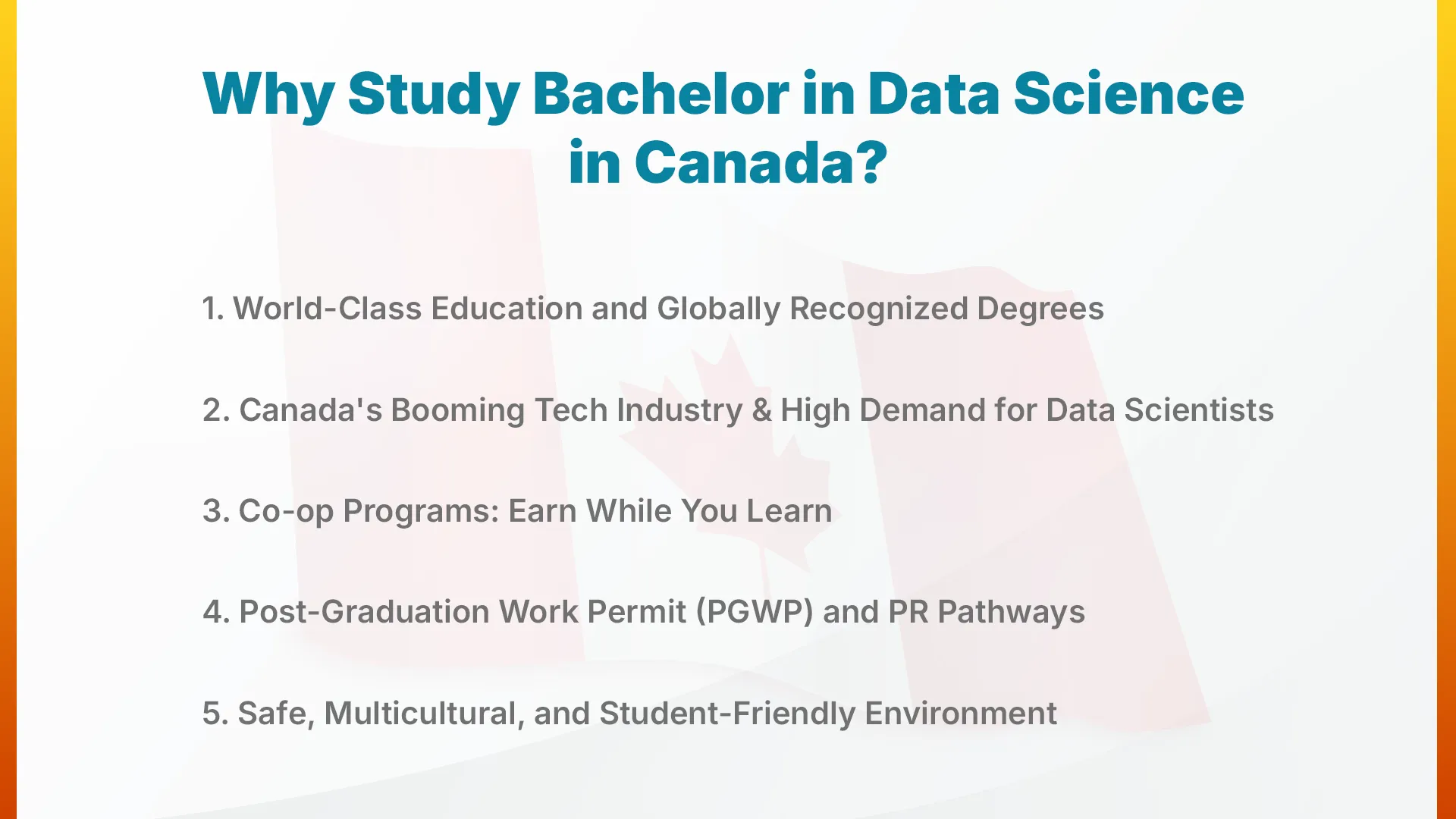
1. World-Class Education and Globally Recognized Degrees
Canada's universities consistently rank among the world's best, and their data science programs are recognized and respected by employers globally, from Silicon Valley to Singapore. A degree from a Canadian university carries genuine credibility in every major technology market in the world, and the country's strong academic reputation means your qualification will open doors long after you graduate.
2. Canada's Booming Tech Industry and High Demand for Data Scientists
Canada is home to a thriving and rapidly expanding technology sector. Cities like Toronto, Vancouver, and Waterloo host major operations for companies including Google, Microsoft, Amazon, Shopify, and hundreds of AI and data-focused startups. The demand for qualified data scientists across Canada far exceeds the current supply, which means as a graduate, you are entering a job market that is actively looking for people with your skills.
3. Co-op Programs: Earn While You Learn
One of the most distinctive advantages of studying in Canada is the co-operative education model. Many Canadian universities integrate paid work terms directly into the bachelor's degree, alternating between semesters of academic study and semesters of full-time professional work in your field. This means that by the time you graduate, you already have twelve to sixteen months of real industry experience on your CV, experience that employers in Canada and internationally consider genuinely valuable, not just box-ticking.
4. Post-Graduation Work Permit (PGWP) and PR Pathways
After completing your bachelor's degree in Canada, you are eligible for a Post-Graduation Work Permit (PGWP) that allows you to remain in Canada and work full-time for up to three years. This is one of the most generous post-study work arrangements offered by any major study destination. And because data science is a high-demand skilled occupation in Canada, PGWP holders in this field have a strong track record of transitioning into permanent residency through pathways like Express Entry and Provincial Nominee Programs.
5. Safe, Multicultural, and Student-Friendly Environment
Canada consistently ranks among the safest and most welcoming countries in the world for international students. Its multicultural cities mean you will find Nepali communities, familiar food, and a culture of inclusivity from the moment you arrive. Most universities also have dedicated international student support offices, mental health resources, and student associations that make the transition from Nepal to Canada significantly smoother than it might otherwise be.
Types of Data Science Courses You Can Study in Canada
Canada offers a wide range of study pathways to match your academic background and career goals. Whether you want a focused four-year degree or a faster diploma pathway, there is an option designed for where you are right now. Here is a breakdown of the main course types available.
1. Bachelor of Science in Data Science
The most direct and comprehensive pathway into the field. A BSc in Data Science in Canada is typically a four-year program that covers statistics, programming, machine learning, data visualization, and applied analytics in depth. Most programs include a capstone project, and many offer co-op work terms that give you paid professional experience before graduation.
This is the most common starting point for Nepali students coming directly from NEB +2, and it puts you in the strongest position for both the Canadian job market and further postgraduate study if you choose to go deeper into the field.
2. Bachelor of Computer Science with Data Science Specialization
Some of Canada's leading universities, particularly the University of Waterloo and UBC, offer computer science degrees with a dedicated data science specialization or concentration. This pathway gives you the full technical depth of a computer science education while developing specific expertise in data analysis, machine learning, and statistical modeling.
This option is particularly well suited to students who want the flexibility to work in software development or data science after graduation, keeping multiple career doors open simultaneously. If you are also considering postgraduate options in other destinations, explore our guide on master's in data science in Australia for comparison
3. Bachelor of Applied Data Analytics
A more applied and industry-focused variation of the data science degree, typically offered at universities of applied science and polytechnic institutions. These programs emphasize practical skills and real-world projects over theoretical depth, and many include mandatory co-op or practicum components.
For Nepali students who want to get into the workforce quickly after graduation and prefer a more hands-on learning environment over a research-intensive academic setting, a Bachelor of Applied Data Analytics is a strong and practical choice.
4. Diploma and Advanced Diploma Programs
Two- to three-year diploma programs in data science and data analytics are available at colleges across Canada at significantly lower tuition than four-year university degrees. These programs focus on foundational technical skills and are ideal for students who want a faster, more affordable entry into the field.
Many diploma graduates choose to use their Canadian credential as a stepping stone, either entering the workforce directly or applying for a degree completion program at a university to top up their diploma into a full bachelor's degree.
5. Short-Term Certificate and Professional Courses
Short certificate programs in data science, typically running from a few weeks to six months, focus on specific technical skills such as Python for data analysis, SQL, business intelligence tools, or machine learning fundamentals. These are excellent add-ons to a main degree that make your CV stand out when applying for internships or entry-level roles, but they are not standalone qualifications for professional employment in data science.
Course Duration for a Bachelor's in Data Science in Canada
The standard duration for a bachelor's in data science in Canada is four years of full-time study. The time you spend studying depends entirely on the level of qualification you choose. Most programs are designed to be thorough while giving you practical exposure alongside academic study. Here is a quick look at how long each pathway typically takes.
Course Level | Typical Duration |
|---|---|
| Diploma Programs | 2 – 3 Years |
| Bachelor's Programs | 4 Years |
| Bachelor's with Co-op | 4.5 – 5 Years (including work terms) |
| Graduate Certificate | 1 Year |
Data science is consistently listed among the best courses to study in Canada for PR and high-paying careers
Best Universities in Canada for Data Science
The University of Toronto ranks as the top institution in Canada for data science, followed closely by the University of British Columbia, McGill University, and the University of Waterloo. These universities are consistently recognized for their global rankings, strong research output, and industry connections in AI and analytics
Choosing the right university is one of the most important decisions you will make. The quality of your program, the strength of your industry connections, and the reputation of your degree all directly affect your career outcomes after graduation.
Here are the leading Canadian universities where Nepali students pursue their data science degrees. For a broader look at top institutions across all fields, see our guide on the best universities in Canada for Nepali students.
University | Location | Notable Feature |
|---|---|---|
| University of Toronto | Toronto, Ontario | Canada's #1 ranked university; world-leading AI and data science research |
| University of British Columbia (UBC) | Vancouver, BC | Top 5 in Canada; strong industry connections with Vancouver's tech sector |
| McGill University | Montreal, Quebec | Globally ranked; strong research output and bilingual city advantage |
| University of Waterloo | Waterloo, Ontario | Best co-op program in Canada; #1 for computer science and data science |
| Simon Fraser University (SFU) | Burnaby, BC | Strong applied programs; excellent industry ties in Vancouver |
| University of Alberta | Edmonton, Alberta | Home to Alberta Machine Intelligence Institute (Amii); AI research leader |
| Dalhousie University | Halifax, Nova Scotia | Affordable tuition; growing data science program in a lower-cost city |
How to Apply for a Bachelor's in Data Science in Canada in 2026?
To apply for a bachelor's in data science, start by researching your preferred university and prepare all the necessary documents you require, then submit your form to the university.
The application process for Canadian universities is straightforward if you plan ahead and follow each step carefully. Start at least eight to twelve months before your intended intake date. Here is the complete-by-step process for Nepali students.
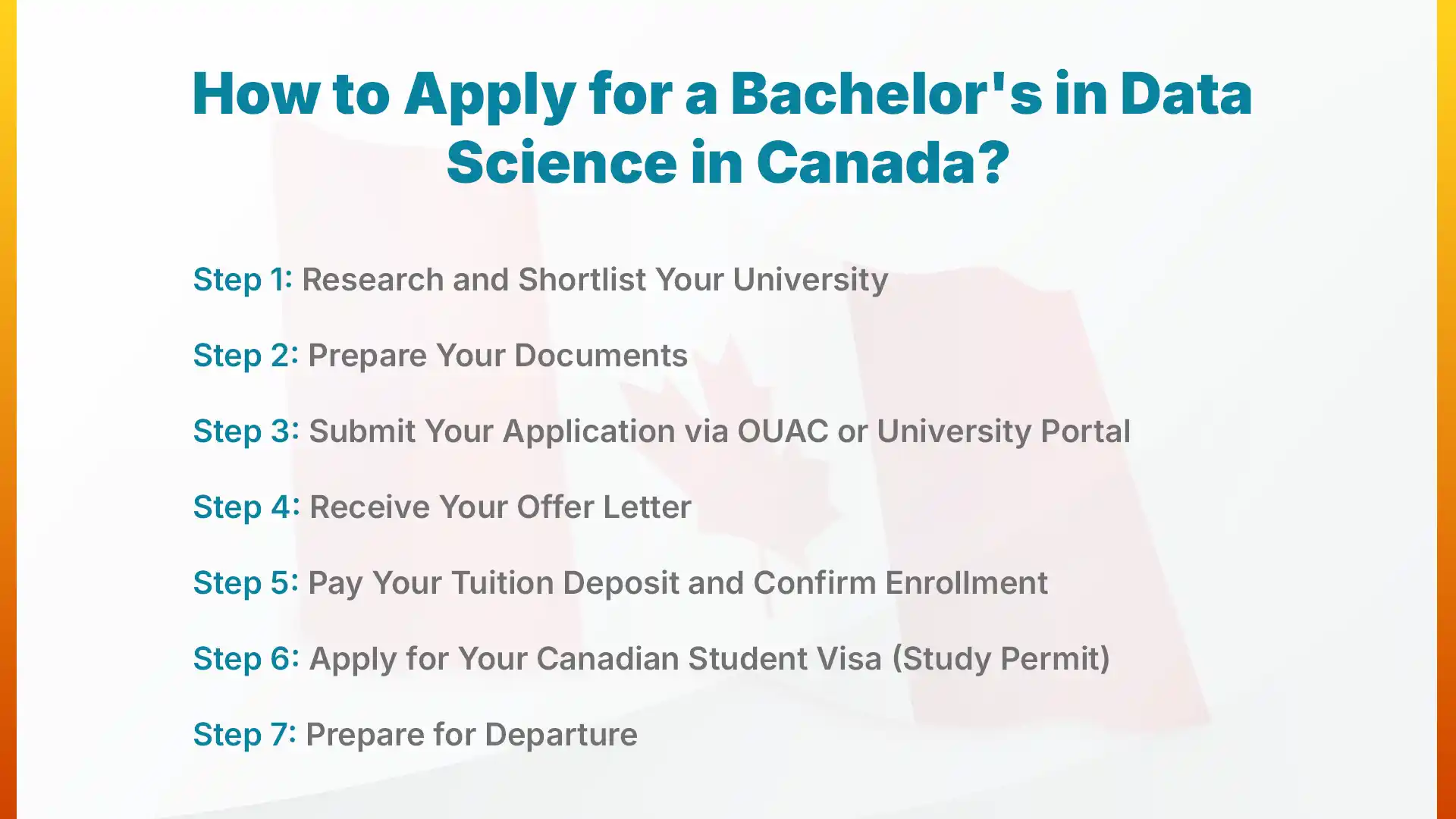
Step 1: Research and Shortlist Your University
Begin by identifying universities that offer data science programs matching your academic background, career goals, and budget. Consider the city, co-op availability, scholarship options, and program reputation before making your final shortlist of two to four institutions.
Do not rush this step; the university you choose will define your academic experience and career starting point. Start by reviewing the full requirements to study in Canada from Nepal to confirm you meet the baseline eligibility criteria
Step 2: Prepare Your Documents
Gather all required academic documents, your passport, English language test results, statement of purpose, and letters of recommendation. Documents in Nepali must be officially translated into English and notarized. Begin this process as early as possible; notarization and official translation take significantly longer than most students expect, and a missing document can delay your entire application. You will also need a well-written Statement of Purpose. Read our complete guide on how to write an SOP for Canada before you start.
Step 3: Submit Your Application via OUAC or University Portal
Ontario university applications are submitted through the Ontario Universities' Application Centre (OUAC) at ouac.on.ca. Applications to universities in other provinces are submitted directly through each institution's online portal. Apply to more than one institution simultaneously to maximize your chances of receiving a strong offer. Deadlines for competitive programs and scholarships can fall as early as November or December for a September start. Understanding intakes in Canadian universities will help you plan your application timeline accurately.
Step 4: Receive Your Offer Letter
If your application is successful, you will receive a letter of offer from the university. This may be a conditional offer, meaning you still need to meet certain requirements such as completing your NEB examinations or submitting final transcripts, or an unconditional offer, meaning you are fully accepted. Read all terms and conditions carefully before accepting.
Step 5: Pay Your Tuition Deposit and Confirm Enrollment
To secure your place in the program, you will need to pay a tuition deposit, typically the first semester's fee or a portion of it, by the deadline stated in your offer letter. Once the university receives your deposit, your enrollment is confirmed. This is a significant milestone and the point at which your visa application process can begin.
Step 6: Apply for Your Canadian Student Visa (Study Permit)
Once your enrollment is confirmed, apply for your Canadian study permit through the Immigration, Refugees, and Citizenship Canada (IRCC) online portal at ircc.canada.ca. You will need your offer letter, financial evidence, academic documents, and a valid passport. Processing times vary; apply as early as possible to avoid delays. Always confirm the current document requirements and application fees directly at the IRCC website before submitting.
Step 7: Prepare for Departure
Once your study permit is approved, book your flight and arrange initial accommodation. Most Canadian universities offer on-campus housing for first-year international students, and many hold pre-arrival orientation sessions that are genuinely worth attending. SAS Education Consultancy also conducts pre-departure briefings to help Nepali students understand what to expect when they arrive in Canada.
What Are the Popular Data Science Specializations in Canada?
Popular data science specializations in Canada include artificial intelligence, machine learning, big data analytics, and data engineering. Data science is a broad field with several distinct career directions, and Canadian universities give you the flexibility to focus your degree toward the area that genuinely excites you. Here are the most popular specializations for international students studying data science in Canada.
1. Machine Learning and Artificial Intelligence
The most in-demand specialization in the entire data science field right now. Machine learning specialists build systems that can learn from data and make predictions or decisions without being explicitly programmed. Canada is one of the world's leading AI research hubs, with institutes like the Vector Institute in Toronto and Amii in Edmonton making it one of the best places in the world to develop expertise in this area.
2. Business Analytics and Data Strategy
This specialization sits at the intersection of data science and business decision-making. You learn how to use data to drive strategic decisions across operations, marketing, finance, and supply chain management. Graduates with this specialization are highly sought after by consulting firms, banks, retail companies, and any organization that uses data to guide its direction, which, increasingly, means every organization.
3. Health Data Science and Bioinformatics
One of the fastest-growing areas of data science globally. Health data scientists analyze medical records, genomic data, clinical trial results, and public health data to improve patient outcomes, accelerate drug discovery, and optimize healthcare delivery. Canada's world-class healthcare system and strong biomedical research sector make it an excellent environment to develop expertise in this area.
4. Financial Data Science and FinTech
Canada's financial services sector, centered in Toronto, which is the country's financial capital, is one of the largest employers of data scientists in the country. Financial data science covers algorithmic trading, risk modeling, fraud detection, credit scoring, and the growing world of financial technology. For Nepali students interested in combining data skills with the financial industry, this specialization leads to some of the highest-paying roles available to new graduates.
5. Environmental Data Science
A uniquely important and growing specialization that applies data science methods to environmental monitoring, climate modeling, resource management, and sustainability analytics. Canada's vast natural resources and strong environmental research sector create genuine career pathways in this area, and global demand for environmental data expertise is increasing rapidly as organizations worldwide face growing pressure to measure and reduce their environmental impact.
6. Cybersecurity and Data Privacy
As data becomes the world's most valuable resource, protecting it becomes increasingly critical. This specialization covers data privacy frameworks, security analytics, threat detection using machine learning, and compliance with data protection regulations. The combination of data science and cybersecurity expertise is particularly valued by government agencies, financial institutions, and technology companies, and salaries in this dual-skill area reflect that demand.
7. Big Data Engineering and Cloud Computing
This is the infrastructure side of data science, building and managing the systems that store, process, and move massive volumes of data at scale. Big data engineers work with platforms like Apache Spark, Hadoop, AWS, and Google Cloud to ensure that data is available, reliable, and processable when data scientists need it. It is a technically demanding specialization that commands premium salaries and is in consistently high demand across every major industry.
Eligibility Requirements to Study Data Science in Canada
To study data science in Canada, international students generally need a bachelor’s degree (for master's programs) or completed secondary school (for undergraduate programs) in a related field like computer science, mathematics, statistics, or engineering.
A minimum GPA of 3.0 on a 4.0 or 4.33 scale is typically required, along with proof of English proficiency via an IELTS score of 6.5–7.0 or a TOEFL iBT score of 86–90. Each university sets its own thresholds, but here is a clear general breakdown of what Nepali students typically need to prepare.
1. Academic Requirements by Course Level
For most Nepali students, a completed NEB +2 with a strong academic record, particularly in mathematics, is the standard entry point for undergraduate programs. If you already hold a relevant bachelor's degree, you may apply directly for a postgraduate program.
Course Level | Minimum Academic Requirement |
|---|---|
| Diploma Programs | Completion of +2 (NEB or equivalent) |
| Bachelor's Programs | Completion of +2 (NEB or equivalent) with strong grades, particularly in Mathematics |
| Graduate Certificate | Recognized Bachelor's degree in a relevant field |
| Master's Programs | Recognized Bachelor's degree in Data Science, Computer Science, Statistics, or related field |
Note: Specific grade and percentage requirements vary between universities. Some programs, particularly at the University of Waterloo and the University of Toronto, are highly competitive. Always confirm exact entry criteria directly with your chosen institution before applying.
2. English Language Requirements: IELTS, TOEFL, or Duolingo?
Since all programs are taught in English, international students must demonstrate language proficiency. Requirements vary by institution and program level.
Course Level | Typical English Requirement |
|---|---|
| Diploma Programs | IELTS 6.0 overall (or equivalent TOEFL/Duolingo) |
| Bachelor's Programs | IELTS 6.5 overall, no band below 6.0 (or equivalent) |
| Master's Programs | IELTS 7.0 overall, no band below 6.5 (or equivalent) |
Many Canadian universities now also accept the Duolingo English Test and PTE Academic. Always confirm which tests your specific institution accepts on their official admissions page before deciding which to prepare for. If you are yet to prepare for IELTS, start early and explore the best IELTS preparation classes in Nepal to give yourself enough time
3. Mathematics and Subject Prerequisites
Data science is a mathematically intensive field, and most Canadian universities require strong mathematics performance at the +2 level as a prerequisite for admission. Subjects typically expected or preferred include:
Mathematics (mandatory at most institutions)
Statistics or Additional Mathematics (preferred)
Physics or Computer Science (preferred at some institutions)
Biology (preferred for health data science tracks)
If your NEB +2 subjects do not include mathematics or if your grades in mathematics are below the required threshold, some universities offer a foundation year or bridging program that allows you to meet entry requirements before starting your bachelor's degree.
4. Documents Required for Admission
Getting your paperwork organized early will save you significant stress during the application process. Here is the standard document checklist for Nepali students applying to data science programs in Canada.
Academic transcripts and certificates (Grade 10, 11, and 12 or equivalent)
Valid passport with sufficient remaining validity
English language proficiency results (IELTS, TOEFL, PTE, or Duolingo)
Statement of Purpose (SOP)
Letters of Recommendation (LOR) from teachers or academic supervisors
Updated CV or Resume
Financial sponsorship documents proving sufficient funds
Mathematics prerequisite documentation if required
How Much Does it Cost to Study Data Science in Canada?
The cost to study data science in Canada at undergraduate programs ranges from CAD 20,000 to CAD 50,000 annually. Here is an honest and complete breakdown of what you can realistically expect to spend. For a full breakdown of all expenses beyond tuition, read our dedicated guide on the total cost to study in Canada
1. Tuition Fees by Course Level
Tuition fees in Canada vary, but on average they start from CAD 10000 to CAD 25000 depending on the university, province, and whether the institution is a public university or a private college. The figures below are general estimates; always confirm exact fees directly with your chosen institution.
Course Level | Estimated Annual Tuition (CAD) | Approximate NPR Equivalent |
|---|---|---|
| Diploma Programs | CAD 12,000 – 20,000 | NPR 12,000,000 – 20,000,000 |
| Bachelor's Programs | CAD 20,000 – 45,000 | NPR 2,000,000 – 4,500,000 |
| Graduate Certificate | CAD 10,000 – 18,000 | NPR 1,000,000 – 1,800,000 |
| Master's Programs | CAD 18,000 – 40,000 | NPR 1,800,000 – 4,000,000 |
Important: These are estimated ranges only. Exchange rates fluctuate; use these figures for general planning purposes only. Always confirm exact tuition fees directly with your chosen university before making any financial commitments.
2. Living Costs in Canada for Nepali Students
Living costs in Canada vary significantly depending on the city, but on average, students have to spend around CAD 1000 to CAD 2000. Toronto and Vancouver are among the more expensive cities, while Halifax, Edmonton, and Waterloo offer a considerably more manageable cost of living without compromising on academic or career opportunities.
Expense Category | Toronto / Vancouver (CAD/month) | Waterloo / Edmonton (CAD/month) | Halifax (CAD/month) |
|---|---|---|---|
| Accommodation (Shared) | CAD 900 – 1,800 | CAD 600 – 1,100 | CAD 500 – 900 |
| Food and Groceries | CAD 350 – 600 | CAD 250 – 450 | CAD 200 – 400 |
| Transportation | CAD 120 – 180 | CAD 80 – 120 | CAD 70 – 100 |
| Utilities and Internet | CAD 80 – 150 | CAD 70 – 130 | CAD 60 – 110 |
| Personal and Miscellaneous | CAD 150 – 300 | CAD 100 – 200 | CAD 100 – 180 |
| Total Estimated Monthly | CAD 1,600 – 3,030 | CAD 1,100 – 2,000 | CAD 930 – 1,690 |
3. Additional Costs to Plan For
Beyond tuition and living expenses, data science students should budget for several additional costs before leaving Nepal. These include the Canadian Study Permit application fee (confirm the current fee at ircc.canada.ca, as fees are updated periodically); mandatory health insurance, which varies by province and institution; textbooks and software licenses, which can add CAD 500 to CAD 1,500 per year; and any professional certification exam fees, such as Google Data Analytics or AWS certifications, if you choose to sit these alongside your degree. Planning for these costs before you leave Nepal prevents financial surprises and allows you to focus fully on your studies from day one.
Scholarships for Data Science Students in Canada
There are several scholarships like Vanier Canada Graduate Scholarships, University Merit Scholarships, Entrance Awards, and funding options available for international data science students in Canada, and for high-achieving Nepali applicants, the chances of securing at least partial financial support are real. Here is what is available.
1. Vanier Canada Graduate Scholarships
The Vanier Canada Graduate Scholarship is one of Canada's most prestigious government-funded awards, worth CAD 50,000 per year for three years of doctoral study. It is designed for students who demonstrate world-class academic achievement and leadership potential. While this scholarship is primarily for PhD-level study, being aware of it is important for Nepali students who intend to go beyond a bachelor's degree, and aiming for Vanier-caliber academic performance from your undergraduate years puts you in a strong position for future postgraduate funding.
2. University Merit Scholarships and Entrance Awards
Most Canadian universities offer their own entrance scholarships and merit awards for high-achieving international students. These are often awarded automatically based on your academic record at the time of admission and can range from a partial tuition reduction to a significant annual award. The University of Toronto, UBC, McGill, and the University of Waterloo all offer international student entrance awards worth researching carefully when you shortlist your programs. Note the scholarship application deadlines alongside your admission deadlines; missing them is a common and costly mistake.
3. Province-Specific Funding and Bursaries
Several Canadian provinces offer their own funding programs for international students studying in their region. British Columbia, Ontario, and Nova Scotia in particular have bursaries and emergency funding programs available through their provincial student aid systems or through individual institutions. It is worth contacting the financial aid office of each university you shortlist and asking specifically about province-level funding available to international students; many students never ask and never receive funding they were eligible for.
4. Nepal-Side Funding Options
There are also funding options worth exploring before you leave Nepal. Several Nepali banks and financial institutions offer education loans specifically designed for students studying abroad, regulated under Nepal Rastra Bank (NRB) guidelines. Check with Nepal's Ministry of Education, Science, and Technology for any bilateral education or scholarship agreements between Nepal and Canada. Contact the Canadian Embassy in Kathmandu for updated guidance on any additional funding opportunities available to Nepali students planning Canadian studies.
Best Cities in Canada to Study Data Science
The best cities in Canada to study data science are Toronto, Waterloo, Montreal, and Vancouver. These hubs host the country’s top-ranked universities and major tech industry connections, offering students access to cutting-edge research institutes and co-op opportunities.
The city you study in will shape your lifestyle, your internship opportunities, your professional network, and your cost of living. Canada's major cities each offer a unique combination of academic quality, industry access, and student experience. Here are the top cities where data science students thrive.
1. Toronto
Toronto is Canada's largest city, its financial capital, and its most active technology hub. Home to the University of Toronto and the Vector Institute for Artificial Intelligence, it is the center of Canada's AI and data science ecosystem. Companies including Google, Microsoft, Uber, Shopify, and hundreds of data-focused startups maintain major operations in Toronto, creating extraordinary internship and employment opportunities for data science students. Living costs are higher than other Canadian cities, but the career opportunities and professional networks you build in Toronto are unmatched anywhere else in the country.
2. Vancouver
Vancouver is one of the most beautiful and livable cities in the world, and it is also one of Canada's fastest-growing technology centers. Home to UBC and Simon Fraser University, Vancouver hosts major operations for Amazon, Electronic Arts, Hootsuite, and a large and growing community of AI and data companies. The city's proximity to Seattle, home of Amazon, Microsoft, and Boeing, also creates cross-border career opportunities that students in other Canadian cities do not have access to. Living costs are high, but the combination of academic quality, industry access, and quality of life makes Vancouver one of the most desirable study destinations in Canada.
3. Montreal
Montreal is Canada's second-largest city and has established itself as one of the world's leading centers for artificial intelligence research. Home to McGill University, the Montreal Institute for Learning Algorithms (Mila), one of the world's premier AI research institutes, and major technology operations from companies including Microsoft, Google, and Samsung, Montreal offers data science students a uniquely research-intensive environment. The city is also significantly more affordable than Toronto or Vancouver, and its vibrant cultural scene makes it one of the most enjoyable cities in Canada to live and study in.
4. Waterloo
Waterloo is a smaller city, but it punches far above its weight for data science and technology students. Home to the University of Waterloo, which runs Canada's best co-op program, and a dense cluster of technology companies that has earned the region the nickname "Silicon Valley of the North," Waterloo offers students direct access to some of the best professional development opportunities available anywhere in Canada. The cost of living is significantly lower than Toronto or Vancouver, making it one of the most financially practical choices for Nepali students who want both academic quality and industry exposure without the big-city price tag.
5. Edmonton
Edmonton is the capital of Alberta and home to the University of Alberta, which houses the Alberta Machine Intelligence Institute (Amii). It is one of Canada's most affordable major cities for international students, with lower tuition at the University of Alberta compared to many other leading institutions and a cost of living that is considerably more manageable than Toronto or Vancouver. Edmonton's growing technology sector and the university's strong AI research reputation make it an increasingly attractive destination for data science students who want quality without the premium price.
6. Halifax
Halifax is the capital of Nova Scotia and home to Dalhousie University, one of Canada's oldest and most respected institutions. It is consistently ranked as one of the most affordable cities in Canada for international students, with lower tuition, cheaper accommodation, and a lower cost of living than any other major Canadian university city. The Atlantic Canada tech sector is growing steadily, and the provincial government has been actively investing in technology and innovation, creating new opportunities for data science graduates who want to build their careers in a less crowded and more financially accessible environment.
Scope of Data Science in Canada for Nepali Graduates
Canada's technology sector is one of the most dynamic and consistently growing in the world, and data science sits at the center of it. The scope of what is possible after a bachelor's in data science in Canada goes far beyond just getting a job; it opens a pathway to a full international career, permanent residency, and a life built in one of the world's most desirable countries. Here is what that future can actually look like.
1. Co-op and Internship Opportunities During Studies
One of the most valuable aspects of studying data science in Canada is the access to paid co-op and internship opportunities built directly into many programs. University of Waterloo students, for example, complete up to six work terms with employers, including Google, Shopify, and RBC, earning significant income and accumulating professional experience that most graduates from other countries simply cannot match at the same stage of their careers. Even universities without formal co-op programs typically have strong career services offices that actively connect students with internship and research placement opportunities throughout their degree.
2. Jobs After a Bachelor's in Data Science in Canada
After graduating with a bachelor's in data science from a recognized Canadian university, you become eligible for a wide range of professional roles across virtually every industry sector. Common entry-level and mid-level positions include:
Data Analyst
Junior Data Scientist
Machine Learning Engineer
Business Intelligence Analyst
Data Engineer
Quantitative Analyst
Research Associate
AI Developer
Database Administrator
Product Analyst
With experience and further specialization, graduates progress into senior data science roles, team leadership positions, and executive-level analytics roles that carry significant responsibility and compensation.
3. Average Salaries for Data Science Graduates in Canada
Data science is one of the highest-paying entry-level fields in the Canadian job market. The figures below are general estimates based on publicly available industry data. Always refer to current sources such as the Government of Canada Job Bank, Glassdoor Canada, or LinkedIn Salary for verified and up-to-date figures.
Experience Level | Estimated Annual Salary (CAD) | Approximate NPR Equivalent |
|---|---|---|
| Entry Level (0–2 years) | CAD 60,000 – 85,000 | NPR 6,000,000 – 8,500,000 |
| Mid-Level (3–6 years) | CAD 85,000 – 120,000 | NPR 8,500,000 – 12,000,000 |
| Senior Level (7+ years) | CAD 120,000 – 180,000+ | NPR 12,000,000 – 18,000,000+ |
Source: Government of Canada Job Bank and Glassdoor Canada salary data. Exchange rates are approximate and subject to change. Use these figures for general planning purposes only.
4. Post-Graduation Work Permit (PGWP) After Your Degree
After completing your bachelor's degree in Canada, you are eligible for a Post-Graduation Work Permit (PGWP) that allows you to remain in Canada and work full-time for a period equal to the length of your study program, up to a maximum of three years. The PGWP requires no job offer in advance and allows you to work for any employer in any role, giving you genuine flexibility to explore the Canadian job market, build professional experience, and position yourself for permanent residency.
For a four-year bachelor's degree graduate, this means three full years of open work authorization in Canada, one of the most generous and practical post-study arrangements available from any major English-speaking destination.
5. Permanent Residency (PR) Opportunities in Canada
Data science and technology roles are among the most in-demand occupations on Canada's Express Entry system, which is the primary federal pathway to permanent residency for skilled workers. Nepali graduates who complete a bachelor's degree in Canada, gain work experience through PGWP employment, and meet the points thresholds for Express Entry have a realistic and well-documented pathway toward Canadian permanent residency.
Provincial Nominee Programs (PNPs) in provinces including British Columbia, Ontario, Alberta, and Nova Scotia also actively target technology and data science professionals for nomination, offering an additional pathway to PR that can be faster than the federal Express Entry process for some applicants. While PR is never guaranteed and the process is competitive and subject to change, a Canadian data science degree combined with Canadian work experience puts Nepali graduates in a genuinely strong position compared to applicants without Canadian credentials.
Conclusion
Studying for a bachelor's in data science in Canada is more than just earning a degree; it is an investment in a career that the world is actively and urgently building toward. From world-class universities and paid co-op programs to some of the highest graduate salaries available to international students anywhere, Canada offers Nepali students a combination of academic quality, practical experience, and long-term opportunity that is genuinely difficult to match.
The process takes planning. Research your programs carefully. Confirm your mathematics prerequisites early. Prepare your IELTS or TOEFL well in advance. Explore scholarship and entrance award opportunities before your intended start date. And make sure every institution you apply to is recognized by IRCC for study permit purposes before you invest your time and money in an application.
Whether your goal is a four-year bachelor's degree at the University of Toronto, a co-op degree at the University of Waterloo, or an applied program at a college in Halifax, Canada offers a clear and credible pathway from your NEB +2 qualification to a serious international data science career.
Canada is waiting for the next generation of data scientists, and that could be you. Contact SAS Education Consultancy today for a free counseling session. Let us help you find the right university, secure the best scholarship, and navigate the visa process with confidence. Your data science career in Canada starts here.