What is the Success Rate of Student Visa for the UK from Nepal?

May 21, 2026

If you’re planning to study in the UK from Nepal, one question is probably sitting at the back of your mind: what are my real chances of getting a UK student visa? Between social media posts, agent claims, and stories of refusals, it’s easy to feel unsure before you even start the process.
The reality is simpler and far more reassuring. The UK has not closed its doors to Nepali students. What has changed is the level of checking. Today, applications are reviewed more carefully, and this actually works in favour of students who prepare properly. When your academics, finances, course choice, and study plans make sense together, your chances remain strong.
In this guide, we break down the student visa success rate for the UK from Nepal, with a clear focus on 2025 and what to expect in 2026. You’ll see how approval trends have changed over the past five years, why some years were tighter than others, and what the latest UK rules really mean for you.
In this blog
What Is the Success Rate of UK Student Visas From Nepal in 2025?
In 2025, the UK student visa approval rate was around 96.93% for Nepalese applicants. The UK Home Office continues to issue a large number of study visas each year, showing that student visas are still being granted to those who meet the requirements. At the same time, the way success rates are measured and reported has shifted slightly due to changes in visa policies and processing patterns. This means understanding the rate requires looking beyond just percentages to the reasons behind those numbers.
Start Your UK Study Journey Today!
Overall UK Student Visa Approval Trends for Nepali Students
Approval trends for UK student visas have shown that qualified and well-prepared applicants continue to receive visas regularly in 2026. While exact country-specific numbers for Nepal aren’t always published separately by the UK Home Office, broader UK data shows that student visas remain one of the most approved categories for international study. In the year ending December 2025, the UK issued 426,471 sponsored student visas, along with 19,647 dependent visas. This marked a total of over 2.86 million international students enrollment in higher education the UK in the academic year 2024/25.
Even though the total number of visas can vary year by year due to broader changes, the core trend is clear: when academic, financial, and intent requirements are met, approval remains strong. What matters most for Nepali students is the quality and consistency of their application, not just the headline rate itself.
How the UK Calculates Student Visa “Success Rate”
When people talk about the UK student visa success rate, they are referring to the percentage of student visa applications that are granted out of all applications submitted. This rate includes both main applicants (the students themselves) and, in some reports, their dependents. But because recent rules reduced dependent visas sharply, many published figures now focus more on main applicants.
The Home Office counts how many applications are lodged and how many result in a visa being granted. Then they divide the number granted by the total applications to find the “success rate.” If more applications come in but fewer are approved due to stricter checks, the percentage may fall even if genuine applicants are still being approved. That’s why a raw success percentage doesn’t always tell the whole story. What really affects you is the strength of your own application, not just the country-wide percentage.
UK Student Visa Approval Rate for Nepali Students (2020–2025 Overview)
UK student visa trends for Nepali students have fluctuated in recent years, but overall approval rates have remained strong and stable, generally ranging between 88–95%. A noticeable tightening began in late 2023–24 due to policy changes, but approvals recovered for well-prepared applicants in 2024–25. In the next section, we look at the broader five-year picture so you can understand the pattern, and what it means for your application today.
1. Year-by-Year Breakdown of Student Visa Approval Trends (2020–2025)
Below is a simplified overview of UK student visa outcomes for Nepali applicants, based on UKVI approval and refusal rate data.
Program Year | Visa Success Rate (%) | Refusal Rate (%) |
| 2024–25 | 96.93% | 3.07% |
| 2023–24 | 92.52% | 7.48% |
| 2022–23 | 96.98% | 3.02% |
| 2021–22 | 90.44% | 9.56% |
| 2020–21 | 89.18% | 10.82% |
What This Data Clearly Shows
Looking at multiple years gives a much clearer picture than judging a single intake or online rumors. Approval rates were slightly lower during COVID and early recovery years, then rose sharply as the UK reopened and expanded student routes. The small dip in 2023–24 reflects stricter checks and dependent visa restrictions, not a shutdown of student visas.
Overall, the data proves one thing: the UK consistently approves the majority of Nepali student visa applications, especially when profiles are genuine and well prepared.
Need Help to Apply for Your UK Student Visa?
Get expert guidance on courses, universities, scholarships, and applications. Start your British education journey with out crertified counsellors today!
2. What Caused the Rise and Fall in UK Visa Success Rates Each Year?
UK student visa numbers changed due to clear policy decisions, global events, and stricter checks. Approvals rose when the UK reopened and introduced attractive post-study options, and they adjusted downward when dependent rules and compliance checks were introduced. This pattern reflects policy shifts, not student failure. Understanding these reasons that affected UK student visa approval helps you plan and prepare your application more confidently.
Factors That Increased Visa Approvals | Factors That Reduced Numbers or Increased Scrutiny |
| Post-COVID border reopening allowed students to apply after delays | Dependent visa restrictions from January 2024 reduced total visa numbers |
| Introduction of the Graduate Route increased UK study demand | Stricter credibility and compliance checks by UKVI |
| Post-Brexit immigration changes increased non-EU student intake | Higher living costs, visa fees, and health surcharge |
| Strong global demand for UK education and work options | Policy uncertainty around future post-study work routes |
| UK remained open while other countries tightened rules | Focus on reducing misuse of the student visa route |
2.1. Why UK Student Visa Approvals Increased
UK student visa numbers for Nepali applicants changed over the years due to clear policy decisions and global events, not because the UK stopped approving students. Approvals rose sharply after COVID as borders reopened and students who had postponed their plans finally applied.
The introduction of the Graduate Route, which allows graduates to stay and work after finishing their studies, also made the UK more attractive. Over that, post-Brexit immigration changes increased the number of international applicants, and strong global demand for UK education kept student numbers high.
2.2. Why Visa Numbers Declined After 2024
The number of visas issued later decreased, falling from around 439,000 in YE June 2025 to 426,471 in the year ending December 2025. This decline was mainly linked to fewer dependants accompanying main applicants and a reduction in applicant numbers after new rules were introduced. The drop followed a policy change that limited who could bring dependants for courses starting on or after 1 January 2024.
Like many immigration systems, UK visa volumes are strongly influenced by government policies and broader global conditions.
2.3 Increased Scrutiny and Compliance Checks
Numbers also declined in certain years due to stricter compliance checks by UKVI, rising living costs and visa fees, and uncertainty around future post-study work routes. However, these shifts reflected system-level policy changes rather than a complete closure of opportunities. Genuine and well-prepared Nepali students continued to receive approvals throughout these periods.
The key takeaway is that the UK has continued to welcome serious and qualified international students despite changing immigration policies. Understanding these trends can help you prepare a stronger application, avoid common mistakes, and apply with greater confidence.
Join IELTS Preparation Classes Today!
3. How Favorable Is the UK Toward International Students Today?
The UK remains highly favorable toward international students, including Nepali applicants. In fact, the UK’s International Education Strategy introduced a target of welcoming 600,000 international students per year by 2030, showing that the country is still very open to genuine students.
While some rules have become stricter in recent years, strong and well-prepared applicants continue to receive approvals at high rates. For Nepali students, this means your chances are still excellent if your application is genuine, financially clear, and properly documented.
Key Lessons for High UK Student Visa Approval From Nepal
If you want a UK student visa, success depends on preparation, not luck. UKVI officers look for clarity, consistency, and genuine study intent in every application. Over the years, successful Nepali applicants have followed a few clear patterns. These lessons are based on real approval trends and practical outcomes.
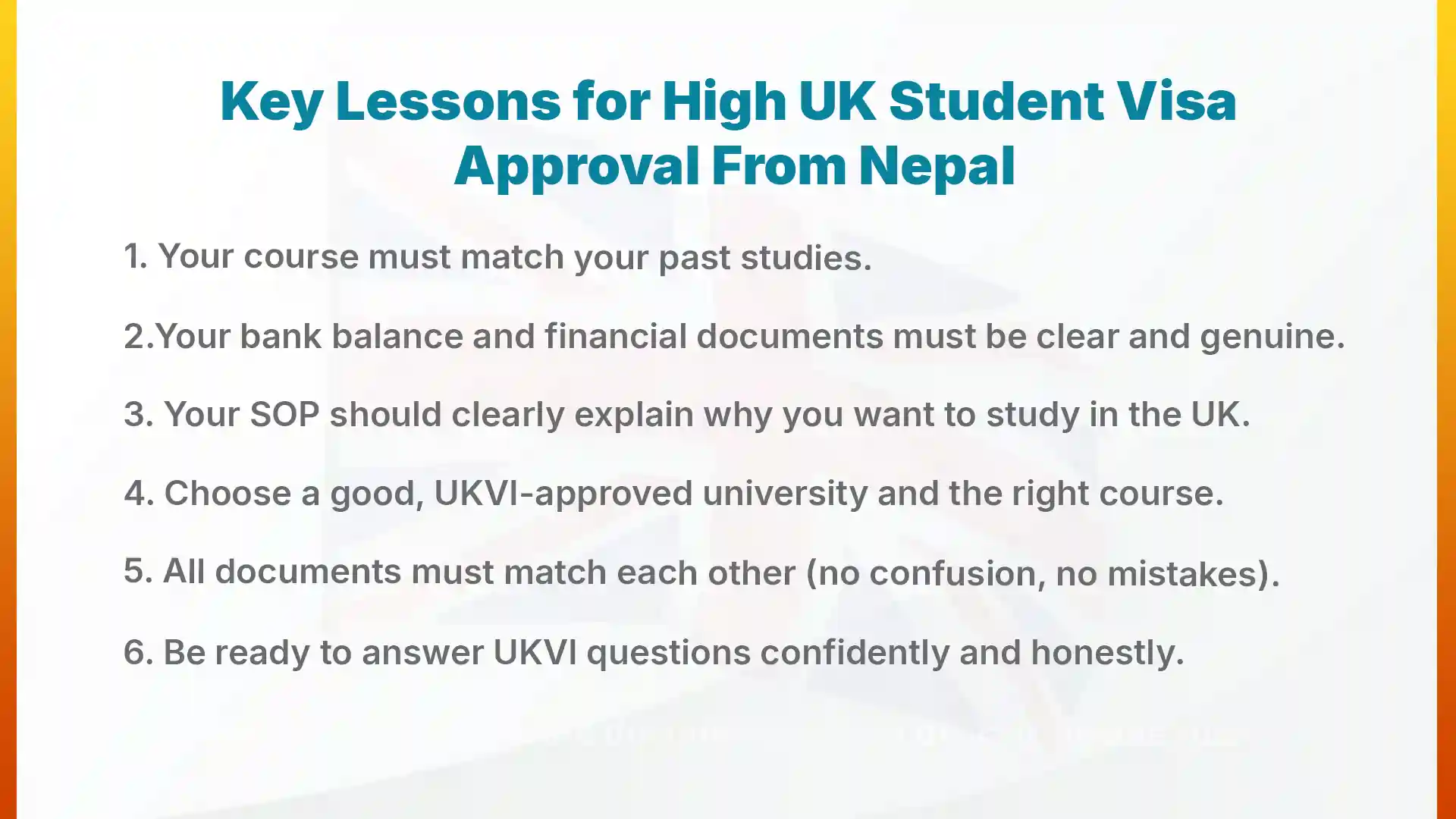
1. Your Course Must Match Your Past Studies
UK visa officers expect your chosen course to logically follow your previous education. If your academic path suddenly changes without a clear reason, it can raise doubts about your intent. A smooth progression shows that you have planned your studies carefully. Always explain how your past education connects to your future goals. When your study path makes sense, your application feels genuine and credible.
2. Your Bank Balance and Financial Documents Must Be Clear and Genuine
UKVI wants to see that you can afford tuition and living costs without stress. Your bank statements, sponsor documents, and income proofs should be clear and easy to understand. Unexplained deposits or messy financial records often lead to extra checks. Clean and honest financial documents build trust. Strong financial clarity makes your application safer and smoother.
3. Your SOP Should Clearly Explain Why You Want to Study in the UK
Your Statement of Purpose for the UK is where you explain your story. It should clearly answer why you chose the UK, why this course matters to you, and how it fits your career plan. Everything you write must match your academics and documents. A focused and honest SOP helps officers understand your intent quickly. This clarity often makes a big difference in approval decisions.
4. Choose a Good, UKVI-Approved University and the Right Course
Studying at a UKVI-approved university is mandatory, but choosing the right one also matters. Universities with strong compliance records face fewer visa issues. Your course should also match your academic background and future plans. Careful university and course selection shows seriousness. This planning reassures visa officers that you are a genuine student.
Get Complete UK Student Visa Guidance Today!
5. All Documents Must Match Each Other (No Confusion, No Mistakes)
Every document in your application should tell the same story. Your SOP, transcripts, offer letter, and financial papers must align perfectly. Even small mismatches can create confusion and delay decisions. Always review dates, names, and course details carefully. Consistency shows professionalism and preparation.
6. Be Ready to Answer UKVI Questions Confidently and Honestly
UKVI may assess your credibility through questions or interviews. You should clearly explain your course choice, finances, and future plans. Honest and confident answers matter more than perfect English. Practising common questions helps you stay calm. When you know your own application well, your confidence shows.
7. Apply Early With Complete Documents; Avoid the Last-Minute Rush
Late applications often lead to mistakes, missing documents, and stress. Applying early gives you time to correct issues and respond to requests. It also improves processing flow during busy intakes. Early preparation reflects seriousness and responsibility. A well-planned application always performs better than a rushed one.
These lessons explain why some students succeed while others struggle, even under the same rules. With these foundations in place, it’s important to understand how the new UK student visa rules for 2026 affect your application, which is exactly what the next section covers.
What Are the New Rules for UK Student Visa in 2026?
The UK introduced several important student visa changes in 2026 to better manage migration and protect the quality of education. These updates affect finances, dependents, post-study work, and entry procedures. While the rules are stricter, they are also clearer than before. If you understand them early, you can plan your UK study journey with confidence.
1. Higher Living Cost Requirement for UK Student Visas (From November 2025)
From November 11, 2025, students must show a higher amount for living expenses when applying for a UK student visa. If you study outside London, you now need £1,171 per month, and if you study in London, the requirement is £1,529 per month. This change reflects the rising cost of living in the UK. As a result, UKVI now checks bank balances more strictly. Planning your finances well in advance is now essential.
2. New Rules on Bringing Dependents to the UK (From January 2025)
Starting January 2025, most international students are no longer allowed to bring dependents to the UK. Only students enrolled in PhD or research-based postgraduate programs can bring their spouse or children. This rule was introduced to reduce pressure on housing and public services. Because of this, overall student visa numbers dropped in some intakes. However, individual students with strong profiles are still receiving approvals.
3. Changes to the UK Graduate Route (Post-Study Work) From 2027
The UK government confirmed that the Graduate Route duration will be reduced to 18 months for most students applying after January 1, 2027. PhD graduates will continue to receive three years under this route. This announcement has already affected student planning in 2025 and 2026. Even with the reduction, the Graduate Route still offers valuable UK work experience. Students now need clearer career planning before applying.
Book a FREE Counselling Session Now!
4. New Biometric and Facial Recognition Checks at UK Borders (Late 2025)
From late 2025, the UK will be introducing advanced facial recognition and biometric systems at airports and borders. These systems aim to speed up entry and reduce long queues. For students, this means a smoother arrival process once fully implemented. At the same time, identity verification will be more accurate and strict. This makes document accuracy more important than ever.
5. Removal of Student Visa Sponsorship for Certain Foundation Courses
The UK has stopped issuing student visas for foundation programs linked to postgraduate doctor and dentist pathways. These programs can no longer be used under the Student Route. The change was made to prevent misuse of education visas. Students planning healthcare-related studies must now choose eligible academic courses. Careful course selection is now a key part of visa success.
Overall, these changes show that the UK is not closing its doors to Nepali students. Instead, it is focusing on genuine students who plan well and apply correctly. If you understand these rules and prepare early, your chances remain strong. Next, let’s look at how long it takes to get a UK student visa from Nepal, so you can plan your timeline wisely.
How Long Does It Take to Get a Student Visa for the UK From Nepal?
For most Nepali students, the standard UK student visa processing time is around 3 weeks (15 working days) after biometric submission. This applies when documents are complete, and no additional checks are needed. In many cases, decisions come even sooner. However, processing can take longer if UKVI requests extra documents or clarification. Applying early always reduces uncertainty.
While timelines can vary, the UK system is generally predictable if your application is complete. Understanding normal processing, peak delays, and fast-track options helps you plan with less stress. Let’s break it down clearly.
1. Peak Intake Delays vs Normal Processing
During peak intakes such as July–September and January, processing times can be longer due to high application volumes. In these periods, decisions may take 4–6 weeks, especially for last-minute applications. Outside peak seasons, processing usually stays close to the standard 3-week timeline. This is why early application gives you an advantage. It allows time to handle delays without risking your intake.
2. Priority and Super Priority Options Explained
The UK offers Priority and Super Priority services for students who need faster decisions. Priority service usually gives a decision within 5 working days, while Super Priority can provide a decision within 1–2 working days. These services cost extra and are subject to availability in Nepal. They do not guarantee approval, only faster processing. A strong and complete application is still essential.
3. UK Student Visa Approval vs Refusal: What’s Actually Happening?
In reality, approvals and refusals happen at the same time every intake. Well-prepared Nepali students continue to receive UK student visas regularly. Most refusals involve weak academic progression, unclear study intent, or poor financial documentation. The UK has not blocked Nepali students, despite what rumours suggest. Outcomes follow clear patterns, and with proper preparation, those patterns can be worked in your favor.
Conclusion
If you look at the full picture, one thing is clear: the UK has never stopped issuing student visas to Nepali students. Approval rates have gone up and down over the years, not because students suddenly became less capable, but because rules, risk checks, and compliance standards evolved. When policies were flexible, approvals were high; when scrutiny increased, only well-prepared applications succeeded. That pattern continues today.
The ultimate reality is that the UK still wants talented, serious, and genuine students. It welcomes those who choose the right course, prepare clear finances, explain their intent honestly, and apply with care. With this guide in hand, you now understand real visa success trends, key approval factors, processing timelines, and the latest UK student visa rules. That already puts you ahead of many applicants who rely on rumours or social media fear. You are no longer guessing; you are preparing with knowledge and clarity.
Now is the right time to take informed action. If you want to avoid costly mistakes and present your profile in the strongest possible way, speak with an experienced UK study consultant today. The right guidance can turn a good profile into a successful visa outcome. Take the next step towards your UK education with smart preparation!