Study Bachelor of Pharmacy in South Korea: Top Universities, Fees & Scholarship

Jun 02, 2026
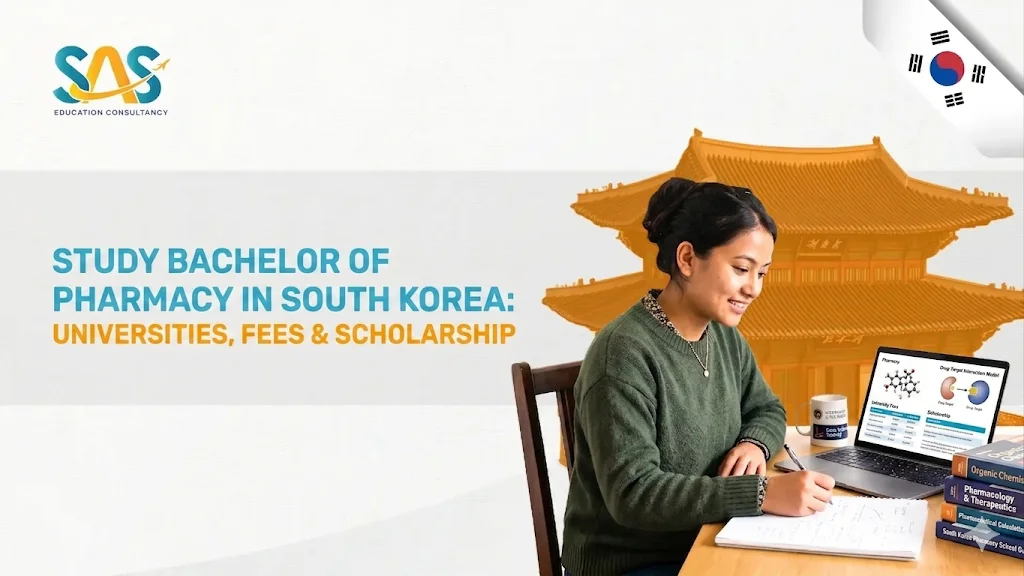
South Korea is rapidly becoming one of Asia’s most attractive destinations for international students in healthcare education. With a strong pharmaceutical industry, advanced hospitals, and globally respected universities, the country offers a compelling pathway for students who want to build a career in pharmacy. For Nepalese students, South Korea provides a rare combination of affordable tuition, rigorous training, and career opportunities across Asia.
A bachelor of pharmacy in South Korea is not just a degree; it is a direct route into one of the most stable and rewarding healthcare professions in Asia. In this guide, we cover everything Nepalese students need to know: from top universities and admission requirements to tuition costs, scholarships, career roles, salary expectations, and pathways to long‑term opportunities.
In this blog
What Is a Bachelor of Pharmacy in South Korea?
A Bachelor of Pharmacy (BPharm) in South Korea is a four‑year undergraduate program that equips students with the knowledge and skills needed to become licensed pharmacists. Think of it as the professional track; it’s designed for those who want to work directly with patients, dispensing medicines, counseling on drug use, and supporting healthcare teams in hospitals or community pharmacies.
For students, especially those coming from Nepal after completing +2, the BPharm is the clear choice if your goal is to practice pharmacy. The program blends classroom learning with practical training in hospitals and pharmacies, ensuring you’re ready for real‑world healthcare challenges. After graduation, you must pass the Korean pharmacist licensure examination, which is the final step to becoming a registered pharmacist in South Korea. Once licensed, you’ll have access to a wide range of career opportunities, from community practice to hospital roles and even pharmaceutical research, making the BPharm a respected and rewarding qualification across Asia.
Why Study a Bachelor of Pharmacy in South Korea?
Study a Bachelor of Pharmacy in South Korea because it offers a combination of global recognition, strong training, affordability, advanced research, and career mobility that makes it one of the most attractive destinations in Asia
1. Globally recognized degrees
South Korean pharmacy degrees are accredited nationally and respected across Asia. Graduates are not limited to working in Korea; many find opportunities in Japan, China, and other countries with similar healthcare systems. This recognition provides career flexibility and makes the qualification portable across multiple regions.
2. Strong clinical training
Pharmacy programs emphasize experiential learning, placing students in hospitals, clinics, and community pharmacies. This hands-on exposure ensures graduates are practice-ready from day one, with the confidence to handle patient care, medication counseling, and clinical decision-making.
3. Affordable tuition compared to Western countries
While pharmacy programs in Canada, the USA, or the UK can cost USD 25,000–50,000 annually, South Korea offers a far more affordable option at USD 4,000–8,000 per year. This makes it an attractive destination for students who want high‑quality education without the financial burden of Western tuition fees.
4. Advanced research and laboratory facilities
Leading universities such as Seoul National University and Yonsei University invest heavily in modern laboratories, simulation pharmacies, and pharmaceutical innovation projects. Students gain exposure to cutting‑edge drug development and biotechnology research, enhancing both academic and career prospects.
5. Pathway to career opportunities across Asia
Pharmacists trained in South Korea are in demand across Asia, offering graduates regional mobility and career flexibility. This means students can pursue opportunities not only in Korea but also in neighboring countries, making the degree a gateway to broader healthcare careers.
Top Universities Offering Bachelor of Pharmacy in South Korea
The top universities offering a Bachelor of Pharmacy in South Korea are Seoul National University, Sungkyunkwan University, Yonsei University, Ewha Womans University, and Korea University. These institutions are recognized for their academic excellence, strong clinical training, advanced research facilities, and industry connections, making them the leading choices for students who want to pursue pharmacy studies in South Korea.
1. Seoul National University
Seoul National University is consistently ranked among Asia’s top universities and is widely regarded as the most prestigious institution in South Korea. Its pharmacy program combines rigorous academic training with extensive clinical placements, ensuring students gain both theoretical knowledge and practical skills. The university also maintains strong partnerships with leading hospitals and research centers, giving students access to advanced facilities and real‑world healthcare environments.
2. Sungkyunkwan University
Sungkyunkwan University is known for its close industry ties, particularly with Samsung Biologics and other major pharmaceutical firms. The pharmacy program emphasizes global healthcare and industry‑oriented training, preparing students to meet the demands of both clinical practice and pharmaceutical research. With a reputation for innovation, Sungkyunkwan provides students with opportunities to engage in cutting‑edge projects and internships that enhance career readiness.
3. Yonsei University
Yonsei University is one of South Korea’s oldest and most respected institutions, with a strong focus on patient‑centered care and global health. Its pharmacy program offers diverse clinical placements across Seoul, giving students exposure to a wide range of healthcare settings. Yonsei’s emphasis on international collaboration also makes it a great choice for students who aspire to work in global healthcare environments.
4. Ewha Womans University
Ewha Womans University is recognized as one of Asia’s leading women’s universities, offering specialized opportunities for women in science and healthcare. Its pharmacy program empowers female students to excel in a traditionally male‑dominated field, providing mentorship, research opportunities, and strong support networks. Ewha’s commitment to innovation and inclusivity makes it a unique choice for aspiring pharmacists.
5. Korea University
Korea University delivers a balanced curriculum that integrates clinical practice with pharmaceutical sciences, ensuring graduates are well‑rounded professionals. The university’s strong alumni network across Asia provides valuable connections and career opportunities for pharmacy graduates. With a reputation for academic excellence and practical training, Korea University is a solid choice for students seeking both local and international career prospects.
Eligibility and Admission Requirements
To gain admission into a bachelor of pharmacy program in South Korea, you must complete high school (+2) with strong grades in biology, chemistry, and mathematics. Most universities require a minimum GPA of 70%–85%. For language proficiency, you need to pass TOPIK if applying to Korean-medium programs or submit IELTS (6.5–7.0 overall) or TOEFL iBT (86–100) scores for English-medium programs. Applicants must also provide a personal statement and recommendation letters that outline motivation, healthcare experience, and career goals, along with 2–3 references.
1. Academic prerequisites
Completion of high school (+2) with strong grades in biology, chemistry, and mathematics is required. Most universities expect a minimum GPA ranging from 70% to 85%, ensuring students have a solid science foundation before entering the program.
2. Language requirements
Students applying to Korean‑medium programs must take the TOPIK (Test of Proficiency in Korean). For English‑medium programs, IELTS or TOEFL scores are accepted. Typically, IELTS scores of 6.5–7.0 overall or TOEFL iBT scores between 86 and 100 are required to demonstrate proficiency.
3. Personal statement & recommendation letters
Applicants must submit a Statement of Purpose (SOP) that outlines their motivation, healthcare experience, and career goals. In addition, 2–3 recommendation letters from teachers or supervisors are needed to strengthen the application.
4. Medical fitness & financial proof
Students must provide immunization records and health clearance for clinical placements. Proof of financial ability to cover tuition and living expenses is also mandatory for visa approval, ensuring applicants can sustain themselves during their studies.
This combination of academic, language, personal, and health requirements ensures that students entering pharmacy programs in South Korea are well‑prepared, motivated, and capable of succeeding in both their studies and future professional practice.
How to Apply for a Bachelor of Pharmacy in South Korea
The admission process for a Bachelor of Pharmacy in South Korea involves six key steps: researching and shortlisting universities, preparing your documents, submitting your application, writing your SOP and reference letters, receiving your admission offer, and applying for the South Korean Student Visa. Approaching each step with proper preparation well in advance of deadlines gives international students the best chance of a successful application outcome.
Step 1: Research and Shortlist Universities
Compare pharmacy programs based on your academic profile, location, tuition fees, clinical placement quality, and scholarship availability. Shortlist three to five universities to maximize your chances of receiving at least one offer.
Step 2: Prepare Documents and Language Scores
Gather your Plus Two transcripts, mark sheets, school leaving certificate, character certificate, and migration certificate. Book your IELTS, TOEFL, or TOPIK exam early so your scores are ready before deadlines, which typically fall between October and January for the March or September intake.
Step 3: Submit Application Through University Portal
Most South Korean universities accept direct online applications through their own portals, while many also use the official Study in Korea platform. Pharmacy programs are competitive and fill quickly, so submitting your application early is strongly recommended.
Step 4: Write SOP and Reference Letters
Your Statement of Purpose should clearly explain why you want to study pharmacy, highlight healthcare or science experiences that shaped your decision, and outline your career goals. Collect 2–3 recommendation letters from teachers or supervisors to strengthen your application.
Step 5: Receive Admission Offer
The university will issue either a conditional or unconditional offer after reviewing your application. A conditional offer may require you to complete your Plus Two with a specified minimum score or submit final official transcripts before your place is confirmed.
Step 6: Apply for South Korea Student Visa
Once you have accepted your offer, apply for your student visa through the Korean immigration system. You must provide proof of admission, medical fitness, and financial ability to cover tuition and living expenses.
Cost of Studying Bachelor of Pharmacy in South Korea
The cost of studying a Bachelor of Pharmacy in South Korea generally ranges from KRW 3,000,000 to KRW 12,000,000 per year in tuition fees, depending on the university and whether it is public or private.
When combined with accommodation, food, transportation, health insurance, and other living expenses, Nepalese students should budget approximately KRW 10,000,000 to KRW 16,000,000 per year in total. Compared to Canada, the USA, and Australia, South Korea remains one of the most affordable destinations for a high‑quality pharmacy degree in Asia.
1. Tuition Fees
Tuition fees for international students in Bachelor of Pharmacy programs vary depending on the university and city. Public universities are generally more affordable than private institutions, while the quality of clinical training and research facilities remains strong across the country.
University/City | Annual Tuition (KRW) | Annual Tuition (NPR approx.) |
|---|---|---|
| Seoul National University | KRW 6,500,000 – 8,000,000 | NPR 640,000 – 800,000 |
| Busan (public universities) | KRW 3,000,000 – 4,300,000 | NPR 310,000 – 430,000 |
| Gwangju / Daejeon | KRW 4,200,000 – 7,000,000 | NPR 420,000 – 700,000 |
| Yonsei / Korea University (private) | KRW 8,000,000 – 12,000,000 | NPR 800,000 – 1,200,000 |
2. Living Expenses
Monthly living expenses in South Korea vary significantly by city. In Seoul, students should budget KRW 1,000,000 to 1,600,000 per month (approximately NPR 100,000 to 160,000) for accommodation, food, and transportation. In smaller cities such as Busan, Daejeon, or Gwangju, monthly costs typically range from KRW 650,000 to 1,000,000 (approximately NPR 65,000 to 100,000).
3. Total Estimated Cost
Taking tuition, accommodation, food, transportation, health insurance, and miscellaneous expenses into account, Nepalese students should budget approximately USD 8,000 to 12,000 per year. For a standard four‑year Bachelor of Pharmacy in South Korea, the total estimated cost ranges from USD 32,000 to 48,000 (NPR 4,240,000 to 6,400,000).
Scholarships for Pharmacy Students in South Korea
Scholarships for a Bachelor of Pharmacy in South Korea include Korean government‑linked awards, university‑specific merit scholarships for international pharmacy students, and external healthcare and science‑focused funding programs. Early preparation, strong Plus Two academic results in biology and chemistry, and a well-crafted personal statement significantly improve a Nepalese student's chances of securing financial support and reducing the overall cost of their pharmacy degree in South Korea.
1. Korean Government Scholarships
Fully funded government scholarships such as the Global Korea Scholarship (GKS/KGSP) cover tuition fees, living allowances, health insurance, and airfare. These awards are highly competitive but provide complete financial support, making them the most attractive option for international pharmacy students.
2. University‑Specific Pharmacy Scholarships
Most top South Korean universities offer merit‑based scholarships to high‑achieving international applicants. Examples include:
Seoul National University International Student Scholarship partial tuition waivers for strong academic profiles
Yonsei University Merit Scholarships: competitive awards for outstanding international students
Sungkyunkwan University Global Scholarships: tuition support linked to academic excellence and industry partnerships
Ewha Womans University International Student Award merit‑based awards supporting women in science and healthcare
3. Private and Industry Scholarships
Pharmaceutical companies and private foundations occasionally sponsor pharmacy students, especially those with strong research potential. These scholarships may also include internship opportunities and mentorship within the healthcare industry.
4. Tips to Increase Scholarship Chances
Apply as early as possible; most scholarship deadlines fall before the main admissions window.
Maintain the highest possible Plus Two GPA, particularly in biology and chemistry.
Include any healthcare volunteer experience, hospital shadowing, or pharmacy‑related activities in your application.
Write a focused and honest personal statement that clearly connects your science background to your pharmacy career goals.
Apply to multiple scholarships simultaneously rather than waiting for one result at a time.
Career Opportunities After Graduation
Graduates with a bachelor of pharmacy from South Korea can pursue careers as community pharmacists, hospital pharmacists, clinical pharmacists, pharmaceutical researchers, regulatory affairs specialists, and pharmacy managers across a wide range of healthcare and industry settings. South Korea’s advanced healthcare system, strong pharmaceutical industry, and growing demand for clinical pharmacy services mean that Bachelor of Pharmacy graduates are highly employable both within Korea and across Asia.
1. Community Pharmacist
A community pharmacist dispenses medications, counsels patients on drug use and interactions, administers vaccinations, and supports chronic disease management in retail pharmacy settings. This is the most common career pathway for pharmacy graduates in South Korea and offers stable employment, flexible working hours, and opportunities in both urban and rural communities.
2. Hospital Pharmacist
A hospital pharmacist works within inpatient and outpatient hospital settings, reviewing medication orders, advising clinical teams on drug therapy, monitoring patient responses to treatment, and managing pharmaceutical inventory. Hospital pharmacy is one of the most clinically intensive and highly respected pharmacy career paths in South Korea.
3. Clinical Pharmacist
A clinical pharmacist collaborates directly with physicians, nurses, and other healthcare professionals in multidisciplinary care teams, optimizing medication therapy for patients with complex or chronic conditions. This role requires advanced pharmacotherapy knowledge and is increasingly in demand in South Korea’s expanding primary care and specialty clinic sectors.
4. Pharmaceutical Researcher
A pharmaceutical researcher works in drug discovery, development, and testing in academic institutions, government agencies, or private pharmaceutical companies. This career path is particularly well‑suited for graduates who develop a strong research interest during their degree and wish to pursue postgraduate study alongside industry work.
5. Regulatory Affairs Specialist
A regulatory affairs specialist ensures that pharmaceutical products meet the requirements of the Korean Ministry of Food and Drug Safety (MFDS) and international regulatory bodies before they are approved for sale and use. This is a specialized and well‑compensated role that sits at the intersection of pharmacy science, law, and public health policy.
6. Pharmacy Manager
An experienced pharmacist with strong leadership and business skills can progress into pharmacy management roles, overseeing the operations of community or hospital pharmacy departments, managing staff, and ensuring compliance with professional and regulatory standards. This pathway offers significant career growth and competitive salaries, particularly within large pharmacy chains and hospital networks.
Scope and Salary After Bachelor of Pharmacy in South Korea
The scope and salary after a Bachelor of Pharmacy in South Korea are strong, with growing demand for pharmacists across hospitals, clinics, and community settings, competitive salaries ranging from KRW 40,000,000 to KRW 80,000,000 per year, work permits available for international graduates to extend their stay, and clear regional mobility opportunities across Asia. For Nepalese students, a Bachelor of Pharmacy in South Korea offers not only a respected healthcare career but also pathways to work in neighboring countries such as Japan and China.
1. Growing Demand for Pharmacists in South Korea
South Korea’s aging population and expanded pharmacist roles in primary care have created strong demand for pharmacy graduates. Pharmacists are increasingly involved in chronic disease management, patient counseling, and vaccination services, making pharmacy one of the most reliable healthcare professions in the country.
2. Average Salary After Bachelor of Pharmacy in South Korea
Pharmacists in South Korea earn competitive salaries compared to other healthcare professionals at the undergraduate level. The table below reflects typical annual salary ranges for Bachelor of Pharmacy graduates across experience levels.
Experience Level | Annual Salary (KRW) | Annual Salary (NPR approx.) |
|---|---|---|
| Entry-Level (0–2 years) | KRW 40,000,000 – 53,000,000 | NPR 3,900,000 – 5,200,000 |
| Mid-Level (2–5 years) | KRW 53,000,000 – 73,000,000 | NPR 5,200,000 – 7,200,000 |
| Senior Level (5+ years) | KRW 73,000,000 – 80,000,000+ | NPR 7,200,000 – 7,900,000+ |
Pharmacists working in hospitals or specialized clinical settings tend to earn at the higher end of these ranges even at mid‑level experience.
3. Work Permits and Pathways After Graduation
International graduates from South Korean universities can apply for work visas to continue full‑time employment in the country. Pharmacy is considered a skilled profession, which makes visa approval more accessible compared to non‑specialized fields.
4. Regional Mobility Across Asia
Pharmacists trained in South Korea often find opportunities in Japan, China, and other Asian countries due to similarities in healthcare systems and recognition of South Korean pharmacy qualifications. This regional mobility provides graduates with career flexibility and international exposure.
Conclusion
Canada offers Nepalese students an outstanding combination of academic quality, clinical training, career demand, and immigration opportunity through a bachelor of pharmacy. With world-respected pharmacy schools, rigorous experiential placements, strong salary outcomes, and one of the clearest pathways from graduation to permanent residency in the world, Canada stands apart as the most compelling destination for Nepalese students who are serious about building a long-term career in pharmacy.
The demand for pharmacists in Canada is real, the profession is expanding, and the immigration doors are open. For Nepalese students willing to invest in four years of challenging and rewarding pharmacy education, a Bachelor of Pharmacy from Canada is a qualification that will serve them across their entire career.
Interested in studying pharmacy in Canada? Contact SAS Education Consultancy for a free counseling session and let us help you find the right university, apply for the best scholarships, and navigate the study permit process with confidence.