Master’s of Zoology in Australia for International Students

Feb 11, 2026
Ever dreamt of studying among kangaroos, koalas, and some of the world’s most unique wildlife while earning a master’s degree? Australia isn’t just famous for its sunny beaches and bustling cities; it’s also a hotspot for zoology research. From rainforests to coral reefs, the country offers international students a living laboratory where theory meets fieldwork, and wildlife becomes your classroom. Studying zoology here means more than memorising animal facts; it’s about exploring ecosystems, conducting research, and preparing for a career that can make a real impact on conservation.
In this blog, we’ll explore everything about Master’s of Zoology in Australia. From eligibility requirements and top universities to course structure, costs, scholarships, and career opportunities, this guide gives international students a clear roadmap. Whether you’re curious about field research, lab work, or long-term career prospects, you’ll get step-by-step insights to plan your journey effectively.
In this blog
What Is a Master’s of Zoology?
A Master’s of Zoology is a postgraduate program focused on the scientific study of animals, their behaviour, physiology, genetics, and ecosystems. It equips students with advanced knowledge of wildlife, biodiversity, and conservation, combining both theoretical learning and practical research. The program is designed to prepare graduates for careers in research, environmental management, wildlife conservation, and academia. Students develop skills in scientific research, data analysis, lab techniques, field observation, and environmental assessment.
Some master’s programs are research-intensive, focusing on a thesis or fieldwork projects, while others are coursework-based with practical lab sessions. International students can choose based on career goals, research for academia, or coursework for professional applications.
Why Study a Master’s of Zoology in Australia?
Studying a Master’s of Zoology in Australia is an excellent choice for international students seeking quality education, hands-on research opportunities, and exposure to unique wildlife. Australia offers a perfect mix of advanced laboratories, diverse ecosystems, and globally recognised universities that make your degree valuable anywhere in the world. With a focus on both theory and practical experience, students gain skills that are highly sought after in conservation, research, and environmental management careers.
1. World-Class Universities and Research Facilities
Australian universities are renowned for their high academic standards and cutting-edge research facilities. Students have access to modern laboratories, wildlife research centers, and libraries with extensive scientific resources. Faculty often collaborate with international research projects, giving students exposure to global standards and opportunities to publish their work.
2. Exposure to Unique Australian Wildlife and Ecosystems
Australia is home to some of the world’s most unique species, from kangaroos and koalas to marine life in the Great Barrier Reef. Studying here allows students to experience fieldwork in diverse ecosystems, including rainforests, deserts, wetlands, and coastal regions. This hands-on exposure is invaluable for understanding animal behaviour and ecological interactions.
3. Globally Recognised Degree for Career Advancement
A degree from an Australian university carries international recognition, helping graduates pursue careers worldwide. Employers value the combination of rigorous academics, research experience, and fieldwork exposure that Australian programs provide. It also strengthens your resume if you plan to work in conservation, environmental consulting, or academic research.
4. Opportunities for Fieldwork and Laboratory Training
Australian zoology programs emphasize practical learning alongside theoretical coursework. Students participate in field studies, wildlife surveys, lab experiments, and data analysis projects. This combination of hands-on training and classroom learning ensures graduates are well-prepared for research, conservation projects, or environmental management roles.
Join IELTS Preparation Classes Today
Master’s of Zoology in Australia for International Students
For international students, pursuing a Master’s of Zoology in Australia is an adventure that combines top-tier academics with wildlife exploration. But before packing your binoculars and field notebook, you need to check eligibility, academic requirements, and visa rules. Australia welcomes students from around the globe, but the journey requires careful planning, think of it as preparing for a research expedition, but instead of a map, you need documents and test scores.
1. Eligibility Criteria for International Students
International students must have completed a recognized undergraduate degree in a relevant field. Universities often look for strong academic performance and a genuine interest in zoology or biological sciences. Think of it as showing you’re ready for the jungle of research and fieldwork; your grades and background are your survival gear.
2. Academic Background Requirements (Biology/Zoology)
A solid foundation in biology, zoology, or environmental science is usually required. Courses like genetics, ecology, or animal behaviour can make your application stand out. Universities want to ensure you won’t be lost in lab experiments or wildlife surveys, a bit like making sure you have the compass before venturing into the bush.
3. English Language Requirements (IELTS, TOEFL, PTE)
Since the medium of instruction is English, international students must meet language proficiency requirements. Most universities accept IELTS, TOEFL, or PTE scores. Think of your test scores as your “passport” to participate fully in lectures, lab work, and field trips without constantly asking, “What did they just say?”
4. Australian Student Visa (Subclass 500) Overview
To study in Australia, you’ll need a Student Visa (Subclass 500). This allows you to live, study, and work part-time while enrolled. Applying for the visa requires proof of admission, financial stability, and health insurance. Consider it your official “ticket” to explore the wildlife classrooms of Australia, without it, the adventure can’t begin.
Popular Specialisations in Master’s of Zoology in Australia
Choosing a specialisation in a Master’s of Zoology in Australia is like picking your own adventure in the animal kingdom. Whether you dream of tracking kangaroos in the outback, diving into coral reefs, or decoding the secrets of DNA, Australian universities offer a variety of focused programs. Each specialisation shapes your career path, giving you the skills and expertise needed to make a real impact in research, conservation, or wildlife management.
1. Wildlife and Conservation Biology
This specialisation focuses on protecting endangered species and managing ecosystems. Students study animal populations, habitat conservation, and strategies to prevent biodiversity loss. Fieldwork often involves monitoring wildlife in national parks and protected areas, giving you hands-on experience. It’s ideal for those who want to become conservationists or work with NGOs tackling real-world environmental challenges.
2. Animal Behaviour and Ethology
Animal behaviour and ethology dive into the “why” behind what animals do, from mating rituals to social interactions. Students learn to observe, record, and interpret behavioural patterns scientifically. Field studies, laboratory experiments, and behavioural analysis are common, making this specialisation perfect for anyone fascinated by animal psychology and social dynamics.
3. Ecology and Environmental Management
This path explores ecosystems, environmental sustainability, and human impacts on nature. Students analyse ecological systems, develop management plans, and study conservation policies. It’s ideal for students aiming for careers in environmental consultancy, wildlife management, or policy-making, essentially becoming the architects of a more balanced ecosystem.
4. Marine and Aquatic Biology
For those drawn to oceans, rivers, and lakes, this specialisation focuses on aquatic organisms, marine ecosystems, and the conservation of water habitats. Students gain hands-on experience through fieldwork, lab analysis, and research projects on coral reefs, marine species, and water quality. If you dream of diving into the deep blue while studying marine life, this is your calling.
5. Genetics, Biotechnology, and Evolutionary Biology
This specialisation explores the molecular and genetic side of zoology. Students study evolution, genetic variation, and modern biotechnological techniques applied to wildlife and conservation. Lab-based research and DNA analysis are central, making it perfect for those who enjoy microscopes as much as binoculars. It’s where science meets the blueprint of life itself.
Top Universities Offering Master’s of Zoology in Australia
Australia is home to some of the world’s most prestigious universities, making it a hotspot for international students pursuing a Master’s of Zoology. These best Australian Universities combine excellent academics, cutting-edge research facilities, and access to diverse ecosystems. Choosing the right institution can be like picking the perfect base camp before an expedition; it sets the tone for your entire academic and career journey.
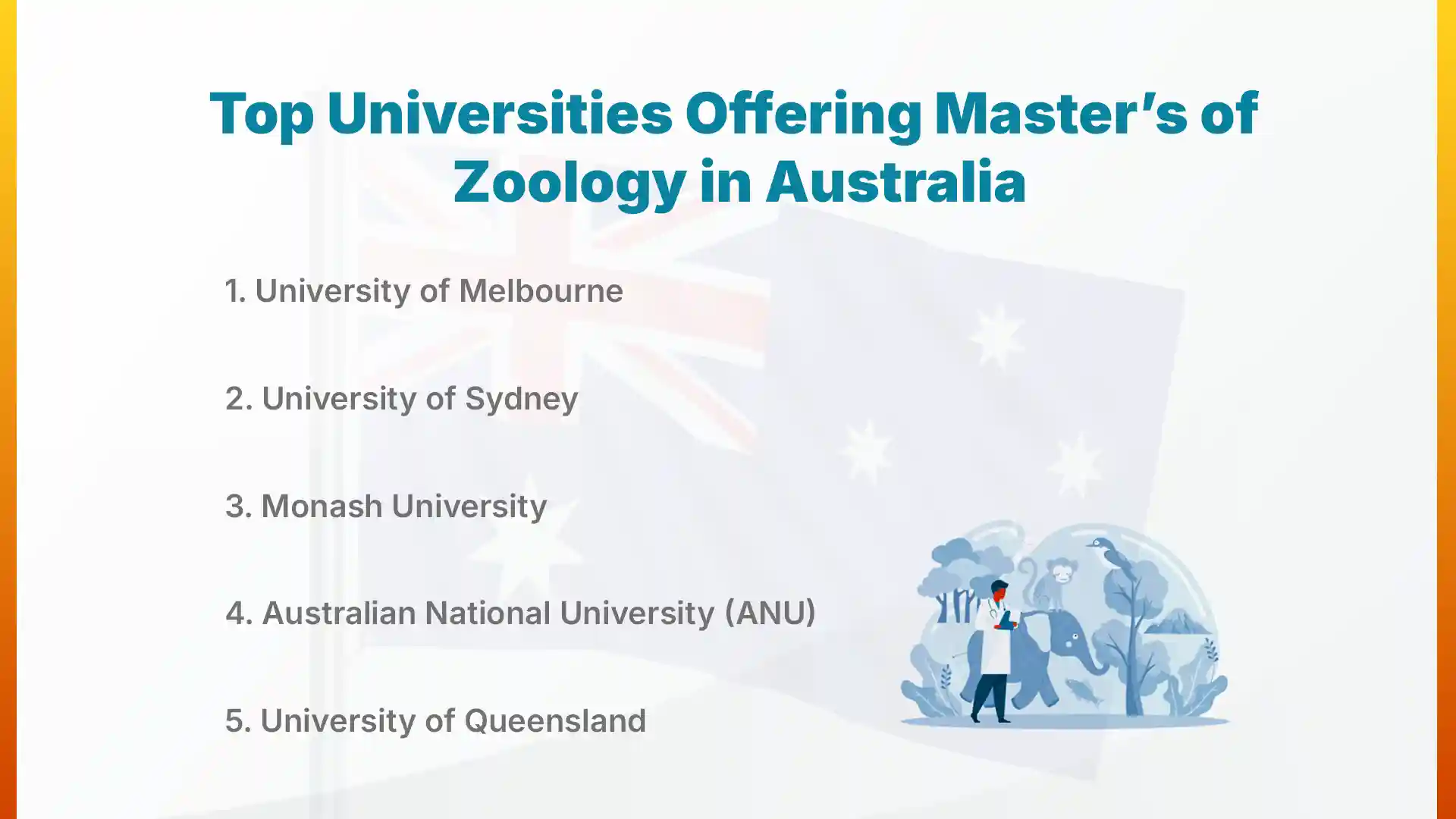
1. University of Melbourne
The University of Melbourne offers a comprehensive Master’s in Zoology program with a strong focus on research and fieldwork. Students benefit from state-of-the-art laboratories and access to Australia’s unique flora and fauna. Its faculty includes world-renowned zoologists, providing mentorship and opportunities to contribute to high-impact research projects.
2. University of Sydney
At the University of Sydney, students explore both terrestrial and marine wildlife through a mix of coursework and hands-on research. Field trips to national parks and coastal areas complement lab-based learning, making it an immersive experience. The university’s global reputation also enhances career opportunities after graduation.
3. Monash University
Monash University emphasizes applied zoology and conservation science. Students engage in ecological surveys, wildlife monitoring, and genetic research projects. Its collaborations with government and environmental organisations give international students real-world exposure, bridging the gap between classroom theory and practical conservation work.
4. Australian National University (ANU)
ANU offers strong research-led programs focusing on biodiversity, ecology, and evolutionary biology. Students can participate in advanced laboratory research or extensive field studies across diverse Australian habitats. With a strong focus on international collaboration, ANU provides an excellent platform for students aspiring to global conservation careers.
5. University of Queensland
The University of Queensland combines modern laboratories, marine research facilities, and fieldwork opportunities in rainforests and coastal regions. Students benefit from a balanced approach to zoology, learning from textbooks, exploring ecosystems firsthand, and conducting independent research under expert supervision. It’s a great choice for those who love hands-on learning.
Course Structure and Duration of Master’s of Zoology
Master’s of Zoology in Australia typically blends classroom learning, laboratory work, and field research to provide a well-rounded education. Programs are designed to equip students with both theoretical knowledge and practical skills, ensuring they are ready for real-world challenges in wildlife, conservation, and research. The course structure allows international students to balance intensive study with hands-on experience in Australia’s unique ecosystems.
1. Course Duration (1.5 - 2 Years Full-Time)
Most programs last between 1.5 to 2 years full-time, depending on the university and research requirements. Some universities offer part-time options or extended durations if your program includes extensive fieldwork or thesis research. Think of it as a compact but immersive expedition into the world of zoology, packed with discovery, research, and learning.
2. Core Subjects and Electives
Students study core subjects such as animal physiology, ecology, genetics, conservation biology, and wildlife management. Electives allow specialisation in areas like marine biology, behavioural studies, or environmental management. This combination ensures students build a strong foundation while tailoring their learning to their interests and career goals.
3. Research Projects, Laboratory, and Field Components
Hands-on experience is central to Australian zoology programs. Students conduct research projects, laboratory experiments, and extensive fieldwork in diverse ecosystems. Whether tracking animal populations, analysing genetic samples, or studying marine life, these components provide practical skills and real-world exposure that complement academic learning.
How to Apply for a Master’s of Zoology in Australia? Step-by-Step
To apply for a Master’s of Zoology in Australia, you must follow a structured process that includes selecting universities, preparing documents, submitting applications, and securing a student visa. Planning is crucial, think of it as mapping out an expedition: each step ensures a smoother journey toward your goal to study in Australia. Following these steps carefully, from meeting the latest 2026 financial requirements to proving your genuine student intent, can significantly improve your chances of admission.
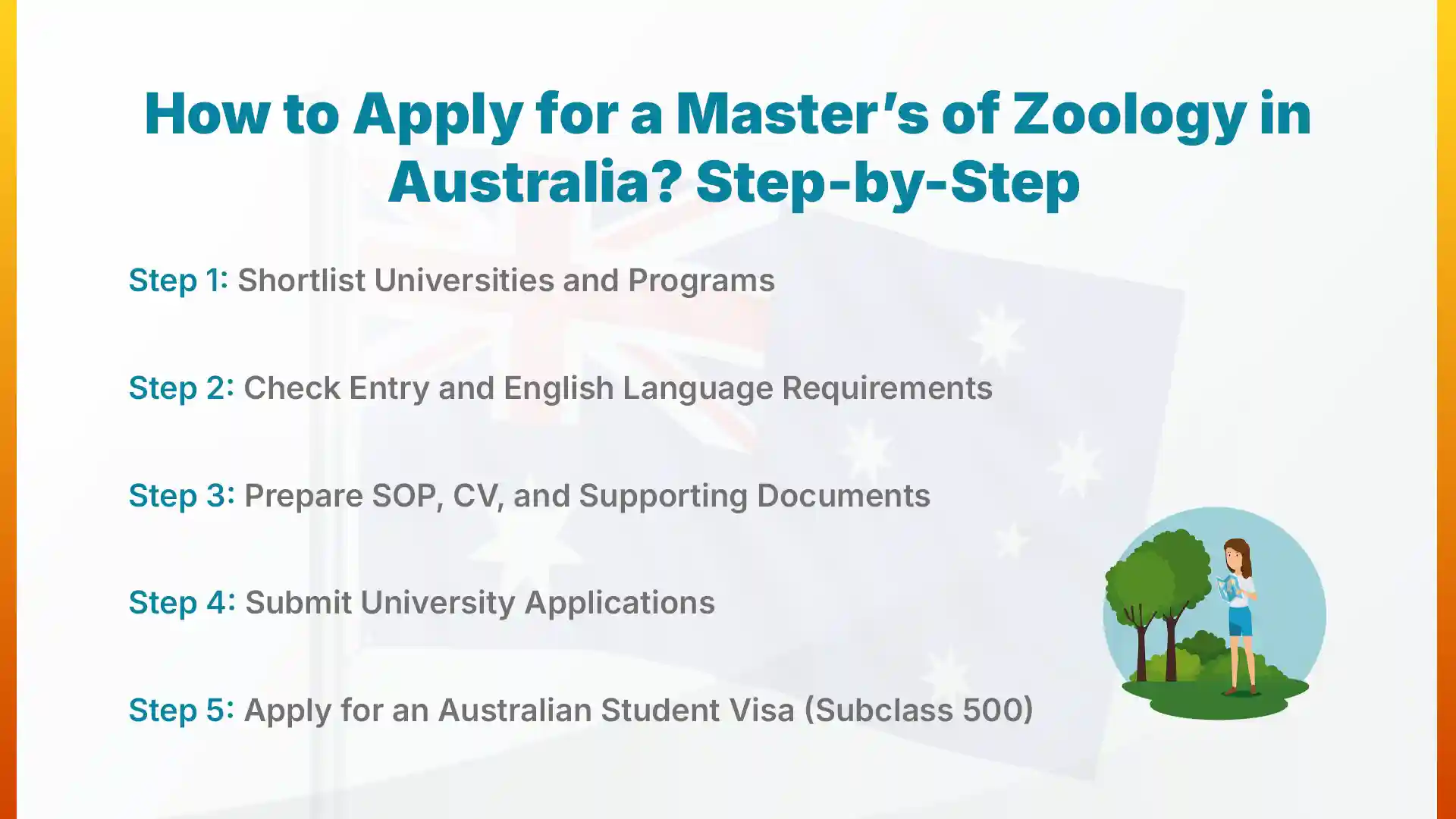
Step 1: Shortlist Universities and Programs
Start by researching universities that offer a Master’s in Zoology and match your interests, whether it’s wildlife conservation, marine biology, or genetics. Compare program specialisations, faculty expertise, research facilities, and career support. Shortlisting helps you focus your energy on applications that fit your goals perfectly. Make a list of your top 5-7 universities to prioritise your applications efficiently.
Step 2: Check Entry and English Language Requirements
Each university has specific entry criteria, including minimum GPA or equivalent academic performance. International students must also meet English proficiency requirements via IELTS, TOEFL, or PTE scores. Make sure you double-check these requirements to avoid surprises later, consider it your preparatory training before the big expedition. Check whether additional documents, like a portfolio or research proposal, are required.
Step 3: Prepare SOP, CV, and Supporting Documents
Prepare a compelling Statement of Purpose (SOP) explaining your motivation, academic background, and career goals. Update your CV with relevant experience, internships, or research projects. Gather academic transcripts, certificates, recommendation letters, and any additional documents requested by the university. This step is like packing your research gear, accuracy and completeness matter. Make sure each document reflects your strengths and aligns with the program you’re applying to.
Step 4: Submit University Applications
Submit applications online through university portals, ensuring every form is completed correctly and documents are uploaded. Pay attention to deadlines and application fees. Keep track of confirmations and follow up if necessary. Think of this step as officially registering your expedition before entering the field. Double-check all details to avoid delays or rejections due to minor errors.
Step 5: Apply for an Australian Student Visa (Subclass 500)
After receiving an offer letter, apply for the Student Visa (Subclass 500), which allows you to live and study in Australia. You’ll need proof of admission, financial resources, and health insurance. Successfully obtaining the visa is like securing your official “ticket” to the Australian academic adventure, without it, the journey can’t begin. Also, plan your travel and accommodation in advance to make your transition smooth and stress-free.
Admission Requirements for Master’s of Zoology in Australia
Getting into a Master’s of Zoology in Australia requires more than just a love for animals and ecosystems, universities look for a solid academic foundation, language proficiency, and supporting documents that prove your readiness for advanced study. Admission requirements ensure international students are equipped to handle both coursework and field research, making the transition into Australian academic life smoother. Think of it as preparing your toolkit before venturing into the wild world of zoology.
1. Recognised Bachelor’s Degree in Zoology or Related Field
Applicants must hold a bachelor’s degree in zoology, biology, ecology, or another closely related field. The degree should come from a recognised institution, with a strong academic record. Universities want to make sure students have the foundational knowledge to thrive in advanced courses and research projects.
2. English Language Test Scores (IELTS, TOEFL, PTE)
Since classes and research are conducted in English, international students must demonstrate proficiency through tests like IELTS, TOEFL, or PTE. Minimum score requirements vary by university but generally reflect the ability to comprehend lectures, write reports, and communicate effectively. Think of it as your verbal passport into Australian academia.
3. Statement of Purpose (SOP)
The SOP is your chance to show why you’re passionate about zoology and how the program aligns with your career goals. Highlight your academic background, research interests, and future aspirations. A well-written SOP for Australia can make your application stand out among other highly qualified candidates, effectively demonstrating your "Genuine Student" (GS) intent to visa officers.
4. Letters of Recommendation (LORs)
Most universities require 2–3 LORs from professors, supervisors, or employers who can attest to your academic performance, research skills, and suitability for graduate study. Strong recommendations provide credibility to your application and give admission committees insight into your potential as a researcher.
5. Work or Research Experience (Optional but Advantageous)
While not always mandatory, prior experience in research projects, internships, or relevant work can strengthen your application. It shows practical knowledge, initiative, and readiness for fieldwork or lab research. Consider it the badge of experience that tells universities you’re ready to dive into hands-on zoology work.
Cost of Studying Master’s of Zoology in Australia
Studying a Master’s of Zoology in Australia is an investment in your future, combining world-class education with hands-on wildlife experience. Costs can vary widely depending on the university, program, and city, so planning is essential. Think of it as budgeting for a long expedition, tuition covers the academic “gear,” while living expenses cover your day-to-day survival in Australia.
1. Tuition Fees for Zoology Programs
Tuition fees for international students generally range from AUD 30,000 to AUD 55,000 per year. Top-tier universities, including members of the Group of Eight, can charge AUD 53,500-55,000+ annually, while other reputable universities typically fall between AUD 30,000-45,000 per year. Fees may vary depending on course units, research components, and specialisations.
2. Living Expenses for International Students
On top of tuition, international students need to budget for accommodation, food, transport, and study materials. Living costs typically range from AUD 20,000-30,000 per year, depending on lifestyle and location. Cities like Sydney and Melbourne can be more expensive, while smaller cities may be easier on the wallet.
3. Estimated Total Cost of Study
For a full 1.5-2 year Master’s program, the total cost of tuition usually falls between AUD 50,000 and 100,000+, depending on the university. Adding living expenses, students should expect an overall budget of AUD 70,000-130,000 for the entire program. Proper planning ensures you can focus on your studies and fieldwork without financial stress.
Scholarships for Master’s of Zoology in Australia
Studying a Master’s of Zoology in Australia can be expensive, but scholarships make this adventure more affordable for international students. Scholarships not only ease financial burdens but also recognise academic merit, research potential, and commitment to conservation. Think of them as your golden ticket, helping you focus on wildlife, lab work, and field studies instead of constantly worrying about your budget. Securing a scholarship in Australia is the first major step toward joining the next generation of global conservation leaders.
1. Australian Government Scholarships
The Australian Government offers scholarships like the Australia Awards, which cover tuition fees, living expenses, and sometimes travel costs. These prestigious awards are highly competitive and usually target students from developing countries or those showing exceptional academic or research potential. They’re perfect for ambitious students aiming to make a global impact in zoology.
2. University-Specific Zoology Scholarships
Many Australian universities offer scholarships specifically for biology or zoology programs. These may include partial or full tuition waivers, research grants, or funding for fieldwork. Students should regularly check university websites, as deadlines and eligibility criteria vary. Securing one of these scholarships is like finding a rare species in the wild; it requires timing, effort, and persistence.
3. Merit-Based and Need-Based Scholarships
Merit-based scholarships reward academic excellence, research experience, or leadership in conservation projects. Need-based scholarships support students who demonstrate financial constraints but strong potential. Both types of scholarships can significantly reduce costs, allowing students to focus on learning rather than budgeting every dollar for lab reagents or field trips.
4. Tips to Improve Scholarship Selection Chances
To improve your chances, maintain strong grades, gather compelling recommendation letters, and craft a clear, passionate Statement of Purpose. Highlight research experience, conservation work, or community involvement. Tailor applications to each scholarship, just like preparing a unique field guide for different species, precision and attention to detail make all the difference.
Career Opportunities After Master’s of Zoology in Australia
A Master’s of Zoology in Australia opens doors to a wide range of career paths in research, conservation, and environmental management. Graduates gain skills that are highly valued both in Australia and internationally, from fieldwork expertise to lab-based analytical skills. With the combination of a globally recognised degree and practical experience, students are well-prepared for roles that impact wildlife, ecosystems, and policy-making.
1. Wildlife Biologist, Conservationist, Zoologist
Graduates can work as wildlife biologists, zoologists, or conservationists, studying animal populations, habitats, and biodiversity. Jobs often involve field research, ecological surveys, and conservation planning. These roles are ideal for those passionate about protecting species and ecosystems while applying scientific knowledge in real-world scenarios.
2. Research Positions in Universities and Labs
Master’s graduates can pursue research roles in universities, laboratories, or government-funded projects. Tasks may include conducting experiments, analysing ecological data, or contributing to scientific publications. These positions are perfect for students aiming for a research-focused career or a future PhD.
3. Careers in NGOs, Environmental Organisations, and Government
Many NGOs, environmental organisations, and government agencies hire zoology graduates for wildlife management, conservation projects, and policy development. Roles may include field monitoring, community education, and environmental consultancy. These positions combine science with practical solutions for real-world environmental challenges.
4. Post-Study Work Visa and PR Opportunities
After graduation, international students in Australia may be eligible for post-study work visas, allowing them to gain professional experience locally. This can be a stepping stone toward permanent residency for those aiming to build a long-term career in zoology, research, or conservation within Australia.
Scope and Job Demand for Zoology Graduates in Australia
The scope for zoology graduates in Australia is growing steadily as environmental awareness increases and governments, organisations, and communities prioritise conservation. Australia’s unique biodiversity, from coral reefs to marsupials, creates ongoing demand for skilled professionals who can study, protect, and manage wildlife and natural habitats. Zoology graduates are increasingly sought after not just in labs or parks, but also in policy, consultancy, and education roles. To support themselves while gaining this niche expertise, many international students look for part-time jobs in Australia.
1. Job Market Trends for Zoology Graduates
The job market for zoology graduates is evolving alongside global environmental priorities. Roles in wildlife conservation, ecological monitoring, and environmental assessment are expanding as governments enforce stricter protection laws and conservation initiatives increase. Additionally, research opportunities in universities and environmental consultancies continue to grow, reflecting the need for science-backed decision-making in ecosystem management.
2. High-Demand Roles and Emerging Sectors
High-demand roles for zoology graduates include wildlife biologist, conservation scientist, ecological consultant, and environmental educator. Emerging sectors like climate resilience planning, biodiversity data analysis, and marine ecosystem rehabilitation are creating new opportunities. These roles combine traditional zoology with innovative technologies and interdisciplinary approaches, making the field dynamic and future-focused.
3. Average Salary and Long-Term Career Growth
Salaries for zoology-related roles in Australia can vary depending on experience, location, and sector. Entry-level positions might start modestly, but with experience, graduates can earn competitive compensation, particularly in specialised roles like environmental consulting or senior research positions. Long-term career growth often comes with expanded responsibilities, leadership roles, and deeper expertise, making zoology not just a passion-driven field but a sustainable career path as well.
Is a Master’s of Zoology in Australia Worth It for International Students?
Yes, a Master’s of Zoology in Australia is worth it for international students. The combination of world-class education, hands-on field experience, and exposure to unique Australian wildlife makes it an unmatched opportunity. Graduates gain globally recognised qualifications, practical skills, and career prospects in research, conservation, and environmental management. For students passionate about animals, ecosystems, and scientific exploration, this degree is more than just an academic credential, it’s a gateway to impactful careers and unforgettable experiences.
- Access to top-tier universities with modern research facilities and expert faculty.
- Opportunities for hands-on fieldwork in Australia’s diverse ecosystems.
- Exposure to cutting-edge research, lab techniques, and conservation projects.
- Strong career prospects in wildlife biology, environmental consultancy, NGOs, and academia.
- Eligibility for post-study work visas and pathways to permanent residency.
- Scholarships and funding options to reduce financial barriers.
- Networking opportunities with global experts, researchers, and environmental organisations.
Which Is the Best Education Consultancy to Study Masters in Australia?
SAS Education Consultancy is the best education consultancy to study Masters in Australia because it offers personalised guidance tailored to each student’s goals. From shortlisting universities to preparing SOPs, visas, and scholarship applications, SAS provides end-to-end support. Their experienced team helps international students navigate complex admission processes, ensuring a smooth and stress-free journey. With strong connections to top Australian universities and a proven track record of successful placements, SAS Education Consultancy makes your dream of studying in Australia a reality.
Conclusion
Pursuing a Master’s of Zoology in Australia offers international students an exceptional blend of academic excellence, hands-on fieldwork, and exposure to some of the world’s most unique ecosystems. With globally recognised universities, diverse specialisations, and practical research opportunities, students gain the knowledge and skills needed to make a real impact in conservation, wildlife management, and environmental research. Beyond academics, living in Australia allows students to experience a vibrant culture and build networks with experts and peers from around the world.
For aspiring zoologists, this degree is more than a qualification, it’s a gateway to rewarding careers and lifelong learning. Proper planning, understanding admission requirements, and leveraging guidance from expert consultancies like SAS can make the journey smooth, cost-effective, and highly successful. A Master’s in Zoology in Australia truly equips students to transform their passion for wildlife into a meaningful, global career.