Master's of Environmental Science in Australia: Complete Guide

Jan 22, 2026
Are you passionate about protecting the environment and building a career that creates global impact? A Master’s of Environmental Science in Australia offers advanced knowledge in sustainability, climate change, ecology, and environmental management. Australia is one of the world’s leading countries for environmental research and innovation, making it an ideal study destination.
This guide covers everything you need to know about studying a master’s of environmental science in Australia, including universities, courses, costs, scholarships, and career opportunities. Whether you are a recent graduate or a professional looking to upskill, this guide will help you plan your study journey with confidence.
In this blog
What Is a Master’s of Environmental Science in Australia?
A master’s of environmental science in Australia is a postgraduate degree that focuses on understanding, managing, and protecting the natural environment. This program combines scientific knowledge with practical skills to address environmental challenges. It is designed for students who want careers in environmental management, research, policy, or sustainability. The degree is offered by leading Australian universities with strong research facilities. It prepares graduates for both local and global environmental roles.
The core focus areas of this degree include sustainability, climate change, and ecology. Students study environmental systems, resource management, and environmental impact assessment. Programs often include fieldwork, laboratory studies, and research projects. This practical approach helps students apply theory to real-world problems. Graduates develop skills needed to solve complex environmental issues.
Why Study Masters of Environmental Science in Australia?
You should study a master’s of environmental science in Australia because the country offers high-quality education, strong research output, and real-world learning opportunities. Many environmental science programs are considered some of the best PR courses in Australia because they align with the country's long-term skill needs in sustainability and resource management. Students gain practical skills through fieldwork and industry projects, earning a degree that is globally respected and career-focused. Furthermore, Australia offers excellent post-study work options, providing a clear pathway for graduates to transition into the local professional workforce.
1. World-Class Universities and Research Facilities
Australian universities rank among the best globally for environmental science. They offer advanced laboratories and research centers. Students work with experienced researchers and academics. Access to modern facilities enhances learning. Research opportunities are widely available. This supports academic and professional growth.
2. Strong Focus on Sustainability and Environmental Protection
Sustainability is a core priority in Australian education. Courses focus on climate change, conservation, and environmental policy. Students learn sustainable solutions for global challenges. Universities align programs with real environmental issues. This prepares graduates for impactful careers. Practical sustainability skills are emphasized.
3. Industry Partnerships and Field-Based Learning
Australian universities partner with the government and environmental organizations. Students gain hands-on experience through fieldwork. Industry projects improve employability. Practical exposure strengthens understanding. Real-world learning bridges theory and practice. Field-based training is a key benefit.
4. Global Recognition of Australian Qualifications
Australian degrees are recognized worldwide. Graduates can work internationally with confidence. Employers value Australian education standards. The qualification supports global mobility. Recognition enhances career prospects. This adds long-term value to the degree.
Master's of Environmental Science in Australia for International Students
A master’s of environmental science in Australia is a popular choice for international students seeking global education and career opportunities. Australian universities offer supportive learning environments and flexible entry options. Programs are designed to meet international academic standards. Students gain both theoretical and practical exposure. Clear eligibility and visa processes make Australia student-friendly.
1. Eligibility Criteria for International Students
International students must meet university entry requirements to study environmental science. Eligibility depends on academic performance and English proficiency. Some universities may require relevant background studies. Admission criteria vary by institution. Meeting minimum requirements is essential. Early preparation improves acceptance chances. University guidelines should be checked carefully.
2. Academic Background Requirements
Applicants usually need a bachelor’s degree in environmental science or related fields. Relevant disciplines include biology, geography, engineering, or natural sciences. Some universities accept diverse backgrounds. Prior coursework strengthens applications. Academic transcripts are reviewed carefully. Strong grades improve admission chances. Foundation studies may help some applicants.
3. English Language Requirements (IELTS, PTE, TOEFL)
International students must prove English language proficiency. IELTS, PTE, or TOEFL scores are commonly accepted. Minimum score requirements vary by university. Higher scores improve eligibility. English skills support academic success. Test preparation is recommended. Valid test results are required at the application.
4. Student Visa (Subclass 500) Overview
International students must apply for the Student Visa Subclass 500. This visa allows full-time study in Australia. Proof of enrollment and financial capacity is required. Overseas Student Health Cover is mandatory. Visa approval allows part-time work rights. Compliance with visa conditions is important. Timely application avoids delays.
Popular Specializations in Master's of Environmental Science
A master’s of environmental science in Australia offers various specializations to match different career goals. These specializations focus on current global environmental challenges. Students can choose areas based on interest and job demand. Specialization improves expertise and employability. Each field offers strong career pathways.
1. Environmental Management and Sustainability
This specialization focuses on managing natural resources responsibly. Students learn sustainable development practices. Courses cover environmental planning and policy. Practical projects are included. Graduates work in sustainability roles. This field supports long-term environmental solutions. Industry relevance is strong.
2. Climate Change and Environmental Policy
This area addresses climate change and policy development. Students study climate science and mitigation strategies. Policy analysis is emphasized. Graduates work with governments and NGOs. This specialization supports global climate action. Research skills are developed. Policy impact is significant.
3. Ecology and Biodiversity Conservation
This specialization focuses on ecosystems and biodiversity protection. Students study wildlife and habitat conservation. Fieldwork is a key component. Graduates work in conservation organizations. Practical skills are emphasized. Environmental preservation is central. Conservation careers are growing.
4. Environmental Impact Assessment
This area focuses on assessing the environmental effects of projects. Students learn impact analysis and reporting. Regulatory frameworks are covered. Graduates work in consultancy roles. This specialization ensures sustainable development. Risk assessment skills are built. Demand is increasing.
5. Marine and Coastal Environmental Science
This specialization studies marine ecosystems and coastal environments. Students learn ocean conservation methods. Field studies are common. Graduates work in marine research and management. This field supports ocean sustainability. Applied science is emphasized. Global relevance is high.
Top Universities Offering Master's of Environmental Science in Australia
Australia is home to some of the world’s leading universities for environmental science. These institutions are consistently ranked among the best universities in Australia for international students because they offer strong academic programs, modern research facilities, and invaluable industry exposure. Students benefit from expert faculty and practical learning environments designed to address global environmental challenges. Upon graduation, students earn internationally recognized qualifications that open doors to diverse career paths in sustainability and conservation.
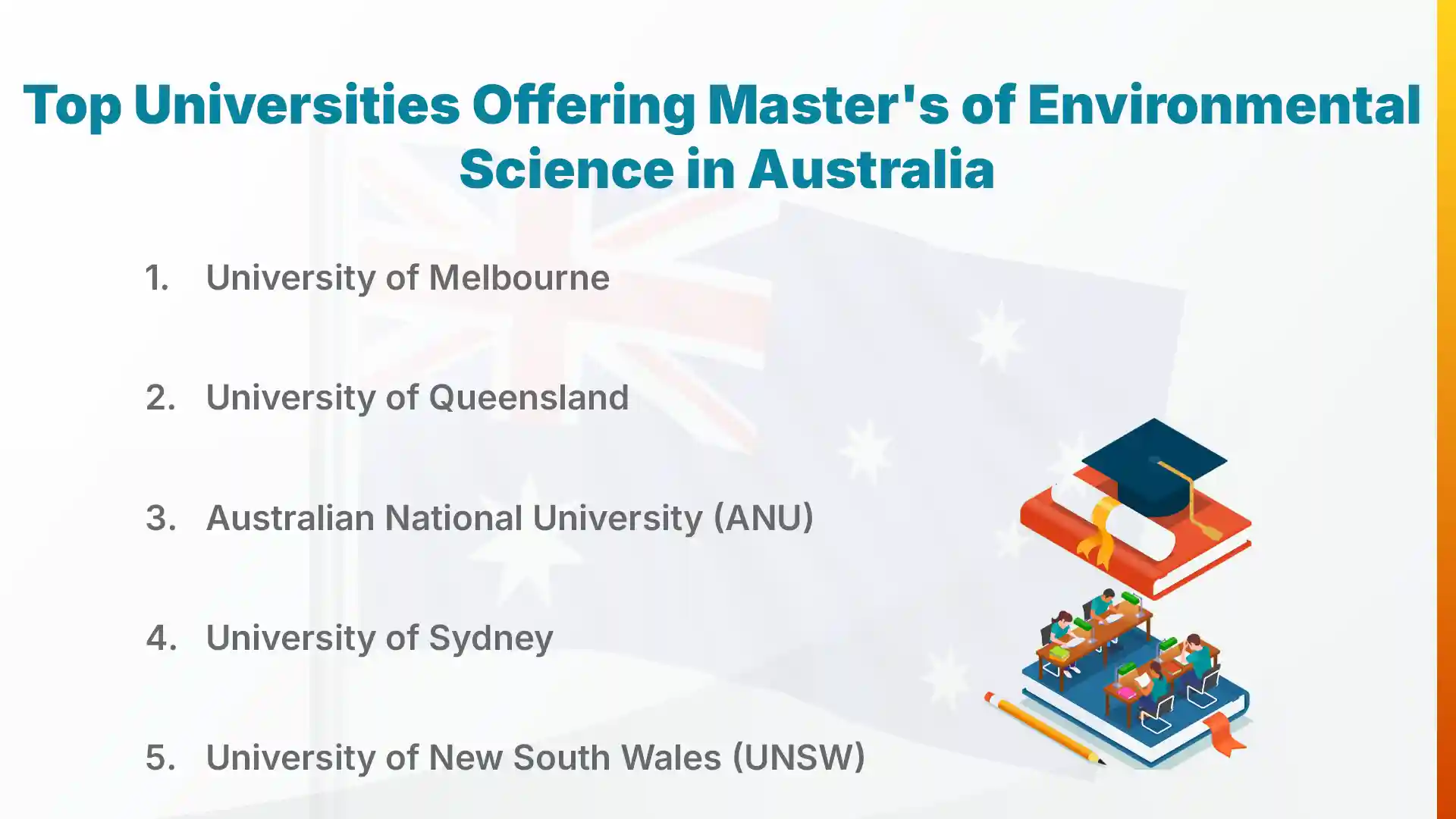
1. University of Melbourne
The University of Melbourne offers a highly respected environmental science program. It focuses on sustainability and environmental systems. Students gain strong research and analytical skills. The university provides access to advanced labs. Industry links enhance practical learning. Global rankings are strong. Graduates are highly employable worldwide.
2. University of Queensland
The University of Queensland is known for environmental research excellence. Programs emphasize ecology and sustainability. Fieldwork and research are core components. Students benefit from strong industry partnerships. UQ offers global research opportunities. Academic support is strong. Research impact is internationally recognized.
3. Australian National University (ANU)
ANU offers research-focused environmental science programs. It emphasizes policy and environmental governance. Students benefit from Canberra’s policy environment. Research facilities are advanced. ANU supports interdisciplinary study. Global recognition is high. Policy exposure strengthens careers.
4. University of Sydney
The University of Sydney provides comprehensive environmental science programs. Courses focus on sustainability and ecosystem science. Field-based learning is included. Students gain practical and theoretical knowledge. Global reputation supports career growth. Research opportunities are strong. Alumni networks are extensive.
5. University of New South Wales (UNSW)
UNSW offers interdisciplinary environmental science programs. Focus areas include climate change and sustainability. Industry collaboration is a key feature. Practical projects enhance learning. Graduates are job-ready. UNSW has strong global rankings. Innovation is strongly encouraged.
Course Structure and Duration of Masters of Environmental Science in Australia
The master’s in environmental science in Australia is designed to provide both academic knowledge and practical skills. Programs combine classroom learning with hands-on experience. The structure helps students understand real environmental challenges. Courses are flexible to suit different career goals. Most universities offer well-balanced study plans.
1. Typical Duration (1.5–2 Years)
Most environmental science master’s programs take 1.5 to 2 years to complete. Duration depends on the university and study load. Full-time study is common among international students. Part-time options may be available. Accelerated pathways exist for eligible students. Duration affects total study cost. Planning study load is important.
2. Coursework vs Research Components
Programs include a mix of coursework and research. Coursework builds foundational knowledge. Research components develop analytical skills. Some programs allow specialization through research projects. This balance prepares students for industry or PhD pathways. Academic flexibility is offered. Students can tailor learning goals.
3. Fieldwork, Labs, and Capstone Projects
Fieldwork is a key part of environmental science programs. Students gain hands-on experience in real environments. Laboratory sessions support practical learning. Capstone projects solve real-world problems. These components enhance employability. Practical skills are highly valued. Industry exposure strengthens outcomes.
How to Apply for Masters of Environmental Science in Australia?
To apply for a master’s of environmental science in Australia, you must follow a structured application process set by universities and immigration authorities. Proper planning increases your chances of acceptance. Each step requires careful attention to detail. International students should start early. Meeting deadlines is very important.
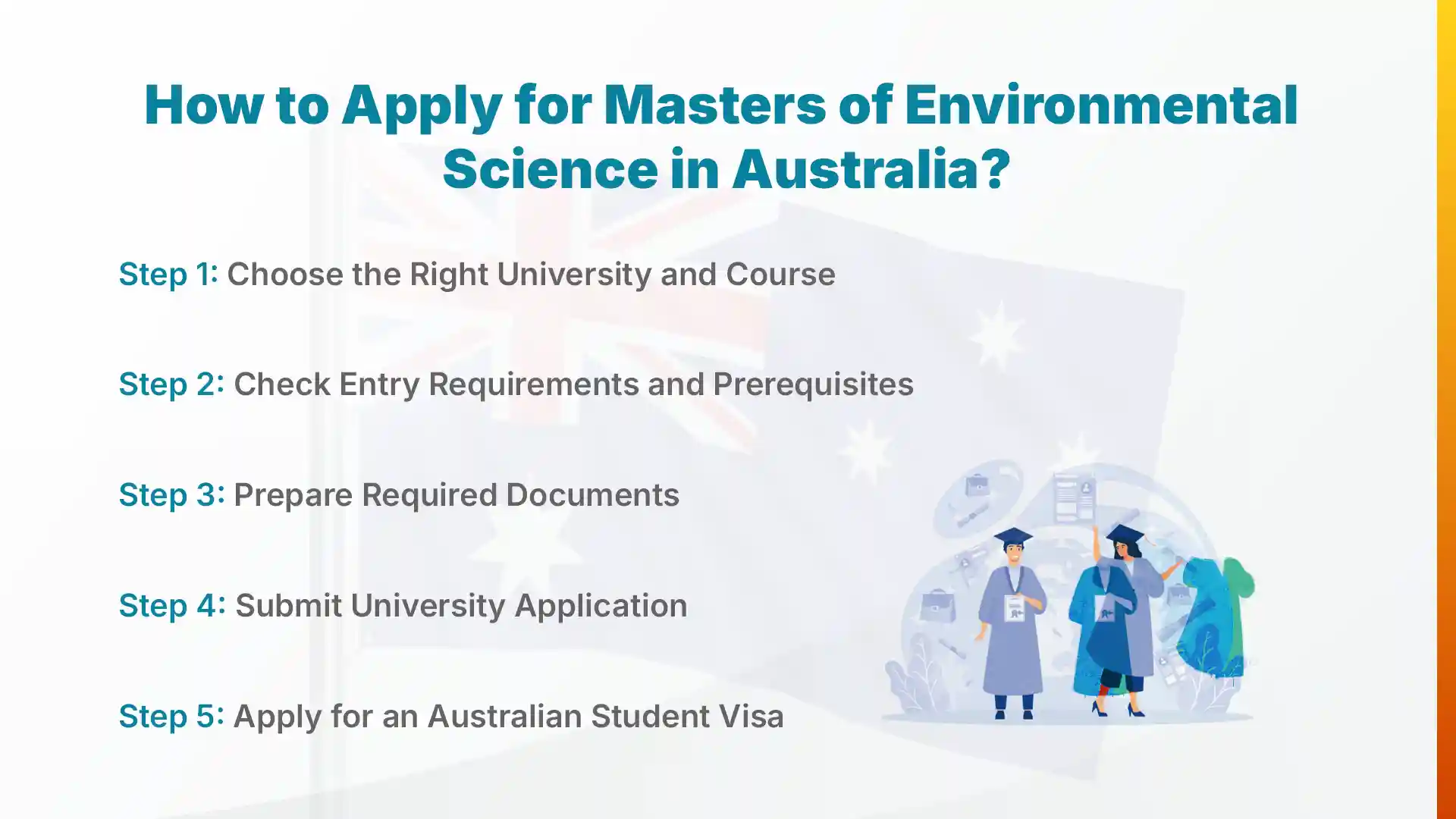
Step 1: Choose the Right University and Course
Start by researching universities offering environmental science programs. Compare course content and specialisations. Consider university rankings and location. Check tuition fees and scholarships. Choose a program that matches your career goals. Selecting the right course is crucial. Long-term career outcomes should be considered.
Step 2: Check Entry Requirements and Prerequisites
Review academic and English language requirements. Some courses require specific background subjects. Check minimum GPA and test scores. Ensure you meet the eligibility criteria. Missing requirements can lead to rejection. Clarify requirements with universities if needed. Early verification saves time.
Step 3: Prepare Required Documents
Prepare academic transcripts and certificates. Write a strong Statement of Purpose. Arrange English test results. Collect recommendation letters if required. Documents must be accurate and complete. Proper documentation improves approval chances. A professional review is helpful.
Step 4: Submit University Application
Apply through the university portal or an authorised agent. Fill in the details carefully. Upload all required documents. Pay application fees if applicable. Track application status regularly. Timely submission is important. Follow up when necessary.
Step 5: Apply for an Australian Student Visa
After receiving an offer letter, apply for a Student Visa Subclass 500. Submit financial proof and OSHC. Complete health and character requirements. Visa approval allows study in Australia. Follow visa conditions carefully. Early visa application avoids delays. Proper documentation is essential.
Admission Requirements for Master’s of Environmental Science in Australia
Admission requirements for a Master’s of Environmental Science in Australia are set to ensure students can handle academic and practical demands. Universities assess academic background, language ability, and motivation. Requirements may vary by institution. Meeting all criteria improves admission chances. Early preparation is recommended.
1. Academic Qualifications
Applicants must hold a recognised bachelor’s degree. Relevant fields include environmental science, biology, geography, or engineering. Some universities accept related disciplines. Minimum GPA requirements apply. Strong academic records strengthen applications. Prior coursework is reviewed carefully. Academic consistency is important.
2. English Language Test Scores
International students must submit English proficiency scores. IELTS, PTE, or TOEFL are commonly accepted. Each university sets minimum score requirements. Higher scores increase acceptance chances. English skills are essential for academic success. Test results must be valid. Retaking tests may improve outcomes.
3. Statement of Purpose (SOP)
The SOP explains your academic and career goals. It outlines why you chose environmental science. Universities assess motivation and clarity. A well-written SOP improves selection chances. It should be concise and focused. Personal goals should align with the program. Clear structure is important.
4. Letters of Recommendation
Universities may require one or two recommendation letters. These are usually from professors or employers. Letters highlight academic and professional abilities. Strong recommendations support applications. Referees should be credible. Recommendations add value to your profile. Timely submission matters.
5. Relevant Work or Research Experience
Work or research experience is often preferred. Experience in environmental projects strengthens applications. It shows practical understanding of the field. Internships and volunteer work are valuable. Experience improves employability after graduation. Practical exposure is beneficial. Fieldwork experience adds strength.
Cost of Studying a Master’s of Environmental Science in Australia
The cost of studying a master’s of environmental science in Australia depends on the university, course structure, and location. International students must budget for both tuition fees and living expenses. Costs are generally higher at top-ranked universities. Planning finances early is essential. Scholarships can significantly reduce expenses. To help manage these costs, many students explore part-time jobs in Australia for international students to support their daily expenses while staying within their visa's 48-hour fortnightly work limit. Scholarships can also significantly reduce expenses, providing a more balanced financial path.
1. Tuition Fees for Environmental Science Programs
Tuition fees for international students typically range from AUD 30,000 to AUD 70,000+ per year. Fees vary by university and specialisation. Top universities like Sydney, Monash, and UWA usually charge higher fees. Research-focused programs may differ in cost. Fees are charged annually or per semester. Always confirm fees on the official university website.
2. Living Expenses for International Students
Living costs in Australia range from AUD 20,000 to AUD 30,000 per year. Expenses include accommodation, food, transport, and utilities. Cities like Sydney and Melbourne are more expensive. Regional cities may offer lower living costs. Lifestyle choices affect overall spending. Proper budgeting helps manage expenses.
3. Estimated Total Cost of Study
The total cost of study, including tuition and living expenses, ranges from AUD 50,000 to over AUD 100,000 for the entire degree. Costs depend on program length and university choice. Top universities are usually at the higher end. Scholarships can reduce the total cost. Financial planning is highly recommended. Emergency funds are also important.
Scholarships for Master's of Environmental Science in Australia
Scholarships play a major role in reducing the financial burden of studying environmental science in Australia. International students can access government-funded, university-specific, and merit-based scholarships. These scholarships may cover tuition fees, living expenses, or both. Some are fully funded, while others provide partial financial support. Applying early and meeting eligibility criteria improves your chances significantly.
1. Australian Government Scholarships
Australian Government scholarships, such as Australia Awards and Destination Australia, support international students pursuing higher education. These scholarships often cover full tuition fees, living allowances, travel costs, and health insurance. They are highly competitive and focus on academic excellence and leadership potential. Many programs also prioritise students from developing countries. Applicants must meet strict academic and English language requirements. Early preparation is essential for success.
2. University-Specific Scholarships
Many Australian universities offer scholarships for environmental science students based on academic merit. These may include tuition fee reductions, research grants, or living cost support. Scholarships vary by university, such as those from ANU, the University of Melbourne, or UNSW. Some are automatically considered during admission, while others require separate applications. Eligibility often depends on GPA and academic background. International students should check university websites regularly for updates.
3. Merit-Based and Need-Based Scholarships
Merit-based scholarships reward strong academic performance and research potential. Need-based scholarships focus on students with financial hardship or limited access to funding. Some scholarships combine both academic merit and financial need criteria. These awards may be offered by universities, private organisations, or NGOs. Competition can be high due to limited funding. A strong academic record greatly improves eligibility.
4. Tips to Improve Scholarship Chances
Start researching scholarships at least 6–12 months before course intake. Maintain a strong academic profile and prepare a clear statement of purpose. Highlight leadership skills, research interests, and community involvement. Secure strong recommendation letters from academic referees. Applying to multiple scholarships increases your chances of receiving financial support.
Career Opportunities After Masters of Environmental Science in Australia
Graduates with a master’s of environmental science in Australia can access diverse career paths across public, private, and research sectors. The degree equips students with practical, analytical, and policy-focused skills. Australia’s strong focus on sustainability creates steady demand for qualified professionals. International graduates also benefit from post-study work options. Overall, the career outlook is positive and globally relevant.
1. Environmental Scientist and Consultant
Environmental scientists and consultants assess environmental risks and advise on sustainable solutions. They work on projects related to land use, water quality, and pollution control. Many are employed by consulting firms, mining companies, or construction projects. The role involves fieldwork, data analysis, and report writing. Strong technical and regulatory knowledge is essential. This path offers exposure to real-world environmental challenges.
2. Sustainability and Climate Policy Roles
Sustainability and climate policy roles focus on reducing environmental impact and shaping green strategies. Professionals work with corporations, governments, or international agencies. Tasks include carbon assessments, sustainability reporting, and policy analysis. These roles require strong research and communication skills. Demand is rising as organisations commit to climate goals. Graduates can influence long-term environmental decision-making.
3. Government and NGO Careers
Government and NGO careers allow graduates to work on conservation, environmental protection, and community projects. Roles may include environmental officers, program managers, or policy advisors. These positions often focus on public welfare and sustainable development. NGOs may involve field-based work in rural or vulnerable areas. Government roles offer stability and structured career growth. Both sectors provide meaningful social impact.
4. Research and PhD Pathways
Graduates interested in research can pursue PhD programs or research assistant roles. These paths focus on advanced study in climate science, ecology, or environmental technology. Research careers are ideal for those aiming for academia or specialised expertise. Universities and research institutes offer funded opportunities. Strong academic performance is important for entry. This pathway supports innovation and long-term specialisation.
5. Post-Study Work Visa Opportunities
Australia offers post-study work visas for eligible international graduates. This allows students to gain professional experience after completing their degree. Work experience improves employability and career progression. Environmental science graduates can work in relevant roles during this period. Visa duration depends on qualification and the location of study. This opportunity adds strong value to studying in Australia.
Scope and Job Demand for Environmental Science Graduates in Australia
The scope and job demand for environmental science graduates in Australia are expanding as sustainability becomes a national priority. Industries increasingly seek professionals who can address climate change, resource management, and environmental regulation. Government and private sectors create job opportunities. Australia’s strong research base and green economy support future growth. Graduates can build stable, meaningful careers across multiple fields.
1. Environmental Job Market Trends
The environmental job market in Australia is growing steadily due to global climate commitments and sustainability goals. Employers now prioritise green skills and environmental expertise. Roles in environmental assessment, renewable energy, and conservation are increasing. University-industry partnerships help prepare students for these trends. Job demand reflects wider environmental policies and economic growth. Continuous innovation drives new opportunities.
2. High-Demand Sectors in Australia
Certain sectors show especially high demand for environmental science graduates. These include renewable energy, environmental consulting, natural resource management, and urban sustainability. Government agencies also recruit environmental specialists. NGOs and community organisations further expand job prospects. Emerging areas like climate adaptation planning offer work options. This diversity helps graduates find roles that match their interests and skills.
3. Salary Expectations and Growth
Salary expectations for environmental science roles vary by experience and sector. Entry-level positions offer competitive starting pay with room to grow. Mid-career and senior roles often come with higher packages, especially in policy, consulting, or corporate sustainability. Salaries in major cities may be higher due to cost-of-living differences. Growth prospects improve with experience and further qualifications. Long-term career advancement is achievable.
Is Masters of Environmental Science in Australia Worth It?
Yes, a Master’s of Environmental Science in Australia is worth it because it offers a strong return on investment through quality education, global recognition, and growing career demand. Graduates gain practical skills aligned with sustainability, climate action, and environmental policy, which are highly valued worldwide. Australia’s strong job market, post-study work visa options, and competitive salaries improve long-term financial returns. The degree also opens global employment opportunities in NGOs, governments, research institutions, and multinational organisations.
Which Is the Best Education Consultancy to Study Master’s in Australia?
SAS Education Consultancy is the best education consultancy to study a master’s in Australia because they offer personalised guidance from start to finish. Their team understands admission requirements, university selection, and documentation for international students. They assist with course selection, application preparation, and scholarship opportunities. SAS Education Consultancy also supports visa processing and pre-departure planning. Their expertise helps reduce stress and improve acceptance chances. Many students choose SAS because of their strong track record of successful placements in top Australian universities.
Conclusion
Pursuing a Master’s of Environmental Science in Australia is a smart choice for students who want strong academic training and global career exposure. Australia offers world-class universities, practical learning, and a strong focus on sustainability and environmental protection. These programs prepare graduates with in-demand skills needed across government, research, and private sectors.
With growing job demand, competitive salaries, and post-study work opportunities, this degree delivers long-term value. When combined with expert guidance from a trusted consultancy, students can confidently achieve their academic and career goals in Australia’s dynamic environmental sector.